
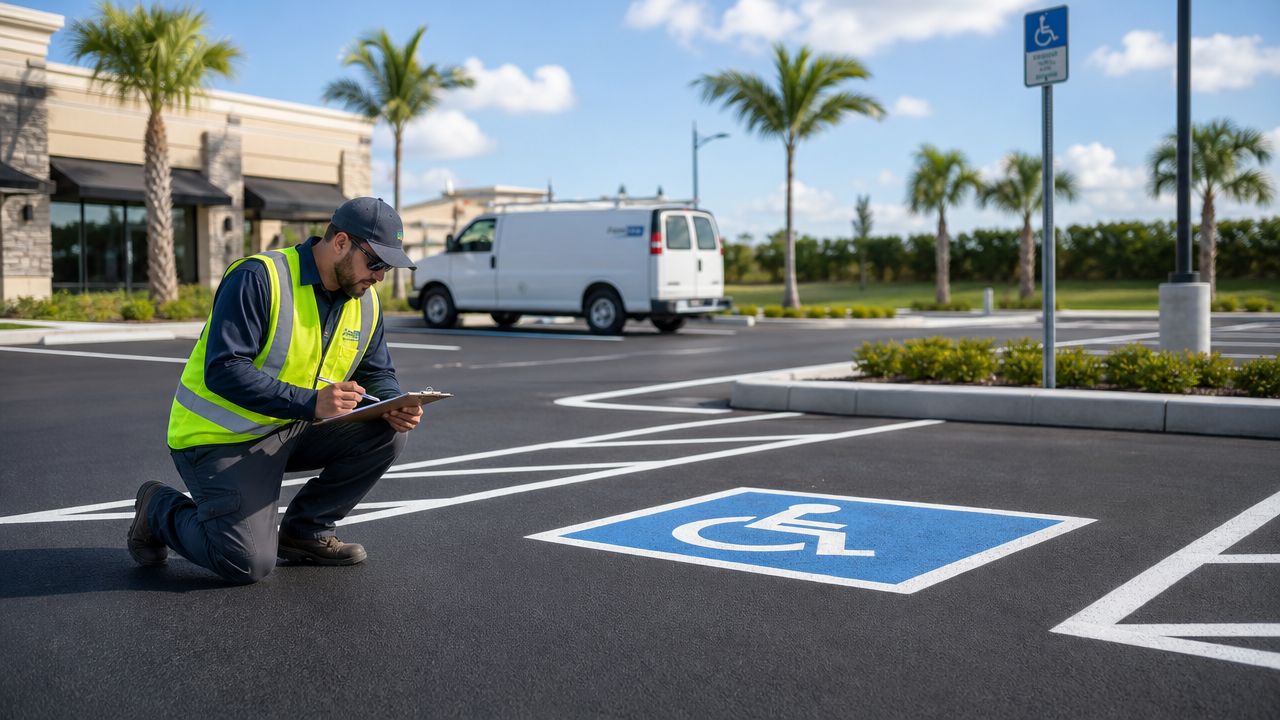
A property manager in Ocala walks the lot before tenants arrive. The striping is faded. Water is still sitting near a low corner from yesterday's rain. A few cracks have opened into rough edges near the drive lane, and the concrete sidewalk by the entry has started to chip. That's usually the moment when parking lot maintenance stops feeling like a cosmetic issue and starts feeling like risk, budget pressure, and a scheduling problem all at once.
That situation is common across Marion County, FL and Citrus County, FL. In places like Dunnellon, Belleview, Summerfield, Crystal River, Homosassa, Inverness, Lecanto, Beverly Hills, Hernando, Silver Springs, and The Villages, property owners deal with the same basic question. How do you hire a parking lot maintenance company that will solve the right problems, not just sell the easiest service?
That choice matters because this isn't a small, occasional category. The North America commercial facility parking lot maintenance market was estimated at USD 16.08 billion in 2023 and is forecast to reach USD 20.46 billion by 2030, according to Grand View Research's parking lot maintenance market report. In plain terms, commercial pavement maintenance is recurring asset management. It's tied to safety, appearance, compliance, and how long your pavement and concrete improvements last.
If you're hiring in Central Florida, generic advice won't get you very far. Heat, UV, heavy rain, drainage issues, and mixed concrete and asphalt surfaces change what a smart maintenance plan looks like. This guide is built around that reality.
Table of Contents
- Your Guide to Hiring the Right Pavement Partner in Central Florida
- First Steps Defining Your Parking Lot's Needs
- How to Vet a Parking Lot Maintenance Company
- Comparing Bids and Understanding True Project Costs
- Navigating Florida-Specific Pavement and Compliance Challenges
- Building Your Long-Term Pavement Management Plan
- Frequently Asked Questions
Your Guide to Hiring the Right Pavement Partner in Central Florida
Hiring the right contractor starts with understanding what you're really buying. You're not just buying sealcoat, paint, or patchwork. You're buying judgment. A good parking lot maintenance company knows when a crack needs sealing, when a failed area needs repair, when drainage is the issue, and when a concrete trip hazard is the part that creates the immediate liability.
That's especially true in Central Florida, where many commercial sites have a mix of surfaces. The drive lanes and stalls may be asphalt, but the sidewalks, curbs, ramps, dumpster pads, and entry aprons may be concrete. If a contractor only looks at the blacktop, they're missing part of the job.
What the right partner actually does
A reliable pavement partner should be able to do three things well:
- Diagnose the site. Not every rough-looking lot needs major work. Not every faded lot only needs striping.
- Sequence repairs in the right order. Drainage and crack issues should be handled before cosmetic work.
- Account for both asphalt and concrete. That matters for safety, ADA paths, and long-term planning.
Practical rule: If a contractor recommends a surface treatment before talking about drainage, crack condition, and concrete hazards, slow the process down.
In Marion County and Citrus County, that local judgment is what keeps owners from wasting money. A shopping center in Ocala may need a different plan than a church in Beverly Hills or an HOA entry in Homosassa. Traffic patterns, shade, runoff, and age all change the answer.
What usually goes wrong
Most bad hires come from one of two mistakes. The owner either shops only by price, or hires a company that treats every lot the same. Both create expensive rework.
The better approach is simple. Inspect first. Vet second. Compare bids carefully. Then hire the contractor whose scope matches the actual condition of the property.
First Steps Defining Your Parking Lot's Needs
Before you call for estimates, walk the property like a manager, not like a driver. Slow down, get out of the truck, and look at the lot from the curb ramps to the back corners. Most owners in The Villages, Summerfield, and Lecanto already know the lot “looks tired.” What matters is identifying what type of tired it is.
Start with a full site walk
Use a notepad or phone and divide the property into areas: entrances, drive lanes, parking stalls, loading zones, sidewalks, ramps, curbs, dumpster areas, and drainage points. You're trying to separate surface wear from structural failure.
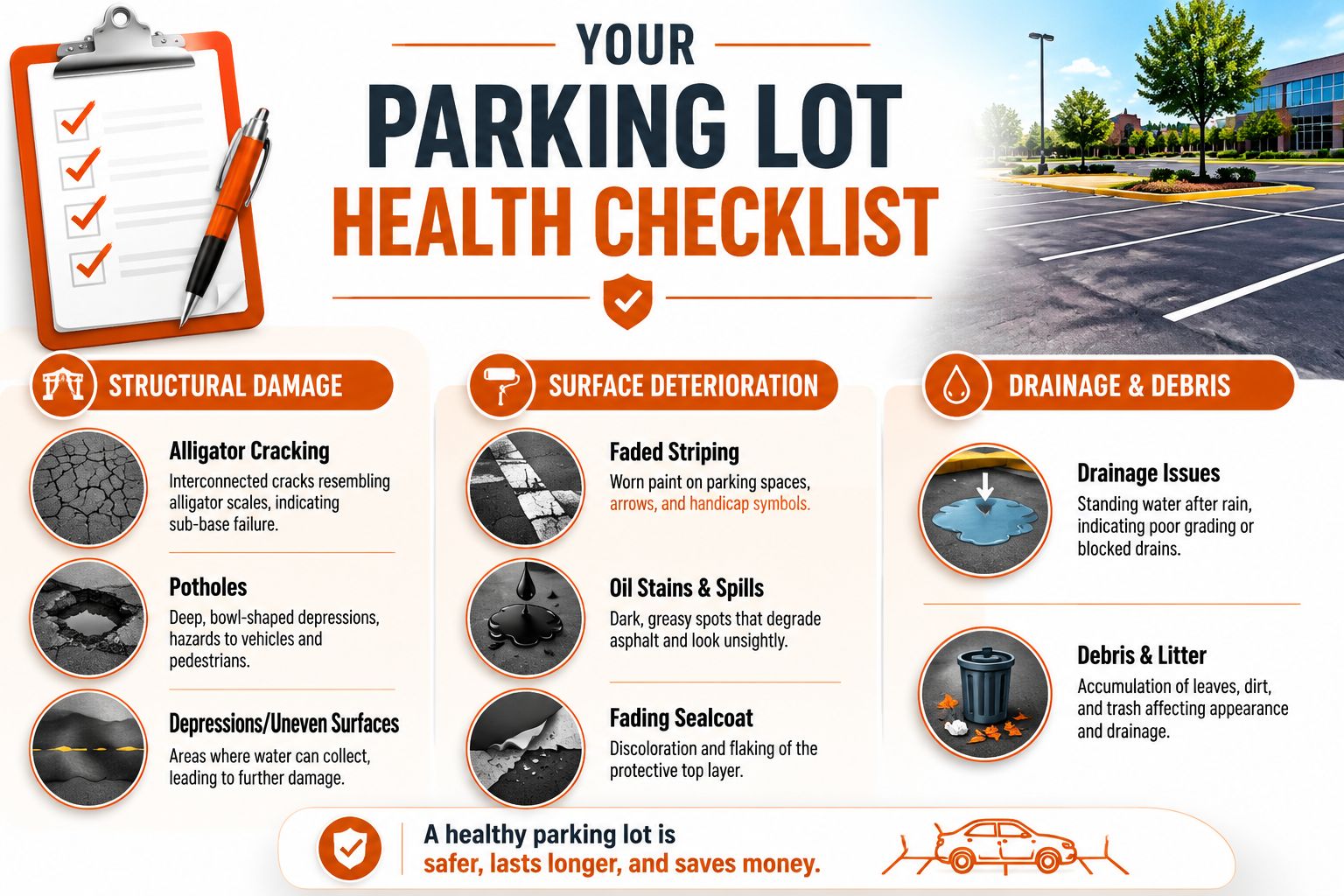
If you want a simple field reference, a parking lot maintenance checklist for property owners can help you organize what you're seeing.
Here's what to look for:
- Alligator cracking means the pavement structure has likely weakened below the surface. Sealcoat won't fix that.
- Potholes and broken edges point to water intrusion, traffic stress, or base failure.
- Standing water after rain usually signals poor drainage, clogged structures, low spots, or settlement.
- Faded striping affects traffic flow, appearance, and accessible parking clarity.
- Oil spots and fuel staining can soften asphalt over time and make a lot look neglected.
- Concrete spalling or broken corners on sidewalks and ramps create trip hazards fast.
- Uneven transitions between asphalt and concrete can cause both accessibility and drainage problems.
Don't inspect only the middle of the lot. Problems often start at drain inlets, curbs, sidewalk joints, and the edges where water sits.
Match the problem to the service
Once you've identified the issues, the next step is matching each condition to the right type of work. At this point, many owners get oversold.
| Condition | Usually calls for | Usually not enough |
|---|---|---|
| Hairline to moderate cracks | Crack filling or sealing | Striping alone |
| Oxidized, weathered surface | Sealcoating if the pavement is still structurally sound | Patching unrelated areas |
| Faded parking layout | Restriping and ADA review | Sealcoat without layout updates |
| Localized failure | Asphalt repair or patching | Cosmetic surface treatment |
| Broken sidewalk or ramp edge | Concrete removal and replacement | Paint or temporary patch |
A good self-audit also includes the concrete around the asphalt. That means checking sidewalks, curbs, dumpster pads, aprons, and ADA routes. A full-service contractor should be able to address both pavement maintenance and related concrete issues, because many commercial liabilities start where people walk, not where they park.
In Central Florida, mixed-surface properties are common. If your lot in Silver Springs or Crystal River has asphalt drive lanes but aging concrete pedestrian areas, define both before you ask anyone for a number.
How to Vet a Parking Lot Maintenance Company
Once you know what needs attention, filtering starts. A parking lot maintenance company can sound sharp on the phone and still be a poor fit once the work begins. The companies worth hiring tend to be straightforward, organized, insured, and specific.

Non negotiables before you discuss price
Start with the basics. These aren't optional.
- Licensed and insured status. Ask for proof of general liability and workers' compensation coverage.
- Clear scope writing. If the company can't explain the work in writing, the crew won't execute it consistently.
- Local operating experience. Marion County and Citrus County sites don't behave exactly like lots in other parts of the state.
- Reliable scheduling. Commercial maintenance often needs phased work, off-hours access, or coordination with tenants.
A local contractor usually has a better feel for common Central Florida job conditions. That includes fast weather shifts, heavy runoff after storms, and the practical reality of working around active businesses, churches, HOAs, and retail sites from Dunnellon to Inverness.
For example, James Young Paving project information and company background gives property owners one model of the kind of experience and service range they should look for when reviewing local providers.
Questions that separate solid contractors from smooth salespeople
Ask direct questions and listen for direct answers.
- How will you handle drainage concerns before surface work? If they jump straight to sealcoat or paint, that's a warning sign.
- What prep work is included? Cleaning, crack treatment, edge prep, layout review, and curing windows should be discussed.
- What concrete items did you notice on site? If they never mention sidewalks, ramps, or curbs, they may be thinking too narrowly.
- Who supervises the job? You want a point person, not a vague promise.
- Can you explain what work is preventive versus structural? Good contractors make that distinction clearly.
A vague estimate usually leads to a vague result.
Red flags that show up early
Some warning signs show up before the first quote lands in your inbox.
One is pressure. If someone insists you need immediate full-site work without a measured inspection, be cautious. Another is oversimplification. Lots in Belleview, Hernando, or The Villages often have different wear patterns within the same site. Anyone who prescribes one treatment for all areas may be trying to sell production, not solve the problem.
Watch for these issues:
- No site-specific notes. The quote reads like a template.
- No mention of traffic control or phasing. That can create operational headaches.
- No discussion of ADA striping or accessible routes. That's a serious omission.
- No attention to concrete. A company serving commercial properties should notice adjacent hardscape conditions.
- No realistic timeline language. Weather, cure time, and access restrictions affect scheduling.
A strong contractor doesn't just say they handle asphalt. They understand that commercial sites are systems. Pavement, striping, sidewalks, curbs, drainage, and access all work together.
Comparing Bids and Understanding True Project Costs
Once bids come in, most owners focus on the bottom line first. That's understandable, but it's also where a lot of bad decisions begin. The right way to compare proposals is to look at scope, prep, sequencing, and assumptions before you judge price.
In the U.S. procurement market, the benchmark price for parking lot maintenance and repair was $2.83 per square foot in 2026, according to IBISWorld's parking lot maintenance and repair procurement benchmark. That gives you a useful reference point for budgeting. It does not mean every project should price the same way.
What a usable quote should include
A professional bid should tell you enough to compare one contractor to another on an apples-to-apples basis.
Look for these items:
- Defined work areas so you know whether the whole property or selected sections are included
- Surface prep details such as cleaning, crack treatment, or repair areas
- Material scope with a clear description of what is being applied or installed
- Striping scope including stalls, arrows, stop bars, accessible spaces, and markings
- Concrete scope if needed for sidewalks, curbs, ramps, or pads tied to the project
- Scheduling assumptions including access restrictions and weather sensitivity
If one quote includes prep and another doesn't, the cheaper number may not be cheaper at all. It may just be incomplete.
Why the lowest number often costs more later
The cheapest bid usually cuts something you can't easily see from the spreadsheet. It might be cleaning. It might be crack prep. It might be layout accuracy. It might be time spent addressing drainage trouble spots before coating or painting begins.
Cheap pavement work usually looks acceptable first. It fails early in the details.
That's the trade-off. A lower number may get the lot black again or freshly striped again, but if the contractor skipped the steps that protect adhesion, water flow, or layout durability, the property owner pays twice.
A better comparison method is to ask three questions:
- What exactly is included?
- What site problems are excluded or ignored?
- How long will this scope remain useful if traffic and weather stay normal for the property?
In places like Homosassa and Dunnellon, where weather swings and drainage can be rough on pavement, true cost is tied to performance, not just invoice amount.
Navigating Florida-Specific Pavement and Compliance Challenges
Florida changes the maintenance equation. What works in a milder climate can fall short here because the pavement takes a more aggressive beating from sun, rain, and heat for much of the year.
The gap in most public advice is timing. Many articles list services but don't explain when to use them most cost-effectively, especially in climates like Florida where heat, UV, and rain accelerate aging, as noted by Erickson Asphalt's discussion of parking lot maintenance timing and budgeting.
Florida weather changes the maintenance timeline
In Central Florida, intense sun dries and oxidizes asphalt faster. Heavy rain tests every low spot, edge, and failed joint. If water gets into open cracks and weak areas, small defects stop being small.
That's why waiting for a lot to “look bad enough” is usually the wrong trigger. By the time owners in Ocala, Crystal River, or Summerfield see broad surface wear and recurring puddles, the lot often needs more than cosmetic work.
A smarter local approach usually includes:
- Watching drainage after storms rather than guessing where water moves
- Addressing cracks early before water reaches deeper layers
- Reviewing striping after surface work and weathering so traffic patterns remain clear
- Checking concrete transitions because sidewalk and ramp failures often accompany asphalt edge problems
Compliance issues usually show up at the edges
ADA concerns don't only live in the painted handicap symbol. They show up in access aisles, route continuity, curb ramps, slopes, signage placement, and surface condition. Local interpretation and site-specific conditions can complicate what looks simple on paper.
For property managers in Marion County, FL and Citrus County, FL, that means your contractor should understand both pavement markings and how they relate to the pedestrian path. A good starting point is reviewing ADA parking lot striping requirements for Florida commercial properties.
If a contractor talks about accessible spaces only as paint layout, keep asking questions. Compliance problems often involve concrete, route condition, or transitions between surfaces. That's another reason it helps to work with Concrete and Asphalt Experts in Marion and Citrus County, not a company that only thinks in one trade.
Building Your Long-Term Pavement Management Plan
A Central Florida lot can look fine in January, then lose ground fast after a summer of heat, hard rain, and standing water. Property managers who wait until tenants complain usually end up paying for patchwork fixes, rushed scheduling, and repairs that could have been smaller six months earlier.
The better approach is a written pavement plan tied to site condition, traffic, and weather exposure. In this region, that plan should account for UV breakdown, water intrusion, and the fact that painted markings fade faster under strong sun and frequent storms. Maintenance timing is not just about age. It is about how the lot is wearing in your specific conditions.
That usually means setting a schedule for crack sealing, sealcoating when the surface is still a good candidate for preservation, and restriping often enough to keep stalls, fire lanes, and directional markings clear. Lots with delivery traffic, poor drainage, or full sun exposure often need closer watch than properties with lighter use and more shade.
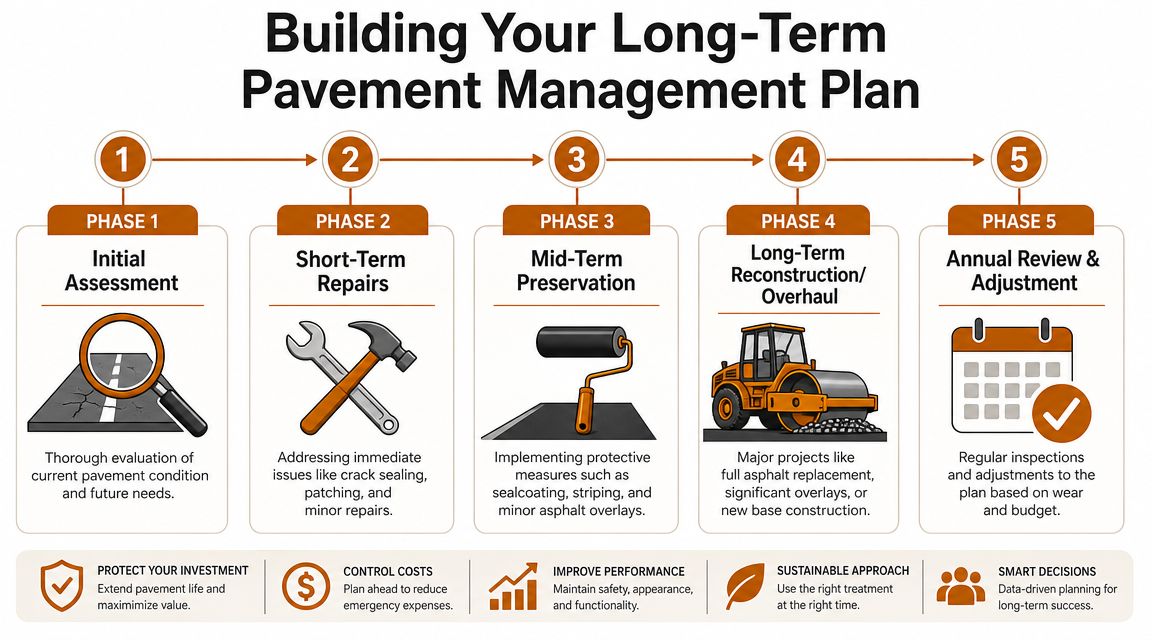
Think in phases not emergencies
Phased planning keeps small defects from turning into capital projects.
- Immediate work covers trip hazards, failed patches, severe cracking, and areas where water is getting into the pavement structure.
- Short-range preservation focuses on asphalt that is still sound enough for crack sealing, sealcoating, or minor patching.
- Routine upkeep includes restriping, joint and crack monitoring, and scheduled inspections after the wet season.
- Budget planning identifies sections that are approaching overlay or replacement so funding is not a surprise.
- Annual review updates the plan based on weather, tenant use, and what changed on site over the last year.
A good contractor helps you separate what needs action now from what should be budgeted next. That matters in Central Florida, where one rainy season can turn a neglected crack pattern into base failure, but a lot with decent structure may still have years left if you protect it on time.
A full-service local contractor can also keep the plan practical. One provider may handle asphalt sealcoating and parking lot striping while flagging concrete sidewalks, ramps, curbs, and pads that should be repaired during the same service window. In that role, Riverside Sealing & Striping, LLC is one example of a contractor serving Marion County, Citrus County, and nearby Central Florida communities with both concrete and asphalt maintenance services.
Frequently Asked Questions
How often should a Florida parking lot be sealcoated
There is no one schedule that fits every property. In Central Florida, UV exposure cooks the surface, afternoon storms drive water into open cracks, and heat keeps asphalt softer for longer stretches of the year. On many commercial lots, sealcoating makes sense every few years, but the right timing depends on oxidation, traffic, drainage, and whether the pavement is still structurally sound enough to preserve.
A contractor should inspect the lot before recommending it. If the surface is brittle, heavily cracked, or starting to ravel, sealcoat alone will not fix the problem.
What's the difference between sealcoating and an asphalt overlay
Sealcoating protects the surface. An overlay adds new asphalt thickness over an existing pavement that still has a usable base and subbase.
That distinction matters because the wrong recommendation wastes money. A lot with only surface wear does not need overlay pricing. A lot with movement, failed areas, or widespread alligator cracking will not be saved by a fresh black coating. In Florida, heavy rain exposes that mistake fast because water finds weak spots and works below the surface.
Should a parking lot maintenance company also inspect concrete
Yes. Parking lots fail at transitions as often as they fail in the main driving lanes. Curbs, sidewalks, ramps, dumpster pads, and loading areas all affect safety, drainage, and accessibility.
A narrow asphalt-only crew may miss settlement at a ramp, spalling at a curb return, or broken sidewalk panels that create a significant liability issue on site. A good maintenance company looks at the whole paved area and tells you which items belong in the same service window and which can wait.
Is restriping just cosmetic
Restriping affects traffic flow, stall count, fire lane visibility, and accessible space clarity. Faded markings also make a property look neglected, which tenants and visitors notice right away.
In Central Florida, striping tends to wear faster on lots with intense sun exposure and frequent storm runoff. That is why layout accuracy and material choice matter, not just whether the lines look bright on day one.
Who is responsible for ADA compliance, the owner or the contractor
The owner is responsible for the site. The contractor is responsible for laying out and completing the work in their scope correctly, and for flagging visible problems that affect access, slopes, signage, or pavement condition.
Good contractors do that early, before paint goes down or concrete is poured. That saves rework and avoids the common problem of fixing striping while leaving the access route or ramp tie-in wrong.
If you are comparing parking lot maintenance companies in Marion County or Citrus County, a site visit tells you far more than a phone estimate. Riverside Sealing & Striping, LLC handles commercial asphalt maintenance, parking lot striping, ADA-related upgrades, and concrete repairs across Ocala, Dunnellon, Crystal River, Homosassa, Inverness, and nearby Central Florida communities.