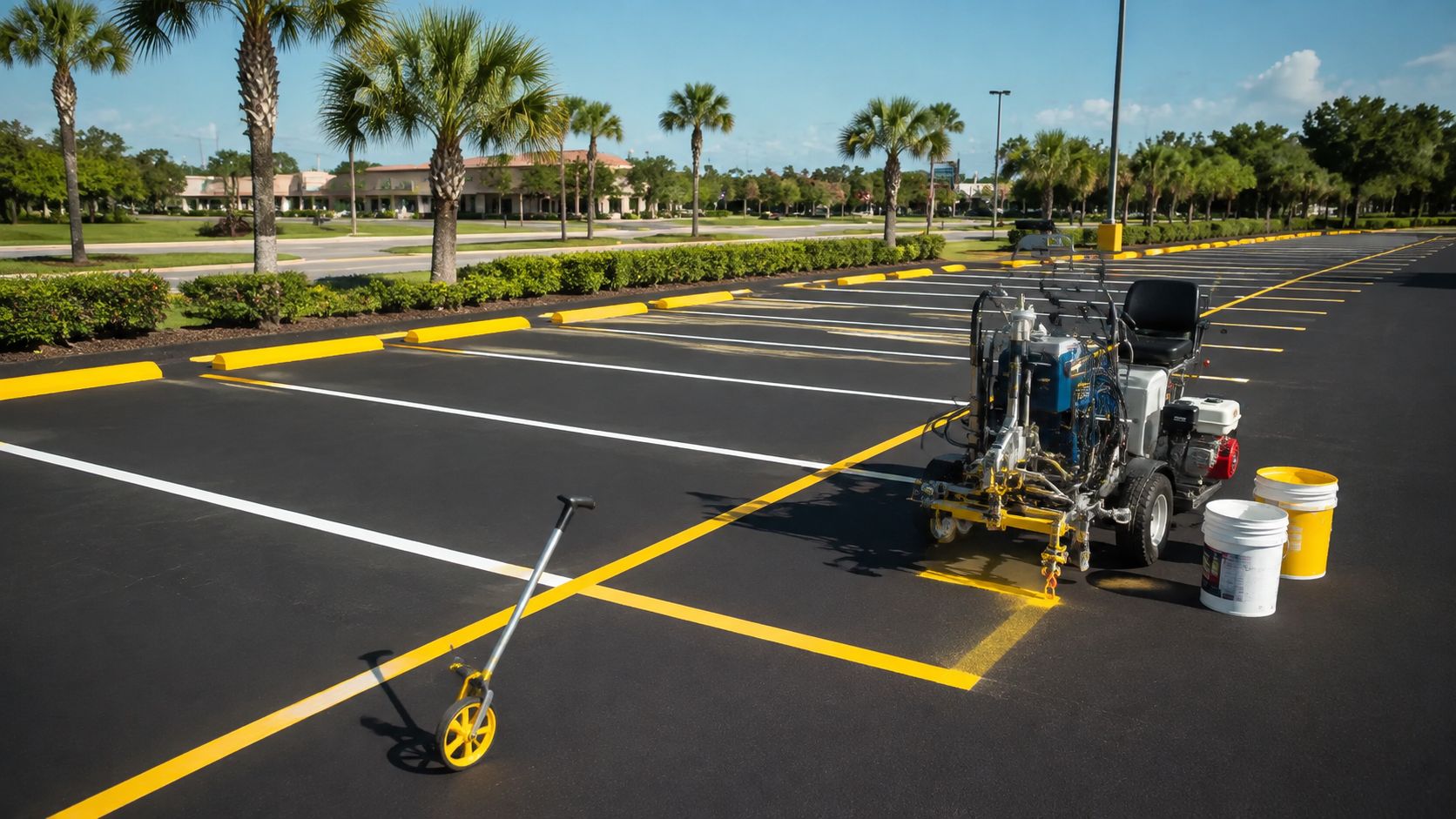
A typical standard restripe job in Central Florida averages around $750, with most projects ranging from $500 to $1,000. Per-stall pricing generally runs $5 to $20, while line-based pricing ranges from $0.20 to $1.00 per linear foot, depending on the scope.
Those numbers give property owners a useful starting point, but they don't tell the whole story. A clean, simple restripe in Ocala can price very differently from an ADA upgrade in Crystal River, a complex layout in The Villages, or a small HOA lot near Inverness with a contractor's minimum trip charge included.
For property managers in Marion County, FL, Citrus County, FL, and surrounding Central Florida communities, the practical question isn't, “What does striping cost?” It's, “What work is included in this quote, and which conditions could change it?” Surface preparation, paint selection, accessible parking requirements, layout complexity, traffic control, and scheduling all influence the final estimate.
Table of Contents
- Understanding Parking Lot Striping Prices
- Comparing Paint, Thermoplastic, and Epoxy Costs
- Hidden Factors That Drive Up Your Estimate
- How Contractors Estimate Parking Lot Jobs
- Central Florida Climate and Maintenance Strategy
- Cost-Saving Tips and Professional Support
Understanding Parking Lot Striping Prices
The most useful way to evaluate parking lot striping prices is to separate the headline benchmark from the job's actual scope. Recent pricing guidance places the average parking lot striping project at about $750, with many jobs falling between $500 and $1,000. Standard restriping commonly falls between $0.20 and $1.00 per linear foot, while a basic per-space calculation often lands between $5 and $20 per parking space. These benchmarks are outlined in HomeAdvisor's parking lot striping cost guide.
Those ranges are broad because a parking space isn't always the same amount of work. A uniform lot with clearly visible existing lines can be measured and painted efficiently. A property with angled stalls, islands, loading zones, arrows, crosswalks, curb markings, or faded lines that no longer show the original layout requires more layout time and more labor.
Why small lots often cost more per stall
Contractors have fixed expenses before the first line is painted. Crews must travel to the site, unload equipment, establish a work area, coordinate access, prepare the pavement, and clean up afterward. On a large commercial lot, those costs are spread across more stalls and more line footage. On a small residential, church, or HOA lot, the same setup can represent a much larger share of the invoice.
That doesn't necessarily mean the contractor is charging unfairly. It means per-unit pricing can rise as project size falls, even when the work itself looks simple.
Practical rule: Use the average project range as a budget anchor, not as a promise. Ask what the quote includes before comparing the number with another contractor's price.
A fair comparison should identify the number of standard lines, specialty markings, preparation work, material type, mobilization, and whether the job is a restripe or a new layout. This approach helps property owners in Dunnellon, Belleview, Silver Springs, Summerfield, and Beverly Hills compare equivalent scopes instead of comparing incomplete totals.
Comparing Paint, Thermoplastic, and Epoxy Costs
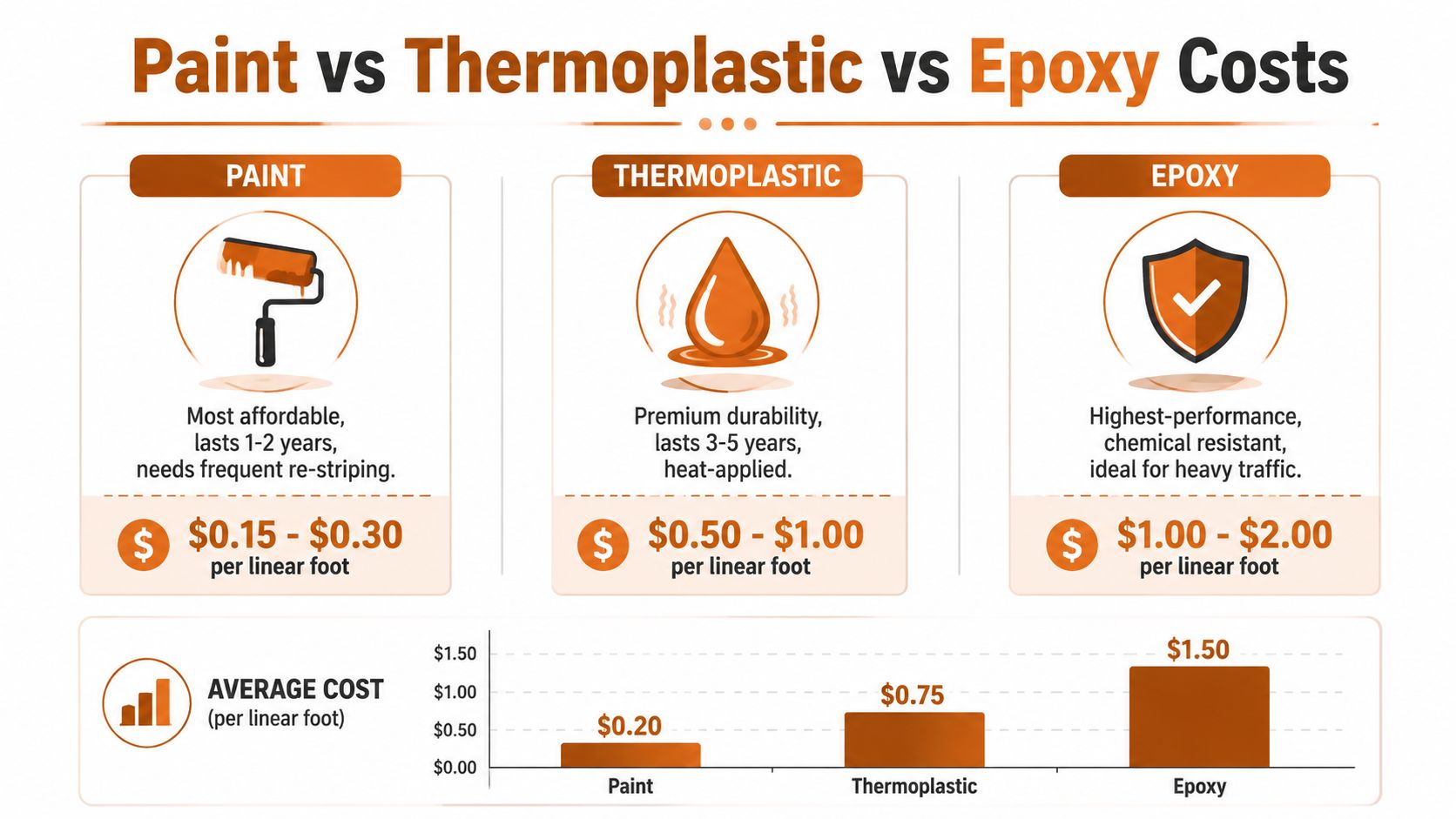
Material selection changes both the initial bid and the maintenance schedule. Standard long-line 4-inch paint is usually the budget choice, with recent guidance placing it around $0.15 to $0.60 or more per linear foot. Thermoplastic generally costs more, roughly $0.60 to $2.50 or more per linear foot, because crews need specialized heating and application equipment. Industry pricing guidance on striping by surface and material explains why higher-performance materials carry a higher unit cost.
Epoxy markings also tend to price materially above basic paint, particularly in public procurement work. Epoxy can make sense where abrasion, chemicals, or heavy use would cause ordinary paint to disappear quickly. It isn't automatically the right choice for every retail lot, though. The correct material depends on traffic, pavement condition, exposure, maintenance access, and how disruptive future restriping would be.
Comparing upfront price with service life
Recent lifecycle guidance notes that water-based striping can cost about $6 to $8 per stall and last 1 to 2 years, while thermoplastic can cost about $15 to $22 per stall and last 3 to 7 years. Striping lifecycle pricing guidance frames the decision more usefully than an upfront-only comparison.
| Material | Typical cost position | Main advantage | Main trade-off |
|---|---|---|---|
| Water-based paint | Lower upfront cost | Fast, familiar application | More frequent maintenance |
| Thermoplastic | Higher upfront cost | Durable, heat-applied marking | Specialized installation |
| Epoxy | Higher-performance pricing | Stronger resistance in demanding conditions | Higher initial investment |
Paint works well for owners who need a clean appearance at a controlled initial cost and can plan regular maintenance. Thermoplastic may suit high-use entrances, fire lanes, or areas where repeated closures create operational headaches. Epoxy deserves consideration when the pavement markings face unusual abrasion or chemical exposure.
Riverside's high-visibility pavement marking service is one example of a service conversation where material choice should be matched to the property's use, not selected from a generic price sheet.
The best bid isn't always the lowest first invoice. A property manager should compare the expected maintenance cycle, traffic disruption, and pavement condition alongside the material price.
Hidden Factors That Drive Up Your Estimate
A quote near $0.20 to $0.30 per linear foot can be reasonable for a clean, uncomplicated restripe. The same property can move toward $0.40 to $1.00 or more per linear foot when the surface needs preparation, the layout is difficult, or specialty markings make up a significant part of the work. Central Florida striping cost guidance identifies the difference between straightforward line work and more involved scopes.
Pavement preparation comes first
Paint won't hide grease, loose debris, failing coatings, or unstable asphalt. Depending on the surface, preparation may involve sweeping, pressure washing, removing loose old markings, or addressing cracks before new lines are applied. If the pavement is dirty or the old paint is peeling, skipping preparation can produce weak adhesion and an uneven appearance.
Crack repair and pavement repair should also be separated from the striping scope. A new line over a deteriorating crack may look finished on the day of installation, but it won't correct the underlying pavement problem.
Layout and access create labor
A simple perpendicular layout is easier to reproduce than angled stalls, irregular islands, multiple entrances, or directional routes that require several layers of markings. Cross-hatched access aisles also take more time than a single straight stall line. New layouts cost more than straightforward restripes because the crew must establish measurements and placement rather than follow a visible pattern.
Site access matters, too. A property that must remain open may require phased work, special coordination, or traffic control. Night or restricted-hour work can add operational complexity even when the painted footage doesn't change.
ADA markings deserve their own line items
Accessible spaces and routes shouldn't be buried inside a generic “striping” allowance. Recent pricing breakdowns estimate an accessible stall at about $115, a crosswalk at about $216, arrows at $25 each, and stop bars at $50 each. These figures come from ADA-related striping cost guidance.
Under federal ADA parking standards, a car-accessible space must be at least 96 inches wide. A van-accessible space may be 132 inches wide with a 60-inch access aisle, or **96 inches wide with a 96-inch access aisle. Property owners should review the current layout, signage, access aisle, and route together rather than treating the symbol as the entire compliance task. The ADA restriping parking resource provides the governing accessibility information.
Small lots often feel expensive because the contractor's mobilization and minimum charge are spread over fewer billable items. That cost should be explained clearly, not disguised.
A transparent estimate will identify preparation, standard lines, ADA elements, traffic coordination, and minimum project charges separately. That makes scope changes easier to understand and prevents a low base rate from creating an unexpectedly high final invoice.
How Contractors Estimate Parking Lot Jobs
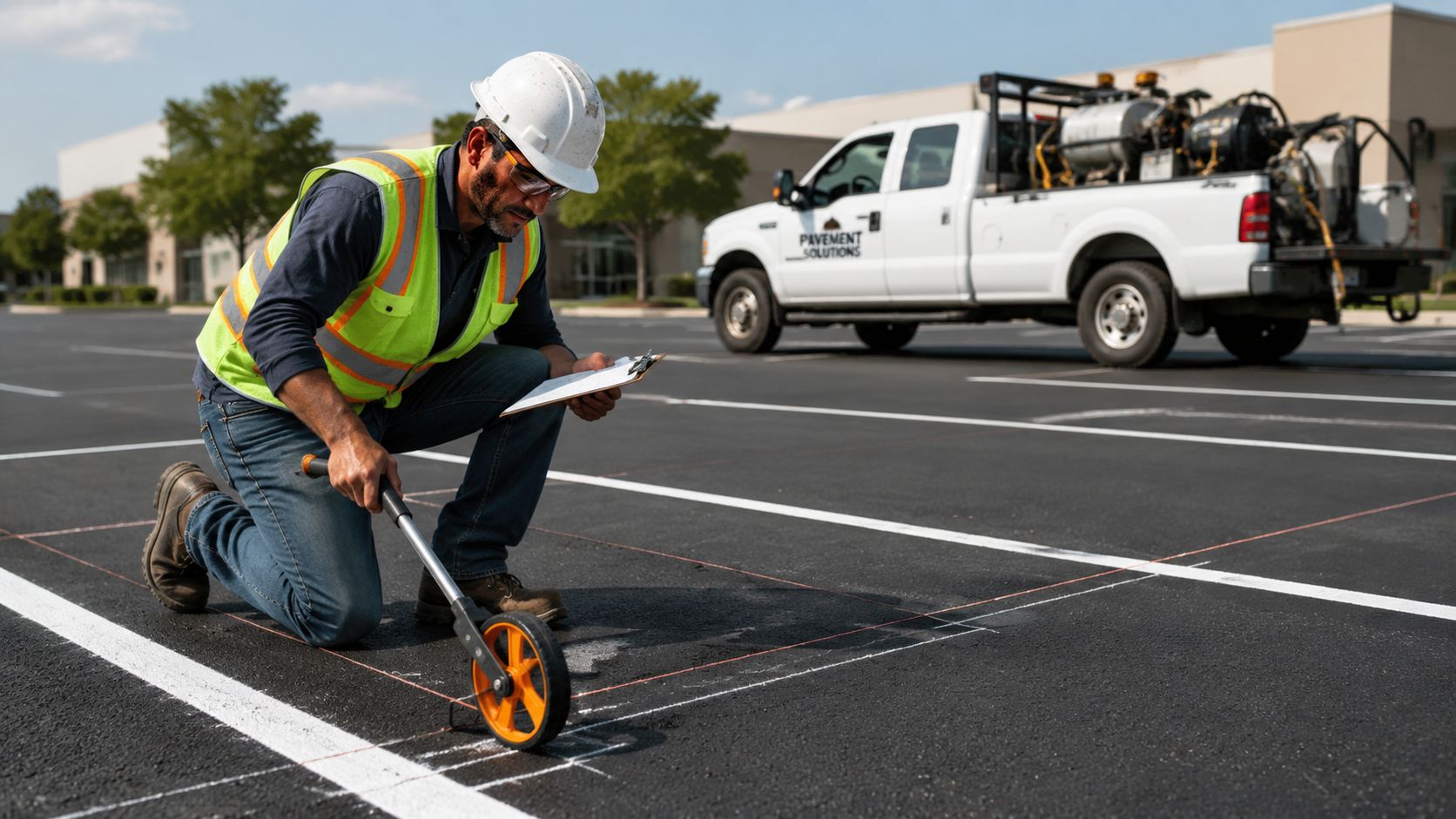
A professional estimate begins with measurement, not a guess. The estimator reviews the lot, counts stalls, measures or calculates line footage, identifies symbols and specialty markings, examines pavement condition, and confirms the material specified for the job.
The basic estimating model
A useful mental model is:
- Measure the core work: Count standard stalls and determine the total line footage.
- Separate specialty items: List accessible spaces, access aisles, arrows, crosswalks, stop bars, curbs, and other stencils.
- Assess the pavement: Note dirt, oil, cracks, loose coatings, faded lines, and any preparation needs.
- Select the material: Match paint, thermoplastic, or epoxy to traffic and maintenance expectations.
- Add fixed project costs: Include travel, equipment transport, setup, coordination, traffic control, and cleanup.
The same logic applies whether the property is in Ocala, Dunnellon, Crystal River, or a smaller surrounding community. A crew still has to move equipment and organize the work, even when the lot contains only a limited number of spaces.
A line-item estimate is easier to evaluate than a vague lump sum. Ask whether the price is based on stalls, linear feet, or a complete project scope. Also ask whether the quoted stall count includes accessible spaces or whether those markings are priced separately.
For a practical field reference, review this guide on how to stripe a parking lot. It helps clarify why layout, preparation, equipment, and sequencing affect the finished result.
The video below provides additional visual context on parking lot striping methods and jobsite execution.
Property managers can negotiate more effectively when they ask for quantities and assumptions. The right questions aren't only about lowering the price. They're about confirming that every required marking and preparation task is included.
Central Florida Climate and Maintenance Strategy
Central Florida pavement takes a steady beating from sun, rain, heat, and daily vehicle movement. In Marion County, asphalt lots around Ocala, Summerfield, and The Villages face intense sun exposure, while properties in Citrus County, including Crystal River, Homosassa, Inverness, Lecanto, Hernando, and Beverly Hills, also deal with heavy seasonal rain and moisture.
Ultraviolet exposure gradually fades painted lines. Rain can wash away loose, degraded coating and expose areas where adhesion has already weakened. Fresh asphalt can also soften under extreme heat, so applying markings at the wrong time or over an unstable surface can lead to smearing and premature wear.
Plan around the pavement, not just the calendar
A reactive approach waits until drivers can barely see the lines. A maintenance strategy watches for fading, surface contamination, cracking, drainage problems, and traffic wear before the markings become a safety concern.
Higher-durability materials may be worth considering where traffic abrasion or repeated closures makes frequent restriping expensive. The lifecycle guidance discussed earlier places water-based paint at 1 to 2 years of service and thermoplastic at 3 to 7 years, so the right comparison is the ownership cost over the period the property will be managed, not merely the first invoice.
Florida property managers should schedule striping as part of pavement maintenance, not as an isolated cosmetic project.
Coordinating striping with sealcoating can reduce duplicated setup and help the lot receive consistent preparation. The surface must be ready for both treatments, and the work sequence should be planned so the new lines remain clean and visible. Riverside's parking lot maintenance checklist can help managers organize recurring inspections and maintenance decisions.
Timing also matters. Cooler, drier working conditions can support cleaner application, while business access and rainfall forecasts should be part of the scheduling conversation. A professional evaluation can determine whether basic paint is adequate or whether a longer-lasting system better fits the site's operating demands.
Cost-Saving Tips and Professional Support
The safest way to reduce parking lot striping prices is to reduce avoidable work, not to remove necessary markings. Bundling striping with sealcoating can limit duplicate mobilization. Repairing cracks and cleaning the pavement before the crew arrives can improve the finished result and prevent new markings from being applied over unstable or contaminated areas.
Practical ways to control the budget
- Bundle related maintenance: Coordinate striping with asphalt sealcoating when the pavement schedule allows it.
- Protect the surface: Address cracks, drainage concerns, and deteriorated pavement before marking work.
- Clarify the scope: Request separate quantities for standard lines, accessible markings, arrows, crosswalks, stop bars, preparation, and mobilization.
- Plan for traffic: Early-morning, late-evening, or phased work can limit disruption when the property must stay open.
- Compare lifecycle cost: Consider maintenance frequency and closure requirements, not only the lowest initial material price.
Riverside Sealing & Striping, LLC is a third- and fourth-generation family-owned contractor based in Dunnellon, serving Marion County, Citrus County, and nearby Central Florida communities. The company handles both concrete and asphalt work, including concrete driveways, patios, slabs, sidewalks, asphalt sealcoating, parking lot striping, ADA upgrades, accessible spaces, and directional markings.
Property managers, HOA boards, churches, schools, commercial owners, and investors can use a no-pressure site consultation to review pavement condition and marking requirements before approving work. Owner Bert Counts provides free on-site consultations and estimates, with attention to scheduling, preparation, ADA details, material selection, and a clear project scope.
A professional should evaluate the lot when existing lines are difficult to follow, accessible routes have changed, pavement is deteriorating, the property needs a new layout, or the work must be completed without disrupting customers and tenants. That evaluation can prevent a low initial quote from becoming a more expensive correction later.
Riverside Sealing & Striping, LLC provides professional parking lot striping, ADA marking upgrades, asphalt sealcoating, and related concrete services throughout Marion and Citrus Counties. Visit Riverside Sealing & Striping, LLC to request a free, no-pressure on-site consultation and a clear evaluation of your Central Florida property's striping needs.