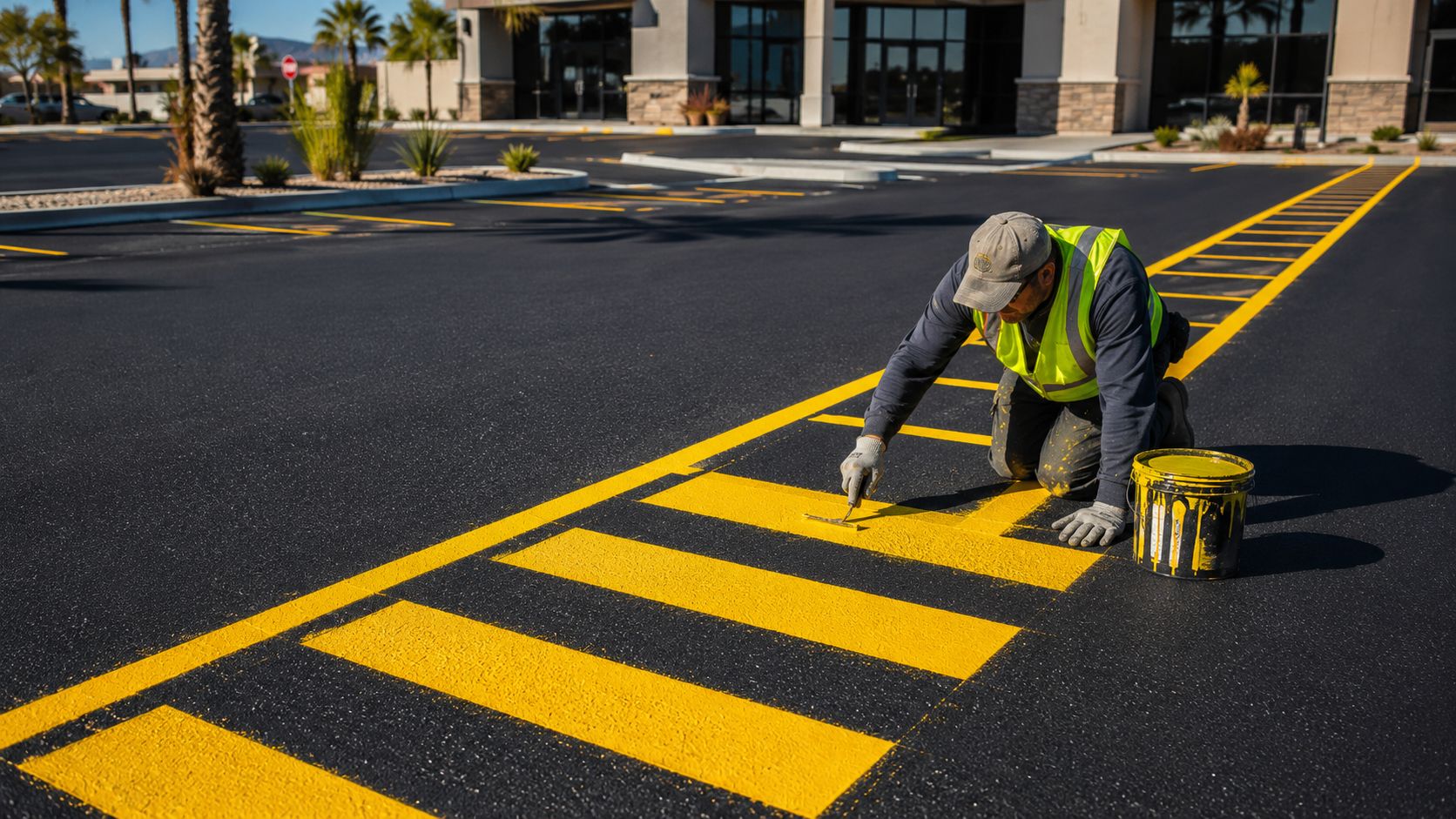
A summer storm rolls across Ocala right at the evening rush. Water sheets across the parking lot, headlights bounce off wet asphalt, and customers start hesitating at every turn. The crosswalk is faded. The arrows are hard to pick out. The walkway from the handicap spaces to the entrance blends into the pavement. Nobody plans for that to become a liability issue, but that's exactly how it starts on many commercial properties in Marion County, FL and Citrus County, FL.
That same problem shows up in different ways across Central Florida. In Homosassa, humidity and grime dull markings faster than many owners expect. In Crystal River, shaded areas and wet pavement can flatten contrast. In Belleview, Dunnellon, Inverness, Lecanto, Beverly Hills, Hernando, Silver Springs, Summerfield, and The Villages, the pattern is the same. A parking lot can still be technically striped and still perform poorly in real conditions.
That's why high visibility paint matters. It isn't just about making lines brighter. It's about helping drivers see direction sooner, helping pedestrians spot crossing zones faster, and helping property managers protect both safety and appearance on asphalt and concrete surfaces. For owners who manage retail centers, HOAs, churches, offices, schools, and medical properties, the right paint system needs to hold up in Florida weather and stay readable when conditions aren't ideal.
For Central Florida properties, the key question isn't just which paint color meets a basic standard. It's which marking system still works after UV exposure, rain, tire wear, and surface contamination start doing damage.
Table of Contents
- Introduction A Clear Path to Safety
- What Exactly Is High Visibility Paint
- Key Applications for Central Florida Properties
- Choosing the Right Paint and Reflective Additives
- Durability and Maintenance in the Florida Climate
- Navigating ADA and Local Compliance Standards
- Hiring Your Concrete and Asphalt Experts in Marion and Citrus County
- Frequently Asked Questions About High Visibility Paint
Introduction A Clear Path to Safety
A property manager usually notices striping problems after someone points them out. A tenant complains that drivers cut across a pedestrian lane. A visitor misses the handicap access aisle in the rain. An HOA board member sees residents step around a cracked sidewalk edge because the elevation change isn't marked clearly enough. By then, the paint issue isn't cosmetic anymore.
Across Central Florida, that moment often comes during bad visibility. Wet pavement in Ocala reflects overhead light differently than dry pavement at noon. Early morning glare in Summerfield can wash out weak striping. A shaded entrance in Crystal River can make directional markings disappear sooner than owners expect. The same color that looked acceptable on the day it was applied may not perform well a few months later.
Practical rule: If a marking only looks good in clear daylight, it probably isn't doing enough for a busy commercial property.
High visibility paint helps solve a specific problem. It improves how quickly people can identify lanes, crossing zones, hazards, curbs, loading areas, and walkways on both asphalt and concrete. That matters for shopping centers, schools, churches, office parks, industrial sites, and community associations from Dunnellon to Lecanto.
There's also a broader market signal behind it. The global road marking paint market was valued at $6.9 billion in 2025 and is projected to reach $11.03 billion by 2034, with Asia Pacific holding a 42.1% revenue share. That growth reflects continued investment in markings that improve visibility, traffic control, and hazard prevention.
For local property owners, the takeaway is simple. High visibility paint isn't a minor upgrade. It's part of a serious safety and maintenance plan, especially when you're managing surfaces that have to perform in Florida heat, rain, and traffic.
What Exactly Is High Visibility Paint
High visibility paint isn't just brighter paint from the same shelf. It's a safety coating designed to stand out faster and stay more noticeable under difficult viewing conditions.
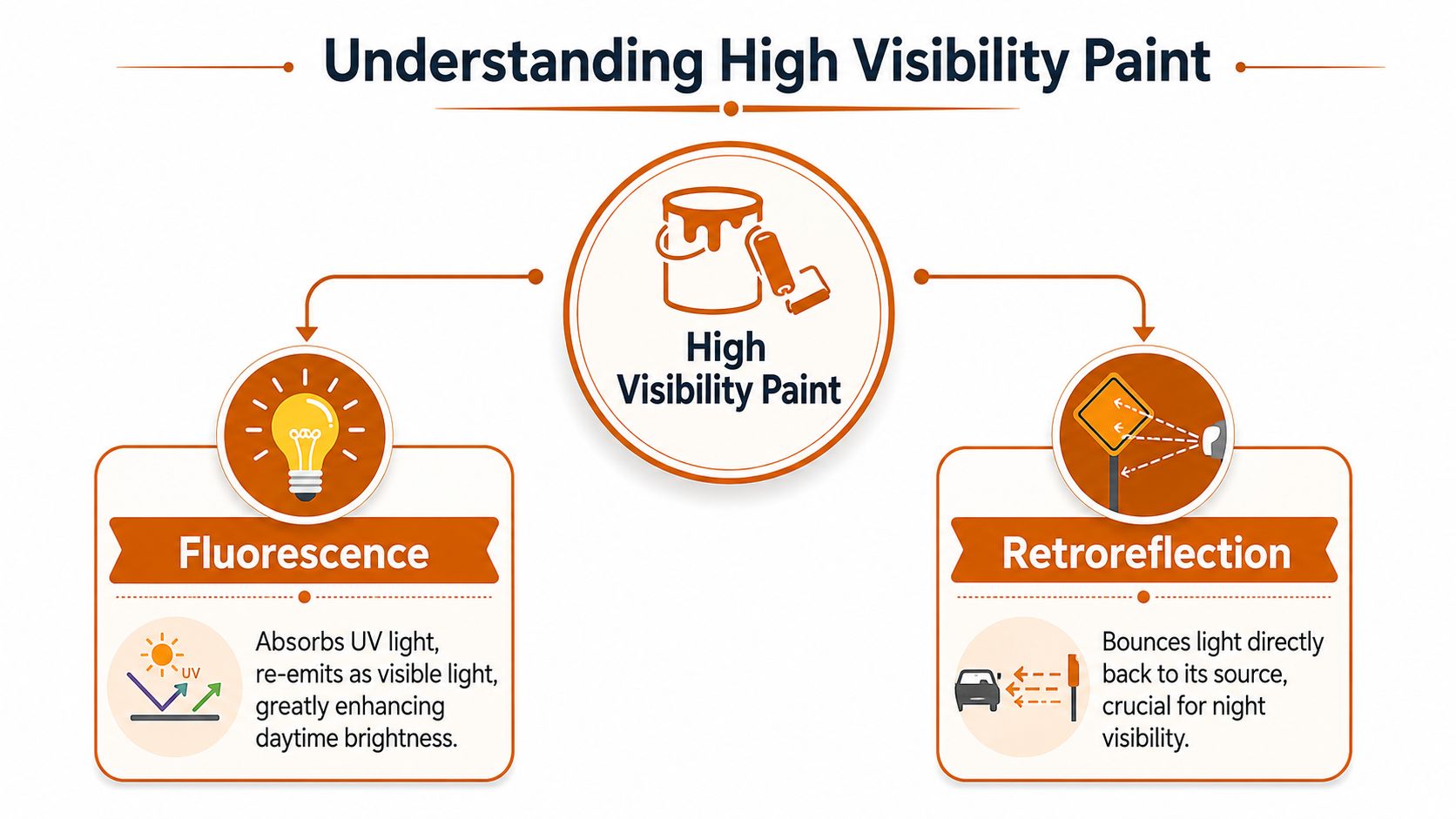
Why bright paint and true visibility are not the same
The first piece is fluorescence. Think of a highlighter on a printed page. It absorbs light and throws back a stronger visual signal than a normal color. With pavement and hazard markings, fluorescent pigments are used to make the marking stand out more aggressively in daylight and low-angle natural light.
The second piece is retroreflection. That's different. A retroreflective surface sends light back toward its source, which is why headlights can make certain markings or signs appear much stronger at night. A paint line can look vivid in the daytime and still perform poorly after dark if it doesn't have the right reflective enhancement.
One technical sheet for high-visibility paint notes that fluorescent pigments can increase hazard detection by 300% compared to standard paints, and that glass bead inclusion can improve reflectivity when used in the proper film build and application conditions, as detailed in this high-visibility paint technical data sheet.
Fluorescence helps in daylight. Retroreflection helps when headlights, site lighting, or low-light conditions take over. You need to know which problem you're solving.
Where the technology came from
This isn't new gimmick paint. It has a long safety history. This technology traces its origins to the 1930s, when American Bob Switzer, after recovering from an industrial workplace accident, invented Day-Glo paint by mixing fluorescent minerals with wood varnish, creating the first commercially viable neon-colored paint that revolutionized safety apparel and hazard marking, as noted by the ANSI blog on high-visibility safety apparel.
That origin matters because it explains the core idea. High visibility materials were developed to make hazards, workers, and boundaries easier to detect under real working conditions. On a commercial property in Marion County or Citrus County, that same purpose applies to crosswalks, curbs, no-parking zones, access aisles, and trip hazards.
Key Applications for Central Florida Properties
The best use of high visibility paint is targeted. It belongs where people need quick visual guidance, not where an owner only wants more color.
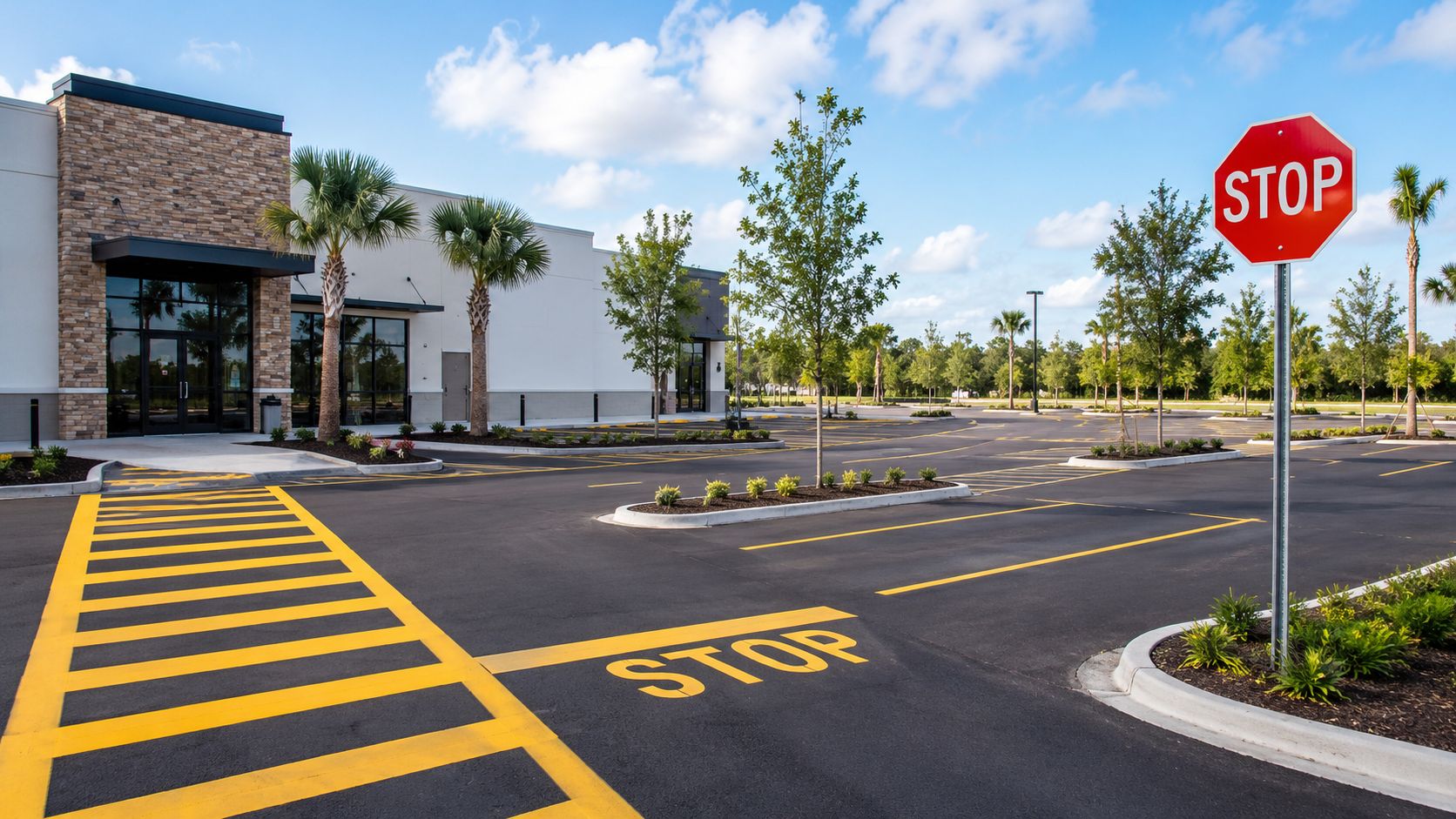
Where it matters most on commercial sites
On asphalt parking lots, the highest-value applications are usually the basics that get used all day:
- Crosswalks near storefronts help separate foot traffic from vehicle flow, especially in busy retail areas in Ocala and Inverness.
- Directional arrows reduce hesitation and bad turns in lots with multiple entry points.
- Fire lanes and loading zones need fast recognition because confusion there creates access and safety problems.
- Stop bars and conflict points matter at drive aisles, pickup lanes, and exits onto busier roads.
- Handicap access routes and aisles need to remain readable, not just present.
In community settings like HOAs in The Villages or church properties in Belleview, the issue is often predictability. Visitors don't know the layout, so markings need to communicate quickly. A line that's technically there but visually weak doesn't do much when someone is searching for an entrance in rain or low light.
Concrete areas need a different approach
Concrete sidewalks, ramps, and pads call for a different mindset. Surface texture, color, and wear patterns change how paint reads. One of the most overlooked examples is trip-hazard marking on uneven sidewalk panels or heaved edges.
For that use, the recommended approach is specific. For high-visibility trip hazard marking on concrete, the recommended technique involves applying paint with 50% transparency to the yellow color, allowing the underlying concrete texture to remain visible for a realistic appearance that alerts pedestrians to elevation changes without obscuring the surface material, according to this discussion of sidewalk trip-hazard marking practice.
That matters on older sidewalks in Dunnellon, Silver Springs, or Beverly Hills, where the goal is to draw attention to the height change without creating a patch that looks like a repair area or decorative coating.
A practical site review usually focuses on these areas first:
- Building approaches: Entrances, ramps, and curb transitions.
- Pedestrian crossings: Especially where sidewalks meet internal drive lanes.
- Hazard edges: Wheel stops, curbs, step-downs, and uneven joints.
- Service zones: Dumpster pads, rear loading areas, and delivery routes.
Good high visibility paint work is less about covering everything and more about placing emphasis where confusion or delay can lead to an incident.
Choosing the Right Paint and Reflective Additives
A lot of owners start by asking which color is best. That's understandable, but it's the wrong first question. The better question is which paint system fits the surface, traffic, lighting conditions, and maintenance plan.
Start with the paint system, not just the color
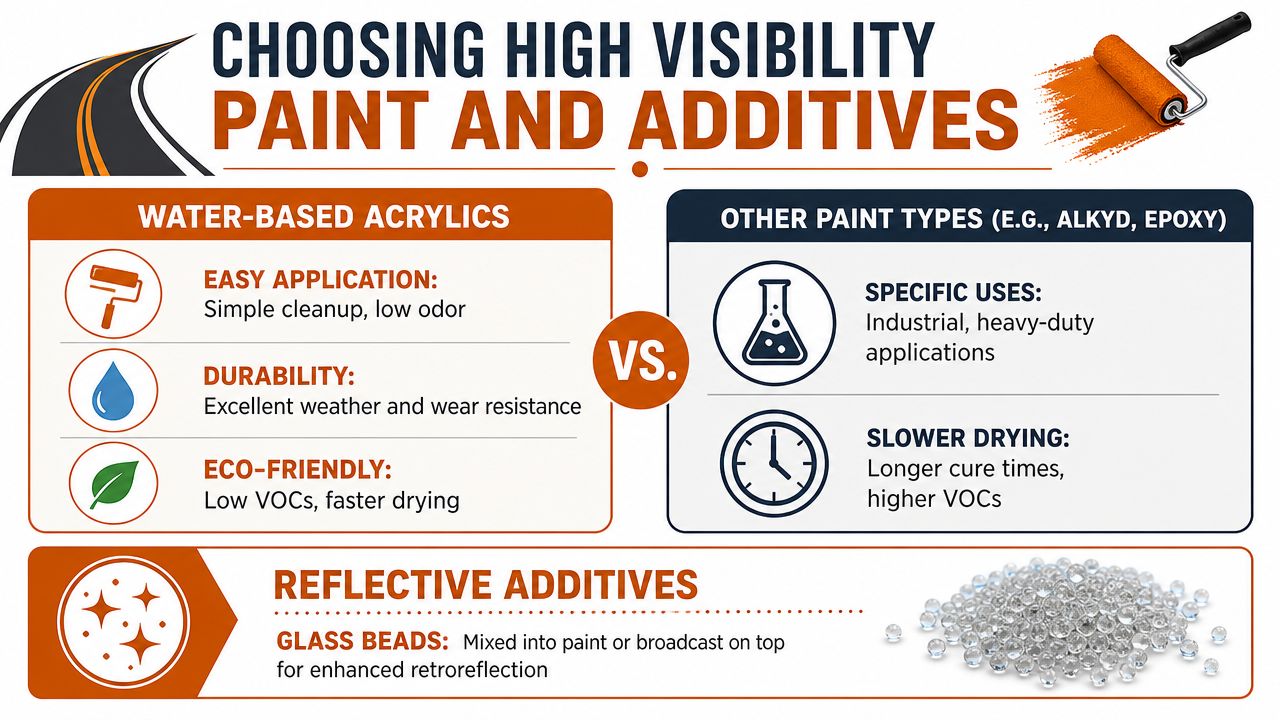
For most commercial pavement marking work in Central Florida, water-based acrylic is the practical standard. It's widely used for striping on asphalt and concrete because it dries relatively fast, handles traffic use well, and fits the needs of routine parking lot maintenance. It also works well when a property needs touch-ups without shutting down large areas for long periods.
Other systems have their place, but they aren't always the right fit for a retail center, church lot, HOA roadway, or medical office in Lecanto or Homosassa. Some are better suited to specialized industrial environments or heavy-duty applications where installation conditions and budgets are different.
Pavement Paint Type Comparison
| Paint Type | Durability | Dry Time | Best Use Case | Cost |
|---|---|---|---|---|
| Water-based acrylic | Good for routine commercial traffic and weather exposure | Typically faster | Parking lots, crosswalks, curbs, ADA markings on asphalt and concrete | Moderate |
| Alkyd | Varies by use and conditions | Slower than many water-based systems | Specific legacy applications where the system is already in use | Varies |
| Epoxy | Strong in certain specialty settings | Longer cure window | Selected industrial or heavy-wear conditions | Higher |
| Acrylic with reflective additives | Better visibility performance where low-light detection matters | Depends on system and site conditions | Parking lots, walkways, conflict zones, and sites with nighttime use | Higher than paint alone |
Why reflective additives change the result
This is the part many property managers don't hear often enough. Base color alone isn't enough when low light is part of the intended application.
A cited industry source states that 65% of pedestrians and 50% of drivers in low-light parking lots cannot detect standard high-vis paint without retroreflective enhancement, even when ANSI colors are used, based on a 2026 National Asphalt Pavement Association study discussed here.
That's why glass beads or similar reflective additives matter. They improve how markings respond to headlights and site lighting. On properties with evening traffic, shaded areas, or poor ambient light, that can make the difference between a marking that merely exists and one that guides people.
What usually works best:
- Water-based acrylic for the base system when the site needs efficient application and dependable striping performance.
- Reflective bead enhancement for low-light parking fields, pedestrian crossings, and internal drive aisles.
- Color choice based on use rather than preference. Safety yellow may make sense in one area, while standard white remains the right choice in another.
- Surface-specific planning because concrete and asphalt don't read the same once they weather.
A bright line that disappears in headlights or on wet pavement isn't a visibility upgrade. It's a false sense of security.
Durability and Maintenance in the Florida Climate
A striping layout can be correct on paper and still fail in Florida conditions. That's the part many generic guides miss.
What Florida weather does to pavement markings
In Central Florida, UV exposure, heat, humidity, organic buildup, and heavy rain all work against visibility. In Summerfield or Belleview, intense sun can flatten color and make bright markings look chalky sooner than expected. In Homosassa or Crystal River, moisture and surface film can reduce contrast even when the line itself hasn't fully worn away.
That loss of contrast matters more than most owners realize. A 2025 industry review on high-visibility colors found that 40% of newly striped parking lots in humid climates failed to meet effective contrast thresholds after 6 months due to pigment fading and surface accumulation.
That lines up with what many Florida property managers already see on the ground. The stripe may still be present, but it no longer reads clearly against aged asphalt, dusty concrete, mildew staining, or a wet reflective surface.
What holds up better in Marion and Citrus counties
A localized maintenance approach works better than a one-time striping mindset. That means evaluating how the lot behaves during rain, early morning glare, and evening traffic, then choosing products and maintenance timing around those conditions.
A strong plan usually includes:
- Surface prep that fits the substrate: Concrete needs different prep than oxidized asphalt.
- Material choice based on exposure: Entrances, drive aisles, and storefront crossings wear differently.
- Scheduled review of contrast: Not just whether paint remains, but whether people can still read it quickly.
- Cleaning as part of visibility maintenance: Dirt, pollen, tire residue, and organic staining all change contrast.
For commercial sites, it helps to treat markings as part of the broader pavement plan, not an isolated line-item. A practical reference point is this parking lot maintenance checklist for commercial properties, especially for owners trying to coordinate sealcoating, concrete repairs, drainage issues, and restriping together.
What works up north or in a dry climate doesn't always hold up in Ocala, Dunnellon, Inverness, or Lecanto. Florida demands a paint system and maintenance schedule that account for weather first, not last.
Navigating ADA and Local Compliance Standards
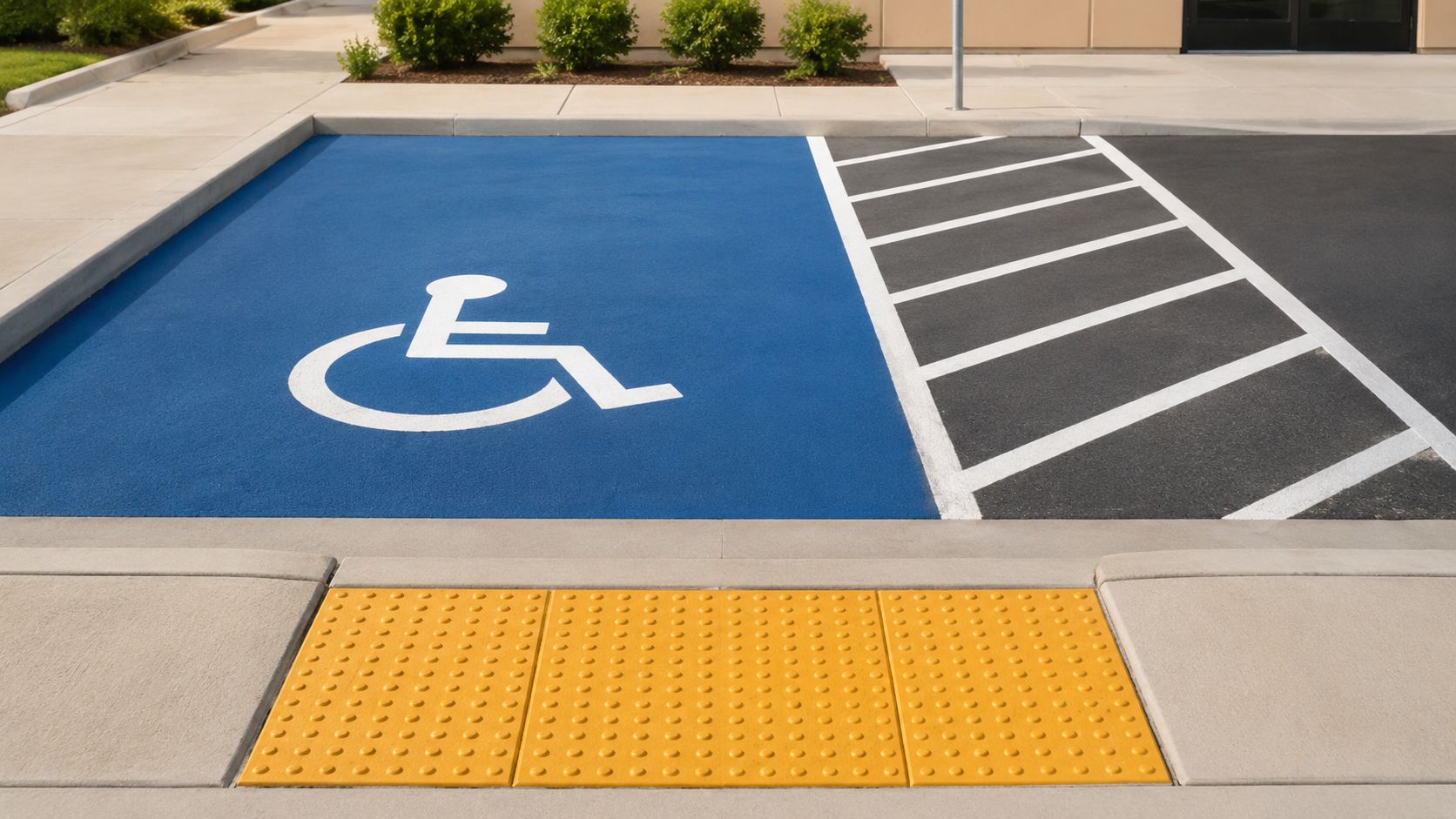
Compliance work has to be clear, deliberate, and consistent. If a property has accessible parking, access aisles, curb ramps, and pedestrian routes, the markings need to support safe use and match the intended purpose of the space.
Compliance starts with clear purpose
For high-traffic areas, water-based acrylic paint is the industry-standard material for pavement marking due to its durability against tire skid and scuffing, UV glare resistance, and high visibility on both concrete and asphalt, as described in this overview of pavement marking paint types.
That matters because ADA-related markings don't just need to be placed correctly. They need to remain legible under use. A handicap space with weak borders, a fading access aisle, or poor walkway definition can create confusion for drivers and pedestrians alike.
On many commercial sites in Marion County, FL and Citrus County, FL, the trouble spots are predictable:
- Access aisles that have lost edge definition
- Crosswalks that don't stand out from surrounding pavement
- Curb ramp transitions that are visually weak
- Older lots where modifications were added over time without a coordinated layout
For owners reviewing existing lots, a practical primer on layout and marking sequence can help. This guide on how to stripe a parking lot correctly gives a useful baseline for understanding how professional striping plans are organized.
Reserved colors and common mistakes
One mistake shows up often in private lots. Owners assume any bright or official-looking color can be used anywhere if the intent is safety. That's not how pavement markings work.
According to the Bloomberg Asphalt Art FAQ, pavement marking paint for private high-visibility applications must never be retroreflective or include official MUTCD colors like ADA blue, bus lane red, or bike lane green in contexts where those uses would create confusion with traffic control symbols or accessibility features.
That's an important distinction. Use the right color in the right place. Don't borrow official traffic-control color schemes for unrelated zones. And don't assume a bright custom marking improves compliance just because it grabs attention.
Compliance isn't about adding more paint. It's about using the correct marking in the correct location so people understand it instantly.
Hiring Your Concrete and Asphalt Experts in Marion and Citrus County
Choosing a contractor for high visibility paint work shouldn't come down to who can put down lines the fastest. The better hire is the one who understands surface condition, drainage, traffic patterns, ADA risk points, and how concrete and asphalt behave differently in Central Florida.
Questions worth asking before you hire
Ask direct questions.
- Are you licensed and insured in Florida? That should be basic, not optional.
- Do you handle both concrete and asphalt surfaces? Many visibility issues happen where the two meet.
- What prep do you do before painting? A weak bond often starts with poor cleaning or no surface correction.
- Have you worked on properties like mine in Ocala, Dunnellon, Crystal River, or Inverness? Local experience matters.
- How do you approach low-light areas and weather exposure? The answer should go beyond color selection.
A contractor who only talks about line layout but not adhesion, fading, water runoff, or pedestrian behavior is missing part of the job.
What a good contractor should understand locally
A capable Central Florida contractor should know when striping alone won't solve the problem. Sometimes the fix is a concrete sidewalk repair, a curb transition adjustment, drainage correction, sealcoating before restriping, or a redesign of traffic flow near entrances.
That's why it helps to work with a company that understands the broader site, not just the paint. A useful example of that kind of full-scope pavement approach is shown in these Southern striping solutions for commercial properties.
The right partner should offer clear scheduling, explain trade-offs, and tell you when a cheaper option won't hold up. For owners in The Villages, Homosassa, Beverly Hills, Hernando, and surrounding areas, that local judgment often saves more than the lowest bid ever will.
Frequently Asked Questions About High Visibility Paint
How long does high visibility paint last in Central Florida
It depends on traffic, surface prep, drainage, UV exposure, and whether the marking is on asphalt or concrete. In Florida, visibility often declines before the paint fully disappears, so performance matters more than whether a faint line is still technically present.
Is brighter always better
No. The marking has to fit the use, contrast with the surrounding surface, and stay understandable to drivers and pedestrians. A color that looks strong in midday sun may not be the best performer in rain, shade, or headlights.
Can property staff apply it themselves
For minor non-regulated markings, possibly. For ADA spaces, access aisles, crosswalks, traffic flow markings, or trip-hazard work, a professional is usually the safer choice because layout errors, bad prep, and wrong color use can create compliance and liability problems.
What affects cost the most
Surface prep, layout complexity, paint system choice, reflective additives, and whether repairs are needed before striping. The cheapest proposal often assumes the least prep.
When should a property manager call for an evaluation
When markings are hard to read in wet weather, at dawn, near entrances, or in tenant complaint areas. Those are usually the first signs that the striping is no longer doing its job.
If your property needs safer, clearer pavement markings or concrete and asphalt improvements that hold up in Central Florida conditions, Riverside Sealing & Striping, LLC offers free estimates and no-pressure consultations. As Concrete and Asphalt Experts in Marion and Citrus County, the team helps property owners across Ocala, Dunnellon, Crystal River, Inverness, and surrounding areas evaluate striping visibility, ADA concerns, concrete issues, and long-term pavement maintenance with reliable scheduling and high-quality workmanship.