
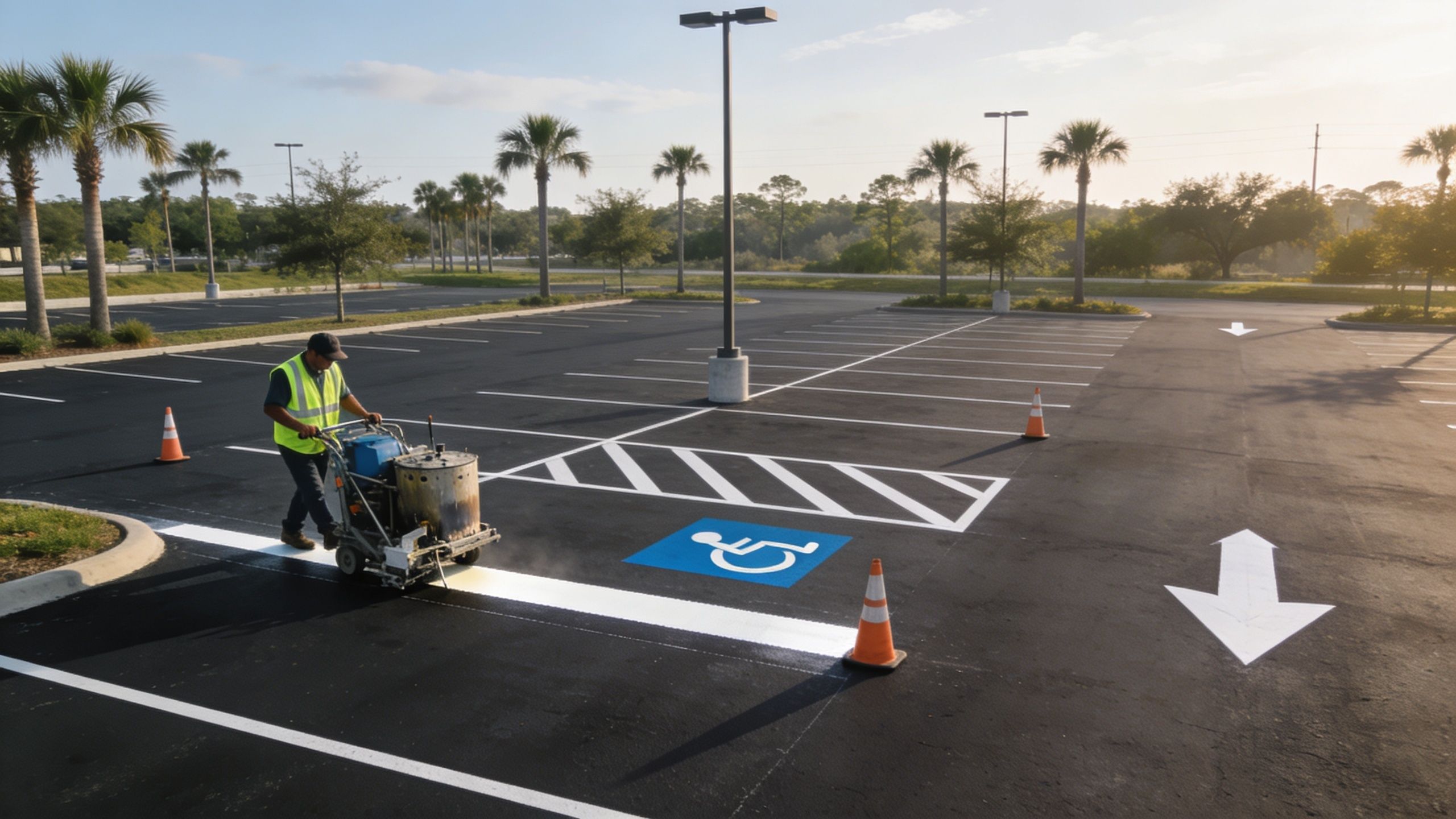
A lot of property managers don’t think about striping until tenants start complaining, delivery drivers cut across parking stalls, or an accessible space no longer looks clearly marked. In Ocala, Dunnellon, Inverness, and the rest of Central Florida, faded lines create problems fast. They hurt curb appeal, confuse traffic flow, and raise the risk of safety and compliance issues.
That’s where southern striping solutions matter. Not just as a company name people may recognize from Florida, but as a practical approach to pavement markings that holds up under heat, rain, and constant traffic. For commercial properties in Marion County, FL and Citrus County, FL, good striping is part of a bigger maintenance plan that often includes both asphalt upkeep and concrete access improvements.
Property managers in The Villages, Belleview, Crystal River, Homosassa, Lecanto, Beverly Hills, Hernando, Silver Springs, and Summerfield usually need more than fresh paint. They need layout accuracy, ADA awareness, material choices that fit Florida conditions, and a contractor who understands both pavement and pedestrian access. That’s why the best results usually come from Concrete and Asphalt Experts in Marion and Citrus County, not from a one-trade crew looking at only part of the site.
Your Guide to Professional Parking Lot Striping in Central Florida
A parking lot tells people what kind of property they’re entering before they ever reach the door. If the stalls are uneven, arrows are missing, and fire lanes are hard to read, the lot feels unmanaged. That affects retail centers, churches, schools, HOAs, office parks, and mixed-use properties across Central Florida.
Professional striping fixes more than appearance. It organizes movement, protects pedestrian areas, defines where vehicles should and shouldn’t go, and supports accessible parking. On a busy site in Marion County, FL or Citrus County, FL, those details reduce confusion in ways tenants and visitors notice immediately.
What striping should do on a working property
At a minimum, a well-planned lot should handle four jobs:
- Create order: Clearly marked stalls help drivers park consistently and use the lot efficiently.
- Direct traffic: Arrows, stop bars, and lane markings reduce hesitation and wrong-way movements.
- Protect access: Crosswalks, no-parking zones, and fire lane markings keep critical areas open.
- Support compliance: Accessible spaces and related markings need to be easy to identify and correctly placed.
Practical rule: If drivers have to guess where to park or where to drive, the layout is already failing.
In places like Ocala and Inverness, I’ve seen lots where the asphalt was still serviceable but the striping had become the weak link. The surface looked acceptable from a distance. Up close, the markings were doing almost nothing.
Why Central Florida properties need a more durable approach
Florida weather and traffic wear down markings quickly. Sun exposure fades color. Rain challenges adhesion. Turning tires grind away high-contact areas near entries, drive aisles, and loading points. A professional striping plan takes those realities into account before the first line is laid down.
That matters even more when the property also includes sidewalks, ramps, curbs, and transitions. A lot isn’t just asphalt. It’s part of a complete site. On many commercial properties, the best outcome comes from coordinating parking lot striping with concrete access routes and any needed ADA-related upgrades.
Core Pavement Marking Services for Commercial Properties
The most effective striping plans start with function, not paint color. Every marking on a commercial lot should solve a specific problem. If it doesn’t improve flow, safety, access, or clarity, it’s usually unnecessary.

The markings most properties actually need
Some markings are standard, but they shouldn’t be treated like a template job.
- Parking stall striping: This is the basic framework of the lot. Good stall striping creates order, helps maximize usable space, and makes the site look maintained.
- Directional arrows and traffic flow markings: These matter more than many owners realize. They reduce hesitation at drive aisles and help delivery traffic, visitors, and residents move through the site without conflict.
- Fire lanes and no-parking zones: These need to be easy to identify and consistently visible. If these markings fade, people start treating restricted areas like overflow parking.
- Crosswalks and pedestrian markings: These are especially important near storefronts, clubhouses, schools, and church entrances.
- Custom stenciling: Reserved parking, loading areas, visitor zones, and site-specific instructions all fall here. Done right, stenciling keeps communication clear without cluttering the pavement.
A retail center in Summerfield won’t have the same needs as an HOA in Beverly Hills or a church lot in Lecanto. That’s why layout review matters before any restriping begins.
ADA compliance isn’t optional
Accessible parking isn’t just one more stripe on the plan. It’s one of the highest-stakes parts of the lot because it affects safety, usability, and owner liability. The markings need to be visible, properly located, and coordinated with access aisles, signage, and pedestrian routes.
According to Southern Striping Solutions, the company specializes in parking lot and roadway striping, sealcoating, and asphalt repair, serving commercial properties, HOAs, and municipalities from its Naples headquarters. That broad service mix reflects the reality of this work. A compliant lot depends on more than fresh paint. It often depends on how the whole site is maintained.
Clear markings don’t just make a property look organized. They show that management is paying attention to safety and access.
For Central Florida properties, that often means looking at both surface markings and adjacent concrete features together. A perfectly painted accessible stall still falls short if the route to the entrance is broken, misaligned, or difficult to use.
Navigating ADA Compliance and Safety Markings
A property manager finds out there is an accessibility complaint after a tenant reports that the marked stall is hard to use in the rain. In the field, that usually traces back to more than faded blue paint. The stall may be striped, but the access aisle may slope the wrong way, pond water, or lead to a broken sidewalk connection.
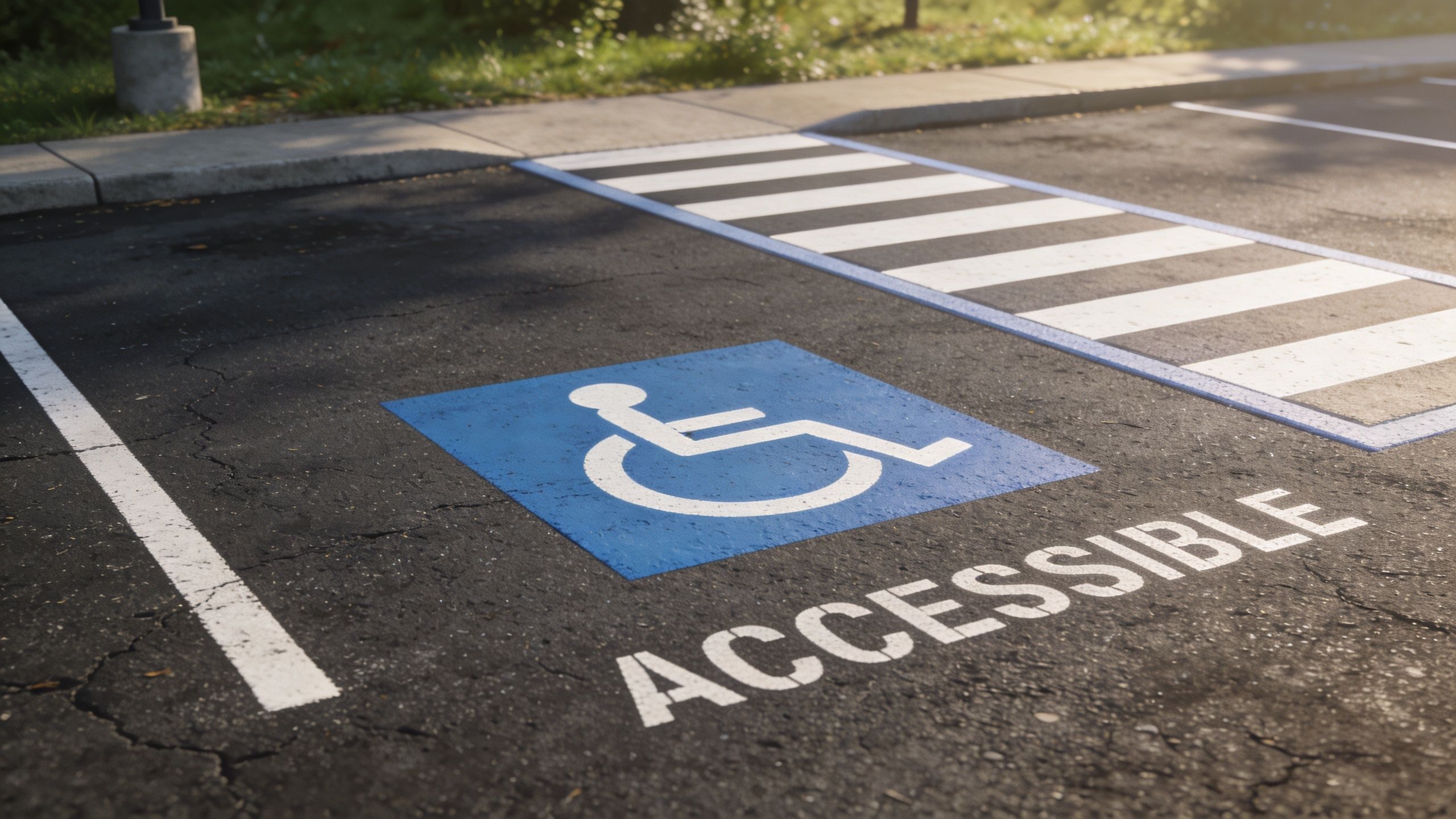
On commercial sites in Dunnellon, Crystal River, and The Villages, ADA work has to be checked as a full access route. That means reviewing the asphalt markings and the concrete path together. A clean layout on the pavement does not fix a bad ramp transition, settled walk, or landing that holds water.
What property managers should check first
Start with how the space works from arrival to entry. Drivers need to identify the stall early, park safely, unload into a usable aisle, and reach the building without hitting a pinch point or damaged transition.
The review usually includes:
- Accessible markings that stay visible: Drivers should be able to pick out the stall and access aisle without hesitation.
- Placement near the right entrance: The shortest route is not always the best route if it crosses traffic or leads to a poor sidewalk connection.
- Access aisles kept open: Aisles need to stay clear of carts, cones, and maintenance storage.
- A pedestrian route that works after storms: In Marion and Citrus County, drainage and surface condition matter as much as layout.
- Concrete ramps and landings in good condition: Cracks, settlement, and lip-height issues can turn a compliant-looking space into a real access problem.
For a more detailed reference, review these ADA handicap parking space requirements before restriping or reworking an access area.
Safety markings need to match actual site risk
Accessible stalls are only one part of the safety package. Crosswalks, stop bars, directional arrows, loading markings, and fire lane designations all need to match the traffic pattern on the property.
That matters more on mixed-use and multi-tenant sites, where delivery traffic, resident traffic, and visitor traffic all use the same pavement differently throughout the day. A church in Lecanto may need high-visibility pedestrian crossings on weekends. A medical office in Ocala may need clearer accessible loading and drop-off guidance every day. The layout has to reflect how people move through the site in practice.
A quick visual can help when you’re evaluating what compliant markings should accomplish in the field.
Where dual-trade expertise matters
Many ADA corrections stall because one contractor handles striping and another handles concrete, and neither one is looking at the full route. The paint crew can lay out the stall correctly and still leave the user with a bad ramp, a rough panel transition, or a sidewalk that misses the natural path to the door.
That is why dual-trade experience matters on Central Florida commercial properties. On sites with both asphalt and concrete issues, the best results come from planning the access route as one scope, not splitting it into isolated fixes. Property managers in Marion County and Citrus County usually save time, avoid rework, and get a better long-term result when the same local team can evaluate pavement markings, curb ramps, sidewalks, and surface transitions together.
Choosing Your Materials Paint vs Thermoplastic in Florida
A property manager in Ocala or Inverness usually sees this decision after the lines have already started fading. The stalls still look serviceable from a distance, but the arrows at the drive aisle are weak, the crosswalk is losing contrast, and the accessible markings near the entrance need to stay clear every day. Material choice decides whether those areas hold up through the year or end up back on the restriping list sooner than planned.
For Central Florida commercial sites, paint and thermoplastic both have a place. The right choice depends on traffic volume, where vehicles turn and stop, how visible the marking needs to stay, and how often the property can tolerate maintenance closures. On mixed-use properties in Marion and Citrus County, I usually recommend a zone-based plan instead of treating every line the same.
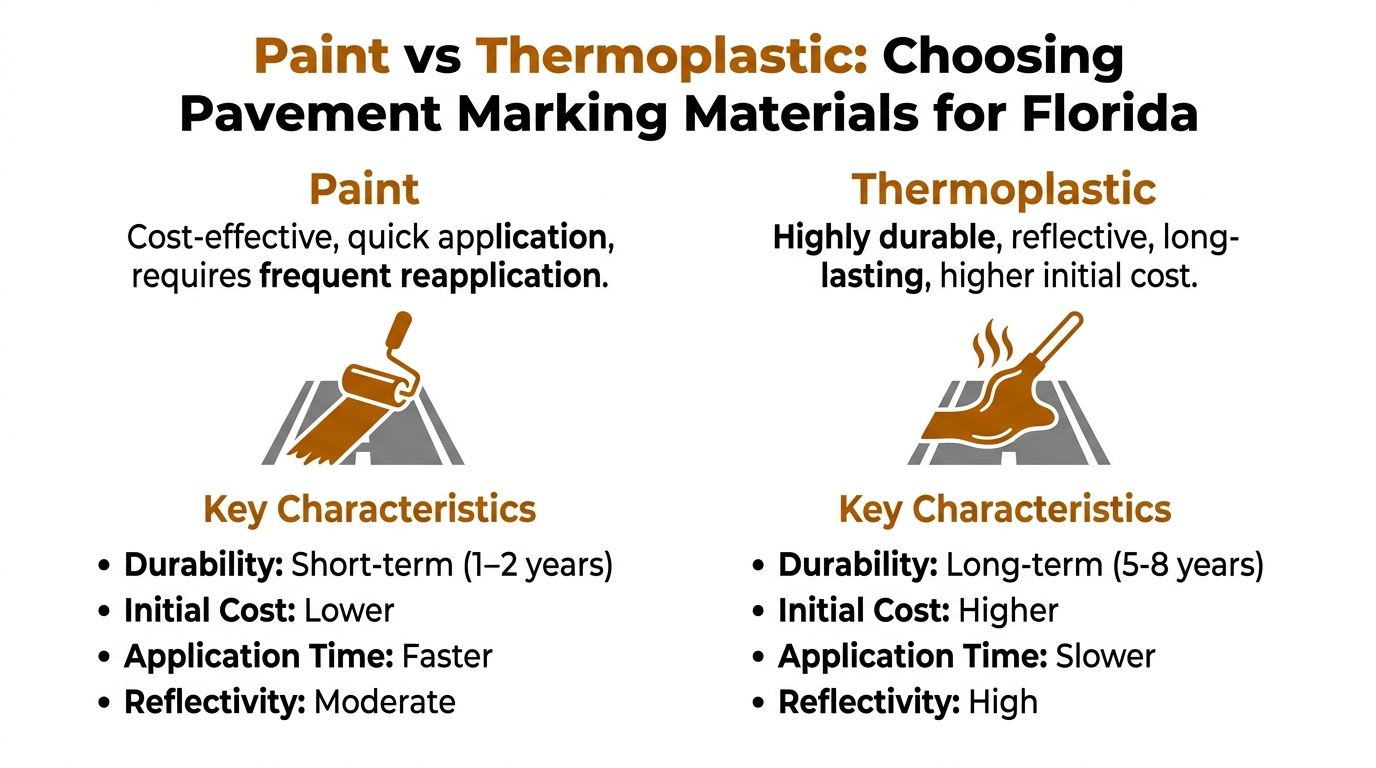
| Material | Best fit | Main advantage | Main drawback |
|---|---|---|---|
| Traffic paint | Standard stalls, lower-stress areas, routine restriping cycles | Lower initial cost and quicker application | Wears faster in heavy traffic and harsh weather |
| Thermoplastic | Crosswalks, directional lanes, accessible zones, high-visibility areas | Stronger durability and better long-term visibility | Higher upfront cost and more involved installation |
That difference matters most where failure creates confusion or liability.
Paint works well for ordinary parking stalls and areas that are easy to refresh during a scheduled maintenance visit. It keeps initial cost down, and on properties that already restripe regularly, that can be the practical choice. Thermoplastic costs more up front, but it holds up better where cars brake, turn, stack, or cross pedestrian paths. On busy retail centers, medical offices, churches, schools, and industrial sites, that longer service life often justifies the higher install cost.
The pavement itself also affects the decision. Older asphalt with oxidation, raveling, or patchwork may not be the best candidate for a premium marking everywhere. Concrete areas bring their own issues, especially at crosswalk connections, loading zones, and access routes. That is one reason dual-trade experience matters. A contractor who understands both asphalt and concrete can match the marking system to the actual surface condition instead of selling one material across the whole site.
Here are the areas that usually deserve closer review before you choose:
- Entry and exit points: Tires scrub the surface during braking and turning, so arrows, stop bars, and lane lines wear first.
- Crosswalks and pedestrian routes: Visibility has to last, especially near storefronts, churches, and medical buildings.
- Accessible stalls and access aisles: These markings carry legal and safety consequences if they fade too far.
- Service drives and loading areas: Delivery traffic and heavier vehicles create more abrasion than standard passenger traffic.
- Remote or low-use stalls: These often do fine with standard paint and a normal restriping cycle.
A smart plan usually mixes materials. Use paint in lower-risk areas where refresh work is simple. Use thermoplastic where the marking controls movement, visibility, or accessibility. Property managers who already schedule sealcoating, crack filling, concrete repairs, or ADA corrections should also line up material choices with the broader parking lot maintenance checklist for commercial properties. Good timing protects the striping investment as much as the material itself.
One more practical point. The cheapest line item on the proposal is not always the lowest operating cost over two or three years. If a crosswalk, directional arrow, or accessible zone has to be restriped repeatedly, the property pays again in labor, scheduling, and disruption. On many Central Florida sites, the best value comes from spending more only where failure causes a real problem.
How Florida Weather Wears Down Your Parking Lot Lines
Florida doesn’t give pavement markings an easy life. In Central Florida, striping takes direct sun, daily heat, heavy seasonal rain, and moisture that lingers longer than many owners expect. That’s why two lots with the same layout can age very differently depending on prep, materials, and maintenance timing.
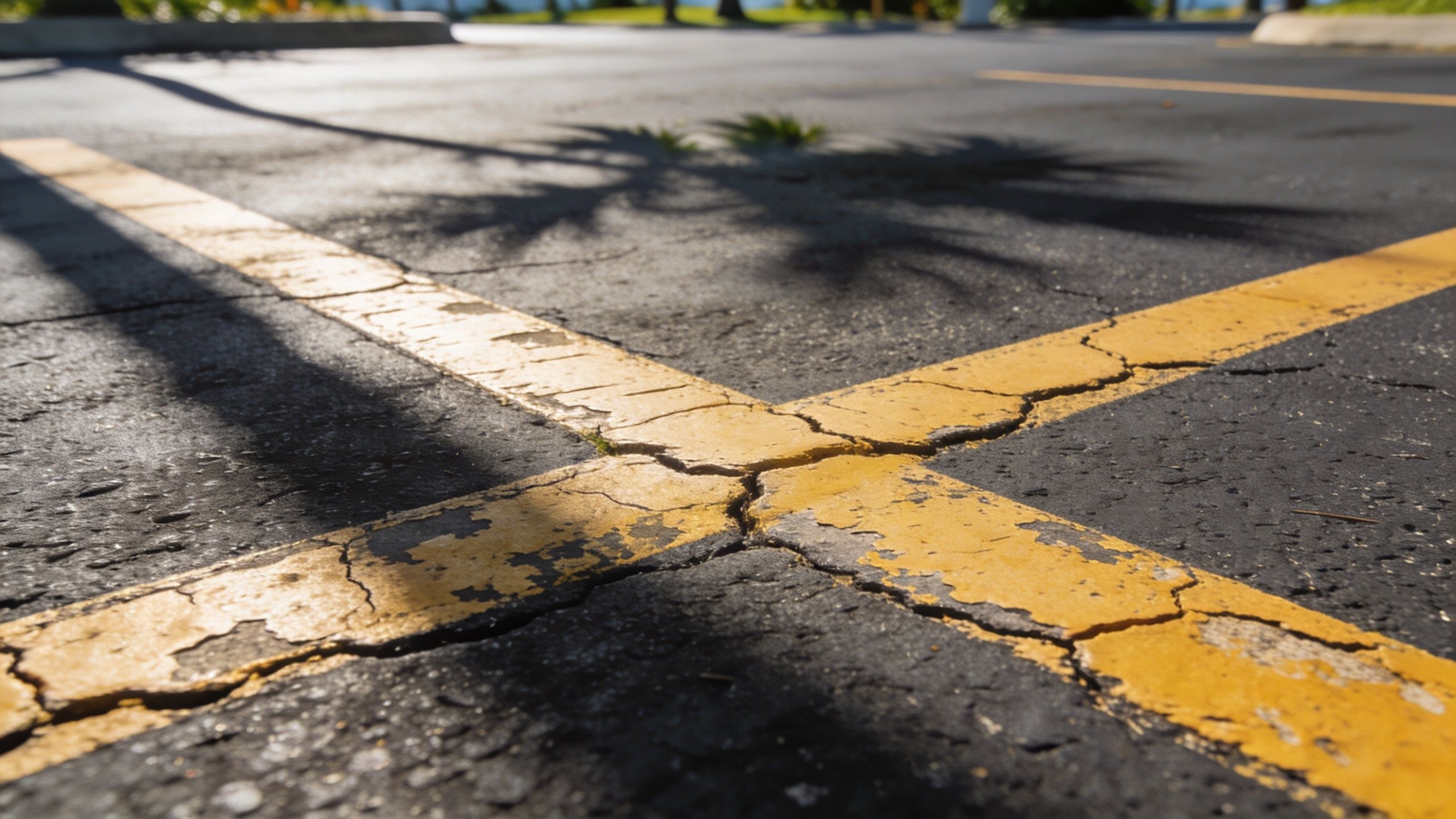
Why lines fail faster in Marion and Citrus counties
UV exposure breaks down color and surface integrity over time. Rain gets into weak spots and challenges adhesion. When water sits on worn asphalt, the striping bond doesn’t get any help. Add turning tires, oil drips, and regular commercial use, and lines disappear faster than many property managers expect.
That’s also why surface condition matters before restriping. If the lot is oxidized, dusty, cracked, or still holding residue, new markings are starting from a bad base.
What a professional project should look like
A proper striping job should follow a sequence, not just a paint pass.
- Site review: The contractor checks traffic flow, faded layout, drainage trouble spots, and any compliance issues.
- Surface preparation: The pavement gets cleaned, and problem areas are identified before marking begins.
- Layout confirmation: Stall spacing, arrows, no-parking areas, and access zones are measured and marked out.
- Application: The selected material is applied with the right equipment for the condition and purpose.
- Protection and cure time: The lot needs enough control after application so markings aren’t ruined by early traffic.
If a contractor skips prep or treats the lot like every other property, the striping won’t last the way it should.
Striping lasts longer on maintained asphalt
Southern Striping Solutions notes that advanced polymer-enhanced sealcoats can extend asphalt life by over 50% in subtropical climates by reducing oxidation, water infiltration, and chemical damage, according to its asphalt sealcoating page. That matters because better-protected asphalt gives striping a more stable surface to bond to.
For owners planning work in Ocala, Summerfield, or Crystal River, a broader parking lot maintenance checklist helps connect striping to the rest of the pavement plan.
Lots don’t usually fail all at once. First the sealcoat ages, then cracks open, then markings lose definition, and finally traffic starts creating its own pattern.
When a property manager understands that chain, striping stops being a cosmetic afterthought and becomes part of long-term site management.
Our Professional Striping Process Start to Finish
A good striping contractor should make the project feel organized from the first call. Property managers don’t want surprises, unclear closures, or layout questions after crews have already started. They want a plan, a schedule, and a finished lot that works better than it did before.
Step one is site evaluation, not guessing
The process starts with an on-site review. That means checking the current layout, identifying worn or conflicting markings, looking at pedestrian routes, and deciding whether the lot should be restriped as-is or adjusted.
This is also the right time to flag related issues. If concrete ramps are damaged, curbs need attention, or the asphalt surface should be repaired before striping, those details need to be addressed early.
Surface prep makes or breaks the result
Once the scope is set, the pavement has to be prepared. Dirt, chalking, loose debris, and failed old markings all interfere with adhesion and clarity. If old lines are misleading, they may need to be removed or covered through a revised plan so drivers don’t see two sets of instructions.
At this stage, reliable contractors also coordinate timing carefully. On a church property in Inverness or a retail lot in Belleview, the best crew will work around traffic patterns and tenant needs instead of forcing the property to adapt to them.
Application should look controlled and deliberate
By the time striping starts, the layout should already be settled. Crews should know where stalls, arrows, fire lanes, accessible zones, and specialty markings belong. Equipment matters, but so does pacing. Rushed work tends to show up in crooked lines, inconsistent spacing, and poor edge quality.
For owners trying to compare proposals, this practical guide on how to stripe a parking lot helps clarify what competent process looks like before you hire anyone.
Field check: Ask how the contractor handles layout verification, cure time, traffic control, and old line conflicts. If the answer is vague, the job probably will be too.
Verify reliability before the work begins
This part gets overlooked too often. In Florida, demand for verifiable contractor reliability surged 22% after recent major storms, yet many property managers still don’t know how to verify credentials like a USDOT number, according to SSS Paving’s striping page. That matters because striping work may involve vehicles, equipment transport, scheduling dependencies, and liability exposure.
Before approving a job, confirm the basics:
- Licensed and insured status: Ask for current documentation.
- Clear schedule commitments: Make sure the contractor can explain timing and closure expectations.
- Scope in writing: Every marking type should be listed clearly.
- Communication process: You should know who to contact before, during, and after the work.
- Operational legitimacy: If a contractor provides a USDOT number, verify it directly rather than taking it at face value.
Property managers in Silver Springs, Lecanto, and The Villages usually don’t need the cheapest crew. They need the one that shows up prepared, communicates well, and finishes the layout correctly the first time.
Frequently Asked Questions About Southern Striping Solutions
How long does a parking lot need to be closed for restriping
That depends on the material used, weather conditions, and how much of the lot is being marked. Small restriping jobs may be handled in phases so part of the site stays usable. The key is planning traffic flow before work begins so tenants and visitors aren’t left guessing.
How often should a commercial lot in Central Florida be restriped
There isn’t one fixed schedule that fits every property. A church in Hernando, a retail center in Ocala, and an HOA in Homosassa won’t wear the same way. Traffic level, sun exposure, drainage, and whether the lot is regularly maintained all affect timing. The practical rule is to restripe before markings become hard to interpret, not after.
Can old or incorrect lines be removed before new ones are applied
Yes, and sometimes they should be. If old markings create conflicting stall layouts, traffic direction confusion, or outdated accessible spaces, painting over them without a plan can make the lot worse. A contractor should review whether the layout needs removal, revision, or a clean restripe.
What weather conditions are best for striping in Florida
Dry conditions and a clean surface matter most. If the pavement is damp, dirty, or unstable, adhesion suffers. In Marion County, FL and Citrus County, FL, timing around rain is often just as important as choosing the right material.
Does striping only matter for asphalt lots
No. Striping often connects directly to concrete work, especially at sidewalks, ramps, curbs, and access routes. On many commercial properties, the safest result comes from treating the lot as a complete system instead of separating concrete and asphalt decisions.
Professional striping improves safety, accessibility, curb appeal, and day-to-day function. If your lot in Dunnellon, Crystal River, Inverness, Belleview, or the surrounding Central Florida area is faded, confusing, or overdue for an ADA review, it’s worth getting a professional evaluation before small striping issues turn into larger property problems.
If you need help from Riverside Sealing & Striping, LLC, you can request a free, no-pressure estimate for parking lot striping, ADA-related upgrades, asphalt sealcoating, or concrete improvements. As Concrete and Asphalt Experts in Marion and Citrus County, Riverside serves commercial properties across Central Florida with reliable scheduling, clear communication, and practical solutions built for Florida conditions.