
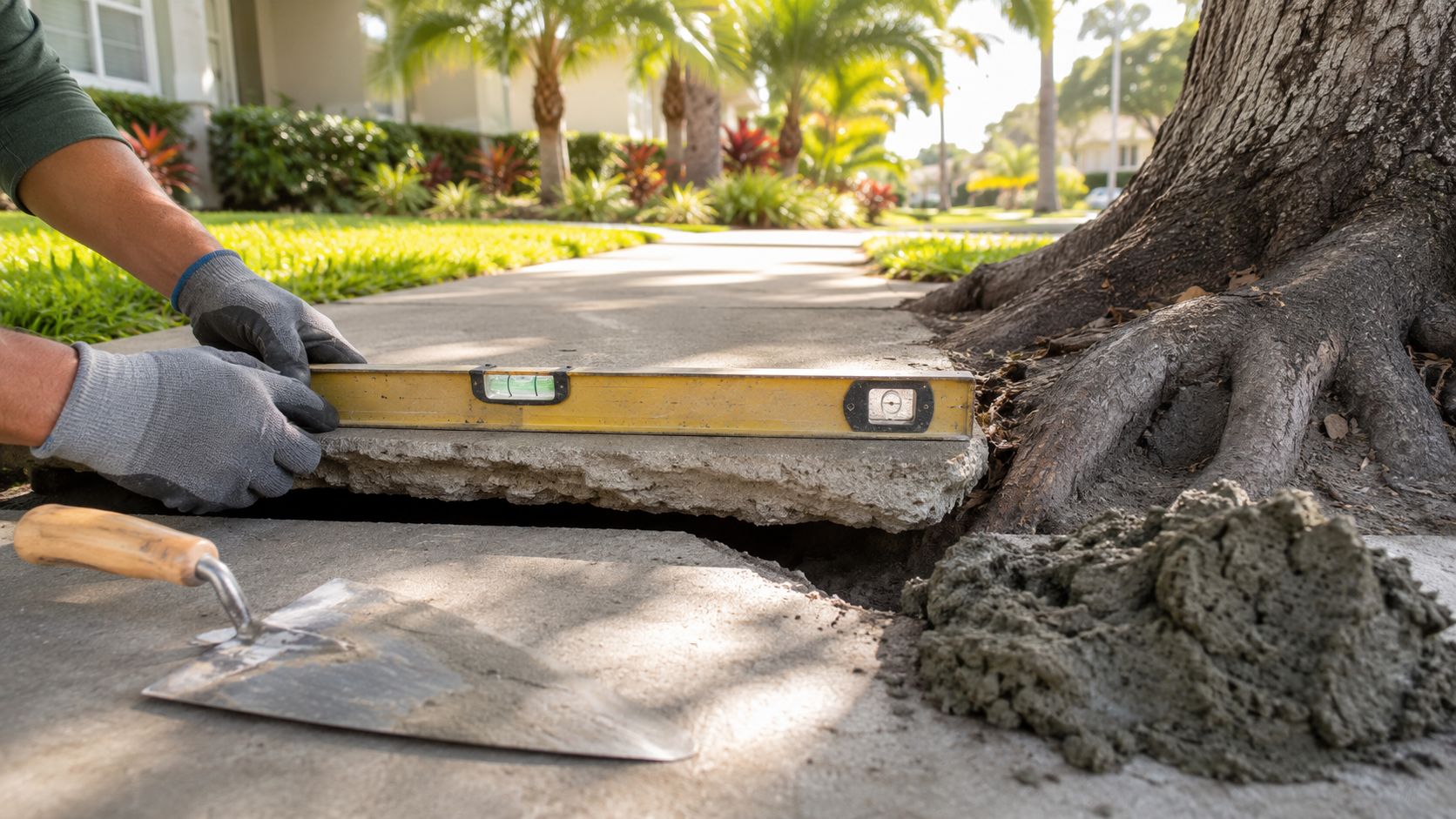
You step outside, look down at the front walk, and one slab is suddenly higher than the next. Maybe it's an old oak near the sidewalk in Ocala. Maybe it's a magnolia by the drive in Crystal River. Either way, the problem feels immediate. Someone can trip, the concrete keeps getting worse, and you don't want to butcher a good tree just to flatten a walkway.
That's the core tension with raised sidewalks in Central Florida. You need a safe surface now, but you also need a fix that won't fail the next time roots thicken, summer rain softens the base, and Florida heat bakes the slab. In Marion County, FL and Citrus County, FL, that combination shows up all the time around mature yards in places like Dunnellon, Belleview, Inverness, Homosassa, and The Villages.
If you're trying to repair sidewalk raised tree roots damage, the right answer depends on what moved, how severe the lift is, and whether the path is private, shared, or subject to accessibility rules. Some repairs are fine as temporary safety fixes. Some are a waste of money. Some protect both the sidewalk and the tree.
Table of Contents
- The Problem with Buckled Sidewalks in Florida Yards
- Assessing the Damage and Your Repair Options
- Executing a Permanent Sidewalk Repair
- Smart Root Management to Protect Your Tree and Sidewalk
- Permits and ADA Rules in Marion and Citrus County
- Why a Professional Concrete Contractor Is Your Best Investment
- Frequently Asked Questions About Sidewalk Repair
The Problem with Buckled Sidewalks in Florida Yards
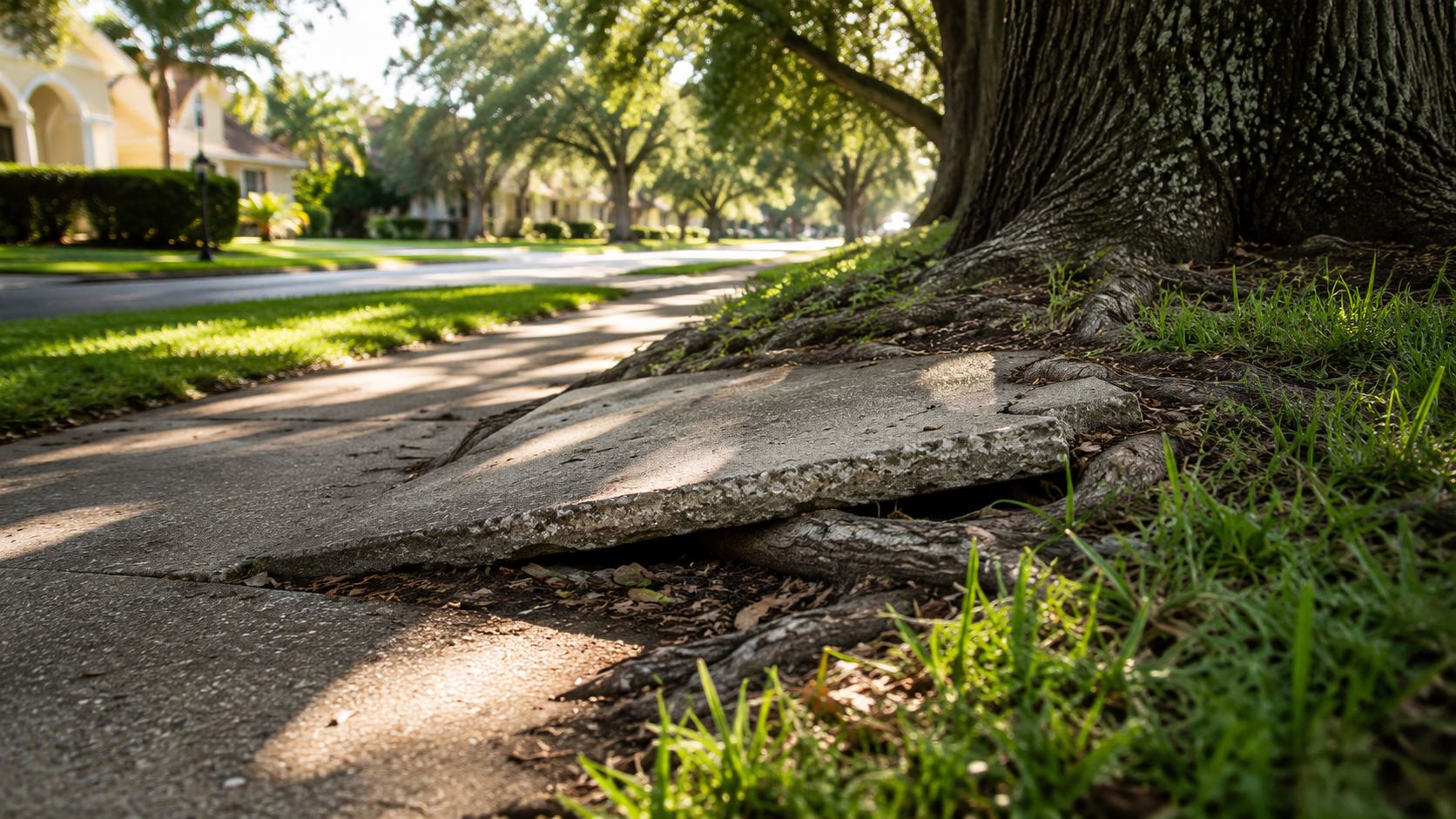
A raised sidewalk usually doesn't start with a dramatic break. It starts with a slight hump, a tiny offset between slabs, or a hairline crack near a tree line. Then one rainy season and one stretch of heat later, the slab becomes a trip hazard.
That's common across Central Florida neighborhoods with mature trees. In places like Silver Springs, Summerfield, and Beverly Hills, older outdoor environments were often planned for shade first and hardscape clearance second. Years later, the roots win. The sidewalk lifts, the edge sharpens, and homeowners are left deciding whether to grind it, patch it, or replace it.
What you can spot on your own
Walk the full length of the sidewalk and look for these signs:
- Vertical lift at a joint where one slab sits higher than the next
- Cracks radiating from the center or corner of the panel
- Surface roots or mounding soil beside the concrete
- Water holding near the slab after rain, which can soften support under the walk
- Crumbling edges that tell you the slab isn't only lifted, it's also breaking down
A lot of homeowners first notice the same warning signs they see in driveways. If the concrete around your home is showing similar movement, this guide on why driveways start cracking helps connect the dots.
Practical rule: If the slab is only ugly, you have options. If it's a trip point, it needs attention now.
The tricky part is that tree-root sidewalk damage isn't just a concrete problem. It's a soil problem, a root-growth problem, and sometimes a permit problem too. That's why the best repair in Ocala might be different from the best repair in Crystal River, even when both sidewalks look similar at first glance.
Assessing the Damage and Your Repair Options
Not every raised slab needs the same repair. Some sidewalks can be made safe with a surface correction. Others are too far gone, especially when the panel is cracked through, rocking underfoot, or still being pushed from below.
What to check before you choose a fix
Before spending money, look at the sidewalk like a contractor would.
- Check the lift pattern. Is one edge slightly proud, or is the whole panel humped?
- Check the concrete condition. A solid slab with one raised lip is different from a slab that's fractured and spalling.
- Check nearby roots. If thick roots are visible near the path, the problem likely isn't finished growing.
- Check drainage. Water washing under the slab can turn a root issue into a base failure too.
- Check who uses the walk. A private garden path has different tolerance than a front entry walk, HOA sidewalk, church path, or public-facing route.
Homeowners in Dunnellon or Belleview can usually sort their situation into one of three buckets. First, a temporary safety fix where the goal is to remove the trip hazard fast. Second, a cosmetic or limited correction where the slab still has life left. Third, a permanent repair where the concrete and root conflict both need to be addressed.
If the slab is cracked, tilted, and still under root pressure, patching the surface only hides the problem for a while.
Sidewalk Repair Methods Compared
| Method | Best For | Est. Cost | Longevity | Tree Impact |
|---|---|---|---|---|
| Grinding | Minor height difference at one edge | Varies by site and severity | Temporary to moderate | Low if roots aren't cut |
| Asphalt ramping | Fast trip-hazard reduction | Varies by area and material | Temporary | Low |
| Patching | Small surface defects | Varies by condition | Usually short-term when roots are active | Low |
| Lifting or leveling | Slabs that settled rather than heaved by roots | Varies by access and slab condition | Moderate when root pressure isn't the main driver | Low to moderate |
| Partial concrete replacement | One or two failed panels with localized damage | Varies by layout and prep needs | Strong when root conflict is addressed | Moderate, depends on root handling |
| Full replacement and redesign | Repeated heaving, broken slabs, ongoing root pressure | Higher upfront | Best long-term result | Can be managed carefully with proper planning |
A few plain truths matter here.
Grinding works when the offset is small and the concrete is still structurally sound. It removes the lip, improves safety, and buys time.
Asphalt ramping works for quick hazard control, especially on commercial or HOA properties that need a fast correction while a permanent plan is scheduled.
Patching is usually money poorly spent if the slab is actively being lifted by roots. The patch won't stop the movement underneath.
Lifting methods don't solve root heave well when the pressure is coming up from below. They're more useful when the slab dropped because the base washed out.
Replacement is the contractor-grade fix when you want durability and a cleaner result. That's especially true in Marion County, FL and Citrus County, FL, where heat, rain, and root growth keep stressing weak repairs.
Executing a Permanent Sidewalk Repair
Permanent sidewalk repair means more than pouring new concrete in the same footprint and hoping for the best. If the root conflict isn't handled correctly, the new slab can end up in the same shape later.
Near the start of any replacement project, the workmanship should be obvious.
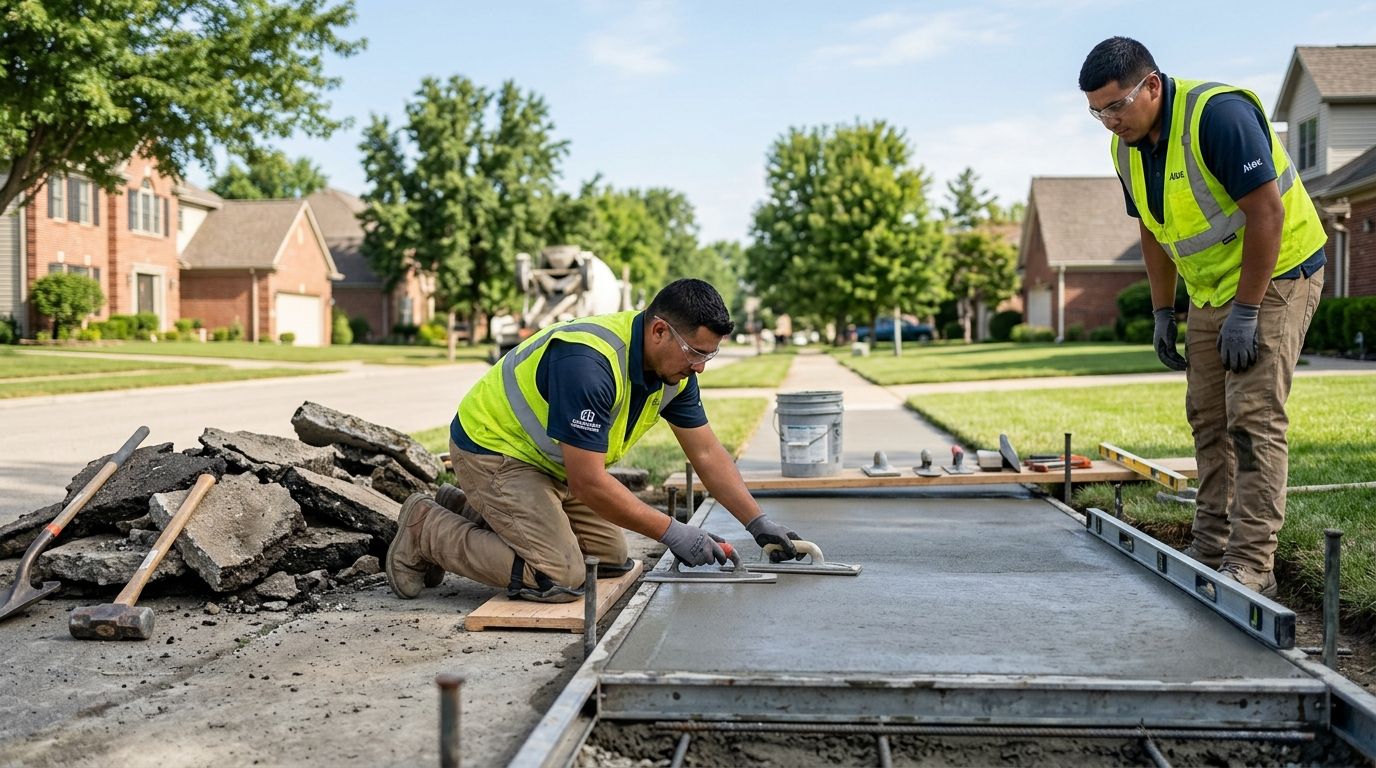
What a quality replacement actually includes
A good crew starts by removing only what needs to come out. That might be one panel, several panels, or a full run of sidewalk if the movement has traveled beyond the original crack.
Then comes the part homeowners don't always see. The crew evaluates the root location, the subgrade, drainage around the walk, and whether the path should stay in the same line. In many cases, the best permanent repair is not a simple replacement. It's a replacement plus redesign.
If you're comparing repair methods for uneven slabs in general, this guide on how to fix uneven concrete slabs is a useful companion.
A durable replacement usually includes:
- Controlled demolition so nearby concrete and roots aren't torn up unnecessarily
- Base preparation that removes loose material and supports the new slab evenly
- Forming and grading for proper drainage and a smooth walking surface
- Concrete placement and finishing that matches the use of the sidewalk, whether residential or shared-access
- Joint layout that helps manage future movement
New concrete is only as good as the prep under it and the decisions made around the roots.
Here's a quick look at a sidewalk repair process in action:
When partial replacement works better than a full tear-out
A full replacement isn't always necessary. If one slab is lifted but the adjacent panels are still sound, a partial replacement can make sense. That's often the practical choice in Lecanto, Inverness, or Homosassa when the damage is isolated and the existing sidewalk line still works.
But partial replacement only holds up if the contractor checks what's happening beyond the broken panel. If the next slab is already under pressure, stopping short may leave you with a fresh section tied to failing concrete.
For Central Florida homes, the best permanent repairs usually share three traits. They account for moisture movement in the base, they respect the tree instead of hacking through major roots, and they build the new section for long-term strength rather than minimum thickness and quick turnover.
Smart Root Management to Protect Your Tree and Sidewalk
A common Central Florida call goes like this. One panel near a live oak gets replaced, it looks good for a season, then the new concrete starts tenting again. The slab was not the problem. The root path was.
Most repeat failures happen because the repair stayed in the same line and nobody made a solid plan for the tree. In Ocala, Crystal River, and nearby neighborhoods, that matters more than many homeowners expect. Sandy soils, fast-growing shade trees, and long wet periods followed by dry stretches all affect how roots travel under a walk.
Why root cutting usually backfires
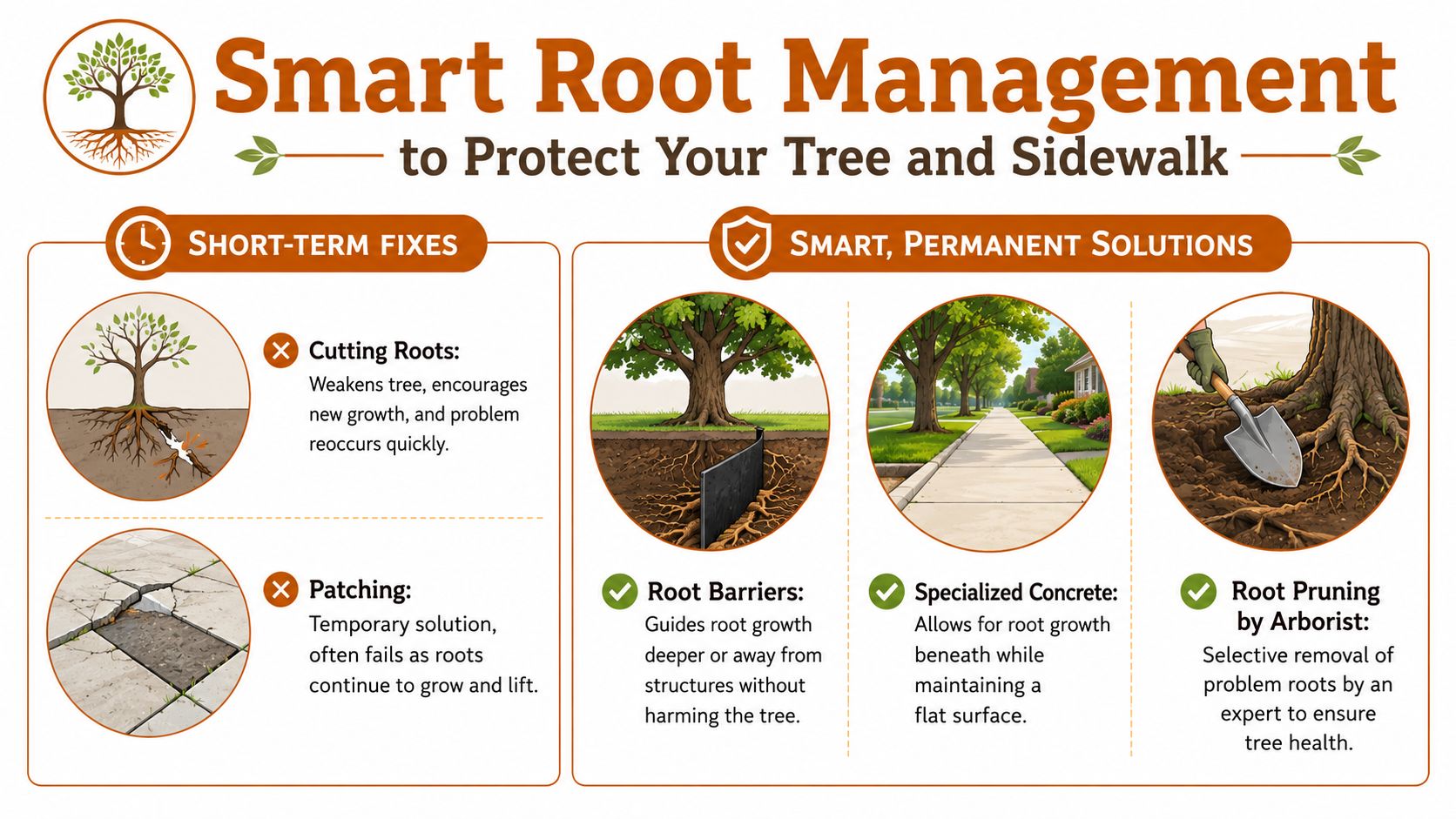
Cutting roots is the fastest way to make a sidewalk sit flat again, but it is often a poor long-term bet.
The basic problem is simple. Mature trees need those roots for support and water uptake, and the same species that cause trouble in Florida yards, especially live oak, laurel oak, and some large maples, do not respond well to aggressive pruning near the trunk. If the lifted slab sits close to a major root flare, cutting first and pouring second can trade one problem for two. The sidewalk may move again, and the tree can become less stable in storms.
Guidance summarized by Shade Tree Expert on sidewalks and tree roots also notes that roots often return under sidewalks after cutting, larger roots should be treated cautiously, and rerouting the walk or building with a thicker reinforced section can outperform a simple cut-and-replace approach.
That is the part homeowners miss. A big surface root is often structural, not incidental.
What tends to hold up better in Marion and Citrus counties
The best option depends on the tree, the amount of lift, and how much room the site gives you. There is no one repair that fits every yard.
- Shift the sidewalk route if space allows. This is usually the longest-lasting fix for large established trees. On wider lots in Marion County, rerouting a few feet can save the tree and stop the repeat repair cycle.
- Use a thicker, reinforced replacement slab. A stronger section can bridge minor root pressure better than a basic residential pour. This is often the practical middle-ground when the walk must stay in roughly the same location.
- Add a root-friendly base under the slab. In Florida soils, base material matters. A setup that gives roots room to travel lower can reduce future surface pressure.
- Prune roots selectively, not aggressively. If pruning is part of the repair, it should be limited and based on tree health, root size, and distance from the trunk. This is usually arborist territory, not handyman work.
- Consider grinding for very small offsets. If the lift is minor and the slab is otherwise sound, grinding can remove the trip edge without disturbing the tree. It is not a cure for active root growth, but it can buy time.
I tell homeowners to compare cost over ten years, not cost on repair day. A cheap cut-and-pour can be the most expensive option if it has to be redone.
Another trade-off is access. If the walk serves an older homeowner, a wheelchair user, or a route guests use regularly, the repair has to stay safe, not just look clean. That is where ADA sidewalk slope and access requirements start to matter, even on projects that seem straightforward at first.
For a small ornamental tree, selective root work may be reasonable. For a mature live oak close to the house, I would rather reroute the walk or redesign the section than gamble with the tree. In Central Florida, the smart money usually goes to the repair that respects both the root system and the way the property is used.
Permits and ADA Rules in Marion and Citrus County
You tear out a lifted panel in Ocala, pour it back the next day, and then find out the cracked section was partly in the county right-of-way. That mistake gets expensive fast. Around Marion and Citrus County, the concrete work is only part of the job. Property lines, access routes, and tree protections can change what you are allowed to do.
On a private sidewalk that stays fully on your lot, the rules are usually simpler. Once the repair reaches the public side of the property line, affects a shared entrance, or sits near utilities, stop and verify the requirements with the city or county before any demolition starts. That matters in Ocala, Crystal River, Inverness, Beverly Hills, Homosassa, and Lecanto because local review can vary depending on whether the walk is in a municipal area, an unincorporated county area, or tied to an HOA or commercial parcel.
Central Florida adds another layer. Live oaks, laurel oaks, and mature shade trees often sit close to sidewalks because older subdivisions were built that way. In Marion County, sandy soil can wash out under slab edges and make a repair look worse than the root issue alone. In Citrus County, shallow root spread and drainage patterns can create the same trip hazard again if the work only replaces concrete and ignores the setting. A permit question and a repair-method question often show up together.
The other place owners get caught is access compliance. If the sidewalk serves a business, church, rental property, HOA common area, or any route the public uses regularly, the repair needs to do more than remove the obvious lip. Slope, cross slope, transitions, and surface consistency all matter. Review these ADA sidewalk slope and access requirements before signing off on the work.
Use this checklist before approving any repair:
- Confirm ownership of the damaged section. Do not assume the walk is private just because it is near your yard.
- Check whether the path is part of a public or shared access route. That changes the standard for the finished surface.
- Ask whether root cutting needs separate approval. On some sites, tree work creates more risk than the concrete replacement.
- Verify final grades before the pour. A panel can look clean and still fail for slope or transition.
- Document the existing condition. Photos help if there is a dispute about the tree, the right-of-way, or who was responsible for the damage.
For homeowners, the practical rule is simple. If the repair is near the street, near utilities, or serves anyone beyond your household, make the calls first. For commercial and HOA properties in Marion and Citrus counties, permit review and access compliance should be part of the scope from day one, not something handled after the concrete cures.
Why a Professional Concrete Contractor Is Your Best Investment
Tree-root sidewalk repair looks deceptively simple from the curb. Break out the bad slab, pour new concrete, and call it fixed. That approach is exactly why so many repairs don't last.
A contractor who works with this kind of damage regularly knows what to watch for. The issue may be active root pressure, washed-out base material, poor drainage, weak slab design, or a mix of all of them. If the diagnosis is wrong, the repair won't hold.
DIY work also creates avoidable risk. Homeowners can cut the wrong root, leave a new trip edge, pour a panel that doesn't drain properly, or create a path that's out of tolerance for shared-use access. On commercial and HOA properties, those mistakes can turn into ongoing maintenance calls and liability concerns.
Concrete and Asphalt Experts in Marion and Citrus County should be able to handle the whole picture, not just the pour. That means understanding site prep, sidewalk replacement, surface transitions, and how adjacent pavement maintenance ties into the same property.
The right crew should also bring the basics that matter more than slogans:
- Licensed and insured
- Local Central Florida experience
- Reliable scheduling
- High-quality workmanship
- Clear recommendations instead of pressure
If you own property in Marion County, FL or Citrus County, FL, the value of hiring a pro is simple. You get a repair plan that fits the tree, the sidewalk, and the site, instead of a generic fix that has to be redone.
Frequently Asked Questions About Sidewalk Repair
A few questions come up on almost every raised-sidewalk call, especially from homeowners in Silver Springs, Hernando, and nearby communities dealing with mature trees.
FAQ
| Question | Answer |
|---|---|
| Can I just grind down the raised edge and leave the rest alone? | Yes, if the height difference is minor and the slab is otherwise sound. Grinding improves safety, but it doesn't stop ongoing root growth underneath. |
| Is cutting the root the best permanent fix? | Usually not. Guidance summarized earlier shows root cutting is often temporary, and larger roots can affect tree stability and health. |
| Should I replace only one slab or the whole sidewalk? | It depends on how far the movement has spread. If adjacent panels are solid and not under pressure, one-slab replacement may work. If nearby slabs are already lifting or cracking, a larger repair is smarter. |
| Do sidewalks in front of businesses or HOA property need ADA consideration? | Yes. Any public-facing or shared-access route should be reviewed for accessibility, including smooth transitions and safe walking surfaces. |
| When should I call a contractor instead of trying a quick fix myself? | Call a pro when the slab is cracked through, the lift is obvious, the route is heavily used, roots are exposed, or the work may involve permits or accessibility concerns. |
A raised sidewalk is usually fixable, but the method matters. Temporary repairs can make sense for short-term safety. Lasting repairs usually require better slab design, smarter root management, and clean execution on site.
If you need a practical plan for a raised sidewalk, Riverside Sealing & Striping, LLC offers free estimates and no-pressure consultations for concrete and pavement issues across Central Florida. As Concrete and Asphalt Experts in Marion and Citrus County, the team helps homeowners, HOAs, and commercial property owners in Ocala, Dunnellon, Crystal River, Inverness, and surrounding areas evaluate the damage, understand the trade-offs, and choose a repair that's built for Florida conditions.