
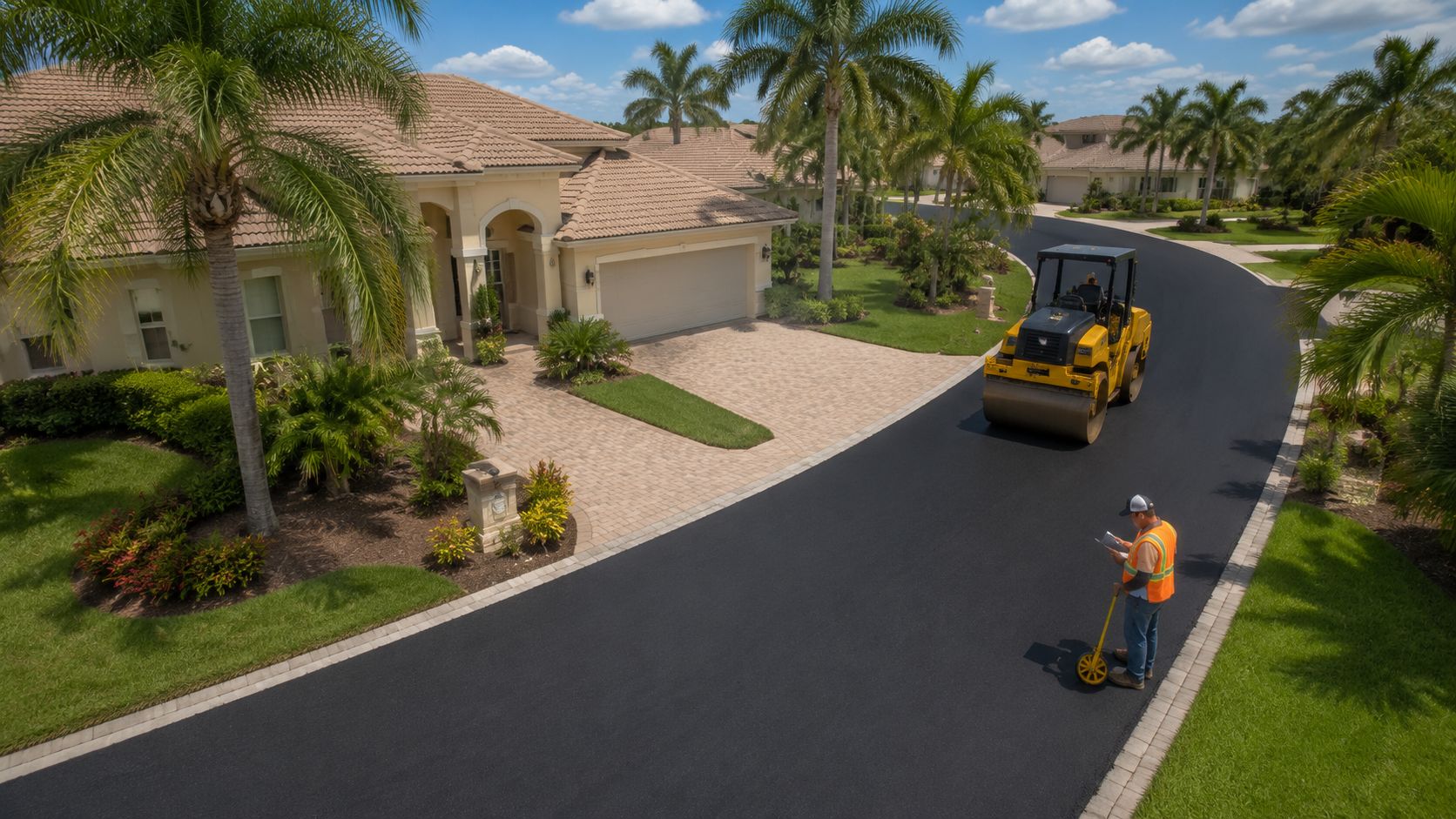
You're probably in the same spot a lot of Central Florida property owners hit every year. The driveway is cracking, the parking lot edge is breaking down, or a new build in Ocala, Dunnellon, or Inverness needs pavement fast, and now you're comparing bids that don't explain much beyond a price. That's where most paving mistakes start.
If you're researching Seminole Asphalt Paving or comparing any local contractor, don't focus on the surface alone. Focus on site prep, drainage, permit details, and whether the material fits Florida conditions. In Marion County, FL and Citrus County, FL, heat, UV exposure, summer rain, and traffic punish weak paving work quickly.
As a starting point, asphalt is usually the cheaper install. In Florida's hot climate, asphalt driveways typically cost $3 to $6 per square foot installed, while concrete typically costs $5 to $10 per square foot and lasts significantly longer according to this Florida driveway paving cost guide. Lower upfront cost matters, but it's only a bargain if the base, drainage, and maintenance plan are right.
Table of Contents
- Introduction to Local Asphalt Paving Projects
- Assess Site Needs and Conditions
- Choose Materials and Consider Climate Impacts
- Prepare Schedule Permits and Budget
- Select a Qualified Contractor with Inspection Checklist
- Sealcoat and Maintain Pavement Over Time
- Conclusion and Next Steps
Introduction to Local Asphalt Paving Projects
A homeowner in Belleview wants a fresh driveway before the rainy season. A property manager in Dunnellon needs a cleaner, safer lot before tenants start complaining about puddles and faded striping. Both jobs sound simple until the essential questions show up. Is the base stable, will the apron meet code, and is asphalt even the smart material for that location?
That's the value in looking closely at companies tied to Seminole Asphalt Paving searches or similar local providers. You're not just buying blacktop. You're buying grading, compaction, transitions at the road, and a maintenance burden that's very different from concrete.
For homeowners in Silver Springs, Summerfield, and The Villages, the biggest mistake is choosing by price before confirming scope. For commercial sites in Crystal River, Homosassa, or Lecanto, the bigger mistake is ignoring traffic patterns and striping compliance until after the pavement is down.
Practical rule: If a contractor can't explain drainage, compaction, and permit responsibility in plain language, keep shopping.
Central Florida pavement often fails from underneath as frequently as it fails on top. Sun cooks asphalt, rain finds weak edges, and heavy turning traffic shoves material where the base is soft. Smart planning avoids expensive do-overs and keeps your project aligned with the broader goal every owner should want: work built for local conditions by Concrete and Asphalt Experts in Marion and Citrus County.
Assess Site Needs and Conditions
Before you compare paving materials or contractor proposals, walk the site like an inspector, not an owner. If you skip this step, you'll end up paying for surprises after the crew arrives.
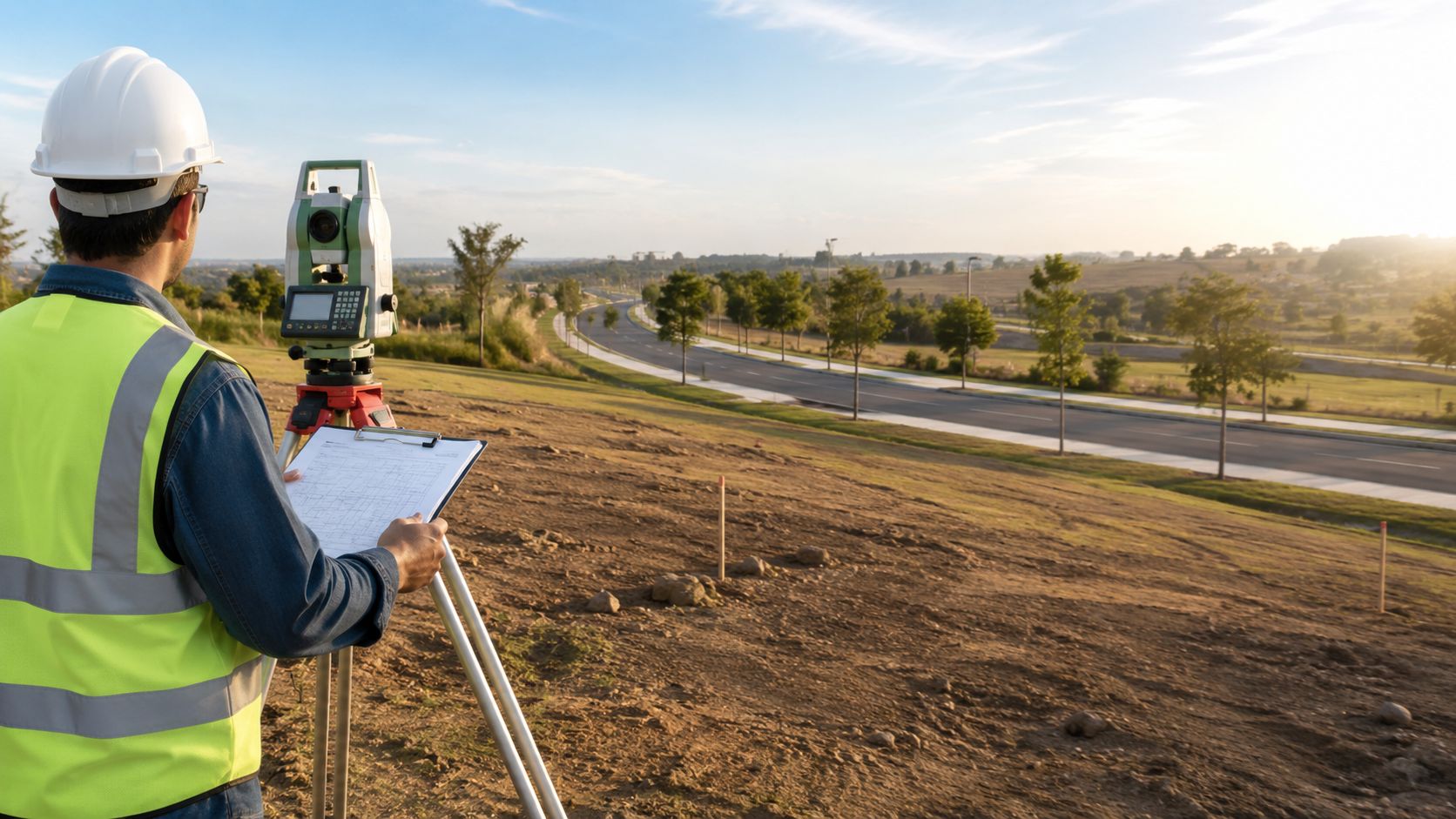
Start with measurements and traffic use
Get the footprint right first. Measure length, width, tie-in points, apron area, and any places where cars will turn sharply or park repeatedly. A narrow residential drive in Belleview has different demands than a church lot in Ocala or a small retail strip in Beverly Hills.
Then define actual use, not ideal use.
- Daily traffic: Is this a light residential driveway, an HOA common area, or a commercial lot with delivery vehicles?
- Turning pressure: Tight turns at entrances and dumpster pads beat up asphalt faster than straight travel lanes.
- Edge exposure: Pavement edges that drop into grass or soft shoulders need more attention than fully confined areas.
If the existing surface is failing, compare whether an overlay is realistic or whether full removal is the honest answer. This overview of asphalt overlay versus replacement is worth reviewing before you accept a shortcut bid.
Check drainage before you choose materials
Drainage decides whether a paving job lasts. Stand on the site after a hard rain if you can. If water sits near the garage, the road tie-in, or the center of a parking area, fix the grading plan before anyone talks about finish appearance.
Watch for these warning signs:
- Ponding areas: Water that lingers usually means slope problems or base settlement.
- Runoff toward structures: That's a property damage issue, not just a paving issue.
- Road shoulder mismatch: If the new pavement sits awkwardly against the street, the apron transition may fail early.
Water doesn't care how good the asphalt looks on day one. It goes straight to the weak spot in the base.
Inspect the base, not just the surface
A clean topcoat won't save a bad foundation. Look for tree roots, soft spots, pumping soil, broken utility trench patches, and areas where old pavement has sunk. Those are clues that the subgrade needs correction, not cosmetic work.
For structural integrity, backfill in bedding zones must be placed in 12-inch layers and compacted to at least 95% maximum density as determined by AASHTO T-180, according to the Seminole Improvement District construction manual. If a contractor shrugs at compaction standards, that's a problem.
Homeowners and managers should think bigger than asphalt alone. Some sites in Marion County, FL or Citrus County, FL need selective concrete work at aprons, sidewalks, or dumpster pads because those areas take punishment that asphalt doesn't always handle as well. That's why the best local contractors are Concrete and Asphalt Experts in Marion and Citrus County, not one-material salesmen.
Choose Materials and Consider Climate Impacts
Material choice in Central Florida isn't just a cost decision. It's a heat, UV, rain, and maintenance decision.
Asphalt versus concrete in Central Florida
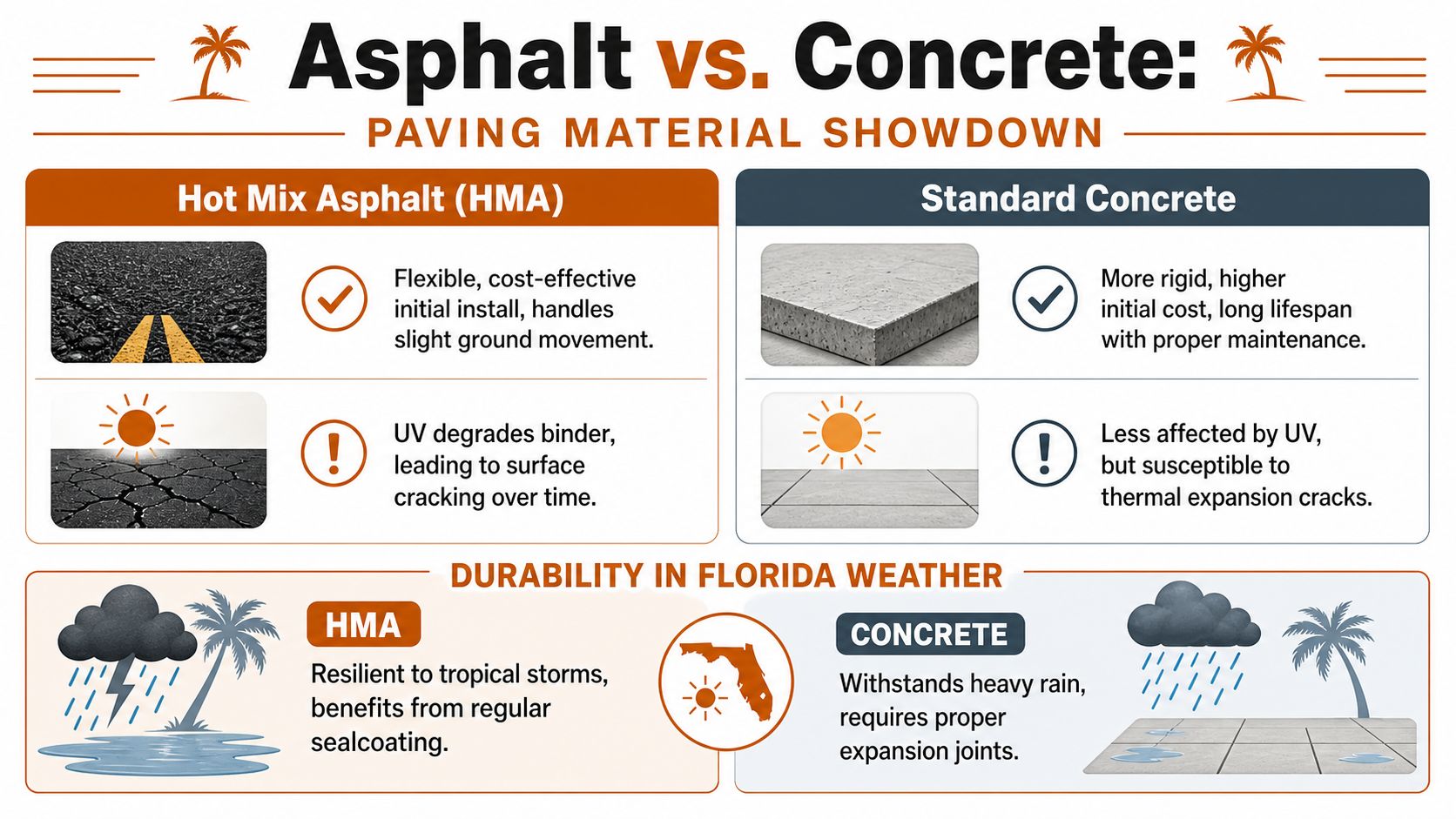
Here's the blunt version. Asphalt is usually the faster and cheaper install. Concrete usually wins on long-term rigidity and heat tolerance. Neither is perfect.
| Material | Best fit | Main trade-off |
|---|---|---|
| Hot Mix Asphalt | Driveways, parking lots, resurfacing projects, areas where lower upfront cost matters | More vulnerable to UV aging and ongoing maintenance |
| Concrete | Driveways, aprons, sidewalks, patios, and locations where longer service life matters most | Higher initial cost and less forgiving if the base moves |
In Crystal River, Hernando, and Inverness, owners often lean asphalt for affordability on larger areas. In places where apron stress, sidewalk durability, or curb appeal matter more, concrete often makes more sense. For mixed-use properties, the smartest answer is sometimes both. Concrete where loads and edges are toughest, asphalt where broad surface coverage is more efficient.
If you want a quick technical primer, review what hot mix asphalt is and how it performs.
Why asphalt installation timing matters
Asphalt performance depends heavily on how it's compacted on site. This isn't a cosmetic issue. It's one of the biggest quality separators between crews.
According to the California DOT construction manual section on asphalt concrete, Hot Mix Asphalt compaction must be completed before the mix temperature drops to 185°F. If crews miss that window during breakdown and intermediate rolling, density suffers, which can lead to premature raveling, moisture infiltration, reduced pavement life, and up to 30% lower long-term durability.
Field advice: When asphalt is cooling too fast, the crew has to move like a crew that planned the job, not like one that just showed up.
Florida climate pushes this decision too. UV exposure is hard on asphalt binders. Concrete handles heat better but still needs proper jointing and base prep. For homeowners in The Villages or Lecanto, that usually means deciding whether you want lower upfront cost or lower maintenance pressure over time.
The right answer depends on the site, the traffic, and whether the contractor is honest about trade-offs.
Prepare Schedule Permits and Budget
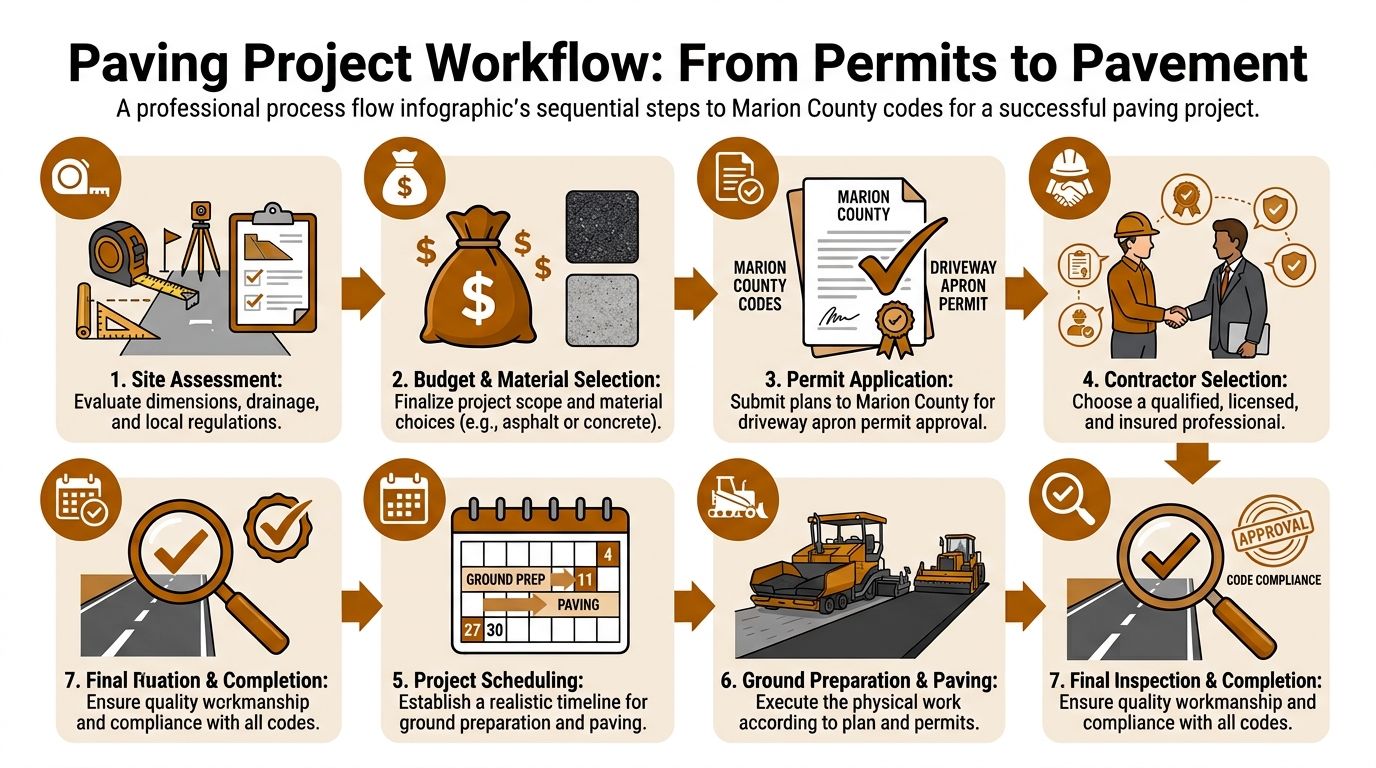
The hidden costs in paving usually come from three things. Permit surprises, extra base repair, and weather delays. Most owners don't get burned because paving is complicated. They get burned because nobody explained the workflow.
Know the apron rules before work starts
If your driveway connects to a paved county road in Marion County, don't assume the apron is a simple add-on. The county requirements shape the job from the start.
The Marion County driveway apron guidance states that residential driveway aprons connecting to paved county roads must be at least 5 feet long from the road edge, made exclusively of concrete or asphalt, and 6 inches thick, with proper flares for turning radius. The same guidance also specifies that for a minimum 12-foot-wide driveway, the apron must be 12 feet wide on the property side and flare to 22 feet at the road edge with 5-foot flares on the road side.
That's where a lot of low bids fall apart. The quote may cover “driveway paving” but not the apron geometry, permit handling, or extra excavation needed to hit the required thickness.
Common permit-related pitfalls include:
- Missing apron details: If the sketch doesn't show flare requirements, expect revisions.
- Wrong material assumptions: Decorative gravel or pavers won't satisfy apron rules where concrete or asphalt is required.
- Incomplete scope: Some bids exclude permit coordination, inspections, or shoulder restoration.
Build a schedule that respects Florida weather
A good paving calendar doesn't pretend weather won't interfere. It builds around that fact. In Summerfield, Silver Springs, Crystal River, and Homosassa, rain can wreck prep work, soften exposed subgrade, and delay paving windows.
Use this sequence:
- Lock site layout first. Finalize dimensions, tie-ins, drainage path, and traffic use.
- Confirm permit responsibility. Get in writing who handles submittals and revisions.
- Schedule demolition and grading with weather flexibility. Don't trap yourself with a rigid timeline.
- Pave only when the site is ready. Fast turnaround is good. Rushed prep is not.
A short visual overview helps if you're planning your own timeline:
Budget for the work you actually need
The cheapest paving proposal often leaves out the expensive parts. Base correction, root removal, edge support, striping, drainage adjustments, and apron compliance all affect final cost even when the square footage looks straightforward.
Use a checklist when reviewing bids:
- Surface removal: Does the price include haul-off of failed pavement or concrete?
- Base repair: Is unstable soil addressed or ignored?
- Transitions and edges: Are road tie-ins, garage thresholds, and shoulders included?
- Finish work: If it's a commercial site, is striping part of the project or a separate line item?
- Material match: Are high-stress areas better served by concrete than asphalt?
For owners in Marion County, FL and Citrus County, FL, the smartest budget move is simple. Spend on prep and compliance before you spend on appearance. A neat finish on a weak base is money wasted.
Select a Qualified Contractor with Inspection Checklist
A paving contractor should make your project clearer, not murkier. If the estimate meeting leaves you with more confusion than answers, that contractor isn't ready.
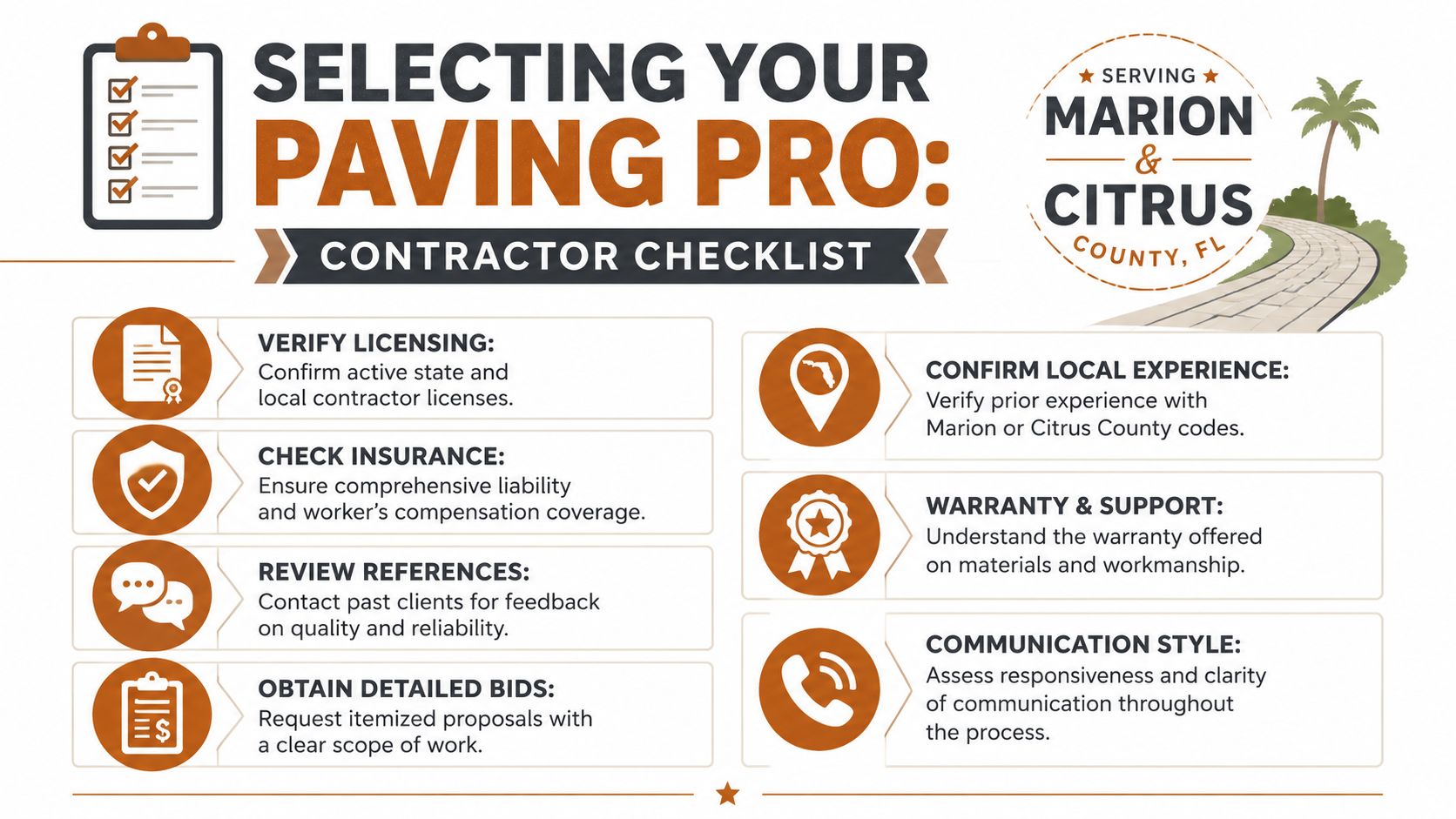
What to verify before you sign anything
Start with the basics. You want a contractor who is licensed and insured, has local Central Florida experience, gives reliable scheduling, and can explain the work without hiding behind vague language. That matters whether you're in Ocala, Dunnellon, Lecanto, or Beverly Hills.
If you're evaluating a company associated with Seminole Asphalt Paving, know that Seminole Asphalt Paving, Inc. is a privately held commercial asphalt paving company headquartered in Sanford, Florida, with $7.9 million annual revenue reported in 2025 and a service portfolio that includes asphalt paving, asphalt repair, seal coating, pavement maintenance, and ADA-compliant striping according to this company profile summary. That tells you they operate in the commercial paving space. It doesn't replace your own vetting.
Use this checklist:
- Licensing and insurance: Ask for proof, not promises.
- Local code familiarity: Marion and Citrus rules matter. Generic Florida experience isn't enough.
- Compaction knowledge: Ask how they verify base prep and density.
- ADA striping experience: Essential for commercial lots, churches, schools, and HOAs.
- Detailed scope: Demand itemized work, not a lump-sum mystery number.
For another example of how contractor credentials and project fit can be presented, review this local paving contractor page.
Questions that expose weak bids fast
Ask direct questions and listen for direct answers.
Hire the contractor who answers hard questions without getting defensive.
Try these:
- What part of the site worries you most?
- Are you planning full removal, base repair, or an overlay?
- Who is responsible for permits and inspections?
- How will you handle drainage at the road and structure transitions?
- Where would you recommend concrete instead of asphalt?
- For commercial work, how do you address ADA-compliant striping and markings?
The best contractor won't try to “win” every material discussion. They'll tell you when asphalt makes sense and when concrete is the better call. That's what Concrete and Asphalt Experts in Marion and Citrus County sound like in real life.
Sealcoat and Maintain Pavement Over Time
A new asphalt surface isn't a one-and-done asset. If you ignore it, Florida will age it quickly. Sun oxidizes the binder, rain works into weak spots, and traffic starts breaking edges and turning areas first.
Don't sealcoat too early
A lot of owners get bad advice here. They're told to seal immediately or on a rigid annual schedule. That's not sound guidance for every property.
The Asphalt Institute engineering FAQs state that well-constructed low-traffic pavements typically do not require seal coating for 2 to 5 years, depending on climate severity and original work quality. Premature sealing can create unnecessary maintenance costs.
That means homeowners in Citrus County, FL and Marion County, FL should stop treating sealcoating like an automatic first-year expense. If the pavement is well built and lightly used, wait until the surface condition justifies it.
A practical maintenance routine for owners and managers
The right schedule depends on traffic and exposure, but the logic stays the same. Inspect often, repair early, and stripe before the site looks neglected.
For residential asphalt:
- Watch the color shift: Fading from rich black to dull gray is an early aging sign.
- Check edges after storms: Edge breakdown often starts before center-lane cracking.
- Fill isolated cracks early: Small defects are cheaper to correct than widespread surface failure.
For commercial and HOA properties in Hernando, Inverness, and Crystal River:
- Inspect high-turn areas: Entrances, loading areas, and dumpster approaches fail first.
- Maintain striping visibility: Parking stalls, directional arrows, and ADA markings are part of safety, not decoration.
- Pair maintenance with a site review: If drainage or base movement is causing repeat damage, sealing alone won't fix it.
Good maintenance saves money only when it's targeted. Sealing over structural problems just makes the lot look better for a short time.
This is also where full-service thinking matters. Some properties need asphalt sealcoating and parking lot striping. Others need selective concrete work at sidewalks, aprons, or pedestrian routes to hold up better under Florida wear. Owners who plan both together usually avoid the patchwork look that hurts curb appeal and property value.
Conclusion and Next Steps
If you're comparing Seminole asphalt paving options or planning a project anywhere from Ocala to Crystal River, the best move is to slow down before the contract is signed. Measure the site carefully, solve drainage first, confirm local permit requirements, and choose materials based on Florida conditions instead of sales talk.
Good paving work isn't just about asphalt. It's about knowing when concrete is the better choice, when maintenance should wait, and how to spot a weak bid before it becomes your problem. That's why the right contractor should think like one of the true Concrete and Asphalt Experts in Marion and Citrus County.
If you want a local, no-pressure opinion on your driveway, parking lot, sidewalk, apron, or striping project, Riverside Sealing & Striping, LLC offers free estimates and on-site consultations across Marion County, Citrus County, and surrounding Central Florida areas. As a licensed and insured family company based in Dunnellon, Riverside handles both concrete construction and asphalt maintenance, which means you get practical recommendations instead of a one-material sales pitch.