
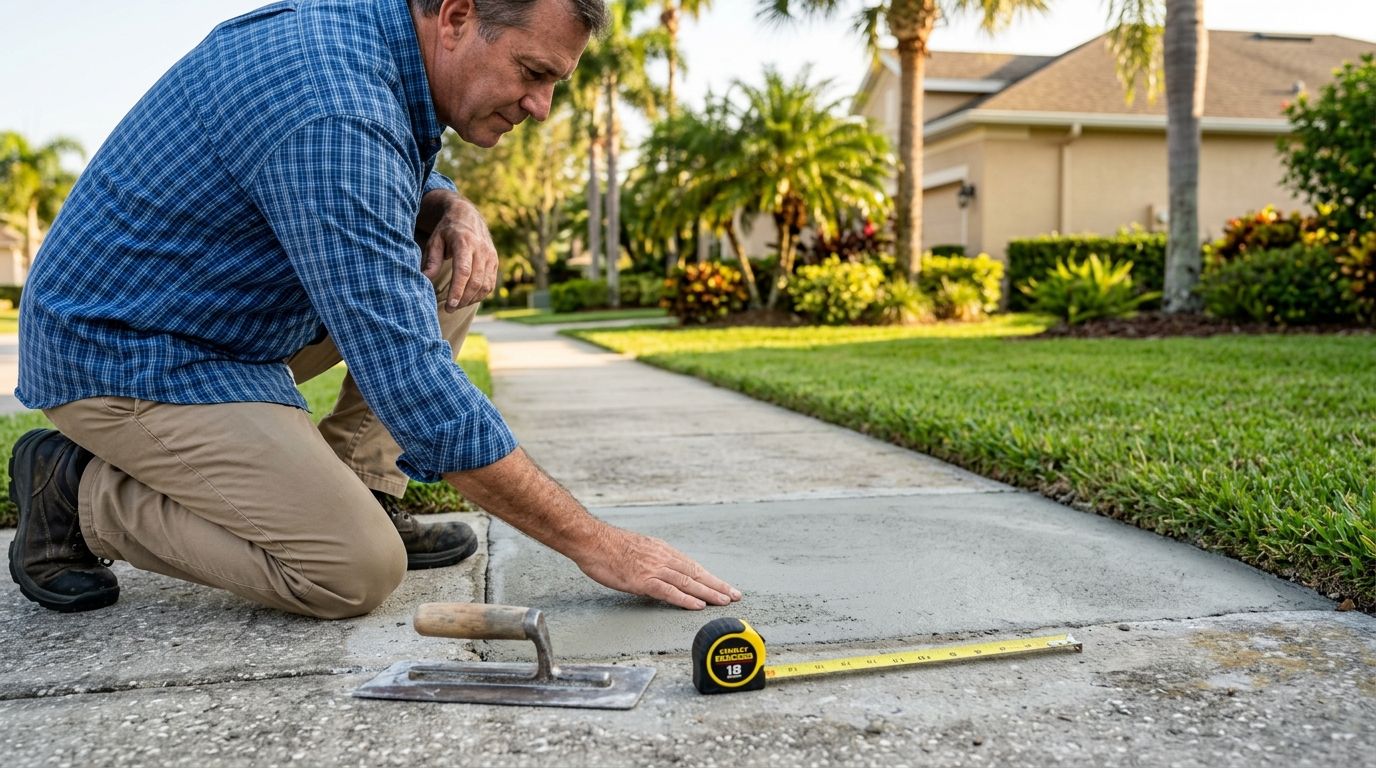
A cracked sidewalk panel rarely starts as a dramatic failure. In Central Florida, a homeowner may first notice a raised edge while walking to the mailbox, a puddle that remains after an afternoon storm, or a crack that catches a stroller wheel. By the time the defect becomes obvious, tree roots, washed-out sand, drainage and repeated heat exposure may already be working together beneath the slab.
For properties in Marion County, FL and Citrus County, FL, sidewalk repair requires more than spreading concrete over the visible damage. The right solution depends on whether the panel has settled, lifted, spalled, cracked from root pressure, or developed a slope that creates an accessibility problem. That decision matters in Ocala, Dunnellon, Belleview, Silver Springs, Summerfield, Crystal River, Homosassa, Inverness, Lecanto, Beverly Hills, Hernando and The Villages, where homes, HOAs, churches and commercial properties often share sidewalks with public rights-of-way.
This guide approaches sidewalk repair like a field inspection. You'll learn how to identify the cause, compare repair methods, understand ownership and permit questions, recognize ADA triggers, and decide when a patch is reasonable and when removal and replacement is the only durable answer.
Table of Contents
- Introduction to Sidewalk Repair in Central Florida
- How to Inspect Your Sidewalk and Diagnose Common Problems
- Comparing Sidewalk Repair Methods and When Each Makes Sense
- Permits Ownership and ADA Requirements in Marion and Citrus County
- DIY vs Professional Sidewalk Repair and Choosing a Contractor
- Maintenance Tips to Extend Sidewalk Life and Prevent Costly Repairs
Introduction to Sidewalk Repair in Central Florida
A lifted sidewalk panel can turn an ordinary walk into a liability concern. The front edge may only look slightly higher than the adjoining slab, but a small change in elevation can catch a shoe, wheelchair caster or cart. In a neighborhood near Ocala or Lecanto, the cause is often an oak or other established tree pushing upward from below. In other cases, heavy rain moves sandy subgrade away from the slab, leaving unsupported sections that settle.
Central Florida concrete faces a demanding combination of heat, ultraviolet exposure, heavy rain, irrigation and root growth. The slab expands during hot weather, receives sudden cooling and saturation during storms, and carries daily foot, bicycle, stroller and golf-cart traffic. The concrete may be sound while the soil beneath it has changed, or the soil may be stable while roots have created enough pressure to lift a panel.
A large sidewalk program shows why the work often includes more than surface restoration. In Los Angeles, the City Controller reported that the city had repaired roughly 2,100 sites, spent more than $122 million by the end of December 2020, repaired over 2.1 million square feet, built 1,372 curb ramps, and issued 3,693 sidewalk certificates of compliance under its sidewalk strategy (Los Angeles City Controller sidewalk audit). The figures also show that sidewalk repair can involve accessibility upgrades and documentation, not merely concrete patching.
Field rule: Fix the reason the panel moved, not just the crack that made you notice it.
A homeowner may need only joint maintenance or a small crack treatment. An HOA may need several panels removed, roots managed and drainage corrected. A store, church or property manager may also need adjacent parking lot striping, accessible routes and pavement maintenance coordinated with the walkway work. Concrete and asphalt serve different purposes, but both affect how safely people move across a property.
By the end of this guide, you should be able to describe the visible defect, identify likely contributing causes, ask better questions about permits and responsibility, and choose between localized repair, leveling, panel replacement or a broader accessibility upgrade.
How to Inspect Your Sidewalk and Diagnose Common Problems
Start with a dry, well-lit walk-through. You'll need a tape measure or ruler, a straightedge such as a level or spare board, a flashlight, and a camera or phone. Don't begin by deciding that every crack needs new concrete. First determine whether the slab moved, lost support, broke apart, or has a joint that needs attention.
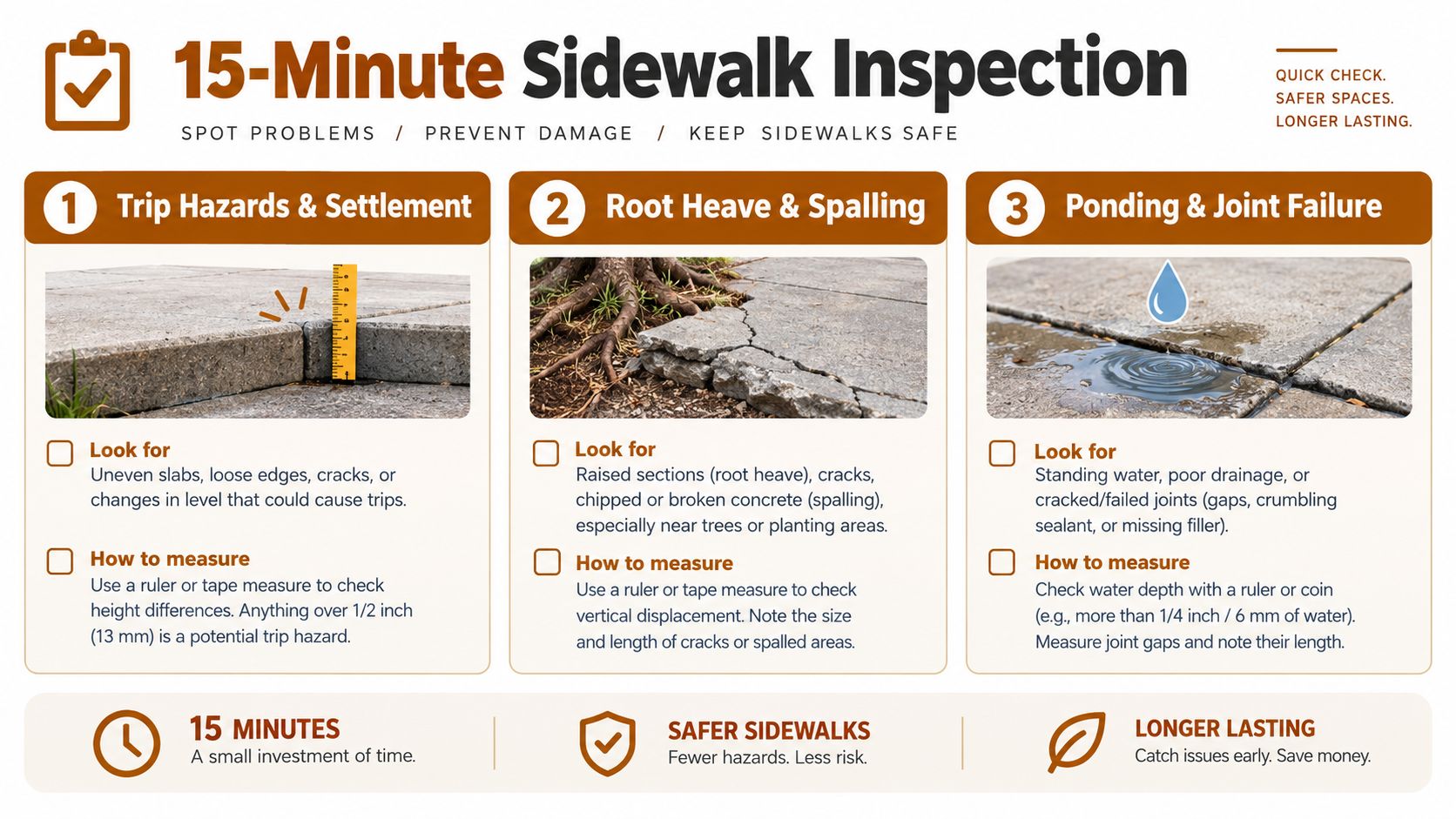
Check trip hazards and settlement
Walk the route slowly in both directions. Look across panel joints rather than only down at the crack. Place a straightedge across a raised or dropped edge and measure the offset with a ruler. A panel that slopes down toward a gap may indicate settlement, while one that rises consistently along a tree line suggests upward pressure.
Look for fresh sand deposits, narrow washout channels or open voids beside the slab after rain. In sandy Central Florida neighborhoods, runoff from a driveway, roof downspout or irrigation spray can carry fine material away from the base. A settled panel may remain structurally intact, but it can still create a trip hazard or hold water.
Separate root heave from surface deterioration
Roots often lift a panel in a broad, gradual curve. The slab may remain relatively solid, with the highest point closer to a tree or established hedge. Ocala, Silver Springs and Lecanto properties with mature oaks can show this pattern, especially where roots have grown beneath a narrow walk.
Spalling looks different. The surface flakes, chips or exposes coarse aggregate, often near edges and joints. Use the flashlight to see whether deterioration is shallow or whether the concrete has broken through its depth. Tap questionable areas lightly with a hammer handle and listen for a hollow sound, but don't mistake a surface blemish for a stable slab if water and freeze-thaw damage are not the main local concern.
Test drainage, joints and slope
After a storm, inspect the low side of each panel. Ponding can result from settlement, a blocked drainage path, an incorrect cross slope or a joint that has opened enough to admit water. A broken or missing expansion material can let adjoining slabs move independently and damage the edges.
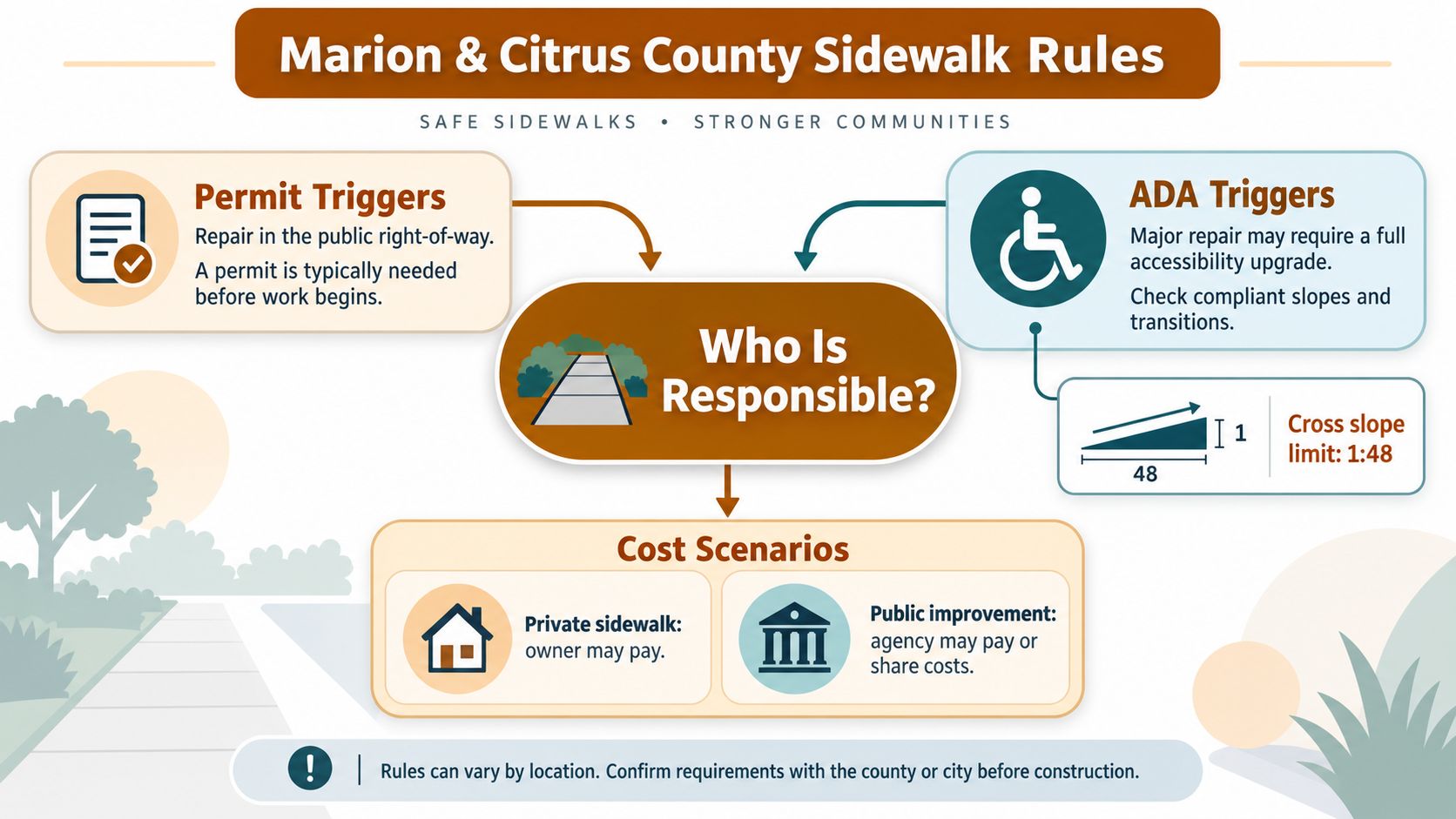
A sidewalk can be structurally sound and still create an accessibility problem if it pitches too steeply or drains the wrong way. The U.S. Access Board identifies a maximum accessible walking-surface cross slope of 1:48, about 2%, and a running slope limit of 1:20, or 5%, before ramp rules apply (ADA accessibility standards from the U.S. Access Board).
For a more detailed response to lifted panels, compare the observations with this guide to sidewalk repair around raised tree roots. Record photographs, measurements and nearby drainage or landscaping conditions. That record helps a contractor distinguish a cosmetic crack from a subgrade, root or compliance problem.
Comparing Sidewalk Repair Methods and When Each Makes Sense
The cheapest-looking method can become the expensive method if it ignores movement below the surface. A thin patch over a moving panel may look acceptable at first, then crack at the same line after rain, root growth or another cycle of settlement. Repair selection should reflect the cause, the walking route, the required finish and whether the work affects an accessible path.
| Repair Method | Best For | Durability and ADA Note |
|---|---|---|
| Surface patching | Minor, stable surface defects | Limited durability when movement or loose concrete continues; it may not correct a slope or trip hazard |
| Grinding | A localized high edge where the surrounding slabs are stable | Can reduce an abrupt lip, but it doesn't restore a panel that is sinking or root-lifted |
| Mudjacking or foam leveling | A sound panel that has settled and still has recoverable support | May improve elevation, but drainage, soil loss and accessible slopes still need verification |
| Partial panel replacement | A defined damaged portion with stable adjoining concrete | Can work when geometry and joints are controlled; larger scopes may create ADA obligations |
| Full panel replacement | Root heave, severe cracking, widespread spalling or failed subgrade | Provides the clearest route to proper thickness, jointing, finish and slope |
Why feather patching usually fails
Municipal sidewalk specifications commonly reject feathering and patching as an acceptable substitute for removing a damaged section. A published specification calls for complete removal of the affected section, removal of loose material and roots, proper base preparation, and new concrete at a minimum 4-inch thickness, increasing to 6 inches where sidewalks meet driveways. It also limits section length to 5 feet and requires at least one expansion joint on repairs or replacements (municipal sidewalk repair specification).
That geometry matters. A thin edge has little resistance to chipping, while a dirty or root-filled base leaves a void beneath the new work. If the replacement doesn't match the surrounding control joints, the crack may move to the weakest point.
Grinding has a narrower use. It can remove a small high edge when both slabs are stable and the resulting surface remains smooth. It won't solve a panel that has been lifted along its entire length, and it won't correct a drainage slope that directs water toward a building or across the walking path.
Match the method to the failure
Leveling can make sense when the concrete panel is intact and settlement is the primary issue. It makes less sense when roots remain active, the panel is heavily cracked, or washed-out soil will continue to move. Partial replacement can be efficient, but only when the crew can establish clean joints and a sound base around the retained concrete.
Full replacement generally creates the most predictable finish for severe damage. Standards commonly call for 3,000 psi to 4,000 psi concrete, a light broom finish, controlled cross slope and thickness ranging from roughly 3.5 to 4 inches for ordinary walks, with 6 inches at driveway approaches (Sacramento sidewalk repair specifications). These aren't decorative preferences. They address ponding, edge failure, cracking and uneven movement.
For a practical look at uneven slabs, see this guide to fixing uneven concrete slabs. The same inspection logic applies, identify whether the slab or its support caused the defect before choosing a method.
Permits Ownership and ADA Requirements in Marion and Citrus County
A sidewalk beside a home can still serve as a public walking route. That makes responsibility less obvious than the property line suggests. Rules depend on the jurisdiction, frontage type and local ordinance. A Connecticut sidewalk responsibility survey shows how differently communities assign repair costs, with some placing them on adjoining owners and others on municipalities. It is not a Florida rule, but it supports one practical step: verify responsibility with the local authority in Marion or Citrus County before authorizing demolition.
Begin by identifying the sidewalk's legal setting. A walk inside a private subdivision, patio area or commercial parcel may follow different approval requirements from concrete in a public right-of-way. Work that touches the right-of-way, changes a curb ramp, redirects drainage or affects an accessible route should be discussed with the applicable city or county office before removal.
Separate ownership from repair scope
The party paying for concrete may not control the right-of-way. Homeowners in Summerfield, Hernando and Beverly Hills should confirm local requirements rather than rely on a neighbor's experience. HOA boards need to review governing documents, maintenance duties and common-area obligations before approving work. Commercial owners in Homosassa, Crystal River and Inverness should document the accessible route and plan the repair around customer access.
Florida conditions can change the repair scope quickly. Tree roots may lift several panels, sandy subgrade may settle after heavy rain, and an afternoon storm can expose poor drainage before the new concrete has gained strength. A patch may correct a surface defect, while a root-lifted run or altered route may require replacement and an accessibility review.
A minor crack treatment may not carry the same accessibility implications as major reconstruction. FHWA guidance identifies cracks approximately one-quarter inch to one-half inch wide as potentially repairable with sealants. Larger cracks can become access problems when the repair material settles or breaks away (FHWA sidewalk accessibility guidance). The guidance also distinguishes limited spot work from larger repair scopes. If more than 100 linear feet is repaired, full ADA compliance may be required. If more than 50% of a sidewalk run is repaired, the entire run may need upgrading.
Those thresholds do not automatically apply in the same way everywhere. They do show when a patch can become a full compliance upgrade. Review ADA sidewalk requirements in Marion and Citrus County before expanding a repair beyond isolated damage.
Control slope, thickness and joints
Measure the finished cross slope. Do not estimate it by eye. A slab can drain properly and still exceed an accessible cross-slope limit. Curb ramps have their own slope requirements, and driveway crossings need a transition that avoids a steep cross slope.
Put the joint layout in writing. A U.S. Department of Veterans Affairs sidewalk detail uses scored joints 1/4 inch deep, spaced at 6 feet or equal to the sidewalk width, and contraction joints 1 inch deep at roughly 15-foot intervals or aligned with the adjacent curb (VA concrete sidewalk detail). Mississauga's standard drawing uses expansion joints every 6000 mm, about 19.7 feet, and dummy joints every 2000 mm, about 6.6 feet (Mississauga sidewalk standard drawing).
Specifications differ, so the approved local detail controls. The working principle remains consistent: thickness, base preparation, joint depth and spacing must suit the soil, drainage and expected movement.
Permit question to ask: Is this repair inside a private parcel, or does it alter a public right-of-way, curb ramp or accessible route?
A Schertz sidewalk detail limits ramp slope to 8.33%, or 1:12, limits driveway crossing cross slope to 2%, and places control joints no more than 10 feet apart, with a maximum of 15 feet. It specifies two 3/8-inch by 18-inch dowel bars at each expansion joint for 4-inch sidewalk pavement (Schertz concrete sidewalk detail). Use these as reference points only. Marion and Citrus County projects still require confirmation of the governing local detail before the pour.
DIY vs Professional Sidewalk Repair and Choosing a Contractor
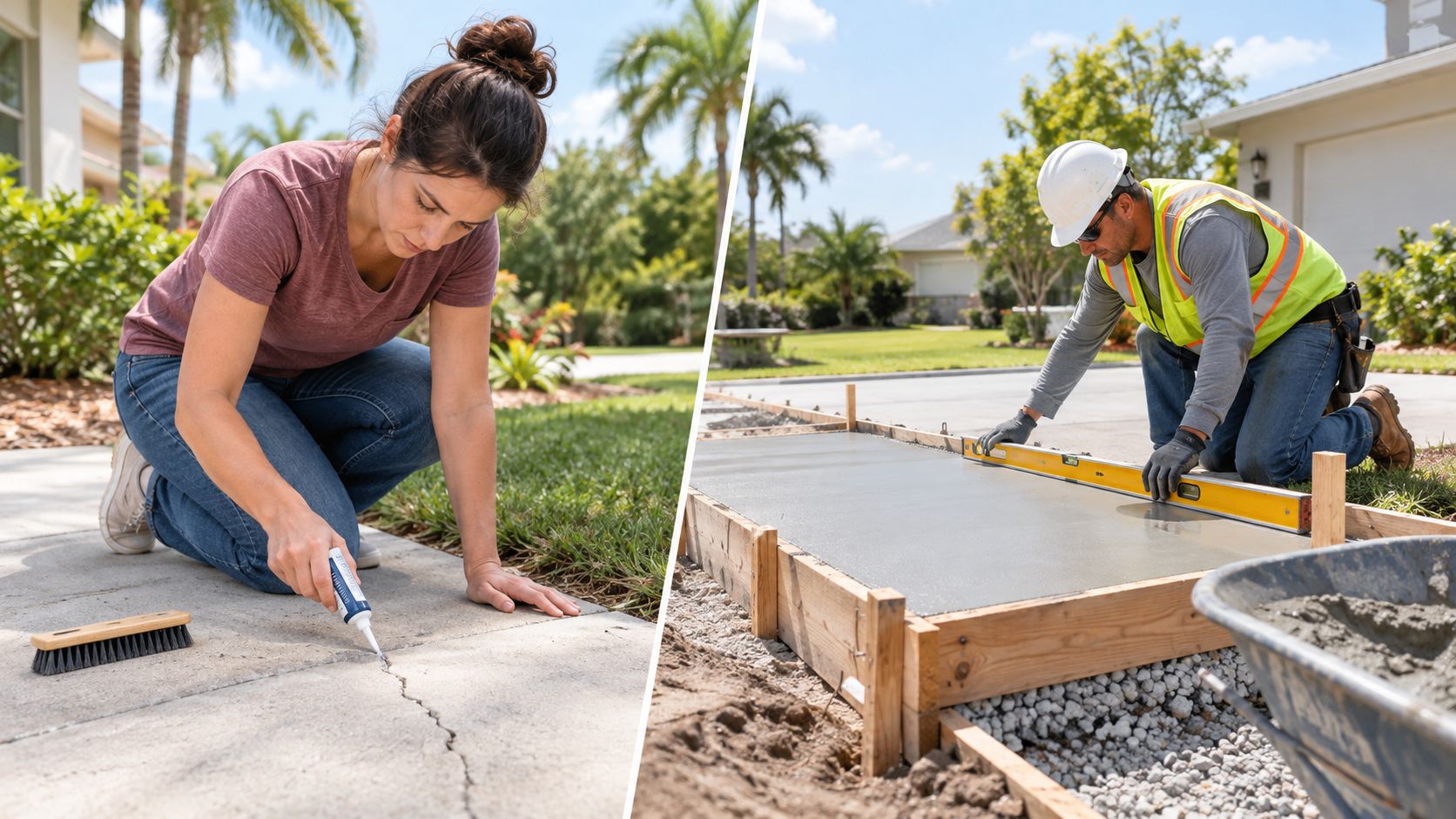
DIY work has a sensible boundary. A property owner can clean dirt from joints, control irrigation overspray, document movement and apply a suitable sealant to a small, stable crack when local rules allow it. Removing a lifted panel, correcting a sandy base, managing roots, setting forms and finishing fresh concrete is a different scope.
The hard part isn't mixing concrete. It's establishing elevation, preparing the base, protecting adjacent panels, managing water and finishing the slab during Florida heat. A repair that looks level before the next storm may settle if runoff reaches the base, and a root problem won't disappear because the visible crack was filled.
Vet the contractor before the pour
Ask for proof of licensing and insurance, a written scope, a clear timeline and an explanation of how the crew will handle roots, drainage, base preparation, joints and accessible slopes. A reliable contractor should explain whether the recommendation is grinding, leveling, partial replacement or full removal, not just quote a price for “concrete repair.”
Look for local Central Florida experience in places such as Dunnellon, Silver Springs, Crystal River and The Villages. Ask how the crew protects the property during removal, how long access will be restricted, what finish will be applied and how the new work will tie into existing sidewalk, driveways and ramps.
Riverside Sealing & Striping, LLC is one local option for removal and replacement of damaged sidewalks, new concrete walks and ADA-related walkway work. The company serves homes, HOAs, churches and retail properties, provides free no-pressure on-site estimates from 7am to 7pm, and also handles concrete work, asphalt sealcoating and parking lot striping.
The video below shows the type of concrete preparation and placement details owners should discuss before authorizing work.
A professional evaluation is especially valuable when several panels have moved, a tree is involved, water crosses the route, or the sidewalk connects to a driveway or curb ramp. The goal isn't to replace concrete unnecessarily. It's to avoid paying twice for a repair that never addressed the cause.
Maintenance Tips to Extend Sidewalk Life and Prevent Costly Repairs
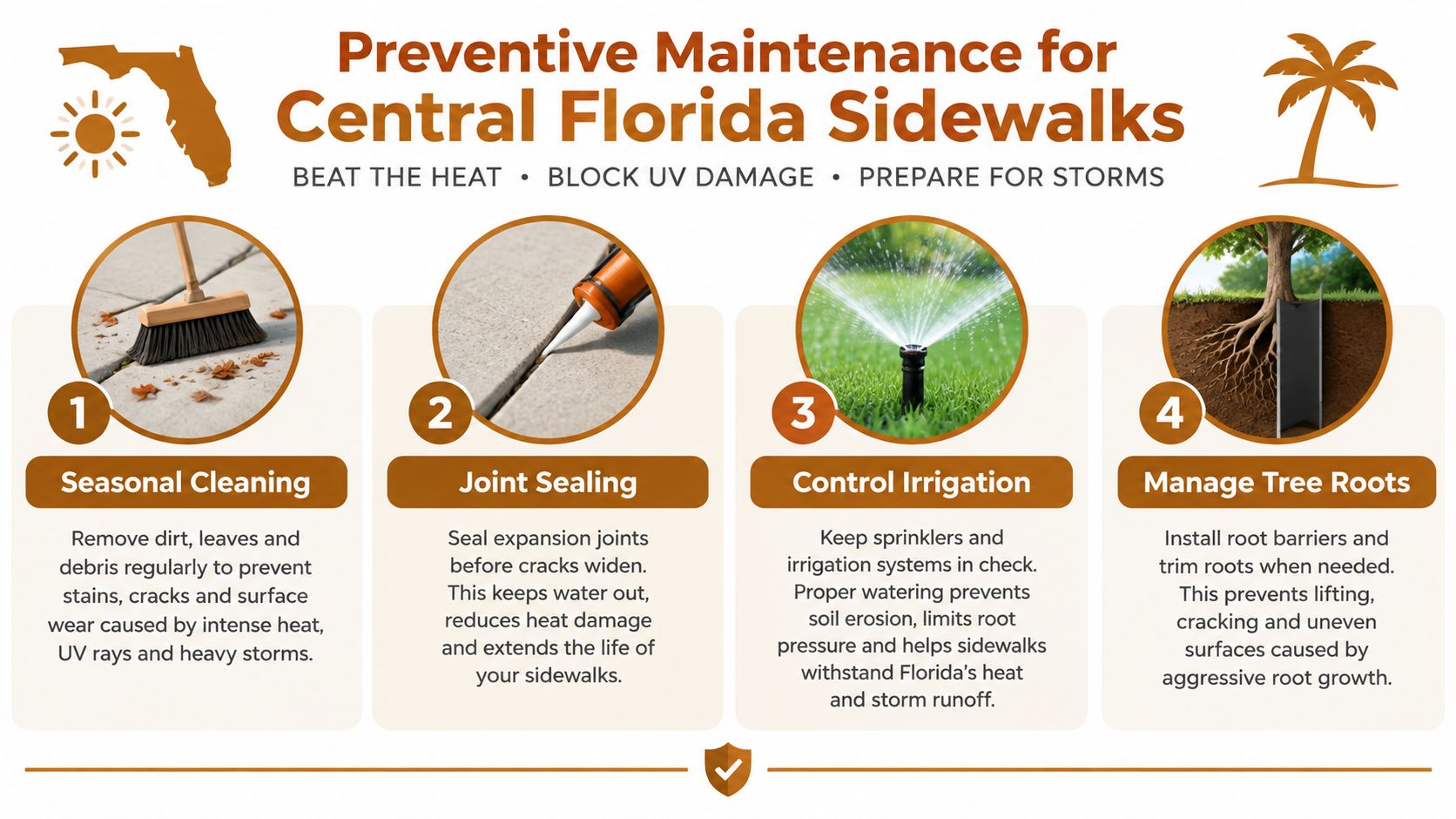
Central Florida maintenance starts with water management. Sweep leaves and sand from joints, clear drainage paths after storms, and adjust irrigation heads that spray the walking surface or keep the base saturated. Remove organic buildup before it holds moisture against the slab.
Inspect joints and cracks during routine property checks. Seal suitable stable joints before water and sand enter the base, but don't use sealant to disguise a panel that has lifted or settled. Keep tree growth under observation, especially near mature oaks, and address root pressure before it affects multiple panels.
Use a simple seasonal routine
- Clean after storms: Remove washed-in sand, branches and debris before they block drainage.
- Watch the edges: Look for open voids, eroded soil and new separation beside the walk.
- Control irrigation: Redirect overspray and avoid watering that repeatedly saturates one side of the slab.
- Review access routes: Check slopes, joints and transitions near driveways, ramps, mailboxes and commercial entrances.
Maintenance also protects the larger property. A clean, level sidewalk improves curb appeal and safety, while commercial owners may need coordinated concrete services along with parking lot maintenance such as sealcoating and striping. Preventive work gives homeowners, HOAs and property managers more control over scheduling and long-term costs.
Riverside Sealing & Striping, LLC provides sidewalk removal and replacement, concrete installation, ADA walkway upgrades, asphalt sealcoating and parking lot striping for properties in Marion County, Citrus County and surrounding Central Florida communities. Visit Riverside Sealing & Striping, LLC to request a free, no-pressure consultation and on-site estimate for your sidewalk repair needs.