
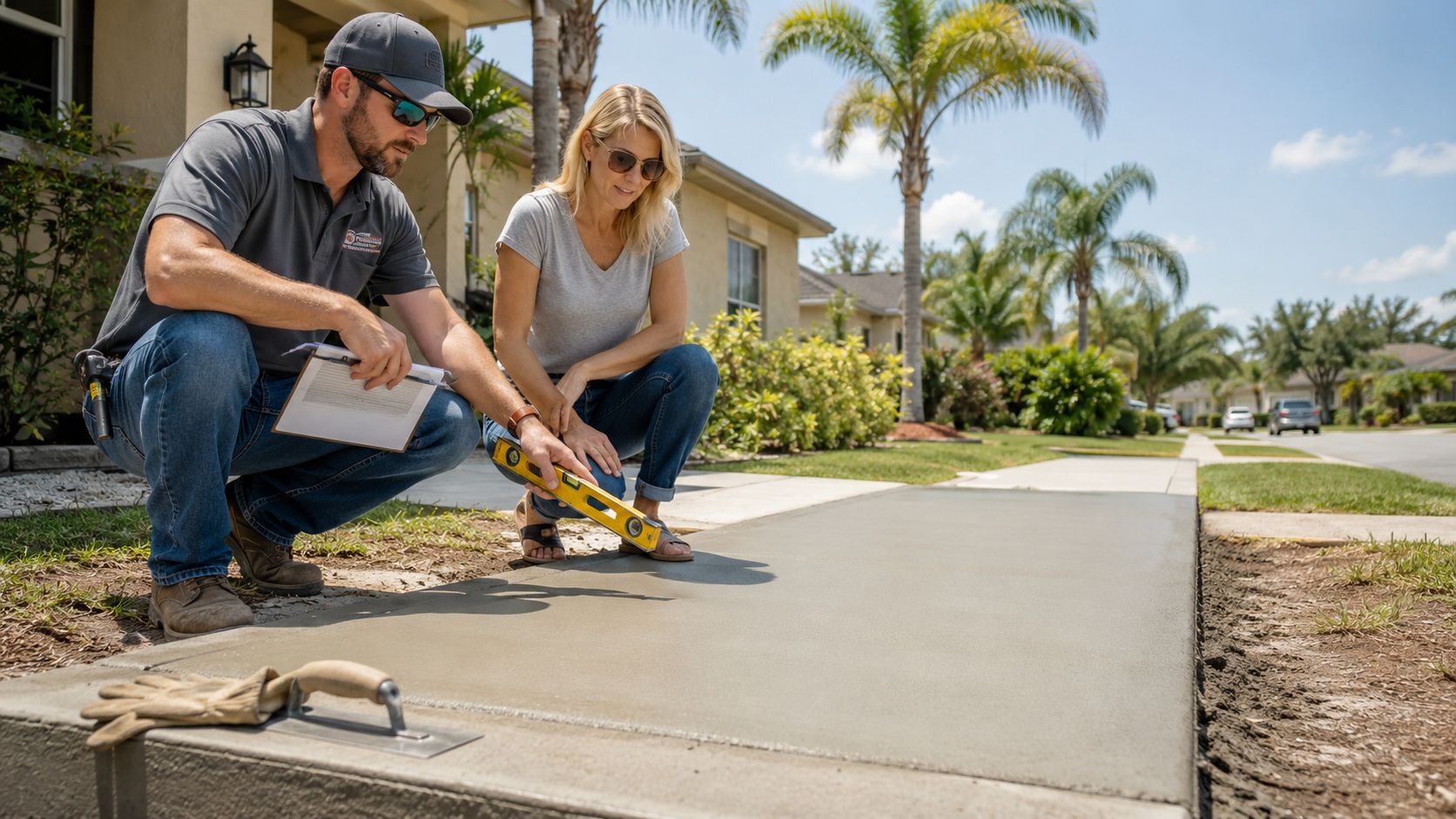
National 2026 estimates put remove-and-replace sidewalk work at roughly $10 to $25 per square foot, so a 4-foot by 40-foot walk typically runs about $1,658 to $3,086 installed before regional adjustments. That's the right starting number if you're in Marion County, FL or Citrus County, FL and you're trying to decide whether to patch a bad walk or hire sidewalk replacement contractors who can handle the whole job cleanly.
If you're staring at a lifted section in Ocala, a root-buckbled path in Dunnellon, or a cracked front walk in Crystal River, the first mistake is treating it like a small repair. In Central Florida, heat, rain, roots, and bad drainage turn weak concrete into a trip hazard fast, and a cheap patch often just delays the necessary fix. The better move is to inspect the slab, understand who pays, confirm the permit trail, and then hire a contractor who knows both concrete and asphalt work, because the details matter more than the price tag on the first bid.
Table of Contents
- Why Sidewalk Replacement Becomes Urgent in Central Florida
- Inspect the Walk Before You Call Anyone
- What Sidewalk Replacement Costs
- Permits, Licensing, and ADA Transitions
- Who Actually Pays for the New Sidewalk
- Vetting Sidewalk Replacement Contractors the Right Way
- Bringing It All Together and Your Next Step
Why Sidewalk Replacement Becomes Urgent in Central Florida
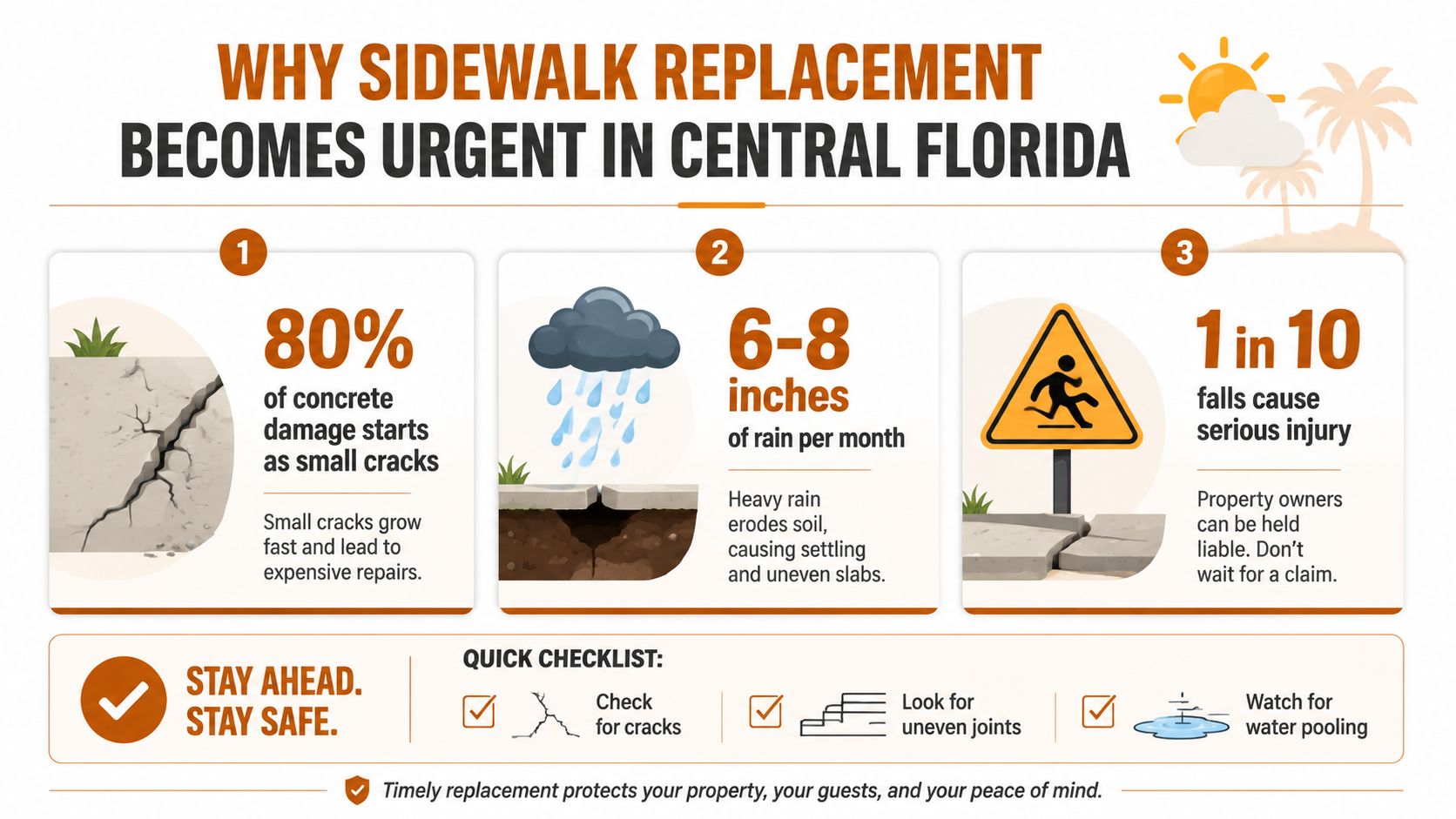
A sidewalk doesn't usually fail all at once. It starts with one lifted corner, a hairline crack that opens up after summer rain, or a section that stays wet because the slope is wrong. In Marion County, FL and Citrus County, FL, that kind of damage escalates quickly because the weather keeps cycling the slab through heat, saturation, and drying, while tree roots keep moving underneath.
What makes Central Florida harder on concrete
In places like Ocala, Belleview, Summerfield, Silver Springs, Dunnellon, Crystal River, Homosassa, Inverness, Lecanto, Beverly Hills, Hernando, and The Villages, you're not dealing with freeze-thaw the way northern cities do. You're dealing with sun, heavy rain, and vegetation pressure. Live oaks and similar root systems can lift slabs, and water that sits under the edge of a walk washes out support over time.
That's why a quick surface patch rarely lasts. If the slab has already lost support, the repair just covers the symptom. The base keeps moving, the crack comes back, and the owner ends up paying twice.
Practical rule: If the walk is uneven, holds water, or keeps cracking in the same place, treat it as a structural problem, not a cosmetic one.
The scale of sidewalk work also tells you this isn't a one-off handyman task. In Oakland's FY25 report, citywide sidewalk construction hit about 320,800 square feet, with 216,165 square feet done by city contractors, 365 CGS permits accounting for 95,562 square feet, and 21 PX permits adding 79,125 square feet Oakland FY25 sidewalk report. That kind of volume shows why replacement is a municipal maintenance category, not a small residential chore.
If you're seeing trip edges, failed joints, or settling near a driveway, you need a plan before you call for bids. The rest of the job, cost, permits, ADA transitions, and who's paying, depends on what that inspection shows.
Inspect the Walk Before You Call Anyone
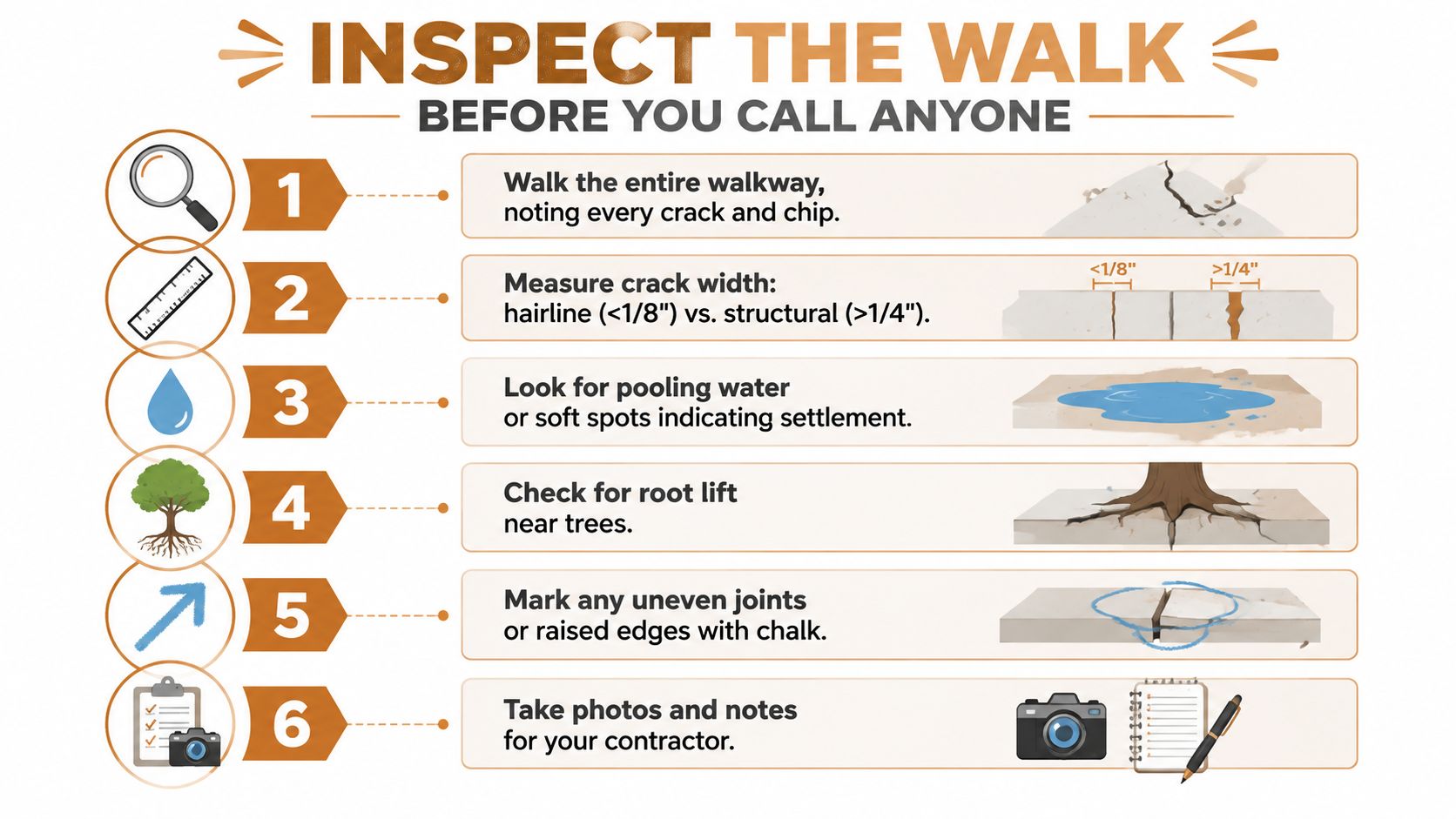
A solid sidewalk bid starts with a simple walk-through. Don't let a contractor be the first person to tell you what's wrong. You want your own rough map of the damage, because a slab that needs grinding is a different animal than a slab that needs full replacement.
Walk it like a contractor
Take a chalk line, a tape measure, and your phone. Mark every crack, chip, sunken edge, and place where water sits after rain. Note whether the problem is one isolated panel or a run of panels, because that difference changes the fix.
A useful public-works benchmark is the inspection-first approach used in sidewalk management programs. One municipal program described a 7-year re-inspection cycle, covering about 15% of the sidewalk system each year TRB presentation on sidewalk asset management. That's a smart way to think about private property too. Don't wait until the whole walk collapses, but don't rush into full replacement if the slab is still serviceable.
Know when repair stops making sense
Grinding and mudjacking can be good longer-term options when the slab is still structurally sound, but they only work under the right conditions. The public-works guide says one criterion for grinding is that at least 1.5 inches of pavement must remain after the grind FHWA pedestrian facilities maintenance guide.
That's the key filter. If you've got a slab with enough thickness left, minor elevation correction may be sensible. If the concrete is spalling, broken, or thin already, replacement is the better move. A mudjacked slab that keeps cracking later isn't a bargain, it's a delay.
Measure first, guess later. If the panel is heaved by roots or sunk from settlement, the contractor should be talking about structure, not just surface appearance.
If you're in Homosassa, Inverness, or a subdivision in The Villages where walkways connect to drive aprons and curb transitions, take photos of every height change. Those transition points often decide whether you need a repair, a grind, or a full tear-out.
What Sidewalk Replacement Costs
A homeowner usually wants a straight answer, but sidewalk replacement gets priced by what the crew has to remove, how easy the site is to reach, and what the ground is doing under the slab. A clean pour costs less. A tear-out with root cuts, broken concrete, and tight access costs more every time.
| Typical Sidewalk Replacement Cost Scenarios in 2026 | Project | Size | Low Estimate | High Estimate |
|---|---|---|---|---|
| Residential walk | 4 ft x 40 ft | 160 sq ft | about $1,658 | about $3,086 |
| HOA connector path | example scope only | varies | based on square footage and access | based on square footage and access |
| Small commercial frontage | example scope only | varies | based on square footage and access | based on square footage and access |
The national 2026 benchmark for new concrete sidewalk installation is about $6 to $15 per square foot, while remove-and-replace sidewalk work is commonly $10 to $25 per square foot or more because demolition and disposal get added in IBISWorld concrete contractors data. That gap comes from the work the public never sees. Saw cuts, haul-off, labor to break out the old slab, and time spent protecting nearby drives, irrigation, and landscaping all push the bill upward.
What pushes a bid up
Demolition is the first cost driver. If the old slab is thick, reinforced, or tangled with roots, the crew spends more time breaking it out and hauling it away. Soil conditions matter too. Bad drainage, soft fill, and irrigation conflicts slow the work and can force extra base preparation before the new concrete goes in.
Access changes the price just as fast. A walk that sits behind gates, tight fence lines, retaining walls, or parked cars takes longer to demo and pour than an open front approach with a straight truck path. Haul-away fees also show up when the contractor has to load broken concrete farther from the street or make multiple dumps because the pile is too large for one run.
If you want a local pricing breakdown that tracks with Central Florida jobs, this 2026 sidewalk replacement cost details page is worth a look.
Finish choice changes the bill too
A standard broom finish is the sensible default for most homes and HOAs in Central Florida. Decorative finishes look better, but they take more care and usually need more maintenance. For a front walk in Ocala or a common path in Crystal River, practical beats fancy unless the property is being built around curb appeal.
Permits, Licensing, and ADA Transitions
A lot of homeowners get surprised. They think sidewalk replacement is just a slab swap, then the city wants permit paperwork, transition details, or proof the contractor is properly licensed and insured. That is not busywork. It is what keeps a fresh pour from turning into a code problem, a drainage problem, or a repeat trip hazard.
The permit line matters
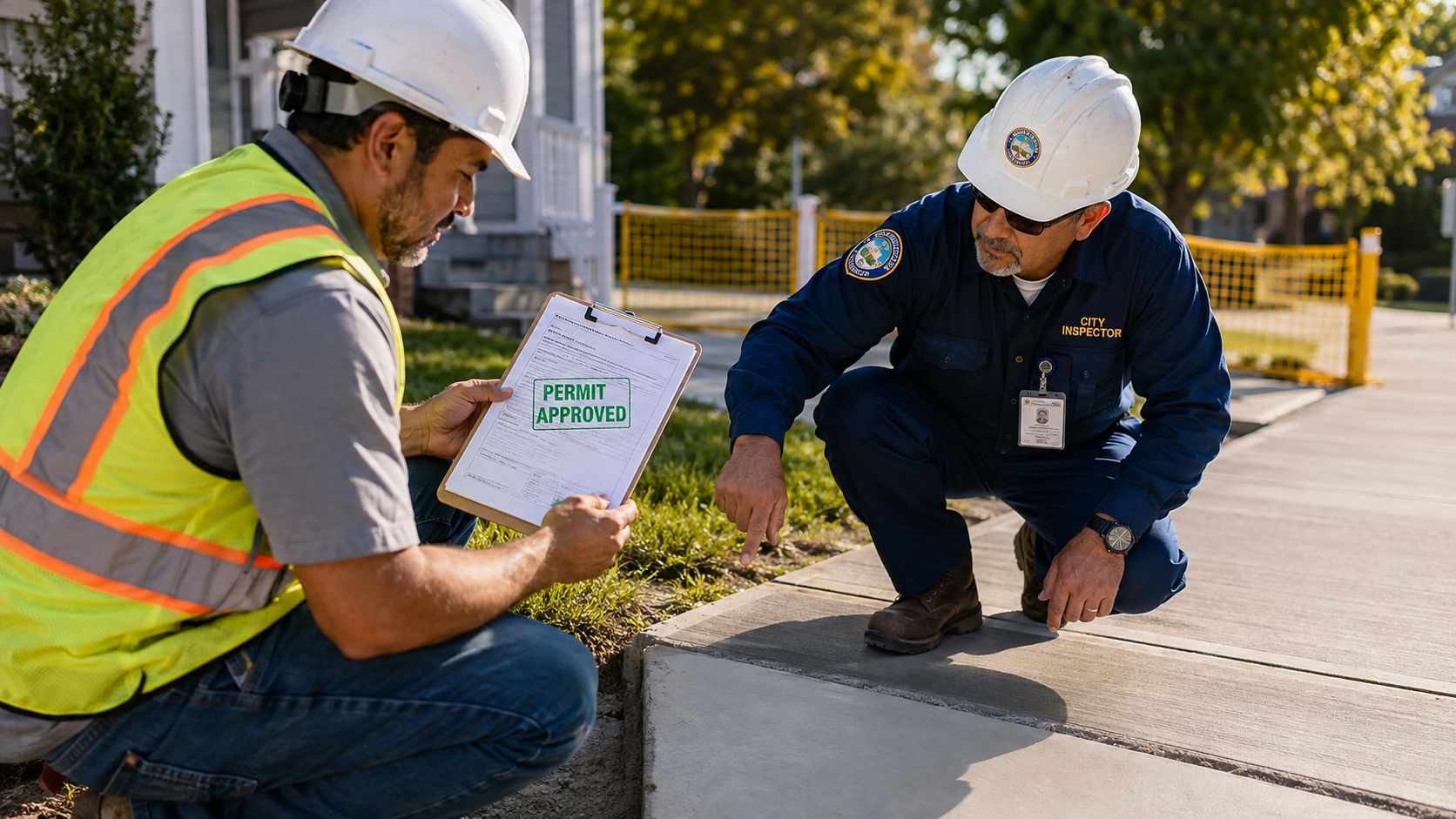
New York City's rule is a useful benchmark because it is plain. A sidewalk construction permit is required when installing, repaving, reconstructing, or repairing a sidewalk if the work covers more than 25 square feet NYC sidewalk permit rule. Smaller repairs of 25 square feet or less may not require a permit unless they relate to a violation.
Central Florida will not copy that rule word for word, but the principle holds. Once the work goes beyond a tiny patch, the city or county may treat it as regulated construction. If you are in Marion County or Citrus County, ask the contractor who pulls the permit, who handles the inspection, and whether the permit is tied to the sidewalk, the driveway tie-in, or both before a form gets filed.
The licensing side gets tighter when the job touches more than one part of the frontage. San Francisco requires that when work includes sidewalk plus curb replacement, including driveway and or existing encroachments, the property owner must hire a California State Licensed Contractor (A or C-8) with a $25,000 City Street Excavation Bond before applying for a Street Improvement permit San Francisco Public Works sidewalk repair permit page. It also says repairs above or adjacent to existing sub-sidewalk basements or other encroachments require a Street Improvement and Minor Sidewalk Encroachment permit, and structural work on the basement needs a building permit first.
Florida does not use that exact setup, but the lesson still applies. A contractor should be able to show current licensing where required, proper insurance, and the paperwork trail that proves the job is covered if the city asks questions. If you want a cleaner standard for that part of the vetting, start with bonded and insured contractors and make the company prove it before you sign.
Ask for the compliance plan in writing
You do not need a California bond in Florida, but you do need proof the contractor can handle regulated work. That means a current license where required, insurance, and a written scope that shows how they will handle transitions at driveways, curbs, and joints with existing concrete.
If the bid does not mention permits, transitions, or inspection steps, it is not a complete bid.
That is why I like these contractor questions before anyone signs a contract. A good company can answer who pulls the permit, what gets inspected, and how the new slab will meet the old one without creating a lip or ponding water.
ADA transitions are not optional
Driveway aprons, curb ramps, and tie-ins to older walks need a clean transition. ADA work does not give anyone room to wing it. A sidewalk-to-driveway edge that changes height by more than 1/4 inch needs to be handled as a proper transition, not left as a sharp step. If the new concrete creates a higher edge or a bad slope, you have built a new trip hazard, and that is exactly the kind of defect that brings complaints fast.
A contractor who knows the work will check the tie-in before the pour, set forms to control the slope, and finish the joint so the walk drains and stays walkable. That is the standard you want on homes, HOA common paths, and any frontage where people cross from slab to slab every day.
Who Actually Pays for the New Sidewalk
This is the question too many contractor pages dodge. Most of the time, the adjacent property owner is responsible for sidewalk maintenance, but that is not the whole story. Some cities run cost-share or rebate programs, and eligibility can depend on where the sidewalk sits, what caused the damage, and whether the property is residential or commercial Mpls Concrete Sidewalk Program information packet.
The default rule is simple, but exceptions matter
If a slab borders your home, your HOA common area, or your business frontage, start with the assumption that the private side may pay first. That is the baseline many municipalities use. Public programs can still shift the bill when the damage traces back to public trees, utility work, or a city-managed repair process.
The practical point is simple. Before anyone orders concrete, someone has to decide whether the work is owner-paid, shared, or covered through a local program. That decision usually comes from an inspection, a request, or a formal notice, not from a contractor guessing at the curb.
For HOA boards in Belleview, Beverly Hills, or Hernando, the reserve question comes first. Do not budget only for concrete. Budget for the chance that some panels are owner-paid, some are program-eligible, and some need paperwork before the crew can start.
Pick the right surface for the site
For most sidewalk replacement jobs, broom-finished concrete is still the cleanest answer. It gives traction, stands up well to foot traffic, and keeps maintenance simple. Exposed aggregate costs more to place and usually needs more care to keep its look. Stamped patterns can work on decorative front entries or HOA-controlled spaces, but they invite more upkeep, especially under Florida sun and rain.
HOA rules in Marion County can also steer the finish choice. Some associations want a plain, uniform look that matches the rest of the frontage, while others allow a more decorative surface only in limited common areas or at entrances. If the board wants a cleaner appearance without turning the walk into a maintenance project, broom finish usually wins. If the board wants more visual texture and accepts higher upkeep, exposed aggregate is the next step up in finish, and it will cost more than a basic broomed slab.
Asphalt walkways have a place on some shared paths or utility corridors, but they are not my first pick for a front sidewalk in Central Florida. Foot traffic, heat, and long-term appearance usually favor concrete. Concrete also holds up better when a walk needs to match existing panels, which is where most homeowner complaints start.
My view: If the path is expected to stay neat, safe, and easy to maintain, concrete is the default. Asphalt is a niche answer for the right site, not the standard answer for a sidewalk.
Build the slab to last
Reinforcing steel, control joints, and slab thickness all affect performance, no matter the finish. A plain broom finish on a properly built slab beats a pretty surface on weak base every time. That is the difference between a walk that lasts and one that cracks before the next summer storm season.
Vetting Sidewalk Replacement Contractors the Right Way
A contractor who knows the trade gives you more than a cheap bid. You get a clear scope, a permit path that fits the job, and a schedule that respects Florida weather. If the proposal stays vague, the company is not ready for your sidewalk.
What to check before you sign
Start with proof, not promises. Ask for license and insurance documents, recent local references in Ocala, Dunnellon, Inverness, or Crystal River, and a written scope that spells out demolition, base prep, pour thickness, finish, and cleanup. If they will not put the method on paper, they expect you to accept guesswork.
The scope should also explain how the crew will handle ADA transitions, utility conflicts, and weather delays. In Central Florida, that matters because a summer cloudburst can ruin a weak base, and live oak or camphor roots in neighborhoods from Belleview to Beverly Hills can push a slab up if the root issue is ignored before the pour.
Ask these contractor questions before anyone starts work: these contractor questions. The answers tell you fast whether the crew understands sidewalk replacement or just knows how to quote it.
Red flags you should walk away from
Storm-chasing crews are a bad sign. So is a lump-sum quote with no line items, a request for cash-only deposits, or a contractor who says permits are not needed when the project clearly falls under regulated work. If they cannot explain the inspection sequence, they are not organized enough to run the job.
A real schedule matters too. Crews that understand Central Florida know when to pour, when to wait, and when rain will ruin a setup. If the contractor promises speed but ignores weather windows, curing, or joint layout, you are buying a do-over.
Materials, weather, and the right finish
Florida sun breaks down unsealed surfaces over time, and heavy UV exposure is hard on both concrete appearance and asphalt maintenance. Ask how the contractor plans to protect the slab during placement, how they handle wet-weather delays, and what they do when the forecast turns bad after demolition starts. A crew that understands those weather windows will give you a cleaner result than one that just talks about finish texture.
For most walkways, I still like straightforward concrete with a layout that sheds water properly. If you need a contractor who can handle concrete replacement, asphalt maintenance, and striping without sending you to three different vendors, a local crew like Riverside Sealing & Striping, LLC can cover that mix of work.
Good crews build for the first summer, not just the day of the pour. That means proper sub-base compaction, sane joint spacing, and a schedule that avoids the worst weather.
Bringing It All Together and Your Next Step
The right order is simple. Inspect the walk, decide whether grinding or full replacement makes sense, price the job against the national benchmark, confirm the permit and ADA path, and vet the contractor like you're hiring for a public project. If the company can't answer who pays, who pulls permits, and how the transitions will be handled, keep looking.
For homeowners, HOAs, and property managers in Marion County and Citrus County, the smartest move is a contractor who does concrete and asphalt work, knows local scheduling realities, and doesn't treat a sidewalk like a throwaway slab. That's how you avoid the costly do-over that happens when a job gets priced too fast and built too light.
If you're comparing bids in Ocala, Crystal River, Inverness, or anywhere between Dunnellon and The Villages, ask the hard questions up front and get the answers in writing. A clean sidewalk job should feel boring after it's done, safe, level, and built to handle another Central Florida summer without drama.
If you need a straightforward opinion on whether your sidewalk should be repaired or replaced, Riverside Sealing & Striping, LLC can look at the slab, discuss concrete replacement options, and help you sort out the scope before work starts. They handle concrete and asphalt services across Marion and Citrus counties, so you're not guessing at who should do what. Reach out for a free, no-pressure on-site consultation and get a clear plan before the next trip hazard gets worse.