
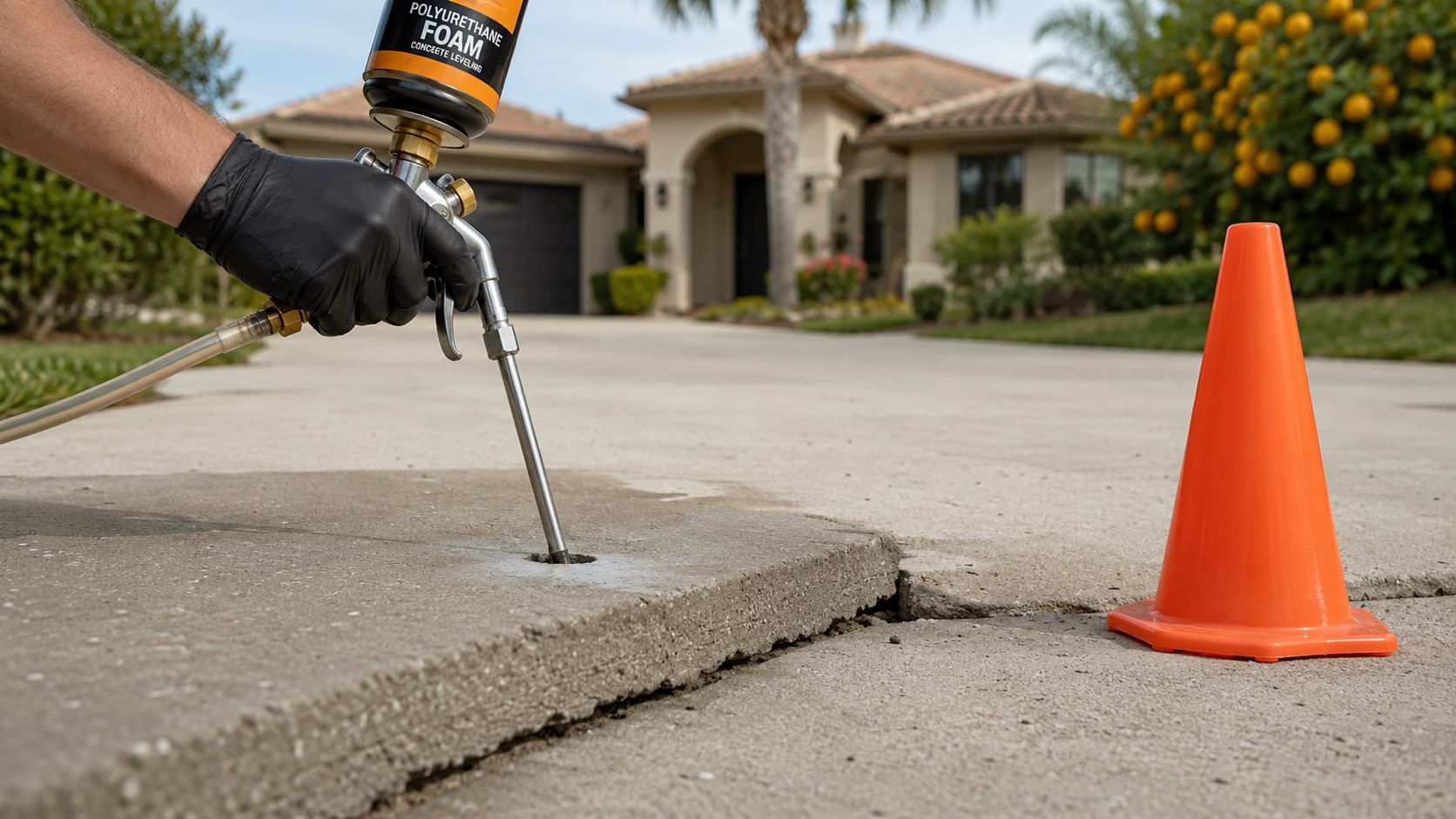
You usually notice a sunken driveway one small annoyance at a time. A puddle starts showing up after a hard rain in Ocala. The front tire drops a little harder than it used to when you pull into the garage in The Villages. A walkway edge in Crystal River starts catching shoes, bike tires, or the lawn mower.
That's how most driveway settlement starts. It rarely announces itself with one dramatic failure. It shows up as uneven concrete, standing water, widening joints, and a slab that no longer drains the way it should. In Marion County, FL and Citrus County, FL, that problem is common because concrete has to sit on soil that changes with moisture, drainage patterns, and traffic over time.
For homeowners in Dunnellon, Belleview, Summerfield, Inverness, Lecanto, Beverly Hills, Homosassa, Hernando, Silver Springs, and nearby Central Florida communities, the main question usually isn't just how to fix it. It's whether sunken driveway repair makes sense, or whether replacement is the smarter move.
Table of Contents
- That Uneven Feeling A Sunken Driveway in Your Central Florida Home
- Why Driveways Sink Common Causes for Florida Homeowners
- Fixing Sunken Concrete Mudjacking vs Polyurethane Foam Lifting
- Repair or Replace A Data-Driven Decision for Your Driveway
- The Professional Repair Process What to Expect
- Your Concrete and Asphalt Experts in Marion and Citrus County
- Frequently Asked Questions About Sunken Driveway Repair
That Uneven Feeling A Sunken Driveway in Your Central Florida Home
A lot of homeowners first assume the concrete itself failed. Most of the time, that's not the actual issue. The slab is often still usable, but the support under it has changed.
In Central Florida, that change shows up fast after a wet stretch. You get one side of the driveway holding water. Then the garage approach develops a lip. Then somebody in the house says, “Was that bump always there?” In places like Dunnellon and Ocala, I've seen that sequence repeat over and over.
The frustrating part is that a sinking driveway can look minor from the street while creating bigger problems at ground level. Water starts collecting where it shouldn't. Tires hit edges that keep breaking down. A trip hazard develops where one panel sits higher than the next.
Practical rule: If the driveway changed shape after a rainy period, don't focus only on the concrete surface. Start by asking what changed underneath it.
That's why a good repair decision comes down to risk, not guesswork. Some driveways need lifting and stabilization. Some need drainage work first. Some need a utility inspection before any concrete contractor should touch the slab.
Homeowners across Marion County, FL and Citrus County, FL run into the same pattern. A driveway in Belleview may settle because the base wasn't compacted well from the start. A slab in Homosassa may move because water keeps washing the support out from one edge. In older neighborhoods around Inverness or Beverly Hills, the problem can trace back to something underground that never gets checked until the driveway starts dropping again.
Why Driveways Sink Common Causes for Florida Homeowners
The short version is simple. A concrete driveway sinks when the support under it stops doing its job.
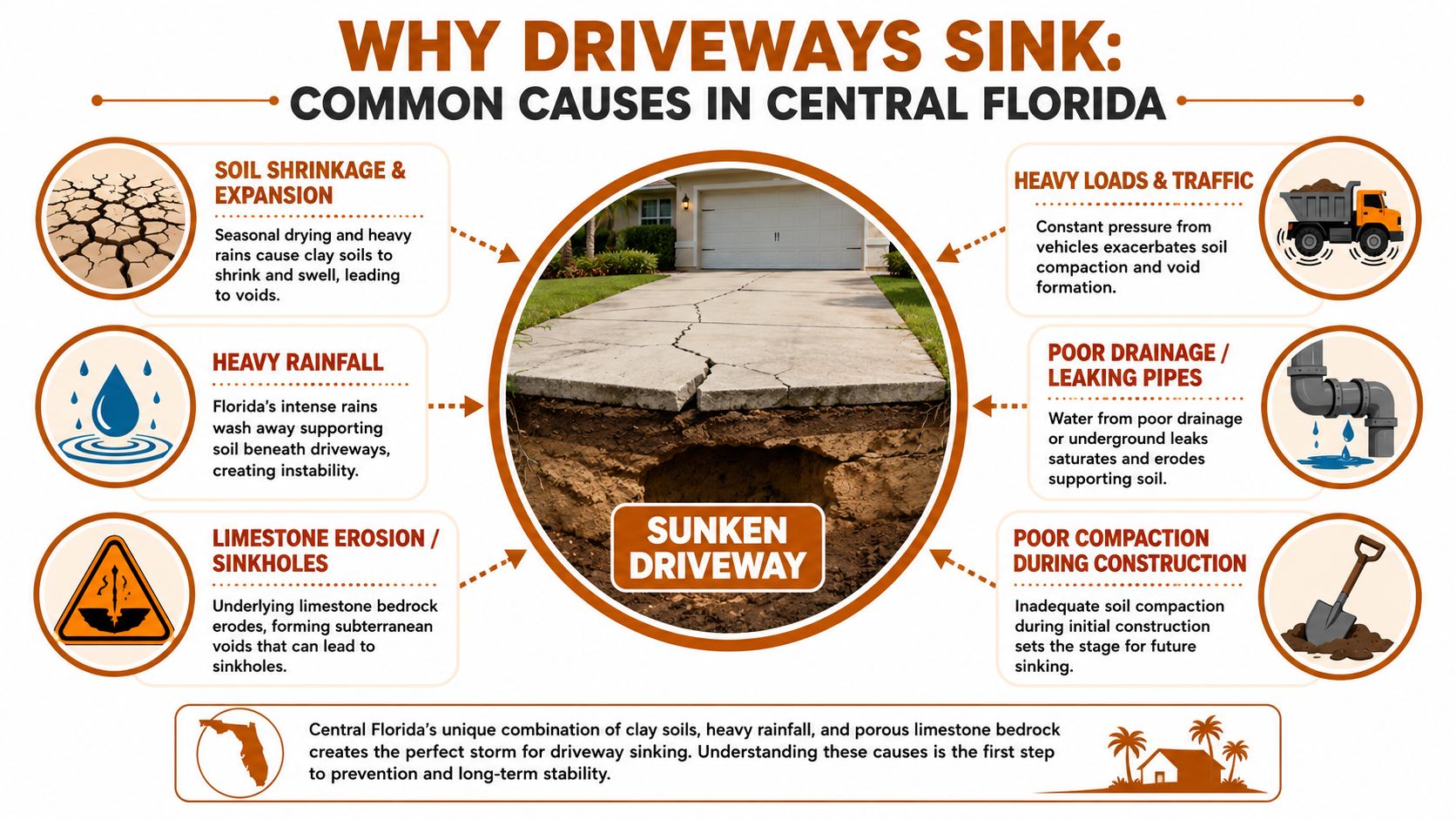
According to this explanation of why driveways sink, sunken concrete driveways most commonly result from underlying support failure due to poor initial installation, water damage from clogged gutters or inadequate drainage, and soil movement. When water pools near the driveway, the soil beneath loses cohesion and compacts, creating voids that cause the slab to sink unevenly.
The usual culprit is below the slab
Florida homeowners often look at the crack or low spot and treat that as the whole problem. It isn't. The slab is usually reacting to one of these conditions:
- Poor site prep: If the sub-base wasn't compacted properly during construction, the driveway may hold up for a while and then start settling as traffic and weather work on it.
- Drainage trouble: Downspouts, clogged gutters, low yard grading, and runoff can send water toward the slab instead of away from it.
- Soil movement: Even when the concrete was poured correctly, soil can shift, compact, or wash out over time.
- Heavy repeated loading: Bigger vehicles parked in the same place can stress one area more than the base can support.
In Marion and Citrus counties, sandy and erodible conditions make drainage mistakes expensive. Water doesn't need much time to find a weak spot under a driveway. Once it starts carrying fines out from under the slab, the concrete loses support and drops.
A lot of owners also forget that the driveway works as part of the whole site. Grading, swales, gutter discharge, and edge erosion matter. That's one reason broader erosion control measures for paved surfaces often connect directly to long-term driveway performance.
The cause many homeowners miss
The biggest overlooked issue is underground utility failure.
Data cited by Today's Homeowner's guide on sinking driveways notes that 20-30% of sinking driveways in older neighborhoods stem from underground utility leaks that erode soil beneath the pavement, and that this type of condition can increase repair complexity by 40% because the leak has to be found and fixed before the pavement repair will hold.
That matters a lot in older parts of Central Florida. In areas around Inverness, Crystal River, and some established sections near Ocala, aging lines can slowly wash out support under the slab. If a contractor lifts the concrete without addressing the leak, the driveway may look good briefly and then start moving again.
If settlement follows a utility path, keeps coming back, or shows up with unusual moisture, the smartest first step may be a utility inspection, not immediate lifting.
That's the difference between a cosmetic fix and a lasting one.
Fixing Sunken Concrete Mudjacking vs Polyurethane Foam Lifting
Once the cause is identified, the next question is the repair method. For most structurally sound concrete driveways with minor to moderate settlement, the choice comes down to mudjacking or polyurethane foam lifting.

How the two methods actually work
Mudjacking, also called slabjacking, lifts concrete by pumping a slurry under the slab. Polyjacking lifts it by injecting expanding polyurethane foam under the slab to fill voids and raise the panel.
Costs vary by method. Angi's driveway repair cost guide says mudjacking usually runs $3 to $6 per square foot, while polyurethane foam jacking runs $5 to $15 per square foot. The same source notes that for a standard two-car driveway of about 600 square feet, mudjacking repair commonly falls between $500 and $3,000, while full replacement of that same size ranges from $4,800 to $10,800.
That cost gap is why lifting is often the first thing homeowners in Dunnellon, Belleview, and Summerfield should evaluate before tearing everything out.
Here's the practical comparison:
| Method | Best fit | Main trade-off |
|---|---|---|
| Mudjacking | Budget-focused repair on suitable slabs | Heavier material |
| Polyurethane foam lifting | Precision lifting where lighter material matters | Higher upfront cost |
What matters most in Central Florida
For Florida conditions, lightweight material matters. According to this Florida guide to repairing concrete driveways, polyurethane foam injection is often preferred for lifting sunken driveways in Florida because it is lightweight, preventing additional soil compression that heavier mudjacking slurry might cause. Polyurethane foam is high-density and expands to fill gaps precisely, making it more effective for long-term stability in Florida's sandy soils.
That lines up with what works in the field. In sandy or erosion-prone areas around Citrus County, FL, adding a heavier material under already weak support can be the wrong move. Foam gives better control in those conditions, especially where the slab is still in decent shape and the problem is localized.
For homeowners comparing options, it helps to also look at practical examples of how to fix uneven concrete slabs so the repair method matches the type of settlement.
Jobsite reality: The cheapest lifting method isn't always the best value if the soil under the slab is already fragile.
Mudjacking still has its place. If the slab is sound, access is straightforward, and the soil conditions fit the method, it can be a reasonable solution. But in many Central Florida repairs, foam is the cleaner technical answer because it adds less load while still filling voids and lifting accurately.
Repair or Replace A Data-Driven Decision for Your Driveway
Homeowners frequently lose money. They choose based on the lowest bid or the fastest sales pitch, not on the actual condition of the slab and base.
A better way is to decide by failure risk.
When repair still makes sense
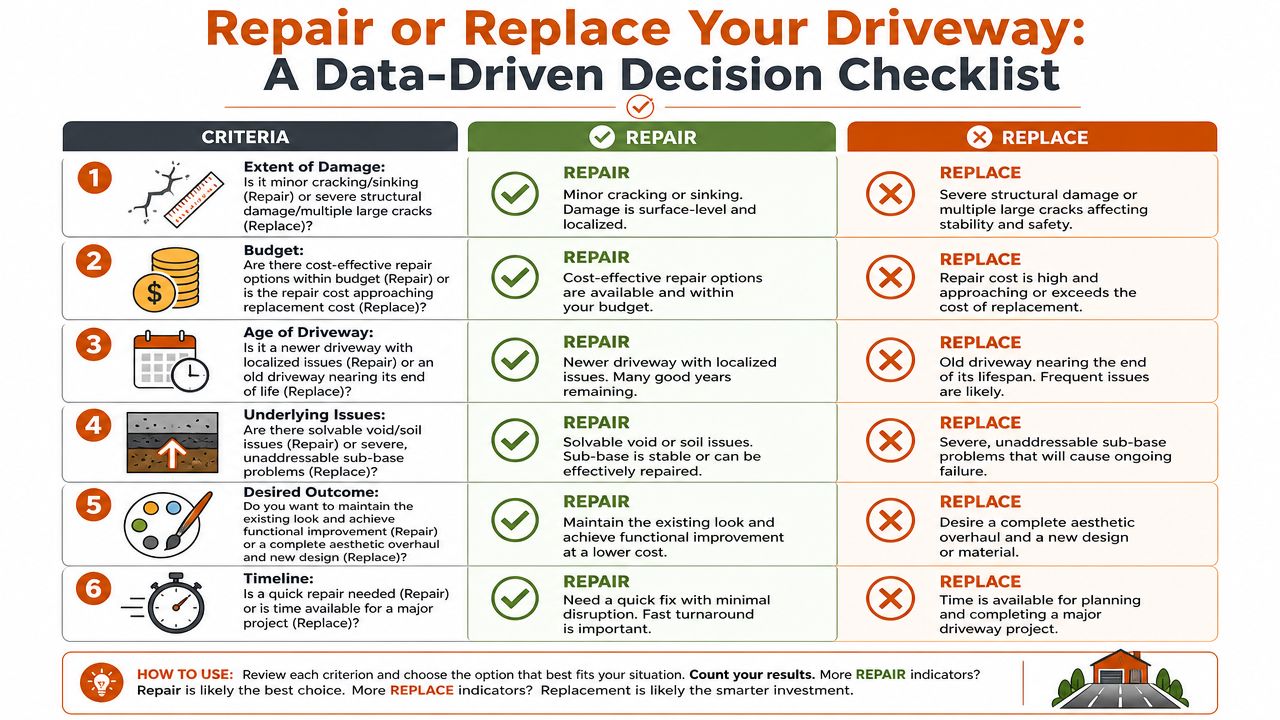
Repair is usually the better move when the slab is still structurally sound and the settlement is limited. Industry guidance in the verified data supports leveling for driveways under 15 to 20 years old when settlement is minor to moderate and the slab itself remains sound.
In practical terms, repair tends to make sense when:
- The sinking is localized: One section dropped, but the rest of the driveway is performing normally.
- The slab isn't breaking apart: A few manageable cracks are very different from widespread structural cracking.
- Drainage can be corrected: If the water issue is fixable, lifting may hold up well.
- You want to preserve usable concrete: That avoids demolition, disposal, and a full repour.
For homeowners trying to budget, replacement costs matter. The source above from Angi puts broad replacement cost for a standard two-car driveway at $4,800 to $10,800, which is why many owners first look at repair.
When replacement is the smarter call
There are situations where lifting is the wrong recommendation.
According to Great Inspector's driveway guidance, when driveway sinking exceeds 2 inches or creates water pooling toward the house, slabjacking has a significantly higher failure rate. In these cases, full replacement with proper base preparation achieves over 90% longevity and is recommended to prevent potential foundation damage.
That's the line I'd pay attention to in Central Florida. If the driveway is pushing water toward the house, the problem is no longer just curb appeal. It becomes a drainage and structure issue.
Replacement is usually the right call when you see:
- More than 2 inches of settlement
- Pooling that drains toward the house
- Multiple cracks across the slab
- Broken panel edges and widespread deterioration
- A base problem too severe to trust with lifting alone
A lot of owners hesitate because replacement can cost more up front. That's understandable. But this breakdown of concrete driveway replacement cost is useful for framing the bigger decision. Paying less for repair isn't savings if the slab keeps moving and you end up addressing the same area twice.
Don't compare repair and replacement only by invoice total. Compare them by whether they solve the actual failure.
Another good rule comes from the verified data. Full replacement is typically 3 to 4 times more expensive than lifting when the driveway is mostly in good condition and the sinking is limited, but that only supports repair when the slab still qualifies as a good repair candidate.
The Professional Repair Process What to Expect
Homeowners usually feel better about driveway lifting once they know what a proper crew does on site. Good sunken driveway repair is controlled work, not guesswork with a pump.
What happens on repair day
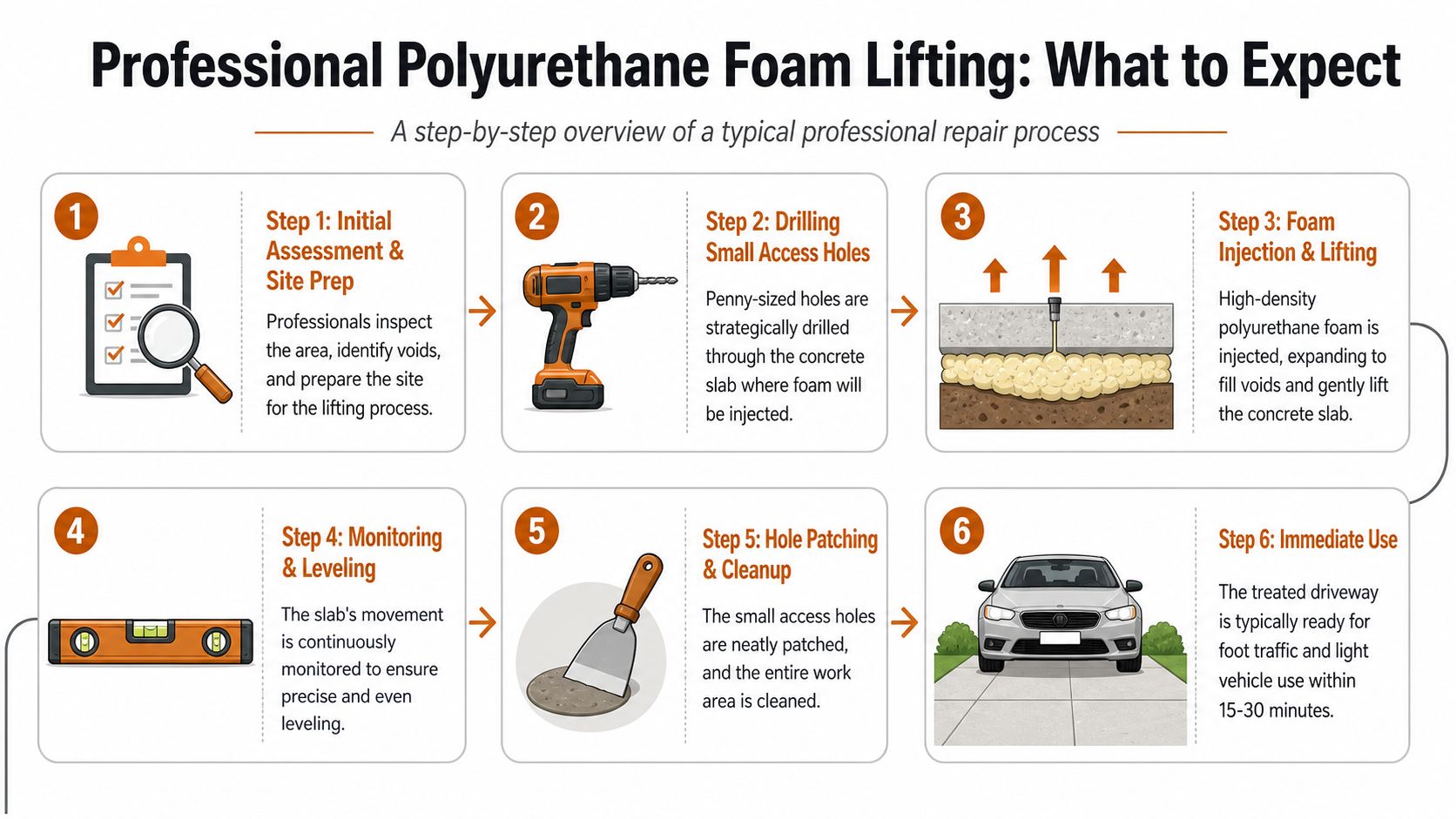
The verified process from VFPaving's slab-lifting overview is straightforward. The crew drills small access holes, pumps controlled polyurethane foam beneath the slab to fill voids, monitors elevation with a laser level during injection, and patches the holes after the slab is back in position. The same source says the area is typically ready for traffic within 24 to 48 hours.
For homeowners, the sequence usually looks like this:
Assessment and layout
The crew checks slab movement, voids, drainage direction, and where the lift has to start.Drilling access points
Industry-standard slabjacking guidance in the verified data notes 1.5 to 2-inch access holes placed strategically, often every 3 to 4 feet, depending on the slab and void pattern.Controlled injection
Foam goes in gradually. The goal isn't to blast the slab upward. It's to fill empty space, stabilize loose soil, and raise the panel in a measured way.Laser monitoring and final patching
Elevation is tracked during the lift so the slab finishes aligned, not over-lifted.
Why this isn't a simple DIY job
The hard part isn't making a slab move. The hard part is making it move evenly, stopping at the right height, and not forcing stress into nearby panels, garage aprons, or walkways.
Good lifting is about control. A slab can rise fast once the void starts filling, and that's why experienced crews watch the reaction constantly.
That's also why licensed and insured professionals matter. A proper repair crew is looking at drainage, joint condition, slab integrity, and whether the driveway should even be lifted in the first place. In Marion County, FL and Citrus County, FL, where water, sand, and older site conditions often work together, that judgment matters as much as the equipment.
Your Concrete and Asphalt Experts in Marion and Citrus County
If you own property in Ocala, Dunnellon, Silver Springs, Crystal River, Homosassa, Lecanto, Hernando, Beverly Hills, or The Villages, local judgment matters more than generic advice. Central Florida driveways don't fail in a vacuum. They fail because soil support changes, water gets where it shouldn't, and traffic keeps working on the weak spot.
That's why it helps to work with a contractor who understands the full picture. Concrete and Asphalt Experts in Marion and Citrus County should be able to talk clearly about concrete lifting, driveway replacement, site prep, drainage, and pavement maintenance without treating every job like it needs the same fix.
The right contractor should also bring the basics homeowners deserve. Licensed and insured service, reliable scheduling, clear timelines, high-quality workmanship, and no-pressure evaluations all matter. The same is true for commercial owners who may also need related work like asphalt sealcoating or parking lot striping as part of broader property upkeep.
For homeowners, the goal is simple. Get the cause diagnosed correctly, choose repair only when it makes structural sense, and replace the driveway when that's the safer long-term call.
Frequently Asked Questions About Sunken Driveway Repair
Can I fix a sunken driveway myself
Small surface patching is one thing. Lifting a settled concrete slab is different. The challenge is identifying the cause, controlling the lift, and knowing when the slab should be replaced instead of raised. DIY work often misses drainage and subsurface problems.
How long does a professional lift last in Florida
It depends on whether the root cause was solved. If the slab is sound, the settlement is limited, and drainage or soil issues are properly addressed, professional lifting can hold up well. If a utility leak or active washout continues under the slab, the repair won't last.
Will I always see the drill-hole patches
You'll usually be able to find them if you know where to look, but quality patching should leave them neat and far less noticeable than a full demolition and repour. Most homeowners care more about restored drainage and a smooth drive path than perfectly invisible patch points.
Could a sinking driveway mean sinkhole activity
Sometimes homeowners jump straight to that concern in Florida. It's possible for subsurface erosion or limestone-related void issues to play a role, but many sinking driveways come from more common causes like drainage, poor compaction, or leaking underground lines. The location, pattern of movement, and surrounding site conditions help tell the story.
Is asphalt repaired the same way as concrete
No. Concrete slabs can often be lifted with slabjacking or polyurethane foam. Asphalt usually needs a different repair strategy, such as patching, overlay work, base correction, or maintenance treatments. That's why it helps to work with a company that handles both materials instead of looking at the property through only one lens.
If your driveway in Marion County, FL or Citrus County, FL has started sinking, pooling water, or creating a trip hazard, Riverside Sealing & Striping, LLC offers free estimates and no-pressure consultations across Central Florida. As Concrete and Asphalt Experts in Marion and Citrus County, the team handles driveway evaluations, concrete replacement, site prep, asphalt sealcoating, and parking lot striping with reliable scheduling and local experience from Dunnellon to Ocala, Crystal River, and beyond.