
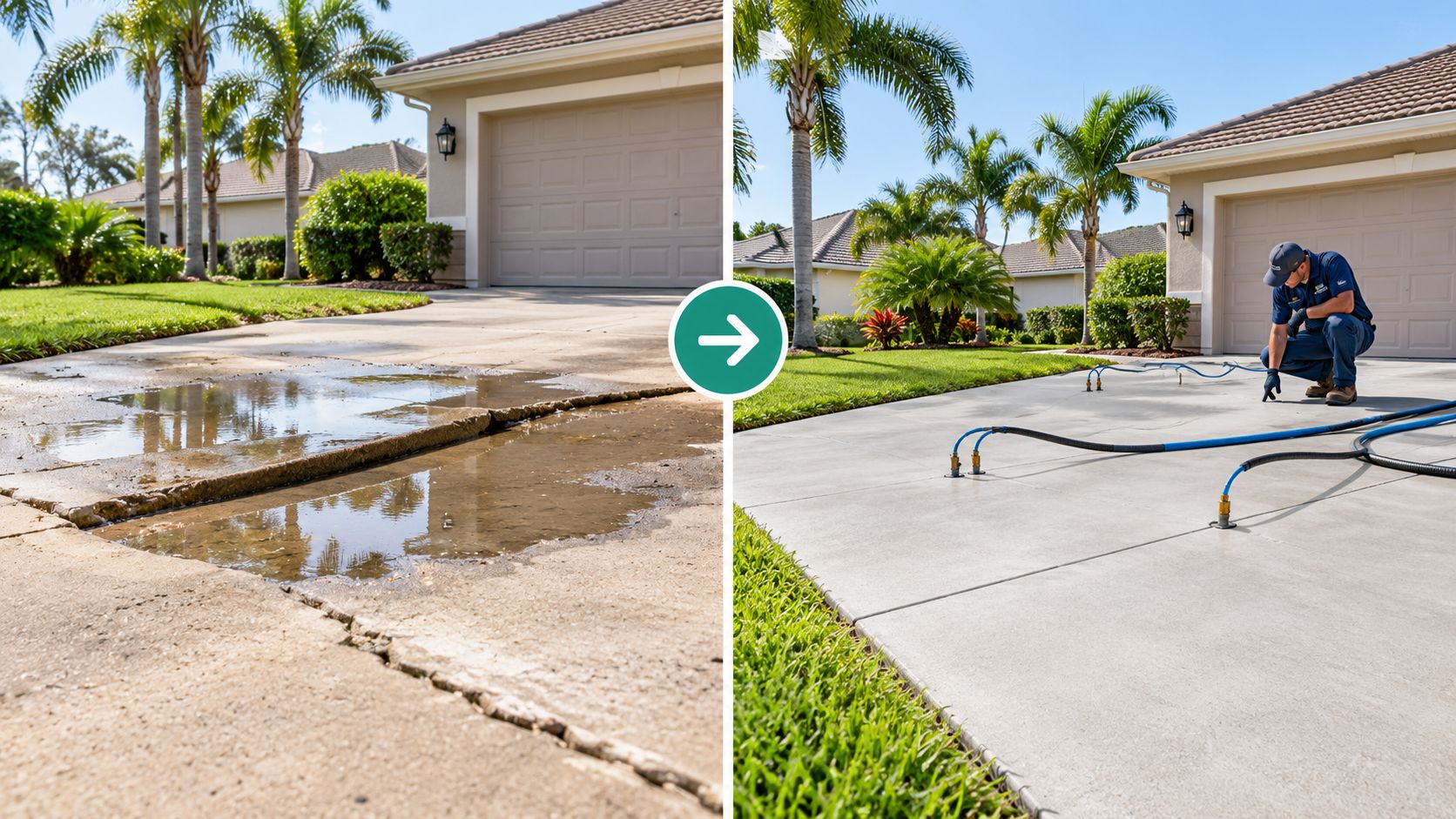
Most uneven driveway repairs in Central Florida run roughly $600 to $2,700 for leveling, while replacement commonly starts around $3,000 and can climb into the several-thousand-dollar range, depending on the fix. A full driveway replacement averages about $6,400 in one 2026 cost guide, while more complex polyurethane lifting projects can reach $9,000.
You notice the problem when your foot catches at the garage apron, your car rolls across a dip, or rainwater sits in a low section after a storm. In Marion County, FL and Citrus County, FL, that uneven slab isn't just an appearance issue. It can point to a void beneath the concrete, washed-out support, poor drainage, or soil movement that will keep stressing the driveway.
The right repair depends on why the concrete settled, not just how wide the crack looks. A professional evaluation should distinguish between a slab that can be lifted, a section that needs removal and replacement, and a base or drainage problem that must be corrected first.
Table of Contents
- What Uneven Driveway Repair Actually Costs in 2026
- Comparing the Main Repair Methods Side by Side
- The Factors That Move Your Quote Up or Down
- When Replacement Makes More Sense Than Leveling
- Why DIY Leveling Usually Costs More in the End
- How to Get an Accurate Local Estimate
- How Central Florida Conditions Affect the Price
- Your Next Steps and How Riverside Sealing and Striping Can Help
What Uneven Driveway Repair Actually Costs in 2026
For a homeowner in Ocala, Dunnellon, Belleview, or The Villages, a reasonable 2026 starting point is $600 to $2,700 for leveling an entire driveway with mudjacking or slabjacking, based on current cost guidance for sunken concrete repairs. Smaller section repairs may fall around $600 to $1,200, while whole-driveway leveling commonly falls around $1,400 to $2,700. HomeGuide's driveway repair cost guide provides those distinct ranges for sinking and leveling work.
Replacement follows a different cost curve. General driveway repair work may range from $300 to $3,000, but structural damage, demolition, new base preparation, concrete placement, and disposal can push replacement well beyond a basic repair. A 2026 cost guide places average concrete driveway repair near $1,873, with a common range of $829 to $2,925, while full replacement averages about $6,400. HomeAdvisor's concrete driveway repair cost data also places repair pricing around $3 to $25 per square foot, depending on the method and severity.
Why an uneven slab costs more than a surface crack
A hairline crack can sometimes be cleaned and sealed. A sunken slab is different. The crew may need to locate voids, raise the concrete, stabilize the material below it, correct drainage, and seal joints or cracks afterward.
That distinction explains why a driveway can move from a modest repair to a structural project quickly. This concrete slab repair cost resource is useful for understanding why leveling and replacement shouldn't be treated as interchangeable services.
Practical rule: If water is pooling beside the garage, the slab is moving, or the drop creates a trip hazard, price the job as structural repair rather than cosmetic patching.
The location matters, too. A national average can't account for the access around a narrow driveway in Silver Springs, a sloped lot near Beverly Hills, or drainage patterns around a home in Hernando. Two driveways with similar dimensions can require very different preparation once a contractor inspects what sits below the concrete.
Comparing the Main Repair Methods Side by Side
There are four practical repair paths for uneven concrete. The contractor should select one based on the condition of the slab and the support beneath it, not because one method is fashionable or easy to advertise.
| Repair Method | Typical Cost per Sq Ft | Best For | Limitations |
|---|---|---|---|
| Polyurethane foam lifting | $5 to $25 | Voids beneath structurally sound slabs and areas where controlled injection is appropriate | The higher price can approach replacement economics on badly damaged driveways |
| Mudjacking or slabjacking | $3 to $6 | Broad settled sections where the slab and supporting base remain stable | Added material can be a poor choice when the subgrade is soft or ongoing washout remains |
| Partial slab replacement | Quote depends on demolition, base work, and affected area | A shattered corner, badly damaged panel, or isolated section that can't be lifted reliably | It may not solve drainage or settlement outside the replaced section |
| Full driveway replacement | Replacement pricing varies by surface area, demolition, base preparation, and finish | Widespread cracking, failed base, severe deterioration, or repeated settlement | It has the highest overall project cost and requires more site preparation |
The wider cost guidance supports the basic method comparison. Mudjacking is commonly listed around $3 to $6 per square foot, while polyurethane lifting is often around $5 to $25 per square foot. Angi's concrete leveling cost guide also notes that labor can represent 50% to 70% of the bill, which helps explain why a small repair may still carry a substantial minimum charge.
Match the method to the failure
Foam injection makes sense when the existing slab is mostly sound and the crew needs to fill voids with controlled access. It can be a sensible option around a sunken garage apron, but it isn't a cure for concrete that has broken into multiple unstable pieces.
Mudjacking can suit a broad settled section when the base can support the lifted slab. It isn't the answer when water continues washing material away or when adding weight could worsen an already weak subgrade.
Partial replacement is the honest choice for a section with severe cracking, broken edges, or structural damage. Lifting damaged concrete doesn't restore its original strength.
Full replacement becomes more practical when the driveway has widespread failure or the base needs to be removed and rebuilt. For a deeper explanation of the decision, see how to fix uneven concrete slabs.
The Factors That Move Your Quote Up or Down
The first price driver is square footage, but it isn't the only one. A small low spot may still require equipment, crew travel, setup, cleanup, and a minimum service charge. A larger area can cost more overall while carrying a lower unit price if the crew can complete it efficiently.
Settlement severity changes the scope. A shallow dip with a solid base needs less lifting material than a slab resting over a deep void. The contractor also has to determine whether the concrete settled evenly or whether individual panels have rotated, cracked, or separated.
What the contractor should inspect
- Affected area: The estimate should identify the slabs involved and measure the section being repaired, rather than guessing from a driveway photograph.
- Drop and grade: The crew should compare the high and low points and check whether the slope sends water toward the garage, home, or sidewalk.
- Base and drainage: Standing water, eroded edges, failed downspout discharge, or washed-out material can make leveling temporary unless the source is corrected.
- Access: Narrow side-entry drives, fences, landscaping, slopes, and parked vehicles can affect equipment placement and mobilization.
- Disposal and preparation: Replacement work may include demolition, hauling, base correction, forming, concrete placement, and cleanup.
Labor matters because leveling is equipment- and crew-intensive. The same Angi cost guidance places labor at 50% to 70% of the total bill, so a limited repair doesn't always produce a proportionally small invoice.
A serious quote should separate mobilization, materials, labor, preparation, disposal, and any drainage correction. If one contractor includes base work and another only includes lifting, their totals aren't comparable.
When Replacement Makes More Sense Than Leveling
Leveling is valuable when the slab remains structurally sound. It becomes a poor investment when the concrete is failing and the underlying cause is still active.
Look for these warning signs:
- A slab has dropped more than three to four inches.
- Several panels create a roller-coaster profile instead of one isolated low spot.
- Deep spiderweb cracking covers a large area.
- Edges are spalling, breaking away, or no longer hold together.
- Soil is visibly washing out along the sides.
- The same location has settled again after an earlier lift.
A single warning sign deserves an inspection. Several together point toward replacement, especially when the base has failed. This driveway replacement cost guide explains why removal and rebuilding can be more appropriate than repeatedly lifting deteriorated concrete.
| Warning Sign | Leveling Likely Fine | Replacement Recommended |
|---|---|---|
| Isolated low section | The slab is intact and cracks are limited | The panel is broken into unstable pieces |
| Minor settlement | Drainage and base appear stable | The slab continues to drop after prior work |
| Small void beneath concrete | The contractor can fill and support the void | Washout continues beneath multiple panels |
| Localized cracking | Cracks don't affect structural integrity | Deep cracking and crumbling edges cover the section |
| Drainage concern | Runoff can be corrected without removing the slab | Base and slope must be rebuilt to control water |
Don't rely on an unsupported promise that a lift will last indefinitely. The useful question is whether the existing slab and base can support the repair after the crew finishes. Replacement also gives the contractor a chance to rebuild the base, correct slope, and address drainage instead of lifting the same failing surface again.
Why DIY Leveling Usually Costs More in the End
A store-bought kit can make a sunken driveway look like a manageable weekend project. The problem is that homeowners usually lack the hydraulic slabjacking pump, polyurethane injection rig, or commercial grout mixer needed to raise a panel evenly and restore support beneath it.
Improvised solutions often fill a visible gap without correcting the grade. Gravel, expanding sealant, or surface patching may hide an opening, but they don't reliably lift the slab, locate connected voids, or stabilize the area under vehicle loads.
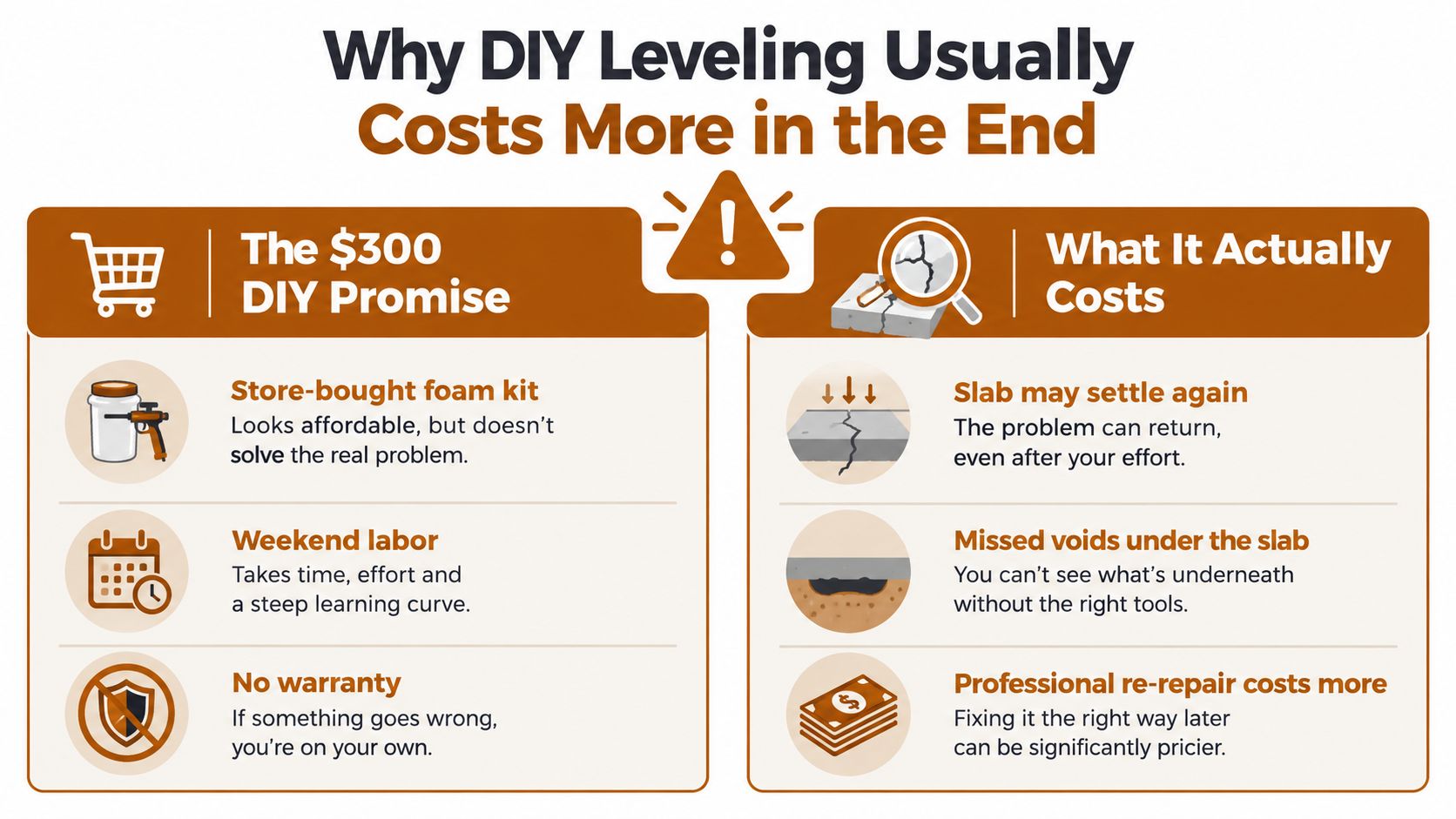
The hidden cost of a failed attempt
The DIY bill isn't limited to materials. You also spend a weekend on a repair that may leave the trip hazard in place. If the material hardens in the wrong location, a professional may need to remove or work around the failed fill before completing the repair correctly.
There is a safety issue as well. Pressurized injection equipment and jackhammers can damage adjacent slabs, blow out a corner, or create a new fracture when the operator raises the concrete too quickly. A driveway beside a garage is a poor place to learn how much pressure a slab can tolerate.
A cheap repair that doesn't restore the grade isn't a repair. It's another layer of work waiting for the next contractor.
DIY is reasonable for cleaning joints or applying a compatible crack sealant to a stable slab. It isn't a dependable substitute for diagnosing settlement, voids, drainage, and base failure.
How to Get an Accurate Local Estimate
A single number with no scope isn't a bargain. It leaves you unable to tell whether the contractor priced lifting, replacement, drainage correction, cleanup, or only a surface patch.
Before requesting estimates, gather the information a contractor needs:
- Measure the approximate affected area.
- Count the slabs or panels that appear to have moved.
- Note the difference between the high and low points.
- Photograph pooling water, open joints, cracks, and washed-out edges.
- Record whether downspouts, irrigation, or roof runoff discharge near the driveway.
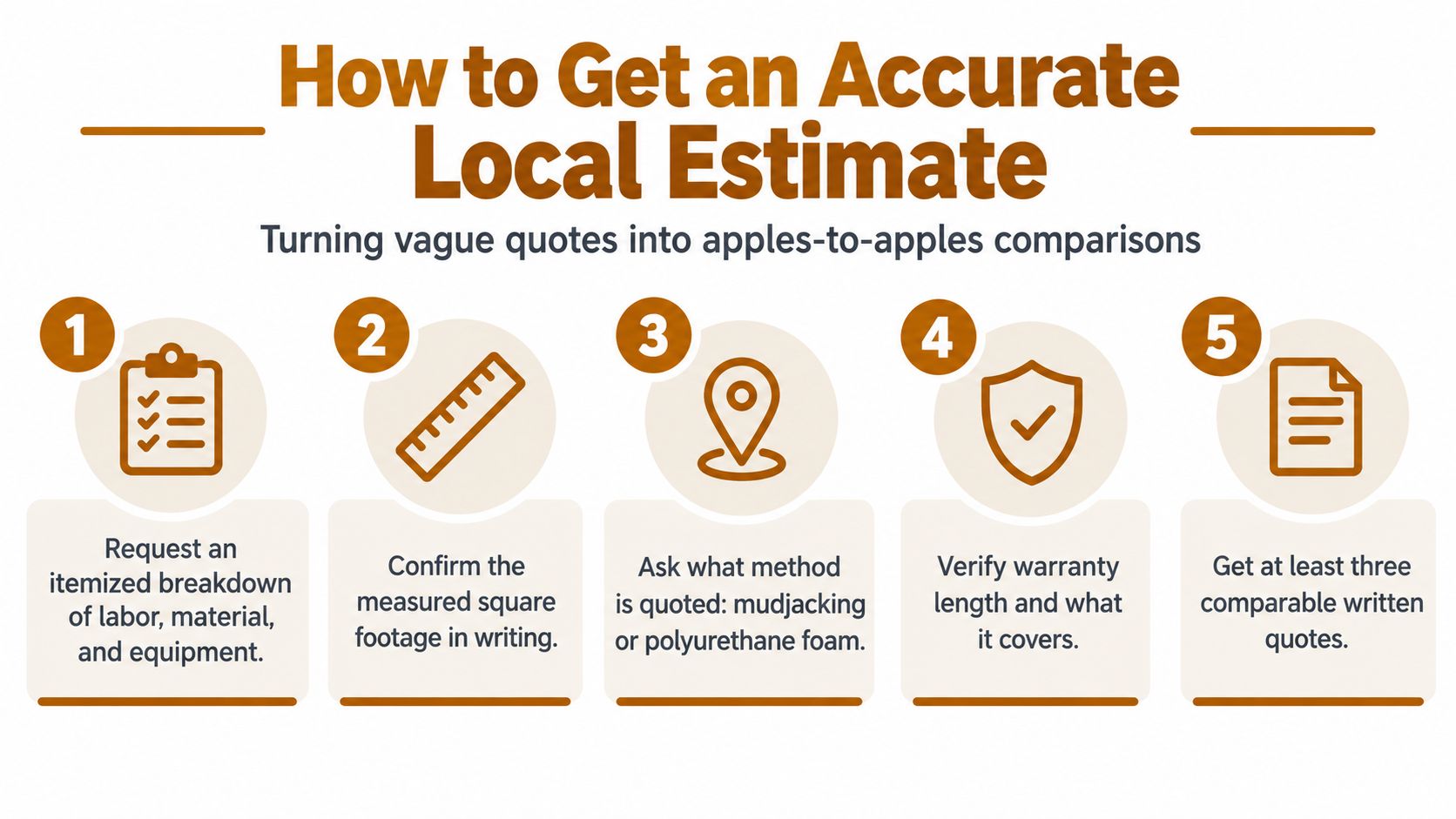
Ask each contractor the same questions:
- What repair method are you recommending, and what caused the settlement?
- Does the price include preparation, cleanup, demolition, disposal, and crack sealing?
- What happens if the crew finds a deeper void or failed base?
- Does the warranty cover re-settlement, and what does it exclude?
- Is the price fixed, or can it change through open-ended allowances?
- Who performs the work, and how familiar is the crew with Central Florida concrete conditions?
A written estimate should itemize materials, labor, equipment, mobilization, and subcontracted work. It should also show the affected square footage and state whether the recommendation is mudjacking, polyurethane lifting, partial replacement, or full replacement.
A phone estimate may be acceptable for simple crack filling. It isn't enough for an uneven driveway. A photograph can't show the depth of a void, the condition of the base, or the direction of runoff.
Choose the estimate that explains the problem clearly, not automatically the one with the lowest total. The cheapest scope often becomes the expensive scope after missing drainage or base work reappears.
How Central Florida Conditions Affect the Price
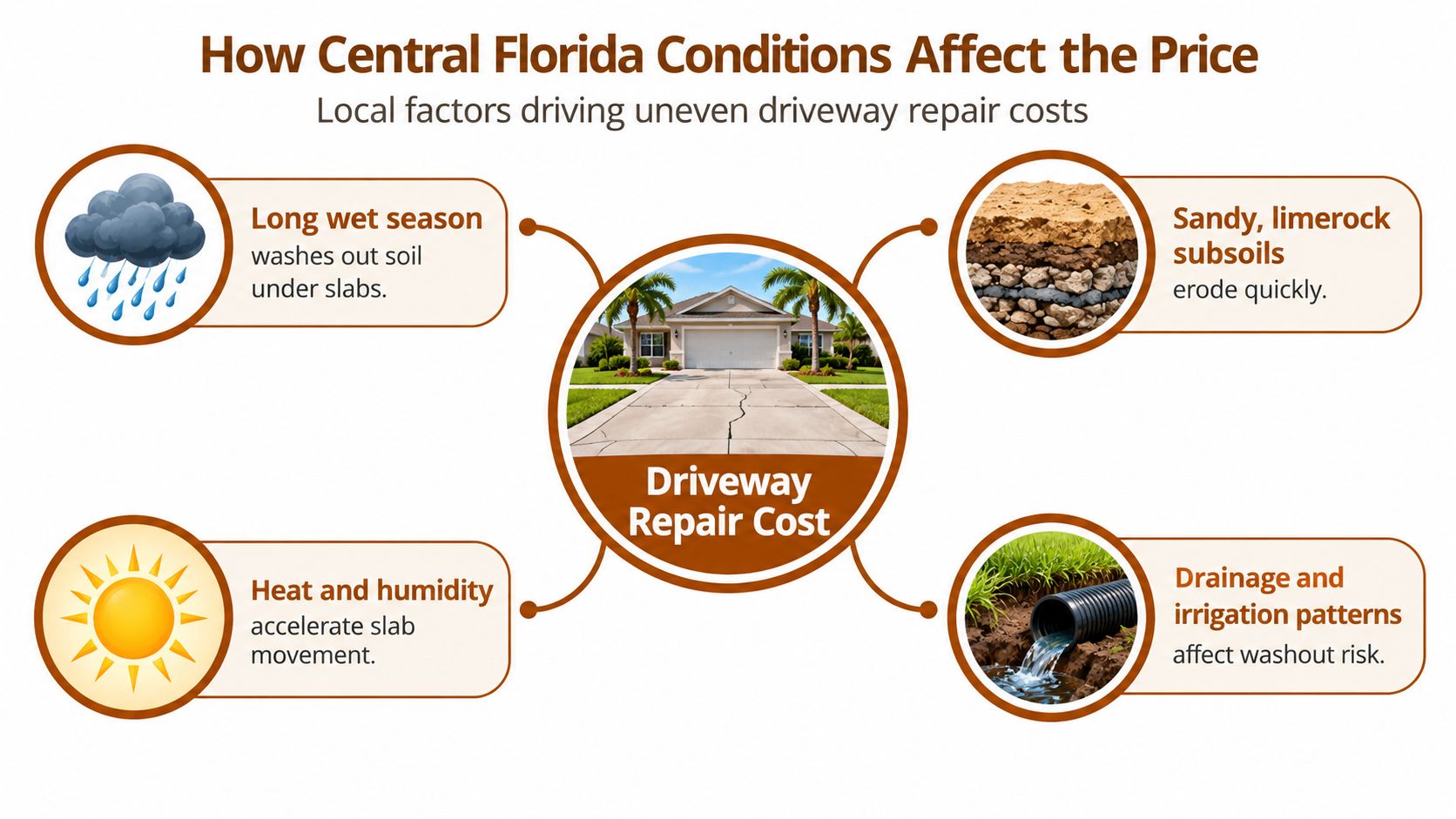
Central Florida's heat, intense sun, heavy rain, and wet-season runoff all deserve attention during a driveway inspection. In Marion County, FL and Citrus County, FL, a contractor should look beyond the visible crack and examine how water travels across the property.
Homes in Ocala and Summerfield may have different access and drainage layouts from homes in Crystal River, Homosassa, Inverness, or Lecanto. A driveway beside a planted side yard may restrict equipment. A low section near a garage may collect runoff. A property near Silver Springs or The Villages may have irrigation and roof drainage patterns that affect the supporting material below the slab.
Why the local site matters
Rain can expose weak drainage and wash material from beneath an edge. Heat can make existing cracks and joints more noticeable as the concrete and surrounding materials respond to changing conditions. Roots, irrigation discharge, and concentrated roof runoff can also create localized problems that a national price calculator won't see.
Those conditions influence the repair method. A contractor may recommend lifting when the slab is sound and the void is manageable. If the support has eroded repeatedly, replacement with corrected grading and base preparation may offer a more dependable solution.
National guides are useful for establishing a budget range, but they can't account for a specific lot in Hernando or Beverly Hills. They also can't tell you whether water is entering from a downspout, whether the driveway lacks a stable base, or whether several panels have settled for the same reason.
Local estimating standard: The price should reflect the cause of settlement, the access to the work area, and the preparation required to keep water from creating the same problem again.
That is why two homeowners may receive different quotes for driveways that look similar from the street. The visible concrete is only the top part of the repair.
Your Next Steps and How Riverside Sealing and Striping Can Help
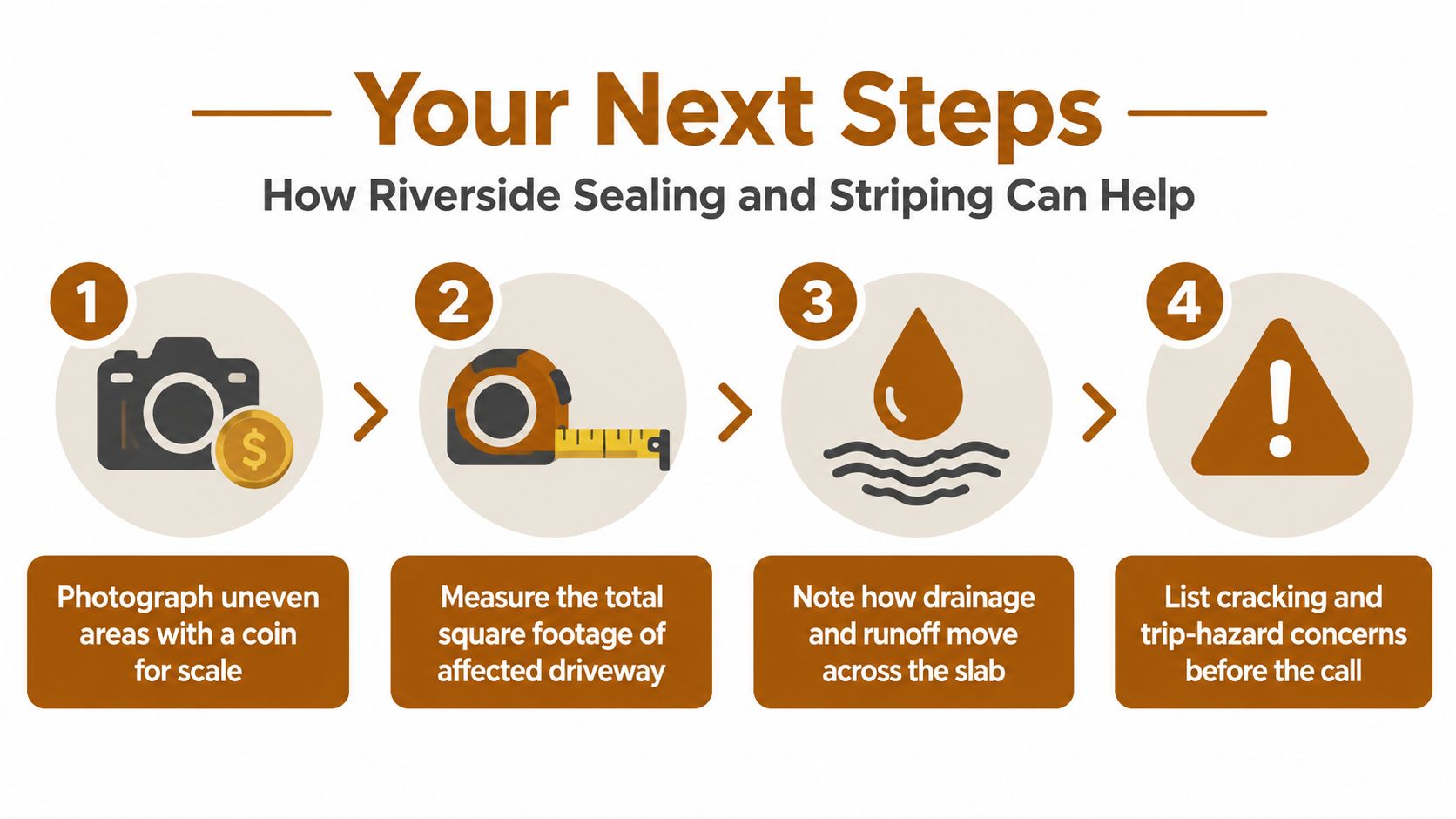
Start with documentation, not a quick patch. Photograph each uneven area from several angles and place a coin beside a crack or height change for scale. Measure the affected length and width, then note where water collects after rain.
Write down every concern before contacting a contractor:
- Safety: Mark trip hazards near the garage, sidewalk, and vehicle path.
- Drainage: Note whether water moves toward the home, garage, or neighboring property.
- Damage: Record broken corners, widening cracks, spalling, and separated joints.
- History: Include any earlier leveling, patching, flooding, irrigation changes, or drainage work.
An on-site walkthrough is more useful than a satellite image or phone-only quote. The contractor can inspect settlement, check the slope, measure the slabs, evaluate visible drainage patterns, and explain whether leveling, mudjacking, partial replacement, or full replacement fits the site.
A proper estimate should give you more than a total. It should identify the affected area, describe the recommended repair, explain preparation and cleanup, and show line-item pricing. If drainage or grading contributes to the settlement, the scope should say how that issue will be handled.
Riverside Sealing & Striping, LLC is a third- and fourth-generation, family-owned concrete and asphalt maintenance company based in Dunnellon, serving Marion County, Citrus County, and surrounding Central Florida communities. Its concrete work includes damaged driveway removal and replacement, new driveways, patios, slabs, sidewalks, and related site preparation. The company also handles asphalt sealcoating and parking lot striping, so homeowners, HOAs, churches, and commercial property managers can address concrete and pavement needs through one local contractor.
For homeowners in Ocala, Dunnellon, Belleview, Silver Springs, Summerfield, Crystal River, Homosassa, Inverness, Lecanto, Beverly Hills, Hernando, and The Villages, the practical next step is a no-pressure evaluation. Bring your photos, measurements, drainage notes, and questions to the visit, then compare the written scope instead of comparing totals alone.
Riverside Sealing & Striping, LLC offers concrete driveway evaluations, damaged concrete removal and replacement, site preparation, and related asphalt maintenance for properties in Marion and Citrus counties. Visit Riverside Sealing & Striping, LLC to request a free, no-pressure consultation and get a written recommendation for your uneven driveway.