
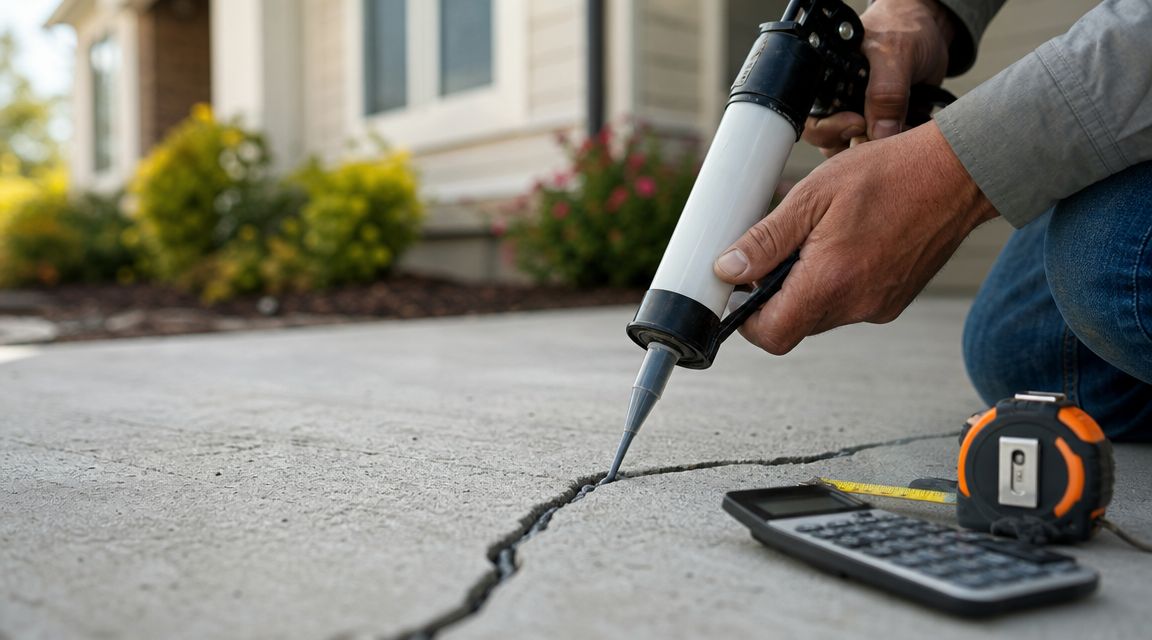
Small concrete slab repairs can start around $250 to $800 per crack for basic patching, while epoxy or polyurethane injection averages $400 to $1,500 per crack and slab leveling can run from $500 to $6,000+ depending on what's causing the movement. In Central Florida, the ultimate cost often depends less on the visible crack and more on whether rain, sandy soil, drainage, heat, or an underlying leak caused the slab to move in the first place.
A lot of homeowners in Ocala, Dunnellon, Belleview, Summerfield, Crystal River, Homosassa, Inverness, Lecanto, Beverly Hills, Hernando, Silver Springs, and The Villages start looking up concrete slab repair cost after they notice one thing: a crack that's getting wider, a patio corner that feels low underfoot, or a driveway panel that suddenly holds water after an afternoon storm.
That's a smart time to ask questions. Waiting usually gives water more time to work into the slab, soften support underneath it, and turn a repairable problem into a bigger one. National numbers help with budgeting, but they don't tell you much about what happens in Marion County, FL and Citrus County, FL, where weather and ground conditions can change the repair approach fast.
If you're trying to decide whether you're looking at a simple patch, a leveling job, or full replacement, this guide will help you think through it like a contractor would during an on-site estimate. If the surface damage includes flaking or top-layer breakdown, this overview of what concrete spalling looks like can help you separate cosmetic wear from deeper slab trouble.
Table of Contents
- Introduction What to Expect for Your Concrete Repair
- Central Florida Concrete Slab Repair Cost by Type
- What Factors Change Your Concrete Repair Price
- The Hidden Cost A Slab Leak Disguised as a Concrete Problem
- Decision Guide Repairing vs Replacing Your Concrete Slab
- Get an Accurate Estimate in Marion and Citrus County
- Frequently Asked Questions About Concrete Repair
Introduction What to Expect for Your Concrete Repair
A slab repair estimate usually starts with what you can see, but it shouldn't end there. A driveway crack in Summerfield and a settling patio in Belleview may look similar at first glance, yet one could be a straightforward repair and the other could point to movement underneath the slab.
That's why concrete slab repair cost is hard to pin down from photos alone. A small non-structural crack may stay in the lower repair range. A slab that has dropped, rocks underfoot, or shows repeated cracking after past patchwork usually needs a different conversation.
Homeowners often want one number. In practice, there are usually three possible paths:
- Localized crack repair: Best when the slab is still stable and the issue is limited.
- Surface correction or resurfacing: Useful when the slab is structurally sound but worn, scaled, or cosmetically rough.
- Leveling or replacement: Necessary when the slab has lost support, settled unevenly, or keeps moving.
Practical rule: The cheaper visible fix isn't always the lower-cost decision if water is still getting under the slab.
In Central Florida, that matters more than many online guides admit. Heat opens and closes cracks. Heavy rain exploits weak drainage. Sandy areas can wash out below a slab faster than homeowners expect. Tree roots, poor grading, and downspout discharge can all push a job out of the “minor repair” category.
A proper estimate also needs to match how you use the slab. A lightly used backyard pad in Hernando isn't judged the same way as a driveway in Ocala that sees daily vehicle traffic. Interior slabs raise another set of concerns, especially if moisture or plumbing is involved.
For homeowners who want clear answers, the job is to identify the cause first, then price the right fix. That's the mindset Concrete and Asphalt Experts in Marion and Citrus County bring to concrete work across residential and commercial properties. The goal isn't to sell the biggest job. It's to avoid spending repair money on the wrong one.
Central Florida Concrete Slab Repair Cost by Type
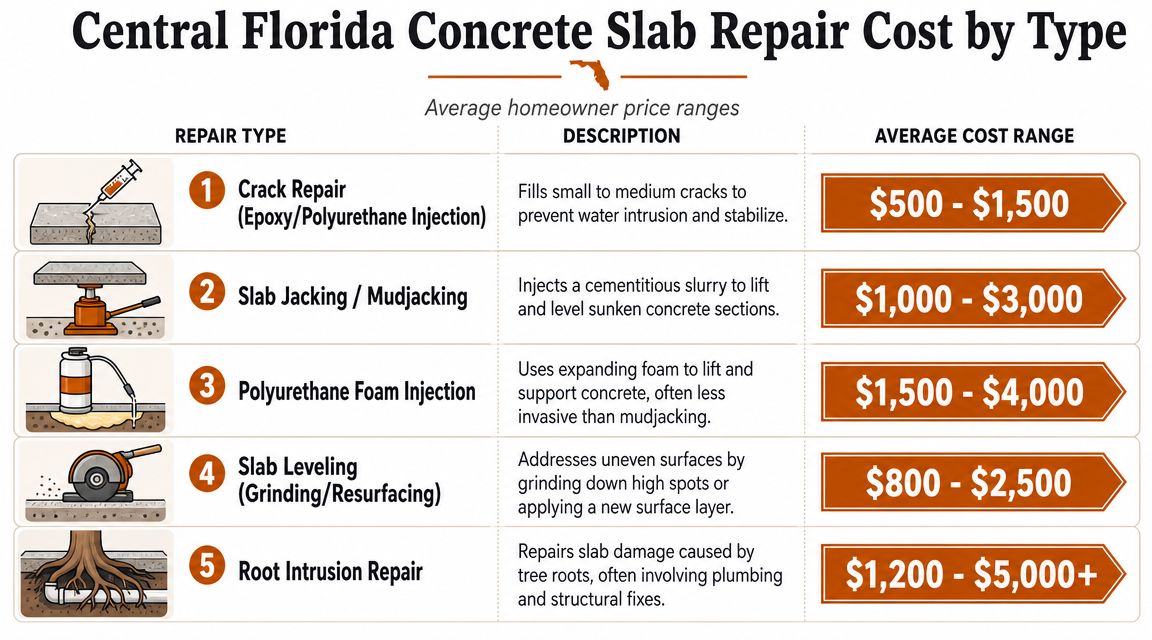
A driveway in Ocala with one tight crack does not get priced the same way as a patio in Homosassa that has dropped at one corner and holds water after every hard rain. That is the part many national cost guides miss. In Central Florida, the repair method depends on how the slab is behaving in heat, rain, and shifting support below it.
Small surface repairs
Minor surface repairs are usually the lowest-cost category, but only when the slab is still stable. If a crack is narrow, dry, and not changing height from one side to the other, patching or injection may be enough. As noted earlier, basic crack patching often falls around $250 to $800 per crack, while epoxy or polyurethane injection often runs about $400 to $1,500 per crack.
Surface protection has its own pricing. As noted earlier, sealing commonly runs about $1.35 to $2.50 per square foot, and full resurfacing often lands around $3 to $5 per square foot. For homeowners comparing repair to starting over, this local page on concrete slab cost per square foot helps frame the difference between improving a sound slab and replacing one that has reached the end of the road.
Early repair usually costs less.
That said, Florida weather can make a slab look like it needs only cosmetic work when the underlying problem is below the surface. If rainwater is washing out support or drainage keeps sending water under the slab, resurfacing alone does not fix much. It just improves the appearance for a while.
Leveling and more involved corrections
Once a slab starts sinking, rocking, or sitting unevenly, the budget changes fast. As noted earlier, leveling commonly ranges from $500 to $6,000+. The wide spread is normal because the contractor is not only correcting height. The job may also involve voids under the slab, poor runoff, edge erosion, or limited access for equipment.
A small walkway panel near Crystal River may sit at the low end if the settlement is isolated and easy to reach. A larger slab in The Villages can climb toward the high end if several sections have dropped, water keeps getting underneath, or nearby structures limit how the crew can work.
Florida soil makes this category tricky. Sandy subgrade can wash out. Clay pockets can expand and shrink. Long dry periods followed by heavy rain can expose weak prep that stayed hidden for years. Those site conditions affect whether leveling is a smart repair or just a temporary reset.
| Repair type | Typical cost range | Best fit |
|---|---|---|
| Basic crack patching | $250 to $800 per crack | Small non-structural cracks |
| Epoxy or polyurethane injection | $400 to $1,500 per crack | Cracks needing stronger filling and bonding |
| Sealing | $1.35 to $2.50 per square foot | Preventive protection on sound concrete |
| Full resurfacing | $3 to $5 per square foot | Worn but structurally sound slab surfaces |
| Leveling | $500 to $6,000+ | Sunken or uneven slabs |
How repair compares with new concrete pricing
Repair numbers only help if you compare them to replacement. As noted earlier, a new slab often runs about $4 to $8 per square foot, though thicker or more complicated pours can go higher. Labor is a major part of that total, especially when demolition, hauling, forming, grading, and reinforcement are part of the job.
That comparison matters most when a slab has multiple failures at once. If you are looking at repeated cracking, settlement, drainage problems, and a worn surface, stacking repairs can get close to replacement cost without giving you the same life expectancy. On the other hand, if the slab is structurally sound and the problem is limited, targeted repair is usually the better buy.
The right decision in Central Florida is rarely about the cheapest line item. It is about whether the slab will stay put through the next few storm seasons.
What Factors Change Your Concrete Repair Price
A slab repair estimate can swing fast, even when the cracks look similar at first glance. In Central Florida, the actual cost usually comes from what caused the failure, how far it has spread, and what it takes to get the repair to hold through heat, rain, and shifting soil.

Type and severity of damage
Surface wear is one price. Active movement is another.
As noted earlier, small non-structural cracks usually stay on the lower end of repair pricing, while injected repairs and structural corrections cost more because they take more prep, cleaner crack routing, better material control, and closer monitoring during the work. A hairline shrinkage crack in a garage slab is a very different job from a widening crack that is letting in moisture or showing vertical displacement.
What matters during an estimate is not just crack width. It is whether the slab has dropped, lifted, or lost support underneath. If one side of the crack sits higher than the other, or the slab rocks when you walk across it, the repair often moves beyond patching and into stabilization or leveling work.
Site preparation and accessibility
Access changes labor faster than homeowners expect.
An open driveway in Ocala is usually straightforward. A rear patio in Lecanto with a narrow gate, screen enclosure, and landscaping around the slab takes more time before the actual repair even starts. Inside a home in Beverly Hills, the crew may also need floor protection, dust control, furniture moving, and careful cleanup around finished surfaces.
Those details affect the total in a few common ways:
- Tight access: Limited entry can rule out larger equipment and slow the job down.
- Interior repairs: Finished spaces require protection, controlled demolition, and cleaner disposal.
- Nearby structures: Walls, columns, pool decks, and screen rooms can limit which repair method is practical.
- Water management work: If runoff, grading, or downspout discharge is part of the problem, correcting that adds labor and materials.
A low quote that ignores access often turns into a change order.
Soil drainage and settling
This is one of the biggest price drivers in Marion County and Citrus County. The slab may be concrete, but the support system is soil.
Central Florida properties deal with intense summer rain, long dry stretches, sandy pockets, and areas that hold water longer than they should. That cycle can wash out fines under the slab, soften one edge, or leave one section expanding and another section drying out. The result is uneven support, recurring cracks, and repairs that fail early if the underlying drainage issue stays in place.
I see this a lot on older homes near Silver Springs and Homosassa. One downspout dumps at the corner, the sprinkler keeps another edge wet, and the slab starts showing stress in the middle. The crack is only the visible part. Lasting repair may require correcting runoff patterns or moisture concentration before the concrete work makes financial sense.
Repair materials and finish expectations
The material choice also affects price. Basic crack filler, structural epoxy, polyurethane injection, resurfacing products, and leveling compounds all solve different problems and carry different labor requirements.
Finish expectations matter too. A utility area where color variation is acceptable is cheaper to repair than a front entry, pool deck, or interior floor where the patch has to blend in closely. Decorative finishes, coatings, saw cuts, and texture matching all add time. They can be worth it, but they should be priced accurately from the start.
Size of the affected area
Small repairs often have a higher cost per square foot because setup, travel, and cleanup still take time. Larger repairs can spread those fixed costs out, but they also increase material use, labor hours, and the chance that hidden issues show up once the slab is opened or leveled.
That is why homeowners should not judge a bid by square footage alone. A small repair with difficult access and active settlement can cost more than a larger repair on a stable, open slab.
Whether the repair addresses the cause
This is the part that decides whether a lower price is cheaper.
If the bid only fills the visible crack and does nothing about drainage, soil loss, or slab movement, there is a good chance the same area will need work again. In Central Florida, that is a common repair-versus-replace turning point. Spending less today can make sense if the slab is stable and the issue is isolated. It usually does not make sense if water, support loss, and repeated movement are still in play.
The Hidden Cost A Slab Leak Disguised as a Concrete Problem
Sometimes the slab isn't the main problem at all. The concrete is just where the symptom shows up.
Why this catches homeowners off guard
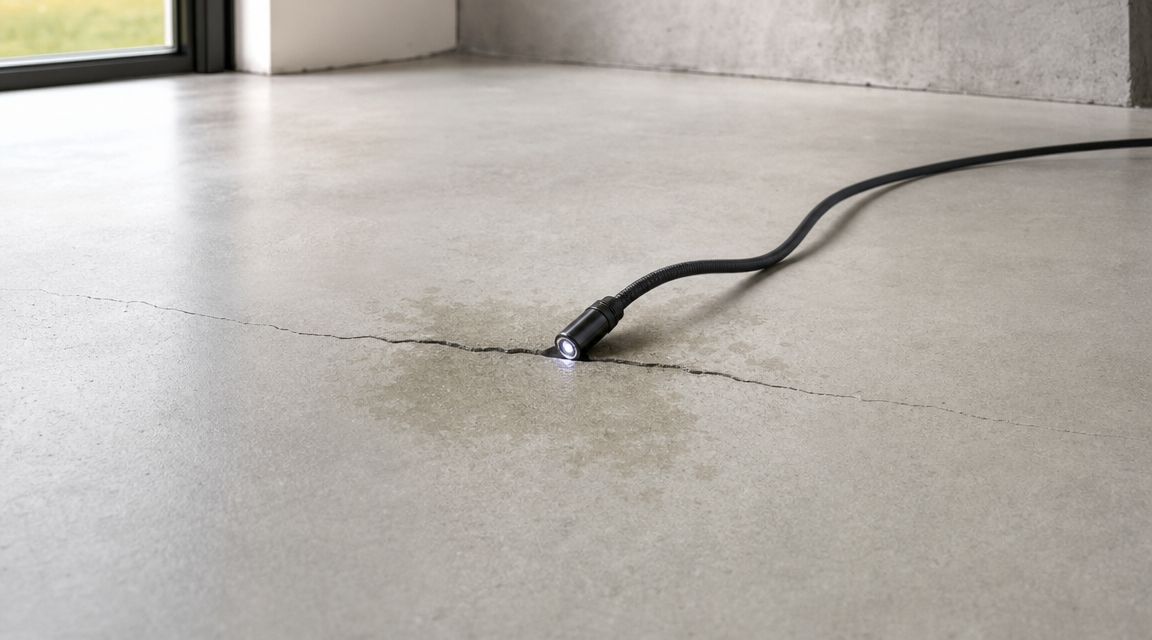
A slab leak often gets mistaken for ordinary cracking or settlement until someone notices warm spots on the floor, damp areas indoors, unexplained moisture, or a water bill that doesn't make sense. At that point, the repair stops being just a concrete question.
This slab leak repair breakdown puts slab-leak repairs at about $2,000 to $6,000, with rerouting alone running $2,000 to $15,000 depending on the chosen solution. The total bill can include leak detection, jackhammer access, pipe repair, rerouting, patching, and floor restoration.
That's why homeowners in Dunnellon and Lecanto sometimes hear a number that feels high for “just a crack.” The concrete portion may be only one part of the invoice.
Signs the problem may not be concrete alone
Not every slab issue points to plumbing, but these are the situations where a deeper check makes sense:
- Interior moisture: Damp flooring or unexplained musty spots
- Repeated cracking in the same area: Especially if prior repairs didn't hold
- Warm areas on the floor: Sometimes associated with hot water line leaks
- Water-related finish damage: Flooring, baseboards, or adjacent materials showing distress
When water is coming from inside the slab, a surface repair can hide the evidence for a while, but it won't stop the damage.
This is one reason a good estimate includes questions that may seem unrelated to concrete. A contractor who asks about moisture, plumbing history, or indoor floor changes is usually trying to keep you from paying twice.
Decision Guide Repairing vs Replacing Your Concrete Slab
A homeowner calls after a heavy summer rain. One corner of the patio has dropped, water is holding near the house, and the first quote says "repair" while the second says "replace." In Central Florida, that call usually comes down to one question. Is the slab itself the problem, or is the ground under it still changing?
When repair makes sense
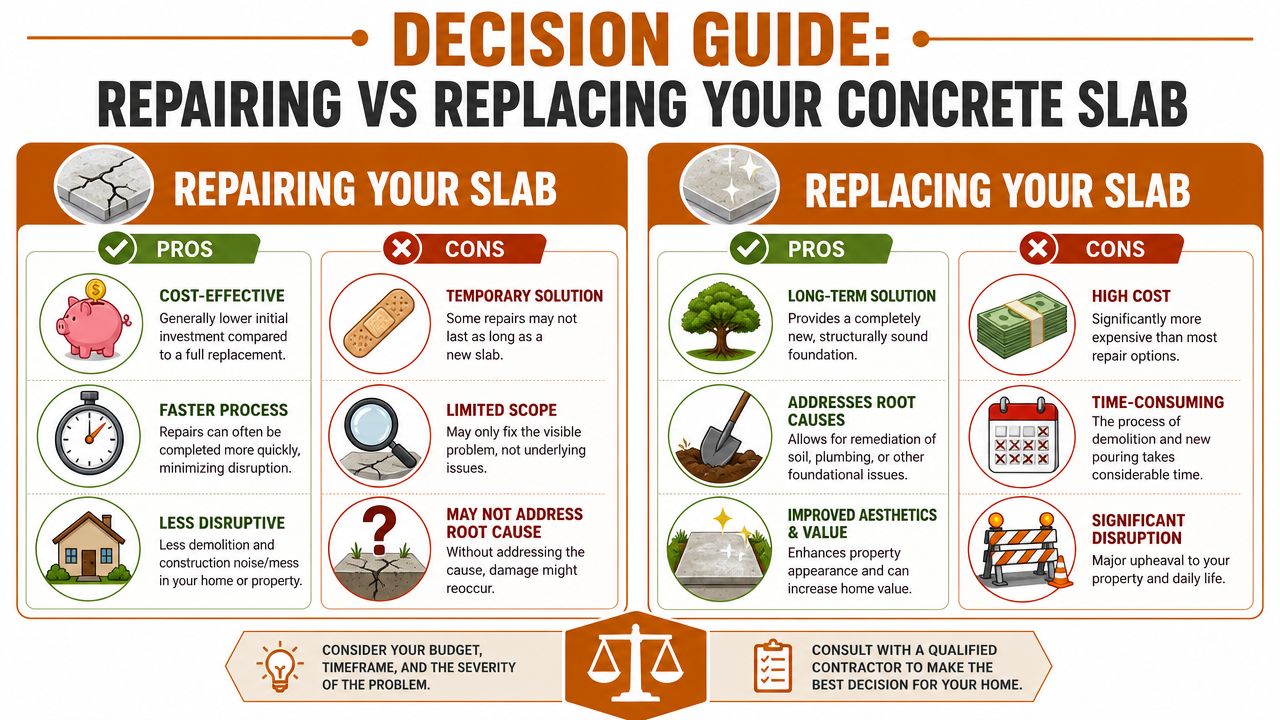
Repair is the right call when the slab still has good structure and the failure is limited to one area. Earlier cost ranges in this guide already showed why. A targeted lift, crack repair, or partial resurfacing usually costs a lot less than tearing out and repouring sound concrete.
What matters is whether the cause can be corrected at the same time. If one section settled because runoff kept washing out support, fixing the grade and repairing the slab can hold up well. If the slab is stable everywhere else, replacement often adds cost without adding much value.
Repair usually makes sense when:
- Settlement is isolated: One corner, one panel, or one trouble spot has moved, not the whole slab.
- The rest of the slab is holding: Cracking is limited and the concrete still feels solid under load.
- The base problem is fixable: Drainage, minor voids, or edge erosion can be addressed with the repair.
- Appearance is secondary to function: A small color or texture difference is acceptable if the slab performs well.
For homeowners weighing that option, concrete repair and resurfacing services can be the practical choice when the slab is still worth saving.
When replacement is the better value
Replacement makes more sense when the slab has lost too much of its support, too much of its surface, or too much of its useful life. I tell homeowners this on estimates all the time. A cheaper repair is not the lower-cost decision if you are likely to pay for another fix after the next wet season.
That comes up often in Central Florida because heat, long rain cycles, and shifting moisture in sandy soils can keep exposing the same weak spots. If several sections are moving, if old repairs keep reopening, or if the slab was poured on poor base prep to begin with, replacing it gives you one chance to correct grade, compaction, and thickness together.
Replacement is usually the better value when:
- Several areas have settled or separated: The problem is spread across the slab, not confined to one section.
- Previous repairs have failed: Patches, fillers, or overlays did not last.
- Surface damage is widespread: Flaking, scaling, or breakdown extends across large areas.
- The slab carries vehicles or heavier daily use: Driveways and working pads need more reliability than a lightly used walkway or patio.
- Drainage corrections require major rework: Sometimes the cleanest fix is removal, base correction, and a new pour at the right elevation.
Before deciding, it helps to see the basic trade-offs in motion.
How to make the call in Central Florida
In Belleview, Inverness, or The Villages, the repair versus replacement decision should be based on service life, not just the first invoice. A slab that is ugly but stable can often be repaired. A slab that keeps moving after each stretch of rain usually needs a harder look.
Start with four jobsite questions:
- Is the movement active or old? A stable crack is different from a slab that is still dropping.
- Can the water be controlled? If runoff, downspouts, or low grading stay the same, the repair may fail for the same reason.
- How much of the slab is still sound? Saving 80 to 90 percent of a slab is different from trying to save 30 percent.
- What does the slab need to do? A backyard pad has more room for repair than a driveway approach or garage slab.
Bottom line: Repair the slab if the concrete is still sound and the cause of failure can be corrected. Replace it if the slab has broad movement, repeated failure, or poor support that makes another repair a short-term patch.
That is how experienced contractors in this part of Florida size up the job. The decision should match the slab condition, the site conditions, and how long you expect the fix to last.
Get an Accurate Estimate in Marion and Citrus County
A homeowner in Ocala or Homosassa will often ask for a ballpark number over the phone. I can give a rough range, but that is all it is. Slab repair pricing gets real only after someone sees the concrete, the drainage, and the ground around it.
Two slabs with the same crack can price very differently. One may need a simple repair. The other may need water control, soil correction, saw cutting, or partial replacement before the repair will hold through another wet season.
What a solid on-site estimate should include
A good estimate starts with the site, not the sales pitch. The contractor should look at how water moves across the property, whether the slab edge has washed out, how close the house or fence lines are, and whether there are signs of past patching that already failed.
You should expect questions like these:
- When did you first notice the damage? A crack that has stayed the same for years is priced differently than one that widened after the last stretch of heavy rain.
- Where does water go during storms? In Central Florida, runoff and standing water often explain why one corner drops and another stays put.
- What is near the slab? Downspouts, irrigation, tree roots, plumbing lines, and pool decks can all change the repair plan.
- How is the slab used every day? A walkway, patio, driveway, and garage floor do not get repaired the same way because the load and finish expectations are different.
The written scope should also be clear. It should spell out surface prep, protection of nearby areas, the repair method, and what is not included. If drainage correction, void filling, or demolition are separate charges, they should be listed that way.
Why local conditions matter in Central Florida
National cost guides help with rough budgeting, but they do not account for Florida conditions. In Marion and Citrus County, sandy soils, fast summer storms, high moisture, and long heat cycles all affect slab performance and repair cost. A cheap repair on a dry, well-supported slab can be money well spent. That same repair on a slab with active washout underneath usually turns into a callback.
Access matters too. A backyard slab in Dunnellon with open access may be straightforward. A patio in The Villages or a pool deck in Crystal River can take more labor if crews have to protect screens, work through tight gates, or match existing finishes.
The best estimates are specific. They tell you what failed, why it failed, what can be repaired now, and what conditions may shorten the life of that repair. That is the level of detail homeowners should expect before approving any concrete work in Marion or Citrus County.
Frequently Asked Questions About Concrete Repair
Can I just patch the crack myself
Sometimes, for a very small surface crack, a homeowner patch can improve appearance for a while. The problem is that DIY patching doesn't tell you why the crack formed. If the slab is moving, holding water, or losing support underneath, a store-bought filler usually won't solve it. It can also make later diagnosis harder if it covers the original crack pattern.
Will insurance cover a cracked or sinking slab
That depends on the cause and your policy. Some damage may be treated differently depending on whether it came from a sudden event, plumbing issue, or long-term settling. The important step is documenting the condition early and getting a professional evaluation so you understand whether the problem looks cosmetic, structural, or tied to another system like plumbing.
Ask two questions before filing anything: what caused the slab to fail, and what portion of the repair is concrete work versus another trade.
How long should a concrete repair last
A good repair lasts longer when it matches the actual failure. Crack filling can hold well on stable concrete. Surface work can perform well when the slab is sound and properly prepared. Leveling can be worth it when the support problem is also corrected. Repairs fail early when the crew treats movement as a cosmetic issue and skips the underlying drainage or subgrade problem.
What should I ask a contractor before approving the job
Ask direct questions and listen for direct answers.
- What caused this damage: If the answer is vague, the repair plan may be vague too.
- Is this slab still a good candidate for repair: You want honesty here, not a quick sale.
- What prep is included: Surface prep and surrounding protection matter.
- Will this fix the cause or only the symptom: That's often the most important question.
- What disruption should I expect: Access, noise, cure time, and cleanup should be clearly explained.
Is resurfacing the same as structural repair
No. Resurfacing can improve the look and function of a worn slab when the base concrete is still sound. It does not replace support under a settled slab, stop active movement by itself, or correct a plumbing leak below the concrete. It's a good option in the right situation, but it isn't a cure-all.
If you're dealing with a cracked, uneven, or failing slab in Ocala, Dunnellon, Belleview, Crystal River, Inverness, Homosassa, Lecanto, Hernando, Summerfield, Silver Springs, or nearby areas, Riverside Sealing & Striping, LLC offers free, no-pressure on-site evaluations for homeowners across Marion and Citrus County. As Concrete and Asphalt Experts in Marion and Citrus County, the team handles concrete removal, replacement, repair, and surface restoration with practical guidance on whether repair or replacement makes more sense for your property.