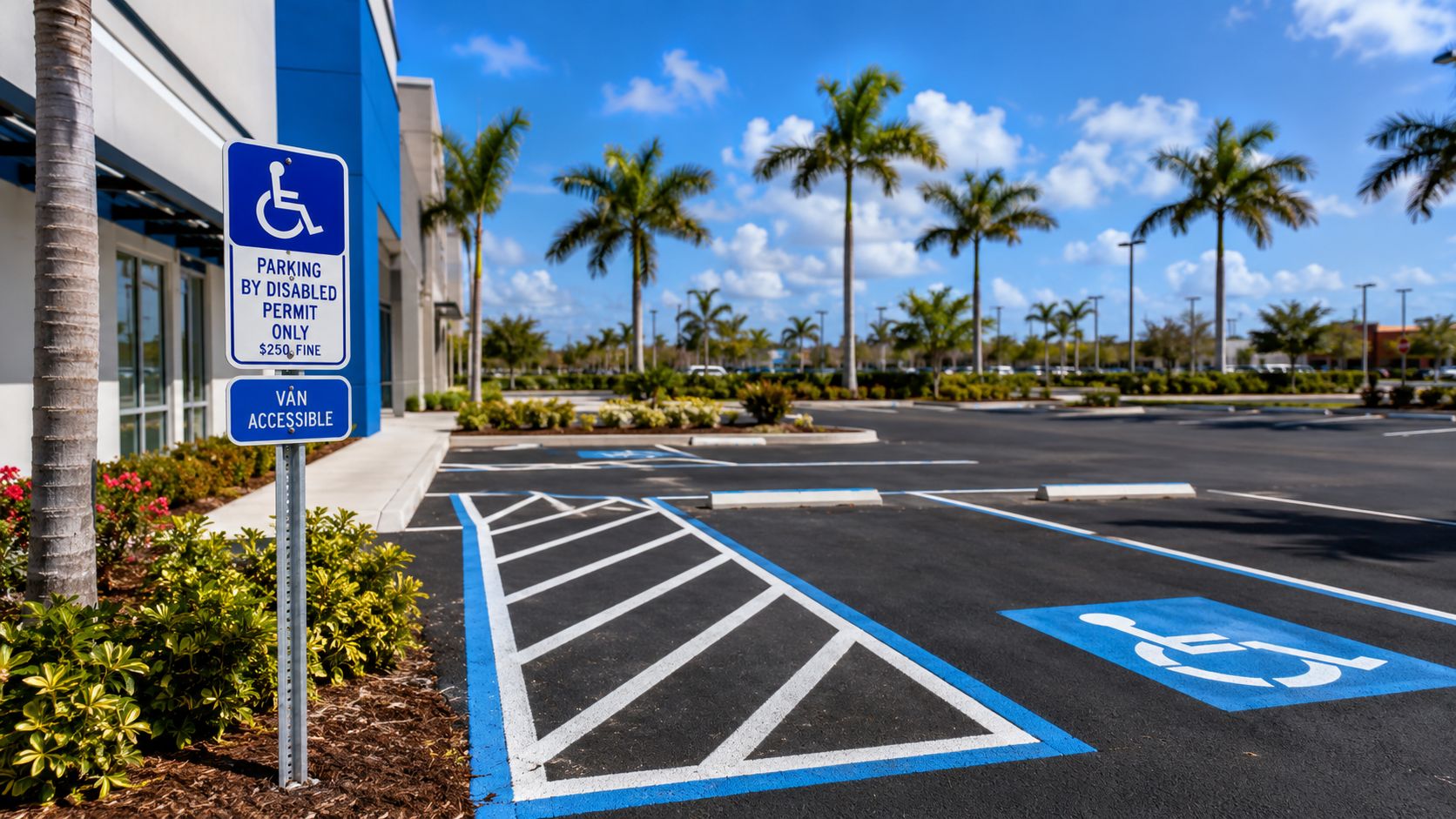
If you manage a shopping center in Ocala, a church in Dunnellon, or a small office property in Crystal River, this situation is familiar. You walk the lot, look at the blue signs, and think the parking probably passes. Then someone asks whether the signs are mounted correctly, whether the van space is marked the right way, or whether local enforcement would hold up if a driver parks there illegally.
That's where ADA parking sign requirements get expensive. Not just because of federal compliance, but because a parking lot can look fine and still fail in the field. In Marion County, FL and Citrus County, FL, property managers also have to think about fading striping, storm wear, resurfacing work, and whether the sign setup works with the actual concrete and asphalt layout.
This guide is written the way a contractor would explain it on site. Direct. Practical. Focused on what gets approved, what gets missed, and what usually causes rework around Ocala, Belleview, Silver Springs, Summerfield, The Villages, Inverness, Lecanto, Homosassa, Beverly Hills, Hernando, and surrounding Central Florida properties.
Table of Contents
- Your Guide to ADA Parking Compliance in Central Florida
- Federal ADA Parking Sign Essentials
- Van Accessible Signage and Space Requirements
- Correct Sign Mounting and Placement
- The Florida Enforceability Gap What Federal Guidelines Miss
- Your Partner for Full ADA Compliance in Marion and Citrus County
- Frequently Asked Questions About ADA Parking Signage
- Do small parking lots in Central Florida need accessible signs
- What's the most common ADA sign installation mistake
- Do faded markings matter if the upright sign is still there
- Should resurfacing be a trigger to review ADA signs and striping
- Can one contractor handle both concrete and asphalt parts of ADA work
Your Guide to ADA Parking Compliance in Central Florida
For any property open to the public, ADA parking sign requirements start with federal rules. Those rules are the baseline, not a suggestion. If the sign, the stall, or the van designation is wrong, the lot can create access problems for visitors and liability problems for ownership.
In Central Florida, the issue usually isn't one big obvious error. It's a cluster of smaller ones. A sign is mounted too low in Summerfield. A van plaque in Inverness sits below the required height. A striping crew repaints the asphalt in Homosassa but leaves outdated sign placement untouched. Each one seems minor until a complaint, inspection, or enforcement question lands on the manager's desk.
What owners and managers need to check first
Start with the parts that are visible and easy to verify on site:
- Sign presence: Every accessible space should be evaluated for proper identification.
- Mounting condition: Bent posts, leaning signs, and low-mounted assemblies are common field issues.
- Van designation: Van spaces need more than a standard accessible sign.
- Pavement relationship: The sign, striping, access aisle, and route need to work together.
Practical rule: If a driver can't clearly recognize the reserved space from the lane, or if enforcement can't rely on the sign as installed, the lot needs attention.
Why local conditions matter
Florida weather doesn't change the federal ADA standards, but it does change how quickly a compliant setup falls out of shape. UV exposure fades markings. Heavy rain exposes drainage and placement mistakes. Repeated traffic in retail centers around Ocala and Crystal River can loosen signposts, wear hatch marks, and make once-clear spaces harder to read.
That's why experienced contractors treat compliance as both a code issue and a maintenance issue. Concrete and Asphalt Experts in Marion and Citrus County look at the whole system, not just the sign face.
Federal ADA Parking Sign Essentials
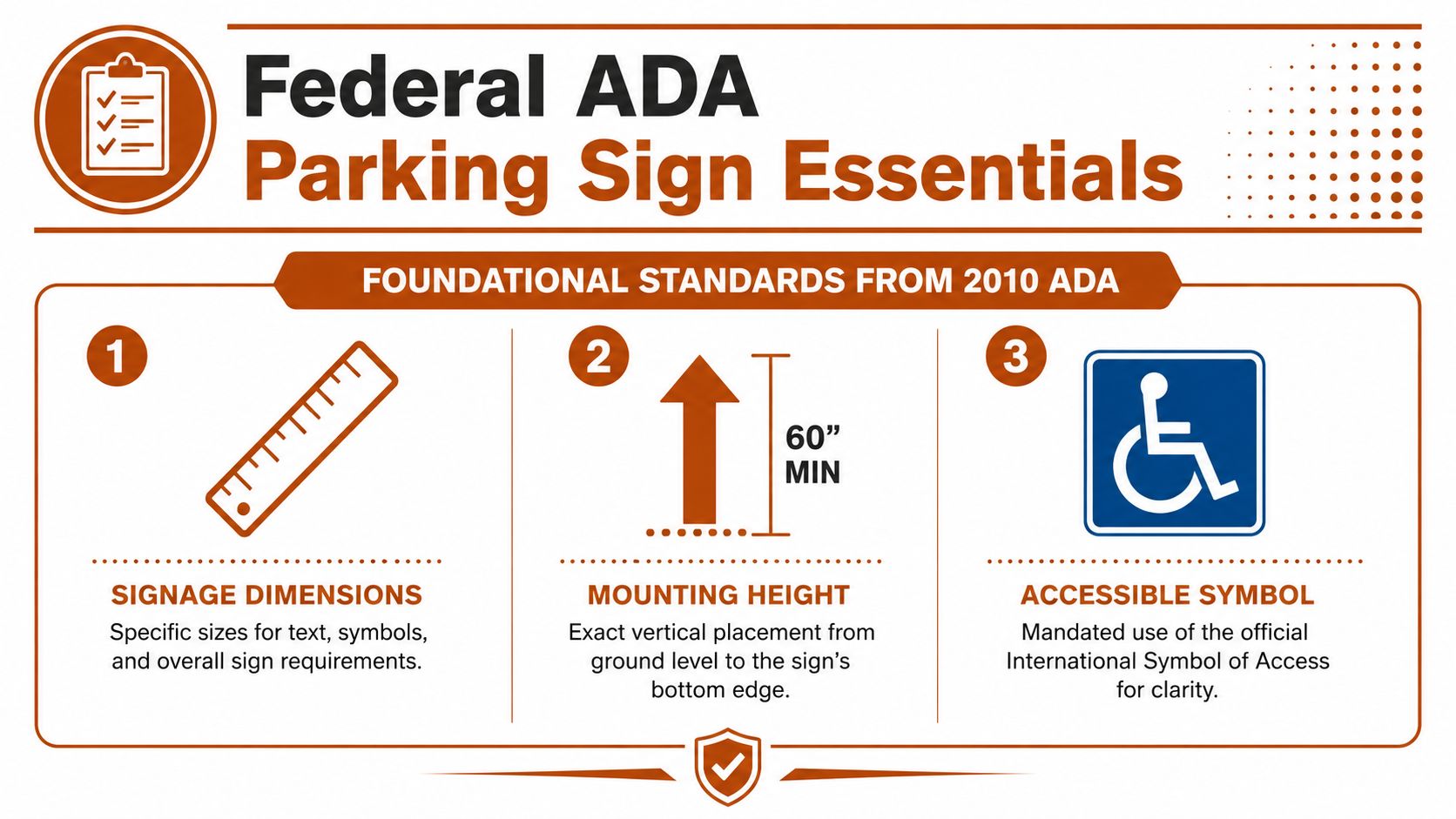
Federal ADA rules set the floor for parking sign compliance. For a property manager, that means every required accessible space needs clear identification with the International Symbol of Accessibility, and the sign has to be mounted high enough to stay visible when a vehicle is parked in the stall. The controlling federal source is the 2010 ADA Standards for Accessible Design, Section 502.6.
What every accessible sign must include
The basic federal check is straightforward. If the space is required to be accessible, the upright sign has to identify it, and the bottom of that sign must be at least 60 inches above the parking surface measured to the lowest edge of the sign.
| Element | Federal requirement | Practical takeaway |
|---|---|---|
| Symbol | International Symbol of Accessibility | Use the recognized accessible parking symbol |
| Height | Bottom edge at least 60 inches above the parking surface | Measure from finished grade, not from a curb face or planter edge |
| Visibility | Must remain visible when a vehicle is parked in front | Keep the post out of landscaping, wheel stop clutter, and other obstructions |
On paper, that sounds simple. In the field across Marion and Citrus County, low signs are still common after resurfacing jobs, re-striping, or post replacements. A lot can look clean and freshly painted and still fail a basic height check.
Federal standards also leave room for bad assumptions. They do not prescribe every detail property owners ask about, such as a universal sign color for standard accessible stalls. That is one reason lot reviews should cover the whole installation, including striping, aisle markings, and stall layout. A manager planning repairs should compare the signs with the rest of the ADA parking lot striping requirements before ordering materials.
Federal minimums leave room for field mistakes
Another point that trips people up is sign size. The ADA standards focus on identification and mounting, while traffic control practice often fills in the practical details. The Manual on Uniform Traffic Control Devices parking sign guidance is commonly used as the working reference for sign format and helps contractors order signs that are readable and familiar to drivers.
That distinction matters in Florida. A sign can meet the federal concept of identification but still create problems if it is undersized, poorly placed, faded, or installed where code enforcement or law enforcement cannot rely on it. Federal minimums protect the baseline. They do not always protect the owner from local scrutiny, complaints, or avoidable liability.
Small lots create another common gray area. Federal rules include a limited exception for lots with four or fewer spaces, where the accessible space is not required to have an upright sign. In practice, many owners in this area still install one. I recommend that approach on small private lots because it improves visibility, reduces confusion, and puts the property in a better position if someone questions the setup later.
Standard accessible spaces and van spaces should also be treated separately in your review. The federal sign requirement starts the same way, but van spaces add another layer of designation and layout that needs its own check.
Van Accessible Signage and Space Requirements
A common Ocala-area failure goes like this. The lot has the right number of accessible spaces on paper, but the only stall a lift-equipped van can use is missing the extra plaque, squeezed against the wrong aisle width, or routed under a low overhang. That is where owners get exposed. Federal minimums address the designation, but local complaints and site inspections usually focus on whether a van user can park, deploy, and reach the building without a problem.
The van count rule property managers need to remember
The federal standard requires a portion of accessible spaces to be marked for vans. The ADA Standards for Accessible Design set that ratio at one of every six accessible spaces, or fraction of six.
That rule catches managers on larger properties because they count total accessible stalls correctly, then miss the van split. Shopping centers, medical offices, churches, and community clubhouses around Marion and Citrus County run into this after restriping or expansion work, especially when the parking count changed but the signage package did not.
The sign itself has to do two jobs. It must identify the space as accessible, and it must also identify it as van accessible. If the extra designation is missing, the stall is incomplete even if the paint layout looks close. For a practical side-by-side reference on layout and marking, review these ADA handicap parking space requirements.
Two van layouts and one route problem owners miss
The same ADA standards allow two compliant van configurations:
- A 132-inch wide parking space with a 60-inch access aisle
- A 96-inch wide parking space with a 96-inch access aisle
They also require 98 inches minimum vertical clearance at the van space, along the van access aisle, and on the vehicle route to and from the space.
That clearance point is where older Florida properties get into trouble. I see this on retrofit jobs all the time. The stall gets restriped and a new sign goes up, but the route still runs under a canopy, carport edge, breezeway beam, or hanging utility line that does not clear a full-height van. The space may look compliant from the driver's seat of a sedan and still fail the user who needs it.
A fast field check helps. Stand at the van stall, then walk the actual route a lift van would take from entry to parking to exit. Check the aisle width, the curb transition, and any overhead obstruction. In Marion and Citrus County, that practical review matters because enforcement pressure does not stop at the stripe and post. If a van user cannot use the full route safely, the owner still has a problem.
Correct Sign Mounting and Placement
Most ADA sign problems aren't about ordering the wrong sign. They come from installing a good sign in the wrong place or at the wrong height.

Where signs should go in the real world
The sign should be placed where it clearly identifies the space it serves and remains visible when a vehicle is parked there. In practice, that usually means mounting it at the head of the stall on a post that isn't blocked by landscaping, carts, or stacked materials.
Three placement mistakes show up constantly on commercial properties:
- Obstructed signs: Shrubs, utility boxes, and low tree branches block visibility.
- Misaligned posts: The sign sits between stalls and creates confusion over which space is reserved.
- Afterthought installation: A restriped lot gets a sign dropped wherever there was room, instead of where the stall layout requires it.
Those are real maintenance issues in busy lots from Ocala to Beverly Hills, especially after resurfacing or site reconfiguration work.
The two-part sign mistake that fails inspections
A lot of van spaces use a two-part assembly, with the accessibility sign above and the “van accessible” plaque below. That setup causes one of the most common installation failures.
According to this two-part sign mounting explanation, the 60-inch minimum mounting height applies to the bottom of the lower sign element, not the top ISA panel. If the installer measures to the top sign and stops there, the lower plaque ends up too low and the installation becomes non-compliant.
That's the detail many crews miss.
A short visual walk-through helps make that mistake easier to spot on site.
For managers in Hernando, Silver Springs, or older shopping centers in Marion County, FL, this is worth checking even if the signs look professionally installed. A clean install isn't always a compliant install.
The Florida Enforceability Gap What Federal Guidelines Miss
Federal ADA rules tell you the baseline. They don't always tell you what makes a sign enforceable under state or local law. That gap causes trouble for owners who assume a federally compliant sign automatically gives them full protection on the ground.
Why a federally compliant sign can still create problems
The issue is simple. A sign can satisfy federal minimums and still fall short of what local enforcement expects for ticketing or legal backing.
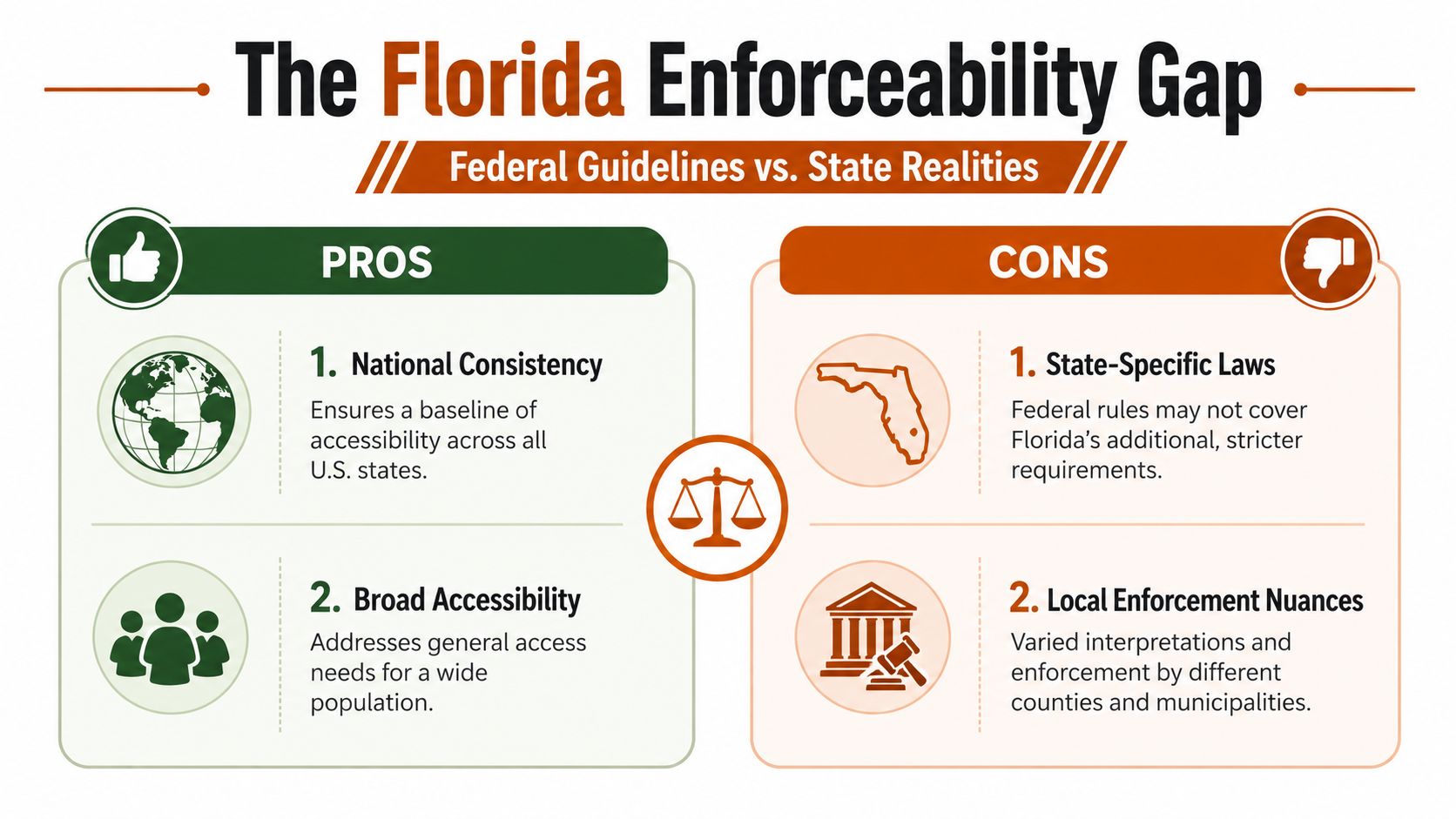
The clearest example in the verified material comes from outside Florida, but the lesson applies directly here. According to Disability Rights North Carolina's accessible parking guide, federal standards don't mandate penalty text, yet some states do. North Carolina requires signs to state “Maximum Penalty $250” for enforcement validity. That creates a compliance gap for property managers who rely only on federal guidance.
That same kind of gap is what Florida owners need to watch for. If a manager in Marion County or Citrus County orders generic online signs based only on national summaries, those signs may not match what local enforcement, counsel, or municipal review expects.
A property can be “close” on paper and still weak in enforcement. That's not where you want to be when a complaint starts.
What this means for Marion and Citrus County properties
This shows up in ordinary situations, not rare edge cases.
One lot has the right sign, but the post sits behind overgrown landscaping in Homosassa. Another has a van plaque mounted too low in Lecanto. Another has upright signs in place, but the asphalt markings are so faded in Ocala that drivers can't read the access aisle clearly. The owner thinks the lot is compliant because the signs exist. In reality, the parking area is hard to enforce and harder to defend.
A practical review in Central Florida should include:
- Local code confirmation: Check what local jurisdiction and enforcement practice expect beyond federal minimums.
- Sign text review: Don't assume a generic catalog sign is enough.
- Visibility review: Landscaping, vehicle overhang, and weather wear all matter.
- Whole-lot coordination: The sign, pavement marking, and access path need to function as one system.
Florida climate adds another layer. Heat, rain, and constant UV don't change the rulebook, but they do speed up fading, corrosion, and visibility loss. On lots in Crystal River, Summerfield, and The Villages, that means maintenance isn't cosmetic. It's part of keeping the parking area usable and defensible.
Your Partner for Full ADA Compliance in Marion and Citrus County
ADA parking compliance isn't just about buying the correct sign. It usually takes coordinated concrete work, asphalt maintenance, striping, and sign installation to get the lot fully right.
ADA compliance is a sign problem and a pavement problem
A compliant setup depends on what happens above ground and on the surface below it.
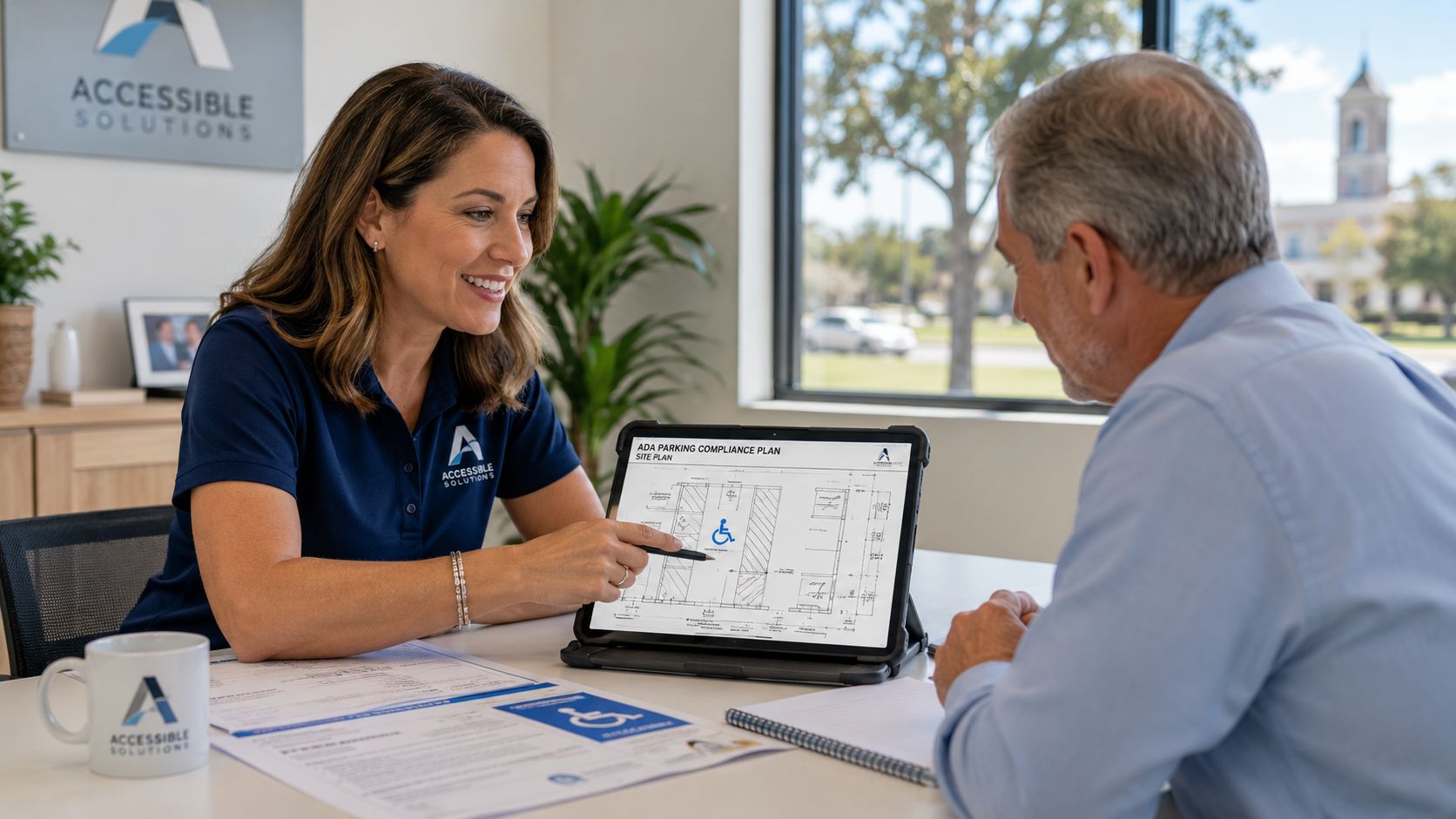
If the post is set poorly, the sign can lean or shift. If the concrete base is wrong, the install won't stay reliable. If the asphalt is worn, the access aisle and symbols lose clarity. If the lot is sealcoated without a plan for restriping, the reserved spaces may come back misaligned or incomplete.
That's why experienced property managers usually want one contractor or one coordinated team to handle the sign post, concrete footing, pavement condition, and striping layout together. It avoids the common handoff problem where the striping crew blames the sign installer, the sign installer blames the paving layout, and nobody owns the whole result.
A company that handles broad pavement services, such as the work shown on Southern Striping Solutions, is often better equipped for this kind of coordination.
Why one contractor usually works better than three
For HOAs, churches, retail centers, and office properties in Belleview, Silver Springs, and across Citrus County, FL, the most efficient process is usually:
| Scope item | Why it matters |
|---|---|
| Concrete post footing | Keeps the sign stable and correctly placed |
| Asphalt repair or sealcoating | Restores the surface before final markings go down |
| Parking lot striping | Defines the stall, aisle, symbols, and traffic flow |
| Final sign installation | Ties the vertical sign to the finished pavement layout |
Owner's shortcut: If three vendors touch the same ADA stalls at different times, expect at least one alignment issue unless someone manages the whole sequence closely.
Licensed and insured contractors with local Central Florida experience also understand scheduling realities. Afternoon storms, heat, and active traffic patterns affect when work should be done and how long markings need protection before vehicles return.
Concrete and Asphalt Experts in Marion and Citrus County should be able to look at the lot as a complete access system, not just a sign order.
Frequently Asked Questions About ADA Parking Signage
Do small parking lots in Central Florida need accessible signs
Under the federal rule, a site with four or fewer total spaces must still provide one van-accessible space, but the sign identifying that space is not required under the federal guidance cited earlier. In practice, owners in Marion County, FL and Citrus County, FL should still verify whether local expectations or property-specific risk concerns make signage the better choice.
What's the most common ADA sign installation mistake
The most common one is the two-part van sign mounted from the wrong reference point. Crews often measure to the bottom of the top sign panel instead of the bottom of the lower plaque. That leaves the “van accessible” portion too low.
Do faded markings matter if the upright sign is still there
Yes. Even when the sign is still standing, worn markings create confusion for drivers and weaken the lot's overall clarity. In Florida conditions, UV, rain, and traffic wear out pavement markings faster than many owners expect, especially in busy commercial lots around Ocala, Crystal River, and Inverness.
Should resurfacing be a trigger to review ADA signs and striping
Yes. Any time a lot is being resurfaced, sealcoated, restriped, or reconfigured, it makes sense to review the ADA stalls, access aisles, and sign placement at the same time. That's usually the most efficient moment to fix layout errors, replace damaged posts, and make sure the finished work functions as one system.
Can one contractor handle both concrete and asphalt parts of ADA work
That's often the best arrangement. ADA parking areas typically involve sign posts, pavement markings, access aisles, and sometimes concrete adjustments near walkways or routes. A contractor that understands both surfaces can catch conflicts earlier and reduce rework.
If you need a practical review of ADA parking sign requirements for a retail center, office property, church, HOA, or mixed-use site in Central Florida, Riverside Sealing & Striping, LLC offers free, no-pressure consultations for properties across Marion County, FL, Citrus County, FL, and nearby communities. As Concrete and Asphalt Experts in Marion and Citrus County, the team handles parking lot striping, ADA upgrades, concrete work, and asphalt maintenance with reliable scheduling and local field experience.