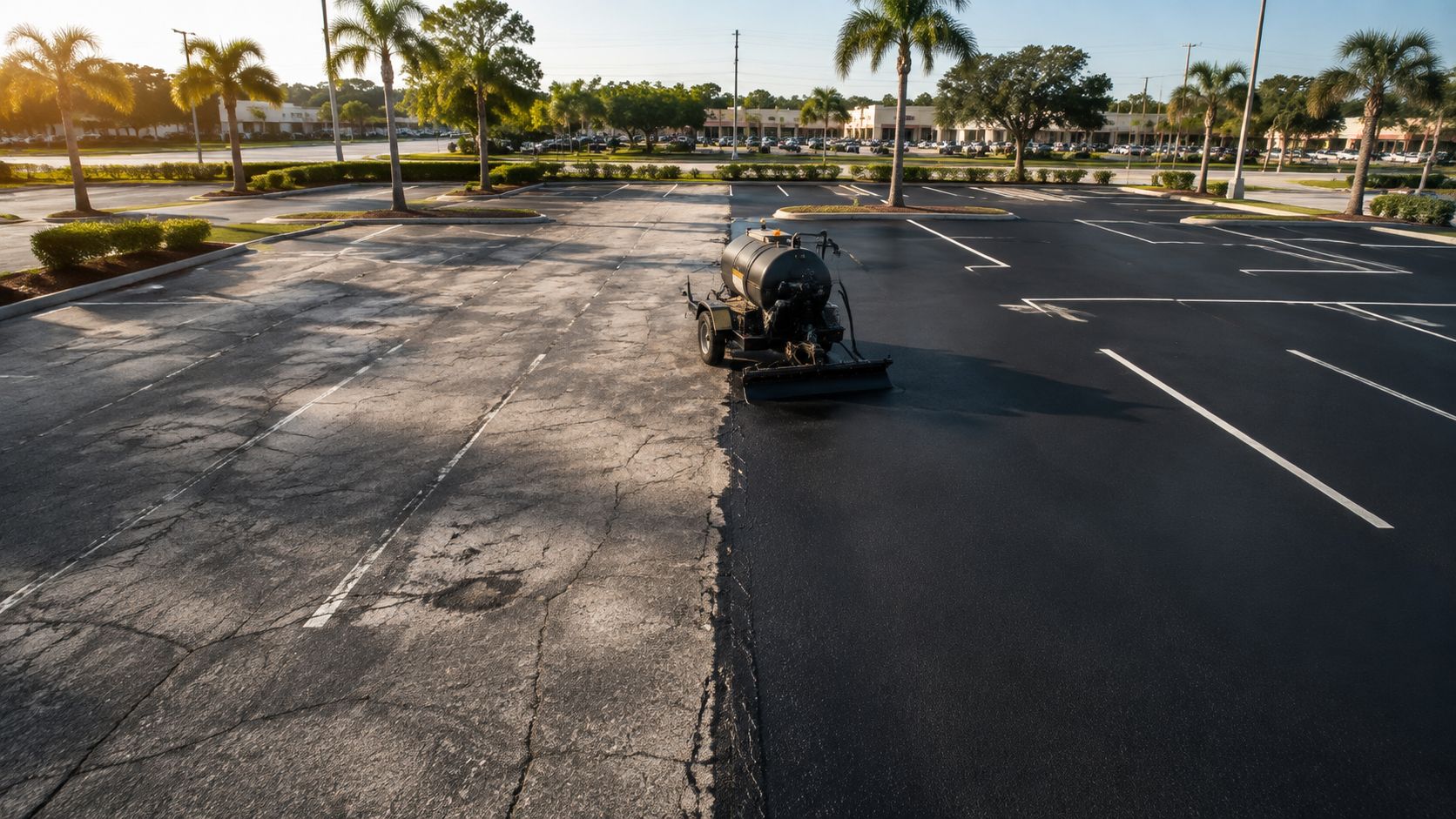
You pull into the lot just after sunrise, and the problems are already there. A fresh crack near the drain, stripes faded to a ghost of themselves, a low spot that holds last night's rain, maybe a pothole where the delivery truck keeps turning. In Marion County, FL and Citrus County, FL, that's usually not random wear. It's asphalt telling you the sun, water, traffic, and the base underneath have already started working against it.
For property managers in Ocala, Dunnellon, Belleview, Silver Springs, Summerfield, Crystal River, Homosassa, Inverness, Lecanto, Beverly Hills, Hernando, and The Villages, asphalt parking lot repair is rarely just about making the lot look better. Job is stopping small failures before they turn into structural ones. If you wait too long, the cost jumps fast, because preventive maintenance is far cheaper than resurfacing or full replacement, and regularly maintained lots can last about 25 to 30 years compared with roughly 15 years when maintenance is neglected, according to industry benchmarks from Cojo Asphalt.
Table of Contents
- What Central Florida Does to an Asphalt Parking Lot
- Reading the Distress Before You Choose the Repair
- Matching the Repair Method to the Level of Damage
- Understanding the True Cost of Asphalt Parking Lot Repair
- How a Professional Repair Is Executed
- ADA Compliance and Parking Lot Striping as a Maintenance Task
- When DIY Stops Making Sense on a Commercial Lot
- A Simple Annual Plan and Choosing Riverside Sealing & Striping
What Central Florida Does to an Asphalt Parking Lot
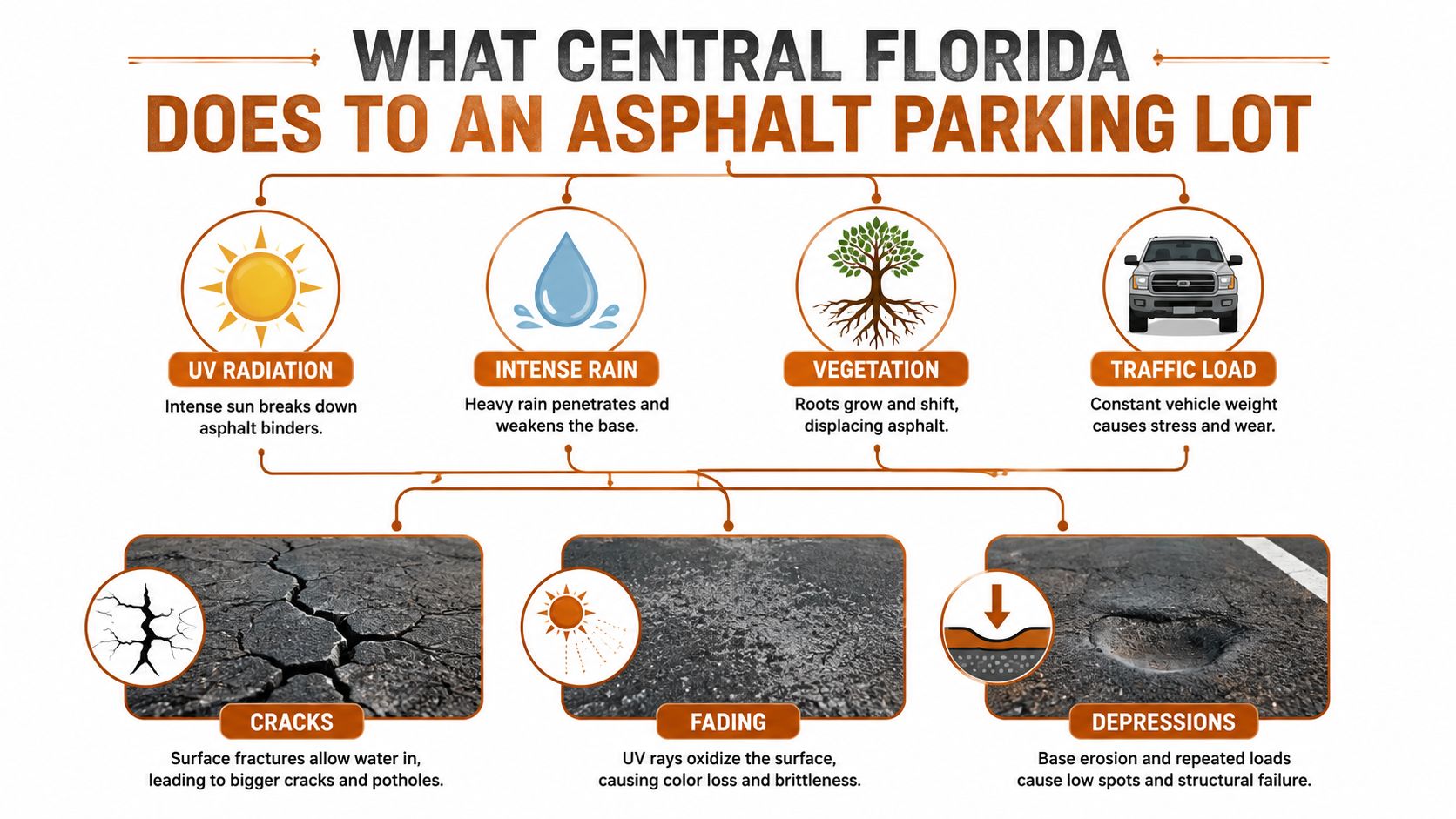
A property manager does not need a lab report to see the first signs of trouble. The lot shows it early in the morning, when the sun is low enough to make fading, cracking, and drainage problems easier to spot. In Ocala and Crystal River, the same pattern shows up again and again. The surface goes dull, striping fades, edges start breaking down near curbs or sidewalks, and then low spots begin holding water after a summer storm.
Surface Aging and Water Infiltration
Central Florida beats up asphalt in a way colder regions do not. Intense UV, daily summer thunderstorms, sandy subgrade, and root intrusion from live oaks and other vegetation attack the pavement from both directions, top down and bottom up. UV exposure dries and oxidizes the surface, which is why black asphalt turns chalky and brittle over time. Water works into open joints and cracks, then starts softening the layers below.
That matters in Marion County, FL and Citrus County, FL because the damage you can see is often only the symptom. A faded top layer is a maintenance issue. A crack that stays open through rainy season becomes a water path, and once the base softens, the repair changes completely. The lot may look like it only needs a cosmetic fix, but the problem can already be under the surface.
Practical rule: if a lot in Dunnellon, Inverness, or The Villages is shedding aggregate, holding water, or cracking in repeated patterns, assume the pavement is reacting to more than sun exposure.
That is why maintenance has to start with the environment, not the product. What works in a dry northern market can fail fast here if it does not account for heavy rain, sandy support, and tree growth. For a simple maintenance rhythm, property teams often schedule sealcoating and related care together, and a local overview like how often to seal coat asphalt is worth keeping in the file when you are planning the next cycle.
Reading the Distress Before You Choose the Repair
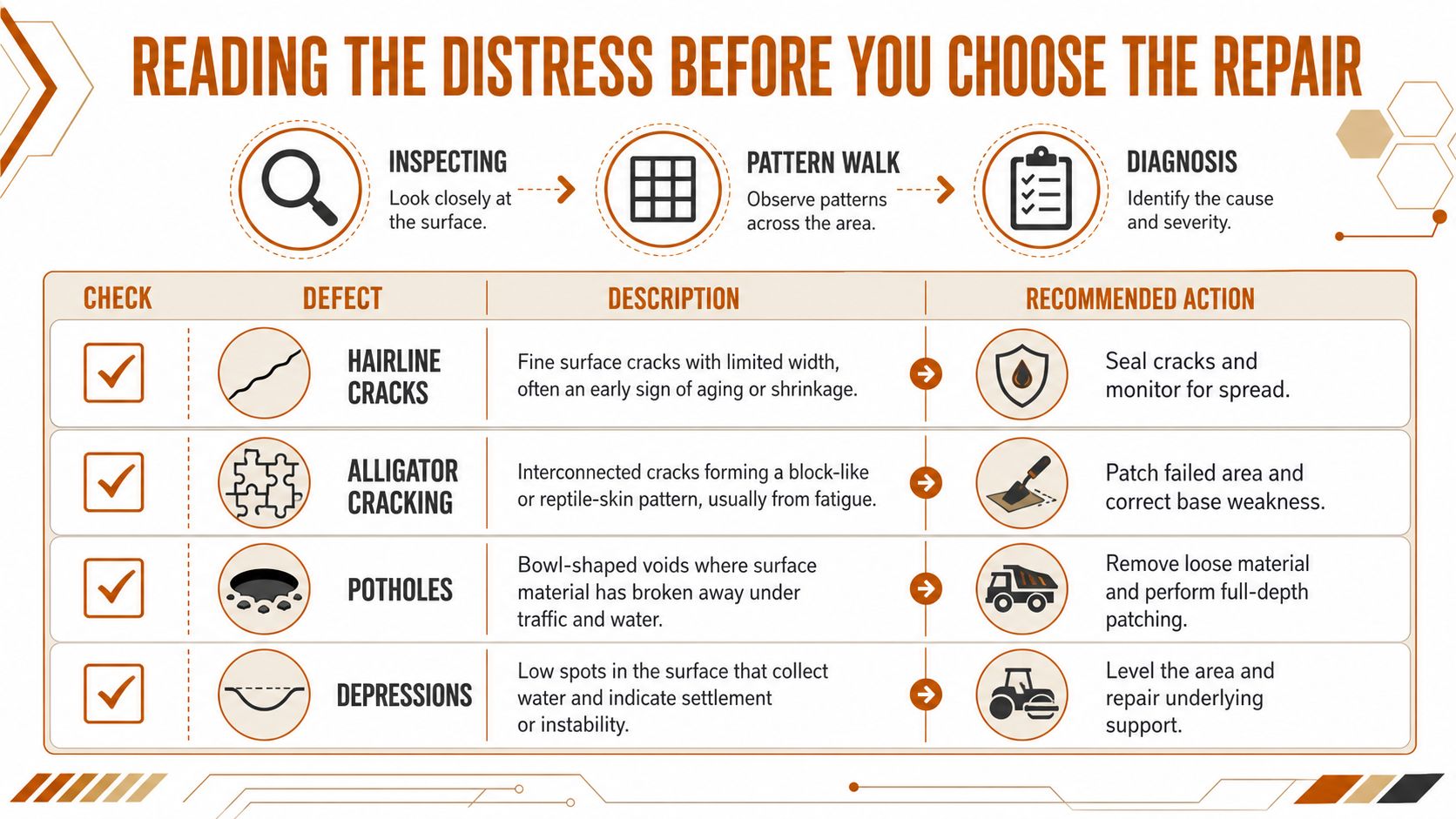
A lot of bad spending starts with a bad diagnosis. Somebody sees a crack, assumes it's minor, and buys a surface treatment for a problem that's already structural. The better habit is to walk the lot in a grid, slow enough to notice pattern, width, and movement. Once you learn what each defect says, the repair choice gets much clearer.
What Each Crack Pattern Means
Hairline cracks under 1/8 inch can usually be treated with surface seals, while cracks between 1/8 and 1/2 inch should be routed and sealed, according to a technical parking-lot repair guide from VFPaving. Once cracks start knitting together into alligator patterns, the problem is no longer cosmetic. That pattern points to structural or subgrade failure, and surface-only work won't solve it.
Raveling is different. That's the loose, worn top surface where aggregate starts coming free. Rutting is the wheel-path depression that shows the surface has deformed under traffic. Edge crumbling near curbs and sidewalks usually means the pavement has been stressed at the margin, often by traffic, water, or weak support at the edge. A wide crack, pooled water, or vegetation pushing through the opening is a warning that the opening is already acting like a drainage channel.
If you want one field test that tells the truth fast, use a screwdriver. Press it into the cracked area. If the asphalt moves, the issue isn't just on top. The support below has already lost integrity, and a surface seal over that area is money wasted.
If the lot flexes under a screwdriver, stop treating it like a crack and start treating it like a failure.
A quick visual can save a lot of guesswork, but the key is to tie each distress type to the layer that failed. Surface wear points to oxidation and age. Repeated cracking or potholes point deeper, into the base or subgrade. That distinction is what keeps a property manager from paying twice for the same problem. A local repair walkthrough can also be matched against parking lot crack sealing so the owner knows what crack sealing can and can't fix.
Matching the Repair Method to the Level of Damage
The right repair matches the failure in front of you. In Central Florida, that starts with what the lot is doing under heat, water, and traffic. A cracked surface from UV oxidation needs a different fix than a lot that has lost support because sand base washed out or the subgrade stayed wet after storms. If the repair does not match the trigger, the same problem comes back.
| Distress Type | Recommended Repair | Typical Cost Range |
|---|---|---|
| Hairline cracks | Crack sealing or surface seal | $0.25 to $0.90 per square foot for crack sealing, according to One and Done Prep |
| Working cracks | Routed and sealed repair | The same $0.25 to $0.90 per square foot range often applies to crack sealing, according to One and Done Prep |
| Small potholes | Localized patching | Small pothole repairs are often priced around $100 to $350 each, according to One and Done Prep |
| Interconnected alligator cracking | Full-depth patching or replacement | Replacement becomes the better investment when annual repairs exceed 20% to 25% of replacement cost or when more than 30% of the lot has structural damage, according to One and Done Prep |
| Widespread surface wear over a sound base | Overlay or resurfacing | Overlay decisions are often separated from replacement in asphalt overlay vs replacement guides |
Crack Sealing, Patching, Resurfacing, Replacement
Crack sealing buys time by keeping water out of the structure. It does not rebuild a base that has already failed. On a lot where the crack edges are still tight and the pavement is firm underfoot, sealing is usually the right first move. Once the crack opens wide enough to carry water into the base, the repair has to do more than fill a line on the surface.
Patching is for a localized failure. It works when the bad area is limited and the surrounding asphalt still has support. Resurfacing makes sense when the base is sound but the top layer is tired, oxidized, or lightly distressed from sun and traffic. That is the point where a manager should compare the cost of an overlay to the cost of starting over, because the cheaper option is only cheaper if the base can carry it.
Replacement is the hard call, and sometimes it is the only honest one. If alligator cracking is spread across a big share of the lot, or if potholes keep returning in the same spots, the pavement is telling you the structure underneath is gone. In Ocala shopping centers and Crystal River church lots, I have seen owners keep buying patch work for years when replacement would have stopped the leak in the budget sooner.
The trigger point is simple. Measure how much of the lot is breaking down, how fast the repairs come back, and whether the damage is tied to the surface or the support below it.
Good asphalt work follows the failure, not the wish.
That is why the first question is never what a crew can place on top. It is what the pavement needs underneath. If the problem is oxidation and light cracking, a surface treatment or seal can make sense. If the problem is saturated subgrade, base washout, or widespread structural cracking, a thin fix just hides the evidence for a little while.
Understanding the True Cost of Asphalt Parking Lot Repair
The cost usually becomes clear only after the lot starts failing in ways you can measure. In Central Florida, that failure often starts with UV oxidation that dries out the surface, sand base washout after heavy rain, or alligator cracking where the subgrade has stayed wet too long. Once those conditions show up, the price depends on whether you are preserving structure, rebuilding support, or just covering damage that will come back.
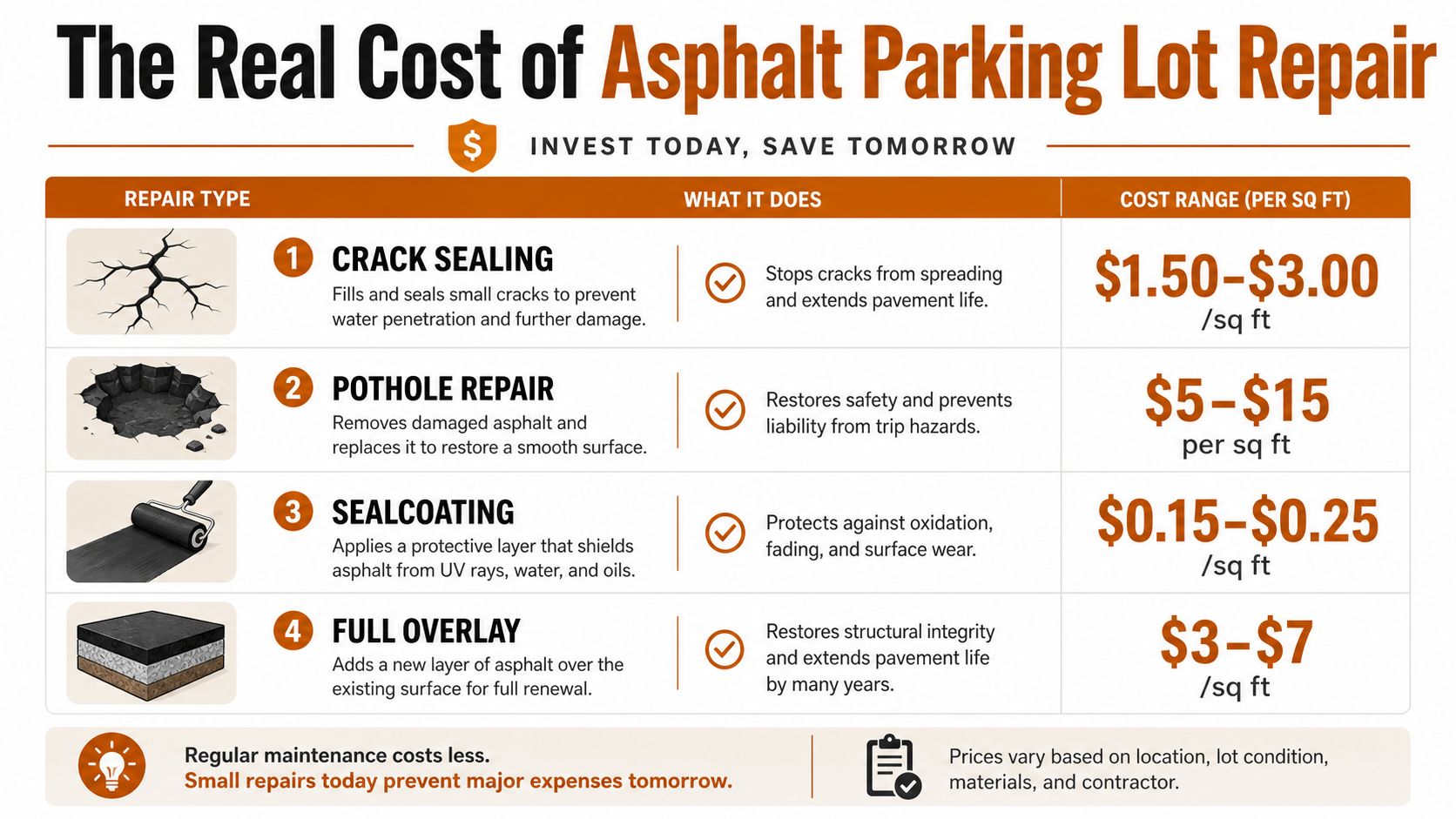
Preventive maintenance is commonly estimated at about $0.10 to $0.30 per square foot each year, while resurfacing can run $1.50 to $3.50 per square foot and full replacement $3 to $7 per square foot, according to the maintenance benchmark from Cojo Asphalt. That is the spread that makes timing matter. If the base still carries the load, maintenance buys time. If the pavement has already lost support, a low bid only postpones a larger bill.
What the Budget Looks Like on a Large Lot
On a 50,000-square-foot lot, those benchmarks translate to roughly $5,000 to $15,000 per year to maintain versus about $150,000 to $350,000 to replace, according to Cojo Asphalt. That kind of spread changes how property managers think about reserve planning. A lot that gets routine attention can last about 25 to 30 years, while a neglected one may fall toward roughly 15 years of service life, using the same benchmark.
The smaller line items still matter because they add up fast. Crack sealing commonly costs about $0.25 to $0.90 per square foot, and small pothole repairs are often priced around $100 to $350 each, according to One and Done Prep. Sealcoating is often recommended every 2 to 3 years after the first application, which should come within 2 or 3 years of paving, according to the same source.
The hidden costs are usually tied to what the surface has been hiding. Drainage correction, base stabilization, ADA upgrades, and striping can all change the scope once the crew opens the pavement and sees how far the failure goes. A bid that looks cheap at first can turn expensive if the lot has soft spots, standing water, or layout work that has to be done before the repair can hold.
| Cost Driver | Why It Changes the Price |
|---|---|
| Drainage correction | Standing water usually means grading or slope work |
| Base stabilization | Soft support has to be repaired before surface work |
| ADA upgrades | Accessible stalls and routes have to meet layout and signage needs |
| Striping | Repainted markings, arrows, and fire lanes are part of the finish |
A board in Crystal River, a retail owner in Belleview, or an HOA in Summerfield all run into the same math. The best time to spend is before oxidation, washout, or structural cracking forces a larger repair decision.
How a Professional Repair Is Executed
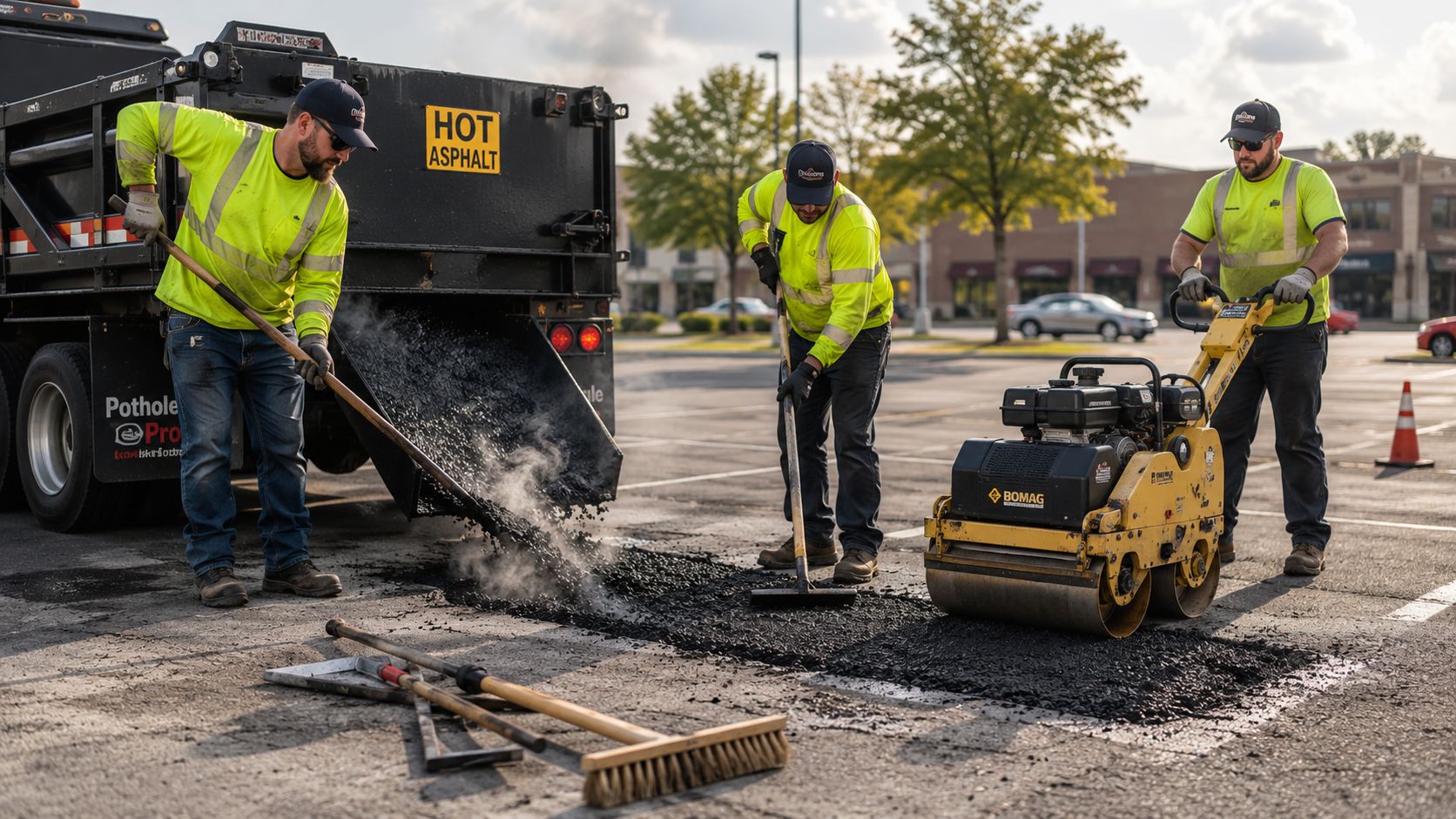
A lot can look fine from the street and still fail at the edges a few weeks later. In Central Florida, that usually means the crew missed a weak base, trapped moisture under the patch, or left oxidized asphalt around the cut where water can get back in. Good work follows the same order every time, cut clean, remove the bad material, rebuild the support, compact it properly, then protect the finished repair so it can handle sun, rain, and traffic.
What a Proper Patch Looks Like
The Asphalt Institute says the cutout should extend beyond visibly damaged pavement, be square-edged for compaction, be tacked on the vertical edges and bottom, and be filled with dense-graded hot mix asphalt. If the hole is deeper than 6 inches, the repair should be placed in two compacted lifts. That is not just a neat detail. It is what keeps a patch from bridging over soft material and breaking apart again.
If the failure has reached the base or subgrade, that weak material has to come out or be stabilized before replacement. In Ocala, Crystal River, and the surrounding areas, saturated subgrade and sand base washout are common reasons a patch looks good for a while and then settles or opens up again. Water left under the repair gives the lot the last word, and the lot usually wins.
A crew that skips the saw cut, leaves ragged edges, or lays hot mix over soft material is not repairing the pavement. They are covering up the problem long enough to make it look solved.
A patch is only as strong as what is under it.
After the repair, the surface still needs protection from oxidation and water intrusion. The first sealcoat should come within 2 to 3 years of paving or repair, and later coats should follow every 2 to 3 years, according to One and Done Prep. In Florida, that timing matters because UV exposure dries out the binder fast, and once the asphalt turns brittle, small cracks start carrying water into the base.
Sealcoating and Striping After the Repair
Once the asphalt is sound, striping has to be refreshed on the same maintenance cycle. Shopping centers, churches, schools, and HOAs depend on clear traffic flow, and faded markings turn a usable lot into one that is harder to read and easier to misuse. Fire lanes, directional arrows, handicap spaces, and crosswalks should all be checked during the same visit.
The job is not finished until the lot is protected and readable again.
ADA Compliance and Parking Lot Striping as a Maintenance Task
Striping on a commercial property is a safety and compliance job. Faded markings, missing signs, and unclear access aisles create confusion for drivers and exposure for owners, especially in busy lots around Ocala, The Villages, and Inverness.
The accessible side of the lot has to be planned, not guessed. Stall counts depend on the size of the lot, and the layout has to include proper access aisles, van-accessible spaces, signage, and routes that connect to the building entrance. If those markings fade out, the lot isn't ugly. It becomes harder to use and harder to defend.
The cleanest way to manage it is to pair striping with sealcoating. That way one mobilization handles the surface protection and the markings at the same time instead of sending crews back separately. Fire lanes, directional arrows, handicap spaces, and crosswalks should all be checked during the same visit.
Faded paint is cheap to ignore and expensive to defend.
For HOAs and commercial owners in Citrus County, FL and Marion County, FL, the practical step is to keep an eye on signs as well as paint. If the accessible stalls are there but the sign is missing or too weak to read, the job still isn't complete. The same goes for directional arrows that no longer guide traffic the way they should.
This is one place where Riverside Sealing & Striping, LLC fits naturally as a local option for commercial properties because the team handles parking lot striping, ADA upgrades, handicap spaces, and directional markings along with seal coating. That combination matters when the goal is a lot that works, not just a lot that looks fresh.
When DIY Stops Making Sense on a Commercial Lot
A maintenance crew can do a lot of good work on the edges of the job. They can keep drains clear, report new cracking, and sweep debris before it turns into a slip hazard. What they shouldn't do is pretend cold patch and a prayer can solve a structural lot.
Cold patch may get a hole out of the way for a short time, but it's not a substitute for proper cutout, base repair, and compaction. On a busy commercial lot, that kind of shortcut can fail fast and create liability if the repair breaks apart under traffic. ADA striping is another line most internal crews shouldn't cross unless they already know the layout and standards cold.
If you're comparing contractors, ask for proof of insurance, a written scope of work, and references from nearby jobs in Ocala or Crystal River. You want a crew that explains the repair sequence, not just the price. If they can't tell you what they're doing with the base, the edges, and the final markings, they're probably selling a surface result without understanding the failure underneath.
A licensed and insured paving crew is also the right call when the work involves structural patching, sealcoat spray application, hot-mix compaction, or layout-accurate ADA striping. That's not because the work is glamorous. It's because mistakes there get expensive, and sometimes they get dangerous.
A Simple Annual Plan and Choosing Riverside Sealing & Striping
The simplest maintenance rhythm is also the one most owners skip. Walk the lot in spring, fix the active failures in early summer, refresh sealcoat and striping together, then check it again in fall before heavier traffic periods hit The Villages or the holiday retail season. That pattern works because it lets you catch drainage issues, new cracks, and worn markings before they spread.
In practice, that means treating the lot like an asset, not a background surface. If the cracks are still tight, crack sealing and routine upkeep can hold the line. If the base has started to go, the plan shifts toward patching, resurfacing, or replacement based on what the distress is telling you.
Riverside Sealing & Striping, LLC fits that maintenance cycle as a third- and fourth-generation, family-owned concrete and asphalt maintenance company based in Dunnellon serving Marion County, FL, Citrus County, FL, and surrounding Central Florida areas. The company handles both concrete work like driveways, patios, slabs, and sidewalks, and asphalt services like seal coating, parking lot striping, ADA-compliant upgrades, handicap spaces, and directional markings. That matters for owners who want one local team to look at the whole property instead of splitting the work between unrelated vendors.
Free, no-pressure on-site consultations from 7 a.m. to 7 p.m. make it easier to get a written plan without turning the first conversation into a sales pitch. For property managers in Ocala, Dunnellon, Belleview, Silver Springs, Summerfield, Crystal River, Homosassa, Inverness, Lecanto, Beverly Hills, Hernando, and The Villages, the right move is usually simple. Get the lot evaluated, define the trigger points, and budget the repair before the damage forces your hand.
If your lot is cracking, fading, or starting to hold water, Riverside Sealing & Striping, LLC can help you sort out whether crack sealing, patching, sealcoating, striping, or a larger repair makes sense. Visit Riverside Sealing & Striping, LLC to schedule a no-pressure consultation and get a practical plan for your parking lot, driveway, or commercial property in Marion County or Citrus County.