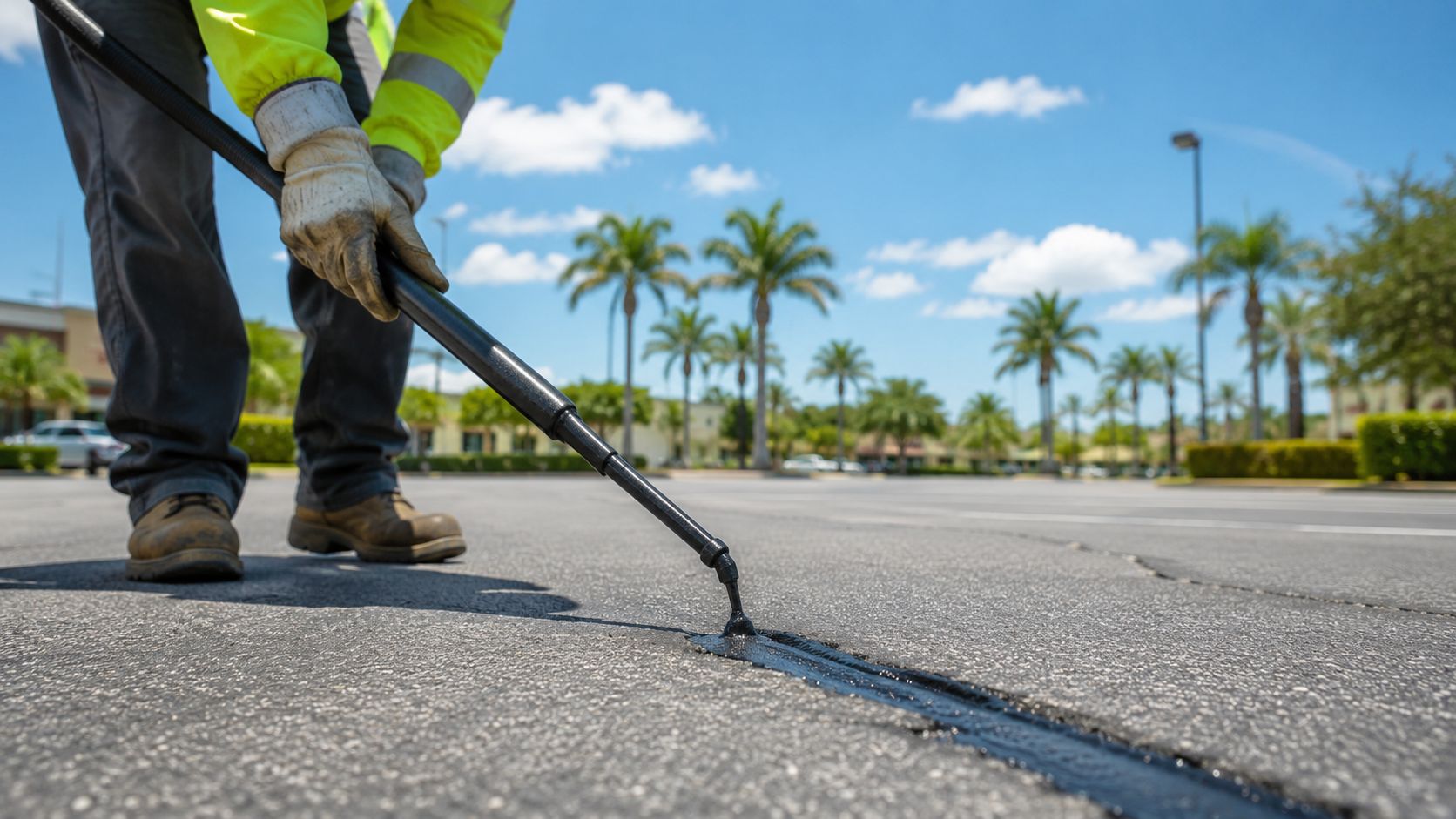
On a wet Monday after a heavy summer storm, a property manager in Ocala walks the back row of a lot and notices the same thing many managers in Marion County, FL eventually see. Small cracks that looked harmless a few weeks ago now hold dirt, moisture, and dark lines that seem to spread after every rain. In Central Florida, that's often the moment when parking lot crack sealing stops being a background task and becomes a real budgeting question, because water intrusion can turn a manageable surface issue into a much larger repair problem later. Riverside's asphalt parking lot maintenance overview is a useful starting point for owners who are trying to sort out what should be sealed now and what should wait.
Table of Contents
- Introduction
- What Parking Lot Crack Sealing Means
- Types of Cracks and Repair Methods
- Ideal Timing Frequency and Climate Impact
- Professional Crack Sealing Process
- DIY Versus Professional Pros and Cons
- Cost Ranges and Influencing Factors
- Choosing a Contractor and FAQ
Introduction
A cracked lot doesn't usually fail all at once. It starts the way dry skin starts to split, one small opening at a time, then water finds that opening and works underneath where you can't see it. That's why a manager in Dunnellon or The Villages who spots early cracks after rainy season isn't just looking at a surface issue, they're looking at the first sign of a maintenance decision.
The timing matters even more in Marion County, FL and Citrus County, FL, where heat, humidity, and frequent storms can keep cracks active. When moisture gets into the pavement structure, it can accelerate deterioration, which is why crack sealing is treated as preventive maintenance instead of a cosmetic touch-up.
For property managers in Ocala, Belleview, Summerfield, Silver Springs, Crystal River, Homosassa, Inverness, Lecanto, Beverly Hills, and Hernando, the question usually isn't whether cracks matter. It's whether the lot still has enough structure left for sealing to make sense, or whether the pavement has already moved into bigger repair territory. The rest of this guide breaks that down in practical terms.
What Parking Lot Crack Sealing Means
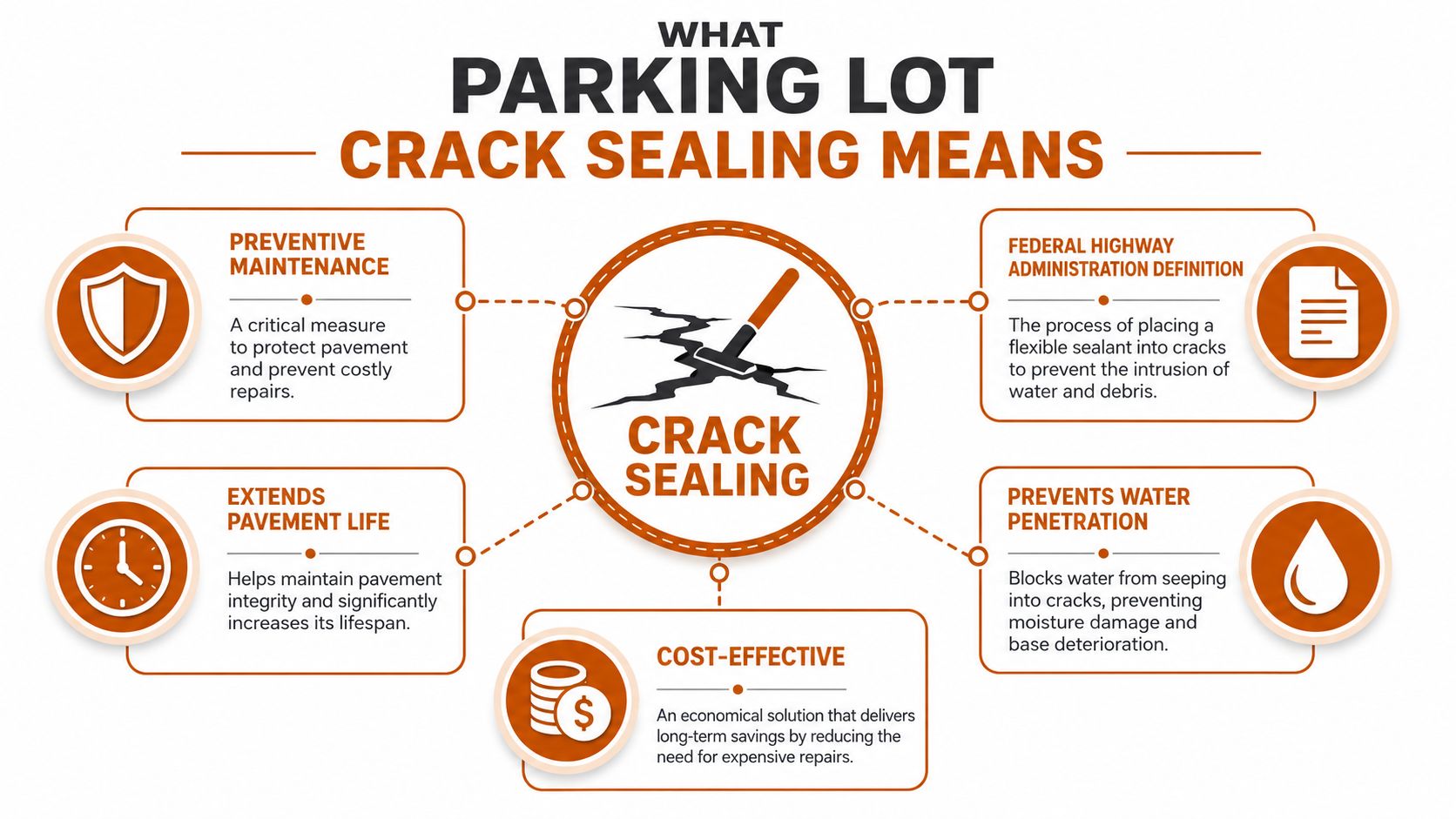
Parking lot crack sealing is the process of placing specialized material into or above cracks so water and debris don't keep traveling into the pavement. The Federal Highway Administration defines crack sealing as placing specialized treatment materials above or into cracks to stop water intrusion, with the goal of protecting the base rather than just patching the surface FHWA definition. That distinction matters because sealing is about keeping the structure underneath healthier for longer.
Think of it like sealing skin
A crack in asphalt behaves a lot like a split in dry skin. If the opening stays exposed, moisture enters and the surrounding material keeps weakening. A good seal closes that opening before the problem spreads deeper.
Practical rule: seal cracks while they're still narrow, because once the pavement starts showing wider, interconnected distress, sealing becomes less effective as a preservation tool.
In commercial parking lots, the best results usually come when cracks are still relatively small, commonly less than 1/2 inch wide technical guidance on crack size and preparation. That's where sealing can help slow water intrusion and extend service life. It's also why crack sealing is different from sealcoating. Sealcoating refreshes the surface, while crack sealing addresses the openings that let moisture in.
Why the detail work matters
The shape of the crack matters because sealant needs the right place to bond. Technical guidance says cracks should be clean and dry, and one white paper recommends a 1:1 width-to-depth ratio before sealing, with deeper cracks often filled using backer rod or similar support material white paper guidance. That's not busywork. It's how crews keep the sealant from failing early.
The same idea shows up in field manuals that stress fast cleanup, dry pavement, and proper bond. If a crack is left dirty or damp, the sealant can't do its job well, no matter how good the material is cleaning and application guidance. For a property manager, the takeaway is simple, sealing works best when the crack is treated before it becomes a bigger structural story.
Types of Cracks and Repair Methods
Not every crack gets the same treatment. A straight, isolated crack is a different problem from a web of interconnected breaks, and the repair should match the damage. That's why the first question isn't “Can we fill it?”, it's “What kind of crack is this?”
Linear cracks, edge cracks, and the ones that need more work
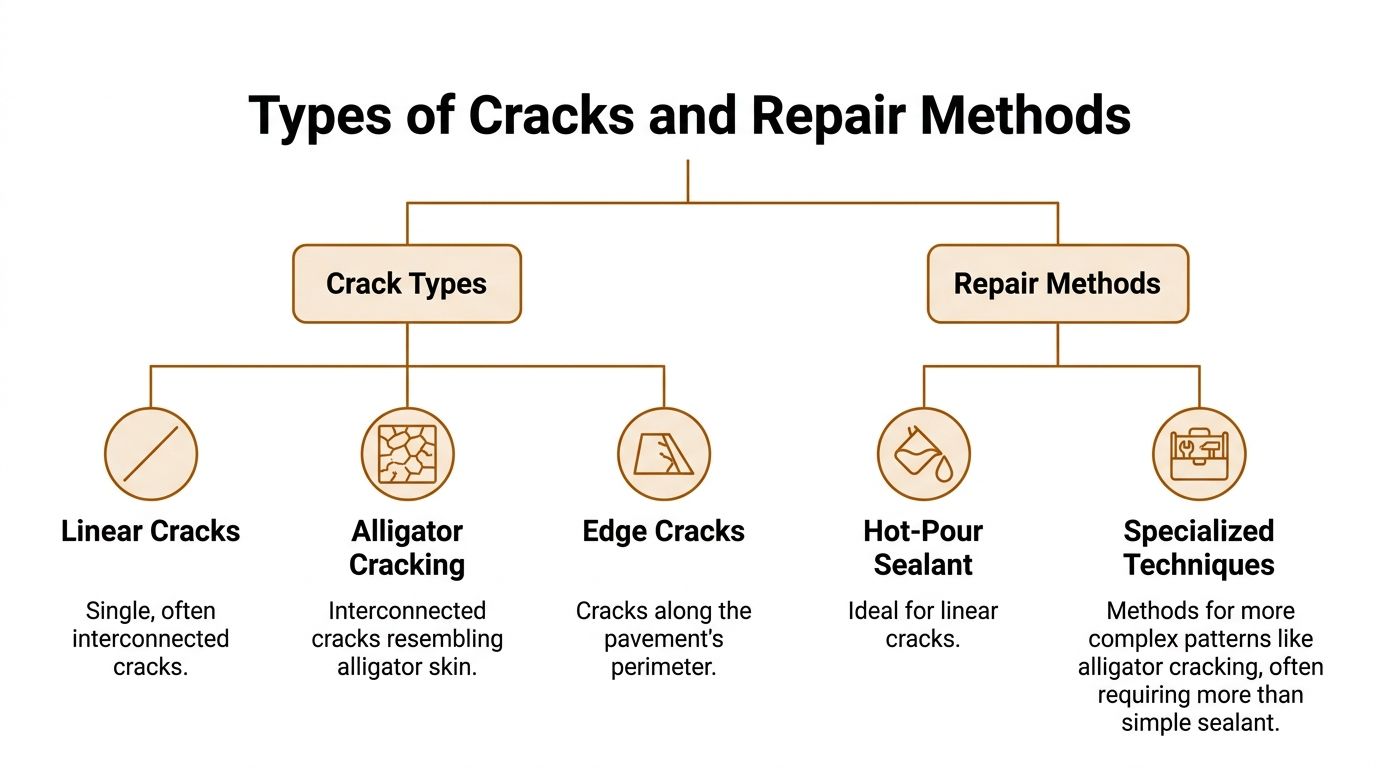
Linear cracks are the cracks most property managers expect to see first. They often run in a single path and can sometimes be sealed effectively if the pavement around them is still sound. Edge cracks happen along the perimeter, where movement and support conditions are often different from the field of the lot.
Alligator cracking is the red flag. It looks like an interconnected pattern that signals a deeper structural problem, and sealing over it won't fix the failure underneath. That's the kind of damage that usually points toward patching, resurfacing, or another structural repair instead of routine sealing.
When routing or mastic becomes the better call
Industry guidance suggests routing cracks to a 1:1 width-to-depth ratio before sealing, and reserving mastic-style repairs for cracks wider than 3/4 inch California crack treatment guidance. That gives the sealant a more stable reservoir and helps keep the finished repair from becoming a traffic hazard.
If the crack is wide enough to swallow a standard sealant line without support, it's probably past the point where simple fill-and-forget work makes sense.
A white paper in the field also notes that routing can be useful, but the right choice depends on crack geometry and pavement condition, not just the visible crack line routing and width guidance. That's the kind of judgment that matters in Belleview, Inverness, or Lecanto, where lots often have a mix of newer sections and older distressed areas. The repair method should match the crack, not just the calendar.
Ideal Timing Frequency and Climate Impact
Central Florida weather changes the maintenance window. Heat opens cracks, afternoon rain pushes water inside them, and humidity can leave surfaces damp longer than crews expect. In Marion County, FL and Citrus County, FL, that means timing isn't a minor detail, it's part of whether the job lasts.
What the weather has to look like
Technical guides recommend sealing when pavement is above 40°F and dry, with annual inspections and resealing intervals of 1–3 years for high-traffic lots temperature and interval guidance. For lots that turn over a lot of cars, that inspection rhythm matters more than a one-time fix.
Spring and fall usually give crews more workable conditions than peak rainy periods, because the pavement is more likely to stay dry long enough for proper cleaning and bonding. That's especially relevant in commercial centers around Ocala, The Villages, and Crystal River, where traffic can't always be paused for long.
How often to seal coat asphalt is a helpful planning reference for owners who want to line up crack sealing with broader maintenance instead of treating every problem separately.
A maintenance calendar that makes sense
A sensible pattern for many Florida lots looks like this:
- Inspect once a year. Catch narrow cracks before they widen.
- Seal when conditions are dry. Moisture is one of the biggest reasons repairs don't bond well.
- Recheck high-traffic areas more often. Retail entrances, church lots, and delivery lanes tend to wear faster.
- Bundle with other care when appropriate. Crack sealing often pairs with sealcoating and restriping when the pavement is ready for broader maintenance.
Local rule of thumb: if a lot still drains well, stays structurally sound, and has isolated cracks, sealing usually makes more sense than waiting for the damage to spread.
That timing matters because the longer water has to work through the openings, the more likely the pavement is to move from surface distress to deeper failure. In places like Homosassa, Hernando, and Silver Springs, where weather swings can be rough on pavement, staying ahead of the cracks is cheaper than chasing them after the base has softened.
Professional Crack Sealing Process
Good crack sealing starts long before the sealant goes down. The crew has to clean the crack, confirm the right geometry, choose the right material, and control traffic so the repair doesn't get damaged while it cures. That's the part most property managers don't see, but it's where the quality is won or lost.
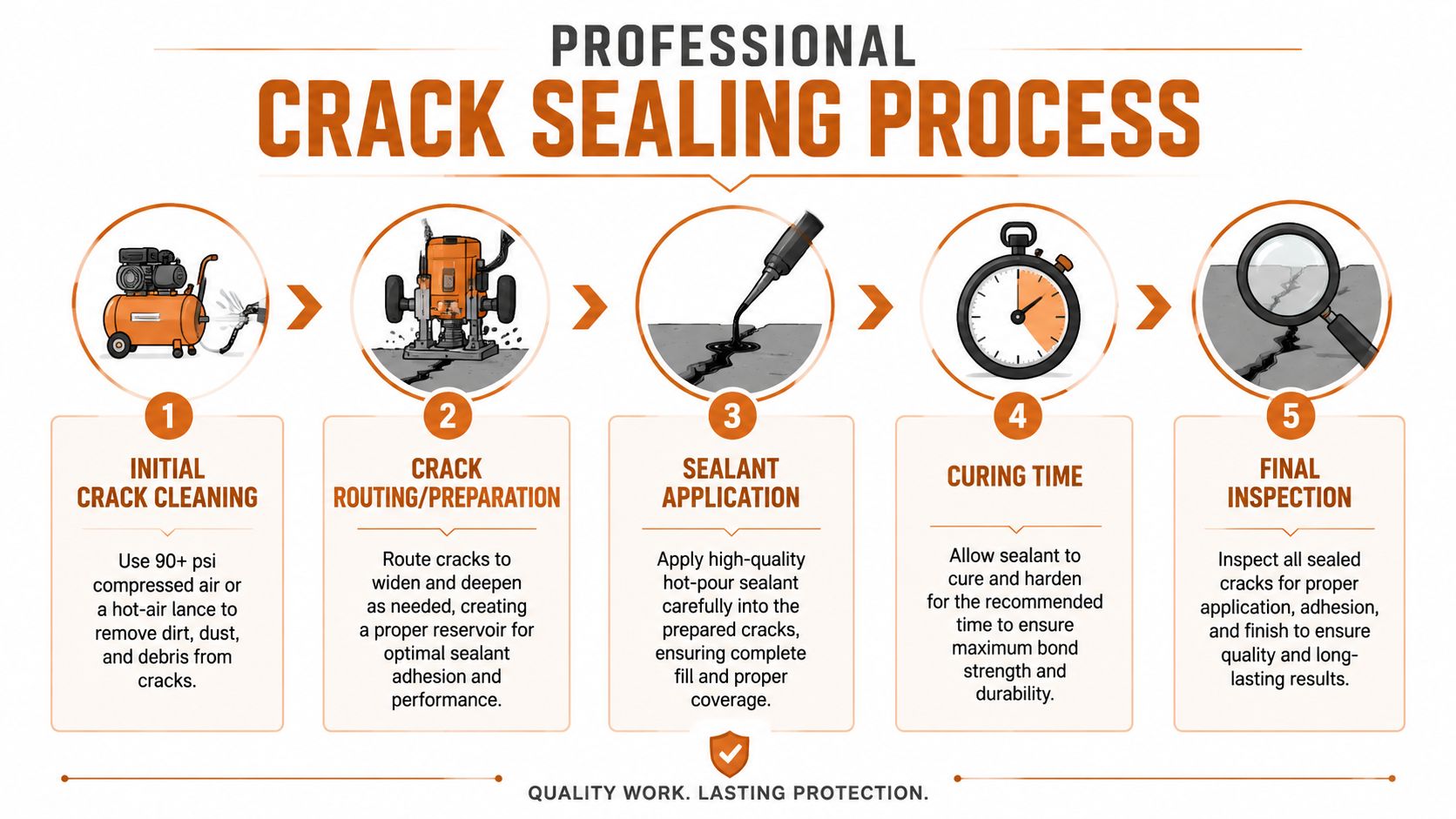
Cleaning and preparation come first
Field manuals specify compressed air at least 90 psi and a hot-air lance below 930°F to clear debris and help dry the crack before sealant is placed manual cleaning requirements. That matters because dust and moisture are common reasons adhesion fails. The crack has to be cleaned right before sealing, otherwise fresh contamination can settle back in.
A crew may route deteriorated cracks before filling them, especially when the opening is irregular or too shallow to hold material properly. The goal is to create a clean reservoir that can hold the sealant without letting it ride too high on the surface.
Material choice and application control
Caltrans guidance says highly modified asphalt or non-asphalt composite sealants are preferred for crack sealing under traffic, while conventional PG binder is not recommended where abrasion is expected material selection guidance. For a busy lot, that's a real durability issue. A seal that softens or wears too fast can end up tracking under tires and looking bad long before the lot is due for broader work.
The finished seal should be close to flush or slightly recessed, typically no more than 1/8 inch above the pavement, to reduce tracking and early wear surface finish guidance. If the bead is too high, cars can pull at it. If it's too low, the crack can still collect water and debris.
Why professional crews use heat and timing carefully
Sealant temperature also matters. Manuals specify sealant temperatures of 370°F–390°F for proper placement and bonding sealant temperature guidance. Crews who rush that step can create a repair that looks finished but doesn't hold up.
A good contractor also checks the lot after application, because traffic control, cure time, and final inspection all affect whether the repair remains intact. Riverside Sealing & Striping, LLC is one local option that handles parking lot maintenance work for commercial properties across Central Florida, including sealing and related pavement care. The reason that matters is simple, equipment and timing affect the repair as much as the material does.
DIY Versus Professional Pros and Cons
Small repairs can tempt owners to try the job themselves, especially if the lot looks manageable. Sometimes that's fine for a very limited area. The problem is that crack sealing is less forgiving than it looks, and the wrong prep or product choice can waste time fast.
Where DIY can make sense
For a small, low-traffic lot with a few isolated cracks, DIY can be a practical short-term choice if the owner already has the right tools and understands the material. The work still needs careful cleaning, dry pavement, and proper placement. If any of those steps get skipped, the seal can fail early.
Where professional help usually pays off
A professional crew brings the equipment needed to clean, heat, route, and apply material consistently. That matters when a lot has multiple crack types, active traffic, or a tight maintenance window. It also matters when the owner needs the work coordinated with striping or broader asphalt maintenance.
Good rule: if you're trying to protect a commercial property instead of just patch a corner of pavement, the cost of a bad repair can be higher than the contractor invoice.
| DIY | Professional |
|---|---|
| Lower upfront spend if you already own tools | Better control of preparation, material, and finish |
| Works for very small, simple jobs | Better fit for active lots and mixed crack conditions |
| Higher risk of uneven application | More consistent results and scheduling |
| Takes more of your time | Frees staff to keep the property operating |
In practice, the best decision often comes down to risk. A property manager in Beverly Hills or Crystal River may not want to absorb a failed repair, especially if customers, tenants, or tenants' visitors are driving over the area every day. For those cases, a professional contractor can be the more predictable route, especially when the work needs to align with sealcoating or line striping.
Cost Ranges and Influencing Factors
Cost is where a lot of owners get surprised, because crack sealing is usually far cheaper than major rehabilitation, but it still isn't one-size-fits-all. In 2026, direct crack sealing is typically priced at about $0.90 to $1.50 per linear foot, while routed work rises to $1.50 to $3.00 per linear foot 2026 cost guide. Many contractors also set minimum job charges of $1,500 to $3,500 same cost guide.
Why the quote changes from lot to lot
The biggest drivers are crack density, access, prep time, and whether routing is needed. A clean lot with clear access takes less time than a property with scattered cracks, heavy debris, or active traffic. If the lot needs routing, the contractor is adding another pass and more cleanup before the sealant goes in.
The same 2026 guide says a 50,000-square-foot lot with moderate cracking may cost $5,000 to $12,500 for crack sealing, while a combined maintenance cycle with sealcoating and restriping can reach $10,000 to $22,500 commercial cost example. If cracks are left untreated, that source contrasts the work with $150,000 to $250,000 for a mill-and-overlay, which shows the size of the cost gap between preventive work and reconstruction same source.
What owners in Central Florida should watch for
A cheap quote isn't always a good quote if it leaves out prep. The price should reflect whether the cracks are cleaned, dried, routed when needed, and finished correctly. In places like Ocala, Dunnellon, and The Villages, local labor, traffic control, and site access can all nudge the final bid up or down.
Budget reality: sealing is most cost-effective when the lot still has a sound base and the cracking is limited. Once the pavement turns structural, the economics change fast.
For property managers trying to protect curb appeal without overcommitting capital, crack sealing usually makes the most sense early. Waiting until the lot needs major resurfacing often turns a maintenance line item into a capital project.
Choosing a Contractor and FAQ
The right contractor should explain what they're doing, not just hand over a price. Look for licensed and insured crews, clear scheduling, local Central Florida experience, and a scope that spells out whether routing, cleaning, and finish height are included. If the contractor can't explain when a crack should be sealed versus routed, that's a sign to keep asking questions.
For owners who want a local maintenance partner, Riverside's parking lot maintenance company page shows how a contractor can coordinate sealing with broader pavement upkeep, rather than treating each problem as a separate callout. That matters for shopping centers, churches, HOAs, and apartment communities that need work done without constant disruption.
Common questions property managers ask
Does routing always improve crack sealing?
No. Routing helps when the crack geometry supports it, but it's not automatically better for every crack. As noted earlier, the best choice depends on width, depth, and how active the pavement is.
When is sealing no longer enough?
When the lot shows interconnected cracking, potholes, depressions, or other structural distress, sealing alone isn't the right fix. That's when patching, resurfacing, or reconstruction starts making more sense.
How often should a lot be checked?
Annual inspection is a solid baseline, with more frequent checks for high-traffic areas. High-use lots usually show trouble sooner, especially where cars turn, brake, or sit in loading zones.
Can sealing and striping be done together?
Yes, as long as the pavement is ready for both and the sequence is planned correctly. That's common for commercial properties that want to restore both function and appearance in one maintenance cycle.
What if I'm in Citrus County instead of Marion County?
The same basic rules apply in Citrus County, FL, but local weather, traffic, and site conditions still matter. A lot in Homosassa won't behave exactly like one in Belleview, so the repair plan should be based on the pavement in front of you, not a generic schedule.
If you're comparing options for a property in Ocala, Dunnellon, Crystal River, Inverness, Lecanto, Hernando, Beverly Hills, Summerfield, Silver Springs, or The Villages, ask for a no-pressure evaluation that separates sealable cracks from structural damage. A clear look at the pavement now can save a much bigger repair later.
If your lot is showing early cracking, contact Riverside Sealing & Striping, LLC for a free, no-pressure evaluation in Marion County, Citrus County, or the surrounding Central Florida area, and get a practical plan for crack sealing, sealcoating, or parking lot striping before small cracks turn into bigger repairs.