

The popular advice is simple: fill the pothole, compact it, and move on. That approach works only when the damage is genuinely isolated and the pavement beneath it remains stable. In Central Florida, a recurring pothole may instead point to trapped water, a weakened aggregate base, a failed utility trench, or pavement edges that were never properly confined.
A qualified asphalt patching contractor does more than place asphalt in a hole. The contractor identifies why the pavement failed, removes unsound material, prepares the surrounding surface, controls lift thickness, compacts the repair mechanically, and checks how the finished patch affects drainage and accessibility. That distinction matters for homeowners, HOA boards, commercial property managers, churches, and other owners in Marion County, FL, Citrus County, FL, and nearby communities from Ocala and Dunnellon to Crystal River and Inverness.
Table of Contents
- Understanding the Role of an Asphalt Patching Contractor
- Comparing Different Asphalt Repair Methods
- Diagnosing Structural Failures Versus Surface Potholes
- Vetting Contractors and Ensuring ADA Compliance
- Evaluating Costs and Warranties for Pavement Repairs
- Protecting Asphalt from Central Florida Weather
- Planning Your Next Pavement Maintenance Project
Understanding the Role of an Asphalt Patching Contractor
A surface fill can hide a defect without correcting it. If water continues entering through an open joint or the base beneath the patch remains unstable, traffic will eventually reopen the same failure. The new asphalt may be sound, yet the repair still fails because the surrounding structure can't support it.
The contractor's first responsibility is diagnosis. That means examining the pothole's edges, nearby cracking, pavement grade, drainage path, and the condition of the aggregate base. A small, cleanly defined defect may justify isolated hot-mix repair. A broad area with interconnected cracking, settlement, or repeated ponding may require a deeper digout, milling and inlay, or drainage correction before new asphalt is placed.
Practical rule: A recurring pothole should be treated as evidence, not just an inconvenience.
Preparation determines whether the patch bonds and stays confined. Loose asphalt and failed material must be removed, the excavation must be cleaned, and the interfaces must be treated correctly. British Columbia pavement-maintenance guidance explains that dust and debris inhibit bonding, while tack coat provides the adhesive connection between old and new pavement. The guidance recommends allowing an emulsified tack product to change from brown to black before placing the mix, then compacting from the outside edges toward the center. Read the pavement-maintenance guidance on tack coat and compaction.
The work also involves quality control after installation. Federal Highway Administration guidance recommends asphalt placement in lifts no thicker than 3 inches, with density verified for each compacted lift. Small repairs can use a vibrating plate compactor, while larger areas generally call for a steel-drum roller. Review the Federal Highway Administration asphalt repair checklist.
A full-service contractor brings another advantage. Pavement defects sometimes meet concrete sidewalks, curbs, driveway aprons, ramps, or drainage structures. A company experienced in both concrete construction and asphalt maintenance can evaluate the entire transition instead of treating each material as an unrelated repair. That broader view is useful in Ocala, Belleview, Silver Springs, Summerfield, The Villages, and rural properties where surface water may travel across several pavement types.
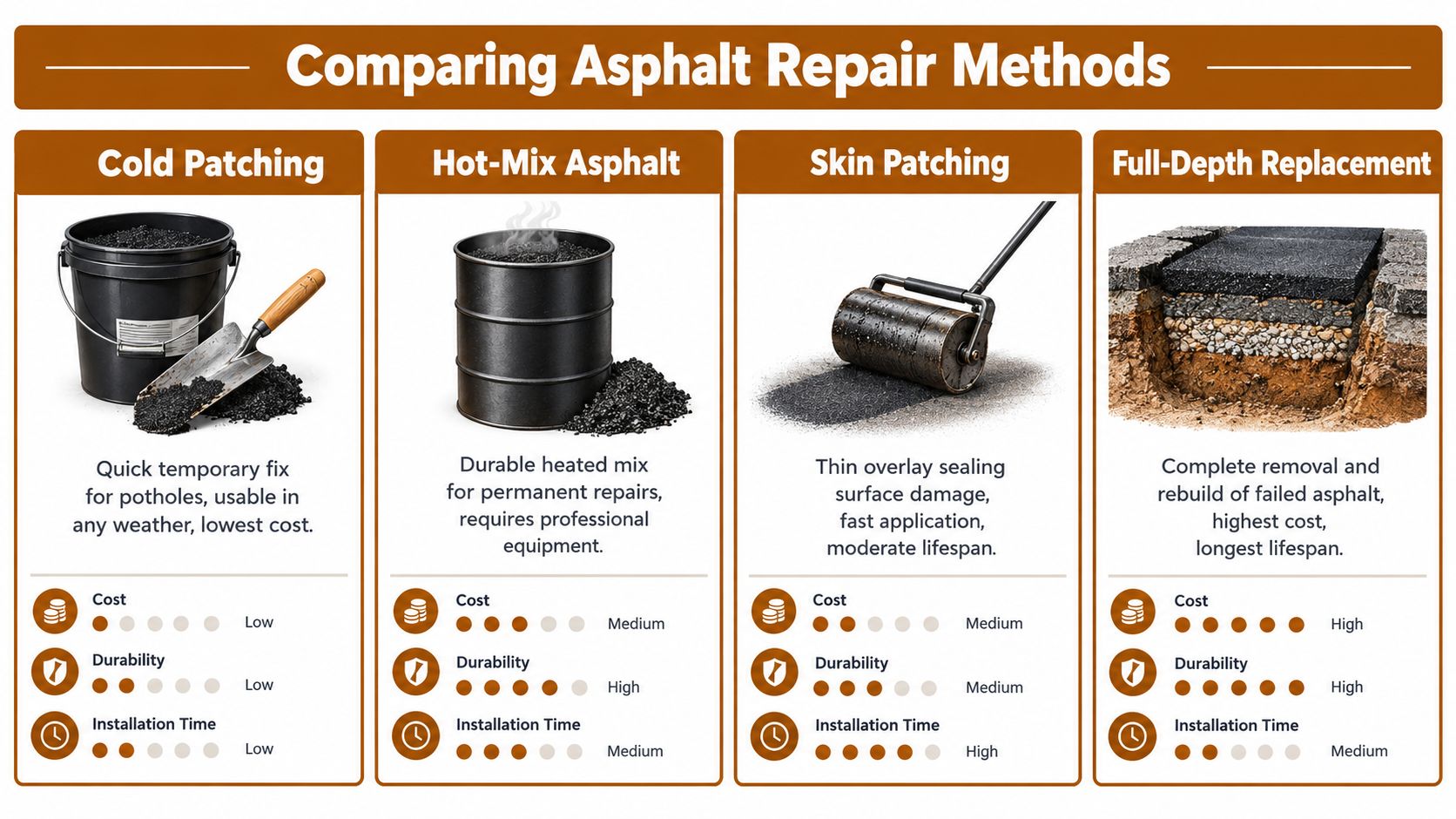
Comparing Different Asphalt Repair Methods
Not every repair deserves the same method. The right choice depends on the depth of failure, the condition of the base, the amount of traffic, and whether the owner needs an emergency response or a planned, durable correction.
Cold patching
Cold patch is useful when safety requires an immediate temporary fill and hot mix isn't available. It can be placed with limited equipment and is practical for short-term stabilization, especially during unfavorable scheduling conditions. It shouldn't be presented as an equivalent replacement for a properly prepared hot-mix repair.
Traffic, moisture, and weak confinement can displace cold material. A contractor should identify it clearly as temporary and explain what permanent work remains necessary. If a proposal calls for repeated cold patches at the same location, the owner should ask whether the repair is postponing a base or drainage correction.
Hot-mix asphalt
Hot-mix asphalt is the standard choice for a durable patch when the excavation has been properly prepared. The contractor removes unsound pavement, cleans the area, applies tack coat to the interfaces, places the mix in controlled lifts, and compacts each lift with suitable equipment.
The material alone doesn't make the repair permanent. Poor edge preparation, insufficient density, an uncured tack coat, or a wet excavation can undermine otherwise good hot mix. A written scope should explain how the contractor will manage those details.
Skin patching
A skin patch addresses surface-level raveling, oxidation, or shallow wear when the pavement below remains structurally sound. It can improve texture and seal a limited area, but it won't correct a failed aggregate base or ongoing water intrusion.
This method becomes a poor choice when cracking reflects settlement or when the surface has lost support. Covering deeper movement may delay the visible failure without stopping it.
Full-depth replacement
Full-depth replacement is appropriate when the asphalt and underlying base have failed. The contractor removes the affected layers, rebuilds the base, and places new hot-mix asphalt over a stable foundation. This requires more preparation and usually creates more disruption, but it addresses the structural cause rather than the appearance alone.
A proposal should make the difference between a surface repair and a full-depth repair unmistakable. If a large failed area is being treated with a thin overlay, ask what evidence shows that the base can support it.
For larger failed areas, neutral pavement guidance recommends removal and replacement with hot-mix asphalt, while the aggregate base should be leveled and recompacted. Recommended digout patches extend at least 1 foot beyond visible cracking. See the pavement guidance on digout repairs and base preparation.
Diagnosing Structural Failures Versus Surface Potholes
The first diagnostic question isn't “How large is the hole?” It's “What pattern surrounds it?” An isolated pothole with firm edges and no nearby settlement may be a localized surface failure. A pothole beside alligator cracking, depressed pavement, ponding, or a repaired trench deserves a deeper investigation.

A contractor should inspect the excavation after removing loose material. Soft, pumping, or visibly wet base material suggests that the problem extends below the asphalt. The inspection should also consider roof runoff, irrigation, nearby drainage inlets, utility cuts, edge exposure, and whether water has a route to leave the pavement.
Central Florida's heavy rain can saturate weak support, but the weather isn't always the root cause. Poor grading, a blocked drainage path, or a trench that wasn't compacted correctly can create the same recurring pattern. The repair decision should follow the evidence found below and around the pothole.
A practical decision framework
Isolated patching makes sense when one defect is clearly separated from surrounding pavement and the base remains stable. The contractor still needs to cut back to sound edges, clean the excavation, use tack coat correctly, and compact the repair.
Full-depth digout is more appropriate when cracking extends around the defect, the base is unstable, or the pavement has settled. A larger repair may cost more at the outset, but repeated mobilization and recurring disruption make the smallest visible repair a false economy.
Milling and inlay can suit broader surface deterioration when the underlying structure remains serviceable. Milling removes the damaged upper layer and creates a controlled surface for new asphalt. It won't solve a saturated or failed base.
Drainage correction belongs in the scope when water repeatedly reaches or remains beneath the pavement. Replacing the surface without correcting the water path may produce a clean-looking repair that fails for the same reason.
A good estimate explains the failure pattern before it recommends the material.
Traffic loading also matters. A residential driveway, an HOA entrance, a church lot, and a commercial travel lane don't place the same demands on a patch. Heavy turning movements and concentrated vehicle paths can expose weak support faster than occasional passenger-car traffic.
The video below provides additional visual context for evaluating pavement damage before selecting a repair approach.
Owners should ask contractors to document the limits of the proposed repair, the condition of the base, and any drainage concern separately. That documentation makes it easier to compare bids and prevents a surface-only scope from being mistaken for a structural solution.
Vetting Contractors and Ensuring ADA Compliance
A neat patch can still conceal poor compaction, trapped water, or a grade that creates an accessibility problem. Vet the contractor by checking how the work will be measured, documented, and accepted, not only by reviewing the material description. Ask for a written scope that identifies repair limits, lift thickness, compaction equipment, traffic restrictions, drainage observations, and the condition required at closeout.
What the work should include
-
Removal of unsound material. The crew should cut or excavate through loose asphalt and unstable support until the repair reaches firm material. Request photographs of the excavation before backfill. If the weak area extends beyond the original pothole, the owner should approve the revised limits before new asphalt is placed.
-
Cleaning and interface preparation. Dust, debris, and loose particles interfere with bonding. Tack coat should cover the vertical and horizontal interfaces uniformly, then break before placement. The emulsion should change from brown to black before the mix is installed, as described in British Columbia's pavement-maintenance guidance.
-
Controlled placement and compaction. Federal Highway Administration guidance recommends lifts no thicker than 3 inches and density verification for each compacted lift. During the job, measure the excavation depth with a tape before the first lift and record the loose and compacted thickness on the daily report. Small areas may use a vibrating plate compactor, while larger repairs generally need a steel-drum roller. Use the Federal Highway Administration checklist as a quality-control reference.
-
Edge densification and elevation review. Poorly confined edges invite raveling and water entry, so the crew should compact the patch perimeter carefully on the surface lift. The finished patch should be flush with the surrounding pavement or approximately 0.1 to 0.2 inches higher to allow for limited traffic-induced consolidation, according to the federal guidance cited above. Require a final straightedge check across each edge and transition.
Traffic should remain off the new mat until it cools to approximately 140°F, or until the governing agency's specified opening temperature. The contractor should state who will confirm that condition and how the owner will be notified.
Accessibility belongs in the closeout
A parking-lot repair is incomplete if it leaves an accessible route unsafe or changes the required layout. The 2010 ADA Standards require an accessible car parking space to be at least 96 inches wide, while a van-accessible space must be at least 132 inches wide when paired with a 60-inch access aisle. The aisle must run the full length of the space, remain level with it, and have a maximum slope of 1:48, approximately 2.08%, in every direction. Review the 2010 ADA parking standards.
Walking surfaces also have a maximum cross slope of 1:48. A settled patch, abrupt lip, or poorly graded transition can create a level change between a parking space, access aisle, sidewalk, and building entrance. See the ADA guidance on accessible route slopes.
After repair, inspect the transitions with a straightedge and walk the entire route from the accessible space to the entrance. Check for ponding around the patch, aisle, curb, and accessible route. Restripe only after the finished grade and layout are confirmed. Keep dated photographs, slope and width measurements, temperature records, material tickets, compaction notes, and the contractor's signed closeout report.
Commercial owners, churches, schools, nonprofits, and HOAs should verify accessible-space counts before restriping. The required number is based on the total spaces in each parking facility, with at least one accessible space for every 25 parking spaces through the first 100. At least one of every six accessible spaces, or fraction of six, must be van accessible. Consult the ADA parking checklist for space-counting guidance.
Before signing, confirm licensing, insurance, scheduling, and coordination for asphalt, concrete, and striping. A bonded and insured contractor helps clarify risk responsibility, but credentials do not replace a measurable scope and documented closeout.
Evaluating Costs and Warranties for Pavement Repairs
The lowest bid often describes the smallest visible intervention. It may omit base recompaction, edge cutting, tack coat, drainage investigation, or post-repair inspection. Those omissions can make a proposal look attractive while transferring the repeat-failure risk to the property owner.
A better comparison separates emergency stabilization, planned hot-mix patching, and structural reconstruction. Cold patch may be appropriate to reduce an immediate hazard, but it shouldn't be priced or described as the same service as a prepared hot-mix digout. A full-depth repair includes demolition, base work, new asphalt, compaction, and often traffic management.
Ask each bidder to identify:
- Preparation: What material will be removed, and how will the base be evaluated?
- Materials: Is the mix hot-mix asphalt, cold patch, or another product?
- Compaction: Which machine will be used, and how will the contractor verify a dense repair?
- Water management: Are drainage or subbase problems included, excluded, or separately priced?
- Warranty limits: Does coverage address workmanship, materials, settlement, water intrusion, or only obvious surface defects?
- Recurring failures: What happens if the same location reopens because the original scope didn't address the underlying cause?
A warranty can't turn an incomplete repair into a complete one. Owners should read exclusions involving standing water, unstable subgrade, utility work, heavy loading, and alterations by other contractors. The contract should also state when traffic can return and who is responsible for protecting the repair during curing.
For a practical discussion of pricing variables and repair scope, review this guide to asphalt patching cost. The useful question isn't "What does a patch cost?" It's "What work is necessary to prevent this location from becoming a repeat expense?"
Full-service concrete and asphalt contractors can also provide a more accurate site-wide assessment when damaged asphalt meets concrete sidewalks, curbs, aprons, or drainage features. That reduces the chance of approving an asphalt-only repair that leaves a hazardous transition or a separate failure untreated.
Protecting Asphalt from Central Florida Weather
Marion County and Citrus County pavement faces a difficult combination of strong sun, heat, intense rain, and repeated traffic. UV exposure dries and oxidizes the asphalt surface. Summer downpours test cracks, joints, edges, and drainage paths. When water reaches a weak base or saturated subgrade, vehicle loading can turn a small defect into a larger depression.
Timing matters. A contractor shouldn't place a patch in active rain or treat a fully saturated excavation as ready for asphalt. The crew may need to remove wet or unstable material, improve drainage, or wait for conditions that allow proper bonding and compaction.
The same issue appears differently across Central Florida. A driveway in Dunnellon may show edge deterioration where runoff travels along the pavement. A commercial lot in Ocala may develop failures in turning lanes. Properties near Crystal River, Homosassa, Inverness, Lecanto, Beverly Hills, or Hernando may experience recurring wet-area problems that require more attention to drainage than a dry surface inspection reveals.
Preventive work begins after the structural repair is sound. Crack sealing helps limit water entry through active cracks, while sealcoating can protect suitable asphalt from sunlight, weather, oil, and fuel. Sealcoating isn't a substitute for repairing failed base material, and it shouldn't be applied over active structural movement.
A written maintenance plan should schedule inspections after severe weather, monitor repaired locations, keep drainage paths clear, and address small cracks before water reaches the support layers. Property owners can also review how to maintain an asphalt driveway for practical maintenance considerations.
The goal is not to eliminate every repair. It is to catch surface deterioration while the repair options remain narrower, safer, and easier to coordinate.
Planning Your Next Pavement Maintenance Project
Start with the failure, not the product. A dependable asphalt patching contractor should explain whether the defect is surface-level, structural, drainage-related, or connected to concrete and site grading. The estimate should show the repair limits, preparation steps, mix type, compaction plan, traffic-opening condition, and any work excluded from the scope.
Watch for proposals that promise a permanent result without discussing the base. Be cautious when a contractor won't explain tack coat, lift control, edge compaction, or how the crew will handle water. For commercial lots and HOA properties, add an accessibility review before restriping so a new patch doesn't create a slope, transition, or route problem.
The strongest choice is often a licensed and insured, locally experienced contractor that handles both concrete construction and asphalt maintenance. That combination matters when a project includes a driveway apron, sidewalk, curb, parking lot, accessible route, sealcoating, or striping. Reliable scheduling, clear timelines, and high-quality workmanship are practical advantages because pavement work affects residents, customers, tenants, and deliveries.
Owners in Ocala, Dunnellon, Belleview, Silver Springs, Summerfield, The Villages, Inverness, Crystal River, Homosassa, Lecanto, Beverly Hills, and Hernando can protect long-term value by requesting a professional evaluation before the next storm turns a small defect into a structural repair. A no-pressure consultation should leave you with a clear explanation of what needs immediate attention, what can be maintained, and what should be planned for later.
Riverside Sealing & Striping, LLC provides professional asphalt patching, concrete construction, sealcoating, and parking lot striping for properties across Marion County, FL, Citrus County, FL, and surrounding Central Florida communities. Request a free, no-pressure on-site consultation from a licensed and insured local team through Riverside Sealing & Striping, LLC to evaluate your pavement, drainage, transitions, and accessibility needs.