
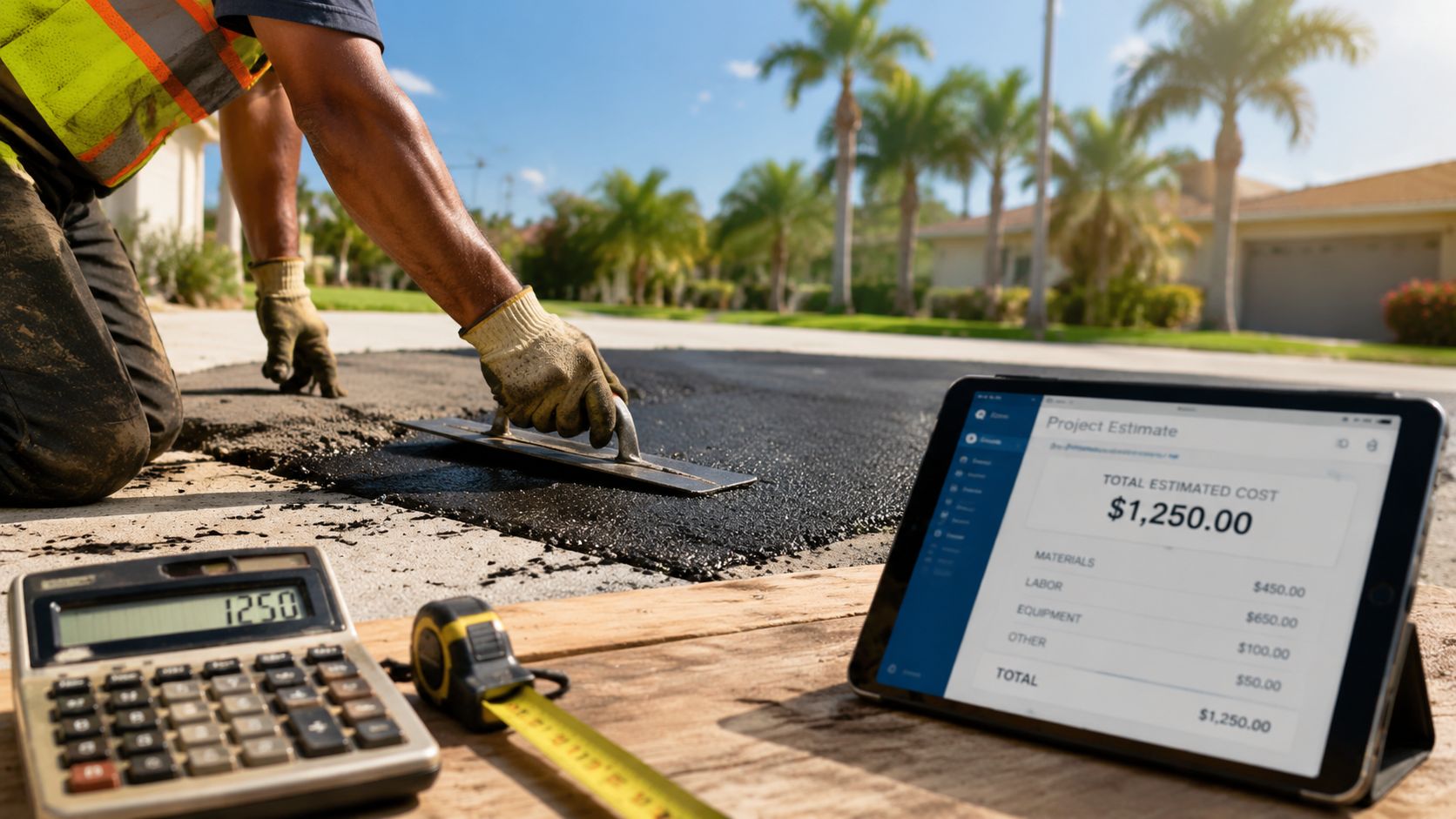
Basic asphalt patching usually runs $2 to $5 per square foot, but that number only gets you into the right ballpark. The final asphalt patching cost depends heavily on the repair method, the size of the job, and what shows up once the damaged area is opened up on-site in places like Ocala or Crystal River.
If you're reading this, you're probably looking at a pothole, a cracked driveway edge, or a rough section of parking lot and asking a simple question: what will it cost to fix? The hard part is that asphalt repairs rarely price out like buying material off a shelf. A small patch in Belleview or Inverness can look cheap from the street and still cost more than expected once labor, mobilization, cleanup, and repair depth are factored in.
That matters even more in Central Florida. In Marion County, FL and Citrus County, FL, heat, UV, heavy rain, and traffic turn small failures into larger ones fast. A patch that makes sense today can save a driveway or parking lot section. A patch on the wrong failure can turn into repeat spending.
As Concrete and Asphalt Experts in Marion and Citrus County, this is the part property owners need to hear clearly: an on-site look isn't optional if you want a real number and the right recommendation.
Table of Contents
- Understanding Your Asphalt Patching Bill
- How Patching Method Dictates Your Price
- DIY Asphalt Patching vs Hiring a Professional
- Central Florida's Impact on Asphalt Repair Costs
- When to Patch vs When to Replace Your Asphalt
- Getting an Accurate Quote in Marion and Citrus County
- Frequently Asked Questions About Asphalt Patching
Understanding Your Asphalt Patching Bill
A patch quote isn't just a number for asphalt. It's a number for solving a pavement failure correctly.
HomeGuide reports asphalt patching at $50 to $300 on average, with more detailed repair pricing for hot-patch work at $2 to $5 per square foot, cold-patch work at $2 to $4 per square foot installed, and a separate service fee of $100 to $250 that may apply to asphalt repairs, which is why very small jobs often carry a higher effective cost than the square-foot rate suggests (HomeGuide asphalt repair cost guide).
Why a tiny repair can still cost real money
A homeowner in Summerfield or a property manager in Homosassa often sees one pothole and assumes the price should be close to the material cost. That isn't how field work is priced.
A crew still has to travel, unload tools, prep the damaged area, compact the patch, clean up, and haul debris. Whether the failed area is small or large, the truck still rolls and the crew still gets dispatched.
Practical rule: The smaller the patch, the less useful a simple per-square-foot price becomes. Fixed labor and setup drive the bill.
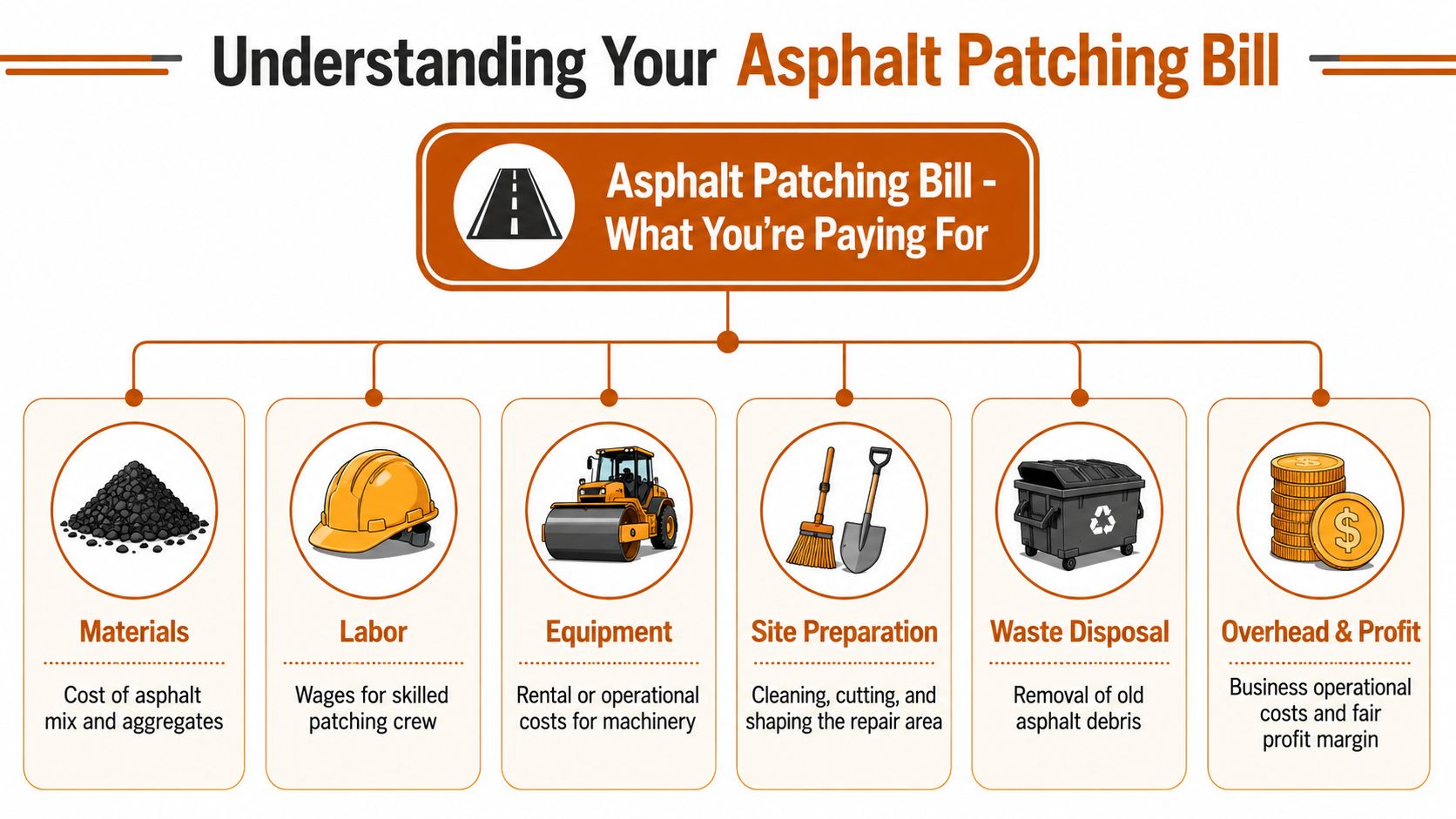
What a professional patch quote usually includes
A solid estimate usually has several moving parts:
- Material cost: The asphalt mix itself, plus any base material if the repair needs support underneath.
- Labor: Cutting, cleaning, shaping, placing, compacting, and finishing the repair.
- Equipment use: Tampers, saws, rollers, blowers, shovels, and haul equipment all factor into the job.
- Site preparation: Loose material has to come out. Damaged edges have to be cleaned up so the patch isn't left with weak sides.
- Disposal and cleanup: Old asphalt and debris don't disappear on their own.
If the contractor is using true hot mix and proper compaction, you're not paying for a cosmetic fill. You're paying for prep, bond, density, and shape. That's also why different repair approaches can produce very different quotes. If you want a primer on the material itself, this overview of hot mix asphalt is a useful reference.
In Ocala, Dunnellon, Lecanto, and Beverly Hills, one of the most common pricing misunderstandings comes from comparing a contractor's patch quote to a bagged patch from a home center. Those aren't equivalent repairs. One is a short-term material purchase. The other is a field repair process.
How Patching Method Dictates Your Price
A pothole at the end of a driveway and a soft, breaking section in a parking lane may look similar from the curb. They do not get priced the same in the field.
The patching method sets the price because it determines how much failed asphalt has to come out, whether the base underneath is still doing its job, what equipment the crew needs, and how long the repair is likely to last in Central Florida heat and rain. Cheap patching usually costs less up front because it skips steps. Those skipped steps are often the reason the same spot fails again.
PaveMade notes that small surface patches may run $2 to $5 per square foot, while a full-depth saw-cut repair can rise to $4 to $12 per square foot because it requires removal, disposal, new base or asphalt placement, and more labor-intensive work (PaveMade asphalt patch repair pricing breakdown).
Cold patch, hot patch, infrared, and full-depth repair
Cold patch is the low-cost option people usually ask about first. It works for short-term hazard control or a temporary fill when speed matters more than lifespan. On a small residential spot, that may be enough if the goal is to buy some time. If the area has movement, weak edges, or water getting in, cold patch is usually money spent twice.
Hot patch is the standard repair for many isolated failures where the surrounding asphalt and base are still in decent shape. It takes more labor and better timing than a bagged patch, but it compacts tighter and holds traffic better. For many driveways and small parking areas, this is often the best balance between price and service life.
Infrared patching is a more specialized method. It reheats existing asphalt so the repair area can be blended and reworked with added material as needed. Owners usually choose it when appearance matters, when they want less visible transition at the patch, or when the failure is shallow enough for the method to make sense. It can be a good repair, but it is not the answer for every pothole.
Full-depth repair costs more because it fixes more. If the asphalt is cracking apart from below, the edges are collapsing, the area feels soft under traffic, or the same hole keeps returning, a surface patch does not solve the underlying problem. The crew has to saw cut, remove the failed section, address the base, and install new asphalt over stable support.
That is the question to ask when one quote comes in much lower than another. What depth is being repaired?
A low number for a quick fill can look attractive on paper. For property owners trying to control long-term repair spending, the better comparison is cost per year of service, not just cost on the day the invoice is signed. A patch that lasts through one rainy season is a different purchase from one that holds up under traffic and drainage stress for years. Reviewing how contractors handle professional asphalt patch repair services can help you see that difference before you approve the work.
Asphalt Patching Methods Compared
| Patch Type | Typical Cost Per Sq. Ft. | Expected Lifespan (Florida) | Best For |
|---|---|---|---|
| Cold patch | $2 to $4 installed | Short-term | Temporary spot repairs and immediate hazard control |
| Hot patch | $2 to $5 | Longer-lasting than cold patch when the base is sound | Small potholes and localized surface failures |
| Infrared patch | Qualitatively higher than basic patching | Durable when properly used in the right application | Areas where appearance and bond matter |
| Full-depth saw-cut repair | $4 to $12 | Best option when the failure extends below the surface | Base failure, recurring potholes, soft spots, edge collapse |
Square-foot pricing also stops being useful on many small repairs. A contractor still has to load equipment, travel to the site, clean and cut the area, compact the patch, and haul off debris. That is why two patches with the same square footage can still come back with different prices.
The main cost difference is usually not the asphalt itself. It is the repair method, the condition underneath, and whether the quote is pricing a short-term patch or a repair with a fair chance of lasting.
DIY Asphalt Patching vs Hiring a Professional
A lot of homeowners in The Villages, Belleview, and Crystal River ask the same thing first. Can I just patch it myself this weekend?
Sometimes you can. The better question is whether you should.
Where DIY makes sense and where it usually doesn't
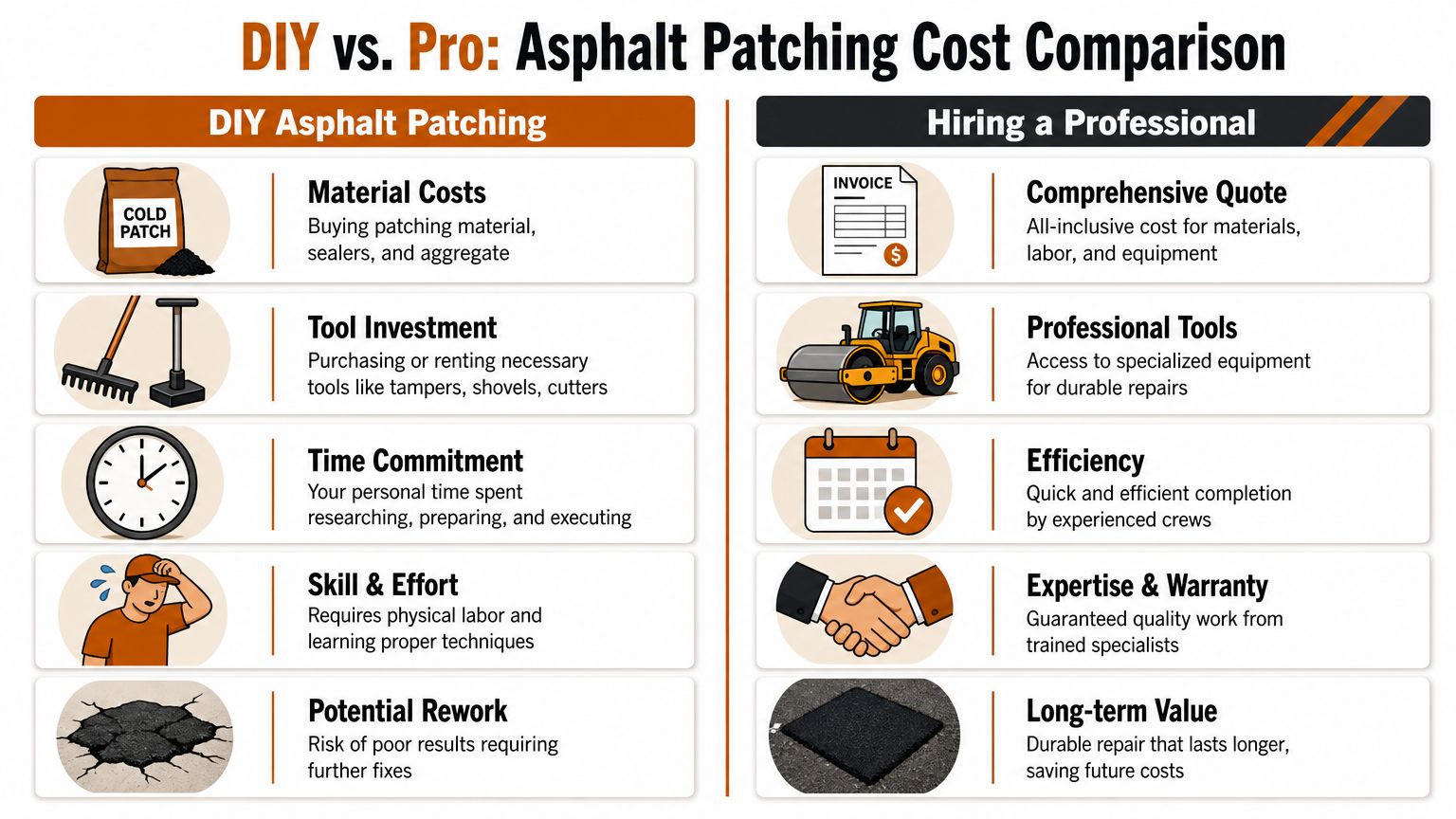
DIY patching makes the most sense when the goal is short-term safety on a very small area. If the pothole is isolated, shallow, and you understand the repair may not hold up well, a basic cold patch can get you by for the moment.
It usually stops making sense when any of these show up:
- Loose or broken edges: If the surrounding asphalt is crumbling, the patch won't have solid walls to hold against.
- Standing water: Water tells you the shape or drainage may already be wrong.
- Repeated failure in the same spot: That usually points to a deeper issue than a surface void.
- Driveway entrance or traffic lane location: High-turning and braking areas punish weak repairs fast.
This walkthrough gives a good visual sense of the difference in execution between a quick patch and a more durable repair approach:
What homeowners usually underestimate
The bag isn't the whole job. The main challenge is cleaning out loose material, cutting back to firm edges if needed, placing the right amount, compacting it properly, and leaving a patch that doesn't dish, hump, or unravel at the sides.
A homeowner also has to absorb the hidden costs that don't show up on the receipt. Time, tool pickup, labor, cleanup, and rework all count. If the patch fails after one Florida rainy stretch, you're buying the repair twice.
A cheap patch isn't the same as a low-cost repair. The low-cost repair is the one you don't have to redo.
Professional work also changes the outcome because the crew can choose the right repair type based on the failure. That's the part a lot of DIY attempts miss. They address the hole. They don't diagnose why the hole formed.
Central Florida's Impact on Asphalt Repair Costs
In Central Florida, asphalt doesn't fail in a vacuum. The weather and the local market both show up on the invoice.
That applies across Marion County, FL and Citrus County, FL, whether you're dealing with a residential driveway in Ocala, an HOA road in Inverness, or a commercial lot in Homosassa.
Heat, rain, and timing matter here
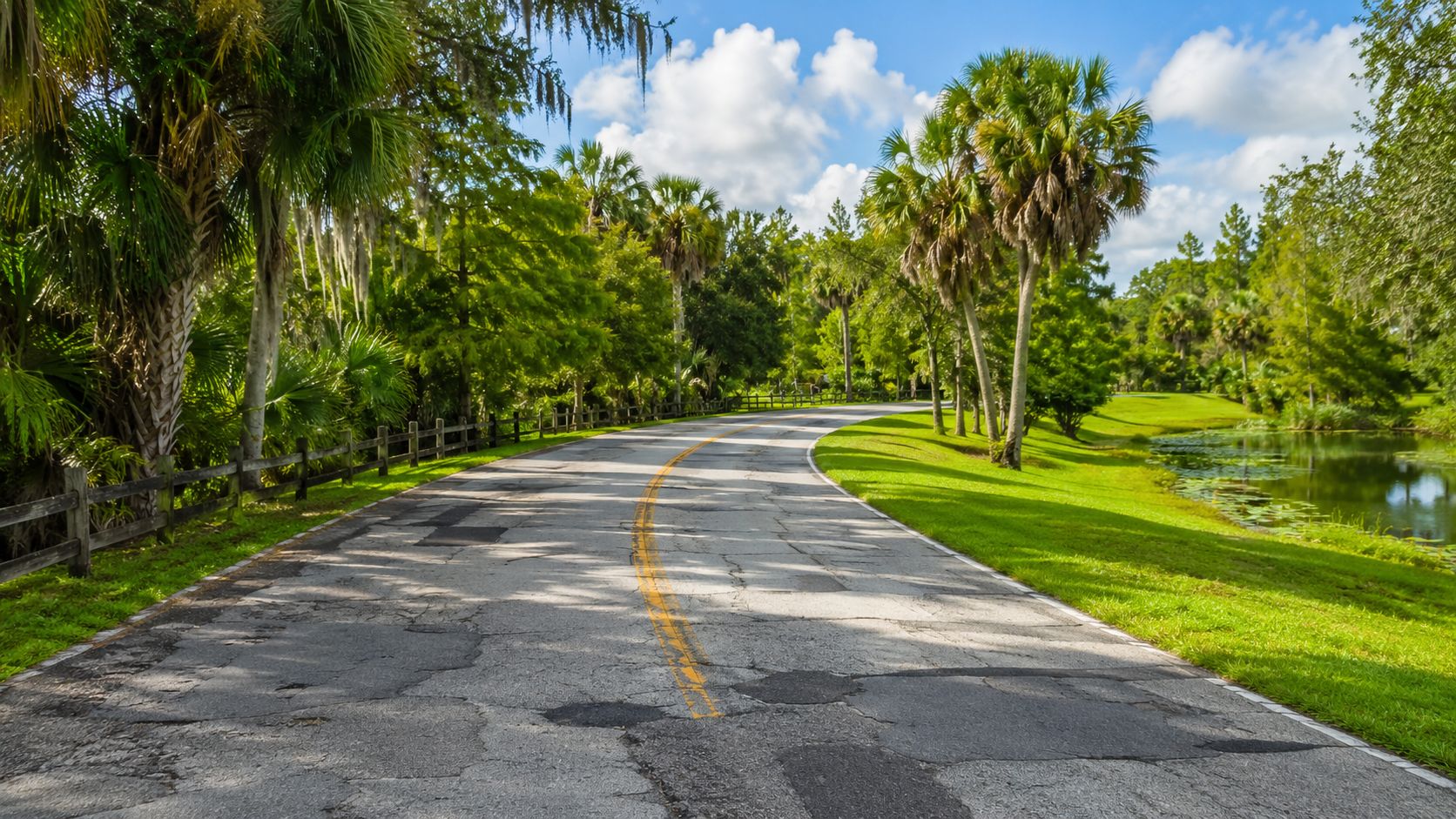
Heat and UV exposure dry out asphalt over time. Once the surface becomes more brittle, cracking and edge breakdown become more common. Then the summer rain cycle gets involved.
Water is the multiplier. It moves through open cracks, softens weak areas, and turns a small surface issue into a section that starts moving under traffic. In places like Summerfield, Beverly Hills, and Lecanto, that's why a patch that looked optional in one season can become urgent in the next.
Scheduling matters too. A proper patch needs dry enough conditions and a repair plan that fits the temperature, traffic, and moisture level of the site. A rushed repair right before another run of storms can be money poorly spent.
Material volatility reaches local repair budgets
Facilities Dive reported in 2026 that because asphalt is petroleum-based, a $10 increase in crude oil prices can translate to a 2% to 3% rise in asphalt costs, and it cited Kansas short-ton pricing at $496, down from $533 in March 2025 (Facilities Dive report on rising asphalt prices).
That doesn't mean every driveway estimate in Marion or Citrus County moves overnight. It does mean material pricing can shift faster than many property owners expect, especially when they wait on a repair after receiving a quote.
In Florida, delay has a double cost. The damaged area often gets worse, and the material market can move while you wait.
Local conditions also affect the recommendation itself. A patch beside a low spot, downspout discharge, or failed edge in Dunnellon or Crystal River may need drainage correction or a different repair scope if you want it to last.
When to Patch vs When to Replace Your Asphalt
A driveway in Ocala or a lot in Inverness gets one bad pothole, and the first instinct is to patch that spot and move on. Sometimes that is the right call. Sometimes it is how owners spend money twice.
Patching is the better buy when the failure is limited and the pavement around it still has strength. Replacement makes more sense when the surface is failing as a system, not as one isolated spot. That distinction decides whether a repair saves money or just delays a larger bill for a few months.
Patch the right failure
A patch makes financial sense when the damaged area is contained and the surrounding asphalt can support it. Good candidates usually include:
- Isolated potholes: One section failed, but the nearby pavement is still stable.
- Limited edge damage: The break is confined and has not spread across a larger run.
- Early surface breakdown: The problem is caught before traffic and water widen it.
- Short-term budget planning: You need to keep usable pavement in service while timing a larger project later.
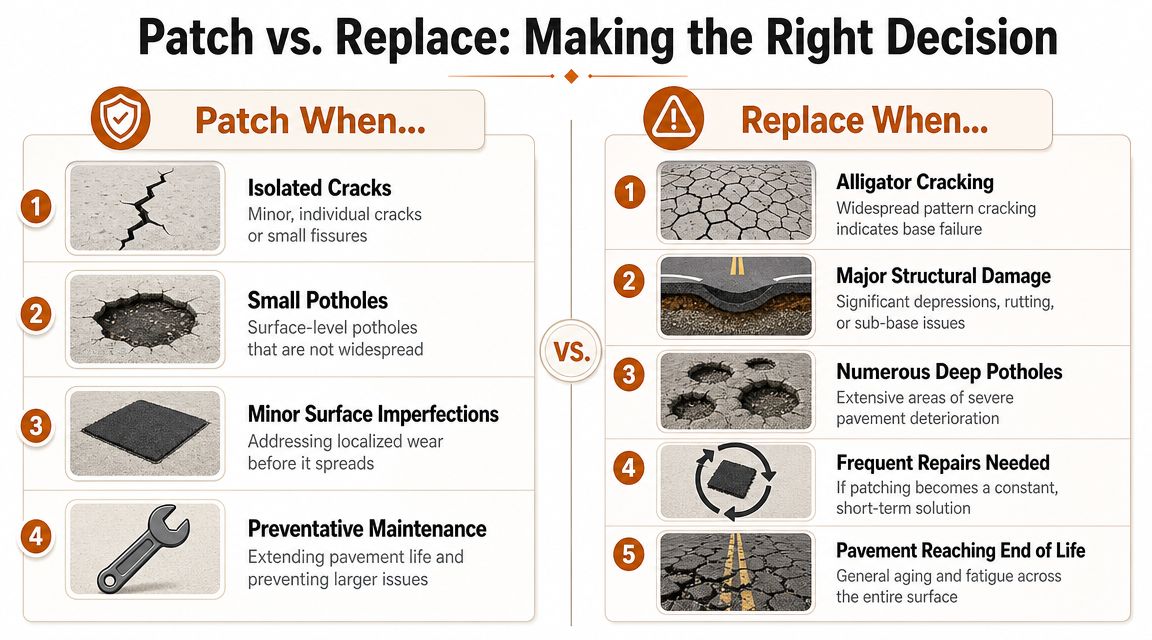
A good patch can buy time. A bad patch, or a patch used in the wrong place, usually fails around the edges first. Then the old weak asphalt breaks loose beside the repair, and the owner ends up paying again.
Replace when the problem is bigger than the hole
The Pavement Group notes that patching is often cheaper upfront, but for widespread damage, drainage problems, or base failure, full replacement is often the lower long-term cost than repeated spot repairs (The Pavement Group repair vs replacement guide).
That matches what shows up in the field across Central Florida. If the pavement has alligator cracking, several potholes in the same traffic path, low spots that stay wet, or sections that pump and flex under vehicles, patching is usually covering symptoms. The base or the surrounding mat has already given up.
Property owners often lose money trying to stay cheap. They approve a small repair because the number looks manageable, then call again after the next rainy stretch when the area opens back up. One larger replacement would have cost more on day one and less over the next few years.
For some older driveways and commercial sites, the best answer is to stop pricing patches one by one and get a full asphalt repair evaluation from a contractor who can see the whole surface, drainage pattern, and traffic load. A local site review from a team that handles asphalt repair in Central Florida helps owners decide whether they are extending pavement life or just extending the failure cycle.
If you are patching the same section over and over in Silver Springs, Hernando, or The Villages, the repair has stopped being a value. It has become a holding pattern.
Getting an Accurate Quote in Marion and Citrus County
Online numbers are useful for budgeting. They are not enough to approve the work.
An accurate quote in Marion County, FL or Citrus County, FL starts with a site visit because the contractor needs to inspect the repair area, the surrounding pavement, drainage, access, and traffic conditions.
What should happen during a site visit
A proper on-site evaluation should look at more than the hole itself. It should check:
- Repair depth: Is this surface wear, or has the failure moved into the base?
- Water movement: Does runoff cross the repair area or sit beside it?
- Edges and transitions: Are the surrounding sections stable enough to support a lasting patch?
- Access and setup: Can equipment reach the area efficiently, or will mobilization be heavier?
- Scope opportunities: Would it make more sense to repair several failed spots at one time?
If a quote is given without seeing the site, it should be treated as a rough budget number only.
Why local experience changes the recommendation
A local contractor understands the difference between a patch in a shaded residential driveway in Belleview and a patch in a busy commercial lane in Ocala or Inverness. The repair method should match the use.
Riverside Sealing & Striping, LLC provides asphalt repair and maintenance in Central Florida, and that kind of field evaluation is where the right recommendation starts. Sometimes the answer is a straightforward patch. Other times it makes more sense to bundle repairs, follow with sealcoating later, or redirect the budget toward concrete replacement if the site conditions support it better.
For homeowners and property managers, the vital step is simple. Get a real on-site look. That's how you find out whether you're buying a lasting repair or just delaying a larger failure.
Frequently Asked Questions About Asphalt Patching
How long should a patch last in Florida
A Florida patch lasts only as long as the repair matches the failure. A quick cold patch in a shallow pothole may buy a little time. It usually does not hold up well through heavy summer rain, standing water, and daily traffic. A properly cut and installed hot asphalt patch, or the right infrared repair in the right location, can last much longer if the surrounding pavement and base are still stable.
If the base is soft or water keeps working under the pavement, patching becomes a short-term expense instead of a real repair.
Can multiple small patches be priced together
Yes, and that is often the smarter way to spend the money.
Crew mobilization, equipment setup, and material delivery are part of the bill whether one area is repaired or several. If a driveway, lot, or private road has a handful of failed spots, grouping them into one visit usually lowers the cost per patch compared with spacing the work out over multiple service calls. It also helps prevent a cycle where one cheap repair is done now and the surrounding weak areas fail a few months later.
Will a patch match the rest of my asphalt
Usually not right away. New asphalt is darker. Older pavement in Central Florida fades, oxidizes, and collects wear differently across the surface.
Infrared repairs and careful finishing can reduce the visual contrast, but some color difference is normal until the repaired area weathers in. Homeowners often care most about appearance in a front driveway. Property managers usually care more about whether the repair holds under traffic. Both matter, but appearance alone should not drive the repair decision.
Can patching be done on commercial lots and HOA roads
Yes, if the failures are localized and the surrounding pavement still has enough strength to support the repair. We patch parking stalls, drive lanes, entrance areas, and sections of private community roads when the damage is limited to specific spots.
Commercial and HOA work needs a stricter look than a small residential driveway. Traffic weight, turning movement, drainage, trip hazards, and striping all affect the repair plan and the price. In some cases, a patch is the right move to stop one failed section from getting worse. In other cases, patching a heavily alligatored lane just burns budget that should go toward a larger repair or replacement.
Costs also vary widely by method, site conditions, and how much prep the area needs. As noted earlier, a cheap store-bought patch may look less expensive at the start, but it often turns into a repeat repair. Professional patching costs more up front because it includes saw-cutting, removal, base correction when needed, compaction, and crew time. That is usually the lower-cost decision over the life of the pavement.
If you're budgeting for a driveway, parking lot, or access lane in Ocala, Dunnellon, Crystal River, or anywhere in Marion and Citrus County, get the site looked at in person first. Riverside Sealing & Striping, LLC provides asphalt and concrete repair work in Central Florida, and that kind of field review is how property owners find out whether they should patch it now, bundle repairs, or stop spending money on a surface that is too far gone.