
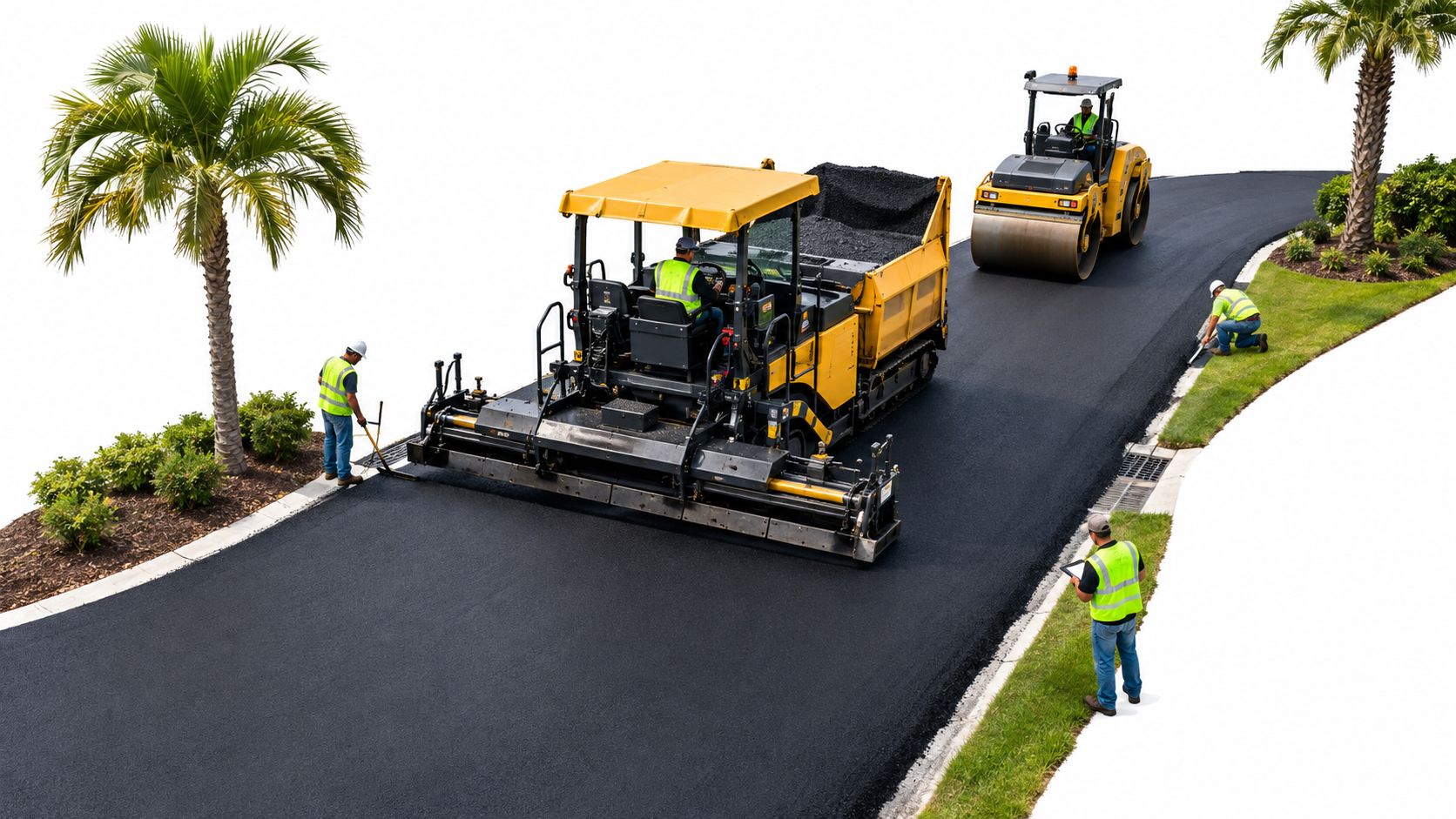
A worn driveway in Dunnellon often looks like a surface problem. The edges crumble, dark cracks spread across the lane, and afternoon rain finds every low spot. But the visible asphalt is only the top of a system. In Central Florida, asphalt paving best practices begin below the mat and depend on decisions made before the first truck arrives.
Heat, ultraviolet exposure, sudden storms, sandy subgrades, clay pockets, and turning traffic all test fresh pavement. A residential driveway in Ocala needs a different design conversation from a commercial lot in Crystal River or a church parking area in The Villages. The right mix matters, but so do drainage, lift thickness, compaction timing, joint layout, and the maintenance plan that follows.
Table of Contents
- Planning the Paving Job Before the First Load Arrives
- Preparing the Subgrade, Base, and Drainage
- Choosing the Right Mix and Lift Thickness
- Joint Layout, Edge Details, and ADA Compliance
- Temperature Windows, Compaction, and Roller Patterns
- Quality Checks, Sealcoating Schedule, and Long-Term Care
- Putting It All Together for a Lasting Florida Surface
Planning the Paving Job Before the First Load Arrives
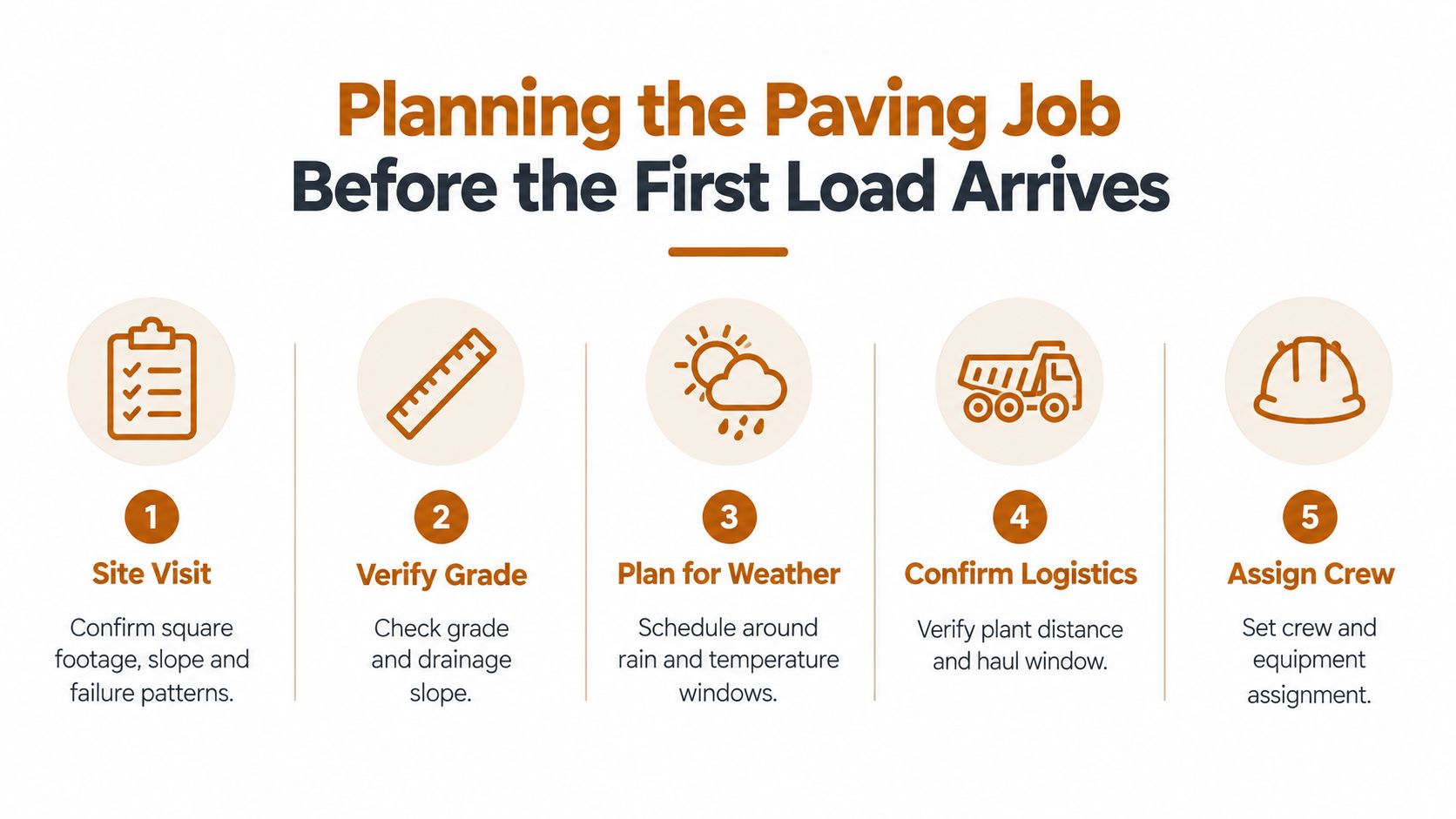
A homeowner may be staring at a worn driveway, while a property manager may be looking across a faded parking lot and comparing repair estimates. Both are seeing the same mistake too often: treating asphalt as a material purchase instead of a constructed pavement system. The first site visit should identify square footage, slope, access, existing failures, and expected traffic before anyone discusses tonnage.
Alligator cracking, pumping, rutting, and isolated soft spots deserve more attention than a simple surface overlay. Those patterns can indicate trouble in the base or subgrade. A crew that paves over structural failure may create a dark, smooth surface that looks finished but breaks down when water and vehicle loads reach the weak area.
Confirm the site and the legal details
Permitting requirements can vary by jurisdiction and project type, so the owner should confirm requirements with the applicable authority in Marion County, FL or Citrus County, FL. Utility locates through 811 belong on the prework list, not in the middle of paving day. The crew also needs a realistic haul route. A dump truck and paver must reach the work area without damaging a neighbor's drainfield, irrigation system, septic components, or narrow shoulder.
Traffic loading controls the pavement section. A driveway used lightly by passenger vehicles doesn't need the same structural design as a shopping lot receiving delivery trucks, forklifts, and repeated turning movements. The lowest bid often removes preparation or thickness that the site needs.
Practical rule: Price the pavement section, drainage work, access plan, and traffic requirements together. Comparing only the asphalt line item hides the decisions that determine service life.
Schedule around Florida weather
A July storm can arrive after a clear morning and leave a fresh mat exposed to heavy rain before it has reached stable density. Crews should review the 10-day forecast, favor morning placement when practical, and keep a clear weather escape plan. Rain, wind, and high surface temperatures affect the available compaction window and the crew's ability to maintain a consistent mat.
Before mobilization, verify the marked layout, expected material yield, paver calibration, roller staging, haul timing, and crew assignments. A contractor serving Dunnellon, Belleview, Silver Springs, Summerfield, or Beverly Hills should be able to explain what happens if a truck is delayed or a storm cell changes direction. For an overview of professional Florida asphalt paving, look for a process that addresses preparation before placement, not just the finished appearance.
Preparing the Subgrade, Base, and Drainage
A Florida pavement succeeds when the subgrade, base, and drainage work as one system. Marion County's sandy areas may drain differently from clay pockets in Citrus County. Both can contain soft zones that only become obvious under equipment or after repeated saturation. Probing, proof-rolling, and correcting weak areas before aggregate placement are more valuable than covering them quickly.
For a residential driveway, a common planning range may include a compacted limerock or crushed concrete base beneath the asphalt, but the actual depth must follow soil conditions, drainage, and vehicle use. Commercial lots generally demand a more substantial stabilized section because delivery vehicles and repeated turning loads concentrate stress. Exact design should come from the site evaluation rather than a universal thickness promise.
Build the section from the ground up
A practical sequence looks like this:
- Expose and evaluate the subgrade. Remove unsuitable material, organic matter, and visibly unstable soil.
- Shape the drainage path. Grade the surface so water moves toward a defined outlet instead of collecting beneath the pavement.
- Place and compact the base in controlled lifts. A thick loose layer can appear stable while remaining weak underneath.
- Check the finished grade. Confirm that the planned asphalt thickness remains available across the entire area, especially at edges.
- Place asphalt only after the base earns approval. The surface shouldn't serve as a correction for an unprepared foundation.
A minimum 2 percent drainage slope is often used as a planning reference away from structures and toward a suitable drainage route, but site constraints may require swales, curbing, inlets, or underdrains. Flat lots need more than a hope that rain will find its way out. A blocked outlet or low edge can keep water under the mat long enough to weaken the base.
Compare pavement sections by use
| Application | Asphalt Thickness | Base Depth | Compaction Target |
|---|---|---|---|
| Residential driveway | Design according to soil and vehicle use | Design according to soil and drainage | Meet project specification |
| Light commercial parking | Design for regular passenger traffic | Stabilized base suited to site loading | Meet project specification |
| Heavy commercial or service area | Design for trucks, forklifts, and turning | Reinforced section suited to repeated loads | Meet project specification |
These are planning categories, not a substitute for testing. A failed pavement edge commonly traces back to thin base support at the perimeter, trapped water, or a transition that was never properly tied into the existing grade. Drainage infrastructure also needs care. Properties that rely on inlets, swales, or storm structures should include storm drain maintenance in the long-term pavement plan.
Choosing the Right Mix and Lift Thickness
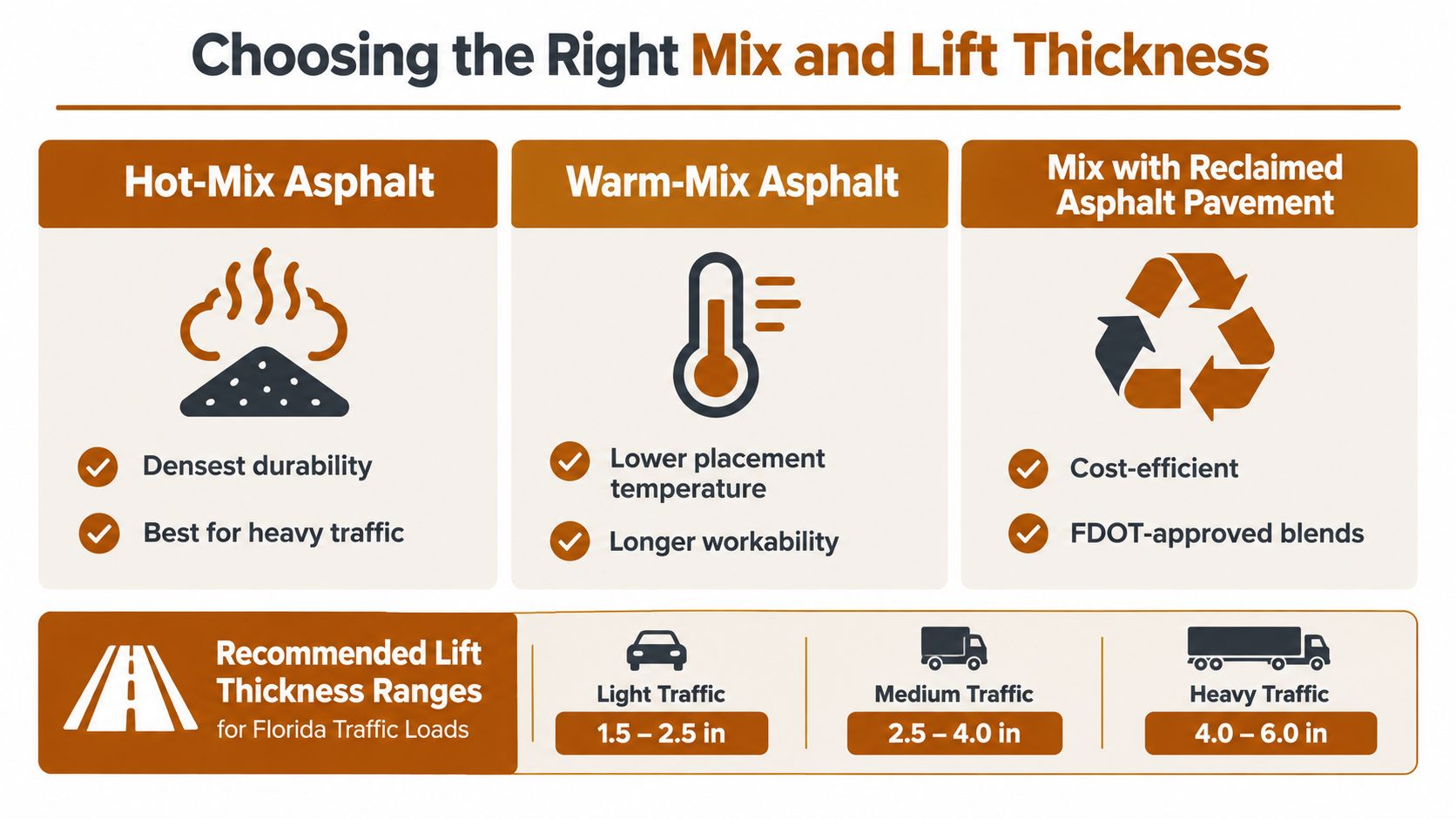
The right asphalt mix is a traffic decision first. Hot-mix asphalt, warm-mix asphalt, and reclaimed asphalt pavement can all fit a project, but they don't behave identically during production, hauling, placement, and compaction. A residential drive in Inverness has a different risk profile from a delivery lane serving a shopping center in Homosassa.
Hot-mix asphalt provides a familiar placement process and a broad performance record. Warm-mix asphalt can offer a lower placement temperature and more workable handling, which may help when haul conditions or compaction timing create pressure. Industry survey coverage reported that warm-mix asphalt represented 40.2% of the total asphalt mixture market in 2024 in the cited update, while adoption differed by sector, so it shouldn't be treated as an automatic answer for every property. See the practical distinction between hot-mix asphalt and other production approaches before selecting a specification.
Match the mix to the loads
A dense-graded mix approved for the applicable Florida specification may suit many driveways and parking lots. Heavier truck lanes, tight turning radiuses, and loading areas may justify a stone-matrix or polymer-modified mix when the additional material and placement requirements support the site's demands. The cheapest mix per ton can become expensive if it can't tolerate the traffic pattern.
RAP deserves the same practical evaluation. 94.6 million tons of reclaimed asphalt pavement were recycled into new mixes in 2021, and 95% of reclaimed asphalt was put back into new pavements, according to the National Asphalt Pavement Association recycling overview. More recent survey coverage reported average RAP content rising from 15.6% in 2009 to 22.9% in 2024, so the question is usually how to optimize RAP for the mix and site, not whether recycling belongs in asphalt.
Protect the compaction window
RAP can stiffen a mixture as content rises, which may reduce workability during a long haul or a fast-moving summer placement. Warm-mix technology may help extend handling flexibility, but plant capability, mix design, weather, and roller access still control the result.
Lift thickness must also support aggregate orientation and density. Industry guidance recommends a minimum lift thickness of at least three times the nominal maximum aggregate size, while other compaction guidance discusses thicker lifts in relation to the aggregate structure. A three-inch total section may therefore work better as multiple lifts than as one oversized pour, depending on the approved design.
Joint Layout, Edge Details, and ADA Compliance
Joints are where one paving pass meets another, and Florida rain will find any weak connection. Longitudinal joints should be planned around lane width, traffic paths, drainage, and the sequence of placement. Transverse joints need a clean, square termination rather than a feathered edge that traffic can break apart.
A crew should tack vertical faces before placing the adjoining lane. Staggered joints are generally preferable to aligned joints because they avoid creating one continuous weak line through the pavement structure. At a curb, concrete edge, or supported shoulder, the asphalt should have full-depth support. Tapered edges often ravel under tire traffic and heat, especially where vehicles repeatedly turn or park near the perimeter.
Verify the layout on site
For commercial properties, ADA compliance includes more than painting a symbol. The 2010 ADA Standards guidance for accessible parking requires a van-accessible space to be 96 inches wide minimum when paired with an access aisle, and the number of accessible spaces scales with lot size. A lot with 1 to 25 spaces requires 1 accessible space, while a lot with 26 to 50 spaces requires 2 under the cited requirements.
The owner or manager should verify accessible routes, access-aisle placement, slopes, detectable warnings where required, and sign positioning with the applicable design professional or authority. Striping that looks clean can still be incomplete if the route from the space to the building is obstructed or the aisle is misused.
| Application | Joint Type | Joint Spacing | Edge Detail | ADA Requirement |
|---|---|---|---|---|
| Residential driveway | Planned transverse and longitudinal transitions | Based on driveway width and placement sequence | Full-depth support at curb or shoulder | Usually not a parking-lot layout issue |
| Commercial parking lot | Lane joints, construction joints, and transverse terminations | Based on paving sequence, traffic lanes, and drainage | Supported edges, clean transitions, protected corners | Accessible spaces, aisles, routes, signage, and markings must be coordinated |
| Shared-use or institutional lot | Construction and repair joints coordinated with pedestrian routes | Based on traffic flow and phased work | Avoid abrupt lips and unsupported pavement edges | Confirm accessible route and detectable-warning requirements |
The joint plan should be visible before paving begins. If the layout only gets decided as the paver moves, the crew may place joints exactly where turning tires and standing water create the most stress.
Temperature Windows, Compaction, and Roller Patterns
The fresh mat has a short working life. Federal guidance explains that asphalt compacts most efficiently while it remains hottest and least stiff, and it recommends finalizing the roller pattern before paving starts, keeping rollers close behind the paver, and adjusting for lift thickness, wind, sunlight, and ambient conditions. The FHWA asphalt compaction guidance identifies typical starting compaction temperatures of about 275 to 310°F, with a usual rolling intensity of 10 to 14 impacts per foot. Dropping below 10 impacts per foot risks corrugation or washboarding.

Roll in zones, not by guesswork
The breakdown roller works closest to the paver while the mat has the most response to compaction. An intermediate roller follows to build density and close the surface. The finish roller removes marks without chasing the mat after it has become too stiff. Roller operators need to maintain consistent travel, avoid abrupt stops, and keep enough overlap to prevent untreated strips.
The asphalt handbook places the typical completion limit before the mat falls below roughly 175 to 180°F. Density guidance identifies about 92% minimum in-place density, with 93% to 94% preferred after construction, because density supports durability and moisture resistance. The practical lesson is simple: a crew can't recover lost density by making extra passes after the mix has cooled.
Florida weather changes the timing
A hot mat can lose heat quickly when wind moves across the surface, yet a sudden storm can deliver thermal shock and water before the crew finishes. Spring and fall evenings can also shorten the cooling window after sundown. Federal guidance recommends adapting the pattern to the actual conditions rather than following a rigid pass count.
The roller should stay close enough to the paver to use the available heat, but not so close that it interferes with the paver's steady movement. Temperature checks, density testing, and communication between the paver operator and roller operators separate controlled placement from hopeful placement.
Quality Checks, Sealcoating Schedule, and Long-Term Care
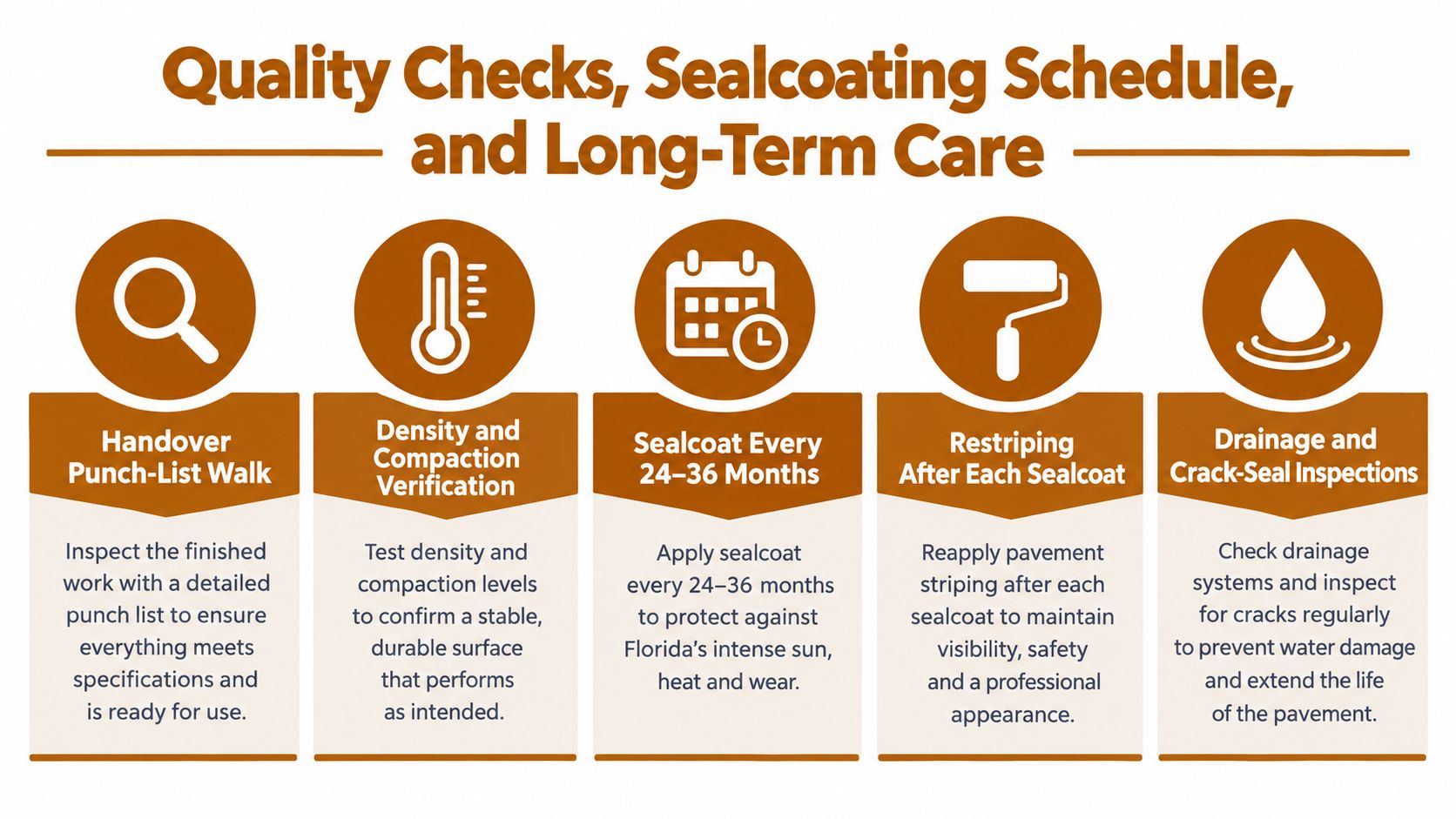
A paving job isn't complete when the rollers leave. At handover, the owner should walk the surface with the contractor and look for segregation, tearing, open joints, ponding areas, rough transitions, and edge failures. Density can be checked with cores or a nuclear gauge, while a straightedge can reveal surface irregularities that aren't obvious from a distance.
The quality record should connect test results to the exact area tested. Federal and industry guidance treats density and smoothness as construction performance measures, not cosmetic preferences. A professional punch list may also confirm joint treatment, drainage flow, clean tie-ins, and the point at which traffic can safely return.
Let the pavement cure before sealing
Sealcoating is a maintenance treatment, not a substitute for a sound base or proper compaction. The surface needs time to cure before the owner applies a protective coating, and the decision should account for traffic, weather, oil exposure, and the condition of the binder. Florida-focused guidance commonly recommends a 2- to 3-year sealcoating cycle, with intense sun, coastal exposure, or heavier traffic pushing a property toward the shorter end of that range, as described in this Florida sealcoating and striping guide.
Material selection also matters. Asphalt emulsion and coal-tar-based products have different handling, environmental, and traffic considerations. The contractor should explain which product fits the property instead of treating every driveway or parking lot as interchangeable.
Give property staff a repeatable checklist
A manager in Ocala or Lecanto can hand the following schedule to the maintenance team:
- After the first rainy season: Inspect cracks, ponding, edge erosion, and drainage outlets.
- Before sealcoating: Confirm that the pavement is clean, structurally sound, and ready for the selected treatment.
- Every 2 to 3 years: Review the sealcoating condition against Florida sun, traffic, and water exposure.
- After each sealcoat: Schedule fresh parking lot striping where markings have faded or the layout has changed.
- During routine inspections: Photograph cracks, oil spots, failing joints, and blocked drainage before small defects spread.
Striping should follow the surface treatment cycle or occur sooner in high-turnover lots. Clear markings improve circulation, pedestrian awareness, and the practical use of accessible spaces.
Putting It All Together for a Lasting Florida Surface
A Dunnellon homeowner who plans drainage, corrects soft base areas, chooses a mix for actual vehicle use, and protects the compaction window is solving the right problem. An Ocala property manager needs the same discipline, with added attention to delivery routes, accessible parking, pedestrian movement, and phased construction. The target is long service life, not just a fresh black appearance on paving day.
The Asphalt Institute notes that asphalt pavements are normally designed for 20 years, while the Federal Highway Administration describes agencies expecting asphalt pavements to last at least 20 years. Preservation treatments such as crack sealing, surface treatments, milling, and overlays can extend performance beyond the original design, and perpetual pavement concepts describe structural life on the order of 50 years or more when the surface is maintained and overlays are planned before full-depth distress develops. These lifecycle principles are summarized in the Asphalt Institute pavement performance document.
Follow the work from morning to handover
A controlled paving day starts with a site walk, weather check, grade confirmation, and equipment inspection. Trucks arrive into a planned haul sequence, the paver maintains a steady speed, and rollers work in their assigned zones while crew members monitor temperature, joints, edges, and yield.
At the end of placement, density readings and surface checks should guide acceptance. The contractor should explain cure protection, traffic restrictions, drainage observations, and the maintenance date to watch rather than leaving the owner with only an invoice.
A workable lifecycle rhythm looks like this:
- Within the first year: Inspect after heavy rain and address cracks or drainage problems before water reaches the base.
- Around the second year: Evaluate whether the binder has cured sufficiently and whether sealcoating is appropriate for the traffic and surface condition.
- Around the fifth year: Review line visibility, accessible markings, edge condition, and the need for restriping or localized repairs.
- Over the full design life: Use crack sealing, surface treatments, overlays, and timely rehabilitation instead of waiting for structural failure.
The cost-of-ownership lesson is more useful than a simple price comparison. A lower initial bid can become the expensive choice when thin preparation, weak edges, poor drainage, or late compaction leads to repeated repairs. Spend the planning effort where the pavement can fail, then maintain the surface before small defects become structural work.
Riverside Sealing & Striping, LLC provides asphalt maintenance, sealcoating, parking lot striping, ADA-related marking upgrades, and concrete construction for properties in Marion County, FL, Citrus County, FL, and nearby Central Florida communities. For a no-pressure planning conversation and free on-site evaluation, visit Riverside Sealing & Striping, LLC and discuss the drainage, traffic, mix, and maintenance decisions your project requires.