
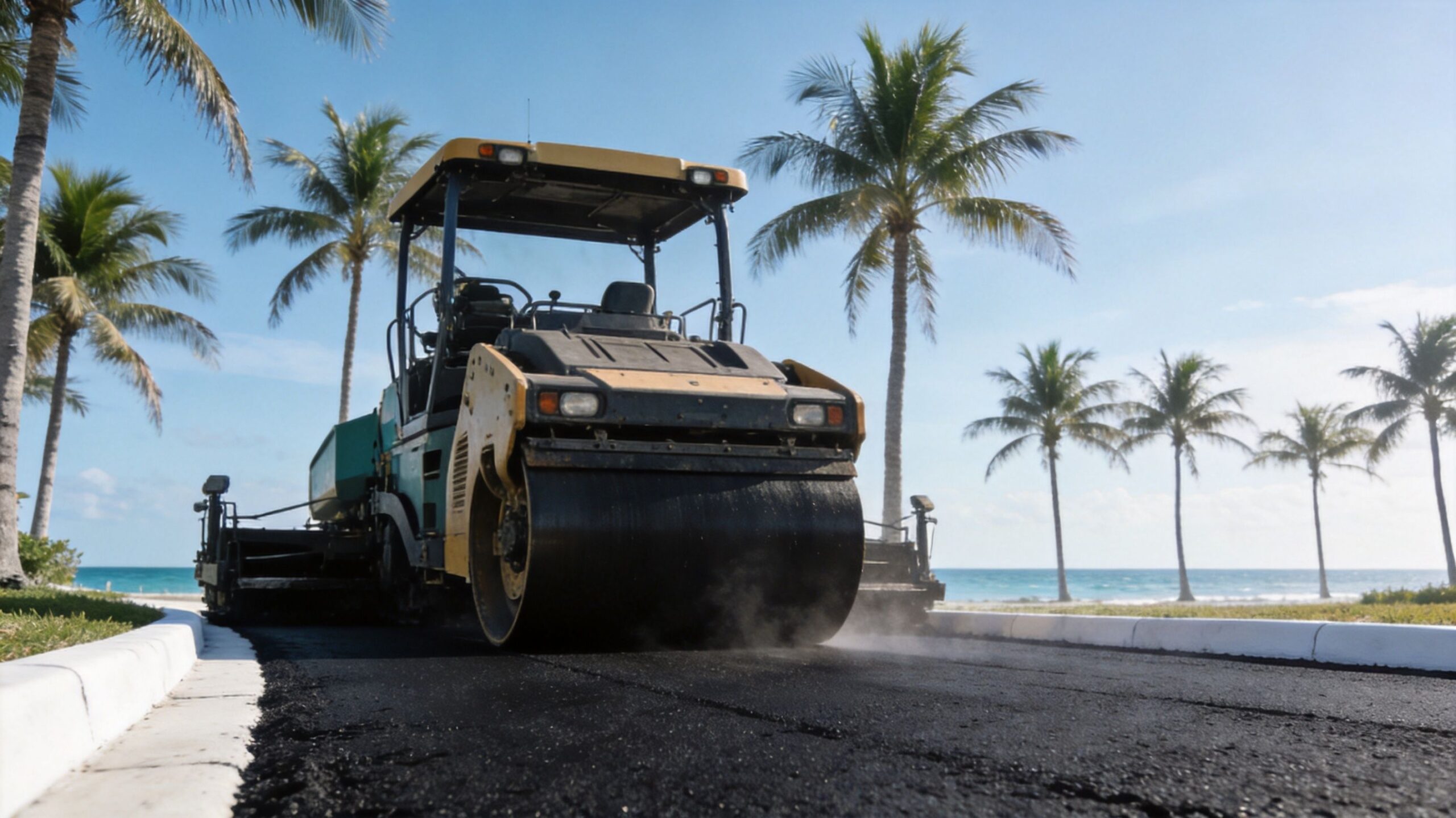
A lot of Fort Lauderdale property owners wait until the asphalt is impossible to ignore. The parking lines have faded so badly drivers make their own spaces. Water sits in the low spots after every hard rain. Cracks spread into rough alligator patterns, and now the surface looks tired before anyone even walks through the front door.
That usually starts the same conversation. Is this still repairable, or is it time to repave? And if it is time, what does a proper asphalt job involve in South Florida?
Those are fair questions. Asphalt paving Fort Lauderdale projects aren't just about laying blacktop and rolling it smooth. Coastal heat, UV exposure, heavy rain, humidity, and constant traffic all push pavement harder than generic online guides admit. The right process, the right base, and the right maintenance plan matter far more in Florida than many owners realize.
Your Guide to Asphalt Paving in Fort Lauderdale
A Fort Lauderdale property manager looking over a worn lot is usually balancing three problems at once. The surface looks bad, standing water is frustrating tenants and customers, and every trip hazard or confusing parking stall creates liability the owner can't afford to ignore.
For homeowners, the signs show up a little differently. The driveway may still “work,” but the edges are fraying, the color has gone chalky gray, and every storm seems to leave a little more water behind. Once oxidation, cracking, and drainage issues start feeding each other, the surface rarely improves on its own.
That's why a paving decision shouldn't start with price alone. It should start with diagnosis. Some surfaces need patching and an overlay. Others need full removal because the base has already failed. A clean-looking top layer over a weak foundation is no bargain.
Practical rule: If water ponds, cracks keep returning, or the surface flexes under traffic, ask about the base before you ask about the finish.
Florida owners in places like Fort Lauderdale, Ocala, Dunnellon, Crystal River, and The Villages deal with different traffic patterns, but the same core issue applies. Asphalt only lasts when the structure under it is sound and the surface above it is protected. If you want a useful baseline before comparing proposals, this overview of Florida asphalt paving is a good place to start.
Property owners across Marion County, FL and Citrus County, FL run into the same questions, even if the setting looks different from coastal Broward. The climate changes by region, but Florida is still hard on pavement.
The Asphalt Paving Process from Start to Finish
A quality paving job follows a sequence. Skip one step, and the finished surface may still look good on day one while already failing underneath. That's why experienced crews treat paving more like building a slab or foundation than applying a cosmetic layer.
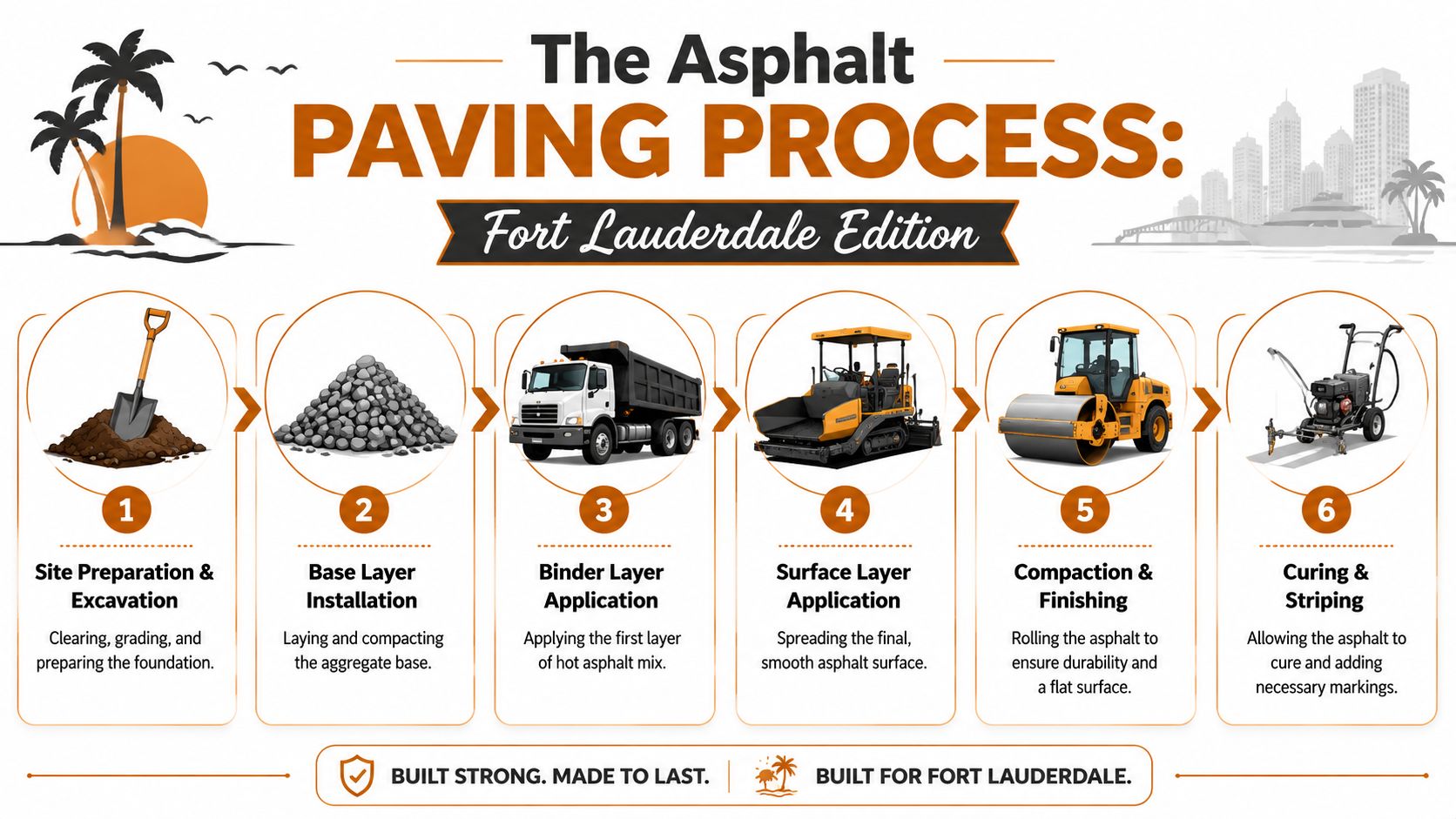
Removal and grading
If the existing asphalt is badly cracked, unstable, or holding water, the first move is demolition or milling. Leaving failed pavement in place just buries the problem. Crews then grade the site so water moves where it should instead of collecting along the driving lane or building edge.
Good grading is not a luxury. In Florida, drainage mistakes show up fast.
Base preparation
The base carries the load. If the subgrade is soft, wet, or unevenly compacted, the asphalt above it will mirror those defects. Such conditions often lead many low bids to cut corners, because owners can't easily inspect what gets covered.
A solid proposal should explain:
- How the base will be evaluated so soft spots are identified before paving
- What material will be added or corrected if grade or support is inadequate
- How compaction will be checked to reduce future settlement and rutting
Surface prep and bonding
When a project involves an overlay rather than full replacement, prep becomes critical. According to FDOT paving specifications, existing pavement must be thoroughly cleaned of loose material using power brooms or blowers, and a tack coat is applied at a precise rate, such as 0.09 gal/yd² on milled or oxidized surfaces, to help the new layer bond properly. If debris stays in place or tack is skipped, the overlay can separate and fail early.
That's one of the easiest ways to spot whether a contractor is serious or just fast.
Clean pavement and proper tack coat are not “extras.” They're part of making one layer act like one pavement.
Asphalt placement and rolling
After prep, the crew places the asphalt in lifts suited to the job. Residential driveways, church lots, retail centers, and access lanes don't all need the same approach. Mix design, thickness, and traffic expectations should line up.
If you want a plain-language explanation of what crews are placing, this guide on hot mix asphalt breaks it down well.
Rolling starts immediately while the mat is still workable. The goal is a tight, uniform surface with no visible segregation, ripples, or tender spots. A finished lot should look smooth, but it must also feel structurally consistent from one end to the other.
Final details that matter
The last stage includes curing time, transitions, edges, and striping. These details often decide whether the finished project feels professional or patched together.
Look for:
- Clean tie-ins where new asphalt meets concrete, drains, or existing pavement
- Protected edges that won't crumble right away under turning traffic
- Clear marking plans for stalls, fire lanes, traffic flow, and ADA-related layout where needed
Understanding Asphalt Paving Costs in South Florida
Most owners ask for a paving price when they really need a scope comparison. Two quotes can look similar on the surface and cover very different work underneath.
That's especially true in Fort Lauderdale, where site access, drainage correction, existing pavement condition, and thickness requirements can shift a project from a basic overlay to a full rebuild. The same pattern applies inland in Marion County, FL and Citrus County, FL, whether the job is in Belleview, Summerfield, Inverness, Lecanto, or Beverly Hills.
What actually changes the price
The biggest cost driver is usually the condition of the existing surface. If the base is stable and grades are workable, an overlay may be possible. If the lot has widespread base failure, severe ponding, or broken edges throughout, demolition and rebuilding will cost more but usually hold up better.
Other common pricing variables include:
- Project size and layout because tight areas, islands, and awkward entrances take more labor
- Required thickness since light residential traffic and heavier commercial use aren't designed the same way
- Prep and drainage work because correcting slope and low areas takes time before paving starts
- Mobilization and access especially when crews must work around business hours or limited entry points
Sample Asphalt Paving Cost Factors (Fort Lauderdale Area)
| Cost Factor | Low-End Impact (e.g., Simple Overlay) | High-End Impact (e.g., Full Demolition & Rebuild) |
|---|---|---|
| Existing pavement condition | Surface is worn but structurally stable | Surface and base both show failure |
| Drainage | Minor adjustments needed | Regrading and drainage correction needed |
| Thickness requirement | Lighter-duty application | Heavier-duty application for traffic demands |
| Prep work | Cleaning, minor patching, tack coat | Removal, excavation, base repair, re-compaction |
| Site access | Open, simple layout | Tight access, phasing, tenant or customer coordination |
| Striping and finish work | Basic layout | Full parking layout, directional markings, ADA-related work |
If one bid is dramatically lower, ask what has been removed from the scope. On paving jobs, the cheapest number often hides the most expensive omission.
A good estimate should separate prep, paving, and finishing clearly enough that you can compare apples to apples. If it doesn't mention drainage, base condition, or surface prep, it's incomplete.
Florida Climate and Local Paving Considerations
A parking lot can look fine in the morning, then take a beating by afternoon. In Fort Lauderdale, the surface may hit punishing temperatures under direct sun, then get hammered by a hard rain the same day. Add salt air near the coast, and asphalt has to hold up under a harsher mix of conditions than many owners expect.
Heat, UV, and humidity change how asphalt ages
Fort Lauderdale's climate dries and oxidizes asphalt faster than milder markets. Intense UV exposure cooks the binder at the surface. Over time, that leaves pavement less flexible and more prone to early cracking, especially in open lots with no shade and constant vehicle turning.
Humidity complicates the early life of new pavement too. As explained in this discussion of Florida paving cure conditions, cure timing in Florida does not always follow the simple rule owners hear elsewhere. Fresh asphalt may look ready before it can handle sharp turns, parked delivery trucks, or repeated point loads from dumpsters and trailers.
That is why post-installation use matters. A good paving job can still get scarred early if traffic returns too aggressively.
Rain exposes mistakes fast
South Florida rain is unforgiving. If water does not move cleanly off the pavement, it settles into low spots, works through cracks, and starts weakening the structure below the surface.
On coastal sites, salt air adds another source of wear. Salt does not attack asphalt the same way it attacks metal, but near-ocean exposure still creates a tougher service environment for the whole property. Surfaces stay damp longer. Adjacent concrete, striping, and metal components often age faster. That changes how owners should plan maintenance and inspection cycles.
For that reason, Fort Lauderdale paving should be judged by how it handles a summer storm, not just how it looks on install day.
Coastal lessons apply across Florida
The same climate logic carries inland, even when the salt exposure drops off. Marion and Citrus county properties do not deal with the same coastal air as Broward, but they still face long heat cycles, heavy seasonal rain, and strong UV. In places like Ocala, Hernando, Dunnellon, and Homosassa, weak asphalt usually fails for familiar reasons. The surface gets brittle, water gets into cracks, and neglected maintenance shortens the life of the pavement.
Owners who want longer service life should plan for Florida conditions from day one and keep up with a realistic asphalt sealcoating schedule in Florida. The climate changes the timeline.
The bottom line is simple. Fort Lauderdale gives you an early look at what Florida weather does to pavement over time. If an asphalt system is built and maintained to handle coastal South Florida, the same discipline usually pays off across the rest of the state too.
Protect Your Investment with Sealcoating and Maintenance
A Fort Lauderdale lot can look clean and solid at handoff, then start aging fast after one wet summer. UV dries the surface, afternoon storms keep feeding moisture into small openings, and salt air adds stress to everything around the pavement. That is why maintenance timing matters so much in coastal South Florida.

Why sealcoating matters in Florida
Sealcoating gets treated as a cosmetic upgrade, but owners get the most value from it as a protective layer. It helps slow oxidation, limits surface wear, and gives water and spills less opportunity to work into a drying pavement surface.
According to one sealcoating overview for Florida conditions, sealcoating acts as a barrier against oxidative degradation from sun and rain. The exact schedule still depends on traffic, drainage, and exposure. A church lot in Ocala, a retail center in Fort Lauderdale, and an HOA street in Citrus County will not all age at the same pace.
The mistake I see most often is waiting until the surface already looks tired. By then, the pavement has usually been losing flexibility for a while.
Maintenance works best early
Asphalt failure usually starts small. The binder oxidizes. Fine cracks form. Water gets below the surface, and Florida rain does the rest. Once that cycle starts, repair costs climb fast.
Owners save the most money when they treat cracking and surface wear while those problems are still shallow and isolated.
A practical maintenance plan usually includes:
- Routine inspections for edge cracking, standing water, raveling, and faded high-traffic areas
- Crack sealing and patching before water reaches the base and softens support
- Sealcoating on a property-specific cycle based on traffic, sun exposure, and drainage conditions
- Fresh striping to keep stalls, fire lanes, and traffic flow clear and compliant
For owners planning ahead, this guide on how often to seal coat asphalt in Florida gives a useful starting point.
A short visual on the process helps many owners understand why timing matters:
What doesn't work
Delayed maintenance is what usually turns a manageable pavement budget into a larger repair project. Sealcoating will not correct failed base areas, ponding that was never fixed, or widespread cracking that has already moved below the surface.
The better approach is disciplined and simple. Protect newer asphalt before it turns brittle. Keep water draining off the pavement. Revisit cracks early. That approach holds up in Fort Lauderdale's coastal climate, and it pays off inland too, where Marion and Citrus county properties face the same heat, rain, and long UV exposure even without the same salt air.
How to Choose a Contractor and Avoid Common Pitfalls
The biggest mistake owners make is assuming all paving proposals describe the same job. They don't. Two contractors can both say “repave,” while one includes proper prep and the other plans to pave over problems.
That's why the lowest bid deserves the most scrutiny, not the least.
Questions that separate professionals from shortcuts
Ask how the contractor handles drainage, base failures, edges, and transitions. Ask what happens if soft spots appear after removal begins. Ask how they prepare an oxidized surface before overlaying it.
A credible contractor should be able to explain the process plainly, without hiding behind vague terms like “industry standard” or “full service.” You want specifics.
Use this checklist when comparing contractors:
- Licensing and insurance so you're not taking on avoidable risk
- Local project experience because Florida paving is not the same as paving in a mild, dry climate
- Detailed written scope that explains prep, paving thickness, and finish work
- Traffic and business coordination for occupied sites that need phased work
- Striping and compliance understanding especially for retail, office, church, school, and HOA properties
Common red flags
Be cautious if a proposal is light on prep details, drainage discussion, or striping scope. Another red flag is a contractor who dismisses existing cracks as “surface only” without checking whether the failure goes deeper.
Watch for crews who promise a quick overlay as the answer to every lot. Sometimes an overlay is the right call. Sometimes it just hides base failure until the owner pays twice.
A detailed contract protects both sides. If the scope is vague, the finished result usually is too.
Commercial owners have another layer to manage
For business and multi-tenant properties, layout and compliance aren't optional. Professional parking lot striping is essential for safety and ADA compliance, and proactive, compliant striping helps owners avoid costly lawsuits and fines, as noted in this overview of Fort Lauderdale parking lot paving and compliance concerns.
For a small shopping center in Ocala, a church in Inverness, or an HOA in The Villages, that means the paint work is not an afterthought. It's part of the property's risk management.
Your Concrete and Asphalt Experts for Central Florida
A Florida property rarely needs just one paving service. A driveway replacement may include a concrete apron at the garage. A retail lot may need asphalt repairs, curb work, and fresh striping on the same job. On older sites, one weak transition between concrete and asphalt is often where water starts getting in and the trouble begins.
That is why owners get better results from a contractor who understands how the full site works together. Asphalt, concrete, drainage, traffic flow, and access are tied to each other. Treat them as separate trades, and the finished job often shows it within a season or two.
That matters even more in Florida. Fort Lauderdale deals with intense sun, heavy summer rain, and salt air that wear surfaces differently than inland properties. In Marion and Citrus counties, the stress shifts toward heat, drainage, tree roots, and soft spots in the base after long wet periods. The climate changes by region, but the rule stays the same. Build for local conditions, or plan to repair early.
Across Marion County, FL and Citrus County, FL, owners in Ocala, Dunnellon, Belleview, Summerfield, Crystal River, Homosassa, Lecanto, Beverly Hills, Hernando, and nearby communities usually need practical scope decisions, not a one-size-fits-all sales pitch. Some properties need full concrete replacement. Others are better served by asphalt maintenance and targeted repairs that extend service life without unnecessary tear-out.
I have seen the same mistake in coastal South Florida and inland Central Florida. Owners spend money on a new surface while ignoring the transition points, drainage edges, or failing base underneath. The pavement may look good on day one, then crack, shove, or ravel long before it should.
Licensed and insured contractors with clear scopes, dependable scheduling, and disciplined site prep usually deliver better long-term value. That applies to a residential driveway in Silver Springs, a church lot in Inverness, or a commercial property that cannot afford downtime.
High standards in paving apply to everyday properties too. Fort Lauderdale-Hollywood International Airport is a visible example of how layered asphalt systems are used where heat, traffic, and weather put surfaces under constant stress. The lesson for property owners is straightforward. Good asphalt is built in lifts, supported by the base, and matched to the site. It is never just black material rolled over an old problem.
A contractor who can handle concrete installation, asphalt maintenance, and site function as one system usually leaves the owner with fewer coordination issues, fewer weak points, and a surface that holds up better in Florida conditions.
Frequently Asked Questions About Florida Paving
Is asphalt or concrete better for a driveway in Central Florida
It depends on the property and how you use it. Asphalt is often a strong fit when you want a smooth driving surface and a maintenance-based approach. Concrete is often the better choice when you want a new or replacement driveway, patio, sidewalk, or slab with a different finish and longer-term structural rigidity. In Marion County, FL and Citrus County, FL, both materials can perform well when installed correctly for local drainage and soil conditions.
When is an overlay enough and when do I need full replacement
An overlay can work when the existing pavement is still structurally sound and the main issues are surface wear, minor cracking, or age. Full replacement is usually the better route when the lot has widespread failure, recurring low spots, broken edges, or signs that the base is no longer supporting the surface.
How long should I wait before driving on new asphalt in Florida
Follow the contractor's instructions for the specific mix, weather, and traffic load. Florida heat and humidity can change curing behavior, so avoid assuming a standard timeline applies to every project. Even when the surface looks ready, sharp turns and heavy vehicles too early can leave marks or create damage.
How often should commercial parking lots be restriped
Restriping depends on traffic, sun exposure, and how visible the markings remain. Busy commercial sites usually need closer attention because faded lines affect safety, traffic flow, and professional appearance long before the asphalt itself has failed.
Can maintenance really save money compared with waiting
Yes, when the pavement is still structurally sound. Sealcoating, crack repair, and timely striping are usually far less disruptive than major reconstruction. Once water gets into the system and the base starts breaking down, repair options become more limited.
If you need help with concrete or asphalt on your property, Riverside Sealing & Striping, LLC serves homeowners, HOAs, churches, and commercial properties across Central Florida with no-pressure estimates and practical recommendations. As concrete and asphalt experts in Marion and Citrus County, the team handles everything from driveway replacement and new concrete work to asphalt sealcoating and professional parking lot striping. If you're in Ocala, Dunnellon, Crystal River, Homosassa, Inverness, or nearby areas, reach out for a free on-site evaluation and a clear scope that fits your property.