Typical asphalt driveway repairs in Central Florida usually fall between $1,070 and $4,023, with small crack filling often running $0.50 to $3.00 per linear foot and full replacement climbing to $8 to $15 per square foot. That's why a quick search for asphalt repair near me usually starts with a small problem and ends with a big cost question.
A homeowner in Marion County spots a fresh crack after a hard rain, a property manager in Citrus County sees water sitting in a parking stall, and both are trying to figure out the same thing, fix it now or wait and risk a bigger bill. In places like Ocala, Dunnellon, Belleview, Silver Springs, Summerfield, Crystal River, Homosassa, Inverness, Lecanto, Beverly Hills, Hernando, and The Villages, pavement gets punished by heat, rain, and daily traffic in ways that make timing matter more than many people realize. For Concrete and Asphalt Experts in Marion and Citrus County, the right repair starts with reading the surface correctly, not just hiring the first crew that answers the phone.
Table of Contents
- Why Asphalt Repair Matters in Central Florida
- Common Asphalt Problems and What They Look Like
- Asphalt Repair Types and When to Use Each One
- What to Expect During an Asphalt Repair Job
- Asphalt Repair Costs and Timelines in Central Florida
- How to Choose a Reputable Asphalt Repair Contractor
- Maintenance, ADA Compliance, and Next Steps for Central Florida Property Owners
Why Asphalt Repair Matters in Central Florida
A crack that looks harmless in January can turn into a real problem by late summer. In Central Florida, the combination of heavy rain, strong UV exposure, and heat puts constant stress on asphalt, and that stress shows up first at the edges, in the joints, and around spots that already hold water.
What the climate does to pavement
Heat softens the binder in asphalt, then rain works its way through the smallest opening and starts weakening the layers underneath. Once moisture gets into the base, the surface doesn't just fade, it starts to lose support. That's why a driveway in Marion County, FL or a lot in Citrus County, FL can look fine from the street and still be in the early stages of failure.
The repair window is the part people miss. If you catch cracking early, sealing or patching can stay focused and affordable. If you wait until the base breaks down, the repair turns into a much larger job and often a much more expensive one.
Practical rule: if water is already pooling in the same spot after rain, the surface is telling you the structure underneath may be starting to fail.
That's not just a homeowner problem. Commercial lots in Ocala, Crystal River, and The Villages take repeated turning forces, delivery traffic, and sun exposure all day long. On those properties, a small defect can become a liability issue fast, especially when visitors, tenants, or customers are using the pavement every day.
Why local searches spike when damage appears
People usually type asphalt repair near me the moment they notice a new defect because the damage feels urgent. That instinct is smart. Asphalt distress rarely improves on its own, and the longer moisture, traffic, and heat keep working on the same spot, the more likely the repair will grow from simple maintenance into structural rehabilitation.
For a Central Florida property owner, the practical takeaway is simple. Don't treat pavement damage as cosmetic until you've checked whether it's still a surface issue. A quick local evaluation can tell you whether the fix is a small repair, a broader patch, or a point where replacement makes more sense.
Common Asphalt Problems and What They Look Like
Not every crack means the same thing. I've seen people pay for the wrong fix because they described the symptom, not the failure, and those two things aren't always the same. A clean evaluation starts with knowing what you're looking at before anyone starts cutting or quoting.
Cracking patterns tell different stories
Linear cracks often start as shrinkage or movement along joints. They're usually narrow at first, and they're the kind of damage that crack sealing can handle before water gets involved. Once the cracks widen, branch, or start connecting, the problem often points to more than surface wear.
Alligator cracking looks like a web or broken skin pattern. That's the one I pay attention to right away because it usually signals deeper structural trouble, not just a bad patch on top. If you see that pattern in a driveway in Belleview or a parking aisle in Homosassa, the base likely deserves a real inspection.
Potholes tell a different story. They form when water gets in, weakens the support, and traffic breaks the surface open. A pothole isn't just a hole in the asphalt, it's evidence that the layers below it have already been compromised.
Depressions, rutting, and soft areas
Rutting shows up as wheel-path grooves, usually from repeated traffic or compaction issues. Depressions are the shallow low spots that trap water and make drainage worse. Soft areas can feel slightly flexible under load, which is often a sign the base isn't carrying weight the way it should.
A patch that covers the top without correcting the reason the surface failed is usually a short-term fix.
Discoloration matters too, but not in the same way. Gray, oxidized asphalt may still be structurally sound, while a dark stain from oil or fuel can weaken the surface over time. The visual clue matters, but the condition beneath it matters more.
If you're walking your property in Silver Springs, Inverness, or Lecanto, check where cracks intersect with drainage lines, gutters, or curb edges. Those are the spots where water usually enters first and damage often spreads fastest. A clear diagnosis here saves money later because it points the repair crew toward the right method instead of the cheapest-looking one.
Asphalt Repair Types and When to Use Each One
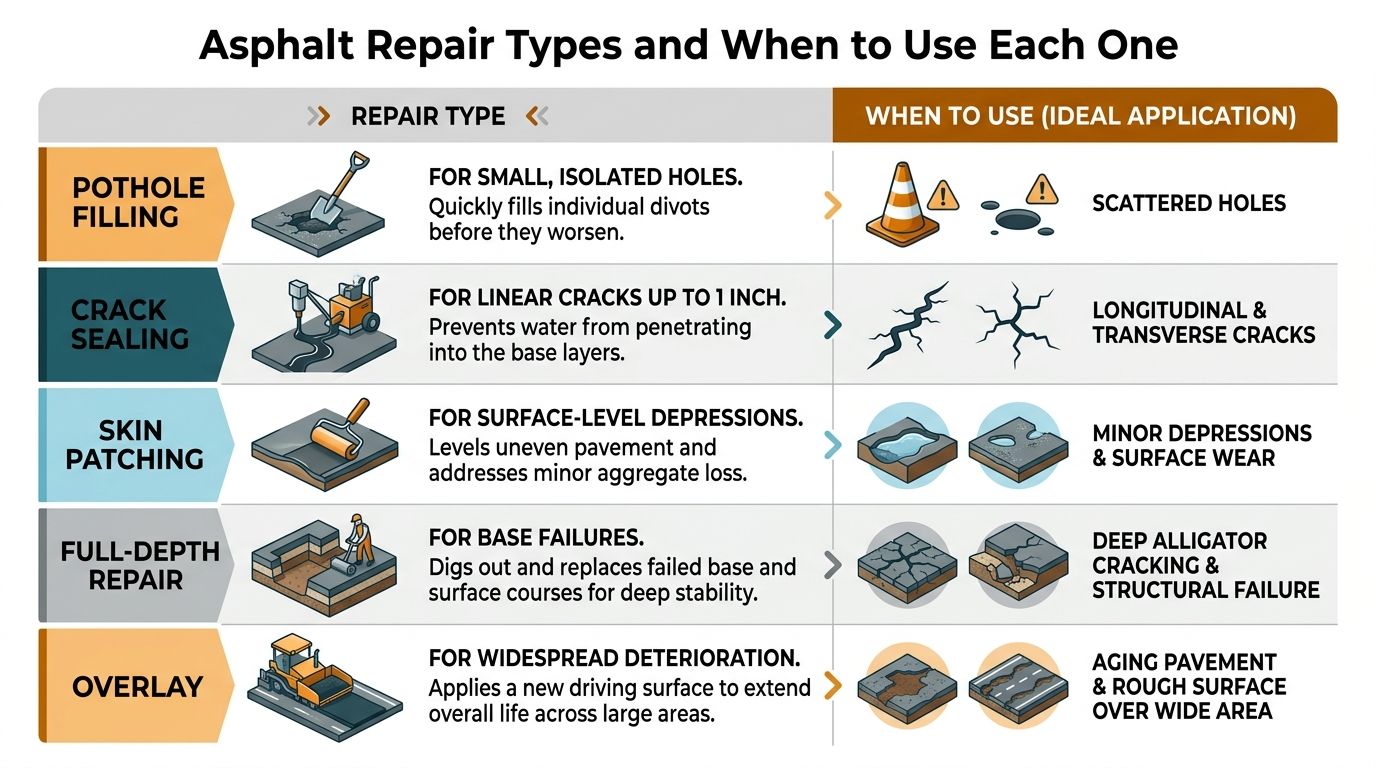
The right repair depends on how deep the damage goes and whether the base is still sound. That's the whole decision tree. Surface-only defects can often be managed with maintenance, but structural failure needs more than a cosmetic fix.
The main repair options
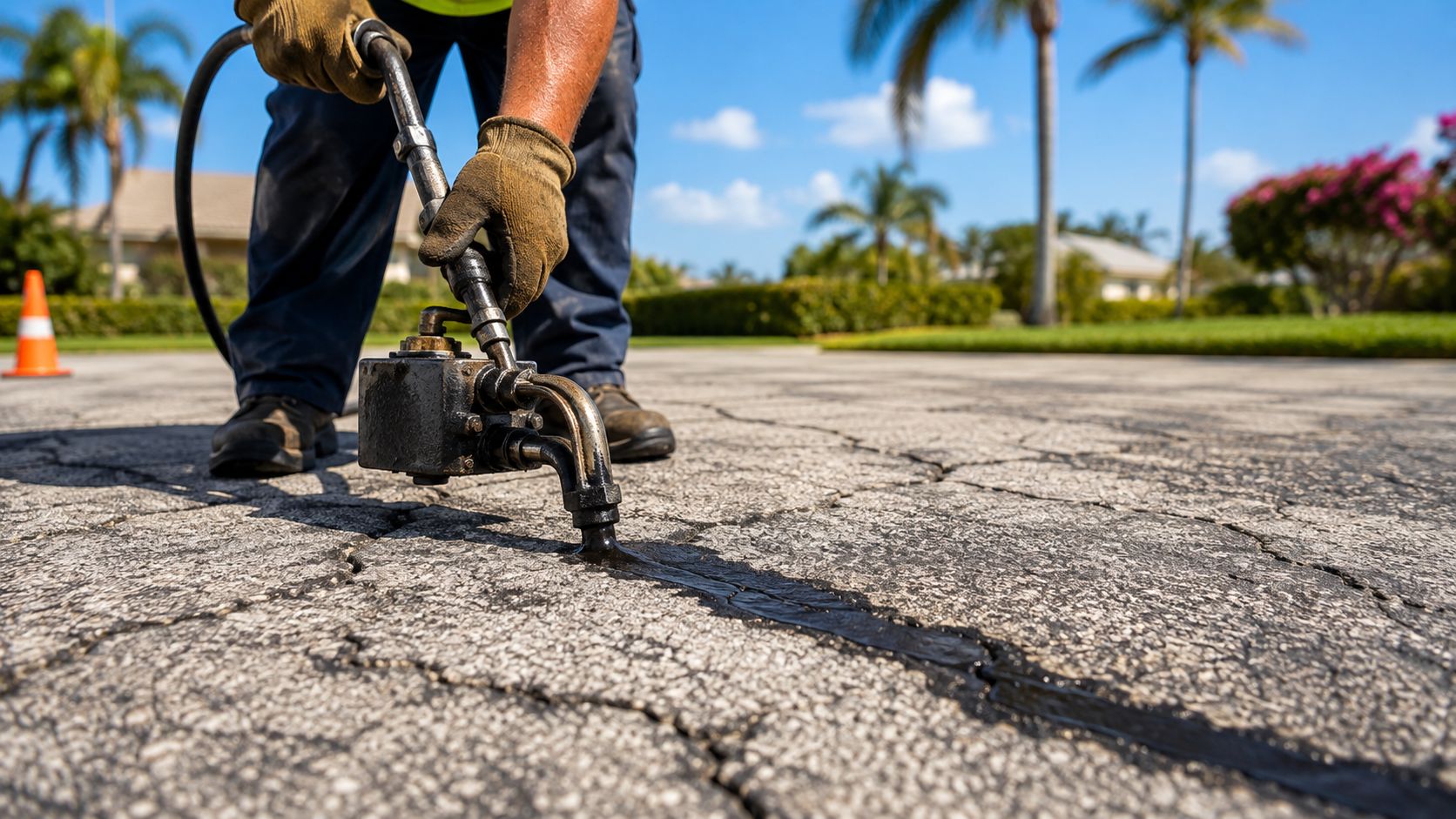
Crack sealing is the first line of defense for small to medium cracks. Hot-pour rubberized sealant is the cleaner, more durable option for most accessible cracks because it blocks water before it reaches the base. Cold-pour products have their place in harder-to-reach spots or expansion joints, but they're usually not the long-term answer on exposed pavement.
Patching is for isolated trouble spots like a broken corner, a small pothole, or a localized sink area. A cold patch can get you through in a pinch, but it's usually temporary. A hot mix patch holds up better because it bonds and compacts more like the surrounding pavement.
Full-depth patching is the durable choice when damage has reached the base or subbase. The failed area is cut into a clean shape, excavated to firm support, the weak base is corrected, and fresh hot mix is placed and compacted flush. It takes more effort, but it's the repair I trust most when structure is the issue.
Overlay or resurfacing works when the pavement is broadly worn but the foundation is still stable. It gives you a new wearing surface without rebuilding the whole section, which is why it can be the smarter middle path on lots and driveways that are aging but not collapsing.
Seal coating is preventive maintenance, not a structural repair. It protects against UV exposure, oil, fuel, and water intrusion, and it's most useful when the asphalt still has good shape underneath.
A good rule is this. If the damage is isolated and the base is firm, repair it. If the distress is widespread but the structure is still holding, consider resurfacing. If the base is failing, full-depth repair or replacement is usually the honest answer.
For a broader side-by-side decision on rehabilitation, the overlay versus replacement discussion is worth reviewing before you approve any work.
What to Expect During an Asphalt Repair Job
A solid repair job should feel organized from the first phone call. If a contractor can't explain the process clearly, that's usually a warning sign. The work itself should be straightforward, but it still needs proper preparation, especially in a climate where afternoon weather can change the schedule.
The normal workflow
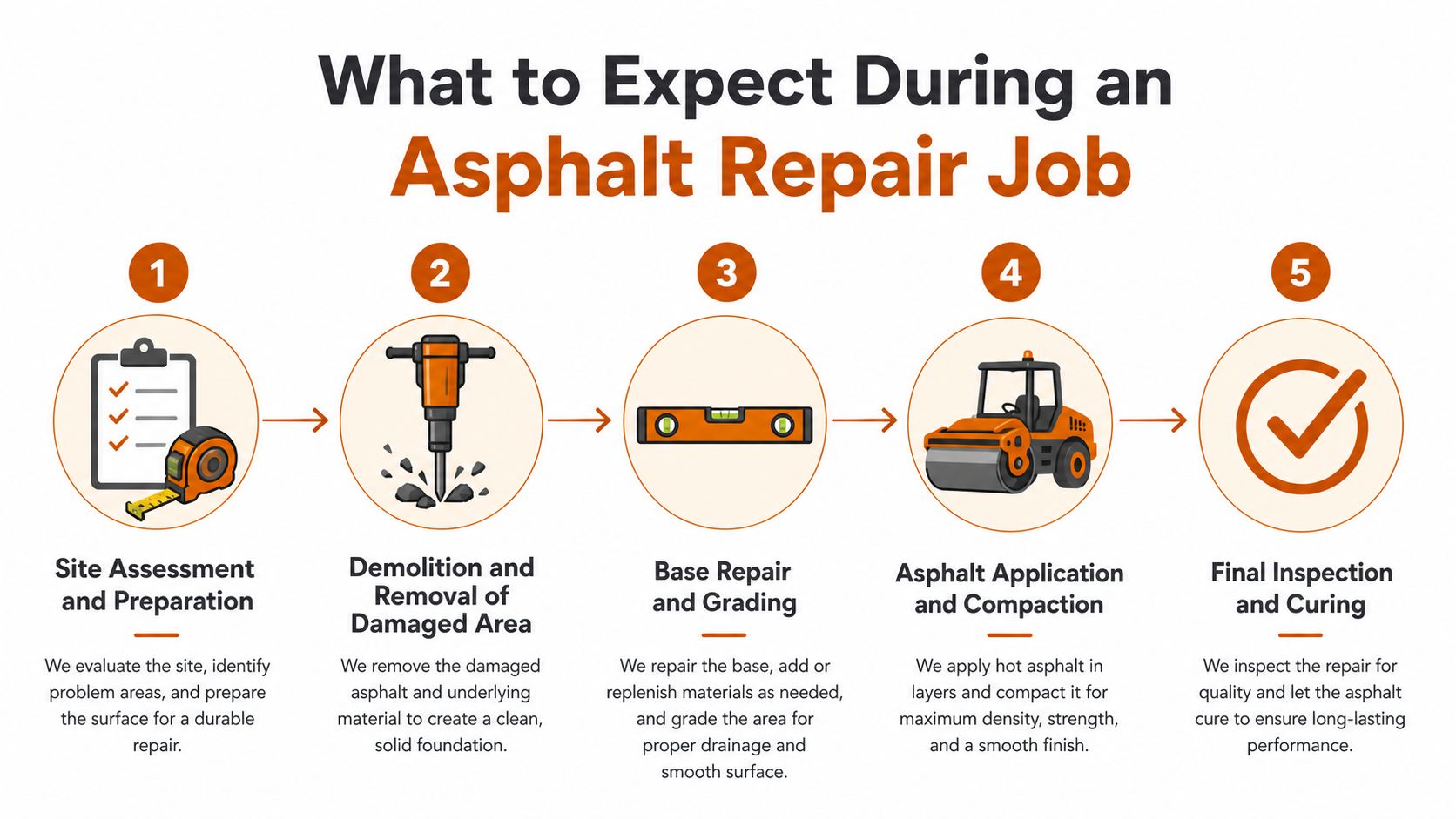
The first step is the site visit. A good contractor looks at the visible damage, checks the edges, and asks what the area does every day, driveway, access lane, turning area, or parking stall. That matters because the fix should match the load, not just the crack.
Next comes preparation. Damaged material has to be removed cleanly, loose debris swept out, and the area shaped so the new material has a stable edge to bond against. If the base is weak, it needs correction before anyone places new asphalt on top.
Then the crew places and compacts the repair material. Compaction is where many sloppy jobs fail, because a patch that isn't dense enough won't perform like the surrounding pavement. After that, the crew should leave the site neat, with the repair flush and the area safe to use once curing is far enough along.
The best crews don't hide the messy part of the job. They explain what they found under the surface and why the repair changed, if it did.
If you're comparing local contractors, a pothole repair specialist should be able to explain whether the issue is surface-only or tied to deeper failure. That's the difference between a quick fix and a repair that lasts.
The included process video can also help you understand the sequence before the crew arrives.
Asphalt Repair Costs and Timelines in Central Florida
A parking lot edge starts crumbling after a storm, or a driveway develops a few wide cracks near the garage. At that point, the first question is usually cost, and the right answer depends on what the pavement is hiding below the surface. A small surface repair can stay relatively modest, but once the base is weak, the price rises fast because the fix has to address more than the visible damage.
Residential and commercial pricing logic
For residential driveways, typical asphalt repair costs are often $1,070 to $4,023, with an average project cost around $2,469 or $2,465 depending on the estimator, and a broader normal range of $1,070 to $4,023 HomeGuide's asphalt repair cost guide. Crack filling often runs $0.50 to $3.00 per linear foot, hot-patch repair is about $2 to $5 per square foot, and full driveway replacement can rise to $8 to $15 per square foot or $3,000 to $10,000 for a driveway.
Commercial properties follow the same logic, but the numbers climb with square footage and traffic load. Small-crack and pothole repairs are commonly $2 to $5 per square foot, while full-depth replacement is typically $8 to $15 per square foot The Pavement Group's commercial repair comparison. On small jobs, repairs are often 60% to 80% less expensive than replacement.
Repair versus replacement
Property owners run into the same choice again and again. They want the cheaper fix, but sometimes the pavement is already too far gone for patching to make sense. The opposite also happens, where a lot gets pushed toward replacement even though a focused repair would have protected the good pavement for less money.
The call should be based on condition, not pressure. If cracking is isolated and the base still holds, repair can be the right move. If the surface is failing in many places, feels soft, or is tied to drainage problems, replacement may cost less over time than repeated patchwork.
| Asphalt Repair Cost Comparison for Central Florida | ||
|---|---|---|
| Repair Type | Typical Cost Range | Best For |
| Crack filling | $0.50 to $3.00 per linear foot | Narrow cracks before water intrusion spreads |
| Hot-patch repair | $2 to $5 per square foot | Isolated potholes and surface breakouts |
| Small commercial crack or pothole repair | $2 to $5 per square foot | Targeted fixes on lots and access lanes |
| Full-depth replacement | $8 to $15 per square foot | Pavement with structural failure or failed base |
For regional context, Angi lists typical asphalt driveway repair costs of $1,071 to $4,022, with a median around $2,465, and its city table shows Fort Lauderdale, FL at about $1,500 for average repair costs Angi's asphalt driveway repair cost guide. That is a good reminder that “near me” pricing depends on labor, damage extent, and market conditions, not just square footage.
How to Choose a Reputable Asphalt Repair Contractor
Finding asphalt repair near me is easy. Choosing the right contractor takes more judgment, because a bad repair can cost more than waiting a few extra days for a better crew.
What to verify before you hire
Start with licensing and insurance. A contractor should be able to show both without hesitation, along with a local track record that helps you confirm they've completed work in the area. In Marion and Citrus County, that local history matters because soil conditions, drainage patterns, and weather exposure aren't the same as they are in every other market.
Ask for a written scope, not just a total price. The estimate should explain what's being cut out, what material is being used, whether base repair is included, and how cleanup will be handled. If the contractor can't answer what happens when hidden base damage appears after excavation starts, you're not getting a real plan.
Practical rule: the lowest bid is only the best value if it includes the same scope, same materials, and same cleanup as the others.
Red flags are usually obvious once you know them. Cash-only pressure, no written estimate, vague timing, and a hard sell to sign immediately all deserve caution. Good contractors are usually comfortable explaining the process, showing recent work, and giving you time to compare options.
What a reliable local crew should provide
- Clear scope of work: You should know whether the job is a patch, overlay, or deeper repair before the crew starts.
- Real scheduling: Reliable timelines matter, especially for commercial sites that need access planning.
- Cleanup plan: Debris removal and final appearance should be part of the quote, not an afterthought.
- Local experience: A crew that works regularly in Dunnellon, Ocala, Inverness, and Crystal River understands how local pavement fails.
- Transparent communication: If conditions change after opening the surface, you should hear that quickly and in plain language.
Riverside Sealing & Striping, LLC is one local option that handles concrete and asphalt maintenance for driveways, lots, and site work across Central Florida. That matters when the project isn't just a patch, but part of a larger pavement or concrete decision.
Maintenance, ADA Compliance, and Next Steps for Central Florida Property Owners
Once asphalt is repaired, the goal is to keep the same problem from coming back too soon. Water is the main enemy, so drainage, edge control, and routine inspection matter significantly.
Keeping the repair in good shape
Seal coating is the most common preventive step for intact asphalt surfaces. It helps shield pavement from UV exposure, oil, fuel, and moisture, and it belongs on the calendar before the surface starts looking dry and brittle. Crack sealing and early edge treatment also matter because they block water from reaching the base layer before a small defect turns into potholes.
For commercial sites, maintenance isn't just about appearance. Faded striping, weak transitions, and poor drainage can create safety issues and liability exposure. If the property includes sidewalks, ramps, or marked stalls, surface condition and accessibility need to be reviewed together, not as separate jobs.
The ADA handicap parking space requirements should be part of that conversation when you're maintaining retail lots, churches, HOAs, or other public-facing properties in Marion County, FL and Citrus County, FL.
Where a local contractor helps most
A seasoned team can handle more than one part of the pavement problem. That matters when a project needs asphalt repair, sealcoating, striping, or even adjacent concrete work on sidewalks, aprons, and ramps. It also makes scheduling cleaner, since one crew can evaluate the whole site instead of treating each issue like a separate emergency.
If you're in The Villages, Hernando, Beverly Hills, or nearby and you're not sure whether the surface needs patching, resurfacing, or replacement, a no-pressure site visit is the smartest next step. A good contractor should tell you what's urgent, what can wait, and what needs monitoring.
For property owners comparing asphalt maintenance to broader site improvements, the advantage is planning ahead. Routine care costs less than waiting for drainage, traffic, and weather to push the pavement past repair.
If your driveway, parking lot, or access lane is starting to crack, pool water, or break apart, Riverside Sealing & Striping, LLC can inspect the damage and give you a straightforward recommendation. They handle asphalt repair, sealcoating, parking lot striping, and concrete work across Central Florida, and you can visit Riverside Sealing & Striping, LLC to request a free, no-pressure evaluation.