
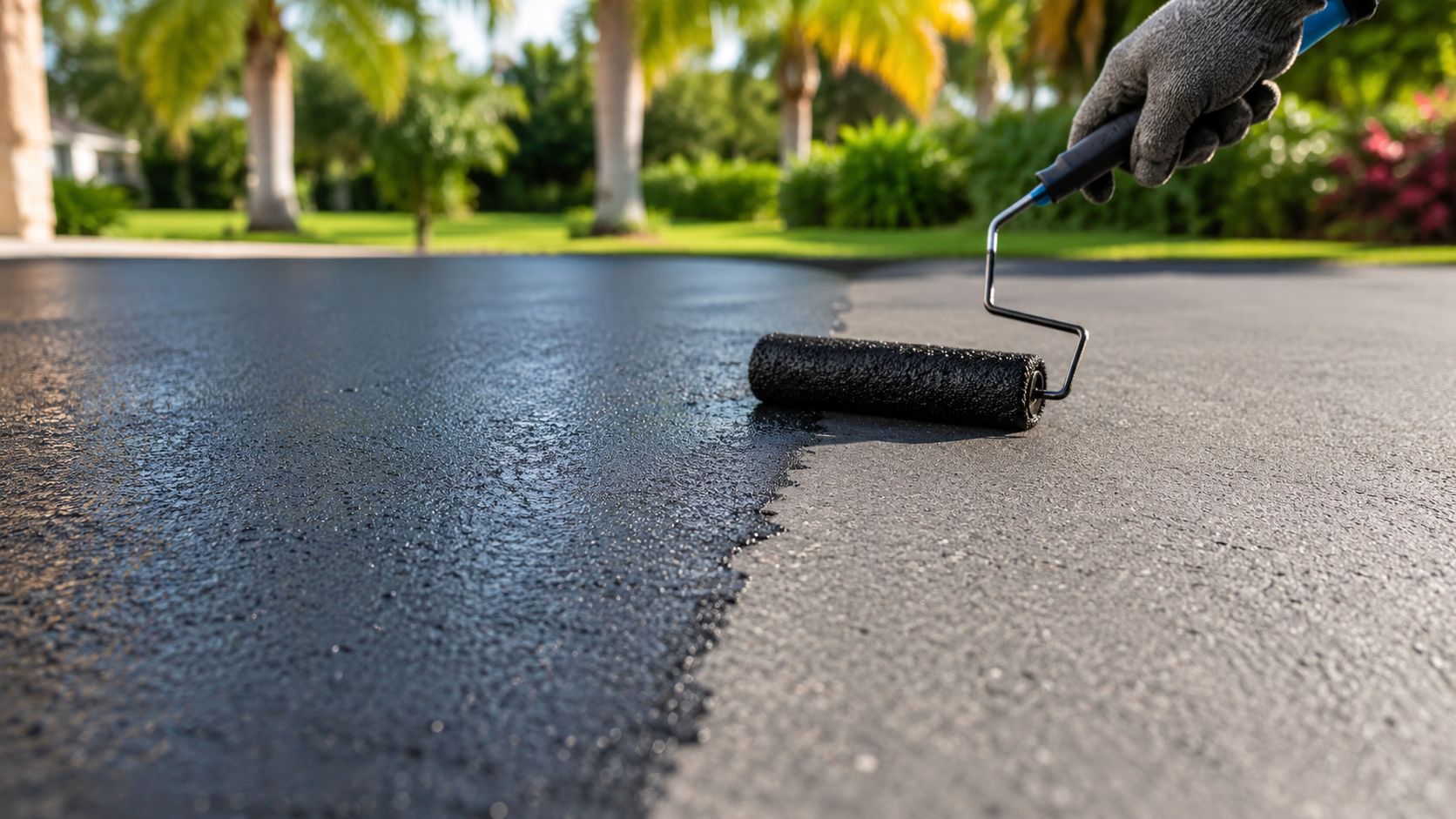
Asphalt sealcoat is usually ready for light foot traffic in about 3 to 4 hours under warm, sunny, dry conditions, while full curing typically takes 24 to 48 hours depending on temperature and humidity. In real Central Florida conditions, light foot traffic may be possible in 4 to 8 hours, but vehicles should stay off for at least 24 to 48 hours, and sudden rain, heavy humidity, and shaded areas can push that timeline longer.
That's the part most property owners in Ocala, Dunnellon, Belleview, Crystal River, Inverness, and The Villages want answered first. You've got a fresh black finish on the driveway or parking lot, it looks great, and now the practical question kicks in. When can people walk on it, and when can cars use it without tearing it up?
In Marion County, FL and Citrus County, FL, that answer is never just about the clock. It's about the weather that day, the moisture hanging in the air, how much sun the pavement gets, and whether the asphalt had cracks that held water before the sealer went down. That's why asphalt seal coat drying time in Central Florida deserves a more honest explanation than a generic one-size-fits-all answer.
For homeowners, this matters because one early tire turn can scuff a brand-new surface. For commercial sites, it matters because reopening too soon can leave tracking, wear, and unhappy tenants or customers. As Concrete and Asphalt Experts in Marion and Citrus County, the goal is to help people protect the work and understand what affects the result.
Table of Contents
- How Long Until You Can Use Your Newly Sealed Driveway?
- Understanding Sealcoat Drying vs Full Curing
- What Speeds Up or Slows Down Sealcoat Drying
- Your Sealcoat Drying Timeline in Central Florida
- Professional Asphalt and Concrete Care in Marion County
- Frequently Asked Questions About Sealcoat Drying
How Long Until You Can Use Your Newly Sealed Driveway?
The short answer is simple. Under ideal warm, sunny, and dry conditions, asphalt sealcoat is often dry enough for light foot traffic in about 3 to 4 hours, with full curing extending to 24 to 48 hours depending on temperature and humidity, as noted in this asphalt sealcoat drying guide.
That's the best-case version. In Central Florida, the answer changes fast when afternoon humidity rolls into Silver Springs, a thunderstorm pops up near Homosassa, or tree cover keeps part of a driveway shaded in Summerfield.
Practical rule: If you're asking whether it looks dry enough for a vehicle, it probably still needs more time.
For homeowners, the biggest mistake is treating a sealed driveway like cured pavement the same day it was applied. For commercial properties in places like Ocala or Lecanto, the mistake is reopening traffic lanes too early because the surface looks dark, even, and firm from a distance.
A safer way to think about it is this:
- Light foot traffic: Often possible later the same day if conditions are favorable.
- Vehicle traffic: Needs more patience, especially with turning tires.
- Full performance: Is often longer than anticipated.
If you're trying to plan around daily use, it helps to read a broader guide on how to maintain an asphalt driveway so drying time, cleaning, and long-term protection all line up.
In Marion County, FL and Citrus County, FL, timing matters because weather can swing from ideal to risky in a few hours. That's true whether it's a residential driveway in Beverly Hills or a small parking area in Hernando.
Understanding Sealcoat Drying vs Full Curing
A lot of confusion comes from one word. People say “dry” when they really mean “ready.”
Dry to the touch is not the same as cured
Sealcoat can become dry to the touch before it's fully hardened. The easiest comparison is paint on a wall or epoxy on a garage floor. You can touch it before it's ready for normal wear, but that doesn't mean it can handle shoes grinding dirt into it or tires twisting across it.
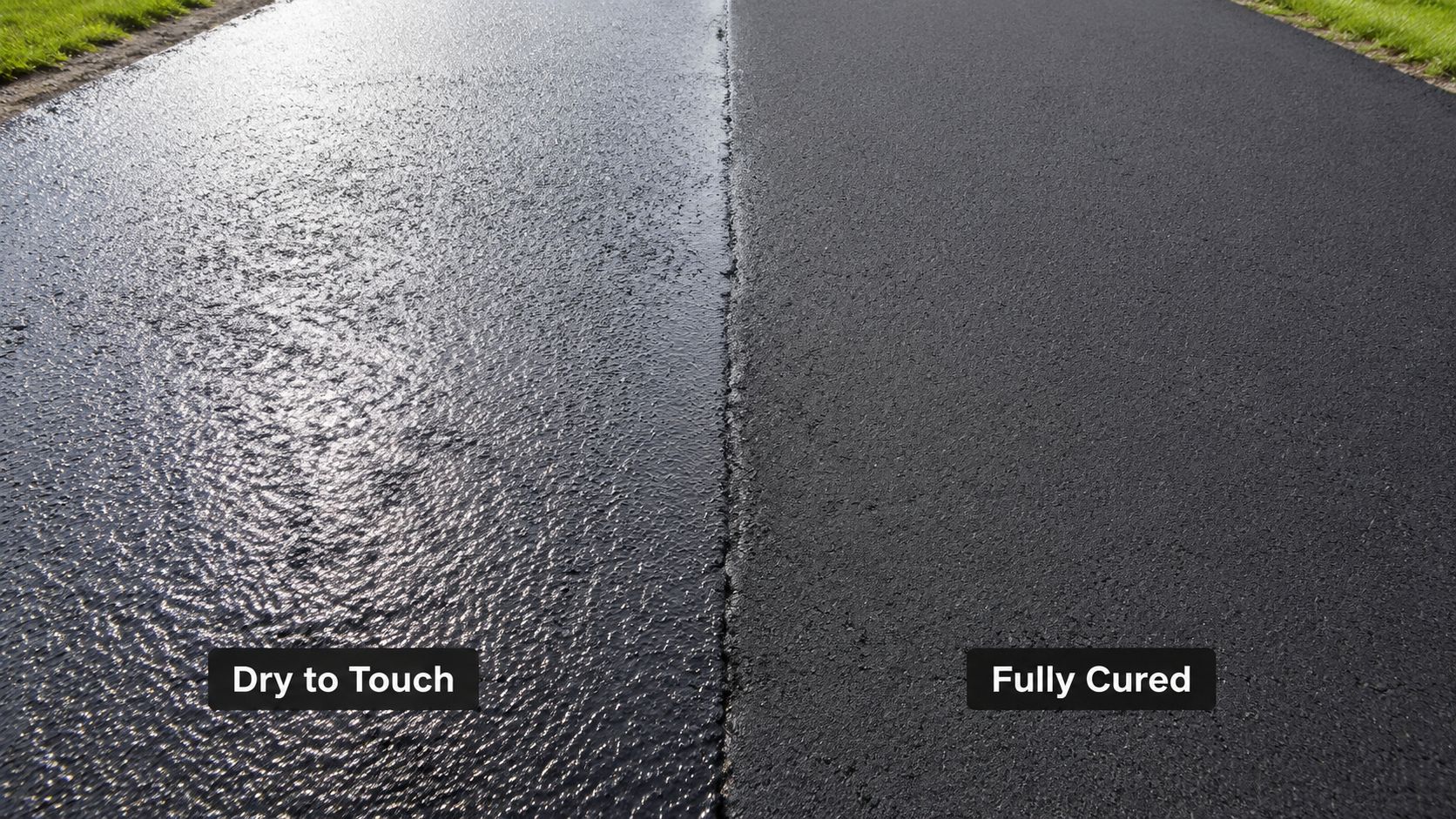
Drying is mostly about moisture leaving the sealer. Curing is the longer hardening process that gives the surface its working strength. That same distinction shows up in other flatwork too, which is why a page on how long concrete takes to cure is useful for comparison.
Why the full cure matters
The long-term cure is what helps the coating hold up against oil, fuel, weather, and regular traffic. According to this sealcoat application reference, the full cure process can take up to 30 days, and repeatedly parking in the same spot during that period can soften the sealer and compromise the protective layer.
That doesn't mean you need to avoid the driveway for a month. It means you should treat the surface with some care after it first reopens.
A simple way to explain it is in this table:
| Stage | What it means | What to avoid |
|---|---|---|
| Drying | Surface is losing moisture | Foot traffic too early |
| Early cure | Surface can begin handling use | Sharp turns, heavy loads, repeated parking in one spot |
| Full cure | Sealer reaches its long-term hardness | Harsh treatment is less risky |
A driveway can look finished long before it's fully hardened.
That's why property owners in Crystal River, Inverness, and Belleview sometimes get caught off guard. The surface appears ready, but aggressive use too soon can mark it up. Understanding that difference is one of the most important parts of managing asphalt seal coat drying time the right way.
What Speeds Up or Slows Down Sealcoat Drying
A sealcoated driveway in Marion or Citrus County can look ready by late afternoon and still be too soft underneath. I see that most often after a hot morning, a humid afternoon, or one of those summer pop-up storms that rolls through with no warning.

Heat and sunlight
Warm pavement and direct sun usually help the surface set faster. In Central Florida, though, strong sun can also dry the top skin quicker than the material below, which creates a false sense that the whole coat is ready for traffic.
A blacktop driveway in Ocala or Summerfield can get much hotter than the air temperature suggests. That heat helps moisture leave the surface, but it also shortens the working window for the crew and makes application quality matter more. If the coat goes down too heavy or starts skinning over too fast, drying becomes uneven instead of faster.
The National Weather Service notes that high humidity slows evaporation, even in warm conditions, which is one reason a bright Florida day can still produce a slow-drying job if the air stays wet: NWS humidity and evaporation guidance. Sun helps. Heat helps. They do not override moisture in the air.
For property owners planning beyond one sealcoat visit, it helps to look at asphalt paving and maintenance services as part of a full pavement strategy instead of a one-time job.
Humidity and airflow
Humidity is the factor people underestimate most in this part of the state.
In Crystal River, Homosassa, and other Gulf-influenced areas, the air often holds enough moisture to slow evaporation even when the pavement feels hot to the touch. A little breeze can help carry moisture away from the surface, especially on open lots. Shaded driveways, fenced-in areas, and spots between buildings usually dry slower because the air sits still.
That is why two properties with the same sealer and the same crew can behave differently on the same day.
This video gives a useful visual sense of how application conditions affect the result.
Surface condition and application thickness
The pavement itself changes the drying timeline as much as the weather does. Older asphalt in Belleview, Dunnellon, or Beverly Hills often has more porosity, more patching, and more texture than newer pavement, so it does not take sealer the same way.
A few field conditions matter most:
- Thicker application: Heavy coats hold moisture longer and usually need more time before they are fully ready.
- Shaded sections: Areas under trees or beside buildings often stay tacky after the sunny side looks finished.
- Rough or porous asphalt: Worn pavement can absorb sealer unevenly and slow the drying pattern across the surface.
- Cracked surfaces: Repaired areas, open cracks, and low spots can trap moisture and stay soft longer.
Good weather helps, but pavement condition often decides how the job performs hour by hour.
That is the main trade-off. Fast drying is not the goal by itself. Even drying is. A properly prepared surface with the right application rate will usually outperform a job that dried quickly on top but never settled evenly underneath.
Your Sealcoat Drying Timeline in Central Florida
A practical timeline helps more than a general promise. In Central Florida, the safe approach is to think in phases instead of one final deadline.

The first several hours
If conditions are strong, sealcoat typically dries enough for light foot traffic in about 3 to 4 hours, and that guidance applies when temperatures stay between 50°F and 90°F with no rain within 48 hours, according to this asphalt sealer drying explanation.
In real Central Florida scheduling, I'd still tell people to be cautious during the first several hours. Keep off it if you can. Don't test it with shoes, bikes, trash cans, or delivery traffic just because the color looks even.
The next day or two
This is the window that matters most for cars and trucks. Most contractors recommend waiting at least 48 hours before allowing any vehicle traffic under those optimal conditions, and that's the smart baseline for homeowners and property managers alike in Marion County, FL and Citrus County, FL.
Use this checklist:
- Keep vehicles off: Don't rush a car back onto the surface the next morning unless conditions were exceptionally favorable and the site has been checked carefully.
- Avoid turning tires in place: Fresh sealcoat is most vulnerable to twisting forces.
- Watch the forecast: A surprise rain event can extend the timeline.
- Protect corners and entrances: Those spots take the earliest stress.
The first month
The surface may reopen before it reaches its hardest state. During the following weeks, treat it like a finish that's still settling in.
For driveways and lots in Lecanto, Summerfield, and Silver Springs, that means avoiding repeated parking in the exact same place if possible, especially during hot afternoons. It also helps to stay alert for fuel drips, heavy equipment, or delivery vehicles that concentrate weight in one area.
If you want the sealer to last, patience in the first couple of days matters more than almost anything else.
Professional Asphalt and Concrete Care in Marion County
The hardest part of sealcoating isn't spreading the material. It's making the right call before, during, and after application.
Why field judgment matters
Central Florida doesn't give you stable lab conditions. A lot can change between morning setup and late afternoon. A driveway in Belleview may get hard sun for hours. A parking area in Homosassa may hold humidity longer. A shaded section in Dunnellon might still be soft when the exposed lane looks ready.
That's where experience matters. A contractor has to read the pavement, the forecast, the amount of sun, the airflow, and the existing surface condition together. Deep cracking is a good example. According to this Gardner Coatings asphalt sealing FAQ, driveways with many deep cracks can add up to 12 hours to full cure time, especially in humid Central Florida conditions where moisture retention in cracks slows evaporation.
That kind of issue is why generic national advice often misses the mark for Ocala, Inverness, Crystal River, and nearby areas.
More than sealcoating
Good pavement care also means knowing when sealcoat isn't the whole answer. If the asphalt base is failing, if cracks are extensive, or if drainage is poor, the right fix may include crack treatment, patching, striping adjustments, or broader asphalt maintenance.
It also pays to look beyond the asphalt itself. Properties often need sidewalk replacement, patio work, curb transitions, ADA-related concrete improvements, or slab repairs at the same time. That's why the strongest local contractors aren't asphalt-only. They're Concrete and Asphalt Experts in Marion and Citrus County who can handle the surface as a system.
For homeowners in The Villages and commercial managers in Marion County, FL or Citrus County, FL, that broader approach usually saves headaches. One crew can evaluate the driveway, parking lot, sidewalks, and traffic layout together instead of treating each piece like it exists on its own.
- Licensed and insured work: That matters when timing, liability, and site access affect occupied properties.
- Reliable scheduling: Weather windows are short in Florida, so clear communication counts.
- High-quality workmanship: Surface prep and timing decisions matter as much as the final coat.
- Long-term savings: Preventative maintenance works best when the right repair is done at the right time.
Frequently Asked Questions About Sealcoat Drying
Can rain ruin fresh sealcoat?
Yes. In Marion and Citrus counties, a clean morning can turn into a hard afternoon shower fast, and fresh sealcoat does not get much forgiveness if rain hits too early. Water can mark the surface, wash material, and leave an uneven finish that does not wear the same across the driveway or parking lot.
That is why job timing matters so much in Central Florida. If the forecast looks unstable, postponing usually costs less than reworking a bad application.
Do deep cracks change asphalt seal coat drying time?
They can. Deep cracks, failed edges, and rough areas tend to hold moisture longer and create uneven drying across the surface. A driveway with solid pavement and minor cracking usually sets up more predictably than one with widespread damage or past patchwork.
Sealcoat also is not a substitute for structural repair. If the pavement is breaking down underneath, the drying timeline becomes only one part of the problem.
When can people walk on a sealed driveway?
Light foot traffic is sometimes fine later the same day if the surface has skinned over and conditions stay favorable. In our area, I still tell people to be careful with kids, pets, lawn crews, and delivery traffic until the coating feels firm and does not track.
Shaded spots often stay soft longer.
How long should vehicles stay off?
For a safe margin, plan on keeping vehicles off at least 24 to 48 hours. In Central Florida humidity, that window can stretch, especially in shaded areas, low spots, and sections that do not get steady airflow.
Heavier vehicles need more caution. Turning tires too early can scuff the coating, leave marks, or pull it sideways before it has cured enough to handle the load.
How long should you wait before sealcoating new asphalt?
New asphalt should not be sealed right away. It needs time to cure, release oils, and harden enough for the sealer to bond well. A common professional recommendation is to wait at least several months, and many contractors prefer longer depending on traffic, mix, and site conditions.
For property owners who want a published reference on that point, the Asphalt Institute's guidance on residential asphalt driveways is a better source for waiting time before the first sealcoat.
If you need a driveway, parking lot, sidewalk, or access area evaluated by true Concrete and Asphalt Experts in Marion and Citrus County, Riverside Sealing & Striping, LLC offers free estimates and no-pressure consultations across Central Florida. Whether you need asphalt sealcoating, parking lot striping, concrete replacement, or a full site review in Ocala, Dunnellon, Crystal River, Inverness, Belleview, or nearby communities, their team brings licensed and insured service, reliable scheduling, and practical guidance built for Florida conditions.