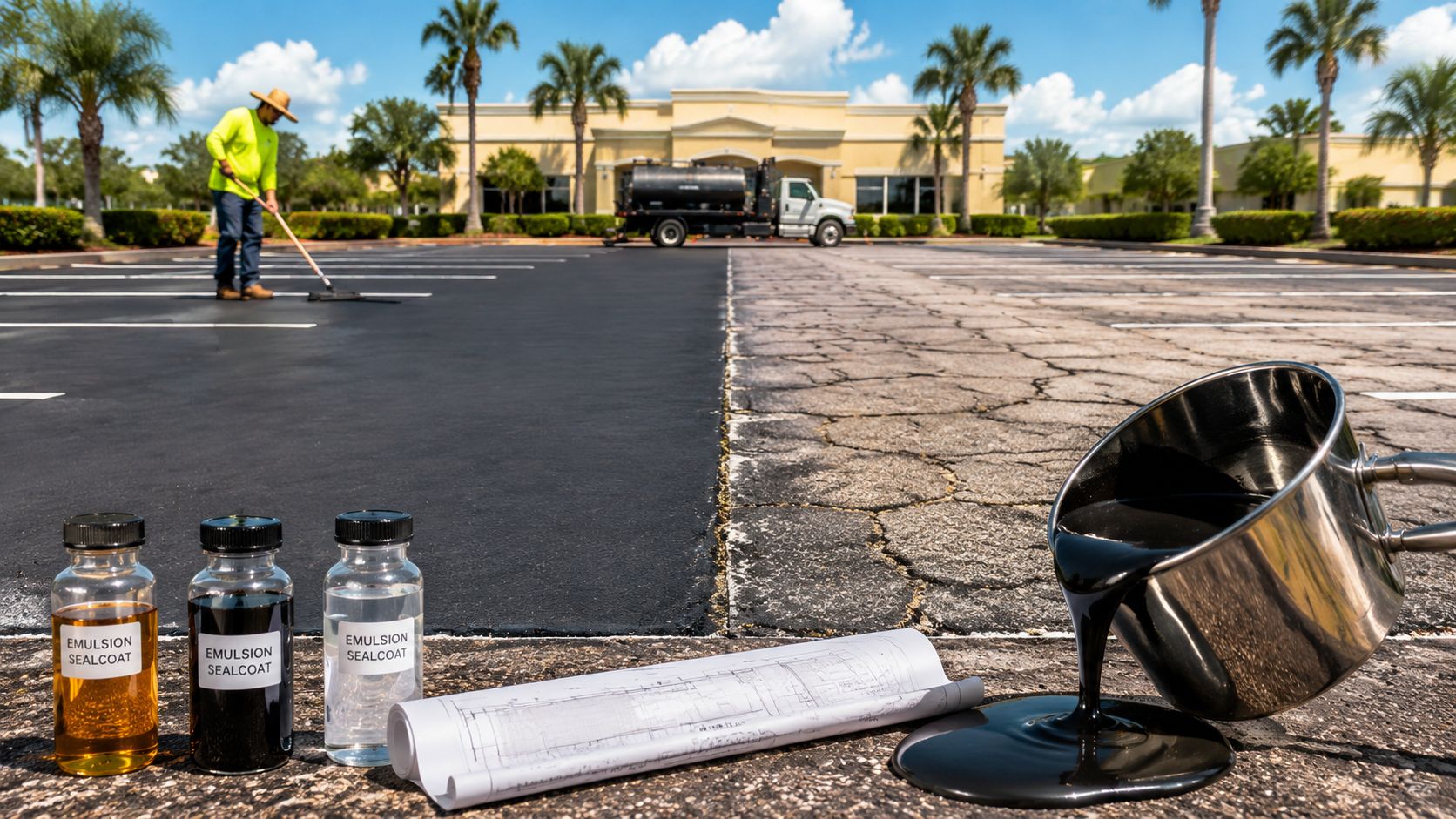
A property manager in Ocala can do everything that appears reasonable, hire a contractor, choose a dark sealer, and schedule the work during warm weather, yet still end up with tire tracking after a thunderstorm or a slick parking lot after the surface dries. The problem often starts before the crew arrives. Asphalt seal coat specifications determine which materials, application rates, preparation steps, and quality checks are acceptable for the pavement.
That distinction matters throughout Marion County, FL, Citrus County, FL, and nearby Central Florida communities. Strong UV exposure, humid air, sudden afternoon rain, and moisture conditions associated with high water tables can expose weaknesses in a generic specification. A seal coat that works on a northern pavement under different weather and traffic conditions may need a more careful material and scheduling decision in Dunnellon, Belleview, Summerfield, Crystal River, Homosassa, Inverness, Lecanto, Beverly Hills, Hernando, Silver Springs, or The Villages.
Table of Contents
- Why Asphalt Seal Coat Specifications Matter in Central Florida
- Key ASTM Standards and Performance Benchmarks
- Comparing Binder Types and Emulsion Options
- Surface Preparation Requirements That Prevent Failure
- Application Rates and Coverage Thickness Guidelines
- Mixing Protocols and Curing Time Requirements
- Testing and Quality Assurance Checks
- When Seal Coating Is Not the Right Solution
- Working with a Local Central Florida Contractor
- Frequently Asked Questions About Seal Coat Specifications
Why Asphalt Seal Coat Specifications Matter in Central Florida
A parking lot in Central Florida can look ready for seal coating and still hold moisture below the surface. If a crew applies sealer before that moisture has moved out, afternoon rain, high humidity, and traffic can produce tracking, weak adhesion, or uneven texture. Asphalt seal coat specifications set the controls that prevent those failures.
A usable specification identifies the material, preparation, application quantity, weather limits, and finished-surface requirements. Those details affect film uniformity, curing, skid resistance, and protection from water and traffic. Generic national language often misses conditions created by intense UV exposure and high water tables around Central Florida.
Why generic recipes fail
UV exposure can age an under-applied film quickly. Excess dilution, humid air, and a sudden storm can leave the coating soft or streaked. Moisture moving through pavement or adjacent soil may also make the surface appear dry while pores remain damp.
A proposal should state:
- Material standard: Product type, emulsion system, and applicable ASTM requirements.
- Preparation scope: Cleaning, oil-spot treatment, crack sealing, patching, and correction of soft areas.
- Application rate: Planned quantity based on pavement condition and texture, not area alone.
- Weather window: Temperature, rainfall, humidity, and drying conditions required for application and curing.
- Acceptance checks: How the contractor will verify coverage, adhesion, curing, and texture before reopening traffic.
A national reference can illustrate the need for measurable language. The Alberta highway construction standard distinguishes a double seal coat, made with two aggregate applications held by asphalt binder, from a graded aggregate seal coat, which uses one spread and compacted application. Central Florida projects may use different materials, but the same principle applies: define the treatment rather than approving “sealcoat” as a complete scope.
Practical rule: A low bid that omits preparation and acceptance criteria may only postpone the repair cost. Require the contractor to document what was applied and when the pavement met the agreed conditions.
Clear specifications protect appearance, pavement performance, and site safety while giving the property manager a defensible basis for comparing bids.
Key ASTM Standards and Performance Benchmarks
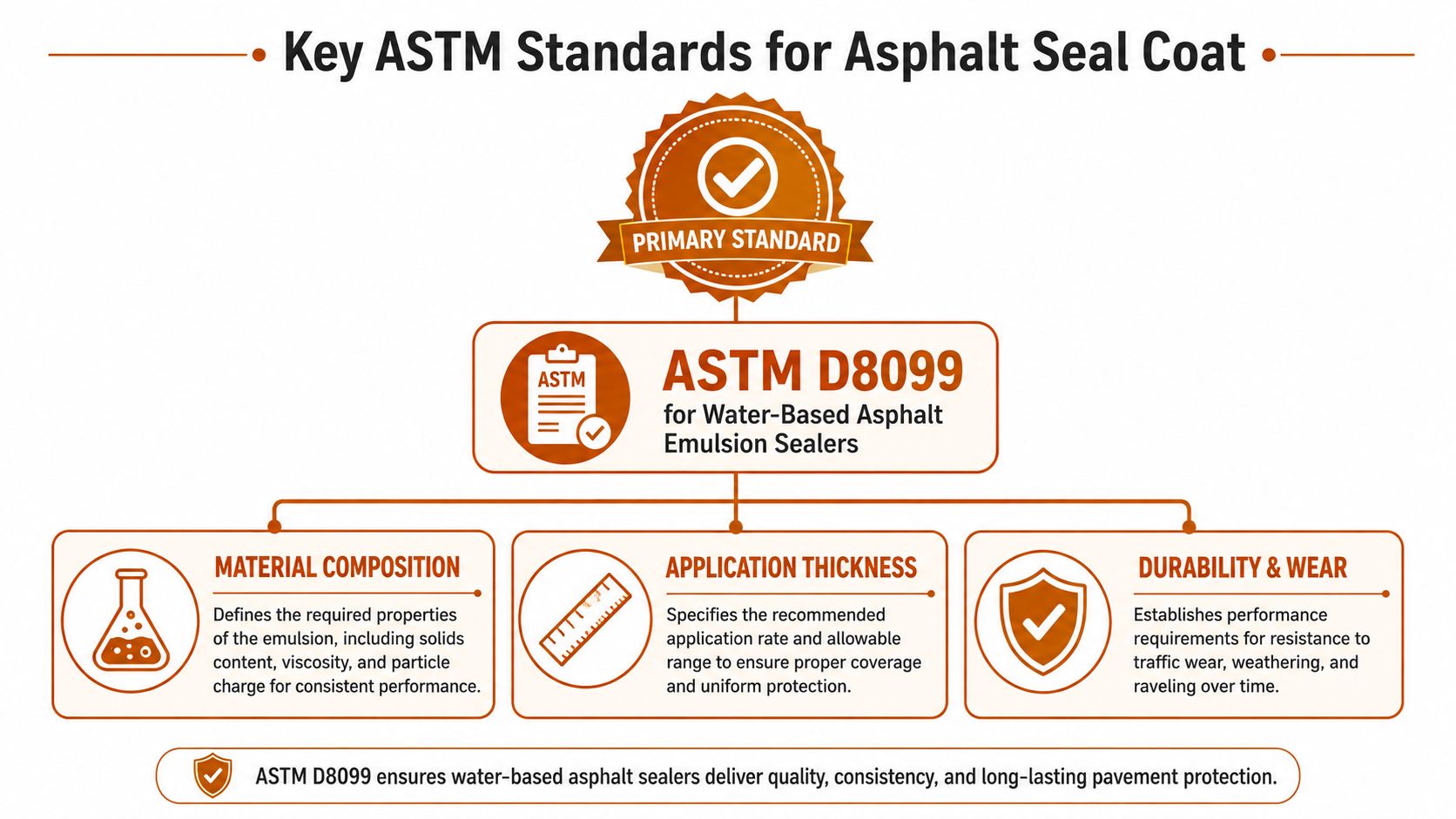
The most useful starting point for a modern material specification is ASTM D8099/D8099M. The standard defines a water-based asphalt emulsion pavement sealer intended as a weather-protective coating over bituminous pavements, including roadways, parking areas, and driveways. The Ontario County seal-coating specification uses ASTM D8099 as part of a broader procurement and quality-control framework.
What the standard should mean in a proposal
A product meeting a named standard still needs project-specific review. A practical specification should require conformance to ASTM D8099 and acceptance testing for:
- Emulsion stability, so the material remains usable and forms a consistent film.
- Solids or nonvolatile content, which helps indicate how much protective material remains after water leaves the system.
- Curing behavior, so the finished coating doesn't remain soft and track-prone under traffic.
Companion references may also appear in public-owner specifications, including ASTM D140, ASTM D466, ASTM D529, and ASTM D2939. Their presence indicates that material handling and performance shouldn't be left to general workmanship language.
Coal tar and petroleum-based alternatives
Material chemistry deserves particular attention. Some public specifications now prohibit refined coal tar and instead require a premium petroleum-based emulsion containing latex rubber, mineral aggregate, and water. That approach reflects both environmental restrictions and the industry's movement toward performance-based product selection.
A state specification cited in the Alberta highway construction material includes acceptance thresholds for coal tar pitch emulsion, including 47% minimum non-volatile content, 50% maximum water content, and a firm set within 8 hours. Those thresholds show why a dark appearance alone proves very little. The owner needs a product with documented composition and curing characteristics suited to the pavement and use.
Comparing Binder Types and Emulsion Options
Binder selection should follow pavement condition and traffic rather than a contractor's habit. Indiana's seal coat specification lists asphalt emulsion options including RS-2, AE-90, AE-90S, and HFRS-2. It further identifies AE-90 or AE-150 for seal coat Type 1 and AE-90S for Type P work in the cited specification. Review the Indiana DOT binder requirements when comparing terminology, but don't treat an Indiana designation as an automatic Florida prescription.
| Binder Type | Best Use Case | Curing Time | Florida Climate Suitability |
|---|---|---|---|
| RS-2 | Aggregate seal coat systems where the binder must hold cover aggregate | Project-specific, based on weather and specification | Can be suitable when aggregate, surface preparation, and rain timing are controlled |
| AE-90 | Seal coat systems identified by an owner specification | Project-specific | Requires careful selection and application in heat, humidity, and storm-prone weather |
| AE-90S | Type P applications in the cited Indiana specification | Project-specific | May be appropriate only when the project specification calls for it |
| Polymer-modified asphalt emulsion | Pavement sealer systems seeking improved film performance and controlled chemistry | Product-specific | Often worth evaluating for exposed, high-use surfaces, subject to ASTM and manufacturer requirements |
A polymer-modified emulsion can make sense for a busy commercial lot, but it isn't automatically the right choice for every residential driveway. A lower-intensity driveway in Ocala, Dunnellon, or The Villages may need a simpler compliant system, while drive aisles and turning areas demand closer attention to texture, adhesion, and traffic exposure.
Sand or aggregate cover isn't decorative. It contributes to texture and slip resistance. The right quantity depends on the sealer system and surface condition, so a proposal should identify the material, gradation, and intended cover rather than promise a uniform black finish at any cost.
Surface Preparation Requirements That Prevent Failure
Florida seal coat work succeeds or fails at the pavement surface. Dust, loose debris, oil, vegetation, and trapped moisture interrupt bonding between the asphalt and emulsion. A surface can look clean while contamination remains along edges, cracks, and parking stops.
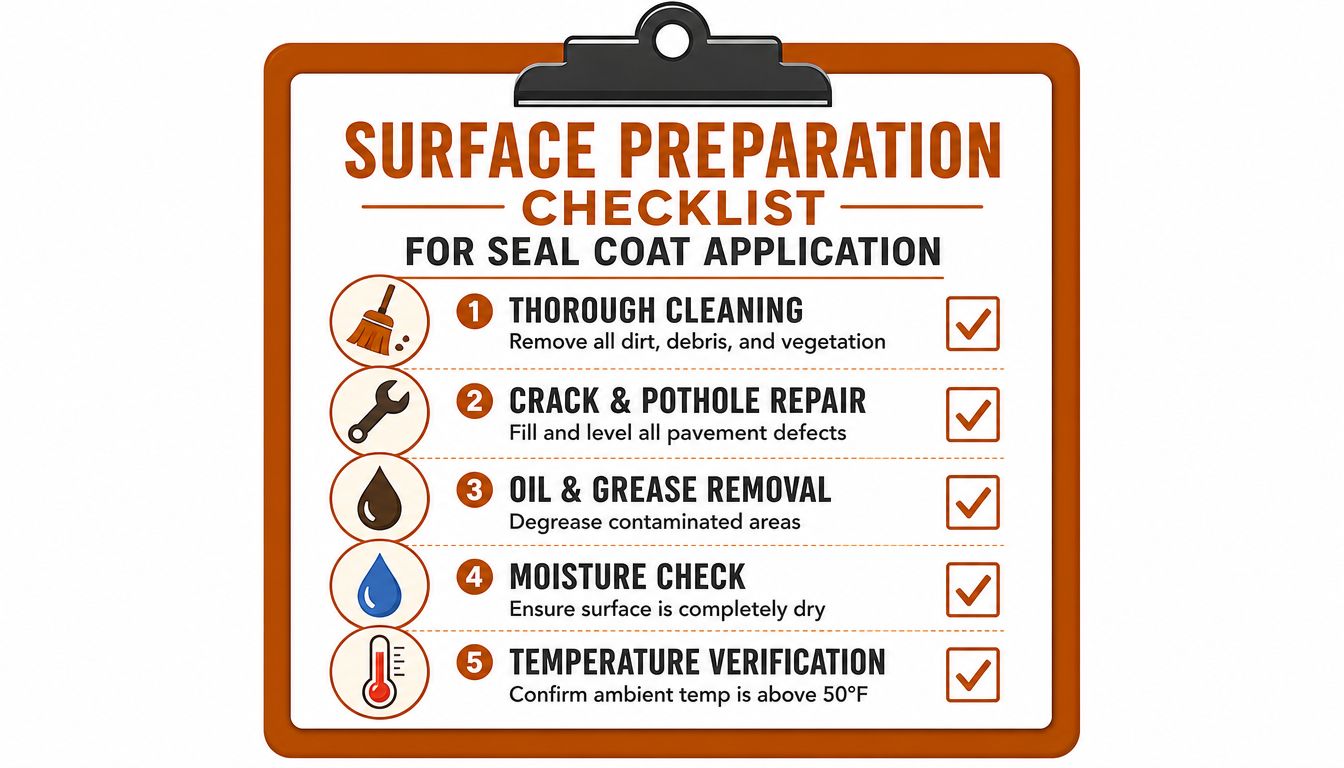
Use this approval checklist:
- Clean the pavement thoroughly. Sweep or blow off loose material, clean corners and edges, and remove vegetation.
- Repair defects first. Include crack sealing, pothole patching, and stabilization of soft or failed areas before coating.
- Treat oil contamination. Clean or treat oil and grease with an approved method. Sealer will not bond reliably to contaminated asphalt.
- Confirm dryness. Check pavement pores after rain and overnight humidity. Hidden moisture can reduce adhesion and delay curing.
- Verify water quality and temperature. Owner specifications may require potable water rather than reclaimed water, with water at or above 50°F (10°C) for mixing or curing. The Los Altos seal coat technical criteria provides a reference for documenting these requirements.
Central Florida scheduling requires more than choosing a warm day. A morning application can create a longer drying window before a predictable afternoon thunderstorm, but the crew must still verify the forecast and pavement moisture. High humidity may slow curing even when temperatures are favorable, and high water tables make moisture checks especially important around low areas and poorly drained edges.
Application Rates and Coverage Thickness Guidelines
Central Florida pavement can look uniform while absorbing sealer at different rates. Porous, oxidized asphalt usually takes more material than a tight surface. Distressed pavement may need repair instead of a heavier coat. Set the rate from field absorption and the approved product system, not from a generic square-foot formula.
A municipal benchmark specifies a spray seal coat rate of 0.10 to 0.15 gallon per square yard and a sand cover coat of 6 to 12 pounds per square yard. It calls for removing excess sand after about five days. The Los Altos seal coat specification provides a useful benchmark, not a universal setting.
| Pavement Condition | Seal Coat Rate (gal/sq yd) | Sand Cover (lbs/sq yd) | Notes |
|---|---|---|---|
| Relatively tight, sound asphalt | 0.10 to 0.15 | 6 to 12 | Confirm uniform coverage without creating a soft film |
| Moderately oxidized asphalt | 0.10 to 0.15 | 6 to 12 | Evaluate absorption and adjust within the approved system |
| Porous or heavily oxidized asphalt | 0.10 to 0.15 | 6 to 12 | Consider whether repair or a different treatment is needed before increasing material |
| High-use drive aisles | 0.10 to 0.15 | 6 to 12 | Prioritize texture, adhesion, and traffic control over appearance alone |
The table establishes a starting range. A contractor should verify coverage with measured material usage, surface appearance, and adhesion checks rather than accepting a rate only because it matches the estimate.
Too much sealer can remain soft in Central Florida humidity, track under tires, and collect dirt. Too little may lose texture and weather protection under intense UV exposure. Afternoon thunderstorms make the application window and cure condition part of the rate decision, while high water tables can keep low areas damp. Use an asphalt seal coat calculator to organize quantities, then confirm the final rate against field conditions and the selected product.
Mixing Protocols and Curing Time Requirements
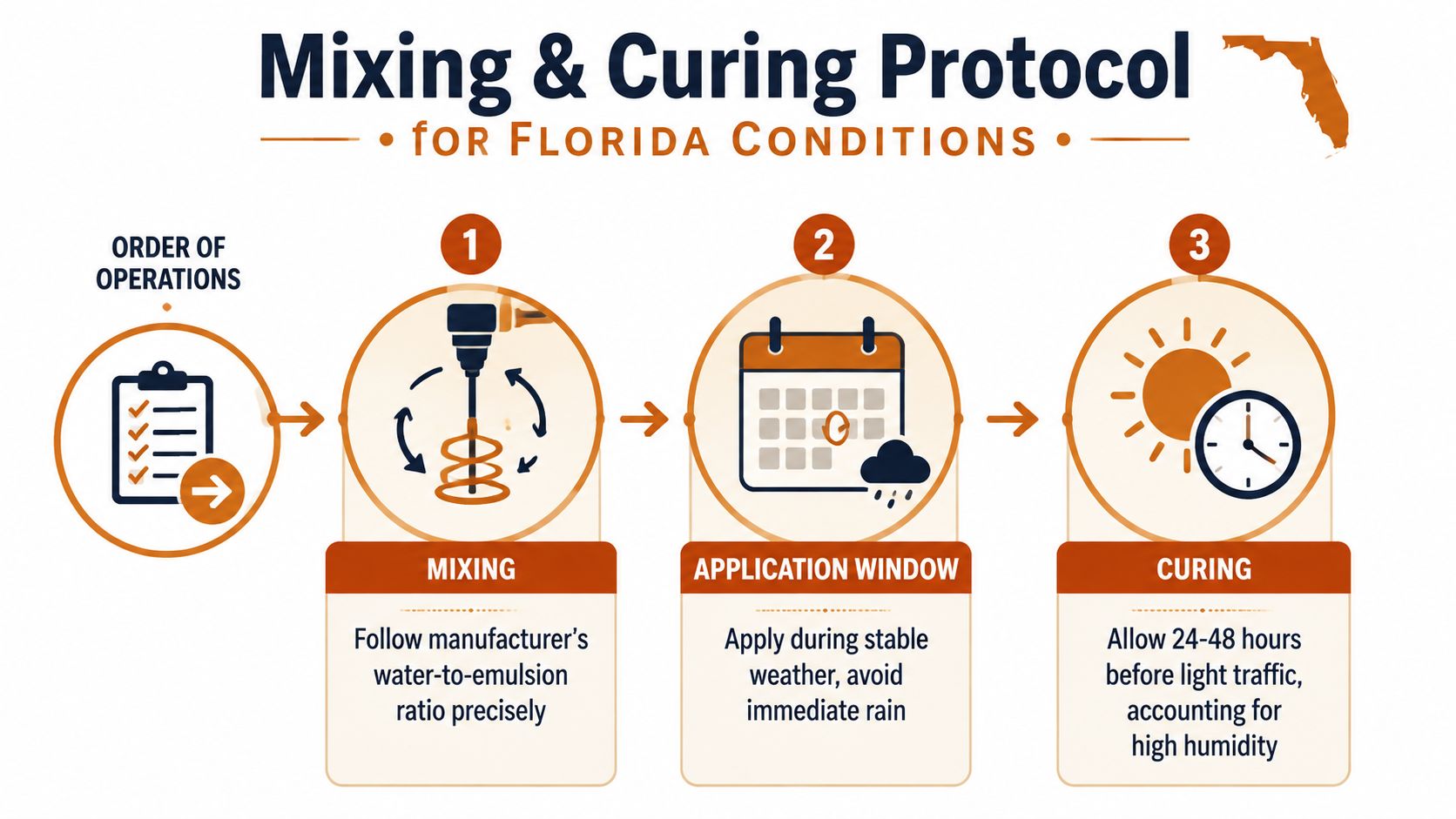
In Central Florida, a mix that appears workable at the start can cure poorly after a humid afternoon or sudden shower. Emulsion chemistry depends on controlled mixing, so follow the manufacturer's water-to-emulsion ratio, maintain consistent agitation, and use the water quality required by the specification. Adjusting water because the product “looks” too thick creates an uncontrolled material.
Mix proportions must be measured, recorded, and matched to the selected system. For slurry-type applications, aggregate gradation, binder content, and added water work together. A specification may require 100% passing No. 8, 65–90% passing No. 16, and 10–20% passing No. 200, but those limits do not automatically suit every seal coat or local pavement. Confirm the approved product data and verify the blend with a small test area before production.
Plan around the weather
FAA guidance describes a specialized emulsified asphalt treatment using emulsion containing 20% Gilsonite and medium to fine graded sand. For a 1:1 diluted emulsion, its application rate is 0.10 to 0.15 gallons per square yard, or 0.05 to 0.075 gallons per square yard undiluted, as described in this FAA-related seal coat guidance. Treat those figures as a reference for that system, not a universal Florida setting.
Do not reopen traffic because the surface looks dry. Cure time changes with the product, film thickness, sunlight, humidity, and rain. The supplied Florida protocol infographic identifies 24 to 48 hours before light traffic as a planning point, while high humidity requires judgment and field observation.
For scheduling details, use this asphalt seal coat drying time guide. Start early when conditions allow, protect the work area, monitor the forecast, and leave capacity for an afternoon storm. High water tables and shaded low areas can keep pavement damp longer, so the reopening decision should follow actual surface condition rather than the clock.
Testing and Quality Assurance Checks
Quality assurance should connect every check to a possible failure. The contractor's submittal should identify the product and its test documentation, while the owner or inspector verifies that field work matches the approved system.
Before and during application
Check the emulsion's stability, solids content, and curing behavior before acceptance. ASTM D8099 provides a defensible baseline for water-based asphalt emulsion pavement sealers, while project-specific testing confirms whether the proposed material is appropriate for the job.
During installation, verify:
- Measured coverage: Compare material used with the treated area and approved application rate.
- Uniformity: Look for streaks, skips, puddling, and visibly thin zones.
- Aggregate or sand distribution: Confirm that cover is consistent enough to support texture and wear resistance.
- Weather records: Document start time, surface condition, rainfall interruptions, and traffic-control decisions.
The Transportation Research Board paper on seal coats and asphalt recycling shows the long-standing use of numeric design relationships. One example produces an aggregate application rate of 25 pounds per square yard when 0.25/0.01 is applied to the governing parameters. The lesson is practical: measured field rates have always mattered.
After the surface is placed
Inspect for adhesion, curing progress, texture, soft spots, and tracking before normal traffic returns. A surface that looks uniformly black but remains tacky isn't accepted work. In Florida, inspect again after rain because storm exposure during early curing can reveal weak bonding or washout.
The TxDOT performance-based seal coat research reports an aggregate cleanliness limit of no more than 1.0% by weight for fine dust, clay-like particles, and/or silt in the aggregate. That kind of measurable threshold helps explain why aggregate quality affects adhesion and durability.
When Seal Coating Is Not the Right Solution
Seal coating protects suitable asphalt. It doesn't rebuild a failed base, close structural cracking, or correct active drainage problems. Applying it to damaged pavement can hide the condition briefly while leaving the underlying failure untouched.
Wait for the pavement
New asphalt needs time to cure before sealing. FAQ guidance identifies a waiting period of 30 to 60 days for new asphalt, along with a clean, repaired, dry surface and warm, dry weather. The exact decision should consider the mix, site conditions, and product requirements rather than a calendar date alone.
Skip or postpone seal coating when you see:
- Alligator or structural cracking: Repair the failed pavement structure first.
- Potholes and soft areas: Patch or stabilize the base before applying a protective film.
- Active moisture problems: Investigate drainage, groundwater, and high-water-table conditions instead of trapping moisture beneath sealer.
- Loose or contaminated surfaces: Clean, repair, and retest the surface.
- Insufficient texture: Reconsider the treatment if the proposed system could create a slick surface.
A protective treatment can become counterproductive when the contractor compensates for poor pavement with extra material. Over-application may produce tracking, while an unsuitable sand balance can reduce comfort and safety for vehicles and pedestrians. Owners in Inverness, Homosassa, and Lecanto should ask whether the pavement is ready for seal coating, not just whether a contractor can schedule it.
Working with a Local Central Florida Contractor
Local conditions affect specification decisions. A contractor working around Marion County, FL and Citrus County, FL should understand how strong sun, heavy humidity, fast-moving storms, soil moisture, and property traffic interact. That knowledge doesn't replace ASTM compliance, but it helps the contractor apply national standards intelligently.
Ask these questions before signing:
- Which ASTM standard applies to the proposed sealer? Request the product data sheet and relevant test information.
- What repairs are included? Make sure cracks, potholes, oil spots, vegetation, and failed areas are explicitly addressed in the scope.
- What rate will you apply? Require the rate in gallons per square yard and explain how pavement porosity affects it.
- How will you manage rain? The schedule should include a realistic weather window and a plan for protecting the site.
- What proves acceptance? Look for material records, measured quantities, coverage checks, and a post-application inspection.
The local Central Florida asphalt seal coat contractor you choose should also be able to coordinate related work. Parking lot striping, ADA-compliant markings, concrete sidewalks, driveways, patios, and slabs may need to follow the seal coat, so sequencing matters.
Riverside Sealing & Striping, LLC is a third- and fourth-generation, family-owned contractor based in Dunnellon. The company provides asphalt seal coating, parking lot striping, ADA-related upgrades, and concrete construction for homes, HOAs, commercial properties, churches, and other sites across Central Florida. A licensed and insured contractor offering reliable scheduling, clear timelines, free estimates, and no-pressure consultations gives the owner a better basis for comparing bids than price alone.
Frequently Asked Questions About Seal Coat Specifications
How often should I seal coat asphalt in Florida?
There is no responsible universal interval. Inspect oxidation, traffic, drainage, pavement condition, and the previous coating before scheduling. In Central Florida, intense UV exposure and frequent afternoon storms can shorten service life, while high water tables may keep pavement and edges damp. A condition-based specification is more reliable than an automatic annual application.
What's the difference between coal tar and asphalt emulsion sealers?
They have different chemistries and are not interchangeable. Current public specifications increasingly restrict refined coal tar and identify petroleum-based or polymer-modified asphalt emulsions instead. ASTM D8099 provides a performance reference for water-based asphalt emulsion pavement sealers, but the selected product still must suit local moisture and heat conditions.
Can I seal coat over cracked asphalt?
Only after evaluating and repairing the cracks and related failures. Seal coat protects sound pavement. It does not replace crack sealing, pothole repair, base stabilization, or removal and replacement of severely distressed asphalt.
How do I judge the proposed application rate?
Ask for the rate in gallons per square yard, the sand or aggregate cover rate, and the reason those values fit the pavement. A municipal benchmark identifies 0.10 to 0.15 gallon per square yard for spray seal coat and 6 to 12 pounds per square yard for sand cover. Treat those figures as a starting point, because porosity, texture, weather, and curing conditions affect coverage.
What should I inspect after the work?
Check for even coverage, firm curing, adhesion, consistent texture, no tracking, and no rain-related washout. Document defects before normal traffic resumes, particularly after a storm.
Riverside Sealing & Striping, LLC offers asphalt seal coating, parking lot striping, ADA-compliant markings, and concrete work in Central Florida. Visit Riverside Sealing & Striping, LLC to request a free, no-pressure on-site consultation about a specification suited to the pavement, traffic, and local weather.