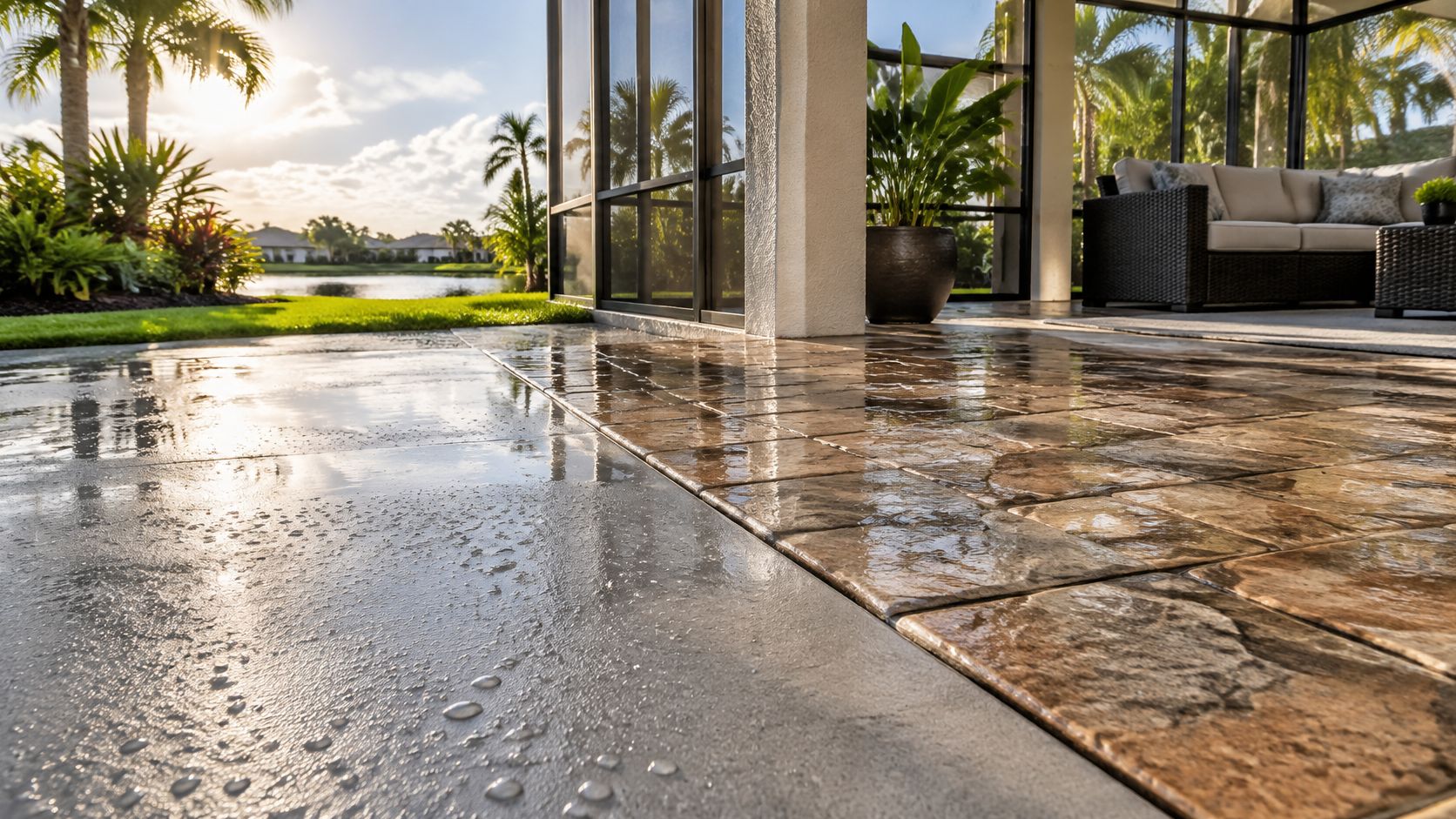
The usual advice to buy the longest-lasting, highest-gloss concrete sealer gets Florida patios wrong. A glossy finish can look excellent on dry decorative concrete and turn cloudy on a damp lanai. The best concrete patio sealer is the one that limits water absorption, allows suitable vapor movement, and matches the moisture condition of your slab, not the bottle with the strongest waterproofing claim.
For Central Florida homeowners, the first decision isn't which brand to buy. It's whether the concrete is ready to accept a penetrating treatment or support a surface film at all.
Table of Contents
- Quick Picks for Florida Patios at a Glance
- Silane Versus Acrylic Sealers and the Specs That Decide Them
- Solvent-Based and Water-Based Sealers Under VOC Rules
- How Florida Heat, Rain and Moisture Change Sealer Results
- How to Apply a Penetrating Sealer on a Florida Patio
- Frequently Asked Questions About Patio Sealers
- Confirm Your Slab Is Ready Before You Seal
Quick Picks for Florida Patios at a Glance
For most plain, uncolored patios in Marion County, FL, and Citrus County, FL, start with a 40% silane or siloxane penetrating sealer that meets documented performance requirements, rather than choosing by appearance alone. The Iowa State penetrating-sealer specification establishes these screening benchmarks:
- Active content: At least 40% silane or siloxane.
- Water absorption: No greater than 20% of unsealed reference concrete.
- Moisture-vapor transmission: At least 75% of the concrete's final average water absorption, using the specification's stated comparison.
- Chloride-ion absorption: No greater than 15% of unsealed reference concrete.
Those are product-screening criteria, not a promise that every patio will perform identically. The concrete must still accept the material, and an existing coating can prevent penetration.
Best sealer type by patio situation
| Patio situation | Recommended sealer type | Main reason | Watch-out |
|---|---|---|---|
| Plain gray slab exposed to rain and sun | 40% silane or siloxane penetrating sealer | Repels water while keeping pores open | Will not hide stains or color variation |
| Stamped or colored decorative patio | Tested exterior acrylic film-forming sealer | Enhances color and gloss | Film can wear, and UV and vapor data must be documented |
| Screened lanai on a damp slab | Penetrating sealer only after a moisture check | Breathable, lower blistering risk | Sealing cannot fix drainage or hydrostatic pressure |
| Pool deck or wet walkway | Penetrating sealer with a non-glossy finish | Lower slip risk than a glossy film | Test traction before choosing any gloss |
| Newly poured patio | Wait for cure, then penetrating sealer | Protects a properly cured slab | Sealing before 28 days can trap moisture |
For the new-concrete row, the Portland Cement Association concrete manual provides the general 28-day curing guidance before a conventional penetrating-sealer application. Purpose-made curing compounds are a different product decision, not a reason to rush an ordinary patio water repellent.
Choose by exposure before appearance
A patio in Ocala or Belleview may receive direct afternoon rain, while a screened space in Dunnellon stays shaded after the yard dries. Summerfield, Crystal River, and The Villages have the same basic selection problem: account for sunlight, retained moisture, and how people use the surface.
Central Florida's storms and humidity make the drying window especially important. A roof or screen enclosure doesn't prove that the concrete underneath is dry.
Practical rule: Find your patio's row, then take the watch-out column as seriously as the recommendation.
Choose the required finish first, but don't purchase until you've checked the product specifications and the slab's readiness.
Silane Versus Acrylic Sealers and the Specs That Decide Them
A patio sealer's label is less useful than its measured performance on concrete. For a natural look, penetrating silane or siloxane is usually the starting point. Choose exterior acrylic when color enhancement or gloss matters enough to accept a surface film and its maintenance.
These are broad comparisons between product families, not guaranteed ratings for every formula. Check the selected product's technical data and match its performance to the slab.
Penetrating silane or siloxane versus film-forming acrylic
| Criterion | Silane or siloxane (penetrating) | Acrylic (film-forming) |
|---|---|---|
| How it works | Penetrates accessible pores and lines them | Forms a surface film |
| Water absorption limitation | Generally reduces absorption | Generally reduces absorption |
| Vapor transmission | Often allows moisture vapor to pass | Varies by product; a film can restrict vapor movement |
| UV resistance | Varies by product | Varies by product; exterior products are made for UV exposure |
| Air permeability reduction | Generally less than film-forming treatments | Can produce a greater reduction |
| Color and gloss enhancement | Minimal; preserves a natural look | Can deepen color and add gloss |
An Iowa State University evaluation of concrete penetrating sealers found that 40% silane generally delivered the best overall performance among the tested penetrating products. Silane-treated specimens remained below 60% saturation after 15 days of continuous water contact. The evaluation also found the greatest reduction in air permeability with the acrylic treatment.
Air permeability and moisture-vapor transmission are different measurements. Ask for vapor-transmission data rather than assuming that a water-repellent label proves a product is breathable.
What those differences mean on your patio
Silane and siloxane treatments enter accessible pores and make the concrete water-repellent. They generally preserve the slab's texture and natural appearance, a practical fit for plain concrete where a shiny wear surface is unwanted.
Acrylic creates a visible finish. It can deepen decorative color and make stamped texture more distinct, but furniture, foot traffic, and weather wear the film. When it degrades, the surface may need compatible recoating or removal; adding another layer without checking compatibility can worsen the finish.
For a sun-exposed patio in Ocala or Inverness, compare documented UV performance as well as appearance. For salt-exposed concrete around Crystal River or Homosassa, look for chloride-resistance results. A sealer does not replace cleaning or sound concrete.
The Iowa State University technical review of concrete sealers reports that performance varies with sealer chemistry and concrete conditions. A result on a prepared test specimen does not guarantee the same outcome on a slab with different moisture or preparation.
Before buying, request and compare:
- Water absorption: ASTM C642 results that identify treated and untreated concrete.
- Vapor transmission: ASTM E96/E96M or ASTM D6490 results, with the comparison method stated.
- Exterior suitability: UV and abrasion documentation for an acrylic finish.
- Application requirements: Approved substrate conditions, coverage, compatibility, and curing restrictions.
Coverage is part of performance
A Kentucky Transportation Center specification gives an approximate application rate of 125 square feet per gallon for 40% silane, targeting 11–12 grams of silane per square foot. It also recommends a test patch to confirm the rate and penetration. Use this as a benchmark, not a substitute for the chosen product's instructions.
An Oklahoma Department of Transportation report on long-term bridge concrete supports the durability potential of properly applied silane. Bridge-concrete absorption results are useful benchmarks, not promises of patio lifespan.
For a plain gray slab under a Dunnellon pergola, documented silane performance is a better priority than gloss. For a stamped, colored Summerfield patio where a wet look is wanted, consider an exterior acrylic with documented performance and plan for finish maintenance.
Solvent-Based and Water-Based Sealers Under VOC Rules
Water-based products can still contain VOCs. Check the product's technical information or safety data sheet for its VOC content in grams per liter, then confirm the limit for its coating category and location.
The carrier and protective chemistry answer different questions. Water-based describes how a product is delivered; it does not establish how well it resists water absorption, allows vapor transmission, or performs in an enclosed lanai.
VOC limits that apply to patio sealers
The federal architectural-coatings rules set a 700 g/L limit for concrete curing and sealing compounds. Local rules can be stricter: Clark County, Nevada, sets a 100 g/L limit for certain concrete and masonry sealers, effective December 31, 2025.
| Rule or area | VOC limit | What it means for buyers |
|---|---|---|
| U.S. federal limit for concrete curing and sealing compounds | 700 g/L | Federal baseline for products in that category, subject to applicable provisions |
| Clark County, Nevada architectural coatings rule, effective December 31, 2025 | 100 g/L for certain concrete and masonry sealers | Local limits can be stricter than the federal baseline |
The Nevada limit does not apply in Florida. Check the applicable Florida and local requirements for the product category before buying.
Plan exposure and ventilation
On a screened lanai, consider where vapors could travel, including nearby doors, windows, and seating areas. A garage also needs a ventilation plan, even when the product is marketed for residential use.
- Check the documents: Find VOC content, protective equipment requirements, ignition precautions, and re-entry instructions.
- Protect occupants: Keep children and pets away during application and curing. Consider exposure carefully if household members have asthma or chemical sensitivities.
- Compare cure requirements: Odor and drying behavior depend on the formulation, not only on whether it is water-based or solvent-based.
- Preserve traction: VOC compliance does not make a glossy coating suitable for a wet pool deck.
Odor is not a safety measure. Follow the precautions in the product's safety documentation, even when the smell is faint.
Confirm the VOC figure, plan ventilation, and choose a finish that suits how the patio will be used. A coating's durability does not justify avoidable exposure inside the home or near neighboring properties.
How Florida Heat, Rain and Moisture Change Sealer Results
A damp slab is the first suspect when a Florida patio finish turns white, bubbles, or protects unevenly. Don't start by adding another coat.
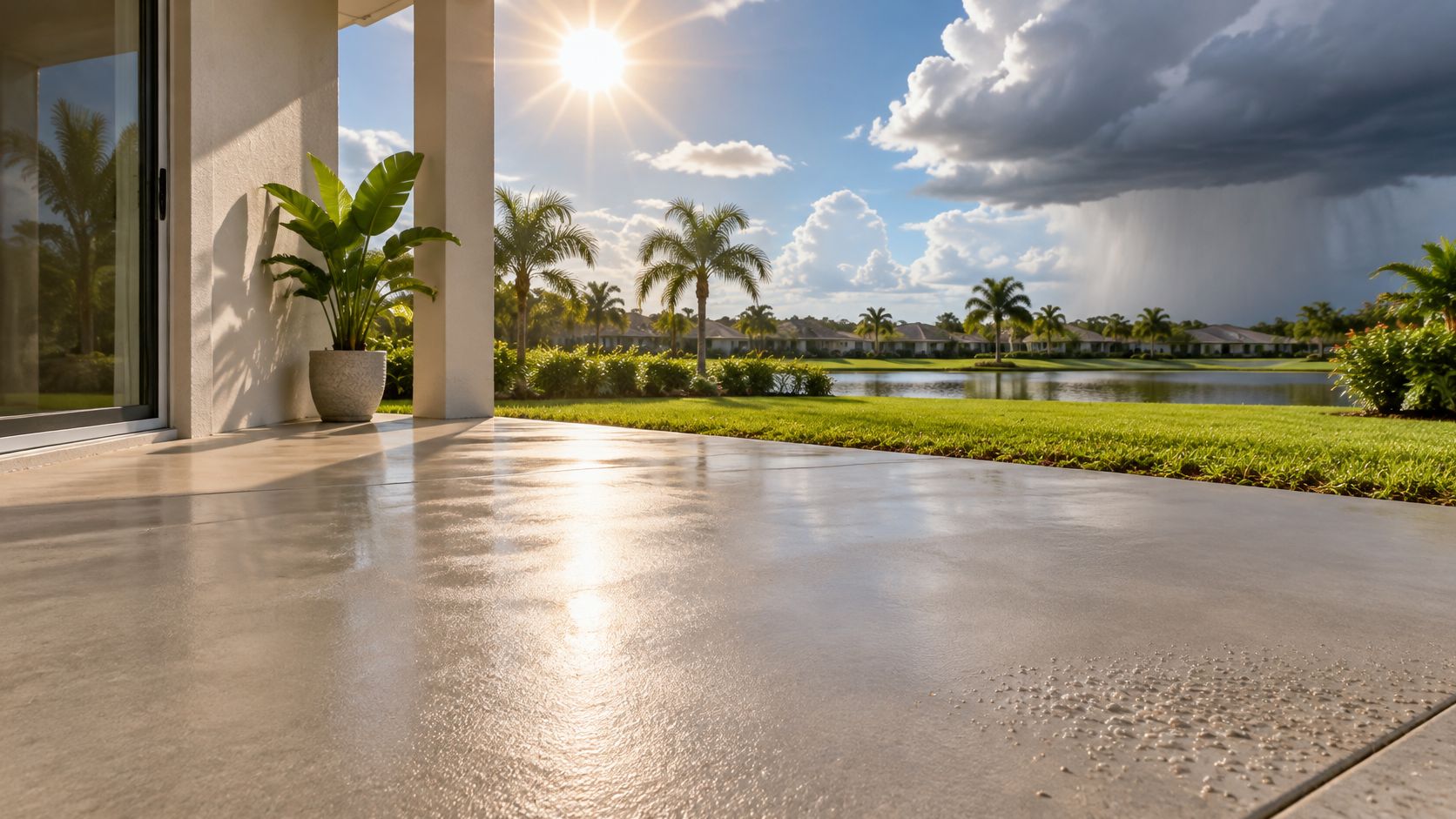
Sun and approaching storms can create a misleading application window.
Different exposures need different decisions
Heat can make material dry before it spreads or penetrates evenly. On a hot surface, solvent-based films can bubble; check slab temperature rather than judging conditions from the air alone.
UV exposure matters on open pool decks in The Villages or Lecanto, where a decorative film receives sustained sunlight. Choose documented exterior performance, and don't assume a clear sealer can preserve weak or incompatible pigments.
Rain and humidity complicate shaded lanais in Ocala, Belleview, and Silver Springs. The open yard may look dry while moisture remains along enclosure edges, beneath mats, or in sheltered concrete.
Ground moisture changes the decision even when no rain reaches the surface. The Concrete Pavement Technology Center literature review explains why absorption reduction alone doesn't establish that a treatment will overcome unfavorable concrete or moisture conditions.
For new work, distinguish concrete curing from surface drying. An apparently dry surface doesn't establish that a new slab is ready for its intended finish.
Use the following video alongside a hands-on condition check, not as a substitute for product-specific requirements.
Check the trouble spots
Salt exposure in Crystal River and Homosassa makes chloride resistance worth reviewing. In Hernando and Inverness, grill grease, furniture feet, and vehicle drips near adjoining driveways may require stain or abrasion resistance beyond ordinary water repellency.
Inspect for:
- White powdery bloom: Investigate recurring efflorescence before coating.
- Persistent dark patches: Compare damp areas with surrounding concrete after rain.
- Peeling old finish: Identify the existing coating and why it released.
- Musty slab edges: Check nearby soil, drainage, and enclosed areas.
Sealing can't repair cracks, redirect runoff, or stop hydrostatic pressure. Those conditions require correction before a finish becomes part of the solution.
How to Apply a Penetrating Sealer on a Florida Patio
The preparation determines whether the material can enter the concrete. A pump sprayer won't compensate for damp pores, oil contamination, or an old surface film.
Use this sequence for a conventional penetrating water repellent, with the selected product's requirements controlling equipment, application limits, and cure protection.
Prepare before opening the container
The essential sequence is curing, cleaning, application, and undisturbed drying.
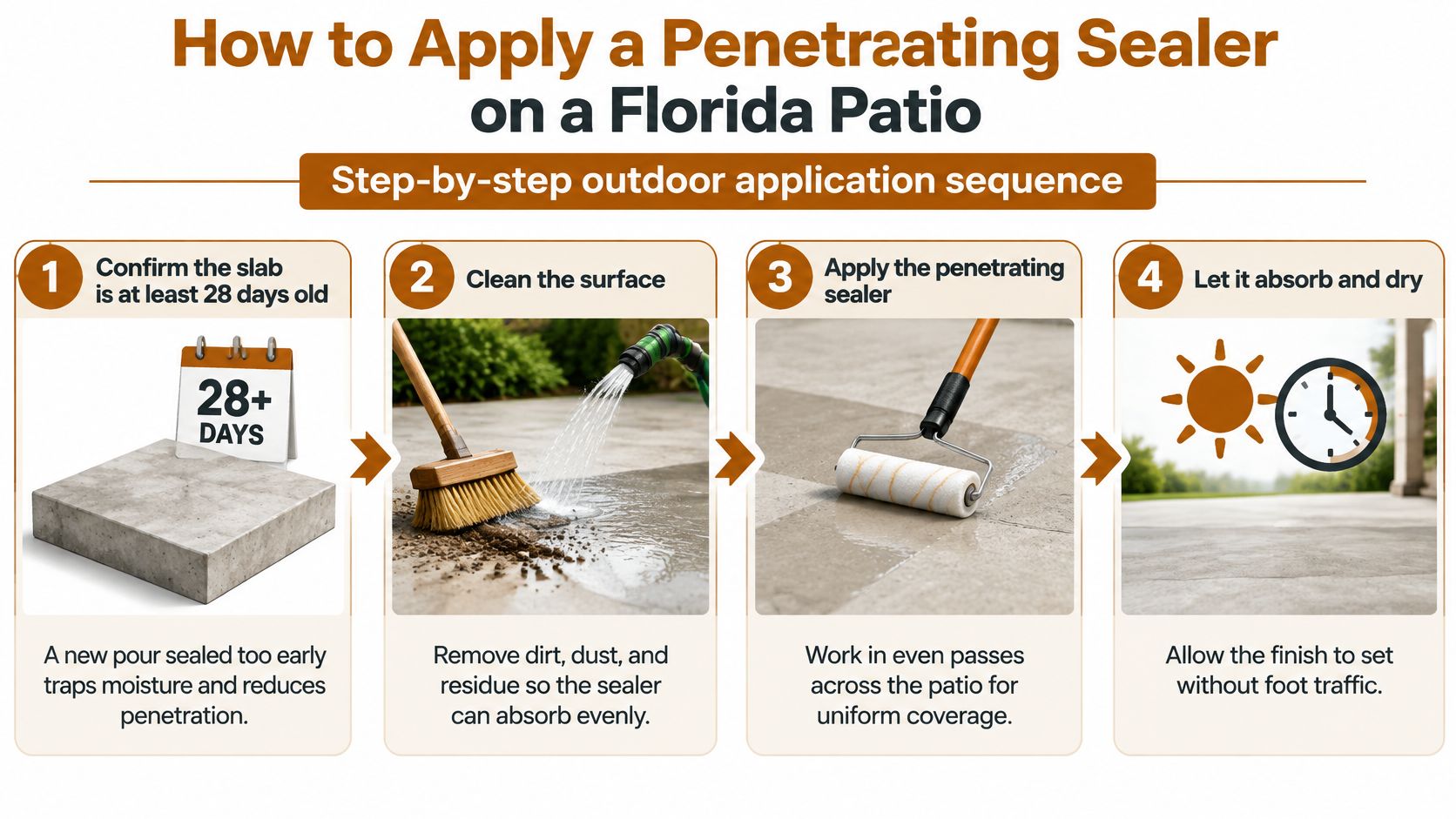
Confirm the concrete is ready. The PCA concrete manual's application guidance supports generally allowing at least 28 days of curing, a clean surface dry for at least 24 hours, and surface and air temperatures above 60°F. Don't confuse reaching a calendar date with proving the slab is dry enough.
Remove contamination and incompatible residue. Sweep, scrub oil with a concrete-compatible degreaser, and rinse thoroughly without sending contaminated runoff into storm drains. Investigate efflorescence and remove incompatible old sealer using the appropriate stripping or mechanical process; washing a film clean doesn't make it penetrable.
Choose a workable weather window. Allow rinse water to leave the concrete, including shaded edges and low areas, and check the manufacturer's upper temperature and rain restrictions. Avoid a hot slab, morning dew, or a forecast that won't allow the required protected curing period.
Screen for hidden moisture. Tape clear plastic tightly to a representative area and inspect after a full day for condensation or darkening underneath. Postpone if moisture appears, and recognize that a clear patch is only a screening result, not proof against intermittent ground moisture.
Control coverage rather than chasing shine
Apply a representative test patch. Use the intended equipment on an inconspicuous area to check uptake, appearance, and compatibility. Measure material use against the approved coverage rate instead of assuming every slab absorbs alike.
Treat the full patio evenly. Use a compatible low-pressure sprayer, roller, or the manufacturer's specified applicator, working systematically so you don't miss strips or repeatedly flood overlaps. Deliver the required quantity without leaving standing puddles, and protect glass, landscaping, and adjacent finishes from overspray.
Manage excess and protect curing. Redistribute or remove surplus material as the product directs, then keep feet, furniture, irrigation, and pets off the treated area until permitted. Don't add material merely because the surface stops looking wet.
Record the job and inspect its condition. Save the product name, batch information, application date, weather conditions, and actual coverage. Reassess periodically and after noticeable changes in absorption rather than automatically adding another treatment.
Application check: A natural-finish penetrating treatment shouldn't leave the patio looking like a glossy coating.
A suitable result may show water beading while retaining the original color and texture, without haze or shiny residue. Beading alone isn't proof of full performance, but streaks, puddled residue, and unexpected sheen are reasons to stop before treating more concrete.
Frequently Asked Questions About Patio Sealers
Can I seal a patio I just poured?
Not with an ordinary penetrating patio sealer immediately after placement. Allow the prescribed curing and drying periods, verify application temperatures, and distinguish a later water-repellent treatment from a purpose-made fresh-concrete curing system. If the installer used a curing compound, identify it before choosing the next treatment.
Does a water-based sealer mean low VOC?
No. Check the product's grams-per-liter VOC figure, safety data sheet, and applicable coating classification rather than relying on the carrier description. Federal compliance doesn't settle every local requirement or eliminate ventilation precautions, especially where a lanai connects directly to occupied rooms.
Is a glossy sealer safe on a pool deck?
Usually, a non-glossy penetrating finish is the more sensible starting point for a wet walking surface. A glossy film can reduce wet traction, so test the proposed finish under realistic wet conditions and evaluate any manufacturer-approved traction additive. Don't treat a dry showroom sample as evidence of poolside safety.
Can sealer fix cracks or wet spots?
No. A water repellent isn't crack repair, a drainage correction, or a remedy for hydrostatic pressure. Find the cause of recurring wet spots before applying anything, and use a concrete patio maintenance routine that includes cleaning, drainage checks, and inspection of joints and damaged areas.
For an uncomplicated bare patio, preparation and product documentation may make the choice straightforward. If moisture, an unknown coating, or moving cracks remain unresolved, arrange a slab evaluation before buying material.
Confirm Your Slab Is Ready Before You Seal
A slab can look dry and still hold moisture that makes a sealer fail. Check its condition before application, especially in Florida, where damp concrete can undermine a film finish.
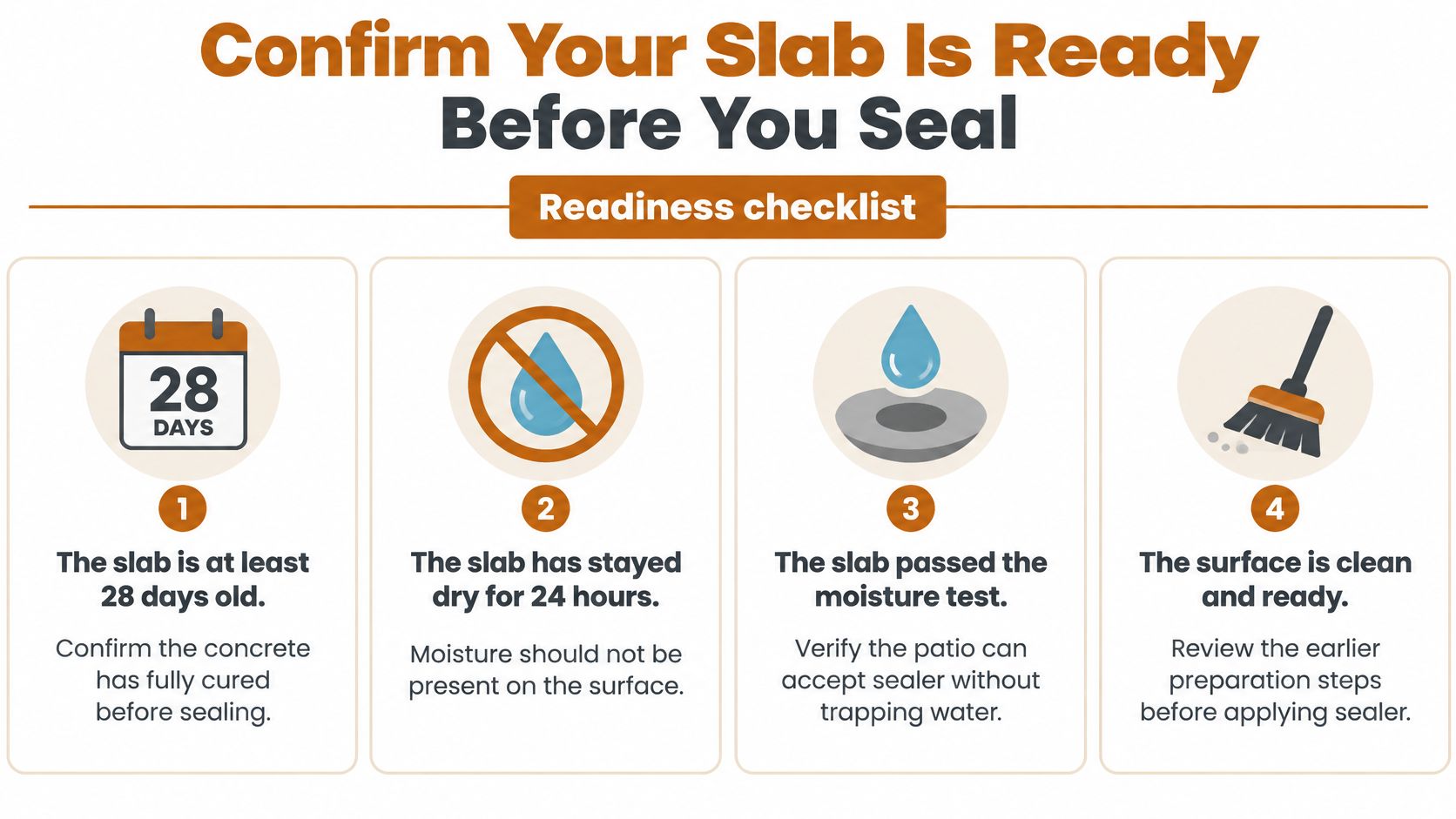
Use this readiness checklist for both the concrete and the product:
- Curing and drying confirmed: The slab meets the product's age, drying, and weather requirements.
- Moisture evaluated: Investigate persistent dampness, condensation, or recurring efflorescence before sealing.
- Surface prepared: Address contamination and identify any existing finish that may be incompatible.
- Performance documented: Review the product's water absorption, vapor transmission, exterior-use, and VOC specifications.
- Use considered: Choose a finish suited to wet feet, furniture, cleaning, and the appearance you want.
When professional evaluation makes sense
Get an assessment if the slab has extensive cracks, recurring efflorescence, drainage problems, or a film coating that has failed. Decorative concrete may also need careful preparation when color matching matters. Riverside's concrete surface preparation standards explain why the substrate needs attention before a finish is applied.
Riverside Sealing & Striping, LLC is a family-owned concrete and asphalt company based in Dunnellon, serving Marion, Citrus, and surrounding Central Florida counties. The company offers free, no-pressure on-site consultations and estimates for concrete, asphalt sealcoating, and striping projects.
Its concrete services include custom patio design and installation, reinforced slabs, and weather-resistant finishes. A consultation can cover patios, driveways, and sidewalks, as well as sealing or striping needs on nearby paved areas.
Owner Bert Counts brings decades of hands-on experience in concrete, asphalt, sealing, and striping. Ask about the slab's moisture condition and preparation needs before choosing a sealer, rather than rushing to application.
Bring the product specification sheet to a consultation so the proposed finish can be considered alongside the slab's condition. Visit Riverside Sealing & Striping, LLC to arrange a free estimate.