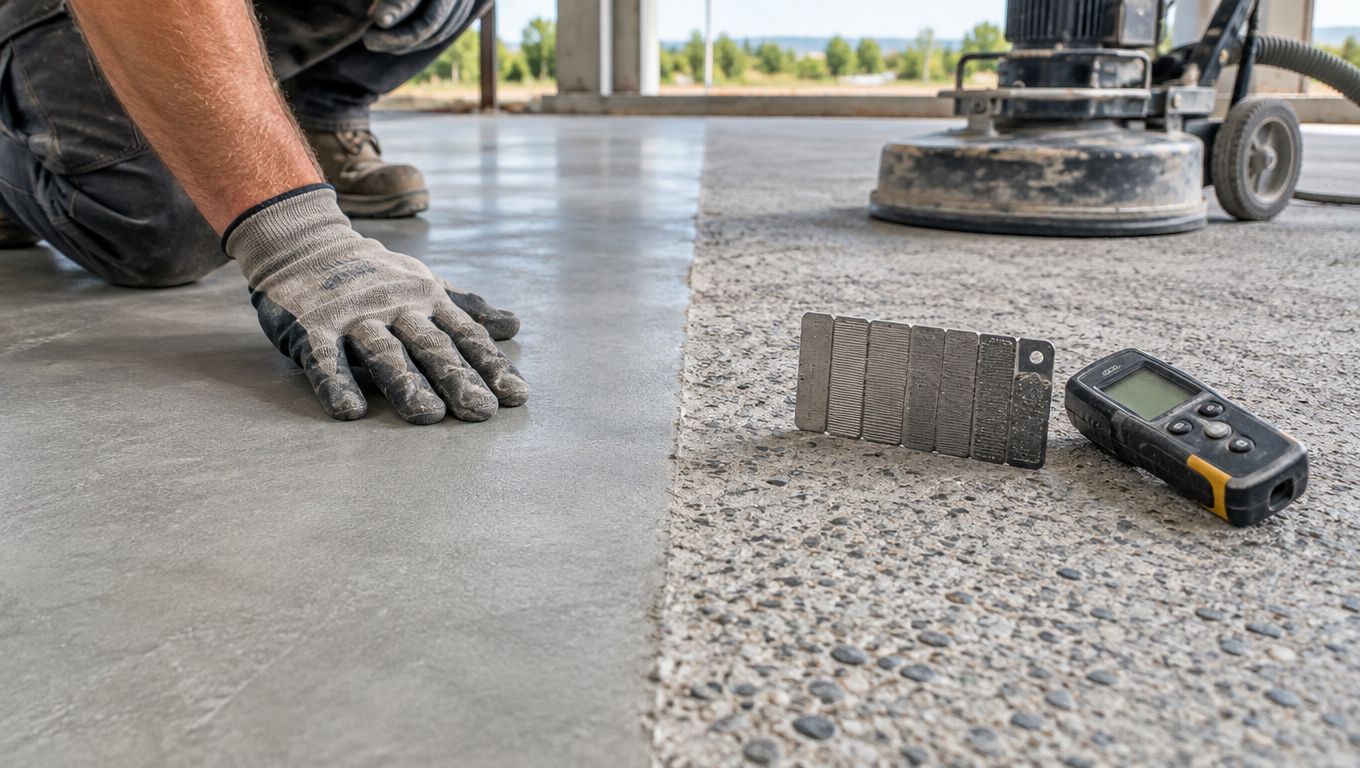
Your driveway looks worn, and a resurfacing estimate promises a fresh finish without removing the slab. Before you approve it, ask what the contractor will do beneath that finish. On a driveway in Ocala or a patio in Dunnellon, the important question isn't just which product goes down. It's whether the existing concrete can support it.
Concrete surface preparation standards help answer that question with measurable requirements rather than a promise to pressure-wash and coat. For homeowners and property managers in Marion County, FL and Citrus County, FL, understanding those requirements makes it easier to compare repair, overlay, and replacement proposals without becoming a concrete inspector.
Table of Contents
- Why Preparation Standards Matter on Real Concrete Projects
- The ICRI Surface Profile Scale from CSP 1 to CSP 10
- ASTM and ACI Standards That Govern Preparation Work
- Matching Profile, Method, and Bond Test to the Project
- Moisture Testing in Florida Humid Climates
- Cleanliness, Cracks, Joints, and Bond Verification
- Curing, Inspection Checkpoints, and Florida Field Conditions
- Questions Property Owners Ask About Preparation Standards
Why Preparation Standards Matter on Real Concrete Projects
Consider a familiar situation: a homeowner chooses a resurfacing product for an aging driveway, then notices peeling and loose edges after installation. This is a hypothetical example, not a documented local case. The visible failure raises questions that should have been answered before placement: Was the surface sound? Was the required texture achieved? Was the substrate's moisture condition acceptable?
Buying another coating doesn't resolve those questions. A contractor needs to investigate the bond surface before recommending another finish.
Preparation is part of the repair system
Modern specifications treat preparation as part of a coordinated repair process, not an isolated cleaning service. ACI SPEC-563-18 addresses removal of deteriorated concrete and substrate preparation alongside repair materials, reinforcement, production, curing, formwork, and construction performance. That structure connects the condition beneath a repair to the procedures used to install it, as described in the ACI reference specification for concrete repair.
For an owner, the practical benefit is accountability. A written scope should identify what the crew must achieve and how someone will confirm it before the surface disappears beneath new material.
- Repair boundaries: Identify where deteriorated concrete will be removed.
- Acceptance requirements: Define the required substrate condition before placement.
- Installation procedures: Identify the selected material and its preparation, placement, and curing requirements.
- Documentation: Record inspections and any changes discovered after removal begins.
Practical rule: Approve the preparation requirements before approving the finish.
This matters on residential patios, HOA sidewalks, and commercial slabs alike. A decorative improvement should support curb appeal, but appearance alone can't establish whether the underlying repair was properly executed. Standards give owners and contractors a shared basis for deciding when work is ready to proceed.
The ICRI Surface Profile Scale from CSP 1 to CSP 10
Concrete Surface Profile, or CSP, describes prepared concrete texture. Think of the progression from a relatively fine sandpaper-like surface toward an aggressively textured repair surface. That analogy helps with visualization, but it isn't a substitute for physical comparator samples or measurement.
The infographic illustrates the progression.
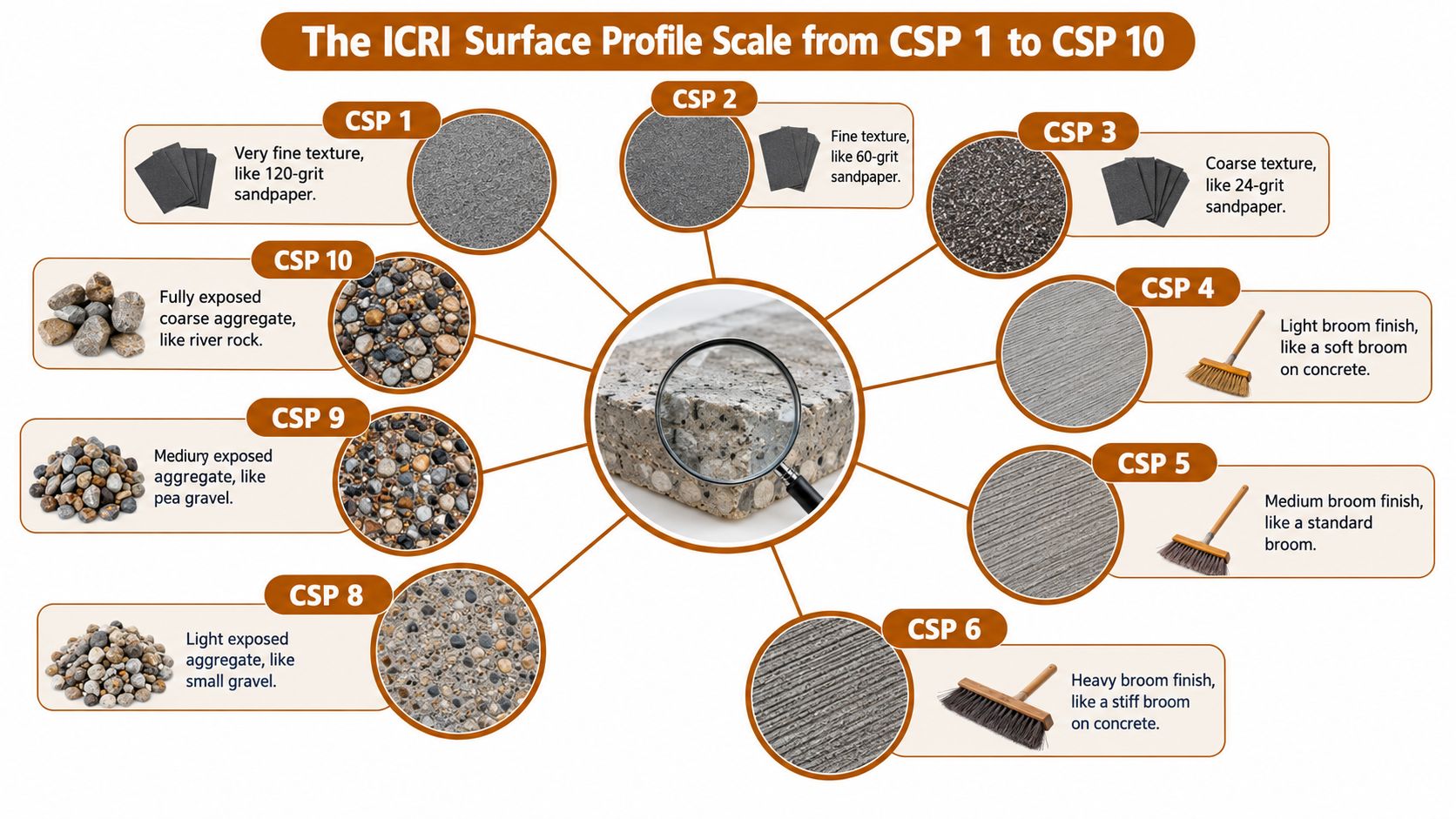
ICRI's framework runs from CSP 1 through CSP 10. The highest category was added in the 2013 revision to accommodate more aggressive repair preparation and represents peak-to-valley amplitude greater than approximately 0.25 inch, or 6 millimeters, according to the concrete surface profile standards overview.
Match texture to material thickness
The target isn't maximum roughness. Thin protective coatings generally need a comparatively fine profile, while polymer overlays and repair materials may require deeper texture for mechanical interlock. Insufficient profiling can leave weak surface paste or inadequate keying; excessive profiling can create high spots, coverage problems, increased material consumption, and localized voids beneath thin coatings, as explained in ICRI's surface-profile guidance.
That's why a texture acceptable for a bonded mortar repair may be unsuitable beneath a thin decorative finish.
- Start with the material: Obtain its written CSP requirement before selecting equipment.
- Prepare a test area: Confirm that the proposed method produces an appropriate, consistent texture.
- Verify the result: Use ICRI comparator chips or an accepted profile-measurement procedure.
- Check transitions: Include edges and repaired areas in the acceptance review, not just the open center of the slab.
ASTM D7682 provides a replica-putty approach for profile measurement within this standards framework. A documented result is more useful than describing the slab as “pretty rough.”
For owners, the most productive question is simple: “What profile does this system require, and how will you verify it?” A contractor should answer with the selected system's requirements, not a universal CSP number applied to every driveway and patio.
ASTM and ACI Standards That Govern Preparation Work
A preparation proposal may list several standards, but their names alone don't establish a complete scope. Each document needs a defined role in the work.
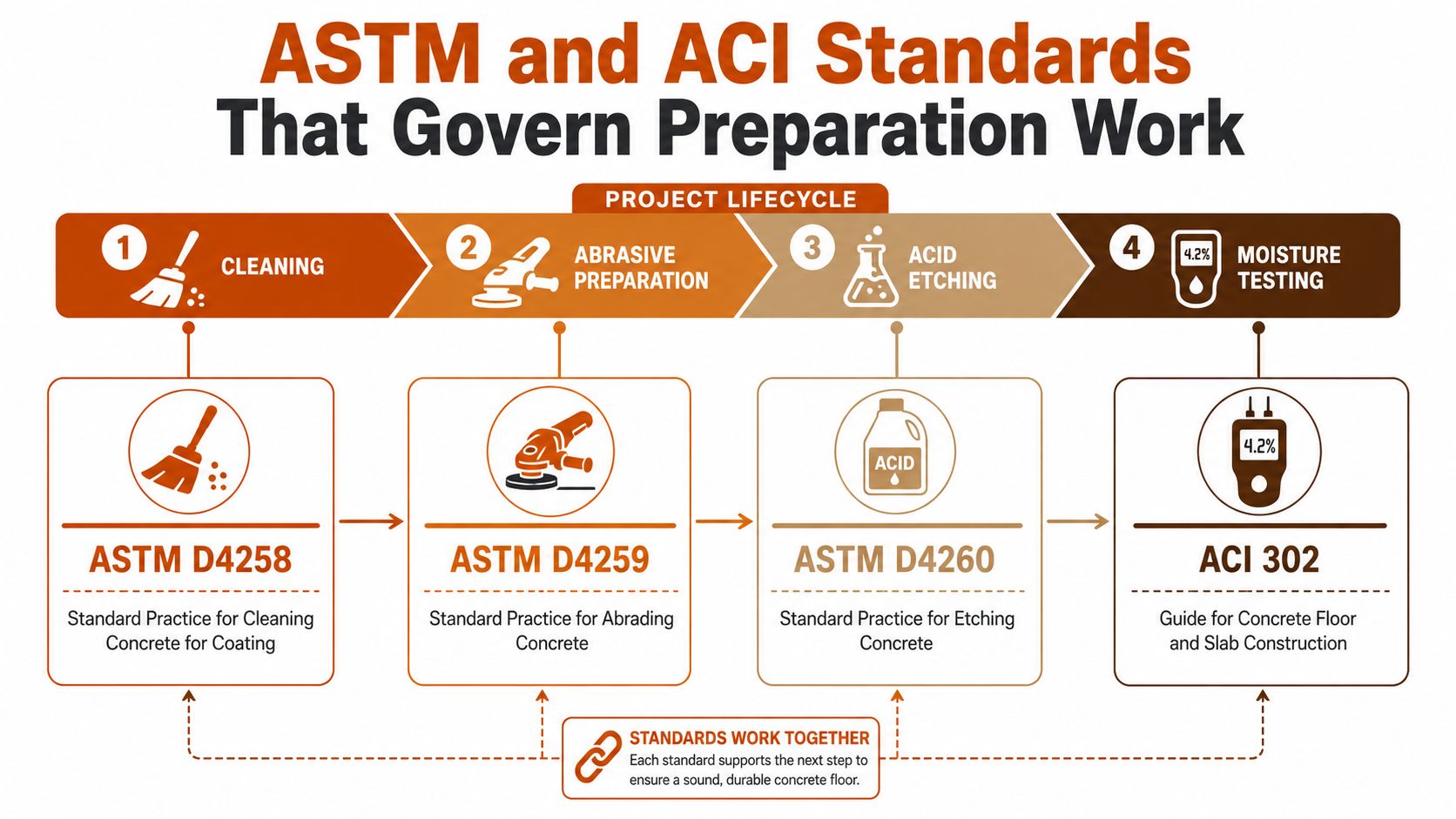
The diagram provides a broad orientation to the preparation process. The written project requirements should identify the applicable documents and acceptance criteria.
Understand what each reference covers
The ASTM preparation references distinguish different operations. Using the standards framework introduced above, their practical roles are:
| Reference | Role in the scope |
|---|---|
| ASTM D4258 | Cleaning concrete |
| ASTM D4259 | Abrasive preparation |
| ASTM D4260 | Acid etching |
| ASTM D7682 | Measuring surface profile with replica putty |
These aren't interchangeable operations. A cleaning requirement doesn't automatically specify an abrasive profile, and naming acid etching doesn't establish that it is appropriate for the selected repair system.
The ACI specification introduced earlier places removal and substrate preparation in its third section and incorporates ACI 503.7 for epoxy-injection crack repair and ACI 506.2 for shotcrete. ACI also identifies ACI PRC-515.3-20 as guidance for assessing concrete and preparing it for protection systems within the same standards ecosystem.
Turn references into enforceable decisions
An HOA in Crystal River, a property manager in Inverness, or a commercial owner in Lecanto shouldn't have to interpret a list of acronyms without explanation. Ask the contractor to connect each applicable reference to a task, an inspection, or a material requirement.
- Specify the operation: State what will be cleaned, removed, abraded, or tested.
- Assign responsibility: Identify who inspects and approves the substrate.
- Define the hold point: Require acceptance before the crew covers the prepared concrete.
- Address exceptions: Establish how unexpected deterioration changes the scope.
The useful distinction is between referencing a standard and specifying compliant work. A proposal becomes much clearer when it explains what the crew will do if the substrate fails inspection, rather than merely listing documents beneath a price.
Matching Profile, Method, and Bond Test to the Project
Inspect the existing concrete before deciding how to prepare it. A sound but worn patio presents a different problem from a driveway with delaminated concrete or widespread deterioration. Surface preparation can expose a suitable bond surface; it can't make an unsound slab structurally adequate.
For certain repairs, ICRI's repair guidance describes approximately 1/8–1/4 inch, or 3–6 millimeters, of texture amplitude, associated with CSP 6–10. Those requirements belong to the relevant repair application, not every residential resurfacing job.
Preparation Decision Matrix for Concrete Repairs and Overlays
The methods below are candidates for a test area, not automatic prescriptions.
| Substrate Condition | Intended Use | Prep Method | Target Profile | Acceptance Test |
|---|---|---|---|---|
| Sound surface with an existing finish | Thin protective coating | Compatible finish removal, followed by controlled grinding or shotblasting | Coating manufacturer's specified profile | Comparator check and required moisture evaluation |
| Sound concrete suitable for resurfacing | Bonded overlay | Grinding or shotblasting selected through a test area | Overlay manufacturer's specified profile | Profile verification and specified bond testing |
| Localized unsound concrete | Cementitious patch | Remove deterioration, then mechanically prepare exposed sound concrete | Repair-system requirement | Repair-limit inspection, cleanliness review, and specified bond test |
| Deterioration requiring substantial removal | Engineered repair | Scarifying or hydrodemolition where appropriate | Engineer's and material supplier's requirements | Documented substrate acceptance |
| Slab unsuitable for a dependable bonded system | Replacement concrete | Removal and a separate installation scope | Not an overlay CSP decision | Site-preparation and construction inspections |
Choose intensity deliberately
More aggressive preparation isn't automatically better. Unnecessary removal can expose aggregate, generate additional dust, or reduce thickness at already-marginal slab edges. Insufficient removal leaves the crew trying to bond to material that should have come out.
For a driveway in The Villages, a patio in Summerfield, or a sidewalk in Hernando, the decision should follow the substrate and intended system. This guide to resurfacing a concrete driveway provides useful context when comparing resurfacing with other options.
A successful test area answers a better question than equipment size alone: can this method produce the required surface on this concrete?
When the contract or project risk calls for it, specify tensile pull-off or another appropriate bond test. Define the test procedure and acceptance requirement before work begins, rather than choosing a favorable interpretation after a result comes back.
Moisture Testing in Florida Humid Climates
A dry-looking slab isn't a complete moisture assessment. Before installing a bond-sensitive coating, the contractor needs to know which test the manufacturer requires and what its written limits mean.
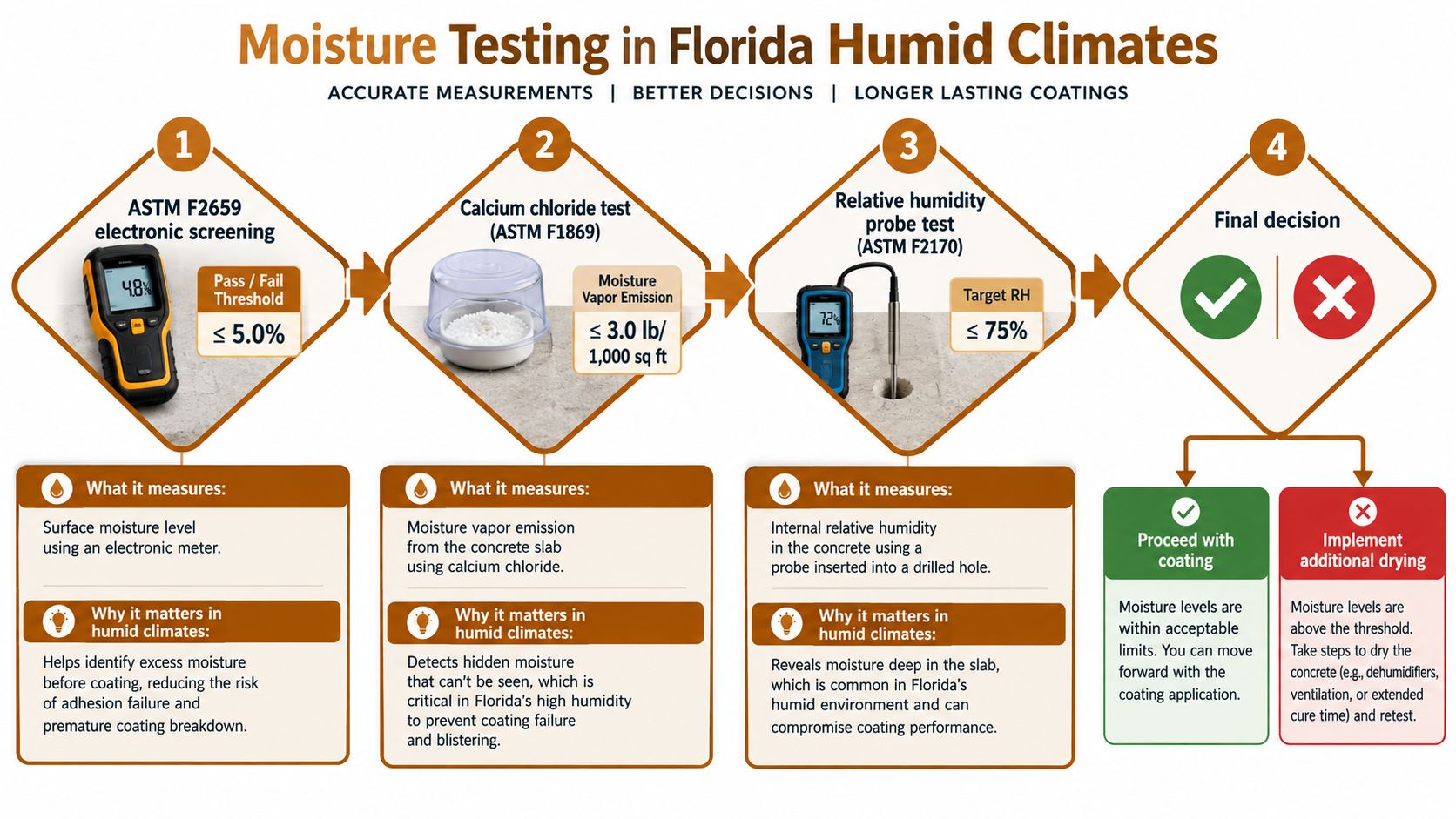
The flowchart helps organize the decision process, but its sequence isn't a universal requirement for every product.
Different tests answer different questions
ASTM F2659 addresses electronic screening, ASTM F1869 evaluates calcium-chloride moisture-vapor emissions, and ASTM F2170 evaluates in-situ relative humidity. They don't measure the same property and shouldn't be treated as interchangeable.
An example traffic-coating specification combines a maximum emission rate of 5 pounds per 1,000 square feet per 24 hours, an in-concrete relative-humidity limit of 75%, visible dryness, and a 28-day cure for new substrates. Those are system-specific requirements, not universal limits for all concrete finishes, as reflected in the Sika surface-preparation guidance.
ACI guidance also requires attention to testing conditions. The surface and equipment should be acclimated near expected service temperature and humidity, and substrate moisture must satisfy the material manufacturer's limits, according to ACI's concrete-repair code guidance.
Resolve conflicts before coating
If required tests disagree, don't select the favorable result and disregard the other. Ask the manufacturer to interpret the complete record and provide a written installation decision.
- Investigate exposure: Consider rainfall, irrigation overspray, drainage, and shaded areas.
- Review slab conditions: Account for slab-on-grade vapor transmission and, indoors, HVAC conditions.
- Choose a response: Delay and retest, address drainage, evaluate a moisture-tolerant system, or reconsider the finish.
For Central Florida properties, those site questions belong in the evaluation rather than being treated as unexpected complications.
This video provides additional visual context for the moisture-testing discussion.
Cleanliness, Cracks, Joints, and Bond Verification
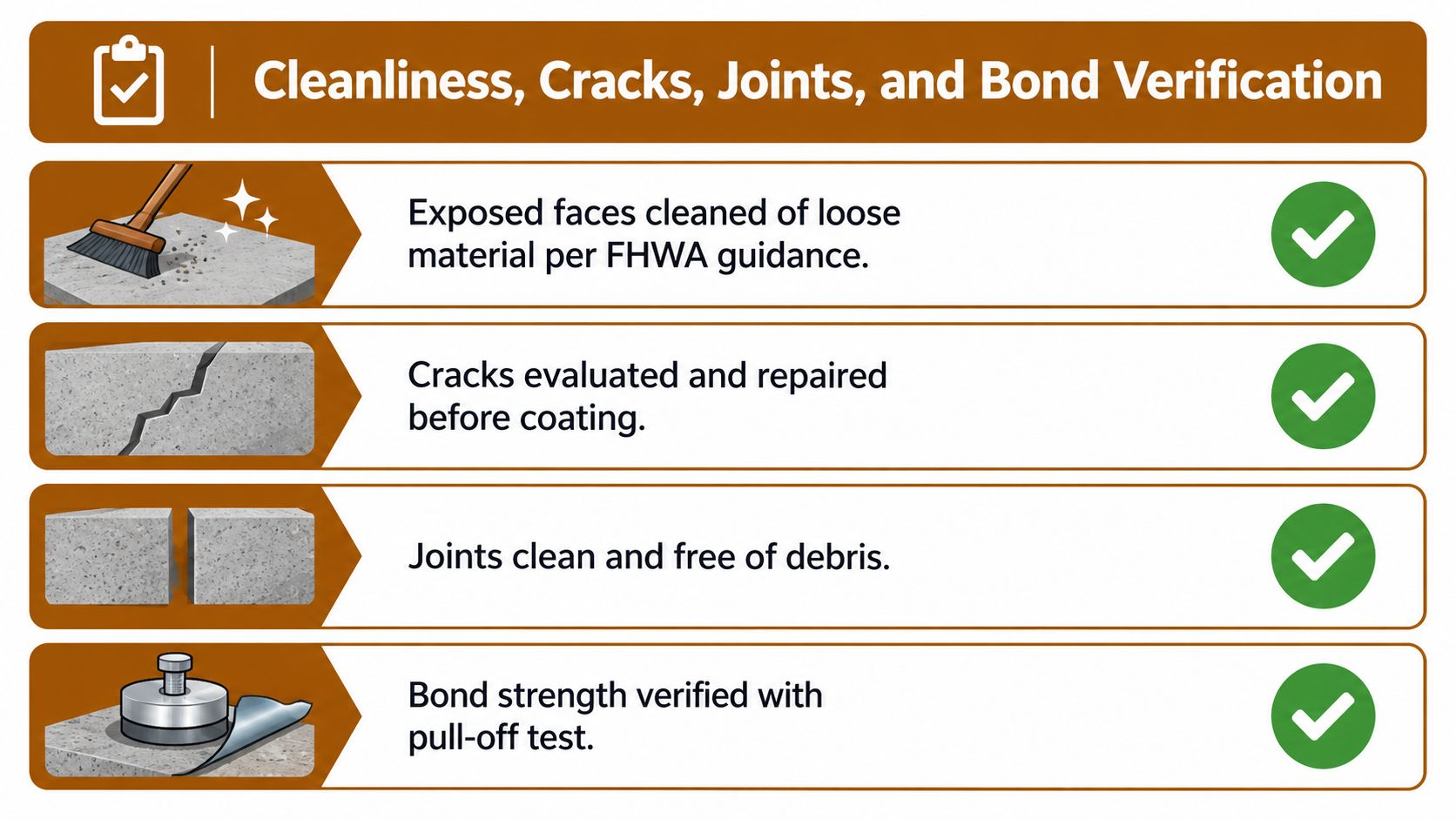
Cleanliness needs its own acceptance check. FHWA repair guidance calls for exposed faces to be free of loose particles, oil, dust, asphalt residue, and other contaminants, with sandblasting residue removed immediately before bonding material is applied. These requirements address the actual bond interface, not merely the slab's appearance, as detailed in the FHWA concrete-repair procedures.
The checklist separates items that are too often grouped under a vague “surface prep” allowance.
Match water condition to the repair material
Many portland-cement-based repair materials require saturated-surface-dry, or SSD, concrete. The internal pores are saturated, but the exposed surface has no free water or puddles. A dry substrate can draw water from the repair material, while standing water can interfere with bonding and placement, according to ACI's concrete-repair field guidance.
That requirement differs from the dry-substrate conditions some polymer systems demand. Crews must follow the selected material's requirements instead of carrying one moisture rule across every product.
Inspect discontinuities separately
Cracks and joints need an explicit treatment plan. Ask whether the proposed work involves routing and cleaning, epoxy injection, polyurethane, cementitious repair, or maintaining a functioning joint. The specification should explain the selection in relation to crack behavior and the intended system, rather than assuming every opening can receive the same filler.
For existing movement joints, review the concrete expansion joint repair considerations before approving a cosmetic treatment over the area.
A practical pre-placement inspection should confirm:
- Soundness: Removal limits expose suitable concrete.
- Cleaning: Mechanical preparation is complete and loose residue is removed.
- Profile: The prepared surface meets the specified texture.
- Water condition: The substrate satisfies the selected material's requirements.
- Cracks and joints: Treatment is complete and consistent with the repair design.
- Bond verification: Required testing is completed and recorded before acceptance.
AMPP's preparation framework similarly treats tensile surface strength, profile, cleanliness, contaminants, pH, and moisture as distinct acceptance considerations. Passing one check doesn't eliminate the others.
Curing, Inspection Checkpoints, and Florida Field Conditions
Preparation establishes the receiving surface. Curing controls conditions after placement. Neither substitutes for the other, and both need room in the schedule.
For the cementitious repair applications addressed by ACI's field guide, curing follows ACI 308.1-98, with a seven-day moist cure identified as an alternative to a compliant curing compound. That is application-specific guidance, not a universal timetable for every overlay or coating, as stated in ACI's RAP-3 repair guide.
Establish inspection checkpoints
Owners should retain the selected product information, approved preparation requirements, test records, and placement notes. Organizing those records around inspection checkpoints makes the file easier to use.
- Before placement: Accept the substrate and confirm that required repairs and tests are complete.
- During placement: Record material use, site conditions, and any departures from the approved procedure.
- After placement: Confirm the curing method, protection measures, and authorized return-to-service conditions.
A defined quality assurance process helps connect field observations to decisions instead of leaving them in separate conversations.
Plan around Florida exposure
Heat, direct sun, sudden rain, and traffic access should influence the work plan. Ask how the crew will protect fresh work, monitor product-specific application conditions, and respond if weather changes. UV exposure also belongs in finish selection, rather than being treated as a problem surface profiling can solve.
For properties combining concrete sidewalks with asphalt parking, coordinate the scopes without confusing them. Concrete construction, asphalt sealcoating, and parking lot striping require different procedures, but owners benefit from a coordinated access and maintenance plan.
Scheduling advice: Fast turnaround should come from planning and reliable scheduling, not skipped acceptance checks or shortened curing.
Hire a professional when substrate suitability is uncertain, required testing exceeds a visual inspection, or removal may reveal additional deterioration. Look for local Central Florida experience, high-quality workmanship, and documented licensing and insurance. Free, no-pressure estimates are available from 7am to 7pm, allowing owners to discuss realistic timelines and potential long-term savings before committing.
Questions Property Owners Ask About Preparation Standards
How can I tell whether an existing coating was under-prepared?
Peeling, loose edges, and areas that separate from the slab justify investigation, but they don't establish a cause on their own. The important evidence is the failed interface: what remains attached to the coating, what remains on the concrete, and whether the original preparation and testing records exist.
Ask the evaluator to distinguish a weak substrate from contamination, moisture incompatibility, or an unsuitable application procedure. Don't authorize another finish solely because the damaged area can be made to look clean.
What should I do when moisture results disagree?
Keep the complete test record and request a written decision from the proposed material manufacturer. Confirm that the tests were performed under appropriate conditions and that the specification accepts the methods used.
A disagreement isn't permission to average unrelated readings. For a shaded patio in Homosassa or an interior slab in Beverly Hills, the appropriate next step may be further investigation rather than immediate installation.
Can acid etching replace mechanical profiling?
Not automatically. Acid etching has a recognized ASTM reference, but that doesn't make it an acceptable substitute for the preparation method required by the selected system.
Ask whether the proposed process can remove the material that needs removal, achieve the specified profile, and satisfy the complete acceptance requirements. If the contractor can't demonstrate that through the approved procedure and test area, choose a different preparation approach.
How long should a properly prepared repair or overlay last?
There isn't a defensible universal service-life promise for every driveway, sidewalk, or patio. Durability depends on substrate suitability, material selection, installation, curing, exposure, traffic, and ongoing maintenance.
For owners in Belleview, Silver Springs, and surrounding communities, the better comparison is a documented scope with clear limitations, not the longest verbal lifespan claim. Proper preparation supports durable work, but it doesn't turn an unsuitable slab into a dependable overlay candidate.
When is replacement the more practical choice?
Replacement deserves evaluation when the contractor can't identify a reliable substrate for the proposed bonded system or when required removal changes the project substantially. Request separate explanations of what repair would retain and what replacement would address.
Concrete and Asphalt Experts in Marion and Citrus County should be able to discuss both concrete construction and pavement maintenance without steering every property toward the same treatment. Concrete surface preparation standards provide a useful starting point for that conversation: establish what's there, define what the proposed system needs, and verify the match.
For concrete installation and replacement, along with asphalt sealcoating and parking lot striping, Riverside Sealing & Striping, LLC offers local property owners a coordinated service option. Request a free, no-pressure on-site consultation to evaluate your driveway, patio, sidewalk, or commercial pavement and discuss whether repair, resurfacing, or replacement deserves the next step.