
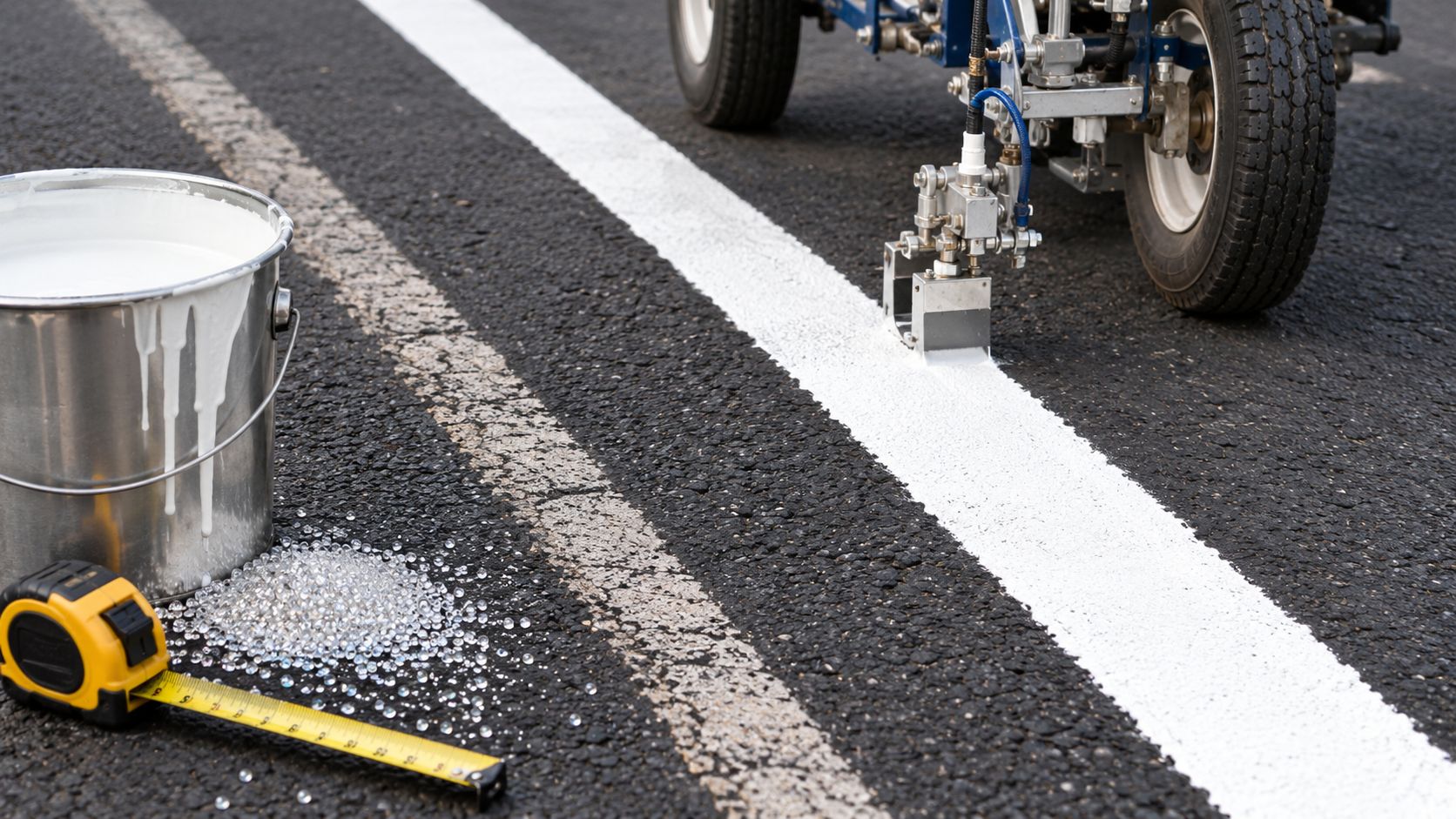
A parking lot can look orderly one season and become difficult to read the next. White stalls fade into gray asphalt, yellow fire-lane lines lose their contrast, and accessible markings become hard to distinguish after months of intense sun and heavy rain. In Central Florida, choosing the best parking lot striping paint isn't just about getting a bright finish on opening day. It affects traffic flow, nighttime visibility, maintenance costs, and accessibility responsibilities.
For property managers, HOAs, churches, retailers, and public facilities in Marion County, FL and Citrus County, FL, the right material depends on pavement condition, traffic, reopening requirements, and local marking expectations. A product that works acceptably in a cooler market may fade or lose adhesion faster in Ocala, Dunnellon, Crystal River, or The Villages. The practical answer is to match paint chemistry and application methods to the lot, not to choose by price alone.
Table of Contents
- The Challenge of Striped Pavement in Central Florida
- Comparing Acrylic, Thermoplastic, and Water-Based Options
- Analyzing True Cost and Durability Trade-offs
- Essential Application Practices for Florida Weather
- Florida Heat and UV Impact on Striping Longevity
- ADA Compliance and Safety Marking Requirements
- Professional Evaluation and When to Hire Help
- Frequently Asked Questions About Striping Paint
The Challenge of Striped Pavement in Central Florida
Central Florida parking lots endure several stresses at the same time. Strong ultraviolet exposure gradually breaks down exposed paint binders, while heat pushes pavement temperatures higher than the surrounding air. Humidity and seasonal downpours create another problem. If a crew applies traffic paint to damp asphalt or schedules work without enough drying time, the coating may not bond properly.
That combination makes line visibility a maintenance and safety issue. Drivers need to distinguish parking stalls, directional arrows, crosswalks, loading areas, and fire lanes. Pedestrians need clear paths through busy lots. Property owners also need markings that remain understandable after repeated vehicle movements, cleaning, sealcoating, and weather exposure.
Practical rule: A line that looks bright when the crew leaves isn't necessarily a line that will hold up through Central Florida's wet season.
The challenge varies by location and property type. A low-volume lot near Beverly Hills or Hernando may place less stress on markings than a busy shopping center in Ocala or a community facility serving The Villages. A medical office in Lecanto may need particularly clear accessible routes, while a waterfront commercial property near Homosassa or Crystal River may deal with persistent moisture and heavy seasonal use.
Historically, pavement striping developed from early painted roadway and parking markings in the 1910s and 1920s. The first Manual on Uniform Traffic Control Devices, issued in 1934, helped establish nationwide consistency, and later standardization in 1971 further shaped modern roadway marking practices. Those conventions still influence common parking-lot layouts, including white for same-direction travel, yellow for opposing traffic, and blue for accessible spaces. The history matters because striping is tied to safety and consistency, not just appearance. This overview of pavement-marking history and standards provides additional background.
Comparing Acrylic, Thermoplastic, and Water-Based Options
A Florida parking lot can look freshly marked after installation and still lose clarity under intense sun, heat, rain, and turning traffic. The right material depends on reopening time, pavement condition, traffic volume, and how long the markings must remain clear for drivers and pedestrians. Striping is also part of maintaining visible accessible spaces, routes, fire lanes, and other safety controls, not just improving appearance.
| Material Type | Avg Cost | Lifespan | Best Use Case |
|---|---|---|---|
| Water-based latex | About $0.08 to $0.15 per square foot | Typically 2 to 3 years | Standard lots where cost and practical repainting matter |
| Solvent-based acrylic | Varies by formulation and specification | Product and site dependent | Projects requiring a particular adhesion, weather, or VOC profile |
| Thermoplastic | About $0.20 to $0.35 per linear foot | Typically 5 to 7 years | High-traffic areas needing longer service life and stronger nighttime visibility |
The table's cost and service-life figures come from parking-lot striping guidance comparing paint options. They are comparison points, not guarantees. Sun exposure, pavement condition, traffic load, film thickness, surface preparation, moisture, and installation quality can shorten or extend actual performance.
Waterborne acrylic for fast reopening
Waterborne acrylic traffic paint suits businesses that need to reopen quickly and can plan periodic restriping. Product specifications list no-pickup or no-track drying from under 6 minutes to under 10 minutes at about 15 mil wet film in warm, dry conditions. Conventional acrylic traffic paint may require roughly 10 minutes to 2 hours, depending on weather. The SealMaster fast-dry specification sheet also lists common requirements such as 4-inch line width and ASTM-based testing for abrasion, bleed, flexibility, reflectance, and scrub resistance.
Florida's humidity and afternoon rain can extend drying beyond laboratory or manufacturer conditions. Schedule application around the forecast, and confirm the pavement is clean and dry before spraying.
Solvent-based acrylic for specialized conditions
Solvent-based acrylic is a product group, not one uniform solution. Selection depends on asphalt or concrete, existing coatings, moisture, reopening requirements, equipment, VOC limits, and the technical sheet. These products may fit a project requiring a particular adhesion or weather profile, but compatibility must be checked before application. New coating will not correct peeling, contamination, or poorly bonded markings.
Thermoplastic for demanding traffic
Thermoplastic is heat-fused into the pavement and may include reflective glass beads. Its thicker construction can provide a longer stated service range and stronger nighttime visibility than basic waterborne paint. It suits busy commercial zones, repeated turning movements, and locations where frequent restriping would interrupt access. Installation requires suitable equipment, pavement preparation, and enough heat control to bond the material without damaging the surface.
Analyzing True Cost and Durability Trade-offs
A lot can look freshly marked after one morning of striping, then show faded lines and weak symbols after a Florida summer. The lowest material price does not necessarily produce the lowest ownership cost. A water-based system may suit a moderate-traffic lot that can be restriped without disrupting operations. Frequent touch-ups, closures, or detailed layout work can make that choice more expensive over time.
Evaluate four cost layers:
- Material: Coating, beads, primer when required, and other consumables.
- Labor: Layout, cleaning, masking, machine operation, and touch-up work.
- Downtime: Lost access, redirected customers, resident inconvenience, and interrupted deliveries.
- Premature failure: Correcting peeling, poor adhesion, faded symbols, or inaccurate lines.
A lightly used private lot in Summerfield may tolerate a shorter service cycle. A retail center in Ocala or a busy community facility in The Villages may place greater value on longer-lasting markings because each project affects parking access and customer movement. Thermoplastic carries a higher stated unit cost, but its 5 to 7 year service range can reduce full replacement frequency at high-use properties. Water-based latex costs about $0.08 to $0.15 per square foot and typically lasts 2 to 3 years. Its value depends on whether the site can manage that maintenance cycle. The material comparison and durability guidance provides the underlying comparison.
Ask which system will keep this lot visible and compliant for its traffic pattern, weather exposure, and operating schedule.
Restriping should follow performance as well as the calendar. Industry guidance commonly points to action when visibility falls below roughly 50%, since fading can affect safety and ADA-related recognition before markings appear completely worn. Florida's intense UV exposure and heat can shorten the useful life of paint, making early evaluation more practical than waiting for total failure.
For a property-specific budget, review parking lot striping prices alongside traffic levels, disruption costs, and the planned maintenance schedule rather than comparing paint prices alone.
Essential Application Practices for Florida Weather
Good paint can't rescue poor preparation. Before striping, the crew needs a sound pavement surface, clear layout, and a weather window that allows the coating to dry and bond. Dirt, loose aggregate, oil, old flaking paint, and surface moisture can all interfere with adhesion.
Prepare the surface before opening the paint
A practical preparation sequence includes:
- Inspect the pavement. Identify potholes, failed asphalt, cracks, oil contamination, and peeling markings before setting line locations.
- Clean the work area. Remove loose material and contaminants that could sit between paint and pavement.
- Confirm layout. Measure stalls, aisles, arrows, crosswalks, fire lanes, and accessible spaces before the machine starts.
- Check weather and pavement moisture. Rain, humidity, and film thickness all influence drying and reopening time.
- Apply consistently. A professional striping machine helps maintain uniform widths and cleaner edges than improvised hand application.
Waterborne traffic paint performs best with high temperature, low humidity, and moving air. One specification lists 30 minutes for dry-no-pickup, 60 minutes to recoat, and 120 minutes before opening to heavy traffic at 77°F and 50% relative humidity, while also stating that actual drying changes with temperature, humidity, and film thickness. The Sherwin-Williams traffic-paint specification supports treating those times as controlled-condition references, not promises for every Florida afternoon.
Build visibility into the installation
Reflective glass beads can improve nighttime visibility, especially on markings exposed to headlights and turning traffic. Thermoplastic incorporates reflective beads through its heat-fused application, while waterborne systems may require the crew to apply beads correctly during the wet-film window.
For a practical layout and installation reference, review how to stripe a parking lot. The point isn't to rush a fast-drying product. It's to reopen the lot only after the installed film has reached the necessary condition for the expected traffic.
Florida Heat and UV Impact on Striping Longevity
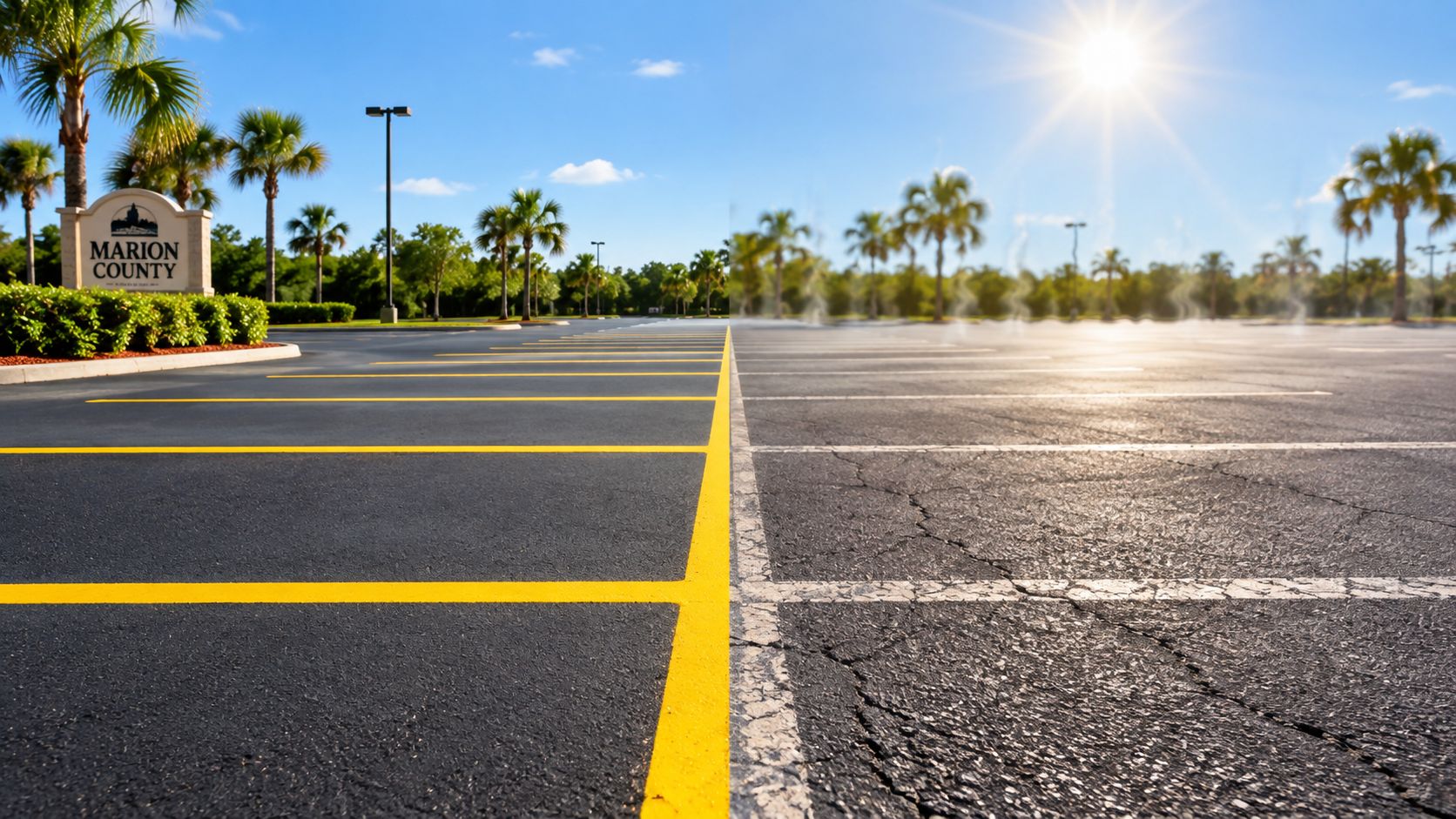
A fresh stripe can look sharp when a Central Florida lot reopens, then lose contrast under months of intense sun, heavy rain, and tire traffic. In Marion and Citrus County, ultraviolet radiation breaks down paint binders while sustained heat accelerates evaporation and strains the bond between the marking and pavement. Rain exposes weak preparation and incomplete curing.
The right product depends on exposure and use. Paint that performs well on a shaded, lightly used lot may fade or lose adhesion sooner at an exposed commercial entrance in Dunnellon, Belleview, or Crystal River. Striping is therefore more than appearance. Clear, durable lines help drivers read lanes, accessible spaces, and directional markings as pavement conditions change.
Why reflectivity matters after fading begins
Color and nighttime visibility can decline at different rates. A line may retain visible pigment while losing the reflective response drivers need after dark. Properly applied glass beads return headlight illumination toward the driver, helping reveal lane edges, accessible markings, and directional symbols.
Thermoplastic has a durability advantage because heat fuses the material into the pavement instead of leaving only a surface film. Its stated service range of 5 to 7 years contrasts with the typical 2 to 3 years cited for water-based latex, as noted in the earlier comparison. Installation quality, traffic volume, surface preparation, and exposure still affect the result.
Standard waterborne systems can provide approximately 9 to 12 months of film durability under suitable conditions. Applied below the minimum temperature, performance may fall to 2 to 3 months. Low-temperature or high-build variants can extend the usable season to about 35°F to 45°F while maintaining adhesion and cross-linking. The SWARCO field guide to traffic paint reinforces the need to match the product with the actual cure window, even in Florida's generally warm climate.
ADA Compliance and Safety Marking Requirements
Restriping is a compliance event, not merely a cosmetic refresh. When businesses, state agencies, or local governments restripe parking spaces, they must provide accessible parking as required by the 2010 ADA Standards for Accessible Design. That means a crew shouldn't just trace faded lines without checking whether the accessible spaces, aisles, signs, and routes still work together.
The official ADA guidance on restriping parking spaces explains why accessibility obligations arise when spaces are restriped. For commercial properties, HOAs, churches, schools, and public-facing facilities, a fresh coat of paint is an appropriate opportunity to correct inaccurate or incomplete geometry.
Dimensions that affect the layout
A car-accessible space must be at least 8 feet wide and paired with a 5-foot access aisle. A van-accessible space needs an 8-foot access aisle. The total width for a standard car space plus its aisle is 13 feet. This parking-lot striping guide with accessible-space measurements provides the practical dimensions.
The access aisle is part of the design, not spare pavement that can be absorbed into an adjacent stall. It needs to remain clear so a person can deploy a mobility device safely. Layout mistakes often happen when crews focus only on the blue stall and overlook the aisle, route, slope, or relationship to the building entrance.
Color, visibility, and local approval
The ADA doesn't mandate a single pavement-marking color, yet many local codes expect blue and white accessible-space markings. Reflective beads or thermoplastic can improve nighttime visibility, but durability alone doesn't establish compliance. Property owners should confirm local requirements before choosing colors, symbols, or layouts.
A site in Ocala may have different review expectations from a property in Inverness, Lecanto, or Homosassa. A contractor should document the layout, use accurate stencils, and identify any local requirement that affects the finished markings. For a focused reference, see ADA parking-lot striping requirements.
Professional Evaluation and When to Hire Help
DIY touch-ups can make sense when a private, lightly used area has a simple layout and the existing pavement is sound. They become risky when the project involves accessible spaces, multiple traffic patterns, deteriorated asphalt, or a business that can't afford an uncertain reopening schedule.
Hire a qualified local contractor when:
- The layout is complex. Large commercial lots, HOAs, shopping centers, and churches need consistent stalls, arrows, loading areas, fire lanes, and pedestrian markings.
- ADA geometry is involved. Measuring accessible stalls and aisles requires more than placing a blue rectangle over an old outline.
- The surface has failed. Cracks, oil contamination, raveling, and loose asphalt need attention before paint can perform.
- The lot must reopen quickly. Professionals can coordinate preparation, application, drying conditions, and traffic control.
- The project includes sealcoating. Sealcoat and striping need to be sequenced correctly so the markings don't become buried or prematurely damaged.
Riverside Sealing & Striping, LLC provides concrete work, asphalt sealcoating, parking lot striping, accessible-space markings, directional arrows, and related pavement maintenance across Central Florida. The company is based in Dunnellon and serves Marion County, Citrus County, and surrounding communities, including Summerfield, Silver Springs, Beverly Hills, and Hernando.
A reliable contractor should be licensed and insured, explain the proposed material, confirm the weather window, provide a clear schedule, and offer a no-pressure estimate. Those details matter as much as the paint brand because application quality controls the result.
Frequently Asked Questions About Striping Paint
What is the best parking lot striping paint for Florida?
No single product fits every lot. Waterborne acrylic suits projects where fast reopening and moderate traffic are priorities. Thermoplastic is a stronger option for heavily used areas when longer service life and reflective visibility justify higher material cost. Pavement condition, traffic patterns, Florida's intense sun, available weather window, and local requirements should guide the choice.
How long does parking lot striping paint last?
Water-based latex typically lasts 2 to 3 years, while thermoplastic typically lasts 5 to 7 years, according to comparative striping guidance. Those ranges require proper surface preparation and application. Central Florida heat, UV exposure, heavy rain, traffic, moisture, and poor curing can shorten the service life.
When should a property be restriped?
Schedule an inspection when markings become difficult to read at night, unclear in busy traffic, or visibly faded. Striping is a safety and access issue, not only a cosmetic repair. Florida's heat and UV can reduce visibility before lines appear completely gone, so inspect the lot before confusion affects drivers or pedestrians.
Does restriping trigger ADA obligations?
Yes. Businesses and public entities must provide accessible parking when spaces are restriped under the 2010 ADA Standards for Accessible Design. Verify stall dimensions, access aisles, routes, symbols, signs, and local color requirements before painting. Incorrect markings can affect safe access and compliance.
How can I evaluate a local contractor?
Ask who will verify the layout, how the crew handles damp pavement, which traffic paint system they recommend, and how long the lot must remain closed. Confirm that the estimate includes surface preparation and accessible markings.
Riverside Sealing & Striping, LLC provides parking lot striping, ADA marking upgrades, asphalt sealcoating coordination, and concrete services across Marion County, Citrus County, and surrounding Central Florida communities. Visit Riverside Sealing & Striping, LLC for a no-pressure consultation and estimate.