
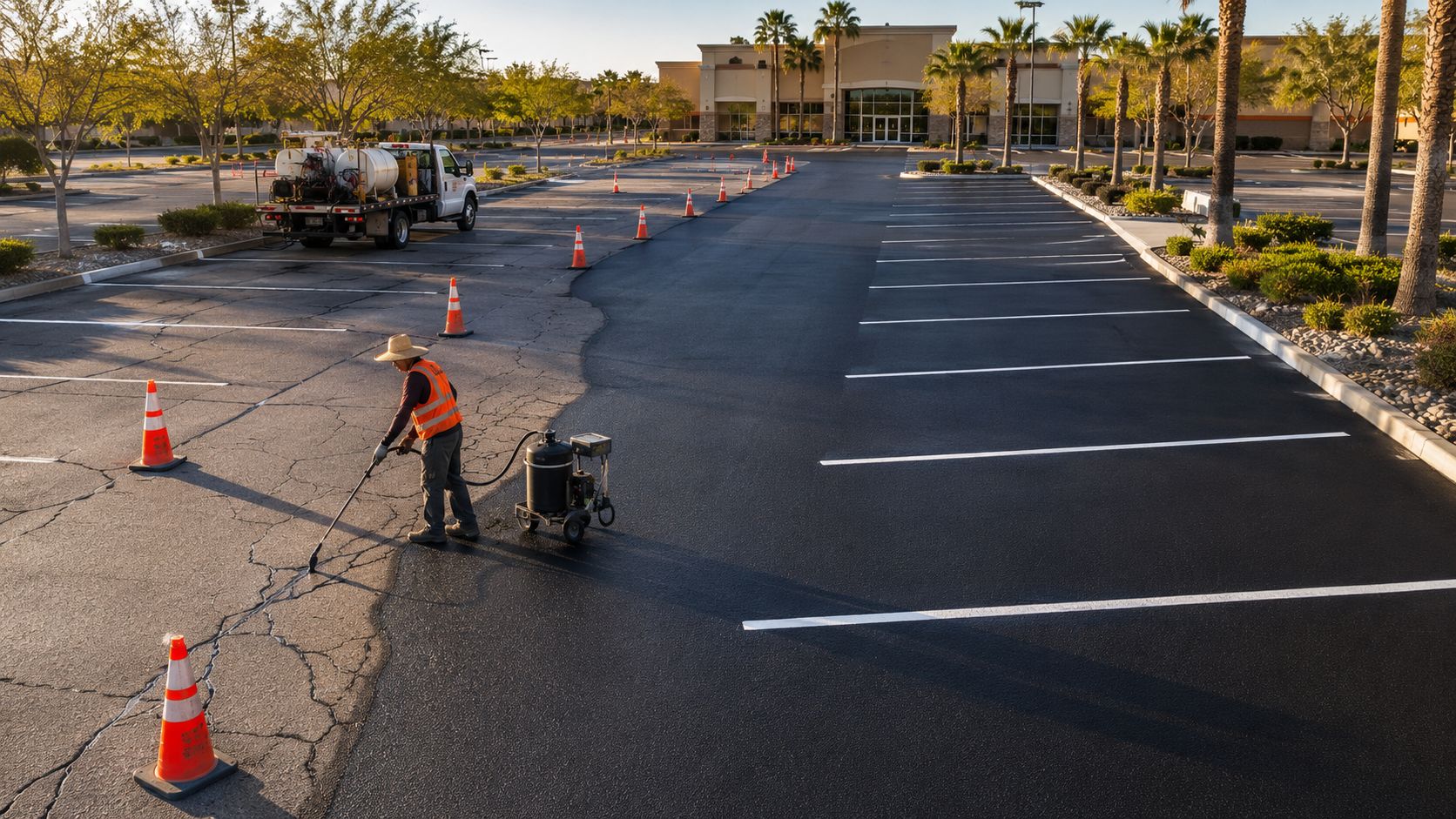
A commercial lot can look acceptable from the office window while water is entering cracks, paint is fading, and turning traffic is pushing weak areas toward failure. By the time tenants complain about potholes or customers trip over a broken transition, the cheapest preservation window may already be gone. That's the reality property managers face across Central Florida, from retail centers in Ocala and The Villages to churches, HOAs, medical offices, and industrial sites in Dunnellon, Crystal River, and Inverness.
Commercial asphalt maintenance works best as an asset-condition decision, not a calendar checkbox. The right question isn't how often to sealcoat. It's what the pavement is showing, which treatment addresses that distress, and how the work can be completed without disrupting tenants, accessible routes, fire lanes, or daily revenue. This guide applies that approach to Marion County, FL, Citrus County, FL, and nearby communities including Belleview, Silver Springs, Summerfield, Homosassa, Lecanto, Beverly Hills, and Hernando.
Table of Contents
- What Property Managers Actually Need to Know
- The Core Maintenance Tasks and What Each One Does
- Inspections, Scheduling, and When Each Task Should Happen
- How Central Florida Climate Changes the Maintenance Plan
- Knowing When Maintenance Stops Paying Off
- What You Can Handle Yourself and What Needs a Crew
- Planning Maintenance Around Compliance and Downtime
- Parking Lot Striping and ADA Compliance Questions
What Property Managers Actually Need to Know
Property managers rarely make pavement decisions in isolation. A busy commercial lot has to carry daily traffic, channel stormwater, preserve pedestrian access, satisfy ADA expectations, and maintain a professional appearance. Every repair recommendation competes with other budget demands, while every delay can increase safety exposure and tenant frustration.
The practical decisions are straightforward, even when the pavement isn't. You need to determine what deserves treatment now, when the work exceeds what an in-house team can safely handle, and how to sequence repairs so the property stays accessible.
Maintenance is preservation, not cosmetic work
The Federal Highway Administration defines pavement preservation as a network-level, long-term strategy using integrated, cost-effective practices to extend pavement life, improve safety, and meet user expectations. FHWA also explains that preservation restores the function of an existing system without increasing its capacity or structural strength, and that preventive preservation is generally performed early in pavement life to extend service life by about 1 to 6 years (Federal Highway Administration pavement preservation guidance).
That distinction matters. Sealcoating can protect a sound surface, but it won't rebuild a failed base. Crack sealing can keep water out, but it won't correct deep settlement. A patch can restore a localized area, but it won't solve a drainage pattern that keeps saturating the same section.
Commercial asphalt maintenance is therefore a program of inspections, crack treatment, surface protection, localized repairs, drainage correction, and pavement marking. The work should be timed to the condition of the asset, not to a generic promise that every lot needs the same service at the same interval.
Practical rule: A maintenance treatment is valuable only when it matches the depth and pattern of the distress.
Commercial lots demand a different scope
A residential driveway usually has limited turning traffic and fewer operational conflicts. A commercial lot has delivery trucks, tighter turning radii, concentrated loading zones, oil exposure, pedestrian crossings, fire access, drainage structures, and accessible parking requirements.
That difference should appear in every proposal. Compare the inspection method, preparation work, repair quantities, traffic-control plan, curing requirements, striping layout, and cleanup obligations. A bid that lists only “sealcoat and stripe” may leave out the repairs that determine whether the coating performs.
FHWA's preservation materials describe a long-running federal framework that has treated pavement preservation as planned asset management since the early 2000s (FHWA pavement preservation publication). For owners, the lesson is simple: budget for condition monitoring and targeted intervention rather than waiting for full-depth replacement to become urgent.
The Core Maintenance Tasks and What Each One Does
No single product maintains a commercial lot. Each treatment addresses a different failure mechanism, and the wrong application can waste money or hide a problem that needs structural attention.
| Task | Distress Addressed | Typical Service Life Added |
|---|---|---|
| Crack sealing | Water and debris entering active cracks | Depends on pavement condition and crack movement |
| Sealcoating | Oxidation, surface wear, and loss of fine material | Crack-and-fog seals can extend pavement life by 1 to 4 years when appropriate (Colas asphalt preservation guide) |
| Asphalt-and-aggregate surface treatment | Minor distress on structurally sound pavement | Can extend useful life by 3 to 7 years (Colas asphalt preservation guide) |
| Pothole and localized patching | Load-related breaks and isolated failures | Restores the affected area, but doesn't correct widespread base failure |
| Infrared or full-depth patching | Thermal cracks, utility cuts, and deeper localized deterioration | Depends on whether the underlying base is sound |
| Drainage correction | Ponding, edge saturation, and recurring soft spots | Protects future repairs by addressing water movement |
| Re-striping and signage | Faded layout, accessibility markings, and wayfinding | Restores visibility until traffic and weather wear markings again |
Match treatment to distress
Crack sealing is intended to block water and debris before they reach the base. It's most useful when cracks are distinct and the surrounding pavement remains stable. If cracking is interconnected with depressed or soft pavement, sealing alone is a surface response to a deeper failure.
Sealcoating restores a protective surface film and slows oxidation. It performs best on pavements in excellent to good condition. It won't fill structural cracks, level ruts, or repair potholes, so preparation and patching must happen first.
Pothole repairs require more judgment than filling a hole. A temporary cold patch can protect traffic while a permanent repair is scheduled, but long-term performance depends on removing unstable material, correcting moisture conditions, and placing compatible asphalt with proper compaction.
Drainage work often determines whether other treatments last. Standing water at a valley gutter, curb line, or transition can keep damaging the same area after repeated patching. Re-striping should follow repairs and surface treatments, not precede them.
Inspections, Scheduling, and When Each Task Should Happen
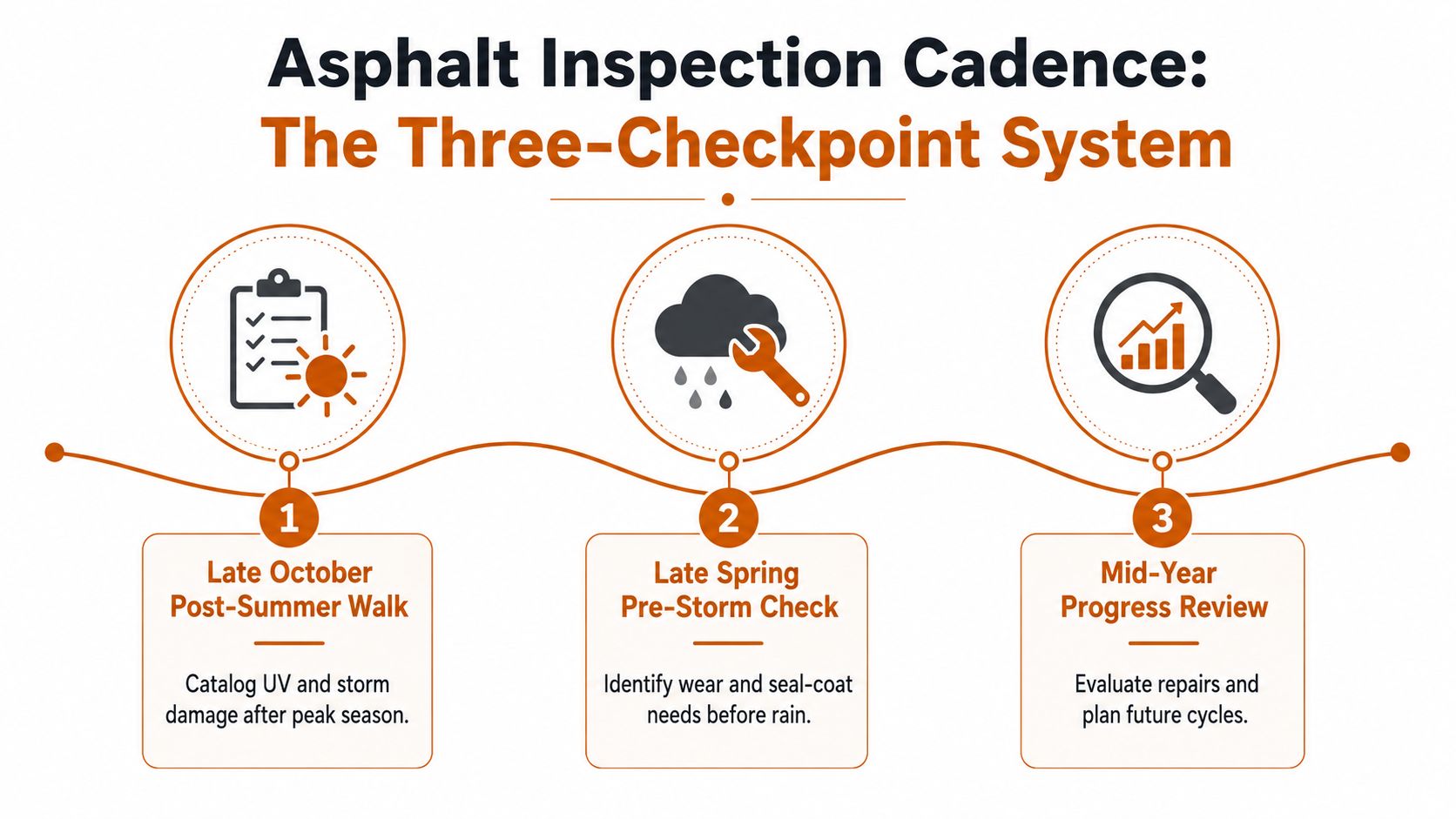
A fixed calendar can help organize staff, but observed distress should control the scope. A practical Central Florida program uses three deliberate inspection checkpoints rather than waiting for tenants to report visible failures.
Start with a late October post-summer walk. Record UV oxidation, storm damage, raveling, ponding, faded paint, soft transitions, and new cracking after the most demanding heat and rain period. Follow with a mid-winter review to see whether cracks have widened or repairs have reopened during cooler nights. Complete a May pre-storm-season sweep to verify drainage paths, scuppers, valley gutters, edges, and emergency access.
Use condition triggers instead of assumptions
Hairline cracking belongs in sealcoat preparation when the pavement is otherwise sound. Cracks around one-quarter inch or wider should be evaluated for crack sealing, while alligator cracking may justify core sampling or a deeper structural review. Faded striping is a clear restriping trigger, particularly where accessible stalls, access aisles, fire lanes, and directional markings are involved.
Commercial sealcoating is commonly scheduled every 2 to 3 years, with heavier-use or fluid-exposed properties sometimes needing it every 1 to 2 years. Industrial areas and truck or loading zones are often maintained on an 18 to 24 month cycle (asphalt lifecycle and sealcoating guidance).
Crack sealing may need attention annually on active lots, while restriping is best tied to visibility and traffic wear rather than a rigid date. Central Florida sun, rain, turning movements, and loading activity can shorten any general interval.
For a field-ready documentation format, use this commercial parking lot maintenance checklist to record distress, repairs, access concerns, and follow-up decisions.
How Central Florida Climate Changes the Maintenance Plan
Central Florida asphalt deals with a different combination of stress than pavement in a freeze-thaw region. Heat and ultraviolet exposure oxidize the binder, while frequent rain tests cracks, edges, drainage paths, and low areas. Year-round warmth keeps asphalt workable during repairs, but concentrated truck turning can still create rutting where the base or surface lacks support.
Afternoon storms make drainage inspection essential. Check scuppers, valley gutters, inlets, curb lines, and transitions before the wet season becomes disruptive. A coating may look intact while water is collecting at the same weak edge.
Build the annual window around risk
Spring and fall are often practical planning windows for sealcoating when site conditions support proper curing. Crack sealing should be completed before sustained heavy rain makes water intrusion more likely. Striping should be scheduled after the surface treatments have cured, with visibility and evening storm conditions in mind.
Hurricane planning adds another operational concern. Managers should identify emergency-vehicle routes, keep drainage access clear, plan where storm debris can be staged, and arrange a post-event pavement inspection promptly after a major weather event. That inspection should distinguish surface contamination from actual base or edge failure.
Sealcoating cure time depends on temperature, humidity, emulsion chemistry, and loading. Government guidance notes that a newly applied surface can take up to two days to cure properly, even though technical examples report much faster drying under favorable conditions (commercial crack filling and sealcoating guidance). A lot that looks dry isn't automatically ready for full traffic.
Use Florida sealcoating timing guidance as a scheduling reference, then confirm the actual work window with the crew based on weather and site conditions.
Knowing When Maintenance Stops Paying Off
The most expensive maintenance mistake is treating a structural failure as a surface problem. If sealed cracks reopen within months, patches break around their edges, or standing water returns after repeated corrections, the pavement may have moved beyond preservation.
Watch for recurring base failures, widespread raveling, deep rutting, interconnected alligator cracking, and drainage problems that repeatedly recreate the same distress. A pavement condition index, visual distress map, or core sample can help separate surface deterioration from failure below the asphalt. The precise test depends on the lot and the decision being made.
Read the treatment history
A section that has received repeated surface treatments may still be serviceable, but repeated failure in the same locations changes the economics. Federal pavement programs track condition, performance, and treatment history at scale, reinforcing the value of using observed performance and lifecycle modeling rather than calendar routines (Long-Term Pavement Performance data search).
| Condition Observed | Keep Maintaining | Move to Resurfacing |
|---|---|---|
| Isolated hairline or working cracks | Prepare and seal where pavement remains stable | Not usually justified by isolated cracking alone |
| Surface oxidation with sound structure | Sealcoat after cleaning and repairs | Consider resurfacing when wear is widespread |
| Recurring potholes in one area | Temporary protection while investigating | Resurface or repair the base when failure repeats |
| Interconnected alligator cracking | Monitor only if isolated and stable | Mill, overlay, or perform deeper repair when widespread |
| Persistent ponding | Clean and correct minor drainage obstructions | Regrade or rebuild when the design or base keeps failing |
The decision shouldn't be “another sealcoat because the budget is available.” It should be whether the treatment will address the distress for a reasonable service period. Crack-and-fog sealing can extend pavement life by 1 to 4 years, while a more reinforced asphalt-and-aggregate surface treatment can extend useful life by 3 to 7 years when the pavement remains structurally sound (Colas pavement preservation guidance).
When the base has failed across broad areas, localized patching and additional coating may only postpone the inevitable. That's when milling and overlay, full-depth patching, or full-depth reclamation deserves a serious comparison.
What You Can Handle Yourself and What Needs a Crew
Property teams can handle useful preventive work. Sweeping, documenting defects, placing cones around an immediate hazard, clearing debris, and reporting ponding after storms don't require a paving contractor. These actions help a manager create a reliable record and protect visitors while a permanent solution is arranged.
A crew should take over when the task changes the pavement surface, traffic pattern, accessible layout, or structural performance. Hot-mix placement, tank-melted crack sealant, calibrated sealcoat application, traffic paint, ADA layout, drainage reconstruction, and full-depth repairs all carry equipment, safety, and liability requirements.
| Task | Property Team Can Handle | Requires Professional Crew |
|---|---|---|
| Routine observation | Photograph and map cracks, ponding, faded markings, and soft spots | Diagnose structural causes when distress is widespread |
| Immediate hazard control | Place cones, barricades, and warning signs | Install and manage a complete traffic-control plan |
| Surface housekeeping | Sweep debris and clear blocked inlets when safe | Capture wash water or manage site-sensitive cleaning |
| Small pothole response | Use cold patch as a temporary stopgap | Remove failed material and install a permanent compacted repair |
| Crack treatment | Report locations and changes | Clean, heat, and apply hot or specialized sealant |
| Striping | Verify the intended layout with site records | Spray accurate lines, accessible symbols, aisles, and directional markings |
| Sealcoating | Protect the area from traffic after work | Prepare, mix, apply, and cure the coating under suitable conditions |
Use a simple risk screen
If the task could change the lot's rating with the fire marshal, an ADA inspector, or an insurance carrier, treat it as a crew job. The same applies when a mistake would require closing the lot again, removing failed material, or repainting an incorrect layout.
Before hiring, verify that the contractor is licensed and insured, and request current general liability and workers' compensation certificates. Ask for a written scope that identifies square footage, sealcoat application requirements, crack quantities, repair locations, striping details, traffic control, and cure expectations.
Local Central Florida experience can help a contractor recognize regional base and drainage patterns. It also matters operationally. References from comparable HOAs, retail centers, medical offices, churches, or schools can show whether the crew stages work around tenant traffic and reopens areas reliably.
Get three bids when the scope is significant. Reject vague line items, door-to-door pressure, large unexplained deposits, and contractors who won't document preparation or curing. The lowest price is often not the lowest cost when it omits repairs, access control, or ADA layout work.
Planning Maintenance Around Compliance and Downtime
A maintenance project should be planned as one coordinated closure whenever possible. Repairs and crack sealing come first, followed by sealcoating, curing, and striping. Paint goes last, because markings applied before surface work can be covered, tracked, or forced into a second closure.
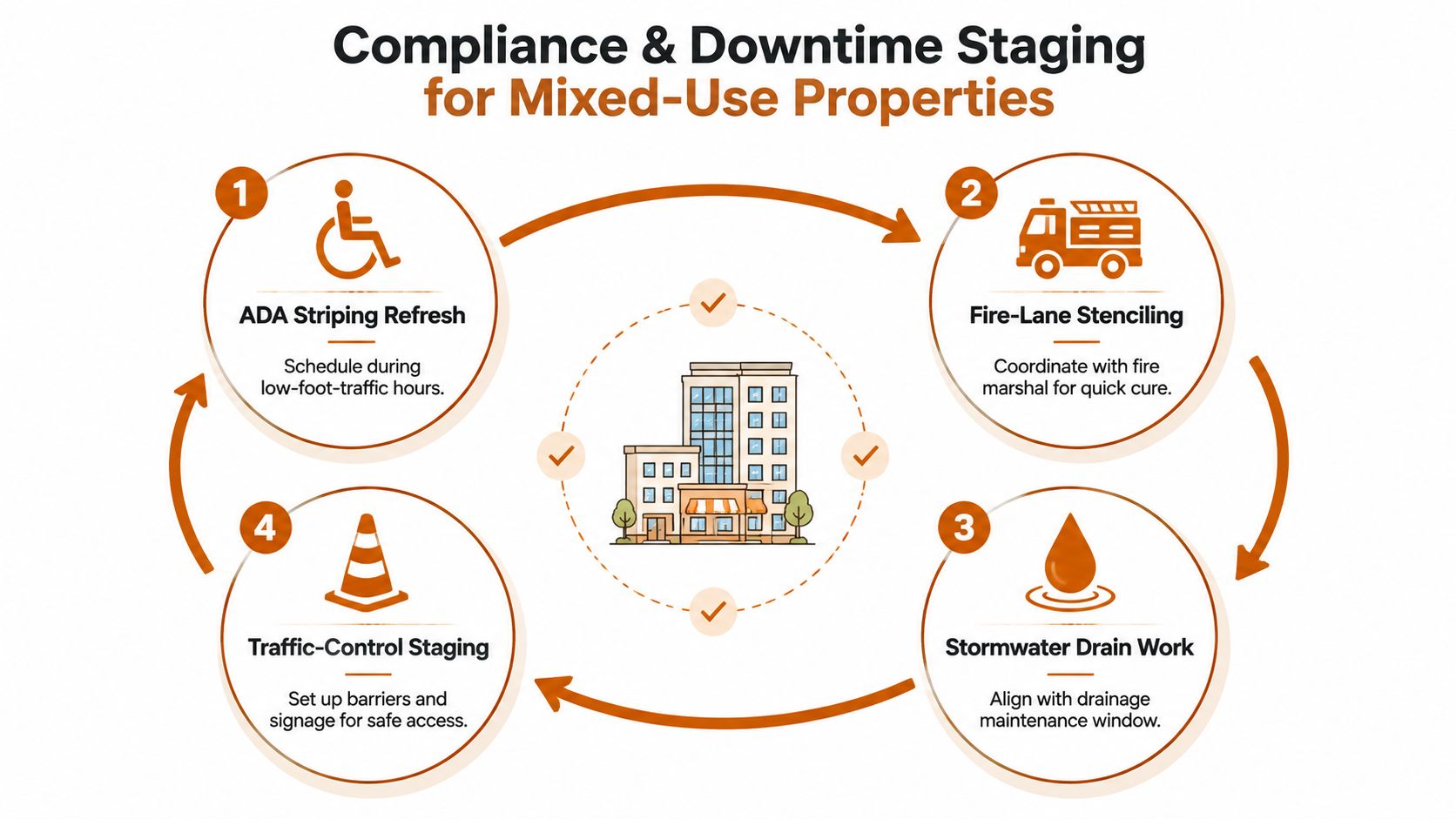
Mixed-use properties add more coordination. Retail centers, churches, schools, HOAs, and apartment communities may need accessible stalls open throughout the work, fire lanes kept clear, pedestrian routes protected, and tenant deliveries scheduled around restricted areas. Properties near retention ponds or covered by stormwater requirements should also plan sweeping and wash-water handling before work begins.
Build the sequence before you approve the scope
A practical planning sequence starts with condition documentation and tenant communication. Confirm the work limits, accessible route, fire-lane requirements, drainage access, staging area, and reopening criteria. Then bundle compatible work so the property doesn't close repeatedly for tasks that could have been completed during the same mobilization.
A useful annual rhythm is:
- Planning phase: Document pavement condition, compliance needs, tenant constraints, and drainage concerns.
- Scope phase: Confirm repair quantities, coating areas, striping layout, signage, traffic control, and weather requirements.
- Execution phase: Complete repairs and surface treatments in a controlled sequence, allowing the contractor's stated cure period.
- Closeout phase: Verify markings, accessible routes, drainage flow, cleanup, and photo documentation.
Avoid inventing a replacement budget from generic market prices. Asphalt quantities, access, base conditions, drainage, mobilization, coating preparation, and striping complexity vary too much between properties. Instead, compare the actual maintenance proposal against the deferred replacement liability the condition assessment identifies.
| Budget View | What to Track |
|---|---|
| Annual maintenance spend | Inspection, crack treatment, surface protection, patching, drainage, and markings |
| Deferred replacement liability | Sections that may require milling, overlay, full-depth repair, or reconstruction |
| Operational exposure | Closures, tenant disruption, pedestrian hazards, fire access, and ADA complaints |
| Long-term value | Whether the proposed treatment matches the pavement's actual condition |
FHWA describes preservation as work that restores existing system function without adding structural strength, which is why surface treatments should never be presented as a substitute for reconstruction when the base has failed (FHWA preservation framework). The budget defense is strongest when it shows what the treatment addresses, what it doesn't address, and what condition would trigger the next level of work.
Parking Lot Striping and ADA Compliance Questions
Accessible parking is part of pavement management, not a final decorative step. The required count depends on the total number of parking spaces. The baseline begins with 1 accessible space for lots with 1 to 25 spaces, 2 for 26 to 50, 3 for 51 to 75, 4 for 76 to 100, and 5 for 101 to 150. The standard also calls for 1 van-accessible space for every 6 accessible spaces (ADA parking lot striping requirements).
Accessible spaces should connect to the shortest accessible route to the building entrance. Check the stall, access aisle, slope, signage, detectable warnings, curb transitions, and pedestrian path together. A surface treatment or overlay can alter elevations at transitions, so restriping may not be enough if the route no longer functions properly.
What triggers a restriping review
Faded markings, sealcoating, resurfacing, a changed site layout, tenant reconfiguration, or complaints should prompt a review. Federal ADA guidance specifically highlights restriping after sealcoating or resurfacing and places accessible spaces on the shortest accessible route; one guide recommends reevaluating striping every two years (U.S. Access Board restriping guidance).
Responsibility can be shared between an owner and tenants, but the property manager should keep the site plan, inspection notes, contractor scope, completion photos, and accessibility review together. In a retail center, documentation helps show that the owner addressed common-area conditions while coordinating tenant-specific changes.
Markings should be refreshed according to visibility, traffic, weather, and layout changes rather than a fixed routine alone. For a detailed planning reference, review these ADA parking lot striping requirements.
Riverside Sealing & Striping, LLC provides commercial asphalt sealcoating, parking lot striping, ADA upgrades, and concrete work for properties in Marion County, FL, Citrus County, FL, and surrounding Central Florida communities. For a no-pressure consultation and free on-site estimate, visit Riverside Sealing & Striping, LLC to discuss a maintenance scope that protects access, appearance, and long-term pavement value.