
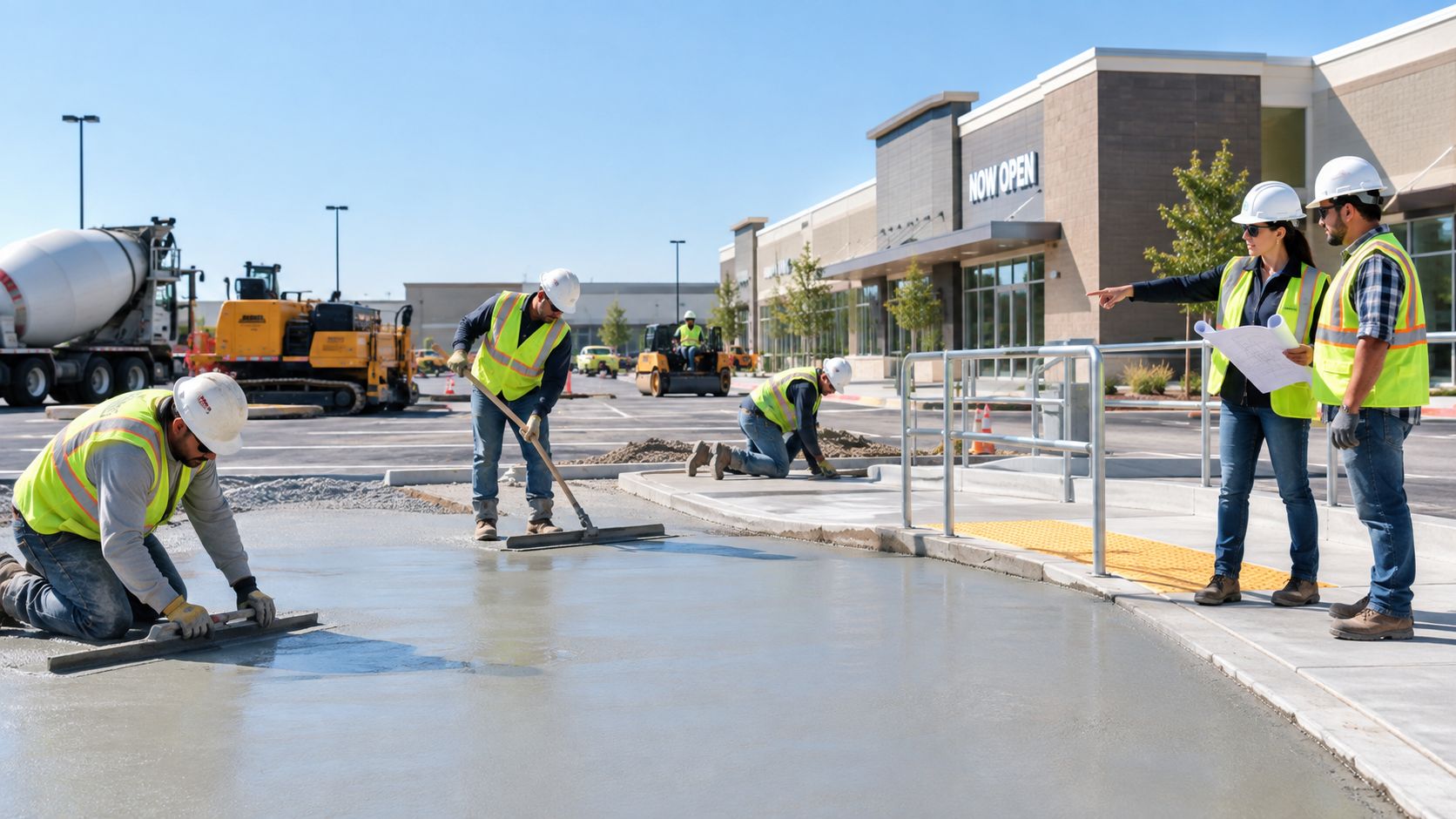
A property manager in Marion County can spend an entire morning staring at a cracked parking area, comparing three bids that don't seem to describe the same job. One quote covers removal and replacement. Another appears cheaper because it leaves base repair, access control, and final striping vague. The leasing team still expects the work finished before the next busy season, while tenants need safe access every day.
That's why hiring commercial concrete contractors isn't just a materials decision. It's a business-execution decision involving tenant access, ADA exposure, drainage, operating budgets, and the contractor's ability to coordinate crews around an occupied property. A capable team can sequence demolition, forming, placement, curing, asphalt maintenance, and striping without turning a retail center or office park into a permanent construction zone.
The market is broad and fragmented. U.S. concrete contractors were estimated at $110.1 billion in 2026, with 90,964 businesses, according to industry market data. That gives property owners plenty of options, but it also means qualifications and execution discipline vary sharply from one bidder to the next.
Table of Contents
- Why Hiring the Right Commercial Concrete Contractors Matters
- Services Commercial Concrete and Asphalt Contractors Should Offer
- Questions to Ask Before You Sign a Contract
- Comparing Bids Without Getting Burned
- ADA Compliance Triggers Property Managers Often Miss
- Central Florida Timelines, Weather, and Cost Factors
- Maintenance, Warranty, and a Practical Next Step
Why Hiring the Right Commercial Concrete Contractors Matters
The wrong crew can make a manageable repair expensive. Poor base preparation, weak forming, rushed finishing, or badly planned access routes often lead to cracked work, ponding, tenant complaints, and rework. A low initial price doesn't protect an operating budget if the property pays twice for demolition, replacement, and disruption.
The right contractor starts with the property's use, not just the square footage. A shopping center with active storefronts needs a different sequence from a vacant development site. A church, apartment complex, or HOA may need pedestrian routes preserved while crews remove damaged concrete, form new work, and keep vehicles moving.
Practical rule: If the bid doesn't explain how tenants, deliveries, pedestrians, and emergency access will be handled, the scope isn't complete.
Treat execution as part of the specification
A commercial concrete contractor should explain where work begins, how sections will be isolated, when concrete trucks can arrive, and how long new surfaces must remain protected. The plan should identify curing restrictions, temporary routes, haul-off, cleanup, and the point at which striping or pavement maintenance can follow.
Quality control also needs to be visible. A strong workflow includes a documented quality control plan, pre-pour review of materials and equipment, testing authority on site, and records that can be retrieved later. One state DOT specification requires a quality control plan at least 10 working days before related work, approval before placement, test and inspection records, and test data within 24 hours after testing or inspection, as summarized in commercial concrete quality guidance.
That doesn't mean every private project follows the same specification. It does mean property managers should expect a disciplined process. Ask who checks batch tickets, who controls sampling and testing, who can reject nonconforming concrete, and who documents corrective action.
Look beyond the pour
Commercial work competes with tenant schedules, deliveries, weather, utility conflicts, and access requirements. A contractor who only discusses the pour is leaving the hardest part out.
The decision framework is straightforward. Confirm the service match, test the contractor's answers, compare identical scopes, identify ADA triggers, plan around Central Florida weather, and establish maintenance and warranty responsibilities before signing. That approach protects the property long after the crew leaves.
Services Commercial Concrete and Asphalt Contractors Should Offer
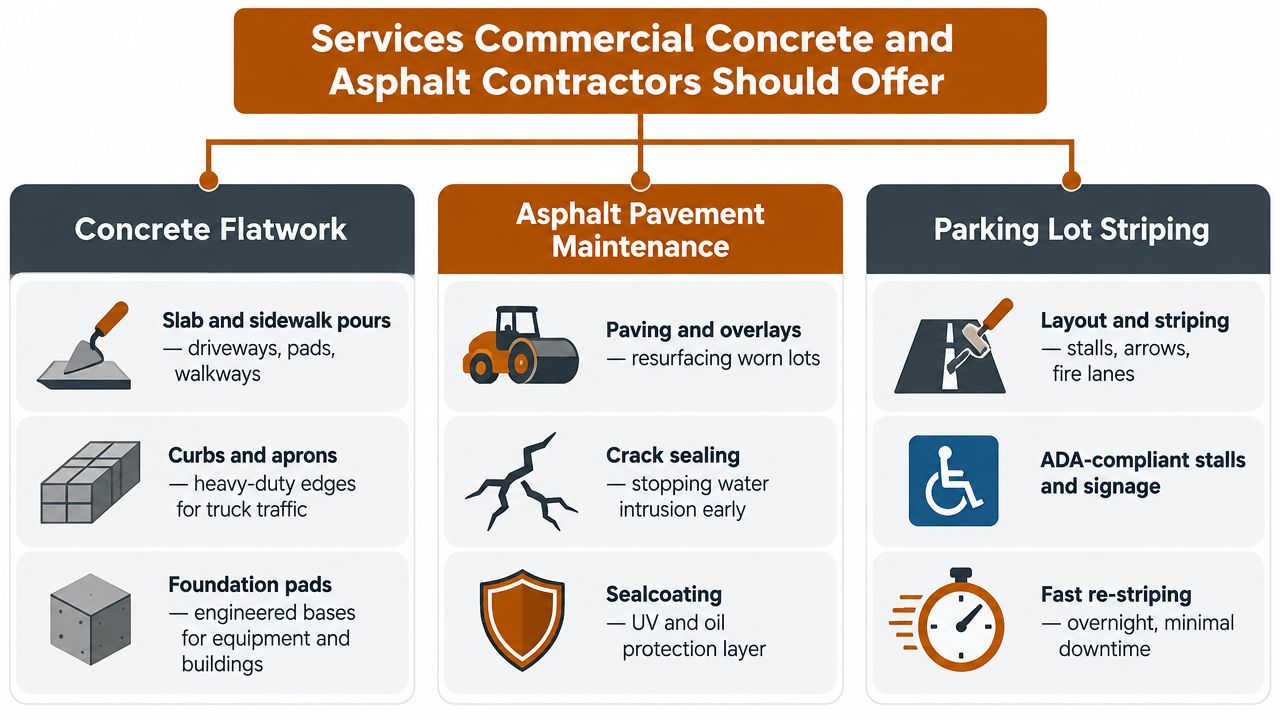
A qualified Central Florida contractor should be able to identify whether your property needs concrete construction, asphalt rehabilitation, preventive maintenance, or traffic-marking work. Those categories overlap, but they aren't interchangeable.
Concrete flatwork comes first when the failure involves a rigid surface or a structural support area. Typical commercial scopes include foundations, equipment pads, slabs, sidewalks, curbs, gutters, dumpster pads, dumpster enclosures, ADA ramps, loading areas, and concrete aprons. The contractor should address excavation, subgrade preparation, forms, reinforcement, placement, finishing, joints, curing, and restoration.
Match the repair to the surface
Asphalt problems require a different diagnosis. Patching may address isolated failures, while milling and overlay can make sense when the surface has widespread wear but a usable base. Full-depth replacement belongs on areas where the underlying structure has failed. Crack sealing and sealcoating are maintenance measures, not substitutes for rebuilding a saturated or unstable section.
For pavement and flatwork, the base deserves as much attention as the visible surface. Guidance for interlocking concrete pavement recommends at least 98% Proctor density for pedestrian areas and residential driveways and at least 98% modified Proctor density under constant vehicular traffic, with aggregate base lifts typically 4 to 6 inches, according to pavement preparation guidance. Commercial specifications may differ, but the principle remains firm: compaction and placement controls are primary quality gates.
Keep striping as its own specialty
Parking lot striping involves more than painting lines. A proper layout may include stalls, accessible spaces, access aisles, fire lanes, directional arrows, stop bars, wheel stops, speed bumps, loading zones, and signs. The layout must work with pedestrian routes and vehicle circulation, not merely look clean from the entrance.
This distinction matters in Marion County, FL and Citrus County, FL, where a property may combine older concrete sidewalks, asphalt parking areas, replacement curbs, and new tenant improvements. A contractor that offers both concrete and asphalt services can coordinate the interfaces instead of leaving one trade to repair another trade's work.
The major U.S. contractors show how specialized the field has become. In a 2023 ranking, Baker Construction Enterprises reported $1.65 billion in revenue and Lithko Contracting reported $1.35 billion, while several other major firms reported revenue between roughly $588 million and $685 million, according to the historical contractor market overview. Local property managers don't need a national builder for every job, but they do need a contractor with the right capabilities for the site.
Questions to Ask Before You Sign a Contract
Start with licensing. Ask for the contractor's Florida license information and confirm that the license matches the work being proposed. Then ask whether the company carries general liability and workers' compensation insurance, and request current certificates rather than accepting a verbal assurance.
Follow up with a direct question: Who is performing the work? Ask how many field employees are assigned, which activities are handled in-house, and which trades are subcontracted. Subcontracting isn't automatically a problem. The problem is not knowing who controls the schedule, safety, quality, and warranty once multiple crews arrive.
Test the experience claim
Ask for recent comparable work in Marion County, FL or Citrus County, FL. “We've done commercial work” is too broad to be useful. Ask whether the examples involved occupied retail, apartment, church, office, or HOA properties, and ask what access restrictions the crew managed.
Then ask a technical follow-up tied to your project. If the proposal calls for a structural or load-bearing slab, ask what specified strength and mix design were used on a comparable slab. If the contractor can't explain the mix, reinforcement, curing method, or testing process in plain language, the bid may have been assembled without enough field knowledge.
For a more detailed screening list, use these questions to ask a concrete contractor. The point isn't to demand a particular answer to every technical question. It's to see whether the contractor responds clearly, documents the answer, and knows when an engineer or testing laboratory must be involved.
Ask for quality records before placement
Request the proposed quality control process in writing. It should identify material verification, pre-pour checks, testing responsibility, joint layout, curing, inspection points, and documentation. Ask who has authority to stop placement if the concrete, forms, reinforcement, or site conditions don't match the approved scope.
References deserve the same treatment. Ask for a property contact and a location you can verify, not only polished photographs. Ask the reference whether the contractor showed up when promised, handled changes fairly, protected access, and returned to address punch-list work.
The contractor's behavior during bidding matters. A responsive bidder who says, “I need to verify that,” is safer than one who answers every question instantly but provides no documentation. Good commercial work depends on accurate communication before the first truck arrives.
Comparing Bids Without Getting Burned
A side-by-side bid comparison only works when every bidder prices the same scope. Commercial concrete proposals often look similar at the top while hiding major differences in preparation, thickness, reinforcement, restoration, and exclusions.
Give each bidder a one-page matrix and require the same response format.
| Scope Line Item | Bidder A | Bidder B | Bidder C |
|---|---|---|---|
| Square footage and concrete thickness | |||
| Mix design and specified strength | |||
| Base preparation and compaction | |||
| Demolition and haul-off | |||
| Reinforcement and dowels | |||
| Joint layout and sealant | |||
| Curing method and protection | |||
| ADA stalls, aisles, signs, and route work | |||
| Mobilization, traffic control, and cleanup | |||
| Weather, utility, permit, and restoration exclusions |
Find the missing work
The cheapest bid often becomes cheaper by omitting work rather than reducing waste. Look for skipped subgrade compaction, thinner slabs on grade, unspecified reinforcement, omitted sealers, unclear joint treatment, and vague language around replacing landscaping or damaged adjacent pavement.
Ask each bidder to state the concrete thickness, base depth, reinforcement, joint pattern, curing method, and testing responsibility. Ask whether demolition includes loading, hauling, disposal fees, and cleanup. If an item is necessary for a functioning finished surface, it shouldn't be hidden under “by others.”
Asphalt proposals need the same discipline. Separate patching, milling, overlay, full-depth replacement, crack sealing, sealcoating, and striping. A sealcoat price can't be compared fairly with a structural repair price, and a fresh surface won't correct a failed base.
Make schedule risk visible
Weather delays, utility locates, permit fees, traffic control, and after-hours access should appear as explicit assumptions. The bid should identify who pays for rain-day standby, who coordinates utility verification, and what happens if tenants can't release an area on the planned date.
A professional proposal also explains restoration. That includes damaged curbs, sidewalk connections, wheel stops, signs, landscaping edges, drainage inlets, and pavement markings. Price differences become understandable once the scope is identical. Until then, the lowest number is only the lowest number on paper.
ADA Compliance Triggers Property Managers Often Miss
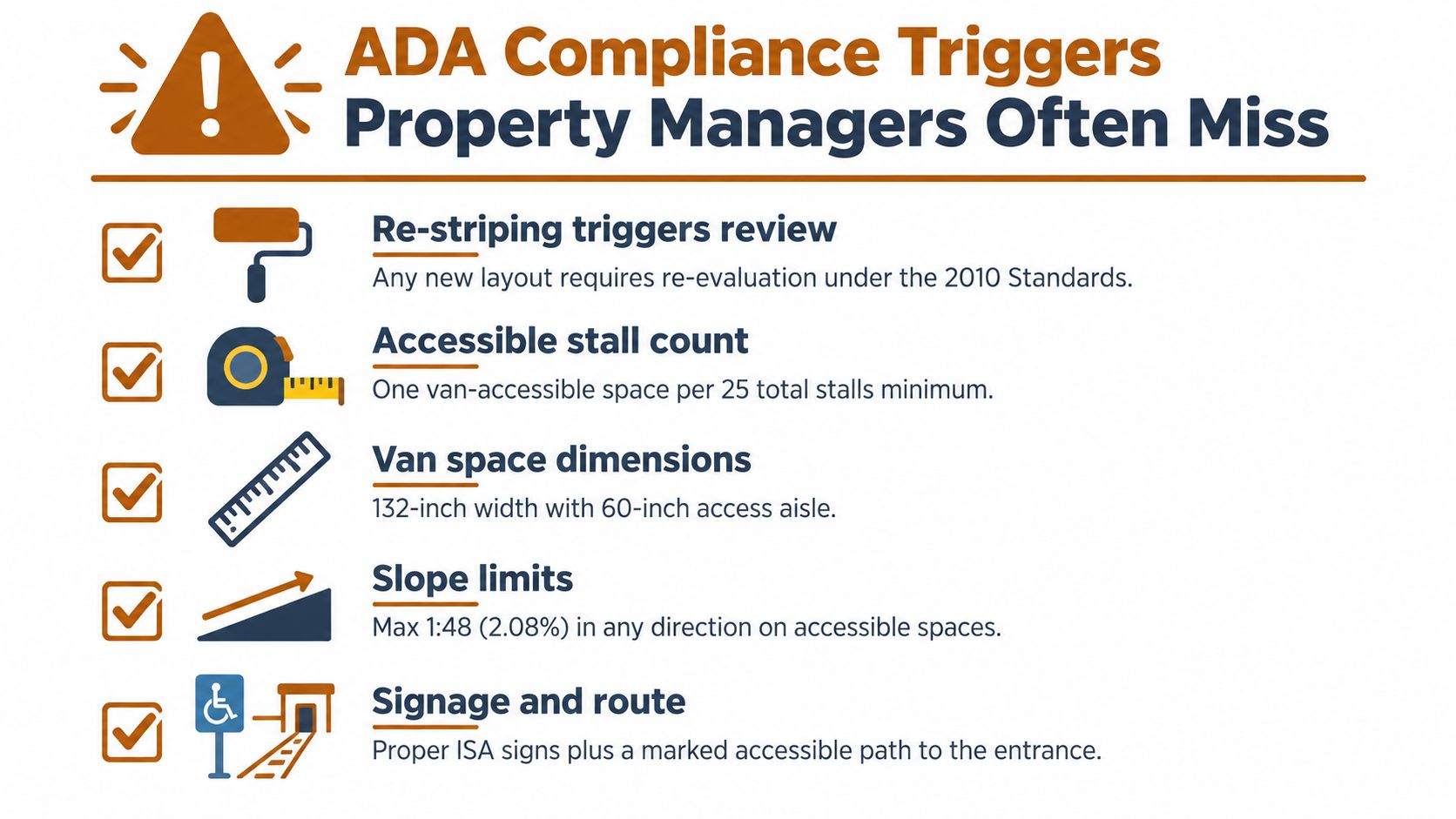
A restriping job can become an accessibility project before the paint truck arrives. When a business or government entity restripes parking spaces in an existing lot or garage, the accessible spaces must comply with the 2010 ADA Standards for Accessible Design, according to the U.S. Access Board restriping guidance. Treat the work as a layout and access decision, not a cosmetic refresh.
Review stall counts, van access, access aisles, slopes, curb transitions, signs, sidewalks, and the route to the building entrance. Use these ADA parking lot striping requirements to check the layout before crews mobilize. In an occupied retail center, phase the work so customers, tenants, and accessible routes remain usable throughout the project.
Check geometry before the paint truck arrives
Florida parking-lot compliance materials commonly identify a standard accessible stall as 96 inches wide with a 60-inch access aisle. Van-accessible spaces require a larger configuration, and at least one in every six accessible spaces must be van-accessible, according to Florida ADA parking guidance.
The same guidance identifies a maximum slope of 1:48, or about 2.08%, for the accessible space and access aisle. Striping cannot correct a settled base or a sloped pavement section. The concrete or asphalt scope may need to include leveling, curb work, drainage correction, or route repairs before markings can serve their purpose.
Signs require the same attention. Accessible parking signs must display the International Symbol of Accessibility and sit at least 60 inches above the ground to the bottom edge, as described in ADA parking and signage guidance. A sign blocked by a vehicle or mounted too low creates a compliance problem, not a minor appearance defect.
Inspect the route, not just the stall
Check for abrupt level changes, blocked aisles, ponding, damaged sidewalks, and curb transitions that fail to provide a usable path. Truncated dome detectable warnings may apply at flush curb transitions, so review concrete, drainage, and striping together.
Curb replacement, sidewalk widening, or utility pad relocation can change the path of travel even when the original work order says maintenance. Noncompliance can lead to federal complaint-driven investigations, attorney fees, and difficult disclosures during a sale or ownership transition. In HOA and retail portfolios, one flawed layout standard can spread across multiple properties.
Central Florida Timelines, Weather, and Cost Factors
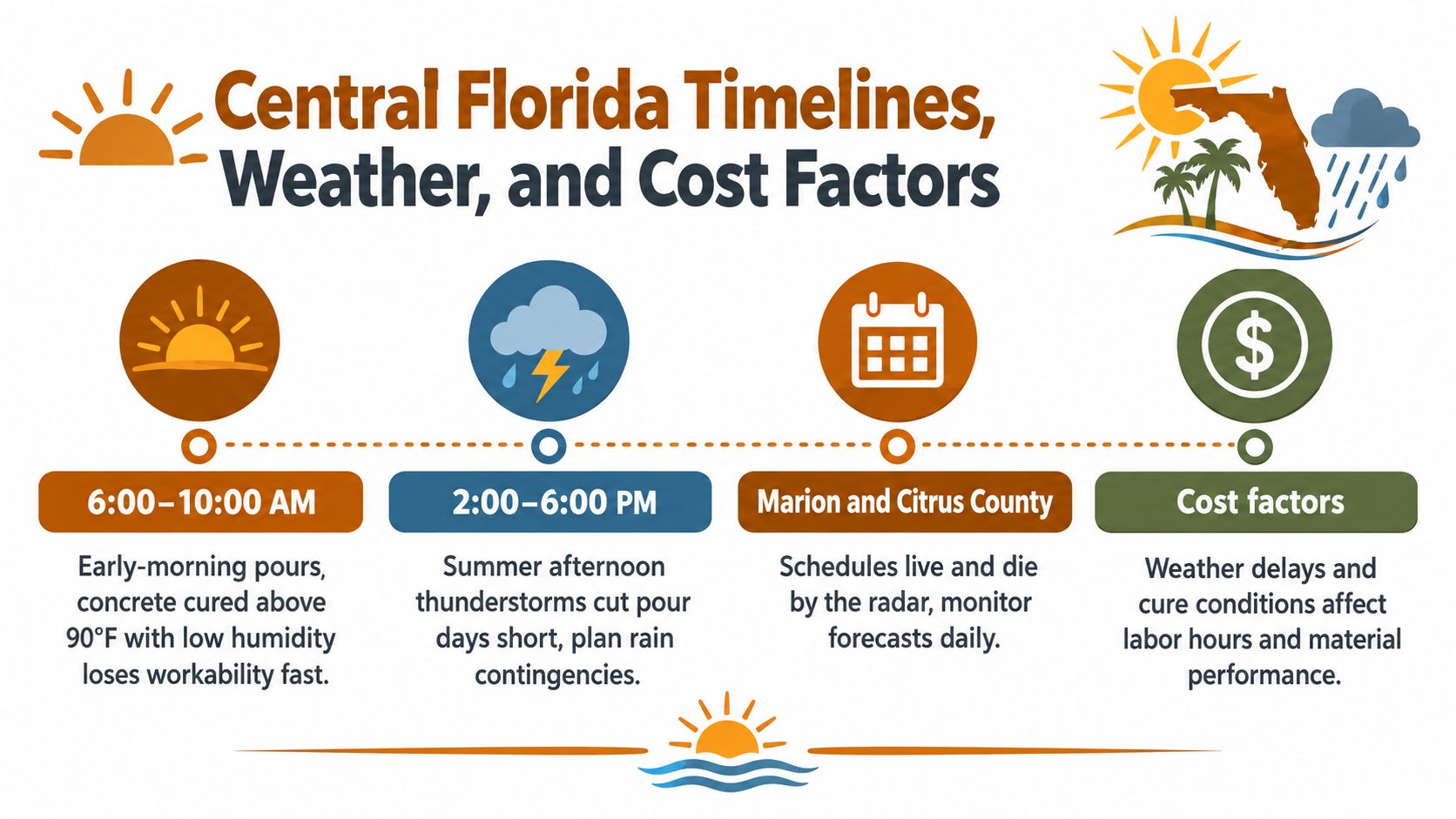
Central Florida schedules live by the radar. A pour planned for the afternoon can become a cancellation when summer thunderstorms arrive, and a completed surface can suffer if crews place, finish, and cure without accounting for heat, humidity, wind, and direct sun.
Concrete cured above 90°F with low humidity can lose workability quickly, according to the project weather guidance represented in the timeline below. Early-morning placement, shade, water management, or approved admixtures may be needed to keep the placement under control. The contractor should explain the weather contingency before the pour date, not after the truck is loaded.
Schedule for performance, not convenience
A 4,000 psi slab should have at least 7 days before vehicle traffic, while new asphalt should wait 30 days before sealcoating and 90 or more days before full friction cure, according to the supplied project timing guidance. These are scheduling benchmarks, not permission to open a surface without confirming actual conditions and project specifications.
Asphalt also takes a beating from Central Florida UV exposure, oil, rain, and turning traffic. Sealers can break down faster than a northern property manager expects, especially where vehicles brake, queue, and turn repeatedly. Rain can also expose weak edges and allow water to reach compromised areas.
Weather affects cost through standby labor, hot-weather admixtures, protection, rescheduling, and premium scheduling during the drier November-to-February window. Peak hurricane season can also increase insurance and bonding pressure for contractors. Put weather allowances and postponement rules in writing.
A reliable schedule includes a rain plan, an access plan, a curing plan, and a communication plan.
Review radar and forecasts daily during active work. Use the drier winter window for projects that need dependable access, but bid early because qualified crews and material suppliers may have tighter availability. Use summer for flexible scopes only when the contractor has a clear storm contingency.
For property managers who need a practical reference, this guide to how long concrete takes to cure helps separate curing requirements from the date someone wants to reopen the drive lane.
Maintenance, Warranty, and a Practical Next Step
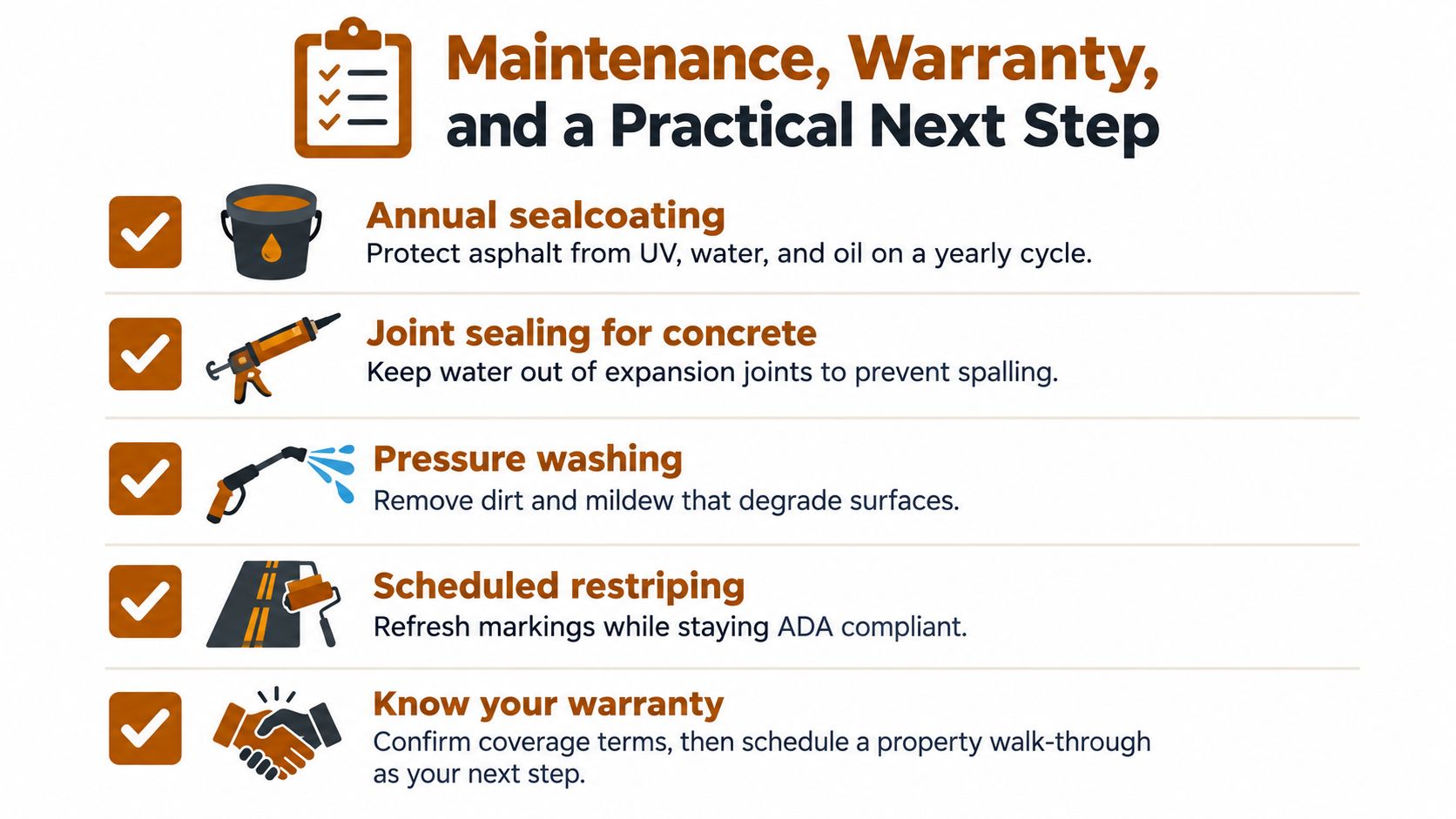
A commercial surface should enter service with a maintenance plan, not disappear from the budget until it fails. Asphalt benefits from a regular sealcoating cycle, timely crack sealing, and prompt repair of areas where water enters. Concrete needs joint review, pressure washing, drainage checks, and attention to spalling, settlement, and trip hazards.
Catch basins deserve inspection before the heavy storm season. A blocked inlet can turn a small drainage problem into standing water, edge erosion, or repeated pavement failure. Parking markings should be reviewed during property walks so faded accessible symbols, fire lanes, directional arrows, and stop bars are corrected before they confuse drivers.
Save this site-walk checklist
- Surface condition: Photograph cracks, settlement, ponding, spalling, raveling, and damaged edges.
- Drainage: Check catch basins, gutters, curb lines, and low areas before storm season.
- Access and safety: Walk accessible routes, aisles, ramps, crossings, fire lanes, and loading areas.
- Markings: Review stalls, access aisles, signs, arrows, wheel stops, speed bumps, and stop bars.
- Documentation: Record repairs, invoices, test results, warranties, photographs, and contractor contacts.
A defensible warranty should state the term in writing and separate workmanship coverage from material coverage. It should identify exclusions for owner neglect, standing water, misuse, third-party damage, and delayed maintenance. Ask whether the contractor provides a one-year walkthrough, what punch-list process applies, and who evaluates a disputed failure.
Make the next decision specific
Request three site visits, not three mail-in prices. Give each contractor the same plans, photos, access restrictions, operating hours, and ADA concerns. Then verify licensing, insurance, comparable local work, quality documentation, scope exclusions, and the person responsible for jobsite decisions.
This approach works for retail centers in Ocala and The Villages, churches in Dunnellon and Belleview, HOA properties in Summerfield and Silver Springs, and commercial sites serving Crystal River, Homosassa, Inverness, Lecanto, Beverly Hills, and Hernando. The same principle applies across Marion County, FL and Citrus County, FL: concrete and asphalt maintenance is asset management, not a one-time transaction.
Riverside Sealing & Striping, LLC provides commercial concrete work, asphalt sealcoating, parking lot striping, and ADA-focused layout improvements for properties across Marion and Citrus counties, with free, no-pressure on-site consultations and estimates. If your property needs a scope review, maintenance plan, or coordinated concrete and pavement evaluation, visit Riverside Sealing & Striping, LLC to request a practical next step.