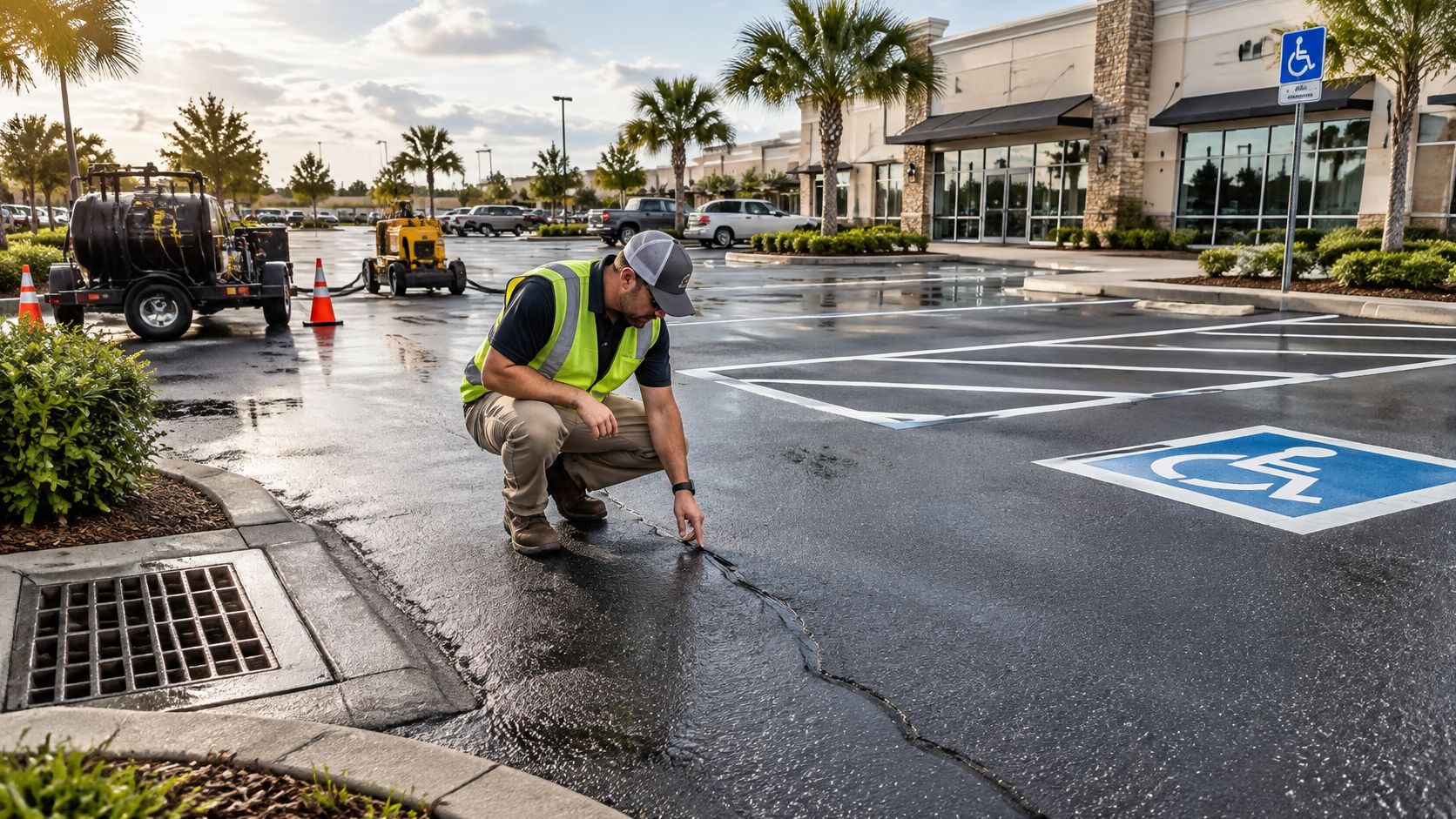
You walked the lot after a hard afternoon storm and the drive lane still holds water. A pothole sits by the cart return, stall lines have gone gray, and the accessible aisle is hard to read. That mix is what commercial parking lot maintenance is for property managers in Marion County, FL and Citrus County, FL. It isn't a cosmetic coat of sealer.
Heat, UV, and sudden rain work on both the asphalt and the concrete walks that connect stalls to the door. A cheap coat on a wet or failed base locks the problem in. I would start with drainage and a usable route, then preserve only the pavement that is still sound.
This 2026 guide covers a written plan you can run: survey first, match the treatment to the condition, and check accessible space counts before any paint goes down.
Table of Contents
- Why Central Florida Lots Need a Written Plan
- How to Survey the Lot Before You Spend
- A Maintenance Schedule You Can Run This Year
- Crack Sealing Sealcoating and Replacement Triggers
- ADA Space Counts and Striping Checks
- Florida Weather Questions Property Managers Still Ask
- Book a Lot Evaluation Before the Next Restripe
Why Central Florida Lots Need a Written Plan
Say Sunday service just let out in Crystal River, or the Saturday rush hit a retail center in Ocala. Rain still sits in the drive lane. Shoppers step around a pothole near the cart return. Stall lines have faded to gray, and the accessible aisle no longer reads as a clear path. Staff in Dunnellon and Inverness see the same pattern, and so do boards around The Villages.
That scene is commercial parking lot maintenance, not a touch-up. Property managers, HOA boards, churches, schools, and investors are keeping asphalt, concrete walks, drainage, and accessible routes working for shoppers, tenants, and staff.
Four outcomes a written plan should hit
A plan you can run this year has four jobs.
Catch defects early. A short crack or a settled concrete panel is cheaper to mark and fix than a lane that has already broken apart.
Keep water out of the base. Once rain reaches the aggregate under the mat, traffic finishes the failure. A clogged inlet and a leaf-filled swale do that faster than cars alone.
Keep markings and accessible spaces usable. Faded lines and a blocked aisle fail people even when the stall count looks fine on paper.
Spend on preservation only while the surface is still fair to good. A sealer on sound, gray asphalt slows aging. The same sealer on a failed base buys a repeat repair.
Practical rule: A calendar date never overrides a failed base or a blocked accessible route.
Who carries the plan
If you manage a shopping center, a church lot, a school drop-off, or an HOA common area, name one person who owns the walk and one folder where the photos live. Concrete and asphalt age on the same site. Treating them as separate jobs is how fresh paint lands on a walk that no longer reaches the door.
I wouldn't approve a seal date until someone has walked the inlets and the route from the stalls to the entrance. The survey, the treatment choice, and the space-count check come before a crew shows up with paint.
How to Survey the Lot Before You Spend
A useful survey is a numbered walk, not a glance from the car. The Federal Highway Administration pavement maintenance publications treat crack sealing, drainage, and preservation as separate jobs, and they support a condition-based program rather than a date on a calendar. Do a formal survey at least once a year, walk again after a severe storm, and have staff do a short look in between. On a Homosassa retail pad or a Lecanto office lot, that short look can be a weekly loop by the same person who already checks lights and trash.
The walk, in order
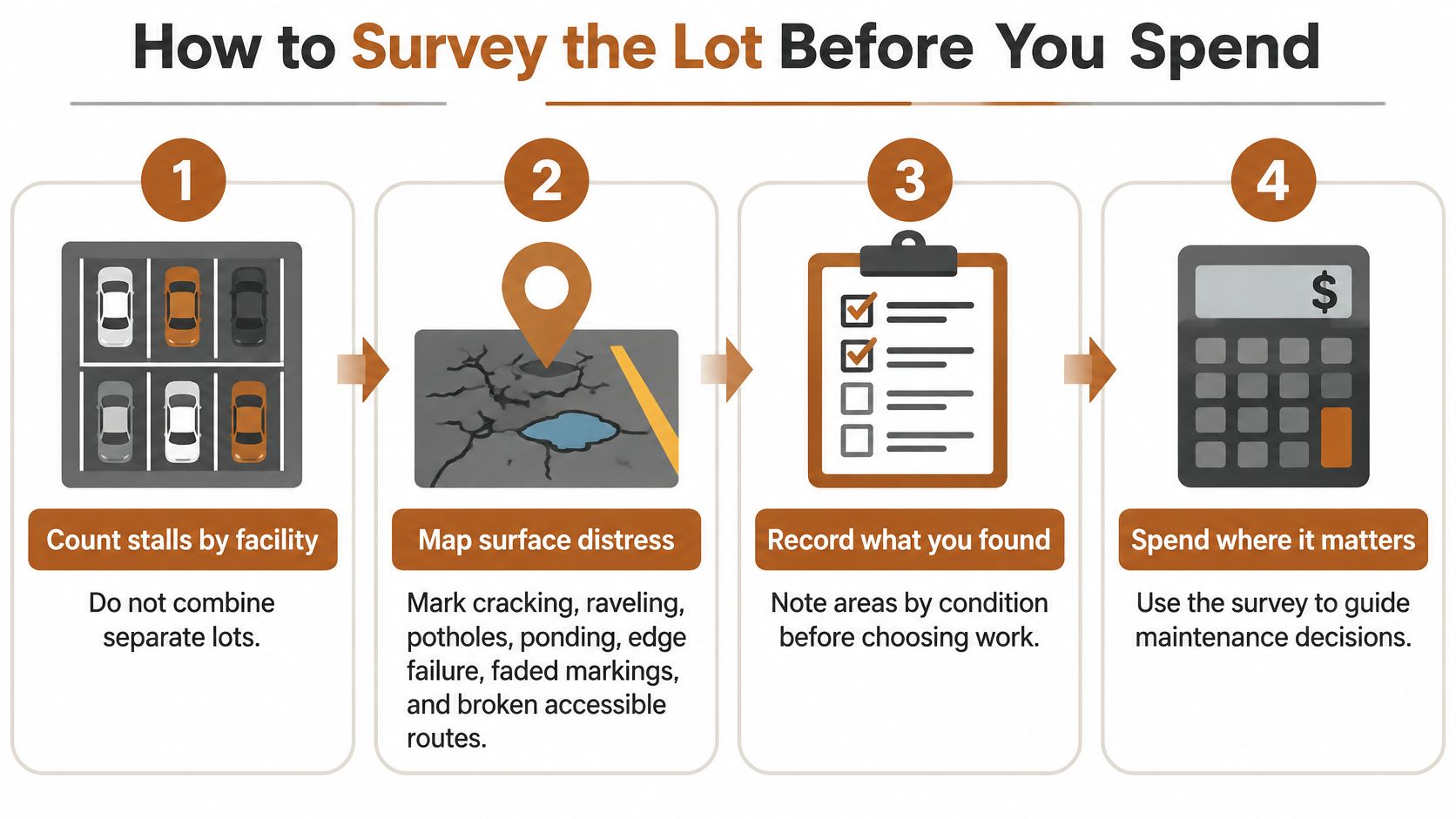
- Count stalls by facility. Each lot or garage stands on its own. Combining two lots into one total hides a short count on the smaller one. The miss is a single site spreadsheet that never names which facility the stalls belong to.
- Map the surface. Mark cracking, raveling, potholes, ponding, edge failure, faded markings, and broken accessible routes. Photograph each one and note a simple location, such as "north of the cart return." The miss is a verbal "it's bad by the entrance" with no photo.
- Rank what you found. Sort by safety first, then by water reaching the base, then by whether the defect is local or spread across a lane. Surface treatments can't make up for a saturated base, active movement, or widespread structural failure, so drainage and failed pavement come before any preservation coat.
- Check inlets, swales, and curb lines. If water is still standing after a normal rain, that area is a drainage investigation, not another sealcoat panel. The miss is circling the puddle as "needs sealer."
- Note oil spots, damp pavement, and cracks that move or pump fines. Those spots will reject a coat or reopen a fill. The miss is sealing them because they're on the way.
- Walk the concrete route from the accessible stalls to the door. Flag wide cracks, loose surface, heaved panels, and a steep cross-slope. The miss is rating only the asphalt.
- Write the acceptance file before you spend. Record weather and moisture, repaired area, crack locations, drainage notes, treatment coverage, and after photos. That file is what lets you see a defect return in the same lane.
How the list should leave your desk
Sort every item into do now, preserve, or rebuild. Do-now items are safety hazards, open routes that don't reach the door, and water in the base. Preserve items are stable cracks and a tight, gray surface. Rebuild items are lanes that have already failed.
Three pitfalls waste the visit: coating damp or oily pavement, sealing active structural cracks, and restriping without measuring stall geometry. A documented pavement management system keeps those notes in one place so the next bid prices the repair you need.
A Maintenance Schedule You Can Run This Year
Treat the rows below as a starting plan for fair-to-good asphalt, not a promise. Put each row on the property calendar with a named owner and a month. Then use the survey to move a task or to skip it.
| Task | Starting interval | Move it earlier when | Do not proceed if |
|---|---|---|---|
| Condition survey | At least yearly plus after severe storms | Repeat ponding or heavy truck traffic | Inlets and prior repairs cannot be located |
| Crack sealing or filling | When cracks are open and stable | New cracks open after summer rain | Cracks are moving, wet, or show base failure |
| Sealcoating | About every 2 to 4 years if fair to good | Surface grays fast under full sun | Pavement is damp, oily, failed, or still ponding |
| Line striping and symbols | About 2 to 3 years busy, 4 to 5 years light | Lines fade or circulation changes | Accessible count, width, slope, or route is wrong |
| Concrete walks and accessible routes | With every asphalt survey | Trip edges, settlement, or steep cross-slope | The route no longer reaches the entrance |
| Drainage cleaning | Quarterly and after storms | Sand, leaves, or landscape debris in inlets | Water remains after ordinary rain |
How to use the rows
The Parking Lot Maintenance planning paper describes pavement management as a systematic process that weighs current and future condition, rehabilitation choices, funding, priorities, and target service life. Market research in that planning literature claims heavy-use facilities may repaint every two to three years, while lower-traffic facilities may wait four to five years. Those figures are estimates, not rules. Your survey sets the date.
Move a row earlier when truck loading is heavy, ponding repeats in the same low spot, or accessible markings have faded past the point where a driver can follow them. A dumpster lane and a delivery apron age faster than the outer stalls. Seasonal traffic at a church or a school can do the same thing in a shorter burst.
Skip sealcoating when the base has failed. Alligator cracking, rutting, or a pothole that returns in the same spot means the cheap coat is the wrong spend. Crack filling and a clear inlet still belong on the calendar, because delaying those low-cost repairs lets water keep working.
What Central Florida adds to the calendar
Intense rain, standing water, sweeping, landscaping, and seasonal traffic change how often you look, even when the seal interval stays put. Sand and leaves off lots in Belleview and Summerfield clog inlets between quarterly cleanings. A walk after a hard storm is part of the plan, not an extra.
Crack sealing follows open, stable cracks, and in this climate that work usually wants to land before the summer rains. Concrete sidewalks and accessible routes get checked on the same walk as the asphalt, because a new stripe over a broken panel doesn't give anyone a usable path.
Assign the survey to the property manager, drainage cleaning to maintenance or a vendor who will remove debris from the inlet, and seal, stripe, and concrete repair to the paving contractor. Write the month next to the name. A plan without an owner becomes a quote you meant to request.
Crack Sealing Sealcoating and Replacement Triggers
Match the treatment to what you can see. The wrong visit looks cheap on the bid and fails in the same season.
| What you see | Fitting action | Why the alternative fails |
|---|---|---|
| Tight pavement, gray color, stable hairline cracks | Crack fill then sealcoat | Waiting lets water and UV open the mat |
| Isolated pothole, sound surrounding mat | Patch, then seal the area | Sealer over an open hole will not bridge it |
| Oil and fuel stains | Clean or remove the spot before sealing | Contamination blocks adhesion |
| Moving cracks, pumping fines, or wet cracks | Repair the base or crack structure first | Filling an active crack reopens |
| Alligator cracking, rutting, or repeat potholes | Mill and overlay or replace | Preservation does not fix a failed base |
| Faded lines on sound, dry pavement | Layout check, then stripe | New paint on bad geometry stays wrong |
| Ponding after a normal rain | Clear or rebuild drainage before any coat | Water under a sealer accelerates failure |
The rule behind the table
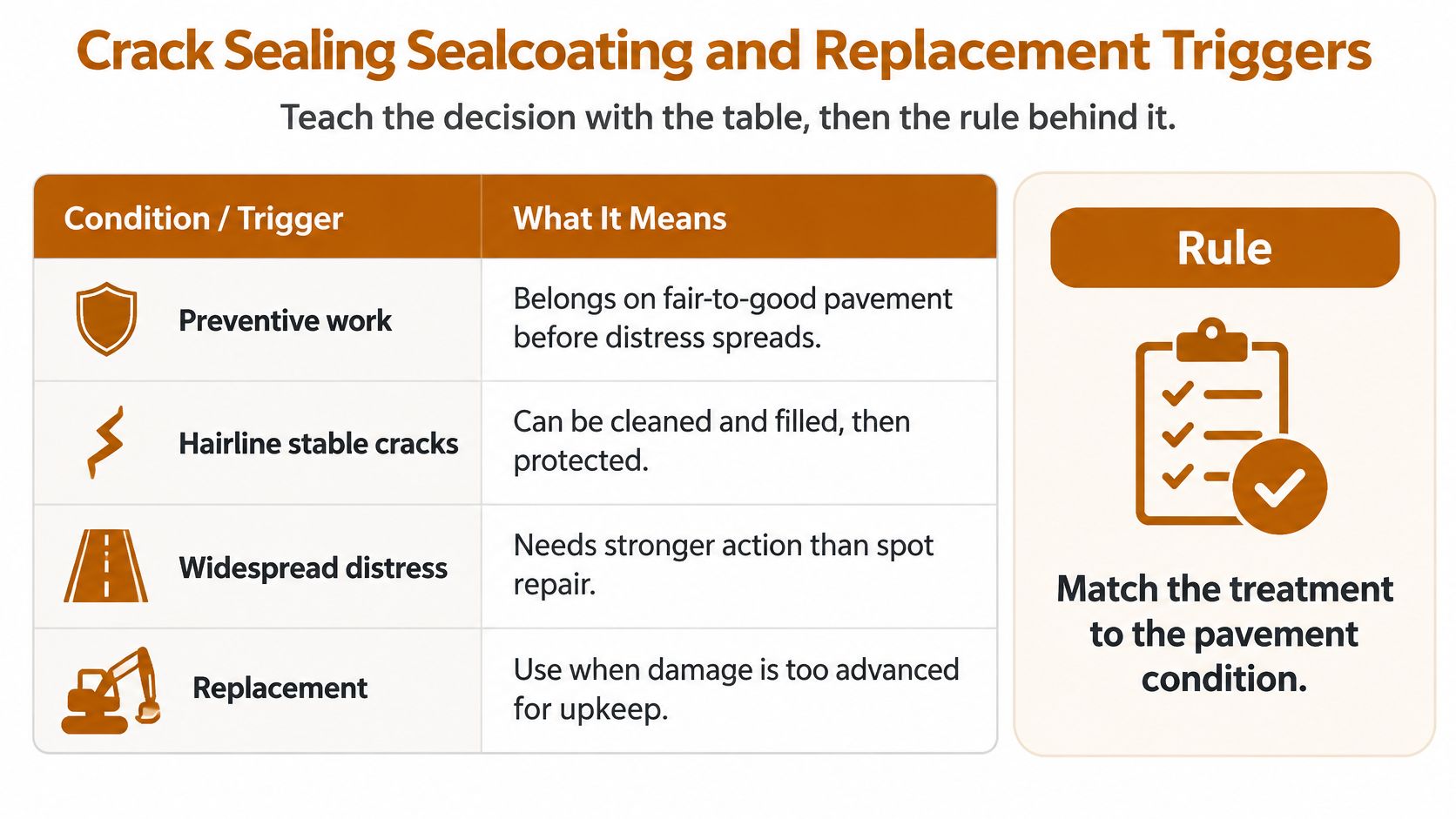
Federal Highway Administration guidance defines preventive pavement maintenance as a treatment applied while pavement remains in fair-to-good condition, generally before significant distress occurs and spreads. Preservation is meant to slow deterioration. It isn't a repair for advanced structural failure. Once widespread cracking, potholes, or base-related damage has developed, you need corrective work, not another surface coat. A documented inspection is what tells you which side of that line the lot is on.
Hairline cracks that are stable can be cleaned and filled, then protected. Sealcoating on that sound mat blocks water, UV, and oil staining. An isolated pothole gets a sound patch first. Oil-soaked spots need cleaning or removal, or the sealer won't bond. Cracks that widen, pump fines, or stay wet aren't sealcoating candidates. Faded lines on sound pavement are a striping job, not a reason to coat a failed lot.
One drive lane, two treatments
Say the lane in front of an anchor store ponds and ruts, while the outer stalls are still tight and only gray. Rebuild that drive lane. Seal the outer stalls after the repairs have cured. Coating the whole lot in one pass hides the bad lane for a few weeks and sends the same water back into the base.
Budget by condition stage, not by the month on a flyer. Crack filling and drain clearing are the lowest-cost lines, and they protect the base. Sealcoating is the mid-cost preservation line. Mill-and-overlay or replacement is the capital line, reserved for failed lanes. Keep a yearly reserve for preservation and a multi-year capital line for rehabilitation. Review that split at each survey so a lot moves from preservation to rehabilitation before failed areas spread across the next bay. A low bid on a failed base usually buys a repeat failure within a season. Parking lot crack sealing belongs on the open, stable cracks, after drainage is working and before any coat goes down.
ADA Space Counts and Striping Checks
Restriping is a compliance event, not a cosmetic repaint. When a business or public entity restripes a parking facility, the ADA restriping guidance says it must provide accessible parking spaces as required by the 2010 ADA Standards for Accessible Design. Count each parking facility separately. A property with two lots can't meet the rule by averaging them into one site total.
| Total spaces in that facility | Minimum accessible spaces | Van-accessible spaces |
|---|---|---|
| 1 to 25 | 1 | 1 |
| 26 to 50 | 2 | 1 |
| 51 to 75 | 3 | 1 |
| 76 to 100 | 4 | 1 |
| 101 to 150 | 5 | 1 |
| 151 to 200 | 6 | 1 |
| 201 to 300 | 7 | 2 |
| 301 to 400 | 8 | 2 |
| 401 to 500 | 9 | 2 |
| 501 to 1,000 | 2 percent of total | At least 1 of every 6, rounding up |
| Over 1,000 | 20 plus 1 per 100, or fraction, above 1,000 | At least 1 of every 6, rounding up |
That schedule is the federal minimum. For 501 to 1,000 spaces, accessible spaces equal 2% of total capacity. Above 1,000, the minimum is 20 spaces plus 1 more for every 100 spaces, or fraction thereof, over 1,000. At least 1 of every 6 accessible spaces must be van accessible.
What the crew measures before paint
An accessible car space must be at least 96 inches wide, with an access aisle at least 60 inches wide. The surface must be firm, stable, slip-resistant, and no steeper than a 1:48 slope, about 2.08%, in any direction.
Van layout is a separate check. ADA standards guidance requires at least one of every six accessible spaces, or fraction of six, to be van accessible. Eight required accessible spaces means at least two van spaces. A van space may be at least 132 inches wide with a 60-inch aisle, or at least 96 inches wide with a 96-inch aisle. The van space, the aisle, and the vehicle route need at least 98 inches of vertical clearance, including at a garage entry or under a canopy.
Aisles run the full length of the space, join an accessible route, and are hatched so people don't park in them. The route is the shortest accessible path to an entrance. Curbs, landscaping, wide cracks, and settled concrete break it even when the stall count is right.
Paint only after the layout is true
Repair pavement and drainage first. Set control lines. Paint accessible symbols, stall lines, arrows, stop bars, and hatch-marked aisles. Install the signs. Then check with a tape and a level.
Say a lot in Beverly Hills or Silver Springs is due for new lines and the old van stall is short. Add the van space and a short concrete walk rather than painting the old layout again. Keep a dimensioned sketch and photos. Our ADA parking lot striping work starts from that measured layout, not from the faded lines already on the ground.
Florida Weather Questions Property Managers Still Ask
Managers in Marion County and Citrus County ask the same four questions every spring. The answers come back to condition, not to a fixed month.
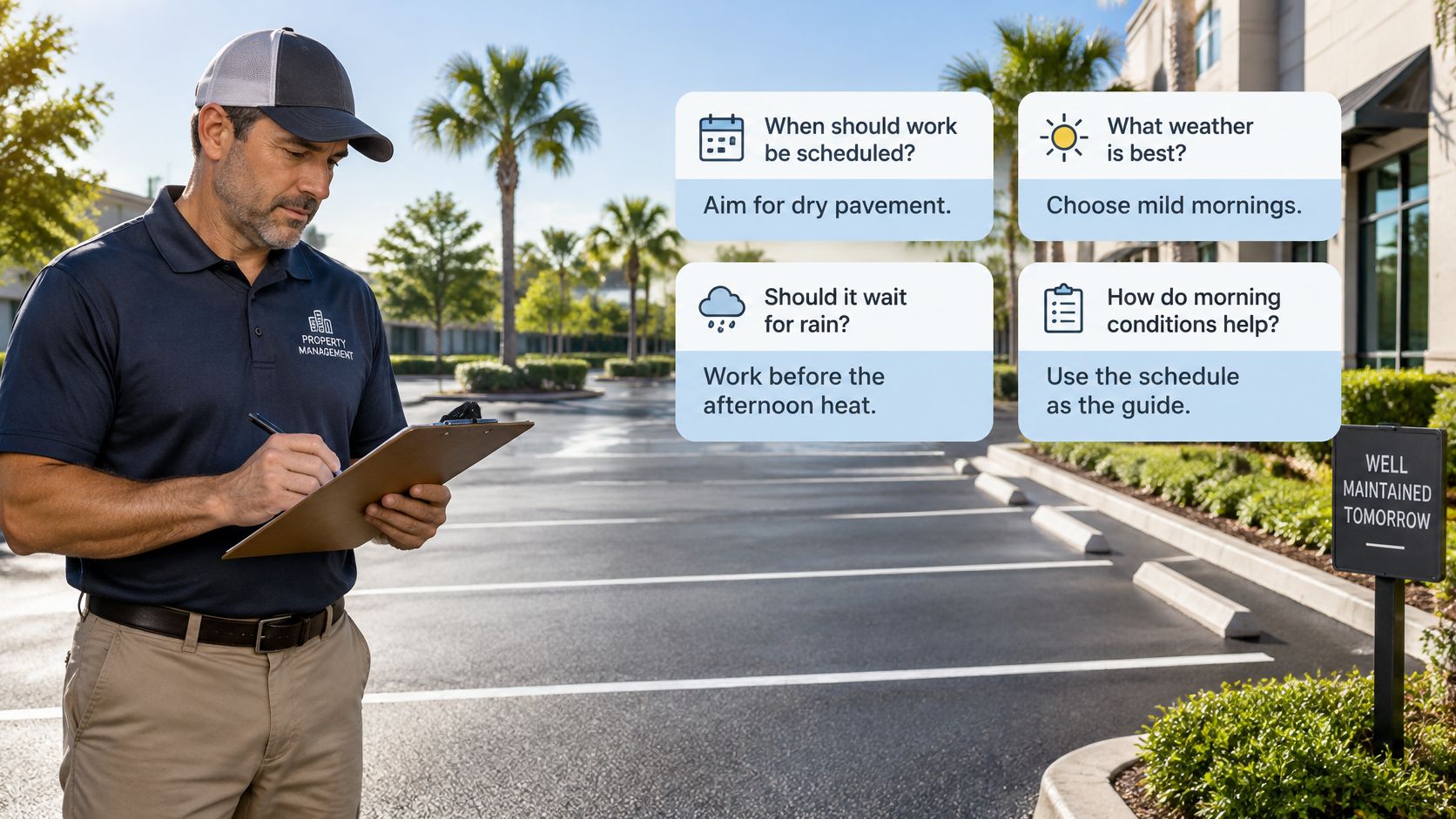
When should the work be scheduled?
Aim for dry pavement, a mild morning, and a window before the afternoon storm. Don't coat after rain or over a damp base. South-facing stalls in Ocala and Crystal River gray faster under full sun, so a sound lot there often wants preservation sooner than a shaded office court. Heat doesn't change the stop rule. If the mat is failed, wait for the rebuild, not for a hotter day.
What does standing water mean?
It means the water isn't leaving. In Hernando, Belleview, and The Villages, soil and mulch wash toward inlets and hold a sheet of water in the drive lane after an ordinary rain. Clear the throat of the inlet, check the swale, and look at the grade before anyone talks about sealer. A coat over that film traps moisture against the mat.
Does new paint fix an accessible route?
No. New symbols on a broken concrete walk, a steep cross-slope, or a route blocked by a curb still leave the space unusable. Paint is the last step, after the path from the stall to the door is firm and connected.
Should concrete and asphalt be bid together?
Yes, when the accessible path crosses both. A new sidewalk, a slip-resistant surface, and a corrected stall layout belong in one closure so you don't stripe a lot and then tear up the walk a month later. Shopping centers and churches planning a phased capital job should map ponding, slopes, catch basins, accessible routes, and any future charger locations before resurfacing. Adding markings or equipment on top of a wet path makes the next project harder, not easier.
A short field walk on video is a useful way to brief a board that can't all be on site the same morning.
Preservation slows aging only while the lot is still fair to good.
Book a Lot Evaluation Before the Next Restripe
Survey the lot. Fix drainage and failed pavement. Then seal only sound asphalt, and stripe to a measured accessible layout with a usable concrete route.
Bring in a local crew when you see repeat ponding, structural cracking, an upcoming restripe, uncertain stall counts, or walks that no longer connect accessible stalls to the door. Many retail centers in Marion County and churches in Citrus County need asphalt and concrete in the same project, so one evaluation can cover a sealed, striped lot and repaired walks.
Riverside Sealing & Striping, LLC is a licensed and insured concrete and asphalt contractor serving Marion County, Citrus County, and nearby Central Florida. We are Concrete and Asphalt Experts in Marion and Citrus County, with reliable scheduling and high-quality workmanship, including maintenance programs set up to limit business disruption. Before the visit, gather defect photos, the stall count, and the last seal or stripe date so the estimate prices the right repair instead of a default coat. A free, no-pressure consultation is a practical next step, not a commitment. You can look through asphalt sealcoating, parking lot striping, and concrete sidewalk work at riversidesealingstriping.com when you want the scope in one place.
Riverside Sealing & Striping, LLC surveys commercial lots across Marion County and Citrus County, then repairs drainage and failed pavement before sealcoating sound asphalt and striping a measured accessible layout with usable concrete walks. We schedule the work to limit disruption and back it with licensed, insured crews. Request a free, no-pressure consultation and estimate through Riverside Sealing & Striping, LLC.