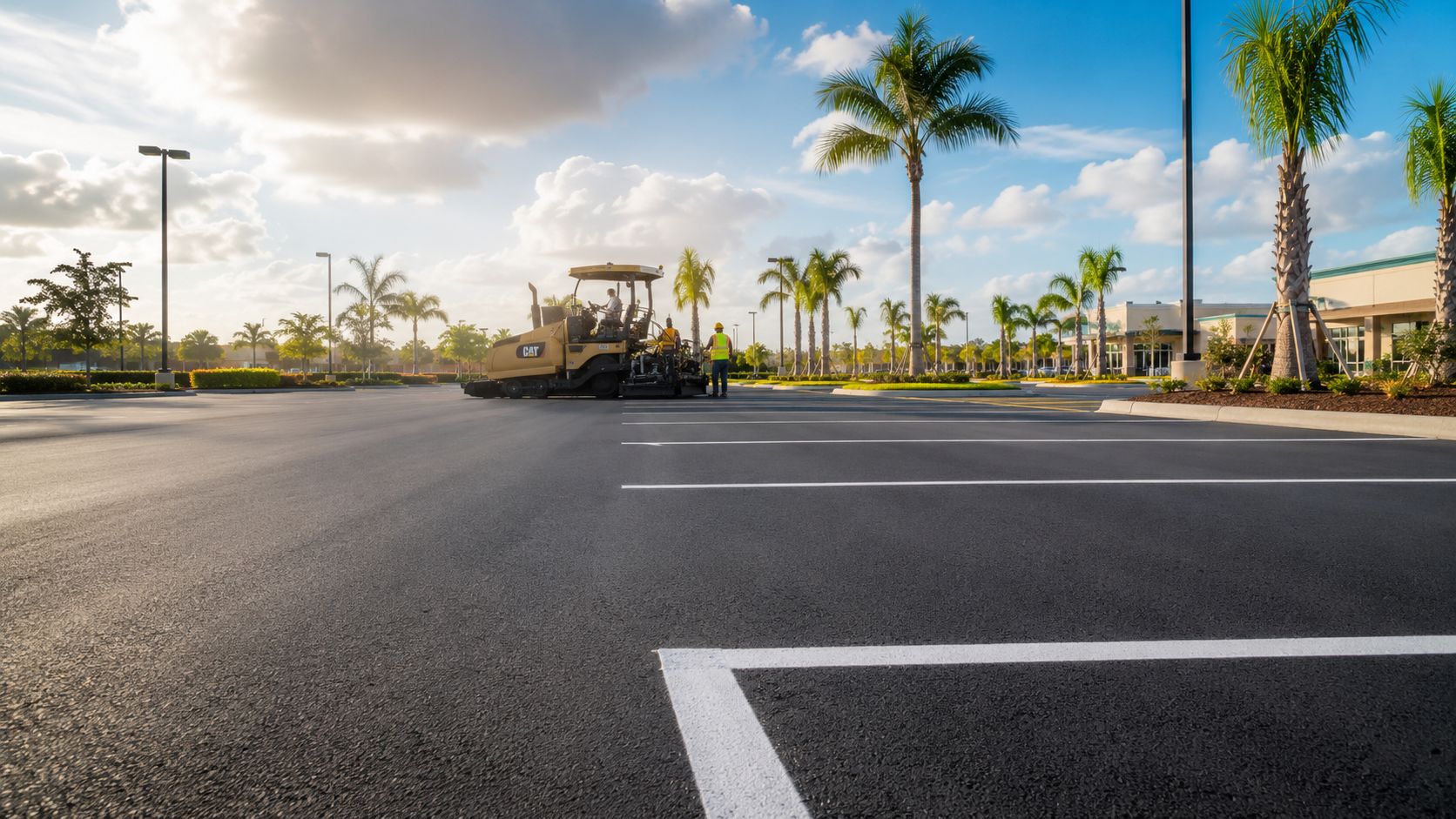
A worn parking lot tells on a property fast in Central Florida. After an August thunderstorm in Ocala or Dunnellon, faded striping, ponding water, edge cracking, and soft spots don't look like small defects, they look like a lot that's starting to work against the business using it. When a manager is staring at that kind of surface in Marion County or Citrus County, the question isn't just whether to patch it, it's whether the lot still has enough structure left to justify repair, overlay, or full replacement.
Commercial parking lot paving sits inside a multibillion-dollar maintenance market for a reason. One North American analysis estimated the commercial facility parking lot maintenance market at USD 16.08 billion in 2023, with growth to USD 20.46 billion by 2030 at 3.4% CAGR, while a separate market report put the global parking lot paving service market at $15 billion in 2025 and about $25 billion by 2033 at 6% CAGR, with commercial properties making up roughly 60% of total value. In other words, this is recurring infrastructure work, not a one-time cleanup, and that reality shows up in every lot from The Villages to Crystal River. Grand View Research
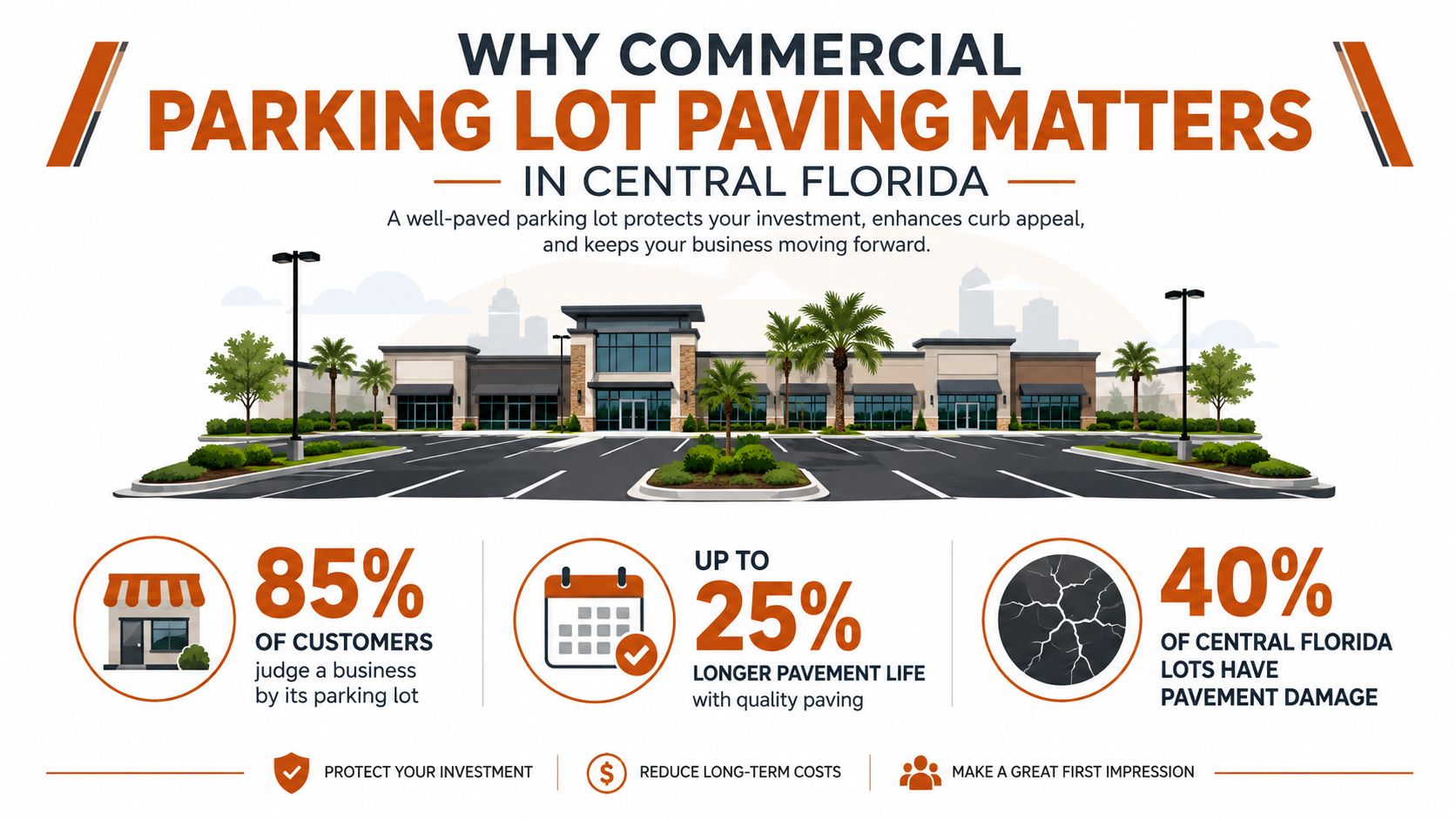
Table of Contents
- Why Commercial Parking Lot Paving Matters in Central Florida
- Asphalt and Concrete Options for Commercial Lots
- Step-by-Step Commercial Parking Lot Paving Project
- Cost Ranges and Budget Planning for Commercial Paving
- ADA Compliance and Safety Requirements
- Deciding Between Rebuild, Overlay, and Repair
- Central Florida Maintenance Plans After Paving
- Frequently Asked Questions About Commercial Parking Lot Paving
Why Commercial Parking Lot Paving Matters in Central Florida
A property manager walks out after a summer storm and sees the same pattern again. Water has pooled near the low spot by the front row, the striping looks worn, and the edge near the drive lane is starting to ravel where cars turn in and out all day. At that point, parking lot work stops being cosmetic and starts affecting daily operations.
The market stays active because the need never really goes away. Parking lot maintenance and paving work is a steady part of commercial property ownership, and the work itself is split across resurfacing, crack repair, drainage fixes, and full replacement. That also shows up in how fragmented the contractor base is, with many small firms handling repeat repairs across local markets. Grand View Research
Why lots fail in everyday use
Commercial lots usually do not fail in one sudden event. They wear down through traffic, sun, water, and base movement, then show the damage where drivers hit the same spots every day. A pavement association example shows how load affects wear, one lot with 1,010 vehicles per day can generate 1,260 ESALs per year, while a heavier-use lot with 5,015 vehicles per day can reach 4,200 ESALs per year. ESALs, or equivalent single axle loads, are a standard wear measure, which is why a church lot in Dunnellon and a retail center in Ocala can age very differently even if they look similar at a glance. NJAPA commercial parking guide
Practical rule: If the lot is only being judged by surface appearance, someone is probably missing the base condition, drainage behavior, or traffic load.
Central Florida adds its own pressure. Intense UV hardens and oxidizes pavement surfaces, sudden thunderstorms push water into weak spots, and sandy subgrades can shift under load if the base was not built right. In Marion County and Citrus County, those conditions turn small flaws into repeat problems, especially when drivers keep using the same entrances, dumpster routes, and turnaround areas. A patch may hide the symptom for a while, but if water is getting under the pavement or the base is already failing, the next storm season keeps reopening the same problem.
For property managers in Dunnellon, Ocala, and nearby communities, commercial parking lot paving is a maintenance decision tied to access, safety, and uptime. It also affects how a property holds up under ADA enforcement patterns, since worn striping, broken slopes, and uneven transitions draw attention fast. That is why the rebuild-versus-overlay call matters so much here, because the wrong fix can leave the same drainage or base problem sitting under a fresh surface.
Asphalt and Concrete Options for Commercial Lots
The asphalt versus concrete choice gets oversimplified all the time. In Central Florida, the better question is which material fits the property's traffic, downtime tolerance, and maintenance plan, because heat, rain, and sandy subgrades all push the job in different directions.
Asphalt works well when speed and repairability matter
For commercial asphalt parking lots, common guidance pairs a 3 to 4 inch hot-mix asphalt surface structure with an aggregate base of about 6 to 12 inches, adjusted upward for heavier traffic and weaker subgrades, while drainage slope around 1.5% to 2% and a drainable subbase help keep water from weakening the structure. That matters in Marion and Citrus counties because a blacktop surface under Florida sun can oxidize faster, and any lot with ponding water loses service life faster than it should. PAIKY parking lot guide
When a retail center, church, or HOA wants a quicker return to traffic, asphalt usually makes scheduling easier. It also fits the kind of patch-and-maintain approach many property teams prefer, especially where phased work is easier than a long shutdown. For a technical primer on the material itself, see this overview of hot mix asphalt.
Concrete fits heavier loads and different expectations
For commercial concrete parking lots, a widely used baseline is 5 inches of concrete for passenger cars and pickup trucks in industrial, commercial, and multi-family areas, 6 inches for light trucks, and 7 inches for heavier commercial or industrial service, with a 28-day compressive strength of 3,500 psi and slump limits tied to the finishing method. Concrete reflects heat better than asphalt, and it's often chosen where long-term rigidity matters more than quick repairability. Kenton Vale specification
That doesn't mean concrete is automatically the answer for every commercial lot in Ocala, Inverness, or Beverly Hills. If the subgrade shifts, concrete will still crack, especially at joints and transitions, and repairs can be more visible than asphalt patching. For mixed-use properties, the right answer is often to separate the surface by use area instead of trying to force one material to solve every problem.
Step-by-Step Commercial Parking Lot Paving Project
A good commercial paving job has a rhythm to it. If the job is handled right, the property owner knows what's happening, tenants know when access changes, and the crew isn't improvising around avoidable surprises.
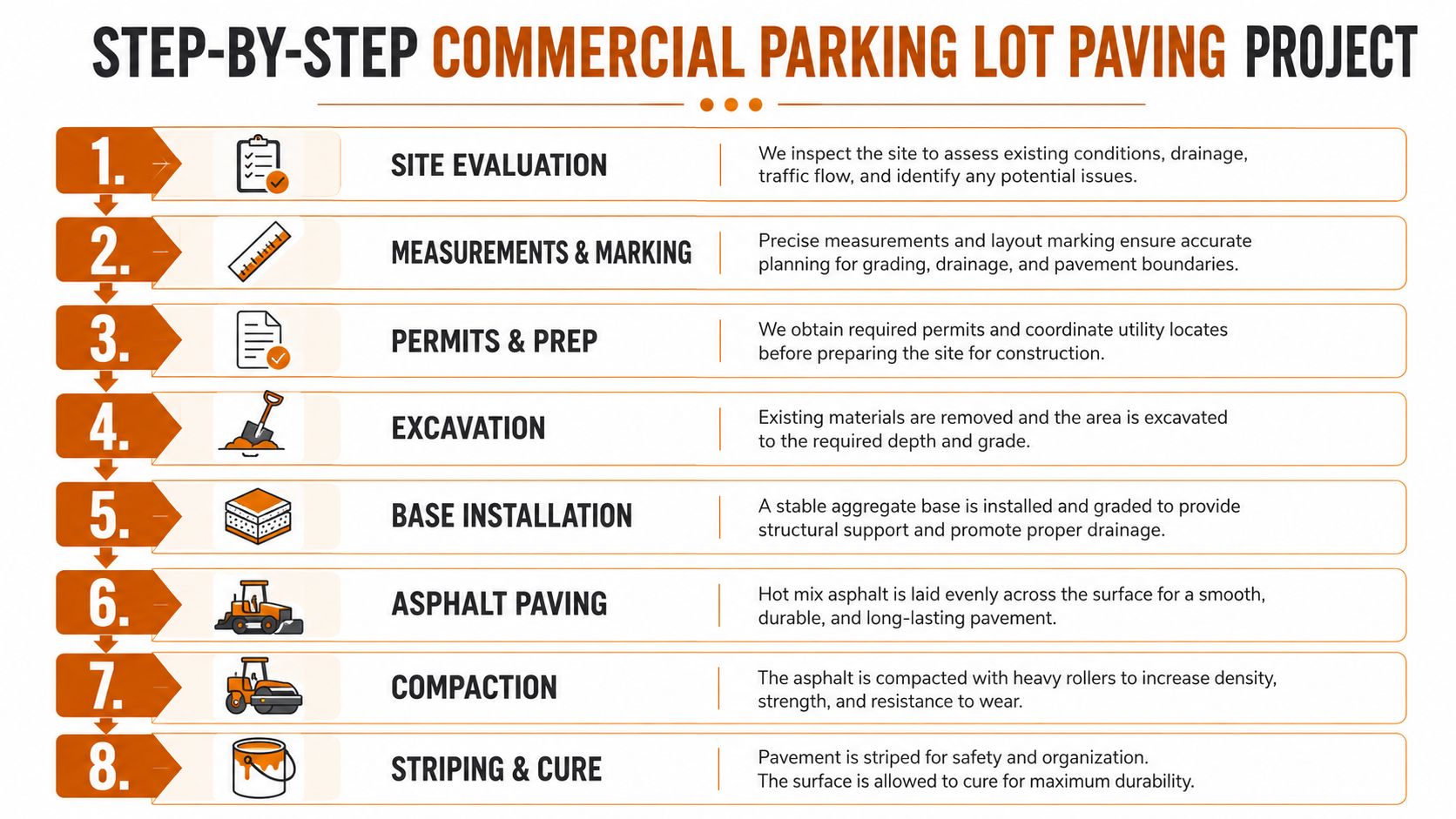
The first visit should start with measurements, photos, and a hard look at drainage, existing pavement, and edge support. If the lot needs demolition or milling, that decision should come early, because it changes grading, haul-off, and the final schedule. After that comes base preparation, which is where a lot of Central Florida projects succeed or fail, since sandy soils and previous repairs can hide weak spots until the new surface is already going down.
Then the surface gets placed, compacted, and finished. Striping, ADA markings, and signage should happen only after the pavement is ready, because paint on a surface that's still being managed is wasted money. Afternoon thunderstorms, permit timing in Marion County, and material delivery windows are the usual reasons a job slips, not because the process is mysterious, but because Florida weather and logistics don't care about the calendar.
What owners should watch during the walkthrough
A property manager in Belleview or Lecanto should expect clear answers at each checkpoint.
- Site evaluation: The crew should identify drainage issues, low spots, and any signs that the existing base has already moved.
- Base work: The surface should look uniformly graded, not like a quick skim over old problems.
- Placement and compaction: The material should be handled in lifts that match the job, not shoved down too thin to save time.
- Final layout: Striping, signage, and accessible stalls should match the actual site plan, not a rough guess.
If the contractor can't explain why the lot is being built that way, the lot is probably being built too fast.
Cost Ranges and Budget Planning for Commercial Paving
The first number on a bid is rarely the full story. One quote may cover the visible paving, while another includes base correction, drainage fixes, striping, density testing, and the cleanup that lets the site reopen cleanly.
| Project Type | Typical Cost per Sq Ft | Best Fit | Lifespan |
|---|---|---|---|
| Asphalt overlay | Lower than full replacement | Sound base with surface wear | Shorter than a full rebuild |
| Full-depth asphalt replacement | Higher than overlay | Structural failure, drainage problems, repeated patching | Long-term reset |
| Concrete installation | Higher upfront than asphalt | Heavy-load or long-life priorities | Long service life when built right |
Those ranges are directional, not a substitute for a site visit, because square footage, base condition, thickness, drainage corrections, ADA work, and access all change the final price. The useful budgeting question is whether the bid covers a durable result or just a fresh-looking surface. Cheap bids often leave out the things that protect the pavement after the crew leaves, especially compaction, proper base prep, and follow-up protection.
How to read the quote in Ocala or Crystal River
Older lots around Ocala, Crystal River, and Homosassa often hide more scope than they show. A lot can look repairable from the front drive and still need serious work once the old surface is opened up and the base is checked. That's why a complete bid should separate the visible work from the structural work, so owners can compare apples to apples instead of comparing a bargain estimate with a full scope package.
For a smaller commercial property, a phased approach can also make sense if the layout allows it. Some owners handle the worst bays first, then schedule the rest later after cash flow catches up. That only works when the contractor is honest about what can wait and what can't.
ADA Compliance and Safety Requirements
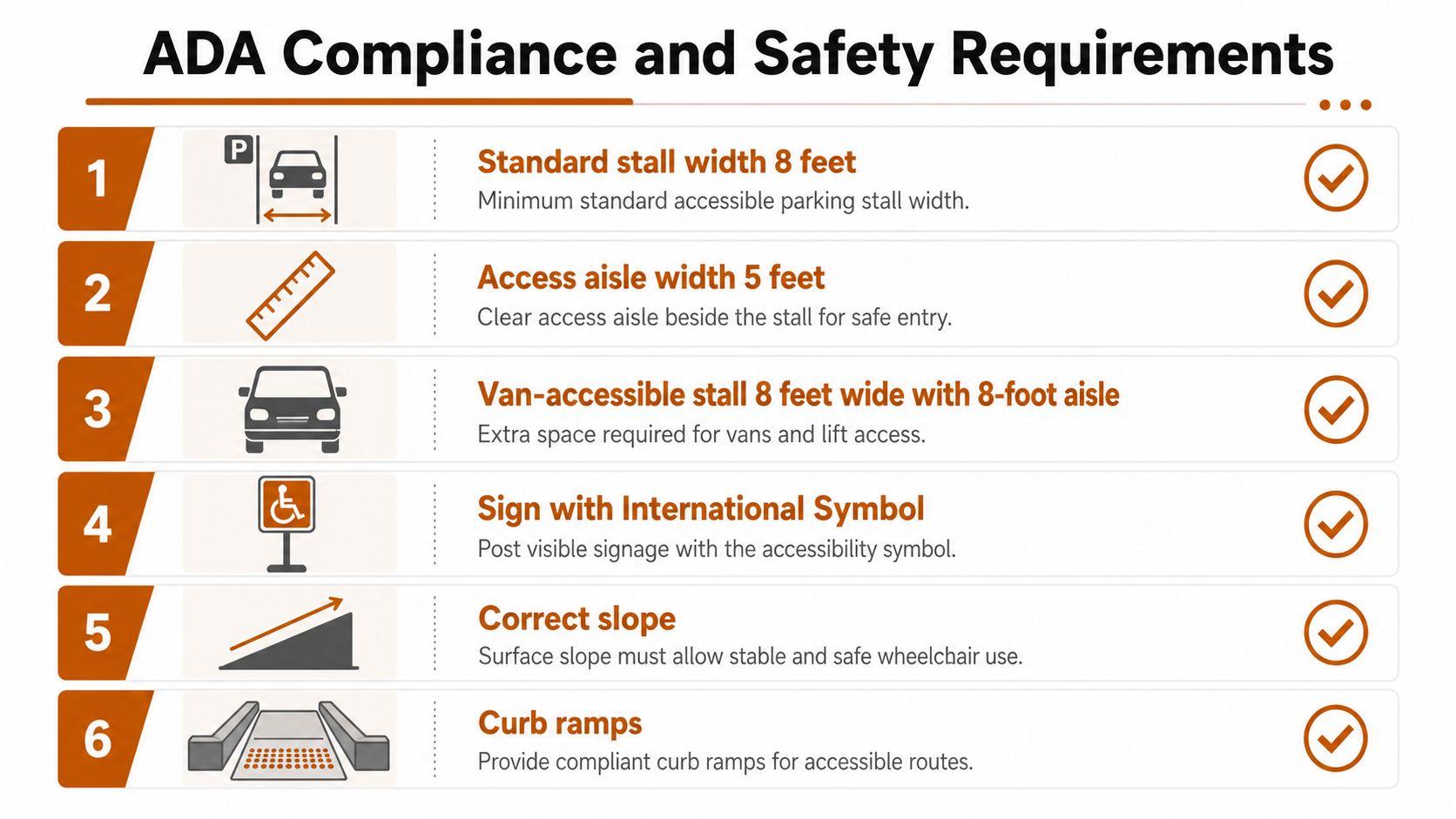
ADA work is where a lot of parking lot problems turn into inspection problems. Striping can look fine to a driver and still fail once the accessible stalls, aisles, signage, and route-of-travel details are measured against the site plan.
A standard accessible space is typically 8 feet wide with a 5-foot access aisle, van-accessible spaces are 11 feet wide with a 5-foot aisle, lots with over 500 spaces must make 2% of spaces ADA-compliant, and accessible stall signage should be positioned at least 60 inches above ground. Those are the kinds of details that need to be thought through before striping starts, not after a tenant complains or an inspector flags the lot. ADA parking lot striping requirements
What gets missed most often
The paint is only part of the layout. Accessible routes, slope, curb ramps, and the way vehicles enter and leave the stall all affect whether the lot works in practice. In Marion County and Citrus County, local enforcement and tenant pressure can both push the issue, because a visibly marked lot that still doesn't function correctly becomes a liability fast.
A lot that needs to be restriped should be checked as a layout problem first, not just a paint job.
That's why parking lot striping belongs inside the paving conversation, not as an afterthought. If the pavement is already being renewed, the accessible stalls, directional arrows, and pedestrian routes should be set up correctly before the paint goes down.
Deciding Between Rebuild, Overlay, and Repair
The hardest call on any commercial lot is not how to pave it, it's how far to go. Surface cracks alone don't tell the whole story, because the question is whether the structure under the surface is still doing its job.
A full rebuild makes sense when there's subgrade failure, persistent drainage trouble, multiple previous overlays that have built the pavement too high, or base course failure revealed by coring or excavation. In those cases, more patching just keeps spending money on a lot that's already lost its foundation. An overlay is smarter when the surface is tired or oxidized but the base is still sound, because it resets the top layer without pretending the entire structure is broken. Targeted repairs can buy time when the damage is local and the lot is otherwise stable.
What to look at before choosing
- Drainage behavior: Standing water and repeated ponding usually point to a deeper problem than surface wear.
- Overlay history: Repeated overlays can hide elevation issues and make drainage, curbs, and transitions worse.
- Subgrade condition: If the base has already moved, patching the top won't fix the movement below.
- Traffic pattern: Heavy turning movements or delivery traffic can turn a weak section into a recurring failure point.
For property owners in Hernando, Beverly Hills, and Silver Springs, that decision is worth slowing down for. A repair that lasts one season is not a savings if the lot needs the same crew back after the next wet stretch.
Central Florida Maintenance Plans After Paving
The lot doesn't stop needing attention once the paving crew pulls off the site. In Florida, the protection starts after the first coat cures, because heat, rain, and daily traffic keep working on the surface every day.
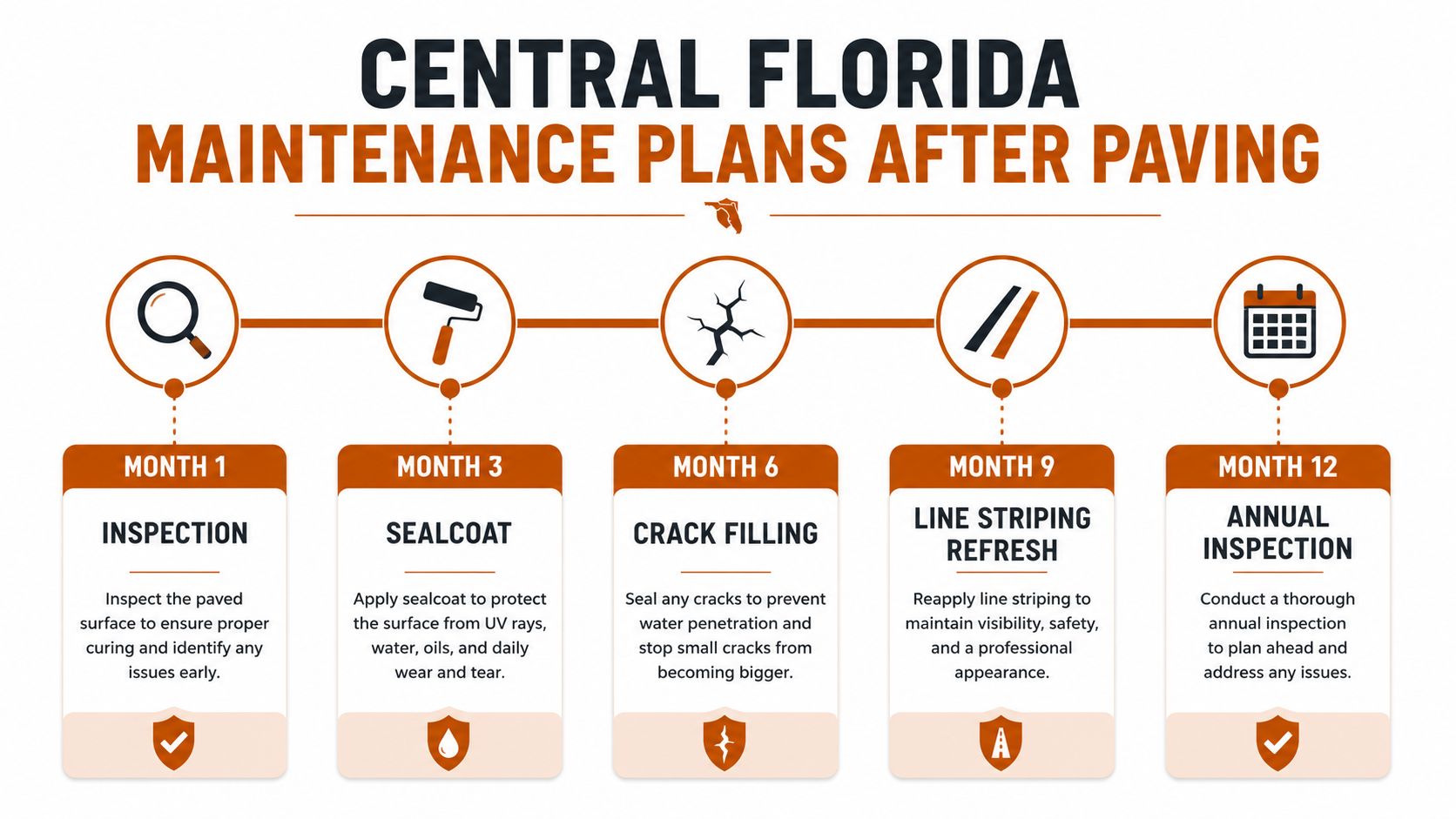
A practical maintenance calendar starts with an early inspection, then sealcoating on a repeating cycle that fits the site's exposure, crack sealing before the rainy season, line refreshes as visibility fades, and an annual check of drains and edges. In Central Florida, that matters because intense sun drives oxidation, summer downpours push water into weak points, and traffic from tourism and everyday commerce keeps the lot active year-round. For properties in The Villages and Crystal River, that kind of regular attention keeps small surface issues from becoming capital replacements.
What a maintenance-minded owner should ask for
A contractor should be willing to show licensing, insurance, local references in Marion or Citrus County, and a clear scope for what's included. If they can't explain the mix, the density expectations, or the sequence of work in plain language, they're asking you to trust the price instead of the process.
The cheapest bid is usually the one that leaves out the part you needed most.
This is also where reliable scheduling matters. A crew that can plan around tenants, deliveries, and operating hours from 7am to 7pm is solving a real business problem, not just laying material. Riverside Sealing & Striping, LLC handles commercial sealing, striping, and concrete and asphalt work across Dunnellon, Ocala, Inverness, Lecanto, and surrounding Central Florida communities, and that mix is useful when a property needs both surface protection and layout work in the same visit. For a deeper look at upkeep timing, see the company's asphalt parking lot maintenance guidance.
Frequently Asked Questions About Commercial Parking Lot Paving
Does permeable paving make sense for every commercial lot?
No. EPA guidance supports permeable paving as a way to reduce impervious-surface impacts, but it also warns against using it in runoff hotspots such as fueling stations, auto repair areas, and high-use commercial lots where contamination risk is higher. That makes it a site-specific tool, not a universal fix. EPA green parking lots guidance
How do Florida lots change the asphalt versus concrete decision?
Heat, UV, sudden rain, and sandy subgrades all matter more here than they do in cooler regions. Asphalt gives flexibility and easier repair, while concrete brings rigidity and stronger long-term load handling, so the right choice depends on how the lot is used and how much downtime the owner can accept.
When does patching stop being cost-effective?
When the problem is structural instead of local. If the base is failing, water keeps coming through, or the lot has already had multiple overlays, patching just delays the same failure and usually doesn't change the long-term cost picture.
What should I ask before hiring a contractor?
Ask for licensing, insurance, local references, and a scope that spells out base work, drainage corrections, striping, and ADA details. Also ask how they handle density testing, mix verification, and scheduling, because those are the details that separate a clean job from a short-lived one.
Can a smaller property phase the work over time?
Yes, if the site layout and condition allow it. A phased plan can help HOAs, churches, and small commercial properties manage cash flow, but the contractor still needs to prioritize the sections that are failing for structural or safety reasons first.
Riverside Sealing & Striping, LLC provides commercial parking lot paving support, asphalt sealing, striping, and concrete work for properties across Marion County and Citrus County. If your lot in Ocala, Dunnellon, Crystal River, or Inverness needs a professional evaluation, visit Riverside Sealing & Striping, LLC for a free, no-pressure estimate and a clear plan for what your property needs.