
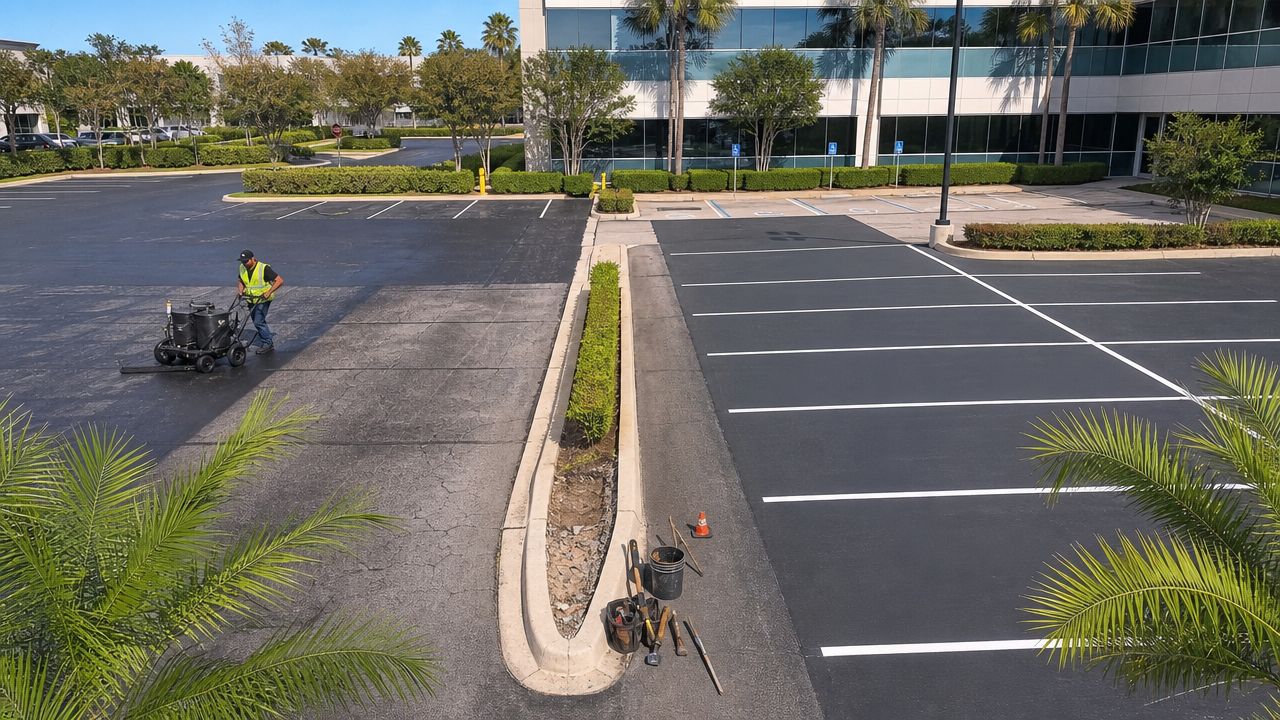
A lot of property managers in Central Florida are dealing with the same frustrating scene right now. The lot still functions, tenants are still open, and nobody wants to approve major work this quarter, but the warning signs are getting harder to ignore. Cracks are spreading across the asphalt, striping is fading, a concrete walkway edge is starting to break, and every rainstorm seems to leave standing water in the same trouble spots.
That's where commercial property maintenance services stop being a routine line item and start becoming a risk-management decision. In Marion County, FL and Citrus County, FL, that decision gets more complicated because heat, heavy rain, and steady traffic accelerate wear on both asphalt and concrete. A retail center in Ocala won't age the same way as a medical office in Lecanto, and a busy entrance in The Villages takes different abuse than a church lot in Inverness or a plaza in Crystal River.
Most guides tell you to maintain everything. That's not wrong, but it's incomplete. Real budgets are limited. Property managers need to decide what gets handled first, what can wait, and which repairs protect the asset, reduce liability, and preserve curb appeal at the same time.
Table of Contents
- Your Property's First Impression Starts at the Curb
- A Breakdown of Core Maintenance Services
- Building Your Preventative Maintenance Plan
- The Business Case for Proactive Maintenance
- Navigating Central Florida's Unique Climate Challenges
- How to Select the Right Maintenance Partner
- Frequently Asked Questions About Commercial Maintenance
Your Property's First Impression Starts at the Curb
A property manager in Ocala can usually spot the problem before a tenant says a word. The entrance drive looks tired. Parking lines are hard to follow. One corner of the sidewalk near the front door has started to crumble, and the lot no longer gives the impression of a well-run site. The same thing happens in Homosassa, Belleview, and Silver Springs. The deterioration shows up gradually, then all at once.
Visible wear does more than hurt appearance. It signals deferred maintenance to tenants, customers, and owners. It also creates exposure. When people cross a lot with uneven pavement, broken curbs, or poor markings, the property isn't just less attractive. It's harder to get around and harder to defend if someone gets hurt.
Practical rule: If the first thing visitors see is deteriorating pavement or damaged concrete at the entry, you already have a maintenance priority.
That's one reason the market for maintenance has grown so much. The U.S. Building Maintenance Services Market was valued at USD 1.4 billion in 2024, with one forecast projecting it to reach USD 9.7 billion by 2034, and the commercial building segment held more than a 34% share in 2024 according to building maintenance market data. Owners and managers aren't treating maintenance as optional anymore. They're treating it like operating infrastructure.
For Central Florida properties, curb appeal and risk control often start outside, long before anyone notices hidden building systems. A shopping center in The Villages, an office property in Lecanto, or a church in Dunnellon all face the same basic truth. The curb line, parking area, sidewalks, and entry sequence shape first impressions and maintenance priorities.
If the exterior already looks dated, practical curb appeal improvements for commercial pavement and entry areas can help frame what should be addressed first.
A Breakdown of Core Maintenance Services
Commercial property maintenance works best when managers stop thinking in isolated tasks and start thinking in systems. Pavement, striping, curbs, sidewalks, ramps, and access routes all interact. If one part is neglected, the rest often suffers faster.
Here's the broad service map most commercial sites rely on:
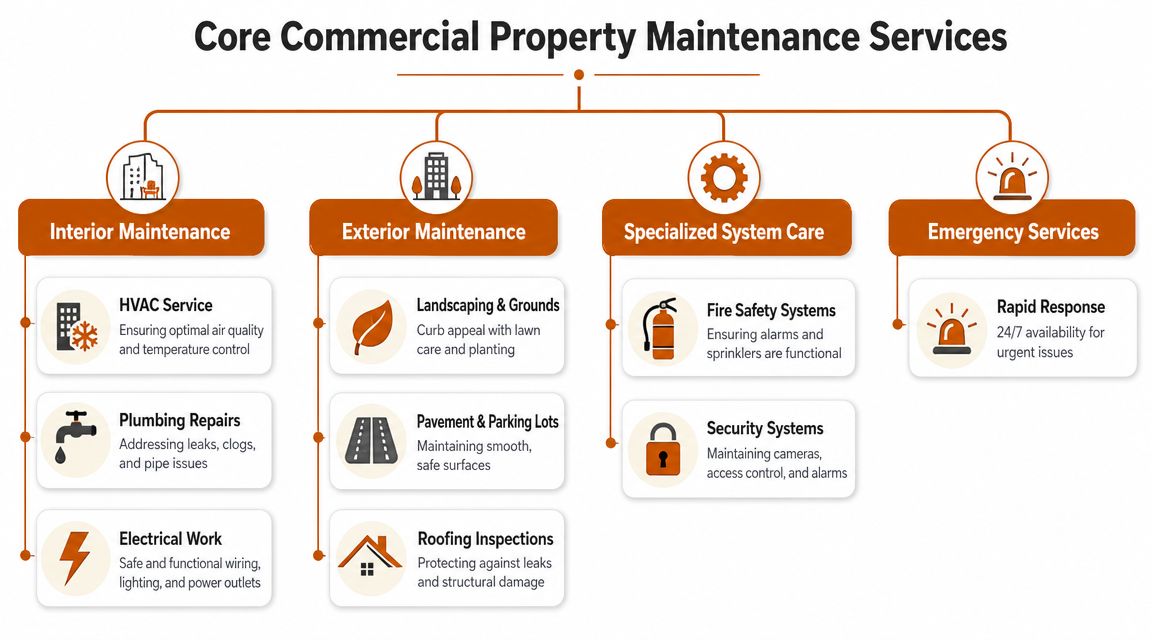
Commercial maintenance guidance specifically identifies parking areas, sidewalks, curbs, and access points as inspection targets for cracks, deterioration, and subsidence, and notes that defects in high-traffic zones can create trip hazards, drainage problems, and accelerated base failure, as outlined in commercial property maintenance inspection guidance.
Asphalt sealcoating and crack sealing
Sealcoating protects the asphalt surface from weather exposure and everyday contamination. In Central Florida, that matters because pavement takes constant sun, summer rain, and vehicle fluids. Once the surface dries out and opens up, water gets deeper into the structure and the damage becomes more expensive to correct.
Crack sealing handles a different part of the problem. It closes active openings before water infiltration widens them and starts undermining the base. Sealcoating without addressing meaningful cracks first usually doesn't hold up the way managers expect.
What works:
- Treating cracks early: Small failures are easier to isolate and manage than broad alligator cracking or base failure.
- Preparing the surface correctly: Cleaning, drying, and applying materials in proper conditions matters.
- Using sealcoating as preservation: It's a maintenance tool, not a fix for structurally failed pavement.
What doesn't:
- Coating over neglected pavement: It may improve color temporarily, but it won't solve underlying structural issues.
- Waiting until potholes develop: By then the conversation often shifts from maintenance to repair or replacement.
Professional parking lot striping
Striping is often underestimated because it looks cosmetic. It isn't. Clear markings control traffic flow, improve parking efficiency, support emergency access, and help properties present as organized and professionally managed.
In places like Summerfield, Beverly Hills, and Hernando, faded striping often shows up first in busy lots with constant turnover. Drivers hesitate, park inconsistently, and cut across travel lanes they shouldn't use. That creates avoidable confusion and wear.
A strong striping plan usually includes:
- Directional clarity: Arrows, stop bars, and lane layout should reduce hesitation.
- Code-conscious layout: Handicap spaces, access aisles, and pedestrian zones need to be visible and usable.
- Re-striping at the right time: Don't wait until markings disappear into the pavement color.
Property teams that want a practical field reference can use this parking lot maintenance checklist for commercial sites to spot common issues before they become tenant complaints.
ADA compliance upgrades
ADA-related work is where maintenance, safety, and legal exposure meet. The biggest mistakes usually happen at transitions. A property may have decent pavement overall, but the route from parking to entry has uneven concrete, poor markings, or worn access aisles.
That's especially common on older properties in Ocala, Inverness, and Crystal River where improvements happened in phases over time. The lot gets patched, then a sidewalk settles, then signage or striping no longer matches the field conditions.
Access routes should be treated as operating infrastructure, not paint-only tasks.
Managers should pay close attention to:
- Accessible parking layout
- Access aisles and route continuity
- Curb ramp condition
- Trip points at joints, edges, and patched transitions
Concrete repair and replacement
Concrete work often gets pushed off because the failure looks localized. Sometimes that's fine. Sometimes it's a mistake. Sidewalk panels, dumpster pads, curbs, loading areas, and entry aprons all take repetitive stress, and once concrete breaks at edges or settles unevenly, spot repairs need to be evaluated carefully.
Repair makes sense when the damage is limited and the surrounding structure is stable. Replacement makes more sense when the slab has lost integrity, movement is ongoing, or patching would leave a weak edge that fails again.
For commercial sites, the right question isn't just “Can this be patched?” It's “Will this repair hold under traffic, weather, and drainage conditions?”
Building Your Preventative Maintenance Plan
Reactive maintenance feels cheaper because it delays spending. In practice, it usually makes budgeting harder. Property managers end up responding to complaints, weather damage, and emergency deterioration instead of controlling the timing and scope of work.
That's a problem when maintenance is already a major operating expense. Industry benchmarks put average annual maintenance cost for commercial properties at about $2.00 to $2.50 per square foot, which translates to roughly $200,000 to $250,000 annually for a 100,000-square-foot property, based on commercial property maintenance budgeting benchmarks. If that much money is tied to upkeep, planning can't be casual.
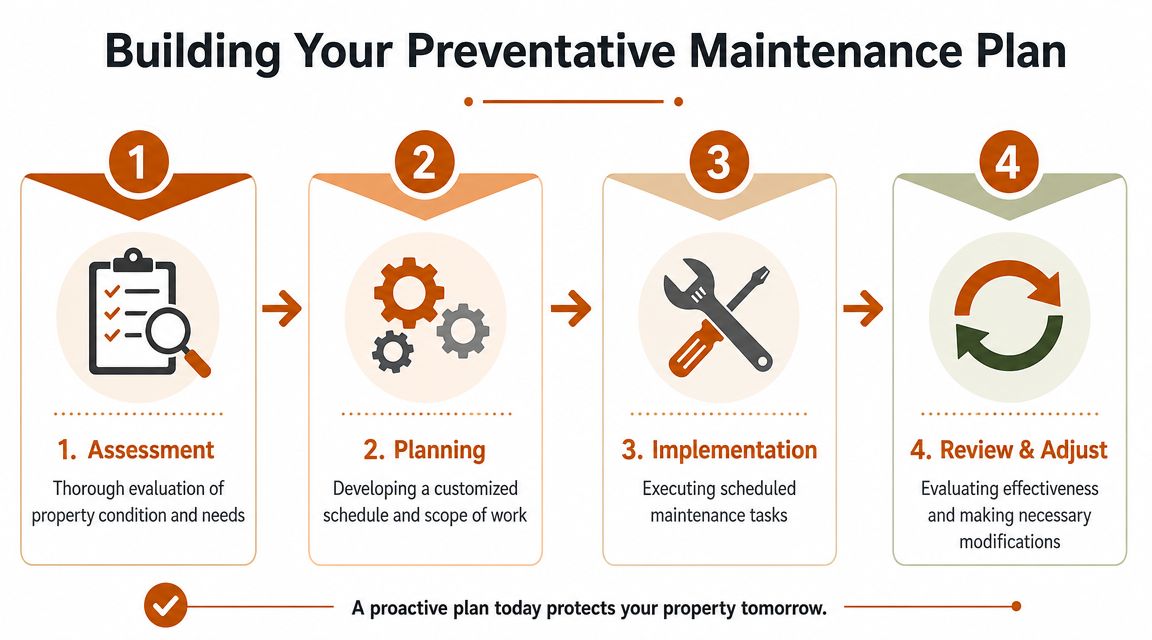
Start with a real site assessment
A useful maintenance plan begins with a walk of the whole property, not just the worst-looking area. In Dunnellon or The Villages, that means documenting pavement condition, concrete trip hazards, drainage patterns, striping visibility, curb integrity, and entry routes.
The key is separating issues into three groups:
- Immediate risk items such as unsafe walk paths, failing ramps, or broken curbs at traffic edges.
- Near-term preservation work such as crack sealing, sealcoating, and re-striping.
- Capital items that likely need phased replacement rather than repeated patching.
Build the schedule around exposure and use
A lot with steady daily traffic in Ocala or Belleview needs a different cadence than a lightly used office site in a quieter part of Citrus County, FL. The right schedule depends on sun exposure, drainage, turning movements, delivery traffic, and how visible the area is to tenants and customers.
A practical plan usually includes:
- Routine inspections: Especially after heavy rain and storm activity.
- Surface preservation windows: Timing sealcoating and striping when conditions support proper application.
- Concrete reviews: Looking at heaving, settlement, and edge breakdown before it spreads.
- Reserve planning: Saving room in the budget for surprise failures that still happen on well-managed sites.
For asphalt-heavy properties, how often to seal coat asphalt in Florida is one of the most useful planning questions to answer early.
The Business Case for Proactive Maintenance
Property managers usually don't struggle to see that maintenance matters. They struggle to defend why one project should happen now instead of later. The business case gets clearer when you look at three outcomes: lower exposure, better presentation, and longer service life.
Safety and liability reduction
Exterior surfaces create some of the most visible risks on a commercial property. A cracked sidewalk at the leasing office, a broken curb near a storefront, or a pothole at a pedestrian crossing can all turn into incidents that were preventable with timely maintenance.
The biggest value in proactive work is that it addresses hazards before someone reports them the hard way. This is especially important at shopping centers, churches, schools, and medical offices where foot traffic includes people with different mobility needs.
The best time to fix a trip hazard is when your staff notices it, not after an insurance conversation starts.
Curb appeal and brand image
Customers may never mention pavement condition directly, but they notice it. So do tenants deciding whether management is attentive. A freshly maintained lot with crisp striping and sound concrete sends a very different signal than one with patched failures, missing markings, and broken edges.
That matters in tourist-influenced areas and high-visibility corridors across Central Florida. In places like Crystal River, Homosassa, and The Villages, exterior appearance affects how professional the whole property feels before anyone walks inside.
A quick comparison makes the point:
| Property condition | Likely impression |
|---|---|
| Faded striping and broken concrete at entry | Deferred maintenance, confusion, avoidable risk |
| Clear markings, stable sidewalks, maintained surface | Organized management, easier access, safer movement |
Asset preservation over patchwork spending
Deferred maintenance often creates a cycle of scattered spending. One patch here, one repaint there, one complaint-driven repair next month. That approach can keep a site operational, but it rarely protects the asset well.
Proactive maintenance is different because it sequences work in the right order. Preserve sound asphalt before it fails. Correct drainage-related trouble spots before resurfacing. Replace concrete sections that are structurally compromised instead of patching the same corner repeatedly.
Owners in Marion County, FL and Citrus County, FL usually get the best long-term value when they treat exterior surfaces as managed assets, not recurring annoyances.
Navigating Central Florida's Unique Climate Challenges
Commercial properties in Central Florida don't age in a neutral environment. Heat, UV exposure, humidity, and sudden downpours put pressure on every exterior surface, especially asphalt and concrete.
That's why maintenance plans in Ocala, Summerfield, and Silver Springs can't just copy what works in a milder region. Local conditions change how surfaces wear and how quickly small defects become expensive ones.
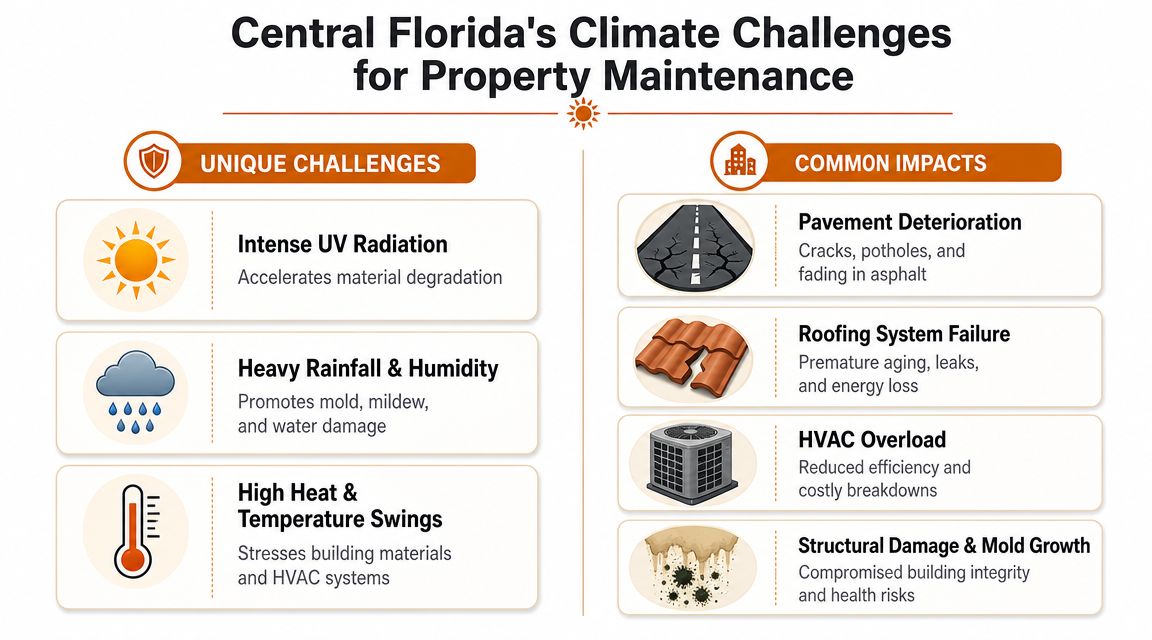
Heat and UV wear down surfaces faster
Florida sun is hard on asphalt. The surface oxidizes, loses flexibility, fades, and becomes more vulnerable to cracking. Once that happens, routine traffic does more damage because the pavement no longer has the same resilience.
Concrete has its own issues. Heat and exposure can stress joints, highlight previous patch failures, and make cosmetic aging more obvious at entrances and walkways. On mixed-surface properties, managers need both asphalt and concrete reviewed together instead of as separate scopes.
Rain finds every weak point
Heavy rain is where neglected surfaces get exposed. Water moves into open cracks, low spots hold standing water, and poorly draining areas start softening the base under asphalt. At concrete walks and curbs, runoff can wash out support or worsen joint movement.
A practical rain-season checklist should include:
- Low areas: Watch where water ponds after storms.
- Crack monitoring: Open cracks become water pathways fast.
- Edge failures: Pavement edges near curbs and where hard surfaces meet soft ground often deteriorate first.
- Walk routes: Entry sidewalks and ramps need fast review after repeated storms.
On most Central Florida sites, water intrusion does more damage than the crack that allowed it in.
Storm prep and post-storm checks matter
Properties in Crystal River and Homosassa also have to think about storm exposure differently than some inland sites. Even where wind or rain doesn't cause major structural damage, storms often accelerate surface breakdown by moving water, debris, and traffic patterns in ways the property wasn't designed for.
After major weather, managers should inspect:
- Access points and drive lanes
- Curb lines and drainage paths
- Concrete trip points hidden by washout or debris
- Striping visibility where surface wear increased
That kind of local review is one reason generic maintenance calendars often fall short in Central Florida.
How to Select the Right Maintenance Partner
A bad maintenance partner usually looks fine at bid time. The problems show up six months later, when the parking lot still holds water at the entry drive, the concrete trip hazard near the storefront was left for “phase two,” and your budget got spent on the most visible work instead of the highest-risk work.
That selection mistake is expensive in Central Florida. Tourist traffic, afternoon storms, heat, and constant vehicle turnover wear out access points faster than many annual plans account for. A contractor should be able to sort cosmetic issues from liability items and explain why one repair moves to the front of the line.
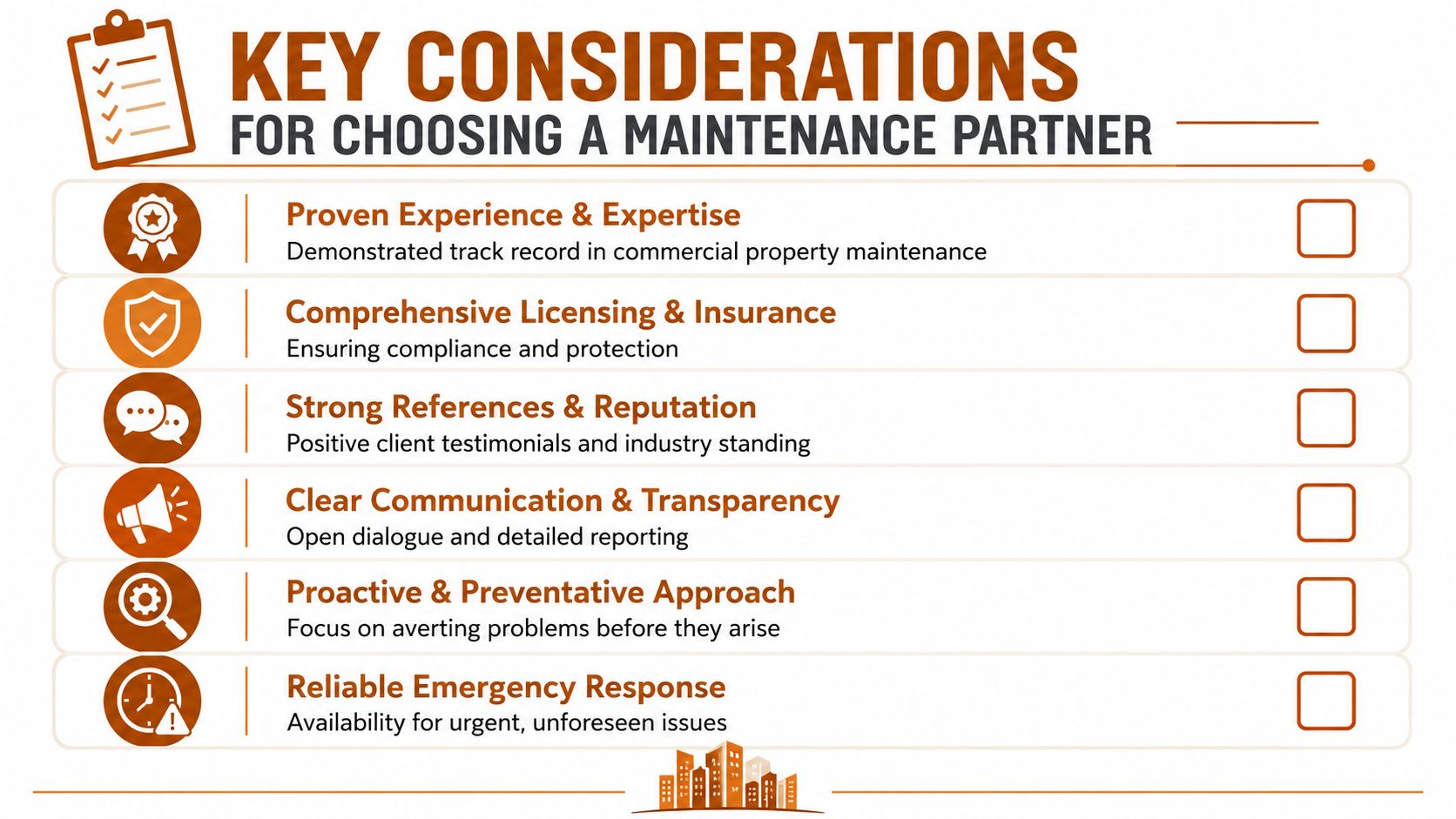
One question property managers should press on early is how the contractor prioritizes visible surfaces against hidden conditions. Guidance on risk-based maintenance sequencing for commercial properties points to a practical truth. Limited budgets should go first to areas tied to slip and trip exposure, ADA access, traffic flow, and deterioration that will spread if ignored.
Before the next checklist, this short video adds a useful hiring perspective for property service evaluation.
Ask how they prioritize work
Start with sequencing. A qualified contractor should walk the site and separate immediate liability concerns from preservation work, then separate both from items that can be monitored.
Ask questions like:
- What are the first liability items you see on site?
- Which repairs protect the most asset value if we phase the work?
- Are you recommending preservation, repair, or replacement, and why?
If every deficiency gets labeled urgent, the contractor is selling scope, not building a maintenance plan.
Look for both concrete and asphalt capability
Many maintenance problems cross material lines. A failing asphalt edge can undermine adjacent concrete. A settled sidewalk panel can redirect water into a drive lane. If different vendors inspect those items in isolation, the owner often gets disconnected recommendations and duplicated mobilization costs.
For commercial properties in Marion and Citrus counties, that matters. Entry drives, loading areas, sidewalks, ramps, curbs, and parking fields all affect safety and drainage as one system. Riverside Sealing & Striping, LLC is one local example of a contractor that handles commercial asphalt maintenance along with concrete construction and replacement work, which helps when the property needs coordinated sequencing instead of separate opinions.
Use a practical vetting checklist
Keep the screening process simple, but make the contractor get specific.
| What to verify | Why it matters |
|---|---|
| Licensed and insured status | Protects the property and reduces exposure if damage or injury occurs |
| Local Central Florida experience | Improves judgment on weather timing, drainage behavior, and high-traffic wear |
| Clear scope of work | Reduces change orders and prevents gaps between trades |
| Reliable scheduling | Helps tenants, customers, and vendors keep access during phased work |
| Ability to explain trade-offs | Shows whether the contractor can protect both appearance and long-term asset condition |
If a contractor cannot explain why one repair should happen before another, they should not be setting your maintenance priorities.
Frequently Asked Questions About Commercial Maintenance
How disruptive is parking lot maintenance work
It depends on the scope, layout, weather, and whether the work can be phased. On most commercial sites, the least disruptive projects are the ones planned early with traffic flow in mind. Managers should ask about sequencing, temporary access routes, tenant notices, and cure time before scheduling work.
For active sites in places like Ocala, Inverness, or The Villages, phasing is usually the difference between a manageable project and an operational headache.
Should you repair or replace damaged concrete
Repair is often the better choice when the damage is isolated and the surrounding slab is stable. Replacement is usually the smarter move when concrete has settled, broken at load points, or failed in a way that suggests the problem will keep returning.
The wrong move is repeated cosmetic patching on structurally weak concrete. That often looks acceptable for a short time and then breaks again under traffic or weather exposure.
What should property managers inspect after heavy rain
Focus on the spots that reveal weakness fastest. Look for standing water, widening cracks, edge breakdown, settlement at sidewalks, washout near curbs, and entry routes that have become slick or uneven.
A quick walk after storms in Belleview, Homosassa, Lecanto, or Beverly Hills can tell you a lot about where water is moving and which areas need attention first.
Do local experience and licensing really matter
Yes. Local experience affects scheduling, material recommendations, and how a contractor evaluates climate-related wear. A licensed and insured contractor also gives property managers a more reliable baseline for professional accountability.
That matters whether the property is in Marion County, FL, Citrus County, FL, Crystal River, Hernando, or Dunnellon. Commercial exterior work needs to be done with both safety and long-term performance in mind.
What's the biggest mistake in commercial property maintenance
Treating maintenance as a list of isolated repairs instead of a sequence of risk-based decisions. The best plans don't just fix what's ugly first. They address what creates liability, what preserves usable life, and what protects the property's image at the same time.
If you manage a commercial property and need a practical evaluation of pavement, concrete, striping, or ADA-related site issues, Riverside Sealing & Striping, LLC provides no-pressure consultations and free estimates across Marion County, Citrus County, and surrounding Central Florida communities. As Concrete and Asphalt Experts in Marion and Citrus County, the team helps property managers prioritize work, phase repairs sensibly, and maintain safer, better-looking sites with reliable scheduling.