

Two estimates land on your table for the same cracked driveway in Ocala, and the totals sit thousands of dollars apart. Both say "remove and replace." Both promise a smooth, broom-finished slab. If the finished surface will look the same either way, what is the extra money buying?
Almost never the concrete. It's the lines most bids leave out. How far down the base gets corrected. Where stormwater goes once it leaves the slab. How the surface is cured when the afternoon heat sits at 95 degrees. In Marion County and Citrus County, sandy subgrades and heavy summer rain do most of the long-term damage to flatwork, so those unwritten lines decide whether a driveway lasts twenty years or shows the same cracks in three.
Reading a bid like an estimator means knowing what the trade covers, how a pour should run, and which measurements belong in writing before anyone signs.
Table of Contents
- What Concrete Contractors Handle in Central Florida
- Replace or Repair a Cracked Concrete Driveway
- How a Properly Run Concrete Pour Progresses
- Vet Concrete Contractors and Compare Written Scopes
- How Florida Heat, Rain and Sand Affect Concrete
- ADA Routes and Parking Limits Property Owners Must Meet
- Frequently Asked Questions About Concrete Contractors
- Next Steps for Your Concrete Project
What Concrete Contractors Handle in Central Florida
Concrete contracting is a specialty trade, not a branch of general building work. The crew surveys grade, excavates, compacts a base, sets forms, ties reinforcement, places and consolidates the mix, finishes the surface, cuts joints and controls curing. The work is tracked as its own industry: the U.S. Census Bureau's NAICS profile files concrete contractors under Specialty Trade Contractors, code 238, a category built for businesses that perform specific construction activities rather than whole buildings. Within that sector, the Bureau of Labor Statistics counted approximately 131,390 cement masons and concrete finishers in May 2021, earning a mean hourly wage of $24.24 and an average annual wage of $50,430. That is a trained trade with its own wage scale, not interchangeable day labor.
Match the contractor to the row that describes your job:
| Project | Typical scope | Key Florida consideration | Ask the contractor |
|---|---|---|---|
| Driveway replacement | Remove damaged slab, correct base, pour and finish | Sandy soils and drainage around the slab | How the base will be compacted |
| Driveway crack repair | Clean, fill and restore cracks | Whether cracks are cosmetic or structural | What caused the cracking |
| Patio | Forming, reinforcement and finish selection | Heat and UV exposure on the finish | Whether the finish is rated for sun and slope |
| Slab | Subgrade preparation, moisture control and reinforced pour | High water table and moisture | How the subgrade and drainage will be handled |
| Sidewalk | Grading, forming and anti-slip finish | Cross slope and drainage | How route measurements will be checked against ADA limits |
| Commercial walkway or lot connection | Accessible route planning and ramp replacement | Heavy traffic and rain runoff | Measurements and phased schedule |
Residential work around Ocala, Dunnellon, Belleview, Summerfield and The Villages usually lands in the driveway and patio rows. Commercial clients in Inverness, Crystal River and Homosassa more often need walkways, slabs and accessible connections between a parking area and an entrance.
A crew that pours beautiful stamped patios may have no process for measured accessibility slopes. A commercial flatwork outfit may not be set up for a residential tear-out with tight truck access and a lawn to protect. Specialization cuts both ways.
Bring three questions to the first conversation: What does base preparation include? How will the surface be finished and cured? Who supervises the crew on site each day?
Replace or Repair a Cracked Concrete Driveway
A crack is a symptom. The cause sets the repair, and misreading it is how homeowners pay twice for the same failure. Florida-focused guidance from Alliance Pavers treats heavy rain, high water tables, sandy or shifting soils, drainage, reinforcement, control-joint layout and curing as interacting factors, and names base preparation as a leading cause of premature failure. A stronger mix cannot compensate for a wet, unstable base.
Walk the slab before you call anyone. Note where water stands after a storm, whether the surface sounds hollow underfoot, and whether one edge has dropped relative to the garage apron or the street.
| Symptom | Likely cause | Usually the right response |
|---|---|---|
| Hairline crack, no displacement | Normal shrinkage | Crack sealing and monitoring |
| Slab edge raised or sunk | Subgrade settlement or poor compaction | Replacement with a corrected base |
| Water ponding after storms | Grade or drainage failure | Regrade and reroute water before any slab work |
| Cracks near downspouts or downslope edge | Water saturating the base | Drainage fix, then patch or replace |
| Hollow sound when walked on | Voids under the slab | Replacement likely |
| Slab heaving near a tree | Root growth under the slab | Root removal and replacement with a root-aware base |
| Surface flaking or crumbling | Poor curing or surface damage | Resurfacing or replacement, depending on depth |
A hairline crack that hasn't moved in years is cosmetic, and sealing it buys time. Water pooling against the slab, a hollow ring, or a lip you can trip on points to the base, and patching that is cosmetic work on a structural problem.
Sandy soils across Marion and Citrus County make this diagnosis matter more, not less. Water moves freely through sand, so a small surface crack often traces back to a base that was never compacted in lifts or a grade that sends runoff under the slab instead of away from it. Tree roots near older driveways in Dunnellon and Inverness lift panels the same way, and no amount of patching fixes a root that's still growing.
When replacement is the honest answer, concrete driveway repair near me work starts with the diagnosis, because the estimate has to show what was corrected underneath. The written scope checklist further down is where that gets verified.
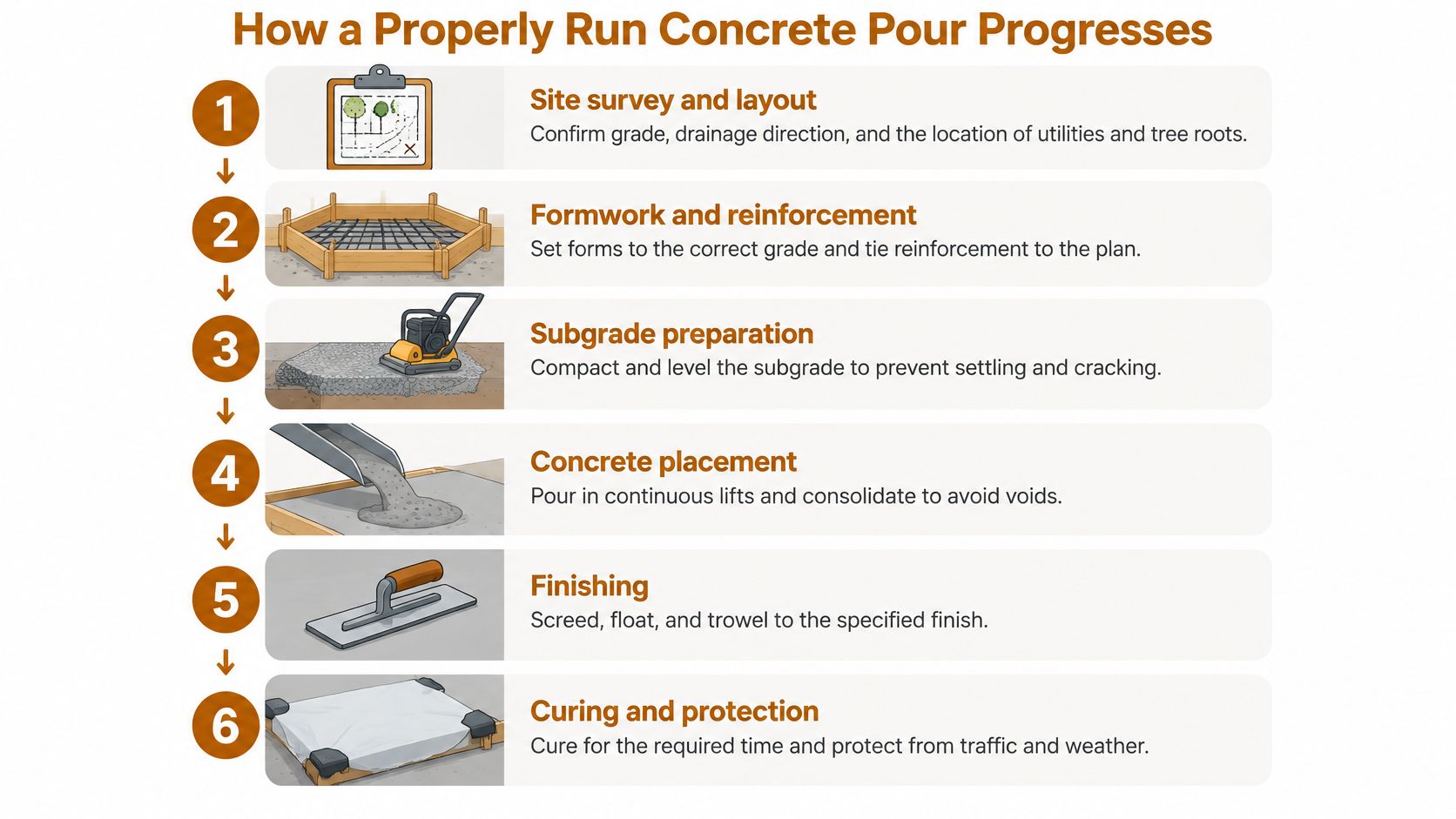
How a Properly Run Concrete Pour Progresses
A good pour is six steps that each exist for a reason. Skip one and the failure shows up seasons later, usually in a place nobody photographs.
- Site survey and layout. Confirm existing grade, the direction water must leave, utility locates and any tree roots inside the footprint. A layout error surfaces as a slab that drains toward the garage door.
- Excavation and base. Strip the old slab, cut to the planned depth, place base material in lifts and compact each lift before the next goes down. Thin, uncompacted base is the most common reason a new driveway fails on sandy ground.
- Forms and reinforcement. Set forms to the planned slope with a string line and a level, then chair the rebar or mesh so it ends up inside the slab rather than resting on the dirt.
- Pour and consolidate. Place the mix at the agreed slump and temperature and work it into the forms to drive out voids, especially at edges and corners.
- Finish and joints. Float, then broom or texture for grip. Cut control joints at the planned spacing while the concrete is still green, so the slab cracks where you decided instead of where it wants.
- Curing. Begin as soon as bleed water disappears. Cover edges as well as the top, and keep the surface wet or apply an approved curing compound.
Curing isn't a formality. The Federal Highway Administration's guidance on curing states that curing must hold enough moisture and temperature to support cement hydration, and that inadequate curing damages the exposed upper 25 to 32 mm of pavement, the zone that takes the weather and the traffic. For conventional concrete placed above 10°C, seven days is the default period, though curing may end earlier once field evidence shows at least 70% of the specified 28-day compressive strength.
Traffic timing belongs to measured strength, not the calendar. FHWA specifications cite 20 MPa (about 2,900 psi) at 24 hours for accelerated-strength concrete and 20.7 MPa (3,000 psi) within 24 hours for rapid-setting repair materials, while normal-setting repair concrete may target 20.7 MPa within three days with traffic kept off for at least 24 hours.
| Concrete situation | Strength or time target | Practical meaning |
|---|---|---|
| Default curing, conventional concrete above 10 C | Seven days | Curing may end earlier once the criteria below are met |
| Curing end point | At least 70% of specified 28-day strength | Confirm by test results, not the calendar |
| Accelerated-strength concrete | 20 MPa (about 2,900 psi) at 24 hours | Benchmark for early opening |
| Rapid-setting repair material | 20.7 MPa (3,000 psi) within 24 hours | Repair can reopen once the target is verified |
| Normal-setting repair concrete | 20.7 MPa within three days | Keep traffic off at least 24 hours |
Central Florida heat is the usual reason curing gets rushed. A crew chasing a second pour the same afternoon sprays compound and leaves, and the surface pays for it first: scaling, dusting, a porous skin that stains and flakes.
Vet Concrete Contractors and Compare Written Scopes
Start with what can be verified rather than what sounds good on the phone.
- License and insurance. Request the license number and a current certificate of insurance, then call the carrier to confirm the policy is active and the limits suit your project size.
- References from the same project type. Ask for two or three, in Marion or Citrus County where possible, and ask each one whether the crew held to schedule and returned for punch-list items.
- A written scope that names the invisible work. Demolition depth, base correction, compaction method, reinforcement, joint spacing, slope, finish and curing method, each on its own line.
- Dates, not ranges. Start date, pour date, opening date, and how weather delays get communicated.
- Payment tied to milestones. Large deposits up front shift the risk onto you; payments should follow completed stages.
- Warranty in writing. What it covers, for how long, and whether labor and materials are both included.

A free on-site estimate is itself a test. A contractor who measures the slab, checks where water runs and asks about soil conditions is scoping the work. One who quotes from a satellite photo and a rough square footage is guessing, and the guess usually gets corrected on your invoice. Bring photos, rough measurements, the age of the existing slab and any known drainage problems, and see how many of them end up in the document.
Then put the scopes side by side and read line by line. A bid that omits base correction, hauling or drainage work isn't cheaper; it's incomplete, and the missing line reappears as a change order. Full details on the questions worth asking are collected in questions to ask a concrete contractor.
Riverside Sealing & Striping, LLC is a family-owned concrete and asphalt contractor based in Dunnellon that handles both sides of a property, from driveways and sidewalks to lot maintenance, and commercial services are performed by licensed and insured contractors. The estimate happens at your site, at your convenience, so the scope is written from what lies under the slab.
How Florida Heat, Rain and Sand Affect Concrete
Local conditions decide how flatwork ages, and they're why a slab built to a national template underperforms here.
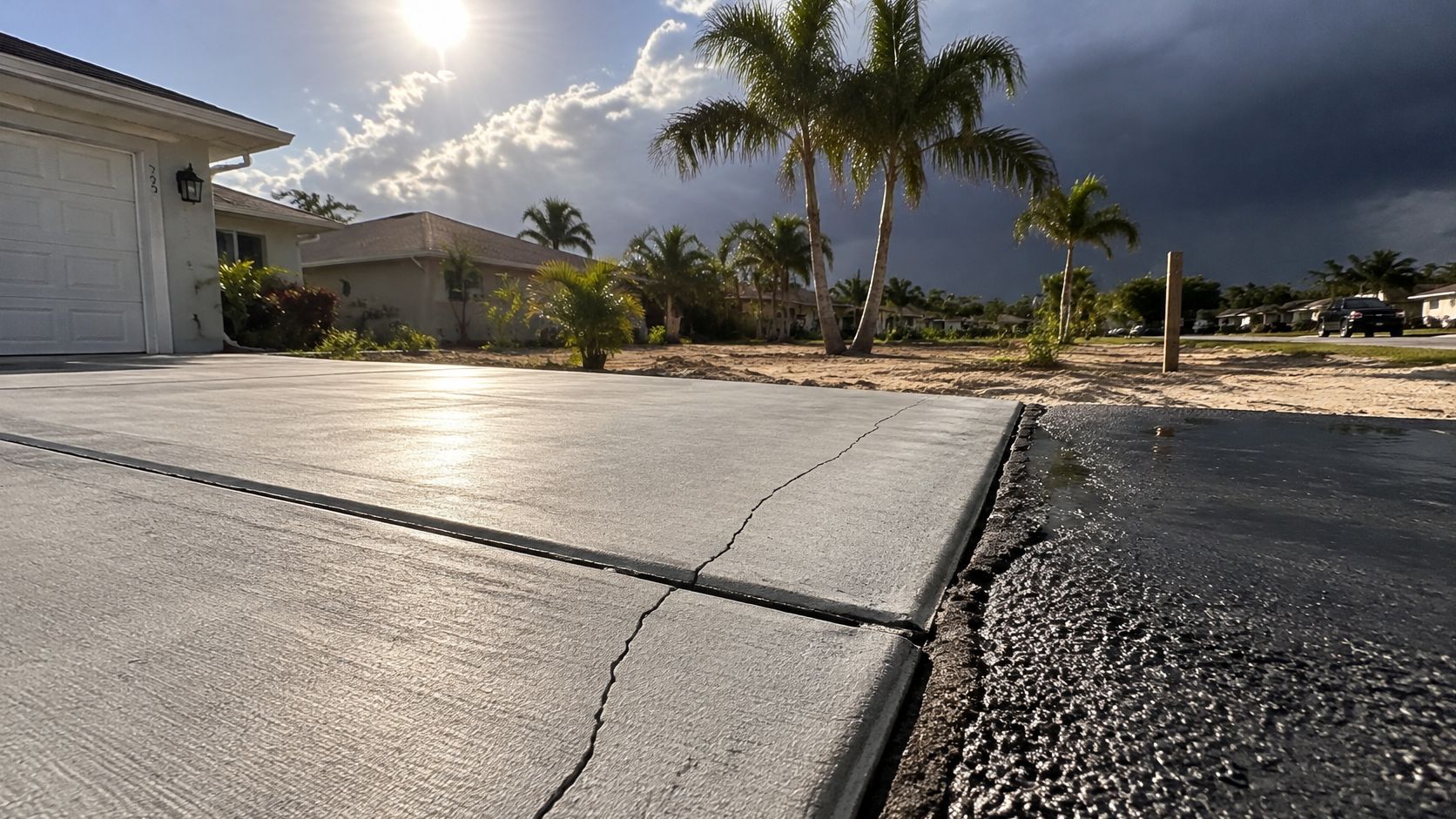
Heat drives daily expansion and contraction that widens joints and opens hairline cracks year after year. On asphalt, sun softens the surface and oxidizes the binder, which dries it out until aggregate ravels loose.
Ultraviolet exposure fades finishes and breaks down sealers fastest on south and west faces, so two driveways on the same street can age differently depending on which side of the house they sit.
Rain is the bigger structural force. Heavy summer storms saturate sandy subgrades, standing water under a slab drives settlement, and runoff along the edge of a parking lot undercuts the pavement that looked fine in dry season.
Traffic compounds all three. Retail centers in Ocala and The Villages, school lots, and connector roads through Belleview and Summerfield carry steady loads that wear a surface far faster than a residential cul-de-sac.
Scheduling is part of the answer. Pours planned for cooler mornings, and asphalt sealcoating applied before the summer peak rather than after it, protect the investment while the weather is still on your side. Cure discipline on a hot, dry, windy afternoon matters more than any additive, because rapid surface evaporation produces a weak, porous skin even when the mix itself was right.
Before you approve anything on site, check four things: sun exposure, slope, how the soil drains and what load the surface will carry.
ADA Routes and Parking Limits Property Owners Must Meet
Accessibility is a route problem, not a slab problem. Under the 2010 ADA Standards, an accessible route must connect site arrival points such as accessible parking spaces, passenger loading zones, public sidewalks and transit stops to the accessible entrance they serve. Replace one sidewalk panel or shift one access aisle and the whole chain has to be checked.
Two measurements do most of the work. ADA guidance on walking surfaces caps cross slope on an accessible route at 1:48, roughly 2.08%, which controls how much a walkway can tilt side to side for drainage. Forming and grading must hold that across the full width, not just at the ramp. For curb ramps built after January 26, 1991, ADA curb ramp guidance limits running slope to 8.33%, or 1:12, so measure rise and run with a level instead of trusting how a ramp looks.
| Element | Limit | What to check on site |
|---|---|---|
| Walking surface cross slope | No steeper than 1:48 (about 2.08%) | Measure across the full width of the sidewalk or route |
| Curb ramp running slope (built after January 26, 1991) | No steeper than 8.33% (1:12) | Measure rise and run, not appearance |
| Accessible path of travel | Continuous and unobstructed | Connects parking, sidewalks and entrances without breaks |
| Accessible parking and access aisle | Dimensions set by the 2010 ADA Standards | Check space size, aisle, sign and paint after every restriping |
Sequence matters as much as the numbers. Pavement repairs come first, restriping and sign placement after, otherwise fresh markings get torn out by the next tear-out. For the full set of requirements, see ADA sidewalk requirements, and build the walk-through around four items a concrete project changes: cross slope, ramp slope, route continuity and trip hazards.
Frequently Asked Questions About Concrete Contractors
How long should new concrete cure before cars drive on it
Treat it as a strength question, not a calendar question. The specification sets an opening strength, the contractor confirms it with field-cured test specimens or the mix design, and vehicles go on after that. Ask for the target in writing before the pour, and expect a specific answer rather than "a few days."
Can a cracked driveway be patched instead of replaced
Yes, when the crack is hairline, hasn't moved and water drains away from the slab. Settlement, ponding against the edge or a hollow sound underfoot means the base needs correcting first, and a patch there only buys a season.
Do I need a permit for a new driveway or sidewalk in Marion or Citrus County
Requirements follow the scope and the location, particularly where work touches a right-of-way, a drainage easement or a commercial accessible route. Confirm with the county building department before work begins, and expect a contractor to know which approvals apply and to say so in writing.
What should I expect at a free estimate
A site visit where the area gets measured, drainage and soil get checked, and questions get asked about the old slab. What comes back should be a written scope with a timeline and warranty, and no obligation to sign on the spot.
Next Steps for Your Concrete Project
Match the contractor to the project type before comparing anything else. Judge bids by the written scope, especially base correction, drainage and curing. Let the cause of the crack, not its width, decide between patching and replacement. Treat the traffic-release date as a strength target that gets verified.
Heat, rain and sandy subgrades apply all of that across Marion and Citrus County, from Ocala and Dunnellon to Inverness, Crystal River and The Villages. A free, no-pressure on-site estimate or consultation from Riverside Sealing & Striping, LLC gives you a scope to compare against the others. Bring the checklist from this guide to the visit, and ask the three questions out loud.
Riverside Sealing & Striping, LLC handles concrete driveways, patios, slabs and sidewalks as well as asphalt sealcoating and parking lot striping, which means one crew can look at the slab, the base under it and the lot around it without handing you off. That combination is what makes a written scope worth signing, especially where sandy soil and summer storms do the deciding. Visit Riverside Sealing & Striping, LLC and schedule a free, no-pressure estimate at your property, at a time that suits you.