
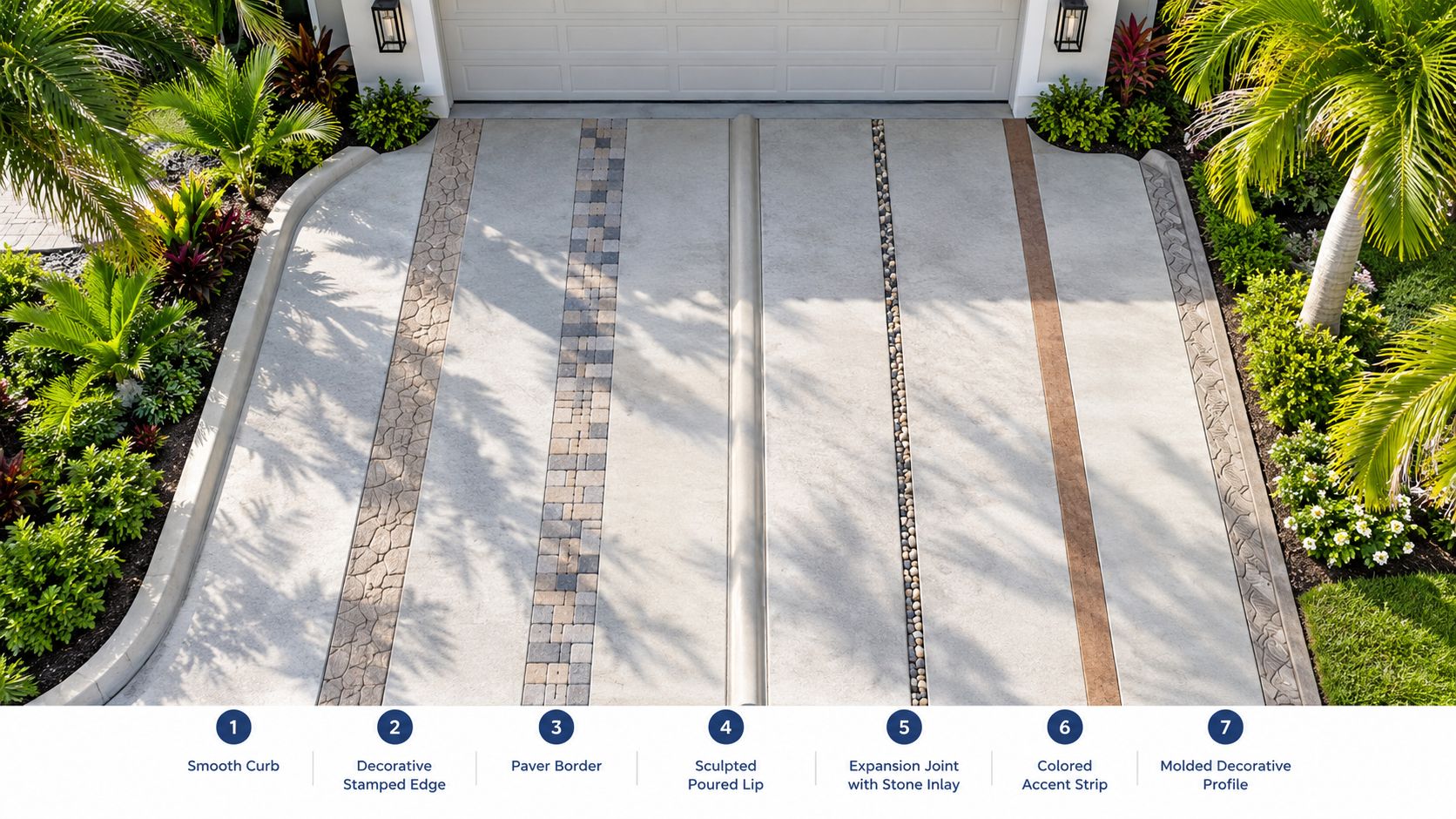
How often do homeowners choose a driveway edge for appearance, only to discover later that it doesn't control runoff, protect the slab, or resist vehicle loads? The right border does more than frame concrete. It can improve curb appeal, protect vulnerable edges from chipping, guide water away from planted areas, improve visibility, and give the entire property a more finished appearance.
The best concrete driveway edging ideas depend on the driveway design, drainage pattern, traffic, maintenance expectations, and budget. Those decisions matter in Marion County, FL, and Citrus County, FL, where heat, intense sun, humidity, heavy rain, irrigation, and daily vehicle movement can expose weak installation details quickly. A driveway in Ocala or Dunnellon may need a different edge treatment from a coastal-influenced property near Crystal River or a planned home in The Villages.
Riverside Sealing & Striping, LLC helps local property owners evaluate concrete and asphalt work before choosing a finish. The following seven options focus on how each edging treatment performs, where it fits, and what should be planned before installation.
Table of Contents
- 1. Decorative and Colored Concrete Edging
- 2. Stamped or Textured Concrete Edging
- 3. Metal or Aluminum Edging Strips
- 4. Permeable and Porous Concrete Edging With Drainage
- 5. Beveled or Chamfered Edge Finishing
- 6. Natural Stone or Exposed Aggregate Edging
- 7. Integrated Lighting and Reflective Edging
- 7-Way Concrete Driveway Edging Comparison
- Choose the Edge That Fits the Property
- Concrete Driveway Edging Questions
- A Practical Choice for Central Florida Properties
1. Decorative and Colored Concrete Edging
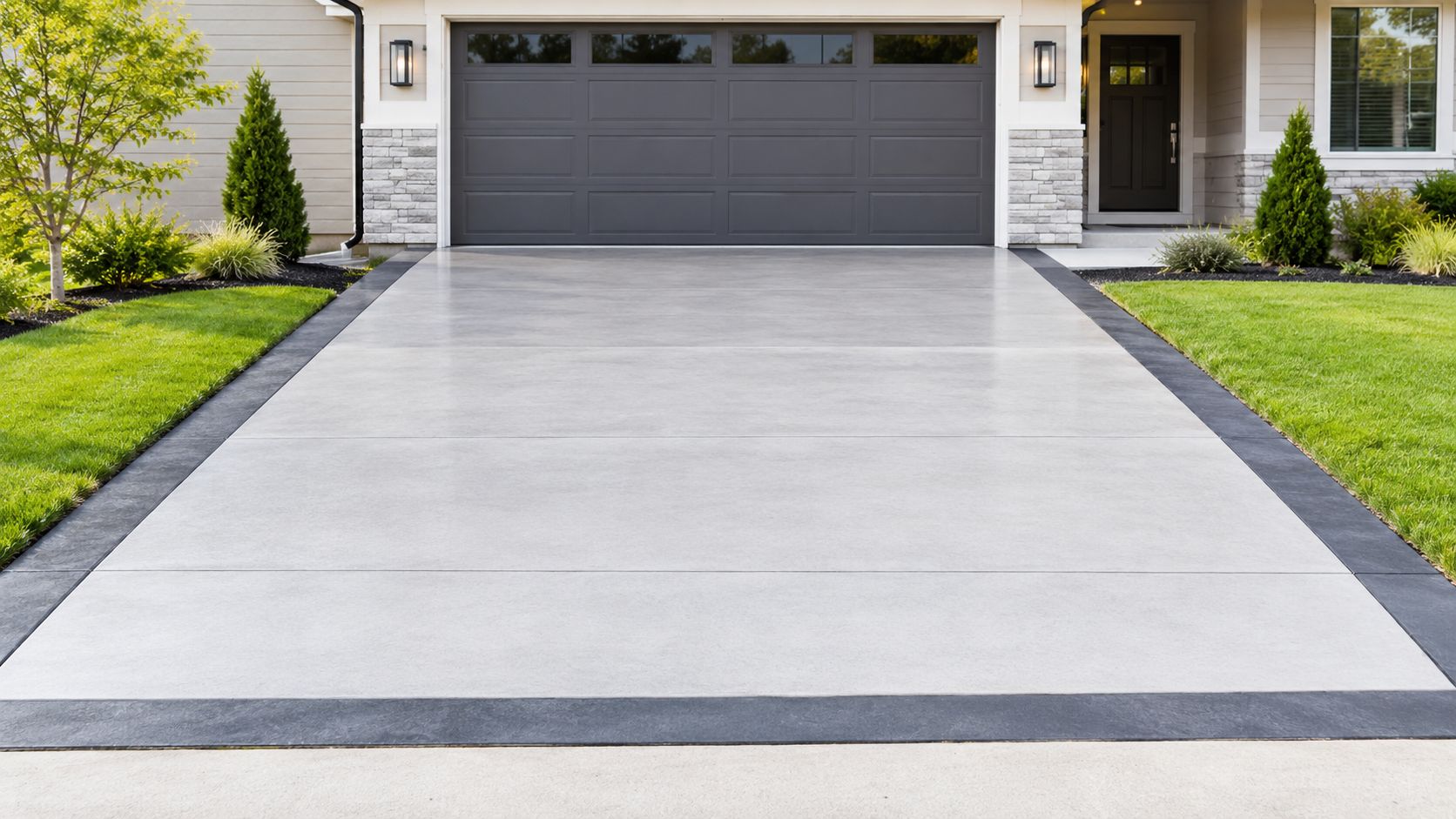
Decorative concrete borders give a driveway a deliberate frame without introducing a completely different paving material. A contractor can use contrasting concrete, integral color, stamped patterns, or a stain applied after curing. The most cohesive results usually pair a smooth driveway body with a darker, textured perimeter.
A charcoal border around light gray concrete can suit a newer home in The Villages. In Ocala, a stamped stone pattern may complement masonry, while an earth-tone border can work well with the brick exteriors common around Belleview. Crystal River vacation properties often benefit from muted amber or weathered colors that connect the driveway with coastal landscaping.
Color selection matters in Florida. Darker, restrained tones tend to disguise dirt and visual fading better than very light or highly saturated colors. Always request sample panels in the actual setting, because surrounding walls, pavers, mulch, and sunlight can change how a stain appears.
Plan the border as part of the slab
A decorative edge isn't a substitute for a structural restraint. Concrete finishing techniques can improve the appearance of the surface, but the base, reinforcement, slope, joints, and edge support still determine how the driveway performs.
A driveway border should also be proportionate. A narrow strip may disappear on a broad approach, while an oversized border can make a small residential drive look crowded. Where possible, the border should help direct water toward an approved drainage route instead of creating a low spot beside the lawn.
Practical rule: Choose the color and pattern after reviewing the drainage plan, not before. A beautiful border that traps water will create maintenance problems.
Decorative concrete works best for established homes, planned communities, and properties where curb appeal matters as much as function. It requires periodic cleaning and sealing, and stains can show unevenly if the concrete has inconsistent porosity. For that reason, test samples and careful surface preparation are more valuable than selecting the most dramatic color.
2. Stamped or Textured Concrete Edging
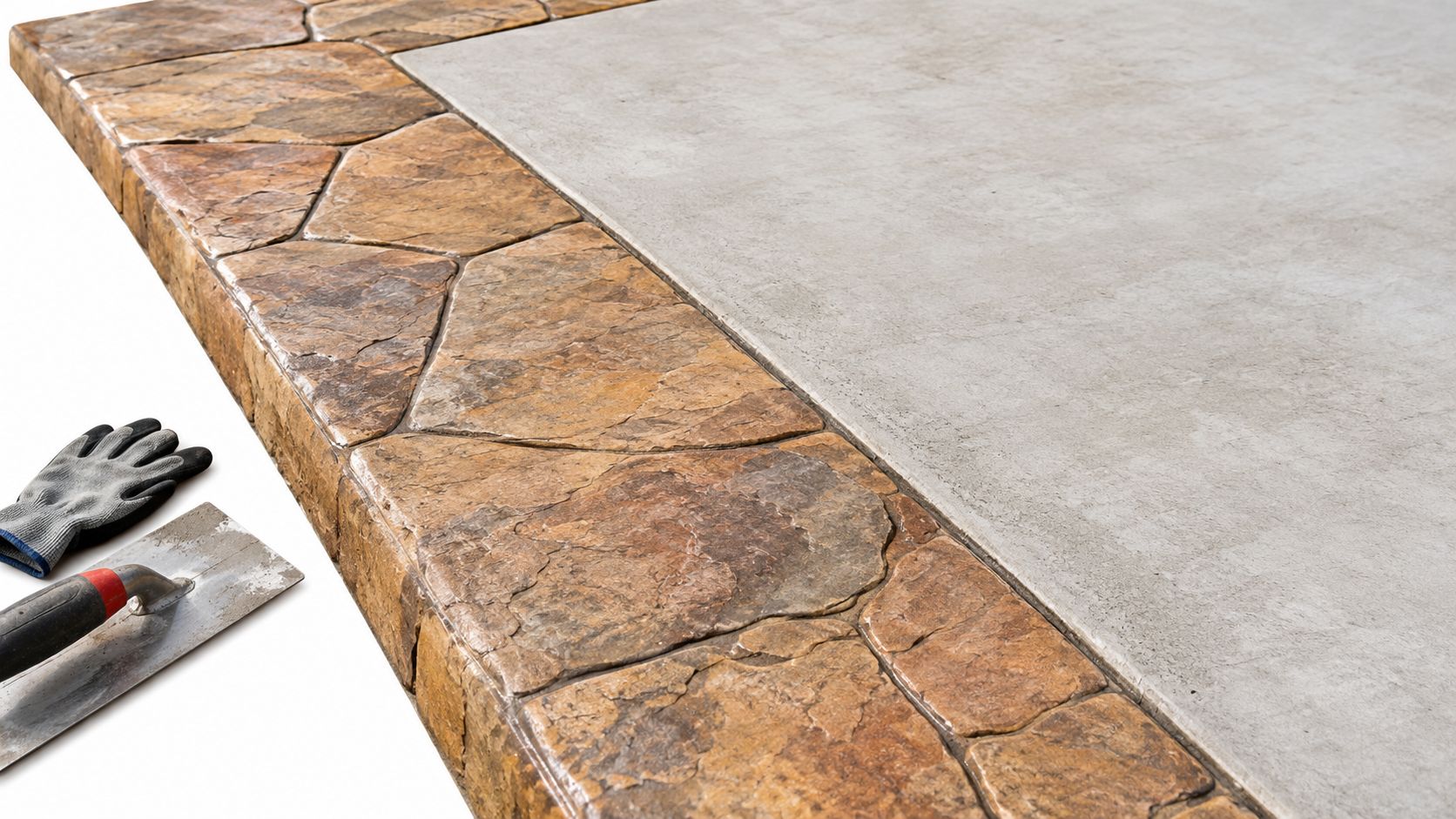
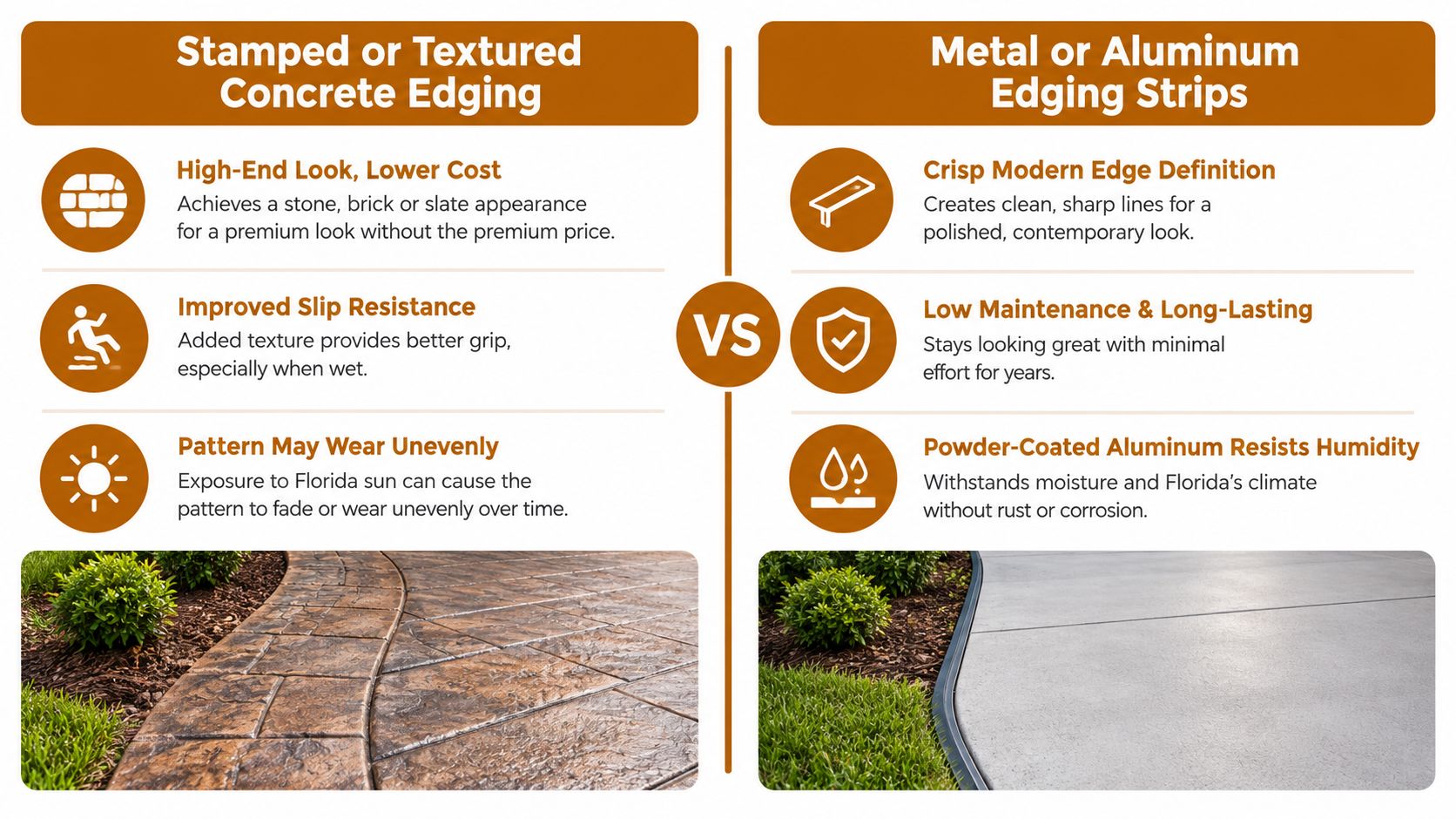
Stamped edging adds pattern where a plain driveway meets grass, planting beds, sidewalks, or a walkway. Fresh concrete can be pressed with patterns that resemble slate, brick, tile, or natural stone. The treatment delivers visual contrast without requiring individual stones or pavers to be installed along the entire perimeter.
A slate pattern can give a Dunnellon residence a more substantial entry, while ashlar slate may suit a larger property in Inverness. Brick-pattern borders can work around homes in Beverly Hills and Summerfield, and tumbled-stone textures can give an Ocala commercial property a more polished arrival area.
Texture also affects use. A modestly textured surface can improve traction near a walkway, but deeper patterns collect more dirt, leaf debris, and organic growth. Shallow texture is easier to clean, although it may show wear more readily in areas where vehicles turn repeatedly.
Match texture to maintenance
Stamped borders need a sound base and a consistent pattern. Uneven spacing, incomplete impressions, or inconsistent release color can make the edge look improvised rather than intentional. The main driveway can remain smooth so tires and sweeping equipment move easily, with the textured material reserved for the border.
Before choosing this option, review examples of stamped concrete driveway work in comparable light and landscaping. A sealer protects the appearance, but it won't correct poor pattern alignment or a border that was installed too close to standing water.
The most practical maintenance plan includes routine sweeping, occasional washing, and resealing when the surface begins to lose protection. Avoid assuming that a textured edge is maintenance-free. Its appearance depends on keeping the recesses clear and preventing contaminants from remaining on the surface.
This installation style is a strong fit for homeowners who want a high-end appearance but don't want the irregular movement that can occur with separate stone pieces. It isn't the best choice where the edge will be heavily exposed to lawn equipment, standing water, or frequent chemical staining without a realistic cleaning plan.
3. Metal or Aluminum Edging Strips
Metal edging creates the sharpest visual separation between concrete and the surrounding greenery. Aluminum and powder-coated steel can produce a narrow, modern line that suits contemporary homes, commercial properties, and planned communities where consistency matters.
Brushed aluminum can complement a modern driveway in The Villages. Black powder-coated steel may suit an Ocala business, while bronze-anodized aluminum can warm up the appearance of a Dunnellon home. In Summerfield HOA common areas, repeating the same profile across multiple drives can make the neighborhood look organized without adding decorative pattern to every slab.
The installation detail matters more than the material label. Bare metal can discolor or corrode in wet, humid conditions, and low-quality strips can bend, loosen, or fail after contact with lawn equipment. Powder-coated aluminum is generally a better Florida choice than untreated aluminum, while stainless steel fasteners help reduce rust at connection points.
Keep a crisp line without creating a hazard
Install the strip slightly below the concrete surface so it doesn't create a trip point or catch a tire. The surrounding grade should meet the edge cleanly, with enough slope to move water away from the driveway rather than hold it against the metal.
Metal edging is visually clean, but it isn't automatically a structural edge restraint for a vehicle-bearing driveway. For block paving or tarmacadam, industry guidance describes concrete-bedded edge restraints as essential, and technical driveway guidance calls for concrete support rather than loose decorative trim. Paving guidance explains the role of bedded and haunched edging, while driveway construction guidance describes concrete bases and reinforced restraints.
A metal line can finish the edge, but it shouldn't be asked to replace the concrete support that carries vehicle loads.
This option works for low-maintenance visual definition, especially on a well-built poured driveway. It works less well where the border must hold back loose gravel, pavers, or soil under repeated vehicle pressure. In those situations, specify the structural restraint first and use metal only as a finish where appropriate.
4. Permeable and Porous Concrete Edging With Drainage
A driveway edge should never be selected without considering where rainwater will go. Permeable or porous concrete uses an open structure that allows water to pass through the surface and into a properly prepared base. For Central Florida properties that receive intense summer rainfall, that can be useful when the site design supports infiltration.
An environmentally focused home in The Villages may pair a porous border with beds. An Ocala commercial property may use a permeable edge as part of a broader stormwater plan, while an HOA in Summerfield or a new Dunnellon development may incorporate drainage-oriented surfaces into common-area improvements.
Base preparation determines performance
Porous concrete isn't a decorative coating placed over an ordinary compacted base. The aggregate layer below must be designed to accept and hold water, and the surrounding grades must prevent sediment from washing into the open pores. Without that preparation, the surface can clog and lose the drainage benefit that justified the choice.
Regular cleaning also matters. Soil, mulch, grass clippings, and fine debris can reduce infiltration. A contractor should explain how the edge will be cleaned and what nearby outdoor materials could contribute to clogging.
Drainage planning must also avoid creating a continuous barrier that redirects water toward a house, sidewalk, or neighboring property. Guidance on driveway landscaping and edge restraints emphasizes the need to consider water flow alongside the border's appearance and structural role.
A slight surface slope can help water move toward the intended collection area, but slope alone can't fix a poor base or blocked outlet. Porous edging is most suitable for properties with a coordinated drainage design, not as a quick repair for an already wet driveway edge.
5. Beveled or Chamfered Edge Finishing
A square concrete corner is vulnerable because impact is concentrated at its sharpest point. A beveled or chamfered finish removes that abrupt corner and creates a small angled transition between the driveway surface and the outside face.
This detail can suit almost any property type. The Villages homes often benefit from a neat, understated bevel, while an Ocala commercial driveway may need a consistent edge treatment near pedestrian routes. Summerfield HOA drives can use the same profile across multiple homes, and a refined chamfer can complement the clean architecture of a Belleview property.
Protect the edge before damage starts
Specify the bevel during the original pour whenever possible. The finisher can form the detail while the concrete is workable, producing a more integrated result than cutting an established slab later. Existing driveways may still be modified with precise diamond-blade work, but the cut must be planned carefully to avoid weakening the slab or leaving an uneven transition.
Beveling isn't a drainage system, and it doesn't replace reinforcement, joint planning, or a supported edge. It does reduce the abrupt corner that gets struck by tires, carts, lawn equipment, and foot traffic. The contractor should match the finish to the driveway slope so the transition looks intentional rather than like a separate repair.
For larger slabs, control joints are part of the same durability conversation. One homeowner-focused concrete association recommends joints no more than 10 feet apart, cuts to one-quarter of the slab thickness, and a centerline joint when a driveway is wider than 12 feet. Its driveway guidance explains those joint recommendations. Another concrete driveway best-practices guide describes joint spacing, saw-cut timing, and depth requirements that help direct cracking to planned locations.
A beveled edge is a practical choice when the priority is protecting the slab and reducing sharp transitions. It can also be combined with colored concrete, a narrow decorative band, or a broom-finished driveway body without making the project visually busy.
6. Natural Stone or Exposed Aggregate Edging
Natural stone and exposed aggregate borders connect the driveway to the surroundings more directly than a plain concrete strip. The finish may expose selected gravel or pebbles within the concrete, or it may use a separate row of stone beside the slab. Both approaches add texture and an organic character.
Crushed granite can give a The Villages driveway a refined appearance, while colorful river rock may suit an Ocala home with informal planting. Mixed-material edging can work particularly well around Dunnellon and Crystal River properties, where owners may want the driveway to feel connected to natural surroundings. Slate or granite aggregate can provide a more formal finish at an upscale Belleview residence.
Control the transition between materials
Exposed aggregate should be consistent. If the stones are revealed too far in one area and barely visible in another, the border can look patchy. The selected aggregate should also complement the home, retaining walls, mulch, and planting beds rather than competing with them.
Separate stone pieces introduce a different maintenance issue. Individual stones can shift or settle, and gaps can allow grass to grow through. A continuous exposed-aggregate concrete edge offers a more stable line, but it still needs proper support and surface protection.
Natural materials look best when the transition is planned, not when leftover stone is used to hide an uneven driveway edge.
Pressure washing can remove dirt from textured surfaces, but excessive pressure or poor technique can dislodge exposed material and damage the cement paste around it. Ask for a sample before installation and inspect the edge periodically for loose stones, surface deterioration, or areas where soil is washing onto the driveway.
This treatment suits established properties that value integration. It may be a poor fit for owners who want the simplest possible cleaning routine or who expect to remodel the driveway layout frequently. Once a continuous border is integrated into the slab, changing its shape later usually requires cutting or removal.
7. Integrated Lighting and Reflective Edging
Lighting changes the driveway edge from a daytime design feature into a nighttime safety and visibility detail. Options include solar fixtures, hard-wired LED systems, reflective aggregate, and passive glow materials. The best choice depends on whether the owner wants functional illumination, a subtle outline, or a stronger architectural effect.
Warm-white or amber fixtures can suit a residential driveway in The Villages or a high-end Ocala home. A security-focused property may prefer a brighter perimeter, while an upscale commercial site may need coordinated pathway lighting rather than small decorative fixtures. New Central Florida developments can also integrate lighting with smart-home or property-management systems.
Protect the electrical details
Florida moisture creates a demanding environment for exterior lighting. Fixtures need waterproofing, connections need protection, and the installation should allow access when a component eventually fails. Solar systems can reduce wiring requirements and ongoing electrical use, but they depend on suitable sun exposure and still need cleaning and battery or component maintenance.
Lighting should be recessed or carefully positioned so it doesn't create a trip hazard, interfere with vehicles, or make mowing difficult. The edge must retain a clean slope, and conduit should be planned before concrete placement whenever possible. Retrofitting a finished slab can increase disruption and may produce a less integrated appearance.
For commercial facilities, lighting should be coordinated with broader pavement safety work. Riverside's parking lot lighting service can be considered alongside parking lot striping, directional markings, and pedestrian routes rather than treated as an isolated decorative upgrade.
Check local requirements and HOA rules before installation. A blue or highly visible light may look appealing in a rendering but feel out of place in a residential neighborhood. Request photos or a demonstration from a comparable project, especially when choosing between discreet path lights and lighting built directly into the edge.
7-Way Concrete Driveway Edging Comparison
| Option | Implementation Complexity 🔄 | Resources & Time ⚡ | Expected Outcomes / Impact 📊 | Ideal Use Cases 💡 | Key Advantages ⭐ |
|---|---|---|---|---|---|
| Decorative & Colored Concrete Edging (Borders and Stains) | Medium, planned during pour or applied as overlay; professional finish recommended | Medium cost; moderate install time; reseal every 1–3 years | Strong curb appeal and increased property value; durable when integrally poured; colors may fade in sun | Homeowners, HOAs, real estate staging, upscale residential | Customizable colors/finishes; cost-effective visual upgrade |
| Stamped or Textured Concrete Edging | High, requires skilled finisher and on-site stamping during finishing | Medium–High cost; adds finishing time; periodic sealing and cleaning | Upscale stone/brick appearance; improved traction; pattern may wear or trap dirt | Budget-luxury homeowners, HOAs, commercial entries | High-end look at lower cost than real stone; texture adds depth & slip resistance |
| Metal or Aluminum Edging Strips | Medium, precise alignment and embedding; professional install advised | Higher material cost; relatively quick install; low ongoing upkeep if powder-coated | Crisp, modern edge definition; prevents edge crumbling; long-lasting if corrosion protected | Modern residences, commercial properties, property managers, HOAs | Durable, low-maintenance, clean contemporary aesthetic |
| Permeable / Porous Concrete Edging with Drainage | High, specialized mix, base prep and drainage design required | Higher cost; longer install; requires routine cleaning to prevent clogging | Reduces runoff and standing water; supports stormwater management and sustainability | Environmentally conscious homeowners, stormwater-regulated sites, flood-prone areas | Environmental benefits; improves drainage and reduces need for separate drains |
| Beveled or Chamfered Edge Finishing | Low, simple when specified during pour; moderate if cut after cure | Low cost if planned; quick install; minimal maintenance | Safer edges, reduced spalling and edge deterioration; subtle aesthetic improvement | Any driveway, high-traffic areas, ADA-conscious properties, HOAs | Cost-effective protection against chipping and tripping; refined finish |
| Natural Stone or Exposed Aggregate Edging | Medium–High, skilled finishing to expose aggregate or install stone strips | Higher cost; longer install; periodic resealing and pressure washing | Natural, organic appearance; improved traction; hides dirt well | Luxury homes, naturalistic landscapes, scenic properties, upscale HOAs | Unique, one-of-a-kind aesthetic; blends with landscaping; durable when sealed |
| Integrated Lighting & Reflective Edging | Very High, electrical work, waterproofing, and precise placement; tech expertise needed | Highest cost; longest install time; ongoing electrical maintenance/repairs | Enhanced nighttime safety and navigation; strong modern curb appeal; higher perceived security | Luxury residences, smart homes, security-focused properties, commercial sites | Safety + ambience; premium, differentiating feature that increases value |
Choose the Edge That Fits the Property
The best concrete driveway edging idea is the one that solves the property's actual problem. Decorative color and stamped texture make sense when curb appeal is the priority and the owner accepts periodic cleaning and sealing. Beveled edges are more understated, but they protect vulnerable corners and reduce abrupt transitions near walkways and vehicle paths.
Metal or aluminum strips create a crisp, contemporary line with relatively little visual bulk. They're a good fit for modern homes, commercial properties, and HOA settings that need consistent lines. They shouldn't be treated as a replacement for a properly supported structural restraint where the driveway carries vehicle loads or where pavers and loose materials could spread.
Permeable concrete is the drainage-focused choice. It can help manage water at the edge when the base, surrounding grade, and maintenance plan are designed together. It won't solve a blocked outlet, a poor subgrade, or water flowing toward the home. Natural stone and exposed aggregate work best when the driveway needs to blend with planting beds and surrounding materials, but both demand careful control of transitions, dirt, and loose material.
Lighting improves nighttime visibility and can add a distinctive finish, although fixtures, wiring, waterproofing, and future replacement need to be planned before the pour. In some properties, a simple reflective edge or low-profile fixture is more practical than a highly illuminated border.
Florida conditions make the installation details important in Marion County, FL, Citrus County, FL, and nearby communities such as Inverness, Homosassa, Lecanto, Hernando, and Silver Springs. Heat and ultraviolet exposure affect finishes. Humidity and heavy rain test drainage. Traffic exposes weak edges, poor joints, and inadequate base preparation. Industry guidance identifies concrete edging as a practical restraint for driveways, with common retail edging dimensions around 3 to 4 inches wide and 4 to 6 inches high for driveway applications. Retail guidance on concrete driveway edging helps explain why proportion and support matter when the border must stabilize adjacent materials.
A professional evaluation makes sense for a new driveway, damaged edges, recurring ponding, settlement, complicated finishes, or a project involving walkways and parking areas. Riverside Sealing & Striping, LLC is a licensed and insured local contractor and Concrete and Asphalt Experts in Marion and Citrus County. The company provides reliable scheduling, high-quality workmanship, free no-pressure consultations, and estimates for concrete work, asphalt sealcoating, and parking lot striping.
Concrete Driveway Edging Questions
Does driveway edging need to be structural?
For traffic-bearing driveways, the edge should be supported by a properly prepared base and concrete restraint rather than installed as loose decorative trim. This is especially important beside pavers, block paving, tarmacadam, or gravel that could move under vehicle loading.
Which edging is best for heavy Florida rain?
Permeable concrete can be appropriate when the base and drainage design support infiltration. A conventional concrete edge can also work well when it has the correct slope and directs water toward a planned drainage route. Neither option should create a barrier that traps water beside the slab or foundation.
Can decorative edging be added to an existing driveway?
Some finishes can be added or cut into an existing driveway, but the result depends on slab condition, available edge width, settlement, and the relationship between the driveway and surrounding grade. A professional should inspect the surface before recommending an overlay, border, or saw-cut detail.
Is a beveled edge better than a square edge?
A bevel removes the sharp corner that is more likely to chip or be struck by tires and equipment. It doesn't replace good concrete placement, reinforcement, control joints, or edge support, but it can be a useful finishing detail for new and selected existing driveways.
When should a contractor evaluate the driveway?
Arrange an evaluation when the edge is cracking, sinking, separating from the surrounding area, holding water, or causing a trip concern. An evaluation is also worthwhile before installing lighting, decorative borders, or a new driveway where drainage and finish decisions need to be coordinated.
A Practical Choice for Central Florida Properties
Concrete driveway edging should be selected as part of the driveway system, not as an afterthought. Color and texture add curb appeal. Beveling protects vulnerable corners. Metal creates a clean line. Permeable concrete addresses drainage when the base is designed for it. Natural aggregate connects the driveway to the surrounding yard, while lighting improves nighttime visibility.
Every option has a trade-off. The most decorative treatments need surface care. Metal needs quality materials and careful installation. Porous edges need protection from clogging. Stone needs attention to shifting and vegetation. Lighting needs waterproof components and a plan for replacement. None of these finishes can compensate for poor grading, inadequate base preparation, or an unsupported driveway perimeter.
Those fundamentals matter in Ocala, Dunnellon, Belleview, Summerfield, The Villages, Crystal River, Inverness, Homosassa, Lecanto, Hernando, and Silver Springs. Riverside Sealing & Striping, LLC serves homeowners, HOAs, businesses, churches, investors, and property managers throughout Marion County, FL, Citrus County, FL, and surrounding Central Florida communities. The team handles concrete driveway installation and replacement, patios, slabs, sidewalks, site preparation, finishing, asphalt sealcoating, parking lot striping, and ADA-related pavement improvements.
For a new driveway, damaged edge, drainage concern, or complex decorative finish, a site evaluation can prevent an attractive idea from becoming a recurring repair. Ask about a free, no-pressure consultation and estimate, and discuss whether your project needs new concrete work, asphalt sealcoating, or parking lot striping as part of a broader pavement plan.
Riverside Sealing & Striping, LLC offers concrete driveway installation and replacement, practical edging and finishing evaluations, asphalt sealcoating, and parking lot striping across Marion and Citrus counties. Visit Riverside Sealing & Striping, LLC to request a free, no-pressure consultation or estimate for your Central Florida property.