
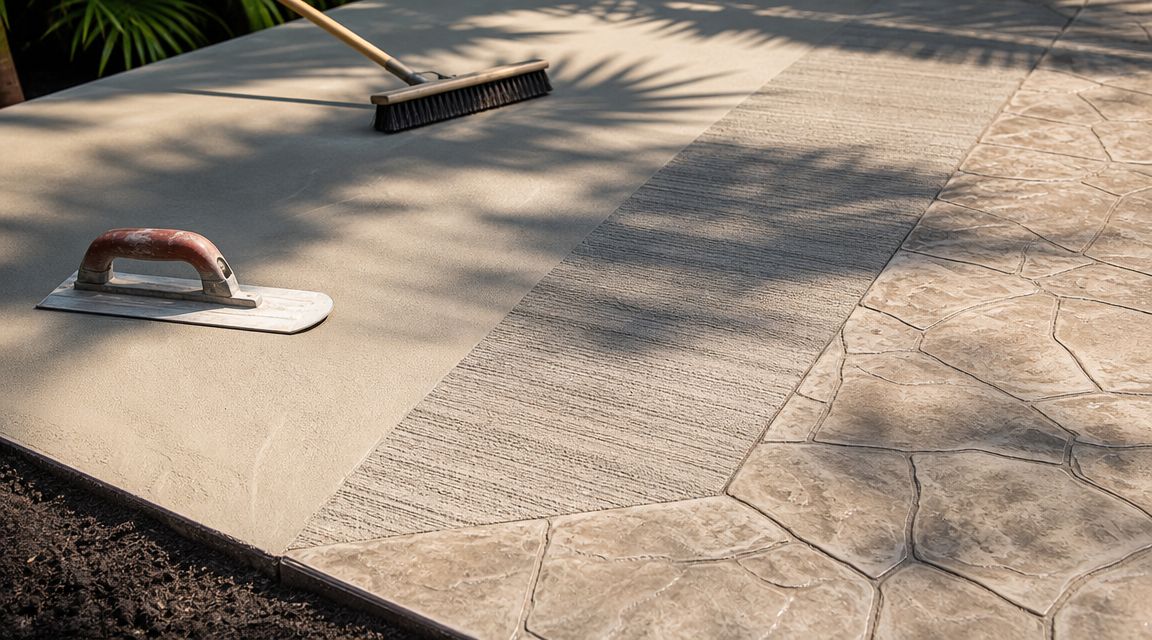
If you're planning a new driveway in Ocala, replacing a worn patio in Crystal River, or pricing a sidewalk upgrade for a property in Inverness, the finish deserves more attention than it often receives. Homeowners usually focus on shape, size, and color first. Contractors look at the finish because that's what controls how the slab feels underfoot, how it sheds water, how it wears, and how safe it stays when Florida rain rolls in.
That matters in Marion County, FL and Citrus County, FL, where heat, humidity, heavy rain, and daily use put concrete to work fast. A finish isn't just decoration. It's part of the slab's performance. The right texture can make a Dunnellon driveway safer in wet weather. The wrong finish on an exposed patio in Homosassa can leave you with a surface that's slick, hard to maintain, or out of place.
This guide is built around a practical question: which concrete finishing techniques fit the job? Not every slab should be finished the same way, and the difference between a durable result and a problem surface often comes down to matching the technique to the application.
Table of Contents
- Your Guide to a Perfect Concrete Finish in Central Florida
- The Foundation of a Great Finish Timing and Preparation
- Popular Concrete Finishing Techniques Unpacked
- Decorative Finishes for Patios and Pool Decks
- Choosing the Right Finish for Florida's Climate
- Maintenance Sealing and Troubleshooting
- When to Hire a Professional in Marion and Citrus County
- Frequently Asked Questions About Concrete Finishes
- What is the best concrete finish for a Florida driveway
- When should finishing start after concrete is poured
- Can old concrete be refinished instead of replaced
- Is stamped concrete too slippery for patios or pool areas
- Which finish is easiest to maintain
- Does Florida weather really change how concrete should be finished
Your Guide to a Perfect Concrete Finish in Central Florida
A good concrete slab starts below the surface with base prep and placement, but it's typically judged by its top. That's fair. The finish is what you see every day when you pull into the driveway in Belleview, walk across a patio in Lecanto, or manage a storefront entrance near The Villages. It affects curb appeal, traction, cleanup, and long-term wear.
Concrete finishing techniques didn't appear out of nowhere. The trade developed over a long chain of material improvements. Early concrete-like materials were used by Nabataean builders around 6500 BC, and by 700 BC they were using hydraulic lime for concrete floors and waterproof cisterns. Then 1824 brought Portland cement, and 1930 brought air-entraining agents that improved freeze-thaw resistance and workability, according to the history of concrete milestones summarized by InterNACHI. Those changes are a big reason modern steps like screeding, floating, edging, and troweling became standardized.
For a Florida property owner, the key point is simple. The finish has to fit the use. A driveway in Dunnellon needs different traction than a covered interior slab. A pool deck in Summerfield should feel different under bare feet than a garage floor in Ocala.
Practical rule: The best-looking finish isn't always the best-performing finish. On exterior concrete, safety and drainage usually matter just as much as appearance.
That judgment call is where local experience helps. Concrete and Asphalt Experts in Marion and Citrus County look at the slab's purpose first, then choose the finish that makes sense for the weather, traffic, and maintenance the owner is willing to handle.
The Foundation of a Great Finish Timing and Preparation
A smooth result doesn't come from a last-minute trowel pass. It comes from reading the slab correctly from the moment the concrete is placed.
Why timing matters more than most people realize
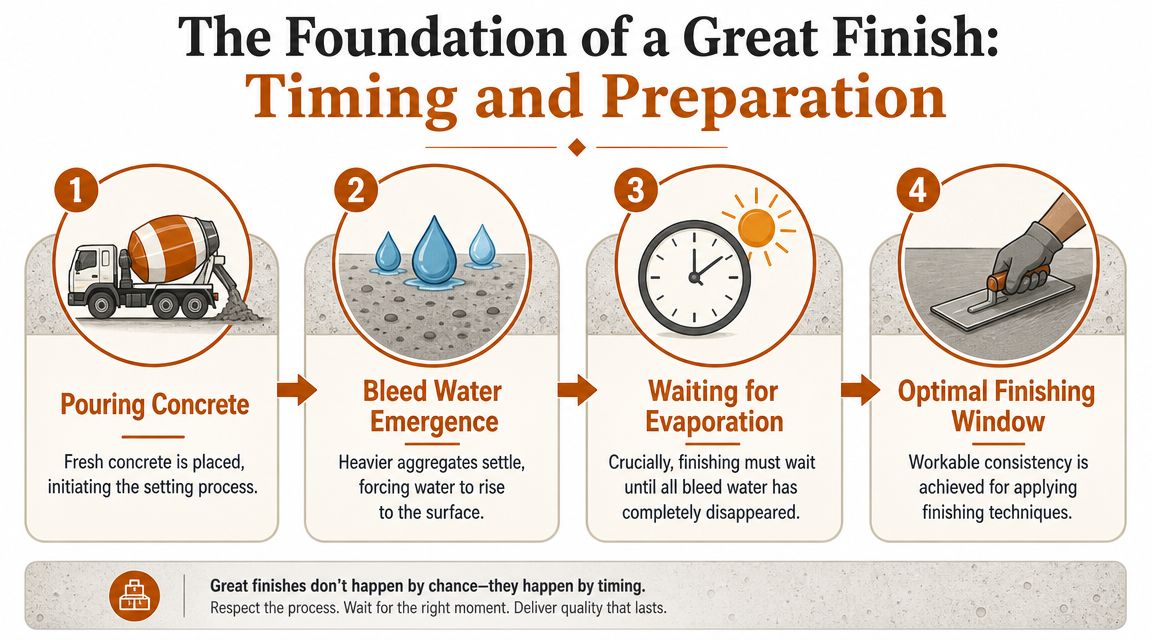
Fresh concrete releases bleed water as the heavier material settles and moisture rises to the surface. That water is the first thing a finisher watches. If someone starts working the slab while that surface water is still there, the top layer can be weakened.
Trade guidance is consistent on this point. Hand floating should start only when pressing the palm into the surface leaves an indentation between 1/4 inch and 3/8 inch, and broom finishing should happen only after bleed water is gone and the slab is firm enough that the broom doesn't drag aggregate, as explained in this concrete finishing timing guide.
That sounds simple, but in Central Florida it takes judgment. A shaded slab in Beverly Hills won't behave exactly like one baking in open sun in Silver Springs. Humidity, breeze, and direct exposure all change the working window. That's why homeowners who want a better sense of the full schedule usually start by understanding how long concrete takes to cure, because finishing and curing are related but not the same thing.
The basic finishing sequence
The order matters. Crews don't jump straight to the final texture.
- Screeding levels the fresh concrete to grade.
- Floating smooths the surface and brings paste upward.
- Edging and jointing help shape the perimeter and control cracking.
- Final texture work creates the finish that matches the slab's use.
A slab that gets rushed usually tells on itself later. It may dust, craze, scale, or wear unevenly.
Wait for the slab to tell you it's ready. Don't force the clock, and don't finish by habit alone.
That's one of the hardest parts for inexperienced crews. The tools matter, but reading the slab matters more.
Popular Concrete Finishing Techniques Unpacked
Most residential and light commercial projects in Central Florida come down to a small group of finishes. Each has a place. Each also has a wrong place.
Broom finish
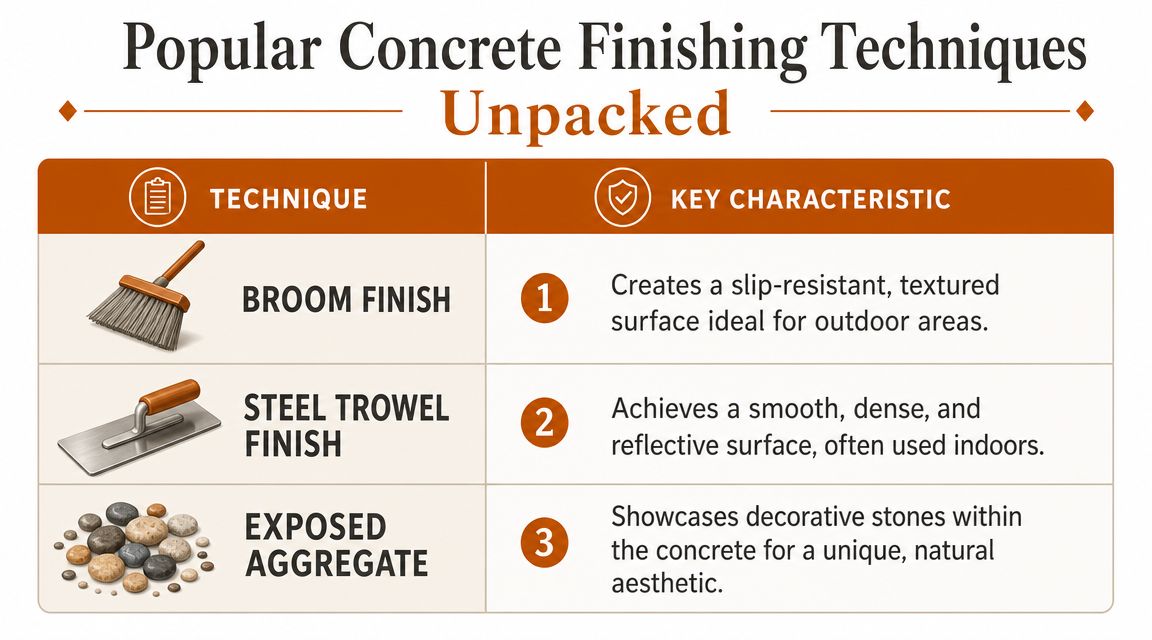
A broom finish is the workhorse for exterior concrete. After the slab is properly floated and firm enough, a broom is drawn across the surface to create light texture. That texture improves traction, which is why this finish shows up so often on driveways, sidewalks, and entry walks.
A trade reference for commercial construction notes that a broom finish is commonly used on exterior slabs because it creates a slip-resistant profile, while a steel-trowel or burnished finish densifies the top layer and produces a harder, smoother surface better suited to interior or protected areas, according to this guide to concrete finishes and performance.
For a driveway in Homosassa or a front walk in Hernando, broom is often the practical choice because it balances appearance, safety, and ease of maintenance.
Steel trowel finish
A steel trowel finish aims for a denser, smoother surface. It works well where you want a harder top layer and don't need outdoor traction. Garage slabs, utility rooms, some covered patios, and certain interior commercial spaces are common examples.
What doesn't work is using a slick troweled finish in the wrong exposed area. On an open patio that gets regular rain, it can become more slippery than many owners expect. It also shows surface imperfections differently than a textured finish. On the right slab, it looks clean and performs well. On the wrong slab, it becomes a callback.
Stamped concrete
Stamped concrete is chosen for appearance first. The slab is textured with mats or tools to mimic stone, brick, slate, or other patterns. It can give a patio or walkway a more decorative look without changing the basic strength of the slab itself.
This finish is popular for back patios, garden paths, and some front entry areas where design matters as much as function. The trade-off is maintenance and execution. If the timing is off, the pattern can lose definition. If the texture is too shallow for the setting, the surface may not provide the grip owners want.
Exposed aggregate
Exposed aggregate reveals decorative stone at the surface instead of hiding it under a fully smooth cement paste layer. The look is more natural and textured than plain broom or trowel finishes.
It fits some patios, walkways, and garden-adjacent areas well, especially when the goal is to break up the plain look of standard gray concrete. But it isn't for everyone. It can be rougher under bare feet, and repairs can be harder to blend than they are on a standard broom-finished slab.
| Finish type | Best fit | Main advantage | Main trade-off |
|---|---|---|---|
| Broom | Driveways, sidewalks, outdoor slabs | Better traction | More utilitarian look |
| Steel trowel | Interior or protected slabs | Smooth, dense surface | Less slip resistance outdoors |
| Stamped | Decorative patios and entries | Strong visual appeal | Needs skilled timing and upkeep |
| Exposed aggregate | Decorative exterior areas | Texture and natural look | Harder to patch cleanly |
For most owners, the choice gets clearer when they stop asking which finish is fanciest and start asking how the slab will be used.
Decorative Finishes for Patios and Pool Decks
A plain slab can do the job, but many patio and pool projects call for more character. In places like The Villages, Summerfield, and Ocala, decorative concrete is often less about showing off and more about making outdoor living areas feel finished.
Where decorative finishes make sense
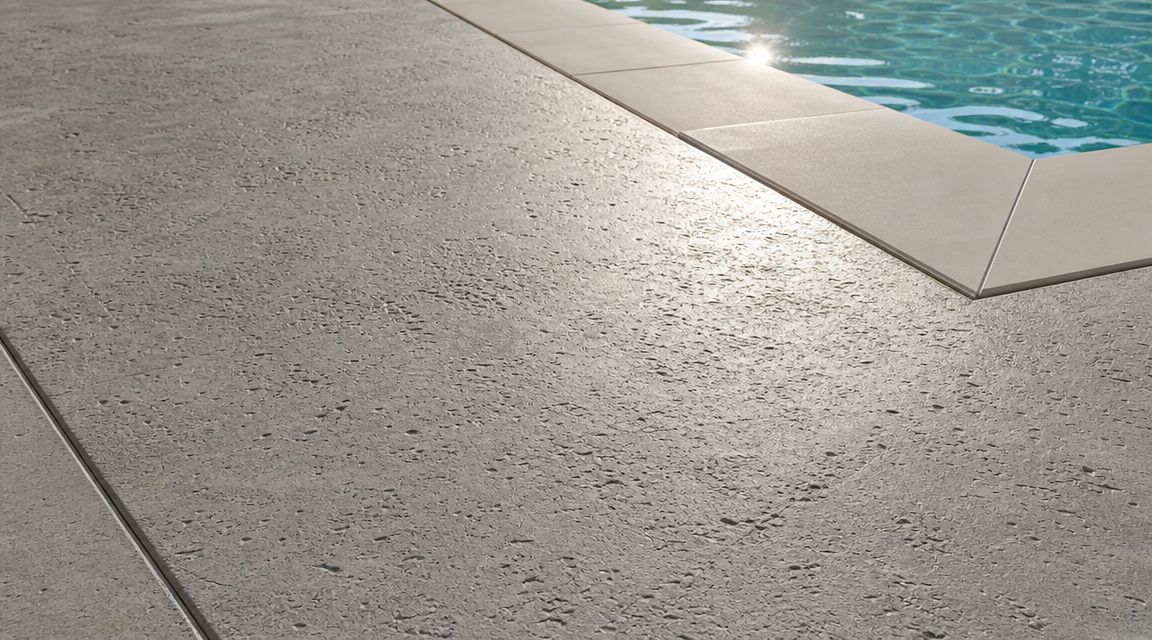
A pool deck is a good example. Owners usually want texture, visual warmth, and a surface that doesn't feel like a warehouse floor. That's where decorative approaches such as brushed textures, stamped patterns, or more subtle specialty finishes can fit.
Color can also change the whole feel of a patio. Some owners prefer a natural concrete look with a little texture. Others want a patterned surface that ties into pavers, landscaping, or the home's exterior.
If you're comparing pattern-driven surfaces, this breakdown of stamped concrete driveway pros and cons helps clarify where decorative concrete works well and where a simpler finish may be the smarter move.
What property owners should weigh before choosing style over simplicity
Decorative work has less margin for error. Pattern depth, release, cleanup, color consistency, and sealing all affect the final result. A finish that looks great in a photo may not be the right fit next to a pool if the texture is too smooth or the maintenance is more than the owner wants.
A short visual example helps if you're comparing decorative possibilities:
For patios in Crystal River or covered outdoor spaces in Lecanto, decorative concrete can absolutely enhance the property. It just works best when the finish still respects the way people will walk on it, clean it, and live with it year-round.
Choosing the Right Finish for Florida's Climate
Florida doesn't forgive bad finishing decisions. A slab in Central Florida deals with strong sun, sudden rain, warm surface temperatures, and humidity that can change how the top sets. That's why the right finish in Marion County, FL may not be the same choice as the right finish for an interior slab under roof in Citrus County, FL.
Driveways sidewalks and open slabs
For exposed concrete, traction usually needs to lead the conversation. A driveway in Inverness, a sidewalk in Belleview, or a patio extension in Dunnellon will get wet. Sometimes often. In those areas, a textured finish usually makes more sense than a slick one.
The technical risk isn't only slipperiness. It's also finishing at the wrong moment. Industry guidance says crews need to wait until bleed water has evaporated before brooming or steel-troweling because finishing too early can trap water at the surface, increase the local water-cement ratio, and lead to weak laitance, blistering, or later delamination, as explained by the Portland Cement Association's concrete finishing guidance.
That rule matters even more in humid weather. When the air is heavy and the slab is slow to release surface moisture, impatient finishing can create a good-looking surface for a short time and a failing surface later. Homeowners don't always see the mistake on pour day. They see it months later when the top starts acting soft, flaky, or uneven.
On Florida exterior slabs, the safest choice is often the finish that gives up a little shine in exchange for better footing and fewer problems in wet weather.
Covered spaces and lower-risk surfaces
Not every slab needs broom texture. A covered lanai in Summerfield, a garage in Ocala, or a protected interior service area may benefit from a denser, smoother finish. Those spaces are less exposed to rain, and cleaning can be easier on a tighter surface.
Even then, the finish still has to match the use. A garage that sees foot traffic, tools, and rolling equipment may do well with a hard, smooth top. A poolside walkway almost never should be treated the same way.
In practical terms, matching the finish to the climate means asking four questions:
- How wet will it get: Open exposure changes the traction requirement.
- How much sun will it take: Surface appearance and maintenance change with UV exposure.
- How will people use it: Bare feet, car tires, carts, and foot traffic all favor different textures.
- How much upkeep is acceptable: Decorative finishes can look excellent, but they usually ask more from the owner over time.
That's the local side of concrete finishing techniques. The slab has to fit Florida, not just the drawing.
Maintenance Sealing and Troubleshooting
Finishing doesn't end when the texture is done. A good surface still needs care if you want it to hold up in Central Florida weather.
Why sealing matters after the slab cures
Sealing is one of the simplest ways to protect a finished slab from moisture intrusion, staining, and everyday wear. On exterior concrete in places like Crystal River, Beverly Hills, and Homosassa, that protection matters because the slab is exposed to rain, sun, and organic debris for long stretches.
For decorative surfaces, sealing also helps preserve the look. For plain broom-finished concrete, it supports easier cleanup and added surface protection. It isn't a magic shield, but skipping it often shortens the life of the appearance people paid for.
Common finish problems and what usually caused them
Some surface issues start long before the owner notices them.
- Dusting: The surface develops a powdery feel. This often points back to a weakened top layer.
- Crazing: Fine shallow cracking can show up when the surface conditions and finishing process weren't well balanced.
- Scaling or flaking: The top begins to break away in patches, which can be related to poor finishing timing or surface weakness.
If you're seeing top-layer breakdown, this overview of what concrete spalling is and why it happens is a useful next step because surface failure can look similar even when the underlying cause differs.
A homeowner can handle cleaning and routine observation. Actual correction depends on the problem. Some slabs need sealing. Some need surface repair. Some need replacement because the finish was compromised from the start.
A defective finish usually isn't just a cosmetic problem. It can be a sign that the surface was overworked, mistimed, or never properly protected after placement.
When to Hire a Professional in Marion and Citrus County
A small shed pad is one thing. A driveway, front walk, patio extension, ADA-oriented walkway, or commercial slab is something else.
Projects that usually shouldn't be treated as DIY
Large or highly visible concrete work usually needs professional handling because the finish depends on everything under it. Subgrade prep, form layout, slope, placement speed, joint planning, and finish timing all happen in a narrow sequence. If one part goes wrong, the finish won't save the slab.
That matters for homeowners in Ocala, Dunnellon, and Silver Springs, and it matters just as much for property managers in Inverness, Lecanto, and Crystal River. The larger the slab, the less forgiving the process becomes.
What professional finishing changes
Professional crews don't just bring tools. They bring judgment about when not to touch the slab yet, what finish fits the site, and how to avoid the common mistakes that create callbacks. That's especially important in Florida where surface conditions can shift fast during a pour.
For owners who need both residential concrete work and pavement maintenance support, Riverside Sealing & Striping, LLC is one local option for driveways, patios, sidewalks, asphalt sealcoating, and parking lot striping across Central Florida. That's useful for HOAs, churches, retail properties, and homeowners who'd rather coordinate with one licensed and insured contractor that understands both sides of exterior surfaces.
Concrete and Asphalt Experts in Marion and Citrus County should be able to do three things clearly: explain the finish recommendation, match it to the actual use of the slab, and give you a realistic schedule. If they can't do that, keep looking.
Frequently Asked Questions About Concrete Finishes
What is the best concrete finish for a Florida driveway
In most cases, a broom finish is the most practical choice for a Florida driveway because it provides texture and better footing in wet conditions. That's usually a better fit for open residential driveways in places like Marion County and Citrus County than a slicker finish.
When should finishing start after concrete is poured
It shouldn't start by the clock alone. The slab needs to reach the right stage before finishing begins. The safest field approach is to watch the surface conditions and wait for the proper finish window rather than forcing the process because the crew wants to move faster.
Can old concrete be refinished instead of replaced
Sometimes, yes. If the slab is structurally sound and the problem is mostly surface-level, resurfacing or other repair approaches may be possible. If the concrete has widespread breakdown, poor drainage, major movement, or deep surface failure, replacement is often the better long-term answer.
Is stamped concrete too slippery for patios or pool areas
It can be if the texture and sealer choice aren't matched to the location. Stamped concrete needs to be planned with traction in mind, especially around water. That's one reason decorative work should never be selected on appearance alone.
Which finish is easiest to maintain
A standard broom-finished slab is often the simplest for exterior areas because it's functional, straightforward, and doesn't require the same level of appearance upkeep as more decorative finishes. Smooth protected slabs can also be easy to clean, but they need to be used in the right setting.
Does Florida weather really change how concrete should be finished
Absolutely. Heat, humidity, rainfall, and surface exposure all affect finish selection and timing. A finish that works on a covered slab in The Villages may be the wrong choice for an open driveway in Homosassa or a rain-exposed patio in Belleview.
If you're weighing concrete finishing techniques for a driveway, patio, sidewalk, or commercial surface, Riverside Sealing & Striping, LLC offers free, no-pressure consultations for property owners across Marion County, Citrus County, and surrounding Central Florida communities. If you'd like a practical recommendation based on how the slab will be used, it's worth scheduling an on-site evaluation before the pour is planned.