
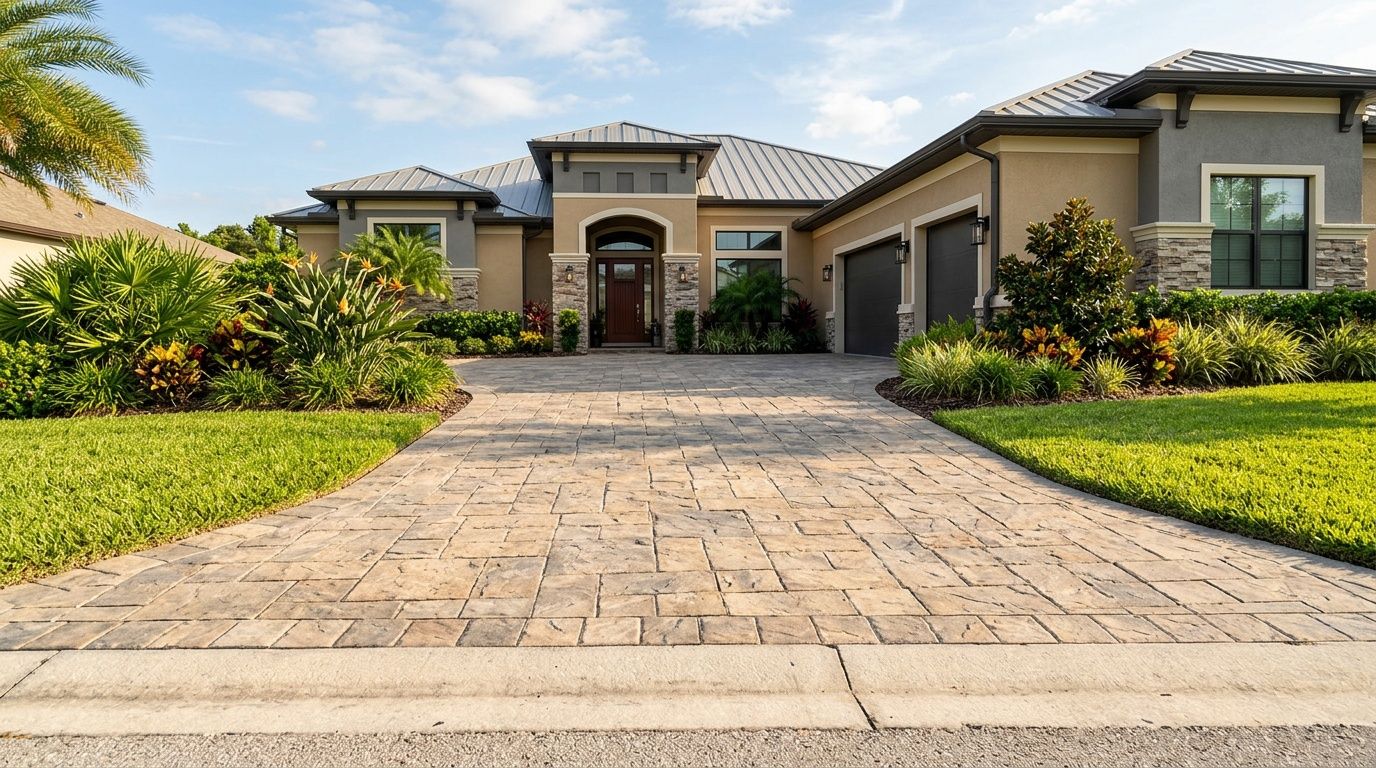
Your driveway is one of the first things people notice. If you're in Ocala, The Villages, Inverness, or Crystal River, you already know how fast a decent-looking surface can turn tired in Central Florida. Sun bakes it. Rain beats on it. Tires grind in dirt, sand, and grit. A plain slab can look dull. Old pavers start looking busy and worn. Cracked asphalt drags down the whole front of the house.
A Stamped Concrete Driveway fixes that when it's built right. It gives you the look of stone, brick, slate, tile, or wood without the upkeep headache that usually comes with separate units. But in Marion County, FL and Citrus County, FL, the smart decision isn't just about looks. It's about base prep, mix strength, sealer choice, curing discipline, and whether the finish is safe when a summer storm rolls through.
If you're weighing options for a new or replacement driveway in Belleview, Dunnellon, Summerfield, Lecanto, Homosassa, Beverly Hills, Hernando, Silver Springs, or nearby Central Florida communities, this guide gives you the straight answer. No fluff. Just the true trade-offs, actual Florida cost ranges, and the mistakes that shorten driveway life.
Table of Contents
- Is a Stamped Concrete Driveway Your Next Home Upgrade
- Defining Stamped Concrete The Beauty of Form and Function
- Costs Designs and Driveway Alternatives in Florida
- The Installation Process and Realistic Timelines
- Stamped Concrete Durability in Central Florida's Climate
- Choosing Your Concrete and Asphalt Experts in Marion and Citrus County
- Frequently Asked Questions About Stamped Concrete
Is a Stamped Concrete Driveway Your Next Home Upgrade
If your current driveway is cracked, stained, patched, or just plain boring, you're not alone. Homeowners across Ocala, Belleview, and The Villages call attention to the same problem. The house looks good, the yard is cleaned up, and the driveway still makes the whole property feel dated.

A Stamped Concrete Driveway is the upgrade a lot of people want because it sits in the middle of the market in the best way. It looks sharper than plain gray concrete. It doesn't come with the same weed and joint issues that annoy paver owners. And it can be built to handle Florida vehicle traffic when the slab and base are done right.
What homeowners are usually trying to solve
Shoppers for this option frequently confront one of these issues:
- Old asphalt looks worn out: Fading, cracking, and edge breakdown make the front of the property look neglected.
- Plain concrete feels too basic: It works, but it doesn't add much curb appeal.
- Pavers create maintenance chores: Joints collect weeds, sand shifts, and individual units can move.
- The home needs a better first impression: Decorative concrete can clean up the front elevation fast.
A driveway isn't just a parking surface. It's part of your home's curb appeal every single day.
For homeowners in Marion County, FL and Citrus County, FL, the bigger question isn't whether stamped concrete looks good. It does. The primary question is whether it's the right fit for your lot, your budget, and Central Florida weather. That's where bad advice usually starts. Most guides stay generic. They don't tell you what happens under hard sun, heavy rain, and rushed curing.
Defining Stamped Concrete The Beauty of Form and Function
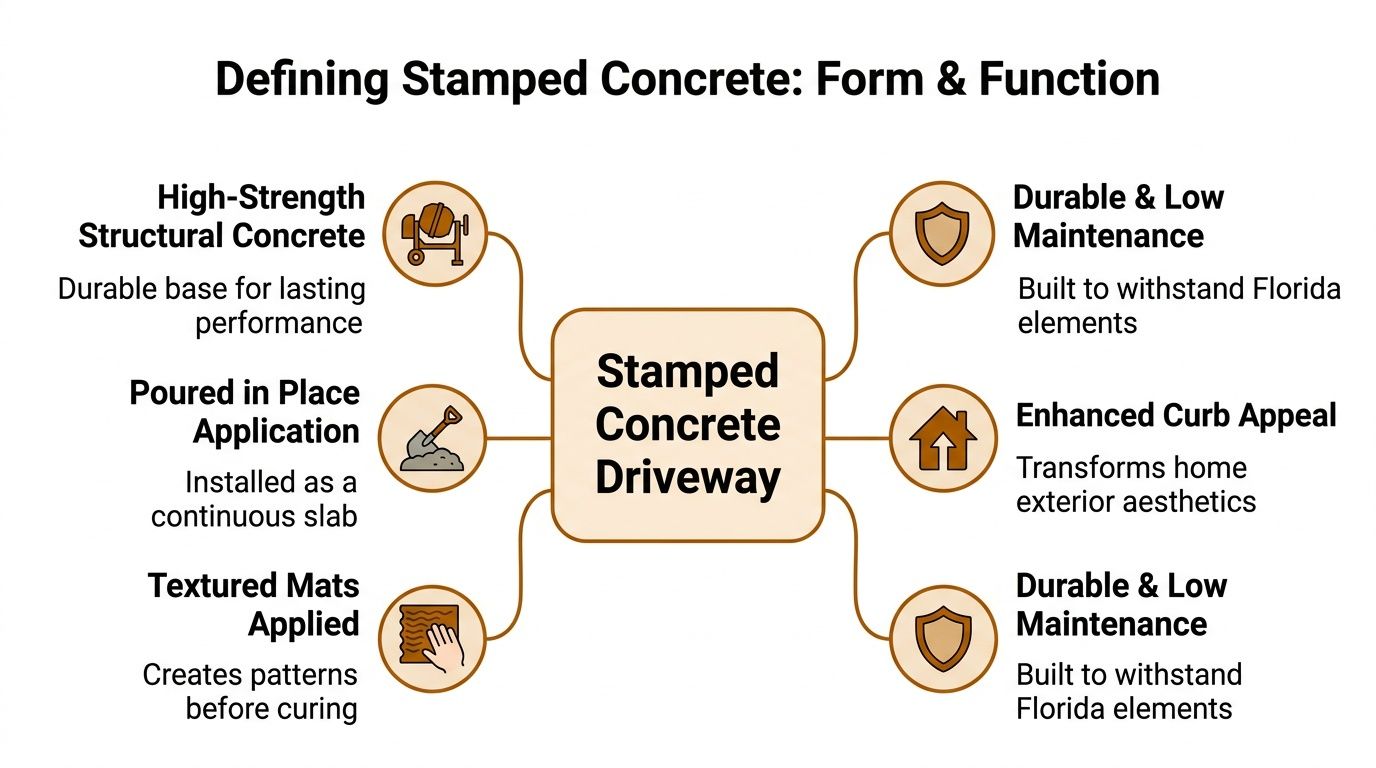
Stamped concrete isn't a coating and it isn't fake pavers glued to a slab. It's a full-depth concrete driveway that gets color and texture while the concrete is still workable. Think of pressing a pattern into dough, except this is structural concrete built for vehicle traffic.
What it actually is
The surface is poured in place as one continuous slab. Then crews add color and press textured mats into the surface to create the pattern. That pattern can mimic stone, brick, slate, tile, or wood. The end result is decorative, but it's still a driveway first.
In Florida, typical poured concrete driveways have a compressive strength of 3,000 to 4,000 PSI, while stamped concrete driveways in high-traffic residential areas often use a 4,000 PSI mix to ensure durability under vehicle loads according to this Florida stamped driveway overview. That's the part many homeowners miss. A stamped finish isn't just about appearance. It should be tied to a stronger driveway build.
Why homeowners choose it over separate units
A lot of folks in Summerfield, Silver Springs, and Homosassa want the look of natural materials without the constant fuss. That's where stamped concrete makes sense.
Here's the practical advantage:
- Single slab construction: No field of individual pieces shifting around under traffic.
- Decorative finish: You get texture and pattern that plain concrete doesn't offer.
- Simpler upkeep: You're not chasing weeds through joints the way paver owners often do.
- Cleaner overall look: Good pattern and color choices can match ranch homes, newer builds, and more traditional homes across Central Florida.
Practical rule: If you want decorative concrete for a driveway, make sure you're buying a structural slab with a stamped finish, not just a pretty surface.
The beauty of this material is that it blends form and function. It can look upscale without forcing you into the maintenance routine that comes with separate stone or brick units. That's why it's become a serious option for homeowners who want a clean upgrade without turning the driveway into a recurring project.
Costs Designs and Driveway Alternatives in Florida
You pull into your driveway after one of those hard summer downpours, and the first thing you notice is whether the surface still looks sharp and still feels safe under your tires. In Central Florida, driveway choices are not just about looks. They are about heat, rain, maintenance, and how much money you want tied up in the front of the house.
What you can expect to pay in Florida
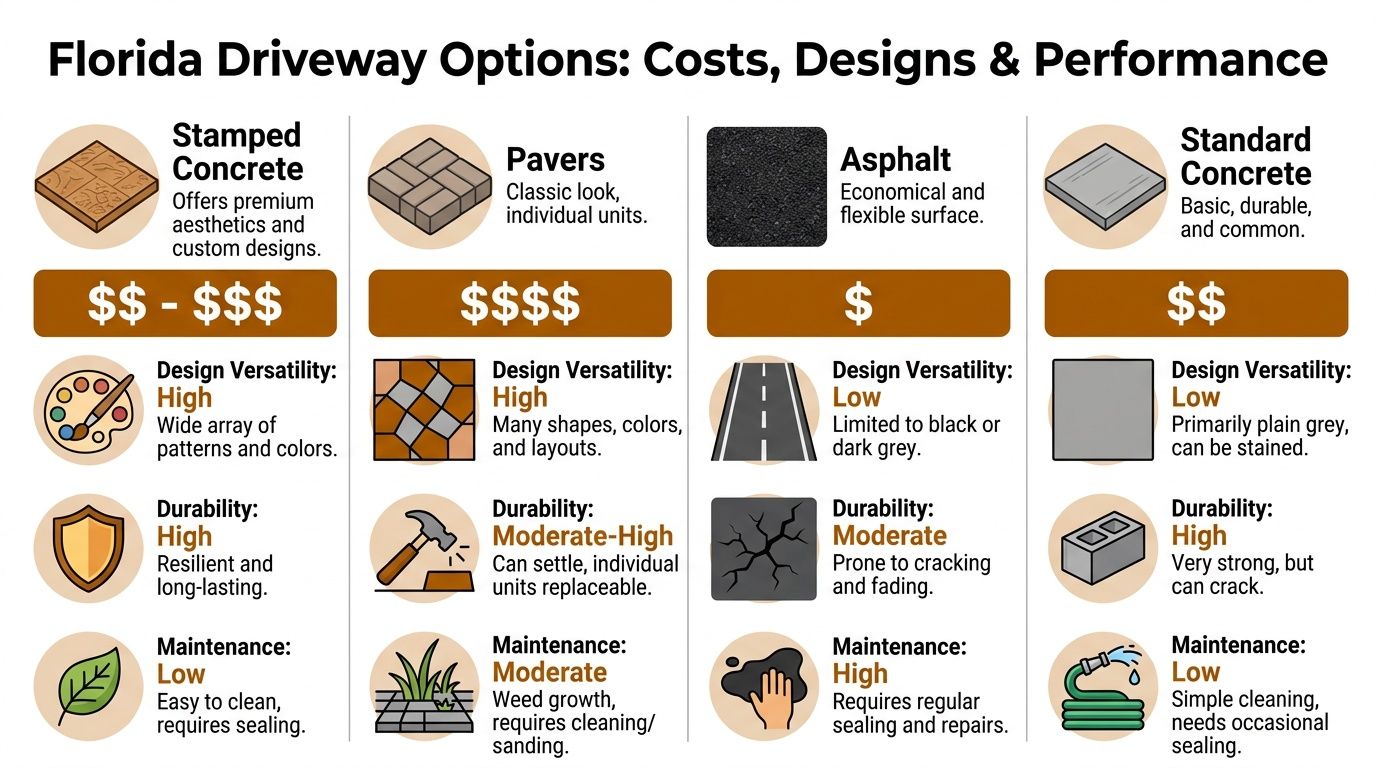
Here is the blunt answer. Stamped concrete is usually a mid-to-upper-tier driveway choice in Florida. It costs more than plain concrete, often less than a premium paver job, and the final number climbs fast once you add multiple colors, borders, or custom pattern work.
For Florida homeowners, stamped concrete driveways cost between $12 and $18+ per square foot, while pavers run about $12 to $25+ per square foot installed based on this Florida driveway cost comparison. That price spread matters. Homeowners who assume stamped concrete and pavers always cost the same usually have not priced a real job yet.
National pricing gives you a decent baseline for finish levels. Installed residential stamped concrete typically ranges from $8 to $12 per square foot on average, with basic single-color designs at $10 to $14, mid-range work with borders or contrasting patterns at $14 to $20, and high-end custom jobs exceeding $20 per square foot according to this stamped concrete pricing guide from Angi. In Central Florida, driveway work tends to land toward the upper end because outdoor surfaces take a beating from sun, rain, and daily vehicle use.
Here's the practical cost snapshot:
| Driveway material | Florida cost range | General takeaway |
|---|---|---|
| Stamped concrete | $12 to $18+ per sq ft | Decorative slab with strong curb appeal and less joint maintenance than pavers |
| Pavers | $12 to $25+ per sq ft installed | Premium appearance, wider price range, more upkeep over time |
| Asphalt | Qualitative only | Lower-style option chosen more for function and upfront savings |
| Standard concrete | Qualitative only | Durable and simpler on the budget, but plain |
My recommendation is simple. If your budget is tight, choose plain concrete and finish it well. If you want a decorative look without signing up for paver maintenance, stamped concrete is usually the smarter spend.
Design choices that work on Florida homes
A good driveway design should still look good after wet season, pollen season, and a year of tire marks. That rules out a lot of flashy choices.
The best stamped concrete driveways around Crystal River, Inverness, Beverly Hills, and Ocala usually stay conservative on pattern and smart on color:
- Stone-look patterns: Clean, upscale, and easier to match with most Florida home styles.
- Brick-inspired layouts: A solid fit for traditional homes and formal entries.
- Medium earth tones: Better at hiding dirt, rain splash, and minor staining than very light or very dark colors.
- Borders and accents: Worth adding if you want definition, but they raise the price.
Homeowners often make mistakes regarding pattern selection. They pick a pattern from a showroom photo instead of picking for Florida conditions. High-contrast colors can fade unevenly in strong sun. Very smooth finishes can become slick when rain hits. Busy patterns can look dated faster than simple stone or slate textures.
Stamped concrete gives you more design flexibility than plain concrete and fewer moving parts than pavers. That trade-off is the whole appeal.
Stamped concrete versus pavers asphalt and standard concrete
Choose by long-term hassle, not just by the quote.
For a broader side-by-side discussion, this breakdown of concrete driveway vs asphalt driveway helps frame the bigger material choice.
- Stamped concrete: Best for homeowners who want decorative curb appeal, a continuous slab, and less weed and joint maintenance.
- Pavers: Best for homeowners who like the modular look and accept more maintenance, more joints, and a higher price ceiling.
- Asphalt: Best for basic function, not for a high-end finished look.
- Standard concrete: Best for straight durability and lower cost, with little design value.
A lot of Florida homeowners hear the same myths. Stamped concrete cracks too much. Pavers are always safer in the rain. Asphalt is always cheaper in the long run. None of those claims holds up as a blanket rule. The actual answer depends on installation quality, surface texture, drainage, and how much maintenance you are willing to deal with over the years.
If you want my honest take, stamped concrete sits in the sweet spot for a lot of homes in Marion County and Citrus County. It gives you a stronger visual upgrade than plain concrete, avoids the joint issues that come with pavers, and usually keeps total installed cost from getting out of hand.
The Installation Process and Realistic Timelines
Here is the mistake I see all the time in Central Florida. A homeowner watches a crew pour on Tuesday, the stamps go down, the color looks great by Wednesday, and by the weekend somebody wants to park the SUV on it. That is how good driveways get damaged early.
Stamped concrete is a process, not a quick cosmetic job. The surface pattern gets the attention, but the base, thickness, drainage, timing, and curing decide whether that driveway still looks good a few years from now.
What happens on the job
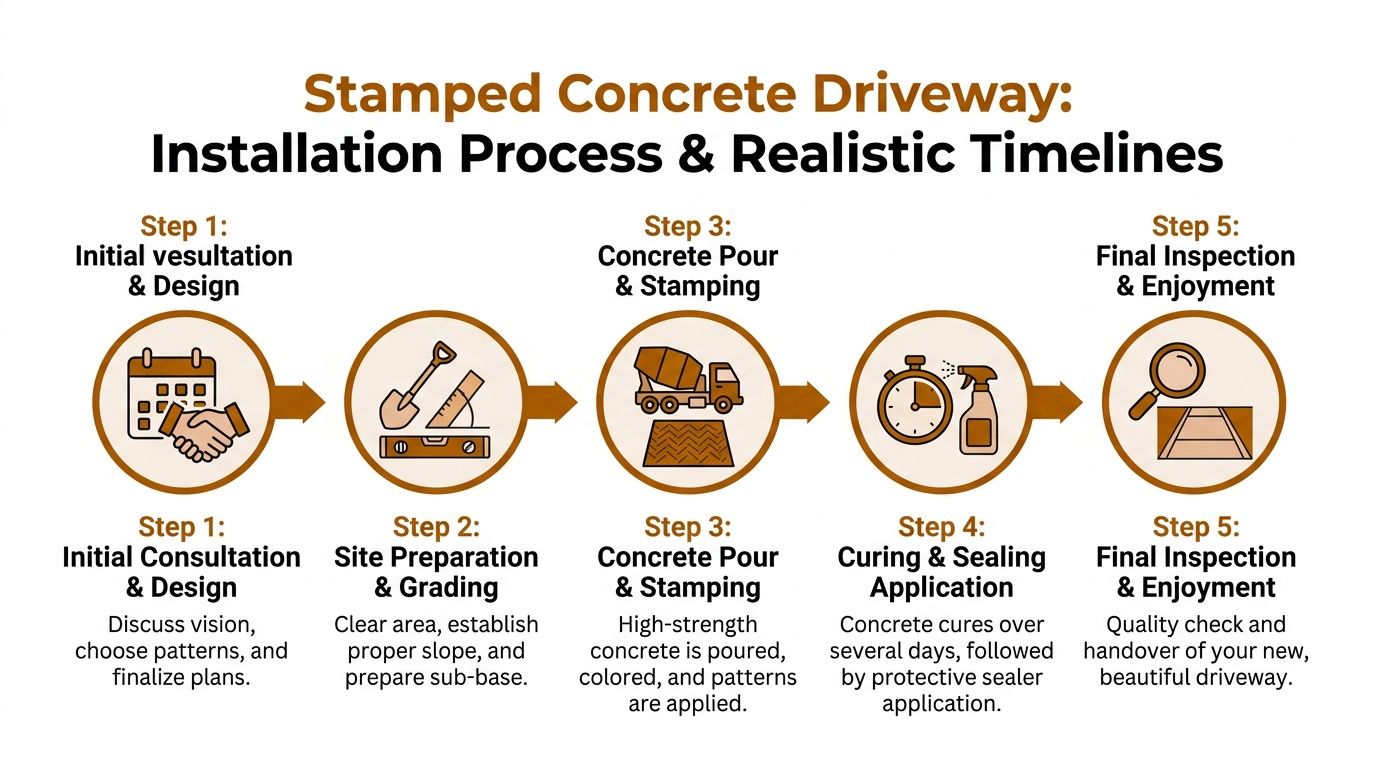
A proper driveway starts with demolition if there is an old slab, then excavation, grading, and base prep. After that, the crew sets forms, places reinforcement if the job calls for it, pours the concrete, adds color, stamps the pattern, cuts control joints, and protects the slab while it cures.
Do not let anybody treat base prep like a minor detail. It is structural work. Residential driveways generally need enough slab thickness for vehicle loads, and heavier areas need more. Good contractors also compact the base correctly so water does not sit under the slab and cause movement later. In Florida, that matters even more because heavy summer rain will expose weak prep fast.
The finishing steps matter too. Stamped work has to be timed right. Color hardener or integral color, release, stamping, jointing, cleanup, and sealing all have to happen in the right sequence and at the right stage of the set. If the crew is rushed or inexperienced, the driveway may still look decent on day one and start showing problems later.
If you want a clear homeowner explanation of cure times, read this guide on how long concrete takes to cure.
Later in the process, this video gives a useful look at how stamped work comes together in the field.
The timeline myth that causes problems
The work itself may only take a few days. That does not mean the driveway is ready for vehicle traffic.
For a straightforward residential job, site prep and forming may take a day or two. The pour and stamping usually happen in one day. Cleanup, saw cuts, and sealer may stretch the job a little longer depending on weather. Rain, soft subgrade, permit delays, and complicated borders can all slow it down. That is normal in Marion County and Citrus County, especially in the wet season.
The key timeline question is not, "When is the crew done?" It is, "When can I use it without hurting it?" Foot traffic usually comes first. Vehicles wait longer. If you drive on a fresh stamped slab too early, you can leave tire marks, stress weak areas, and shorten the life of the finish before the driveway has had a fair chance.
Keep vehicles off the slab until the driveway is ready for vehicle traffic. A rushed homeowner can ruin a solid pour in one afternoon.
Permitting can affect timing too. In Marion County, FL and Citrus County, FL, a new driveway often needs approval before work starts. A contractor who knows local permitting handles that upfront. A bargain crew often leaves that problem sitting in your lap.
My advice is simple. Ask for a real schedule before the job starts. Ask when demolition happens, when the pour is scheduled, when you can walk on it, when you can park on it, and what weather will do to the timeline. If the answers sound vague, keep shopping.
Stamped Concrete Durability in Central Florida's Climate
You notice the true test in August. The driveway is hot enough to throw heat back at the garage, then a hard afternoon rain hits, and any weak sealer, weak mix, or weak finish starts showing itself fast. That is why stamped concrete in Central Florida has to be judged by local conditions, not by a generic pros-and-cons list.
A stamped driveway can hold up for decades here. Bad installation shortens that life in a hurry. Strong base prep, proper thickness, clean joint layout, drainage, and the right sealer matter more in Florida than the pattern you pick. If you want the bigger picture on lifespan, read this guide on how long a concrete driveway lasts.
Florida sun, rain, and what actually wears these driveways out
The sun is brutal on color and sealer. Heavy rain tests drainage and surface texture. Those two forces work together. Once the sealer starts wearing thin, the finish loses protection, color fades faster, and water has an easier time sitting in low spots and working into small surface defects.
That is why I tell Central Florida homeowners to plan on regular resealing instead of waiting until the driveway looks tired. Waiting too long is how you end up paying for avoidable repairs. A stamped surface always needs upkeep. In our climate, that upkeep comes around sooner than many sales pitches admit.
The durability myth that trips up homeowners
Stamped concrete is not fragile. It is also not maintenance-free.
A lot of homeowners hear one extreme or the other. Neither is useful. A well-built stamped driveway handles Florida weather just fine, but only if the slab was poured correctly and the finish was chosen for actual driveway use. Decorative concrete fails when the job is treated like patio work and then asked to carry daily vehicle traffic in full sun and heavy rain.
Watch for these Florida-specific trouble spots:
- Standing water: Shortens sealer life and exposes low areas.
- High-gloss sealers: Look good early, then create traction problems in rain.
- Dark colors in full sun: Show fading sooner and hold more heat.
- Poor drainage at the apron or garage: Pushes water where it should not sit.
- Skipped maintenance: Turns small wear issues into surface breakdown.
Slip resistance matters as much as crack resistance
Many stamped concrete articles spend all their time on cracking. Fair enough. Cracks matter. On Central Florida driveways, slip resistance deserves just as much attention.
Rain is frequent here. A slick sealer on a sloped driveway, apron, or front walk tie-in is a bad specification, plain and simple. I recommend a lower-sheen sealer and a finish that keeps some bite underfoot. If a contractor is pushing high gloss without talking about traction, ask better questions.
Use this standard when you choose the finish:
- Lower-sheen sealer: Better for traction in daily wet conditions.
- Gloss-heavy finish: Better reserved for areas where people and tires are not dealing with rain runoff.
- Sloped driveway sections: Need extra attention to texture and sealer choice.
- Homes with frequent shade and moisture: Need even more caution because damp surfaces stay slick longer.
If the driveway looks sharp on day one but gets slick every time it rains, the problem is the specification, not the weather.
The bottom line is simple. In Central Florida, stamped concrete durability comes down to trade-offs. You are balancing appearance, traction, heat, maintenance, and long-term wear. Pick the finish for Florida weather, not just for the sales photo, and the driveway has a much better shot at aging the right way.
Choosing Your Concrete and Asphalt Experts in Marion and Citrus County
The finish gets the attention. The prep determines whether the driveway holds up. That's why contractor choice matters so much on stamped concrete.
What separates a pro from a guy with a truck
A real driveway contractor talks about excavation, slope, sub-base, thickness, curing, joint layout, and sealer type. A weak bidder talks mostly about color and pattern boards. That's backward.
When you're hiring for decorative concrete in Ocala, Belleview, Inverness, or Beverly Hills, look for these basics:
- Licensed and insured: This shouldn't be up for debate.
- Clear scheduling: Homeowners need realistic timelines, not guesswork.
- Concrete experience, not just decorative talk: Pretty work fails if the slab underneath is weak.
- Florida-specific recommendations: Sealer choice and drainage have to fit local weather.
- Reliable workmanship: Straight forms, clean edges, and good site prep still matter more than sales talk.
A stamped driveway is only as good as the slab under it and the crew that finishes it.
Why local concrete and asphalt knowledge matters
This is also where dual-trade experience helps. Homeowners often think in silos. Concrete here, asphalt there. Good contractors don't. They understand transitions, grades, vehicle use, drainage patterns, and how one surface choice affects the rest of the property.
That's why the right company should think like Concrete and Asphalt Experts in Marion and Citrus County, not an asphalt-only outfit and not a one-trade handyman. The same local knowledge that helps with driveway replacement also matters for surrounding work like parking transitions, asphalt sealcoating on commercial sites, and professional striping where traffic flow and drainage matter.
If a contractor can't explain why your lot in Marion County, FL or Citrus County, FL needs a certain sealer, a certain slope, or a certain curing timeline, keep looking. Decorative concrete doesn't forgive lazy work.
Frequently Asked Questions About Stamped Concrete
Can you stamp over an old driveway
You can, but I rarely recommend it for a driveway in Central Florida.
If the old slab already has cracks, weak spots, settlement, or drainage problems, an overlay turns into a cosmetic patch over a structural issue. The new finish may look good at first, then the old problems start printing through. For a front entry or small patio, an overlay can make sense. For a driveway that carries vehicles, tear-out and replacement is usually the smarter call.
Does stamped concrete help with home value
It helps curb appeal. That matters.
A clean, well-finished stamped driveway makes the house look cared for, especially if the existing drive is stained, cracked, or plain gray and tired. I would not sell it as some magic return-on-investment number, because sale price depends on the house, the neighborhood, and whether the rest of the exterior matches the upgrade. What I will tell you is this. Buyers notice the driveway the minute they pull up, and a sharp one helps the whole property show better.
Why don't weeds come through stamped concrete like they do with pavers
Because you are dealing with one slab instead of a surface full of joints.
Pavers have many seams, and those seams collect sand, dirt, moisture, and seeds. That is where weeds get started. Stamped concrete still has control joints and perimeter edges, but you do not have weeds popping up all across the field of the driveway the way you often see with pavers.
What if a crack shows up anyway
Concrete can crack. Good work keeps that risk in check and controls where stress releases.
A small crack is usually a cosmetic issue. A crack with height difference, widening, or signs of settlement points to a bigger problem under the slab. That is why I keep coming back to subgrade prep, compaction, joint layout, and water runoff. In Florida, water often poses the biggest challenge.
Is stamped concrete slippery when it gets wet
It can be if the finish or sealer is wrong.
That is one of the biggest myths I hear. Homeowners assume stamped concrete is automatically slick in the rain. It is not automatic. The surface needs the right texture, and the sealer needs grip, not just shine. Around here, with summer downpours and pool traffic, I would choose a sealer and finish that favor traction over a glossy showroom look every time.
Is stamped concrete a good fit for Florida homes
Yes, if you build it for Florida instead of copying what looks good in a brochure.
Our sun is hard on color. Our rain exposes drainage mistakes fast. Our heat changes curing and sealing schedules. A stamped concrete driveway works well here when the mix, base, jointing, slope, and sealer are chosen for local conditions. If you want the decorative look without the maintenance load of a lot of paver joints, it is a strong option. If you skip maintenance or chase the slickest finish on the chart, you will regret it.