
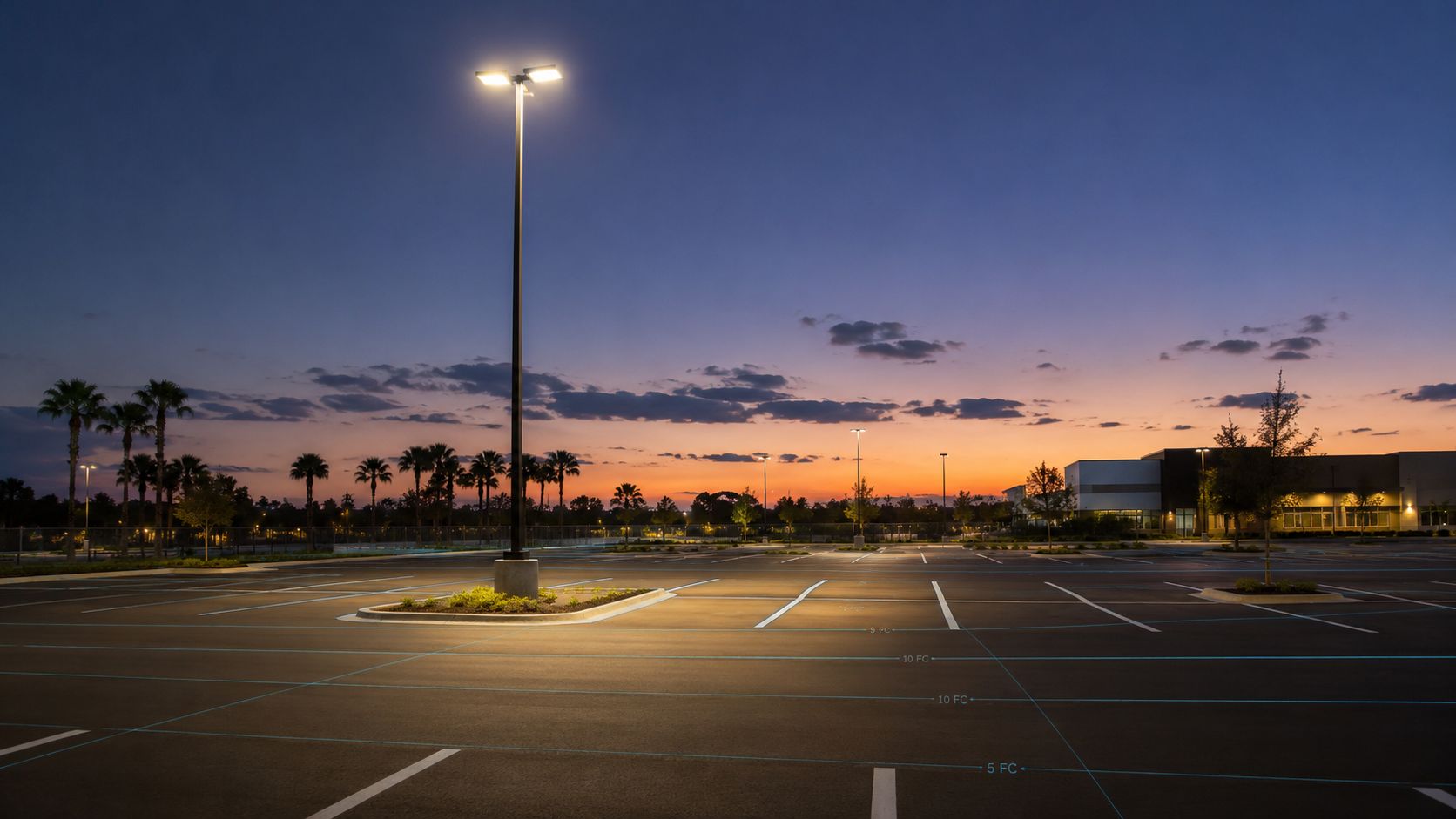
Parking lot lighting looks simple until you're standing in a dim lot after sunset, trying to decide whether the problem is the bulbs, the pole layout, the controls, or the pavement itself. In Marion County, FL and Citrus County, FL, that question comes up often because heat, rain, UV exposure, and fast-moving maintenance cycles all push lighting systems harder than owners expect. If you manage property in Ocala, Dunnellon, Belleview, Silver Springs, Summerfield, Crystal River, Homosassa, Inverness, Lecanto, Beverly Hills, Hernando, or The Villages, the right plan has to do more than make the lot look bright. It has to stay uniform, compliant, and easy to maintain alongside concrete and asphalt work.
Table of Contents
- Understanding Parking Lot Lighting Fundamentals in Central Florida
- Designing Light Layout and Pole Specifications
- Meeting Illumination Standards and Safety Objectives
- Choosing Fixtures and Controls for Efficiency and Compliance
- Integrating Lighting with Asphalt and Concrete Maintenance Projects
- Budgeting and Energy Cost Analysis for Marion and Citrus Counties
- Planning Maintenance and Selecting a Parking Lot Lighting Vendor
- Frequently Asked Questions
Understanding Parking Lot Lighting Fundamentals in Central Florida
The first mistake most property managers make is chasing brightness alone. In parking lot lighting, uniform minimum illumination matters more than a single hot spot that looks bright at the pole but leaves dark patches near curbs, stalls, and walk paths. The Illuminating Engineering Society guidance cited in the literature recommends 2 lux of horizontal illuminance for basic visual tasks, and it also emphasizes that average light levels strongly affect how safe people feel in a lot. IES parking lot lighting guide
Start with the two measurements that matter
Horizontal illuminance is the light falling on the pavement. Vertical illuminance is the light hitting a person or object upright, which matters when drivers need to recognize faces, see movement, or spot a pedestrian near a vehicle. Those two measurements help explain why a lot can look “bright enough” from one angle and still feel unsafe from another.
In Central Florida, the sun creates a false sense of security during the day, then fades quickly after sunset. Once that happens, any fixture with poor distribution or bad aiming can create hard shadows under vehicles, near landscaping, or along striping. That's why the fundamental question isn't, “How many watts did we buy?” It's, “Where does the light land?”
Practical rule: If a lot has visible dark bands between poles, the problem is usually distribution and spacing, not just fixture output.
Why Florida weather changes the design brief
Heat, humidity, and storms don't just wear out hardware faster. They also make poor layouts more obvious. When fixtures sag, lenses get dirty, or pole bases settle, the lot loses uniformity first, then safety, then visual appeal.
For owners in Marion County and Citrus County, that means the lighting plan has to work with the site, not fight it. A well-designed system also needs to respect nearby homes and streets. That's where full-cutoff optics help, because they keep light aimed where it belongs and reduce glare at the property edge. If a lot borders residential areas in places like Ocala, Crystal River, or Hernando, that matters just as much as total brightness.
The simplest way to think about it is this. Brightness is the headline. Uniformity is the part that determines whether people can walk, park, and drive through the lot without guessing.
Designing Light Layout and Pole Specifications
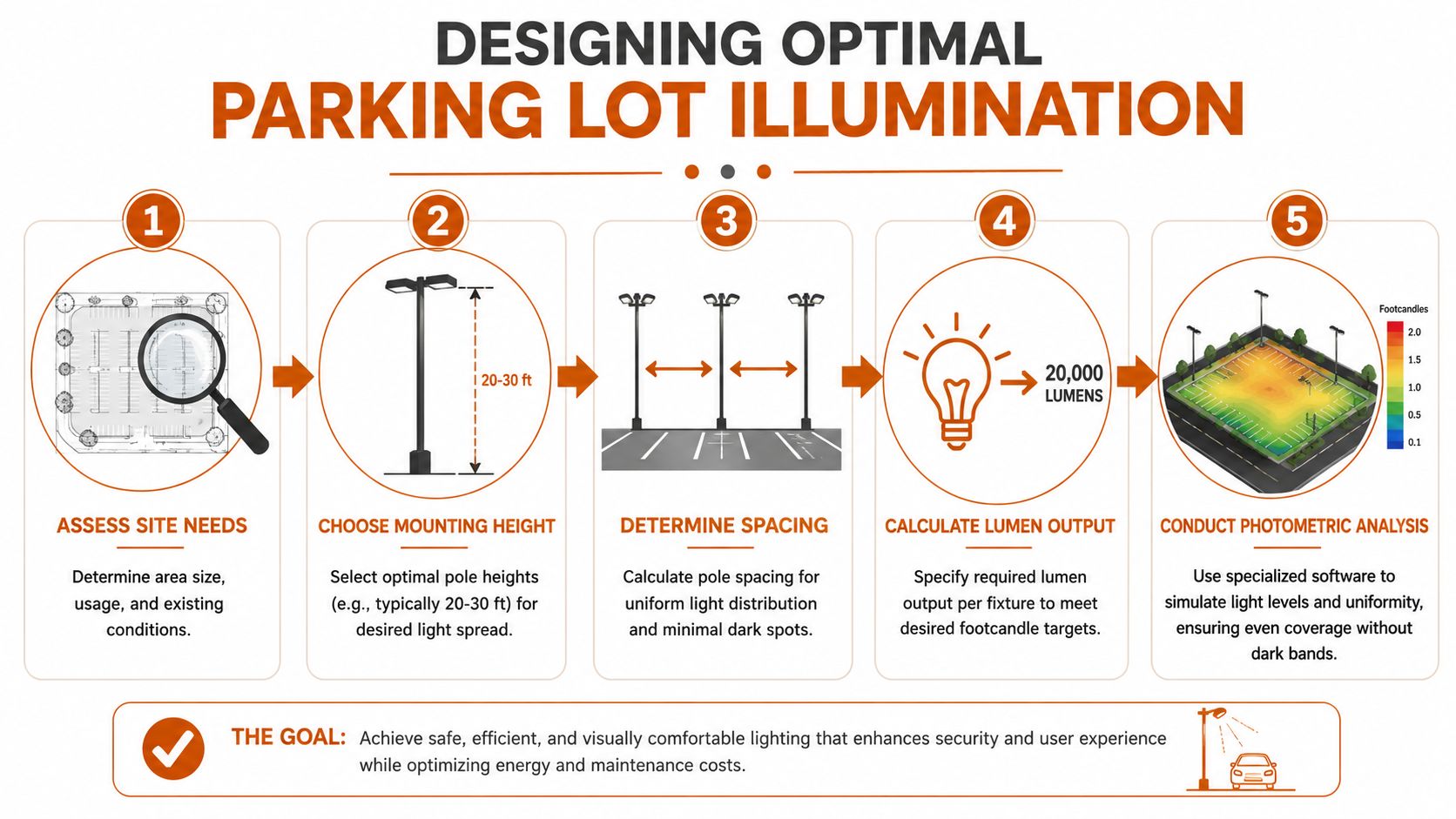
A good layout starts with the poles, not the fixture catalog. A lot that uses the wrong spacing can waste light, create glare, and still leave the middle of the aisle too dark to feel secure. Effective parking lot lighting often uses 15 to 20 ft poles with 12,000 to 18,000 lumens spaced 20 to 30 ft apart, and photometric analysis confirms that spacing on the order of 2 to 2.5 times pole height can achieve coverage without dark bands. Parking lot lighting requirements
Build the layout from the ground up
Start by mapping the site. The pole locations should follow how people move through the lot, not just the property line. If a customer parks near the back row, walks past a sidewalk, and crosses a drive lane, that path needs the same care as the front entrance.
Then choose mounting height based on the area size and the required spread. Smaller lots often perform well with shorter poles, while larger commercial layouts usually need taller poles to carry light farther across the pavement. The key is to avoid treating pole height like a style choice. It's a coverage decision.
Here's the sequence most designers follow:
- Assess the site needs. Look at entrances, walk paths, curbs, trees, and any uneven pavement.
- Choose mounting height. Match pole height to the width of the area you need to cover.
- Set spacing. Keep poles close enough to prevent dark bands, but not so close that the middle becomes overly bright.
- Confirm lumen output. Make sure each fixture contributes enough light to the target area.
- Run photometric analysis. Verify the actual pattern before anything gets installed.
Use the lot edge as a design boundary
Perimeter control is part of the layout, not an afterthought. Parking-lot design guidance states that illumination beyond the perimeter should not exceed 0.50 horizontal footcandles to avoid trespass, and it also requires a sharp cutoff for luminaires near buildings or residential districts at no greater than 78 degrees vertical angle above nadir, with no more than 5% of total lamp lumens projecting above that angle. PDHOnline parking lot manual
That matters in communities near homes, apartments, or sensitive neighbors in places like Belleview, Summerfield, Lecanto, and The Villages. A layout that protects the edge of the site is easier to defend if a neighbor complains about glare. It also helps the owner avoid lighting the road, the sky, or the windows next door.
A clean layout doesn't happen by accident. It happens when the pole plan, the beam pattern, and the property edge all get reviewed together before installation.
Meeting Illumination Standards and Safety Objectives
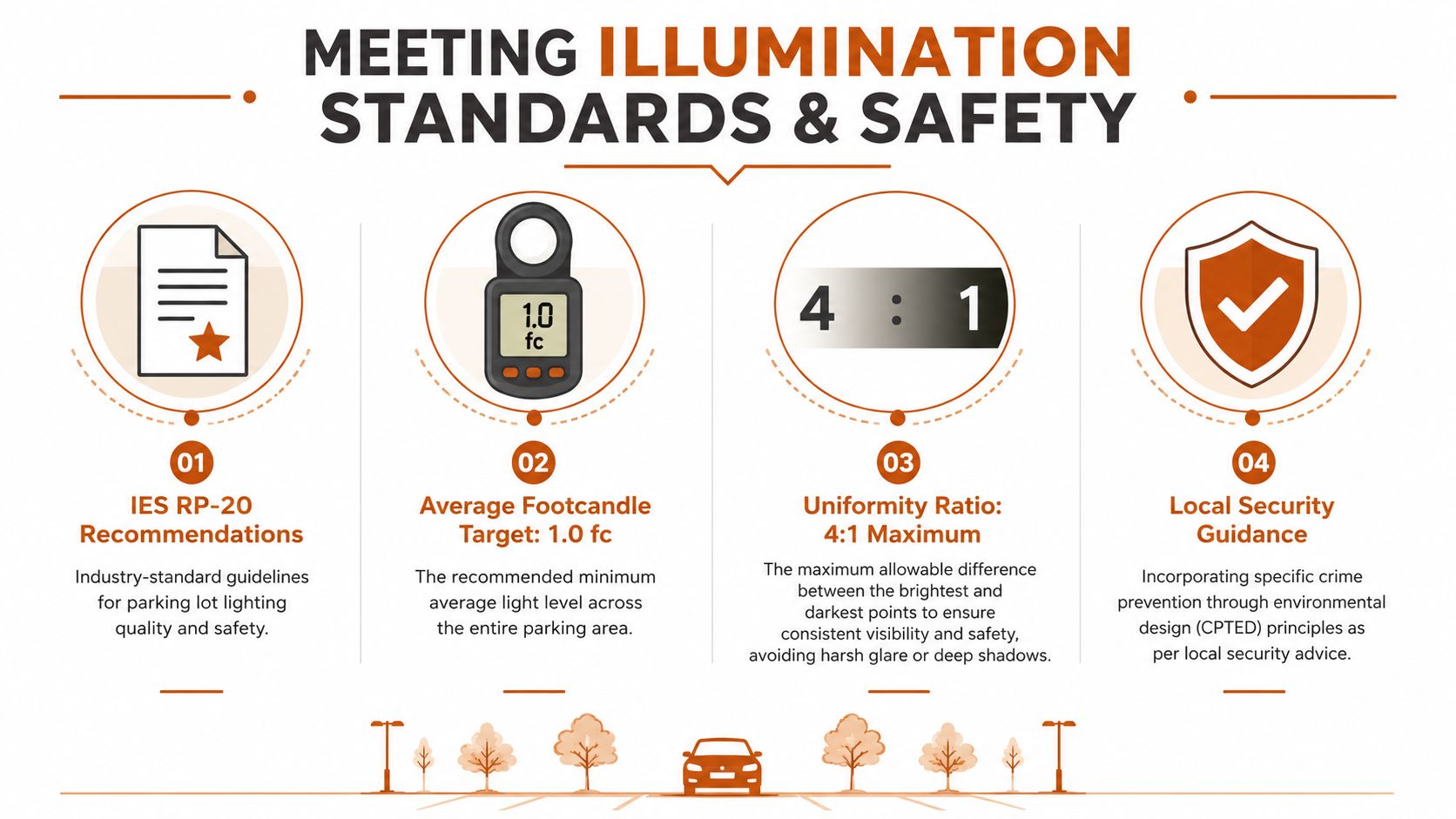
The safest lots don't just feel brighter. They give drivers and pedestrians enough light to recognize shapes, movement, and obstacles without harsh contrast. IES RP-20 guidance targets a maintained average of about 1.0 footcandle with a 4:1 average-to-minimum uniformity ratio, rising to 3.0 fc average in enhanced-security areas, because uniformity matters as much as brightness to avoid blind spots. Parking Professional lighting design guide
Standard lots and higher-security areas aren't the same job
A grocery center, an office park, and a gated loading area don't need identical lighting. The security profile changes the target. Security-industry guidance summarizing IES recommendations says a typical parking lot should maintain at least 0.2 footcandles of horizontal illuminance, while enhanced-security areas should reach 0.5 footcandles horizontal and 0.25 footcandles vertical, with a uniformity ratio of 20:1 in standard lots and 15:1 for higher-security settings. ASIS lighting standards overview
That difference matters in lots near entrances, cash-handling areas, or places with late-night traffic. A darker lot isn't automatically unsafe, but a poorly balanced one usually is. When the brightest spot is much brighter than the rest, people's eyes keep adapting, and the darker corners become the places where trips and missed hazards happen.
Safety goals include emergency resilience
Emergency lighting is part of the same system, not a separate concern. The same security guidance notes that emergency lighting should provide 90 minutes of illumination and activate within 10 seconds of a power loss. That changes the design conversation, because owners aren't just buying fixtures. They're buying a system that has to stay useful when normal power fails.
For commercial sites in Ocala, Inverness, and Crystal River, that is a liability question as much as a convenience question. It also connects to accessible parking and circulation. If the striping, curb ramps, and pedestrian routes are hard to see, the lighting system isn't fully doing its job, which is why ADA parking lot striping requirements should be reviewed alongside the light plan.
Choosing Fixtures and Controls for Efficiency and Compliance
Fixture selection used to be a simple debate between “what is bright enough” and “what fits the budget.” That's no longer enough. Recent energy codes like ASHRAE 90.1 and the IECC increasingly require LED fixtures with automatic shutoff controls and daylight harvesting, making controls-enabled systems the best ROI over standalone high-lumen fixtures. Luminate Lighting Group FAQ on parking lot lighting standards
Compare fixtures by lifecycle, not just output
LED fixtures usually make sense because they combine output, efficiency, and simpler maintenance. Metal halide can still show up in older sites, but it tends to ask for more attention over time. Retrofit kits can be a smart middle path when pole locations, conduits, or mounting hardware are already in place and the owner wants to improve performance without rebuilding everything.
The mistake is buying the brightest fixture and stopping there. If the control strategy is weak, the lot can still waste energy when it's empty, fail to dim or shut off when needed, and drift out of compliance later. A smarter plan links the fixture to the controls from day one.
Match controls to how the property actually works
Automatic shutoff matters at sites with predictable closing times. Daylight sensors help in areas where the morning or late afternoon light does some of the work. Occupancy sensors can make sense in lower-traffic zones where full output isn't needed all night. Each control should serve a specific part of the property instead of being treated as a gimmick.
The practical benefit is maintenance, too. A controls-enabled system makes it easier to keep the lighting plan documentable when inspections, permits, or changes in occupancy come up. That matters in Central Florida, where property use can shift between seasonally busy months and quieter periods.
Good rule of thumb: The right fixture is the one that stays compliant, stays serviceable, and doesn't force you into avoidable energy waste.
Integrating Lighting with Asphalt and Concrete Maintenance Projects
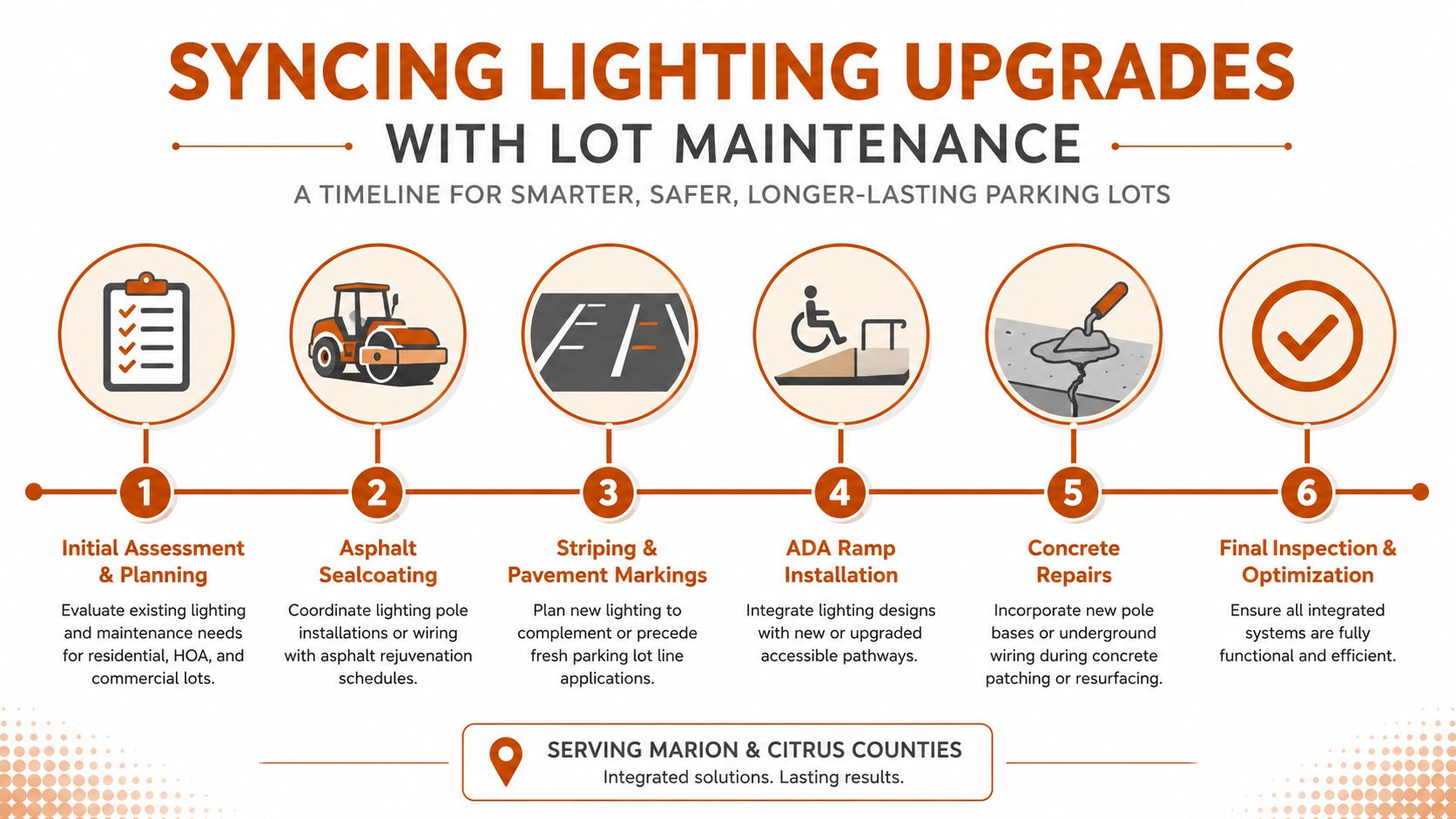
Lighting work becomes much easier when it's planned alongside pavement work. If a lot is already scheduled for sealcoating, striping, ADA upgrades, or concrete repair, the owner can often coordinate the lighting installation so crews aren't tearing up the same area twice. For properties in Marion County and Citrus County, that kind of sequencing saves disruption and helps the finished site look intentional instead of patched together. The asphalt parking lot maintenance discussion is a useful companion when the lot needs both surface and lighting upgrades.
Sequence the job so each crew helps the next one
Start with the site walk. If poles, conduit, or bases need to be installed, those decisions should happen before fresh striping or a new sealcoat goes down. Then coordinate the pavement work around access points, trenches, and any concrete restoration that may be needed around light bases or sidewalks.
A practical sequence looks like this:
- Initial assessment and planning helps identify whether the lot needs lighting alone or lighting plus pavement work.
- Asphalt sealcoating should be scheduled around any excavation or pole-base work.
- Striping and pavement markings come after the lighting layout is finalized.
- ADA ramp installation needs to stay coordinated with visible paths and entry routes.
- Concrete repairs are the right time to address pole bases, pads, or damaged walks.
- Final inspection and optimization confirms the system still works with the updated lot layout.
That order keeps new work from getting damaged by later crews. It also helps commercial owners in places like Dunnellon, Homosassa, and The Villages reduce the number of service interruptions.
Why pavement and lighting should be treated as one project
Concrete and asphalt age differently in Florida weather, but both affect how light performs. Fresh striping is easier to see under balanced lighting. New walkways and curb areas are safer when the light reaches them evenly. And if a lot gets repaved without adjusting pole bases or aiming, the lighting can end up poorly matched to the new surface.
That's the part many owners miss. Lighting doesn't live by itself. It lives on top of the pavement plan.
Budgeting and Energy Cost Analysis for Marion and Citrus Counties
A parking lot lighting budget has to cover more than fixture pricing. Property owners also need to plan for energy use, maintenance access, emergency readiness, and the cost of getting the edge of the property wrong. Parking-lot design guidance says illumination beyond the perimeter should stay within 0.50 horizontal footcandles to reduce trespass light, because spillover can trigger neighbor complaints and correction work if it is ignored.
Budget for the whole system, not the bulb count
A lighting project is often most expensive when it has to be redone. If the layout misses uniformity targets, the owner may need extra poles, different optics, or control changes later. If the system spills light onto nearby property, nuisance complaints and redesign pressure can follow. If the controls do not match the code, the owner may need another retrofit to stay compliant.
That is why the lowest fixture price is not always the lowest project cost. In Ocala or Inverness, a property manager should budget for design work, controls, wiring, testing, and verification, because each part supports the one before it. A lighting plan that ignores those items can create hidden costs through glare, wasted power, and future rework. A good way to frame the budget is to treat it the same way you would a pavement project, the surface, the striping, and the drainage all have to work together or the site costs more to maintain.
Think in terms of operating stability
LED and control systems usually make the most sense when the owner wants fewer maintenance calls and a clearer compliance record over time. That does not mean every property needs the same package. A small neighborhood lot in Belleview does not carry the same operating demands as a busy retail site in Crystal River.
Operating stability also depends on timing. If parking lot lighting upgrades happen during a paving cycle, the owner can reduce repeat visits, limit equipment conflicts, and keep conduit, pole bases, and surface work aligned with the site plan. For local managers, especially those comparing vendors or planning a maintenance cycle, a parking lot maintenance company can help coordinate those moving parts. The point is simple. Careful planning up front helps avoid costs that show up later, and it works best when lighting is tied to pavement maintenance instead of treated as a separate job.
Planning Maintenance and Selecting a Parking Lot Lighting Vendor
Good lighting doesn't stay good on its own. Dust, storm debris, worn seals, loose hardware, and aging controls all chip away at performance. The best maintenance plan treats the system like a living part of the site, with checks scheduled before the lot starts looking obviously tired.
Keep a simple maintenance checklist
A property manager should watch four things closely. Lens cleanliness, because dirty fixtures spread less light. Pole condition, because corrosion or impact damage can change the aim. Emergency function, because backup lighting has to work when power fails. Photometric performance, because a lot can drift away from its original layout even if every fixture still turns on.
If a site feels darker in some areas than it did after installation, that doesn't automatically mean the fixtures failed. It may mean the surfaces, landscaping, or controls changed. That's why periodic review matters. Lighting is easiest to keep right when small changes get caught early.
Vet the vendor the same way you vet the design
A qualified contractor should be licensed and insured, familiar with Central Florida conditions, and able to explain the work in plain language. Reliable scheduling matters because commercial sites can't always afford drawn-out disruption. Strong workmanship matters because lighting touches pavement, electrical systems, and pedestrian safety all at once.
A local partner who also understands concrete and asphalt can be especially useful when pole bases, walk repairs, or striping have to happen in the same project window. That kind of coordination is easier to manage through parking lot maintenance company resources than by hiring separate teams with separate timelines.
Ask for a plan that shows how the lighting work will affect the pavement work, not just a price for fixtures.
Frequently Asked Questions
How often should LED parking lot lights be replaced?
LED systems usually last far longer than older lighting types, but the practical answer depends on controls, heat, and site use. If the light output drops, the optics get dirty, or the controls stop behaving correctly, it's time to evaluate the system rather than guessing.
How do I know if the lot has good uniformity?
Walk the site at night and look for bright pools with dark stretches between them. If shadows are hiding curbs, striping, or pedestrian routes, the layout probably needs a photometric review.
Do I need lighting changes when I re-stripe the lot?
Sometimes, yes. Fresh striping can reveal how much of the pavement is visible under the current light plan, and that helps decide whether pole spacing or aiming should change.
What about special events or seasonal traffic?
Use controls that can adapt without forcing the whole site to run at full output all night. Temporary traffic peaks are easier to manage when the system has flexible settings.
Can lighting and pavement repairs be done together?
They can, and that's often the smarter route. Coordinating the work helps protect new pavement, keeps paths visible, and reduces the chance of paying for the same access area twice.
If your property in Marion County, FL or Citrus County, FL needs parking lot lighting that works with your asphalt, concrete, striping, and ADA layout, schedule a no-pressure consultation with Riverside Sealing & Striping, LLC. Their local team can help you review the site, plan the work in the right order, and get a clear path toward a safer, cleaner, more cost-effective finish.