
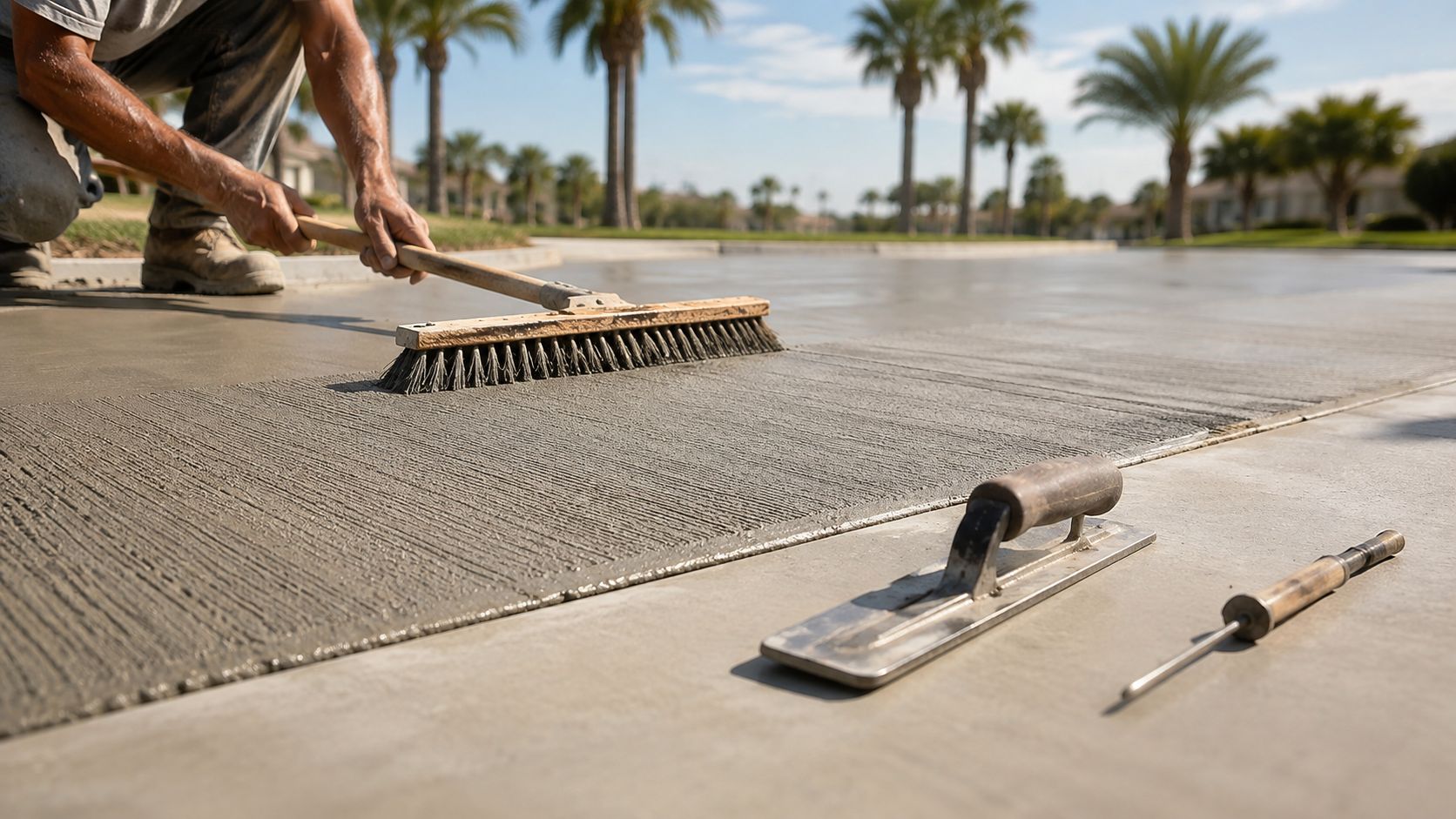
Concrete driveway finishing in Central Florida usually makes more sense when you hire a pro, because a $5 to $8 per square foot broom finish and a $8 to $21 per square foot decorative finish can swing the outcome from practical to expensive fast. On a common 600-square-foot two-car driveway, that's roughly $4,800 to $9,000 for a basic slab and about $9,000 to $15,000 for stamped or decorative work, before the weather starts testing your timing (Concrete Network driveway cost guide).
A lot of homeowners around Marion County, FL and Citrus County, FL get distracted by pattern books and forget the main issue. In Ocala, Dunnellon, Belleview, Silver Springs, Summerfield, Crystal River, Homosassa, Inverness, Lecanto, Beverly Hills, Hernando, and The Villages, the finish that survives heat, humidity, and afternoon storms is the one placed at the right moment, with the right moisture control, and with enough restraint to avoid surface damage.
Table of Contents
- Introduction
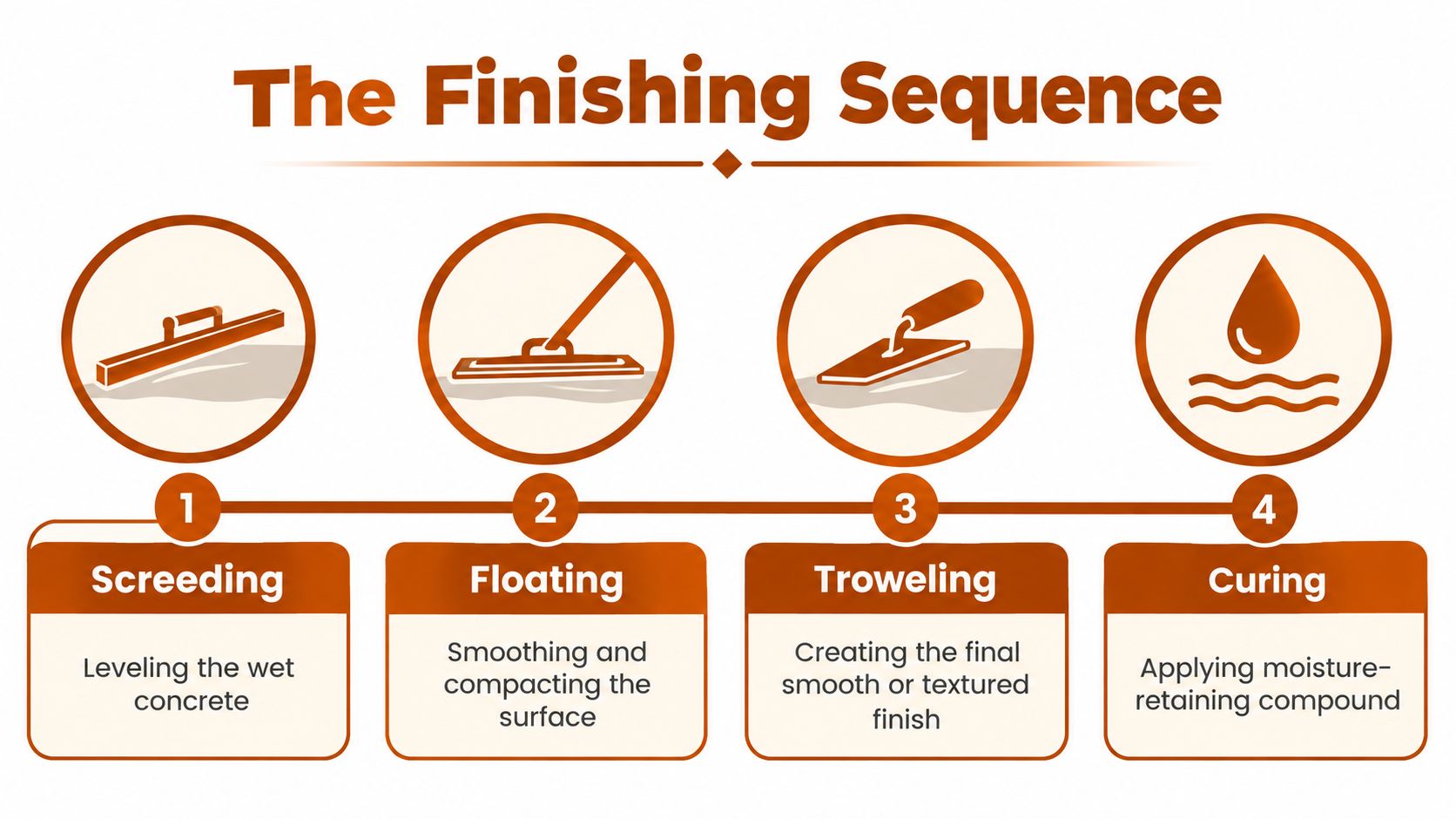
- The Finishing Sequence
- Finish Types and Cost Comparison
- Curing and Sealing Best Practices
- Common Defects and How to Fix Them
- When to Call a Professional
Introduction
The prettiest advice is often the wrong advice. A stamped sample looks fine on a table, but on a Florida driveway the priorities are traction, moisture control, and timing. I've seen homeowners in Marion County, FL and Citrus County, FL get sold on decorative ideas, then watch a fresh slab go bad because the crew worked the finish too early, added water on site, or rushed right through bleed water.
That's the part most glossy finish guides skip. A driveway has to stay tight, grip tires and shoes, and hold up through summer heat and heavy rain. Ocala and Crystal River are not showroom conditions. The slab sits in sun, takes daily traffic, and gets punished by weather that exposes sloppy work fast.
Before anybody talks texture, start with the mix and slab plan. The practical basics matter more than the brochure, and the concrete mix guidance from the concrete mix team at Riverside Sealing & Striping is a solid place to start that conversation.
The Finishing Sequence
Why timing beats style
Concrete driveway finishing unfolds as a sequence, strike-off, then bull floating or darbying before bleed water pools, then edging and jointing, then the final texture, then curing. If a crew skips that order, the slab usually pays for it later with dusting, scaling, crazing, or blisters (Michigan Concrete Driveway and Sidewalk Guidelines-1.pdf?hsLang=en)).
The biggest mistake I see is impatience. When bleed water is still visible, the surface is too wet to finish properly, and adding water or sprinkling the slab only invites surface defects. On exterior driveways, a broom finish is the smart default because it gives a non-slip surface, while steel troweling can trap bleed water and leave you with a slick, less durable top layer.
Practical rule: if the slab still looks shiny with bleed water, keep your hands off it.
A good field check is simple. A footprint should leave only about 1/8 to 1/4 inch of indentation when the slab has stiffened enough to refine without sealing water into the paste (Michigan Concrete Driveway and Sidewalk Guidelines.pdf?hsLang=en)). In Central Florida heat, that window closes fast, which is why experienced finishers stay alert instead of guessing by the clock.
The finish window on a hot slab
The surface has to be ready, not just available. Moderate slump control, typically about 3 to 5 inches, helps because a wetter mix and aggressive overworking are both tied to crazing and weak paste. In Marion County, FL and Citrus County, FL, that matters more than people think because humidity can hide problems for a while, then the first hard use or hot spell shows the damage.
A solid driveway sequence looks like this:
- Strike off and level: set the plane before the surface skins over.
- Float lightly: close the surface without trapping water.
- Edge and joint: create controlled crack paths, not decorative lines.
- Texture last: broom only when the slab is ready to take it.
- Cure immediately: don't leave the slab exposed and guessing.
The practical way to judge the work is by the order, not the photo. If the crew respects the timing, the driveway usually behaves. If they rush the finish, the repairs start earlier than they should.
A closer walkthrough of the method is available in these concrete finishing techniques, and it matches what experienced finishers already know, the job lives or dies on moisture control.
Finish Types and Cost Comparison
The cheapest-looking option is not always the cheap one, and the prettiest finish is not always the smartest pick. For most driveways in Ocala, Inverness, and Crystal River, a clean broom finish gives the best balance of traction, cost, and upkeep. Decorative work has its place, but it brings more labor, tighter timing, and more ways to get burned by Florida heat and humidity.
Here's the straight comparison, with the cost ranges laid out in the Concrete Network driveway cost guide.
| Finish Type | Cost Per Sq Ft | Traction | Maintenance | Best For |
|---|---|---|---|---|
| Broom | $5 to $8 | Strong | Low | Everyday residential driveways |
| Stamped | $8 to $21 | Moderate | Higher | Homeowners prioritizing appearance |
| Exposed Aggregate | Qualitative, mid to upper range | Strong | Moderate | Texture, grip, and a decorative look |
| Colored Concrete | Qualitative, varies with pigment and finish | Depends on surface texture | Moderate to higher | Matching a home's exterior style |
On a 600-square-foot driveway, the budget reality is hard to ignore. A basic broom-finished slab lands around $4,800 to $9,000, while stamped or decorative versions can reach about $9,000 to $15,000. That spread is real money, and it should buy more than a prettier first impression.
My advice is blunt. If you want the best value in Marion County, FL or Citrus County, FL, start with a high-quality broom finish or a light texture, then put your money into proper placement, joints, and curing. Decorative finishes are fine when the budget already covers the extra labor and upkeep, but they are not the default choice for a driveway that has to hold up under Florida sun, rain, and daily use.
Curing and Sealing Best Practices
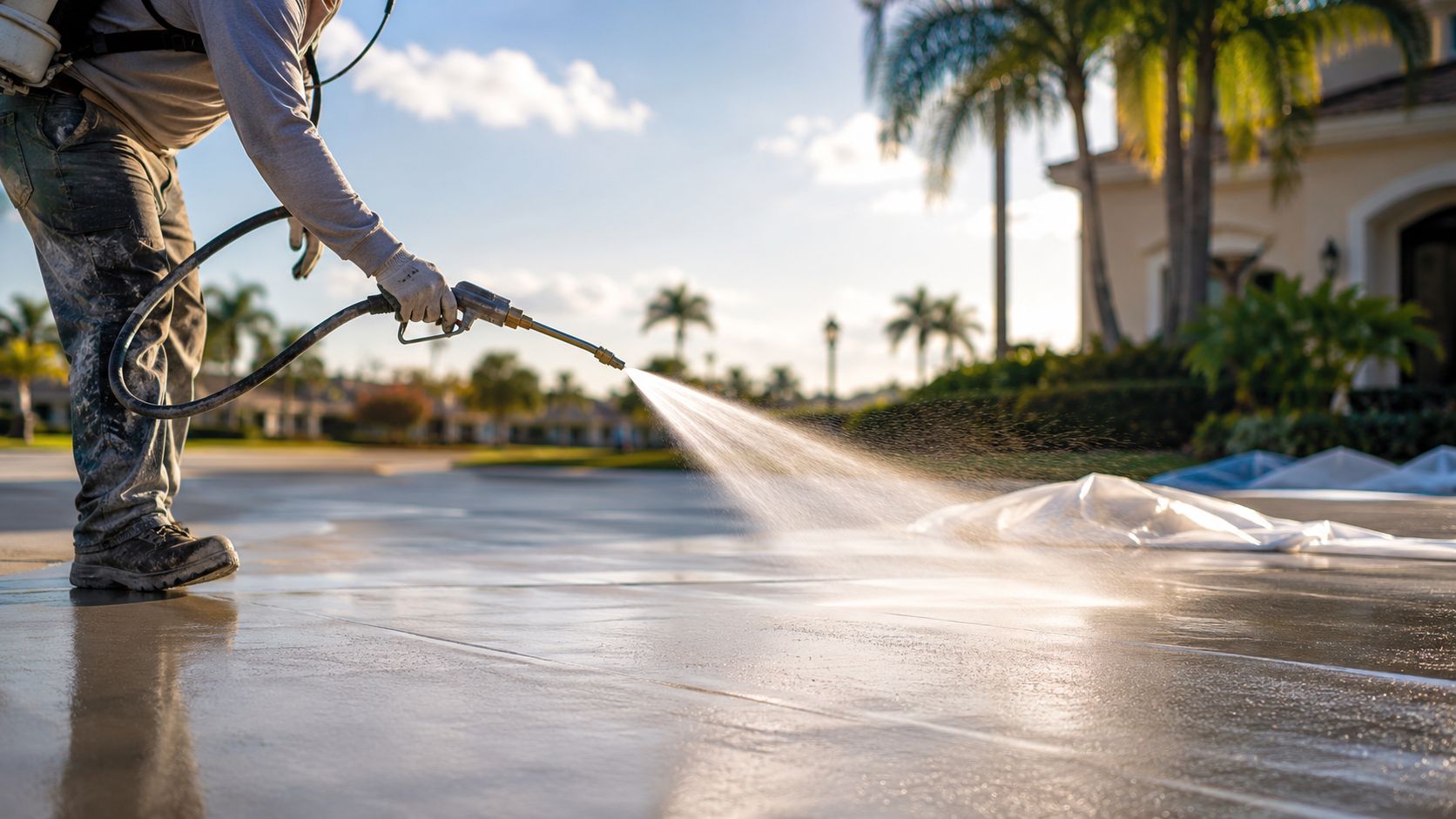
Curing is where a lot of driveway jobs go wrong. Concrete gains strength through a chemical curing reaction that depends on moisture, and Central Florida heat can pull that moisture away too fast. The result is a weak top layer that scales, cracks, or turns dusty early.
Start curing as soon as the final texture is done. A liquid curing compound should go on within about 20 minutes of finishing, then the slab should stay moist for a minimum of seven days (Michigan Concrete Driveway and Sidewalk Guidelines). On jobs in Summerfield, Lecanto, and Hernando, that often means using burlap or polyethylene sheeting during the cooler part of the day, because direct sun can punish fresh concrete by late morning.
Don't treat curing like an optional cleanup step. It's part of the finish.
Sealing comes later, after the slab has cured for at least 28 days. A good penetrating or film-forming sealer helps block stains, UV exposure, and moisture intrusion, which is why I don't like seeing sealant sprayed on too early just because the slab “looks dry.” In hot, humid communities like Ocala and Central Florida's coastal-influenced areas, resealing every two to three years is a realistic maintenance rhythm for driveways that see steady use.
If you want a straight answer on timing, this curing guide is worth reading before anyone starts spraying sealer. A driveway that cures right lasts longer, and that is where the long-term savings show up.
Common Defects and How to Fix Them
Most finishing defects start with timing mistakes, not bad concrete. Crazing is the fine web of surface cracks you see when the top gets overworked or when someone sprinkles water on a slab to slow evaporation. Scaling is the flaking or chipping that shows up when finishing starts too early, the surface is over-troweled outdoors, or sealant goes on before the slab has fully cured.
A few common failures stand out:
- Crazing: usually a surface paste problem, not a deep structural one.
- Scaling: often means the finish was rushed or sealed too early.
- Joint spalling: the edges crumble, usually because the mix, water content, or edge treatment wasn't right.
- Blistering: raised bumps caused by trapped air or bleed water under the surface.
The fix depends on how deep the damage goes. Minor crazing can often be stabilized with a quality sealer. Spalled joints may need filling or resurfacing. Once scaling exposes aggregate, it's time for a professional look because the problem may run deeper than a patch can solve.
I've seen plenty of driveways in Marion County, FL and Citrus County, FL where the owner blamed the weather first. Weather matters, but the main culprit is usually a finish that got moved along too early. If the slab was worked while water was still on top, the damage was baked in from day one.
When to Call a Professional
Concrete driveway finishing is one of those jobs where experience shows up before the first truck leaves the site. A sudden afternoon storm, a fast temperature shift, or a slab that firms up quicker than expected can turn a decent pour into a problem in minutes. That's why I don't tell homeowners in Belleview, Silver Springs, Crystal River, Homosassa, or The Villages to gamble on the finish stage if the driveway has to come out right the first time.
The bigger issue is that proper driveway work isn't just finishing. It's site prep, thickness, joint layout, timing, curing, and then maintenance after the fact. The Bureau of Labor Statistics counted 203,560 employed cement masons and concrete finishers in May 2023, with a mean hourly wage of $27.60 and a mean annual wage of $57,410, which tells you this is skilled labor, not casual labor (BLS occupational profile). That skill matters because bad finish work doesn't announce itself until later.
If you want one company that handles both the concrete side and the maintenance side, Riverside Sealing & Striping, LLC works across Marion County, FL and Citrus County, FL on concrete driveways, asphalt sealcoating, and parking lot striping. For homeowners and property managers who want reliable scheduling and clear expectations, a no-pressure site visit is the right move before any slab gets poured or repaired.
If your driveway in Marion County or Citrus County needs new concrete, a better finish, or a repair plan that fits Florida conditions, contact Riverside Sealing & Striping, LLC for a free estimate. They handle concrete driveway work, sealing, and related pavement services across Central Florida, and a quick on-site evaluation can save you from paying twice for the same problem.