
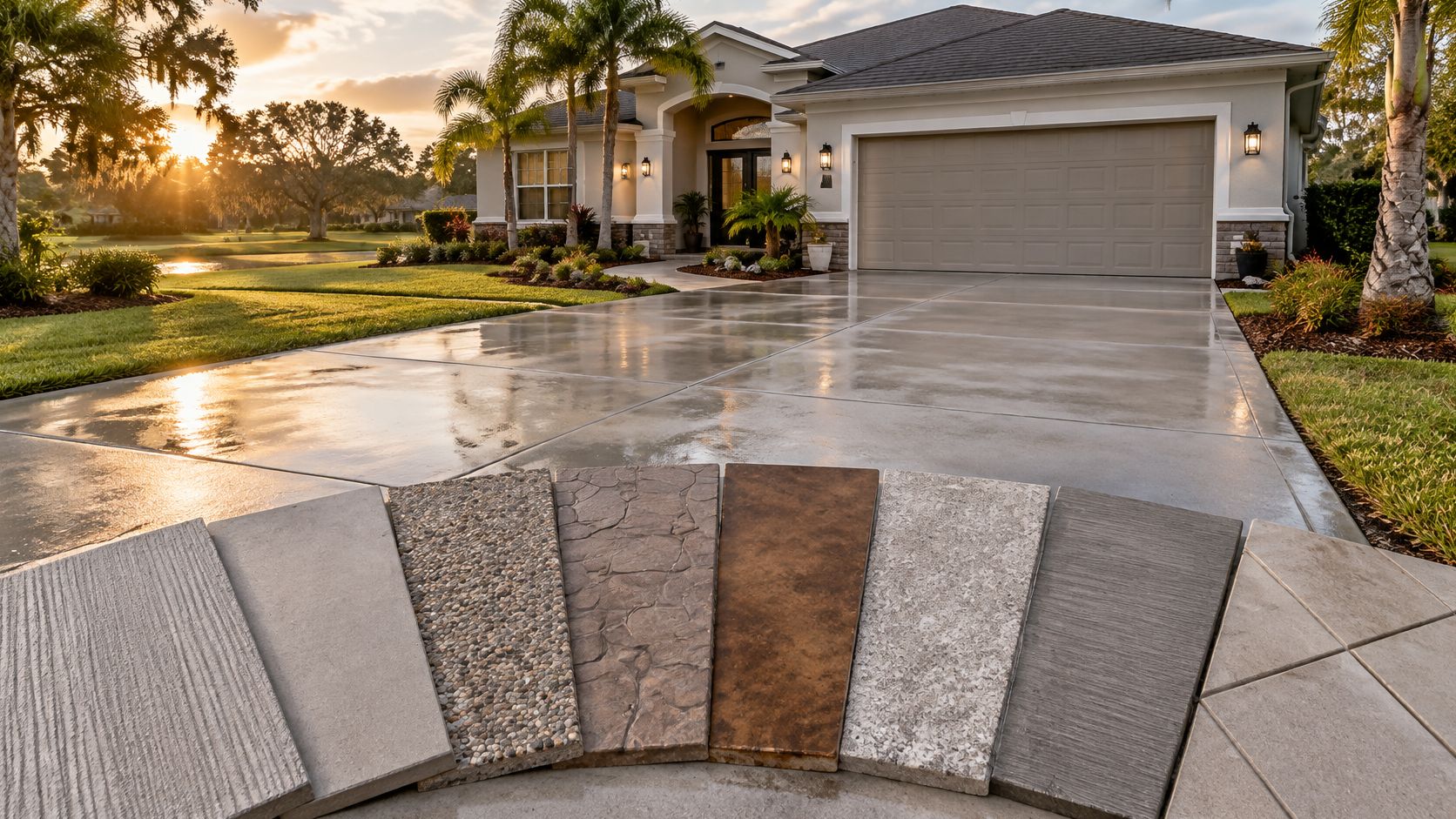
You're looking at your driveway after a July storm in Ocala. Water sits near the garage, the smooth surface feels slick, and the color looks washed out once the sun returns. You start browsing concrete driveway images, but most photos show dry, freshly finished surfaces without explaining what happens after summer downpours and daily traffic.
The right finish has to work wet, hot, and under your tires, not just look good from the street. Texture affects footing. Color changes how the surface feels in direct sun. Sealers influence appearance and maintenance, while grading determines where rainwater goes.
For homeowners in Marion County, FL, and Citrus County, FL, the best choice often comes down to how much decoration and upkeep you want. A straightforward broom finish suits a working driveway. Stamped, stained, and exposed aggregate surfaces offer more visual detail, but they need more careful selection and maintenance.
The following concrete driveway finishes give you practical options for Central Florida homes. Treat the neighborhood examples as design scenarios, not completed-project claims. And when you compare pictures, look beyond color to joints, drainage, edges, and the walking route to your front door.
Table of Contents
- 1. Broom-Finished Concrete Driveway
- 2. Exposed Aggregate Concrete Driveway
- 3. Stamped Concrete Driveway
- 4. Stained Concrete Driveway
- 5. Ribbon Driveway
- 6. Concrete Driveway with Paver or Brick Border
- 7. Saw-Cut Scored Concrete Driveway
- 8. Salt-Finish Textured Concrete Driveway
- Driveway Finish Comparison at a Glance
- Choosing the Right Driveway Finish for Your Home
1. Broom-Finished Concrete Driveway
Broom-finished concrete is the practical starting point when you want dependable texture without paying for elaborate decoration. After screeding and floating the slab, the finisher draws a concrete broom across the surface to create parallel grooves.
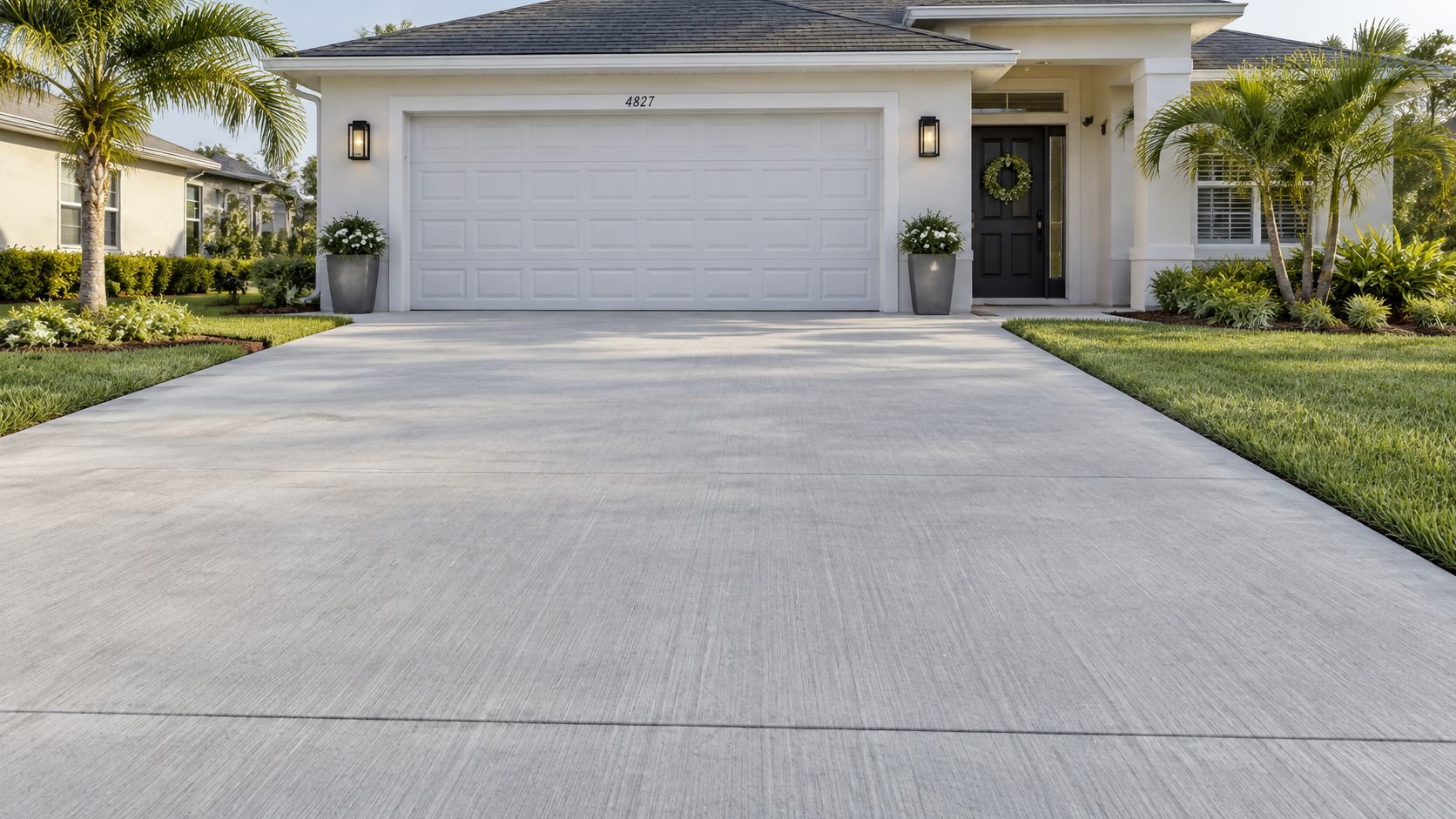
For a home in Belleview or Summerfield, a light gray field with straight, consistent broom lines gives the garage approach a clean appearance. It also avoids the color-matching work that comes with decorative repairs. In full sun, that restrained finish is often easier to live with than a dark, glossy treatment.
What Makes It Work in Florida
The grooves help provide footing during rain, but texture doesn't fix poor drainage. The slab still needs appropriate grades, a supported base, and transitions that don't trap water against the garage.
- Keep the texture balanced. Deep, harsh grooves collect dirt and feel rough under bare feet. A nearly smooth finish sacrifices useful texture.
- Plan joints before placement. Joint locations should suit the slab geometry, garage opening, and adjoining walkways.
- Choose protection deliberately. A compatible penetrating treatment can help limit moisture and staining without adding a glossy film. It isn't a substitute for curing or a universal UV shield.
For an Ocala household that parks outside daily, this is a sensible low-decoration option. Our concrete driveway finishing guide explains the finishing choices that matter beyond the final photograph.
2. Exposed Aggregate Concrete Driveway
A light concrete border around a stone-textured field can suit a Lecanto home without making the driveway look overly formal. Exposed aggregate achieves that appearance by removing surface cement paste at the proper stage to reveal selected stone.
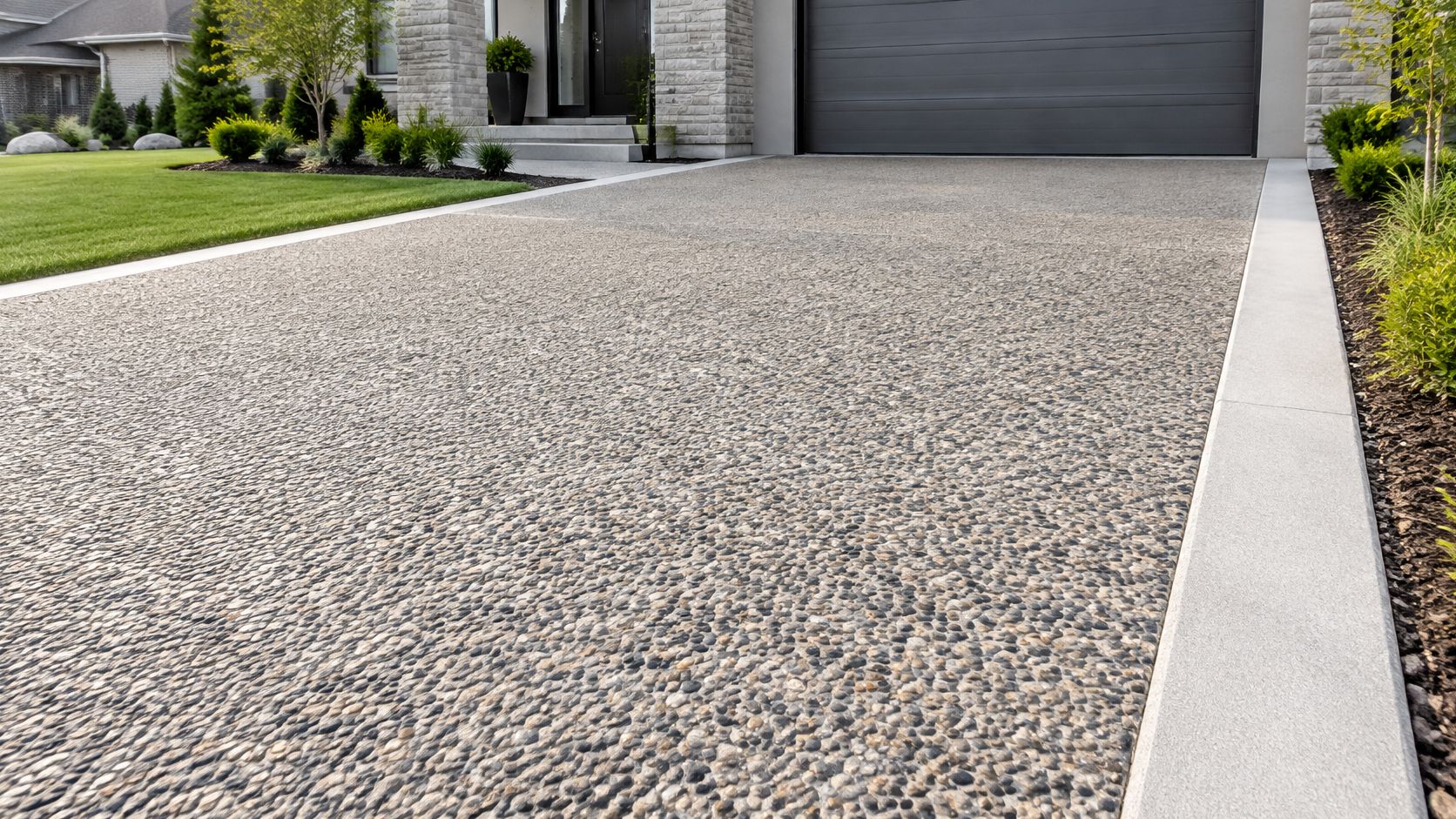
The trade-off is texture. Rounded aggregate can provide useful wet-weather grip, but an aggressive exposure can feel uncomfortable underfoot and make rolling bins harder to move. Stone selection and exposure depth matter as much as color.
Choose the Stone Before the Sealer
Take a physical sample outside in direct sun and shade. A dark blend may complement a Crystal River home's trim, yet feel hotter than a lighter selection in the same exposure. Wet stone and color-enhancing sealer can also look substantially darker than a dry sample.
Practical rule: Approve the aggregate both dry and wet. A driveway shouldn't surprise you every time it rains.
Hot concrete and drying wind can shorten the finishing window. The crew needs a controlled exposure process, not improvised washing that leaves uneven patches or loosens stone.
For a natural-looking entry in Homosassa or Hernando, choose the aggregate around walking comfort first, then coordinate the border. Review these exposed aggregate concrete pros and cons before committing.
Keep the surface clean and inspect the protective treatment for wear. Resealing should follow the product and observed condition, not a calendar copied from a different property.
3. Stamped Concrete Driveway
Stamped concrete gives you a patterned slab, not individual pavers. Finishers press textured mats into workable concrete to create stone, slate, brick, or cobblestone effects. Color and release treatments add contrast.
An ashlar slate pattern with a restrained border could suit a Belleview home. A brick pattern continuing toward the front entrance could work in Summerfield, provided the walking surface stays comfortable.
This video provides a visual reference for decorative concrete work.
Judge the Sealed Sample, Not Just the Pattern
Deep texture can catch dirt and leave small pockets of water. A glossy film may sharpen the color but become slippery when wet, particularly where tires and foot traffic polish the surface.
- Request a representative mockup. It should include the intended pattern, color, release treatment, and final sealer.
- Keep contrast controlled. Heavy antiquing can look artificial and make future repairs harder to blend.
- Set a condition-based reseal plan. Inspect traffic lanes, sun-exposed areas, and spots beneath roof runoff. Don't keep adding coats over a failing film.
Central Florida sun can change the appearance of decorative treatments, while rain exposes weaknesses in texture and drainage. Lighter colors are worth considering for an unshaded Dunnellon driveway.
Stamped concrete still needs functional joints, and those joints may cross the decorative pattern. Don't sacrifice crack-control planning to preserve an uninterrupted photograph. Also compare complete installed scopes before assuming stamping will cost less than pavers.
4. Stained Concrete Driveway
Staining can change a sound driveway's appearance without adding a heavy-looking surface layer. Acid stains react with suitable concrete, producing variegated tones, while water-based products use different coloring systems and offer broader color choices.
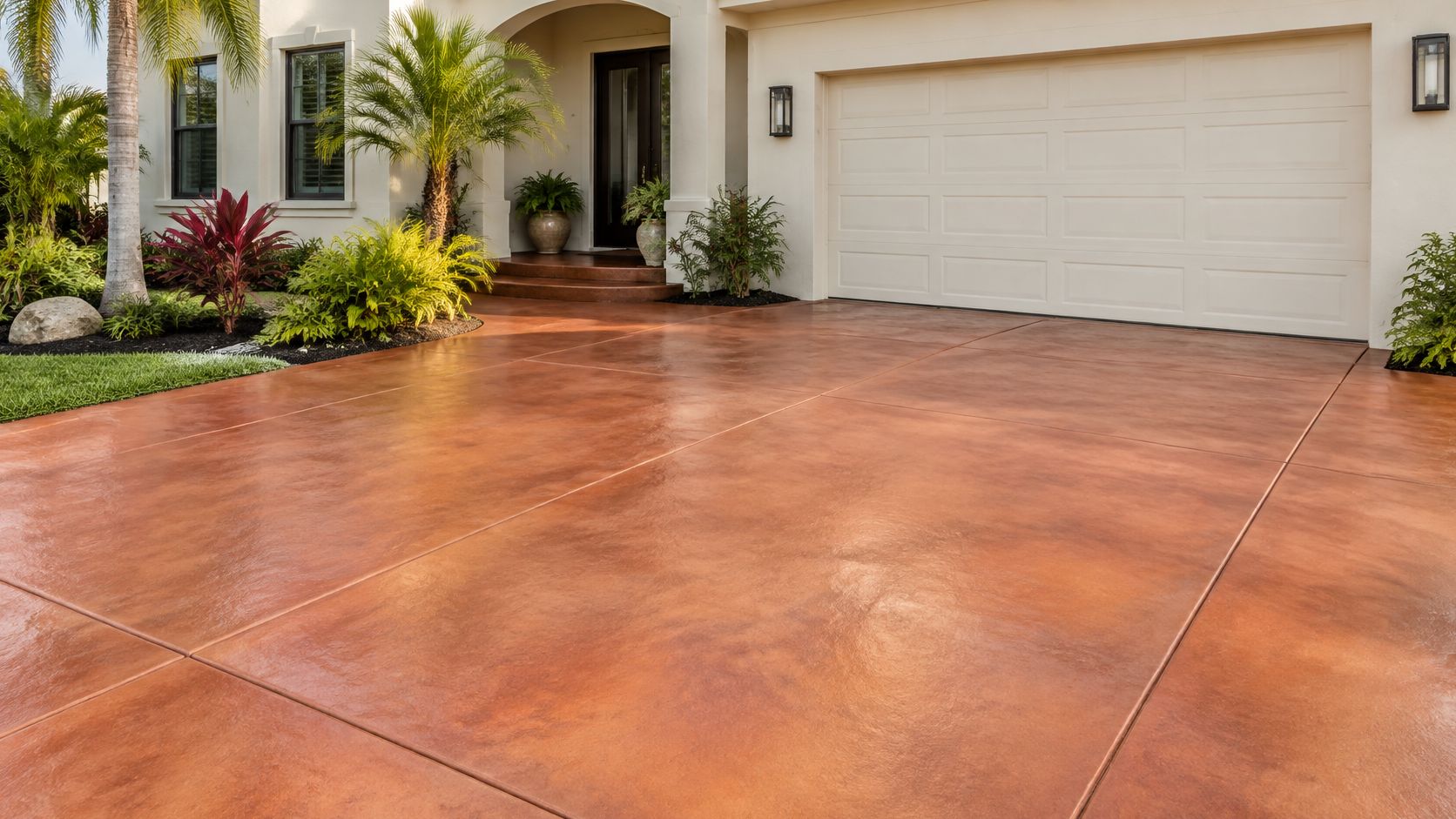
A terracotta treatment with dark scoring could complement a Homosassa home's light stucco. A softer tan might suit a Beverly Hills property where the owner wants warmth without a strong orange cast. Those are design possibilities, not promises of an exact shade.
Existing Concrete Determines the Result
Stain doesn't hide everything. Oil contamination, previous sealers, repairs, and differences in surface absorption can remain visible or affect color development.
Stain changes appearance. It doesn't correct settlement, close structural cracks, or make standing water drain away.
Prepare a test area before treating the whole driveway. Clean and prepare the slab according to the chosen system, then evaluate the sample with its intended protective finish.
For an Inverness driveway exposed to strong sun, select an exterior-rated coloring system and a compatible sealer. Don't assume every stain is UV-stable or that every water-based product behaves like a reactive acid stain.
Clean fertilizer spills and vehicle fluids promptly. Summer rain can spread contaminants across the slab, while excessive sealer buildup can create cloudy or slippery areas. Allow the required curing and drying periods between steps, even when you want a fast turnaround.
5. Ribbon Driveway
A ribbon driveway uses separate concrete wheel paths with grass, gravel, or planting between them. It softens the appearance of a long entry and reduces the area covered by concrete, but it demands more attention to vehicle movement than a full-width slab.
The image below is useful for considering how a bright driveway relates to palms and the house exterior. It isn't a construction reference for ribbon spacing.
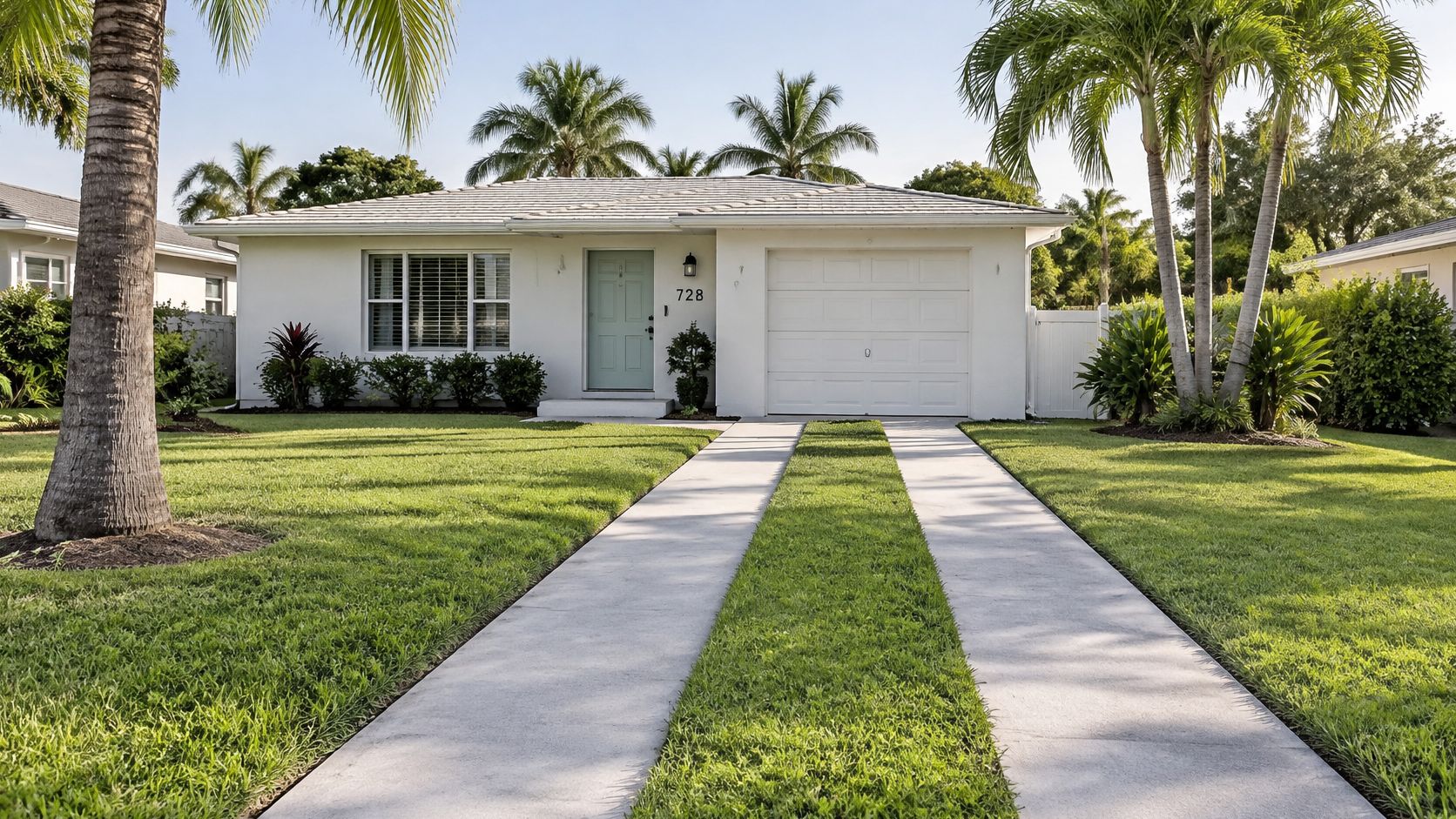
For a larger Dunnellon lot, concrete tracks with a planted center could fit the property. A rural Ocala entry might use contained gravel instead, especially where maintaining grass beneath a parked vehicle would be difficult.
Lay Out the Vehicle Paths First
Check the actual vehicles, turning movements, delivery access, and where passengers step out. Narrow ribbons can leave tires running along unsupported edges or passengers stepping into muddy ground.
- Plan the center material. Grass needs suitable light and maintenance. Gravel needs containment so it doesn't scatter across the concrete.
- Provide a solid walking connection. A planted center isn't a dependable pedestrian route during heavy rain.
- Review drainage below the surface. An open center doesn't automatically make the entire driveway permeable.
The EPA's permeable-pavement guidance emphasizes site suitability, including underlying conditions, drainage, traffic, and maintenance. Apply that same caution before assuming a ribbon layout will solve runoff.
Sun, shade, and wet-season use should guide the center planting. The concrete still needs proper support and jointing.
6. Concrete Driveway with Paver or Brick Border
A brick or paver border adds definition without covering the whole driveway in decorative material. The junction between the materials matters more than matching their colors. For a home in The Villages, a light concrete field with a darker brick edge can frame the approach. In Lecanto, a vehicle-rated concrete paver could tie the driveway to an entry walk while keeping the main surface simple.
Build the Border for Traffic
Concrete and pavers respond differently to movement and weather. If the border lacks support, its units can settle or rock, leaving a raised edge beside the slab.
- Choose vehicle-rated materials. A paver made for patios may not suit tires turning at the driveway edge.
- Support and restrain the border. Compaction, bedding, edge restraint, and the transition should work as one system.
- Use compatible joint material. Polymeric sand can reduce joint loss, though poor installation or concentrated runoff can still wash it out.
Summer downpours in Marion and Citrus counties test the bedding and drainage. Heat and UV exposure can fade colored pavers or change how their sealers look. View samples outdoors before choosing, and account for the finish's maintenance and resealing needs.
Explore these concrete driveway edging ideas to coordinate a border with the home without letting it dominate the design.
For an HOA or public-facing property, inspect the adjoining pedestrian route as carefully as the driveway, since ADA accessible-route rules limit abrupt changes in level along it. Keep the transition between the pavers and concrete even, especially where people walk across the edge.
7. Saw-Cut Scored Concrete Driveway
Decorative scoring and contraction joints aren't interchangeable. Shallow cuts create visual patterns. Properly designed contraction joints help establish where shrinkage cracking is intended to occur.
That distinction matters when concrete driveway pictures show a perfect grid with no explanation of cut depth or timing. A decorative line may look convincing while doing little for crack control.
Draw the Pattern Around the Joint Plan
A light gray, grid-scored driveway could suit a contemporary Ocala home. A colored field with a restrained geometric pattern could work in Crystal River, provided the layout doesn't create awkward panels or fight the garage alignment.
The San Marcos concrete-driveway specification calls for weakened-plane joints at approximately 10-foot centers in its municipal application. That's an example of documented joint planning, not a universal specification for every Florida driveway.
Before the pour: Resolve the functional joint layout first. Fit the decorative scoring around it.
Concrete temperature, mix, weather, and equipment determine the appropriate cutting window. Cutting too early can damage edges; cutting too late can allow random cracks before the joints are effective.
For Central Florida sun, a light field with subtle scoring avoids the visual maintenance of heavily contrasted colors. Rainwater still needs a graded route off the slab because score lines aren't drainage channels.
Sweep grit from the grooves and clean staining before it becomes established. If the surface is sealed, inspect wear and compatibility before recoating rather than repeatedly building film over dirty cuts.
8. Salt-Finish Textured Concrete Driveway
A salt finish creates small depressions by pressing rock salt into fresh concrete and washing it out after the surface has hardened appropriately. The result is a pitted texture, not exposed stone or a stamped pattern.
For a Homosassa entry, that restrained texture could pair with a stained border. On a sloped Hernando driveway, however, don't choose it from a photograph alone. Wet footing depends on the finished texture, slope, cleanliness, and any sealer.
Consistency Matters More Than Dramatic Texture
Salt distribution and pressing depth affect the result. Uneven application can leave dense patches beside nearly smooth areas, and overly aggressive pits collect debris.
- Approve a sample panel. Check the texture underfoot and see how the intended sealer changes it.
- Keep pits clean. Leaves, grit, and organic buildup can lodge in the depressions during rainy weather.
- Avoid excess gloss. A shiny film can undermine the practical benefit you're seeking from texture.
Salt finishing doesn't replace grading or drainage correction. It also doesn't guarantee slip resistance under every wet condition.
A light natural color can be a practical choice in direct sun because there's less decorative color to maintain. If you add stain or a tinted treatment, select an exterior-rated system and inspect it for sun-related appearance changes.
For a sloped Citrus County property, the base, grades, transitions, and final walking texture deserve professional review. A licensed and insured crew with textured-finishing experience is more important than a dramatic inspiration image.
Driveway Finish Comparison at a Glance
| Item | Typical Look | Relative Cost | Reseal Guidance | Best For |
|---|---|---|---|---|
| Broom-Finished Concrete Driveway | Neutral gray with parallel grooves | Low | Inspect for wear, staining, or water absorption; reseal as the product directs when these appear | Budget-friendly traction and simple upkeep |
| Exposed Aggregate Concrete Driveway | Visible natural stones with a rough texture | Higher than broom finish | Check for wear, staining, or water absorption; follow the sealer's instructions when resealing | Wet-weather traction and natural curb appeal |
| Stamped Concrete Driveway | Patterns mimicking stone, brick, or cobblestone | Lower than natural stone; higher than basic finishes | Reseal when wear, staining, or water absorption indicates it is needed, following product instructions | Decorative style with fewer joints than pavers |
| Stained Concrete Driveway | Mottled or consistent color, often in earth tones | Lower than many stamped or paver options | Inspect the finish for wear, staining, or water absorption, then reseal according to product instructions | Adding color without a surface coating that can peel |
| Ribbon Driveway | Two concrete wheel strips with a grass, gravel, or planted center | Lower material cost than a full-width driveway | Inspect concrete for wear, staining, or water absorption; follow product instructions when resealing | Larger lots and reduced hardscape |
| Concrete Driveway with Paver or Brick Border | Concrete field framed by pavers or brick | Moderate upgrade over plain concrete | Check the concrete finish for wear, staining, or water absorption; use its product instructions to guide resealing | A more finished look without a full paver driveway |
| Saw-Cut Scored Concrete Driveway | Geometric or random lines cut into the surface | Low added cost | Inspect for wear, staining, or water absorption; reseal according to product instructions when needed | Modern style and planned crack control |
| Salt-Finish Textured Concrete Driveway | Uniform, lightly pitted surface | Relatively low for a textured finish | Look for wear, staining, or water absorption, and follow product instructions for resealing | Slip resistance on wet or sloped driveways |
In Marion and Citrus County, heat, strong sun, and summer downpours affect every finish. Check the surface for wear, staining, and water absorption rather than relying on a fixed resealing calendar. Follow the sealer's product instructions, since finish and product choice affect upkeep.
Choosing the Right Driveway Finish for Your Home
Choose a driveway finish by considering how the surface will be used and maintained. Daily parking, turning tires, walking to the mailbox, and moving trash bins all affect what will work well. Broom and scored finishes keep the look simple. Aggregate, stamped, and stained finishes add detail, with different cleaning and resealing needs.
In Marion and Citrus counties, the installation matters as much as the finish. Heat affects concrete placement and finishing. Sun and UV exposure can fade colors and wear sealers, while summer downpours expose low spots, weak edges, and poorly planned transitions. Drainage and jointing deserve attention before decorative details.
Compare Evidence, Not Just Attractive Photos
Ask to see concrete driveway images that show the project beyond a freshly cleaned surface. The FHWA Long-Term Pavement Performance program documents pavement condition alongside construction, environmental, and maintenance information. The practical takeaway is to compare photos with a clear description of the work.
Check proposals for three details:
- Preparation and support. Clarify removal, base correction, specified reinforcement, and edge support.
- Water management. Confirm where runoff will flow and how the driveway meets the garage, sidewalk, and street.
- Maintenance expectations. Identify the finish, protective product, cleaning method, and signs that resealing is needed.
Settlement, recurring cracks, ponding, and difficult grades call for professional assessment. Adding a decorative finish alone will not correct the underlying issue.
Local Planning and Professional Help
Riverside Sealing & Striping is a family-owned concrete and asphalt contractor based in Dunnellon, serving Marion, Citrus, and surrounding Central Florida counties. The company offers free, no-pressure on-site consultations and estimates from 7am to 7pm. Its concrete driveway services include removal and replacement of damaged driveways, new installations, and decorative finishes.
Concrete and Asphalt Experts in Marion and Citrus County means planning for the property as a whole. Concrete finishing and asphalt maintenance use different materials and methods. Homeowners and associations should consider the needs of each surface separately, and weigh appearance against drainage, durability, and upkeep.
Choose a finish you like, then confirm the drainage, joints, and maintenance plan before work begins.
Riverside Sealing & Striping, LLC offers concrete driveway installation, removal and replacement, decorative finishes, and asphalt maintenance for Central Florida properties. Bring your favorite concrete driveway images to a free, no-pressure consultation to discuss appearance, site drainage, traffic, and maintenance needs. Visit Riverside Sealing & Striping, LLC to arrange an on-site estimate.