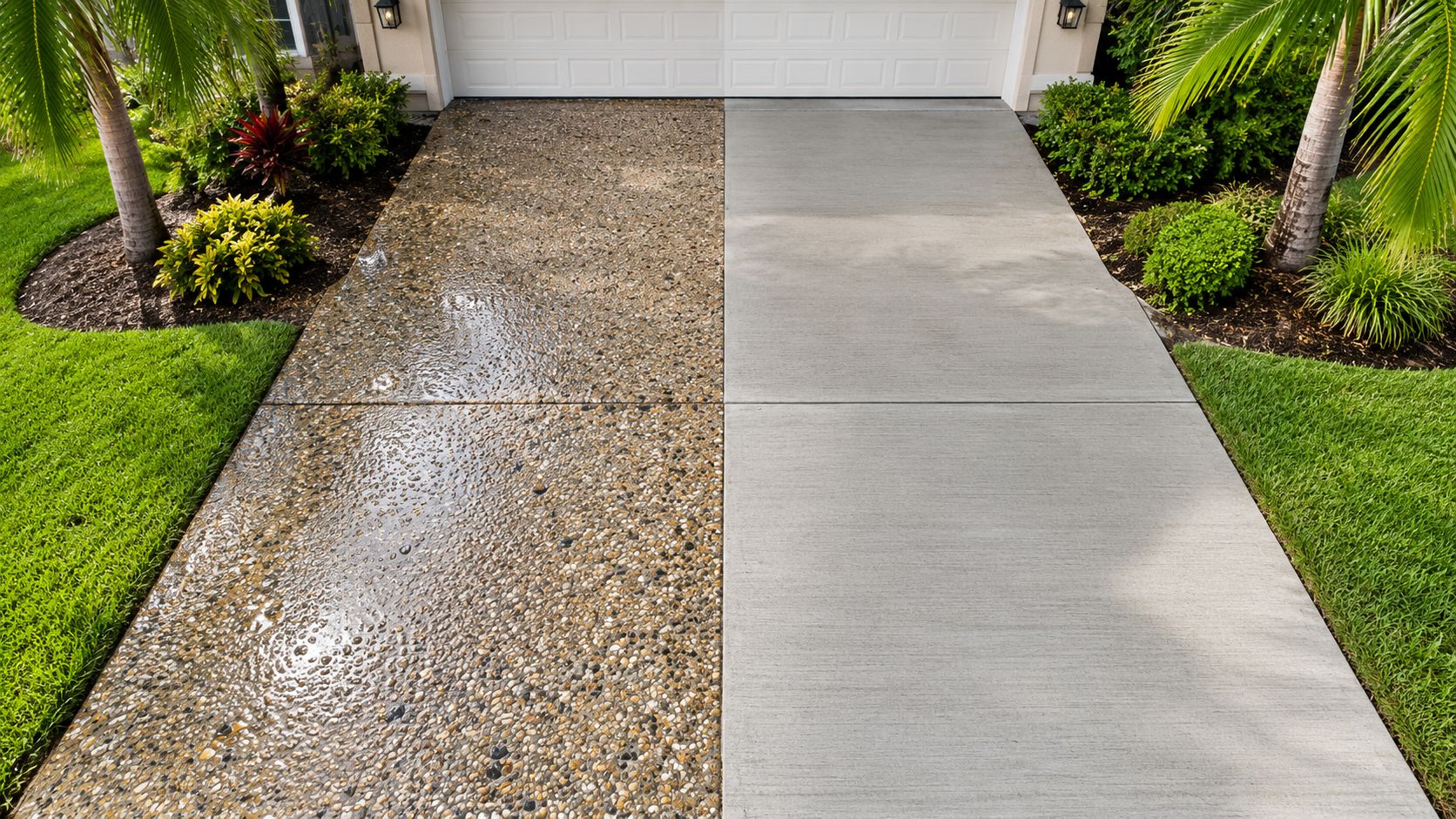
After a Central Florida storm, a homeowner walks across the driveway and finds puddles near the garage, slick patches by the walkway, and a plain gray slab that looks tired. They're considering exposed aggregate concrete for a new driveway or patio, but want to know whether its stone-textured look is worth the trade-offs.
The straight answer: exposed aggregate can be a durable, attractive choice for Marion County, FL, and Citrus County, FL, but it isn't automatically safer or maintenance-free. The stone, mix, drainage, curing, and finishing all matter. Before signing, ask your contractor exactly what materials and methods they plan to use.
| Finish | Main advantage | Main trade-off |
|---|---|---|
| Exposed aggregate | Distinctive stone texture and useful traction | Needs careful aggregate selection and consistent exposure |
| Broom-finished concrete | Straightforward, practical surface | Simpler appearance |
| Stamped concrete | Patterned appearance | Texture and sealer require careful consideration for wet conditions |
Table of Contents
- What Homeowners Notice First About Exposed Aggregate
- How Exposed Aggregate Is Made and What Controls the Look
- Real Durability and Traction Benefits in Florida Conditions
- The Hidden Cons Most Pros and Cons Lists Miss
- Cost, Lifespan, and Maintenance Compared to Plain Concrete
- What to Ask Before Hiring a Central Florida Contractor
- When Exposed Aggregate Is the Right Call in Central Florida
What Homeowners Notice First About Exposed Aggregate
After rain, the surface underfoot becomes more than a design choice. A smooth-looking slab can leave a homeowner wondering whether the finish offers enough grip around a driveway, patio, or pool. Exposed aggregate catches the eye for a different reason: its visible stones give the concrete a natural, varied appearance instead of a uniform gray plane.
The technique has a long architectural history. The National Park Service identifies the 1920s onward as a period when concrete achieved major design results, including John J. Earley's work at Meridian Hill Park in Washington, D.C., and the Baha'i Temple in Wilmette, Illinois, constructed from 1920 to 1953 (National Park Service preservation guidance). Those examples show how concrete moved beyond a purely structural material into deliberately finished architecture.
On a home, the same principle produces a surface with visible coarse aggregate. The stones may differ in color, size, and shape, so the final look depends on the material chosen and how much of it the installer exposes. That gives homeowners room to choose a finish that complements a home's exterior, but it also means a sample and a finished driveway can look noticeably different if the work isn't consistent.
My advice: Choose exposed aggregate because you like the actual stone and texture, not because someone promises it will solve every wet-surface concern.
For homes in Ocala, Dunnellon, Belleview, Silver Springs, Summerfield, and The Villages, the finish can add visual character to a driveway or entry walk. It can also suit patios in Crystal River, Homosassa, Inverness, Lecanto, Beverly Hills, and Hernando. But the label alone doesn't tell you whether the surface will perform well. The exposed finish is only as dependable as the aggregate and installation behind it.
How Exposed Aggregate Is Made and What Controls the Look
Exposed aggregate isn't a coating applied over a finished slab. The installer places concrete, then removes or washes away some of the surface cement mortar so the coarse stones remain visible. The American Cement Association identifies chemical surface retarders, sandblasting, water blasting, and acid etching as methods for exposing aggregate, and stresses that aggregate should be clean, hard, strong, and durable to help prevent popouts and wear (American Cement Association guidance on concrete applications).
The process and material both shape the result. A contractor should be able to explain:
- Which stone will be used: Color, hardness, size, shape, and gradation affect appearance and wear.
- How the surface will be exposed: The method and timing influence how much aggregate shows.
- How the slab will be cured: Consistent curing supports a sound surface.
- How exposure will be checked: A representative sample helps confirm the look before the full pour.
A useful way to compare finish options is to look beyond their names. Each one brings a different balance of appearance, texture, and upkeep.
| Finish type | Look and texture | Traction when wet | Relative cost | Typical maintenance |
|---|---|---|---|---|
| Exposed aggregate | Visible stones with a natural, textured look | Can provide useful texture, but depends on stone, exposure, wear, and sealer | Often more involved than a basic broom finish; confirm the project quote | Cleaning, inspection, and possible resealing |
| Broom-finished | Plain concrete with linear texture from brooming | Textured, with performance depending on finish and upkeep | Usually a straightforward finish option; confirm the project quote | Routine cleaning and inspection |
| Stamped concrete | Patterned surface made to resemble other materials | Depends on pattern, surface treatment, and sealer | Depends on pattern and installation; confirm the project quote | Cleaning and sealer maintenance |
For a closer look at patio surface options, review this guide to types of concrete finishes for patios. The important point is that exposed aggregate's decorative character comes from the actual stone, not a printed or stamped pattern.
Ask to see a sample panel made with the proposed aggregate and exposure method. If the sample looks uneven, contains loose particles, or feels too rough for bare feet, settle those concerns before the contractor places the full slab.
Real Durability and Traction Benefits in Florida Conditions
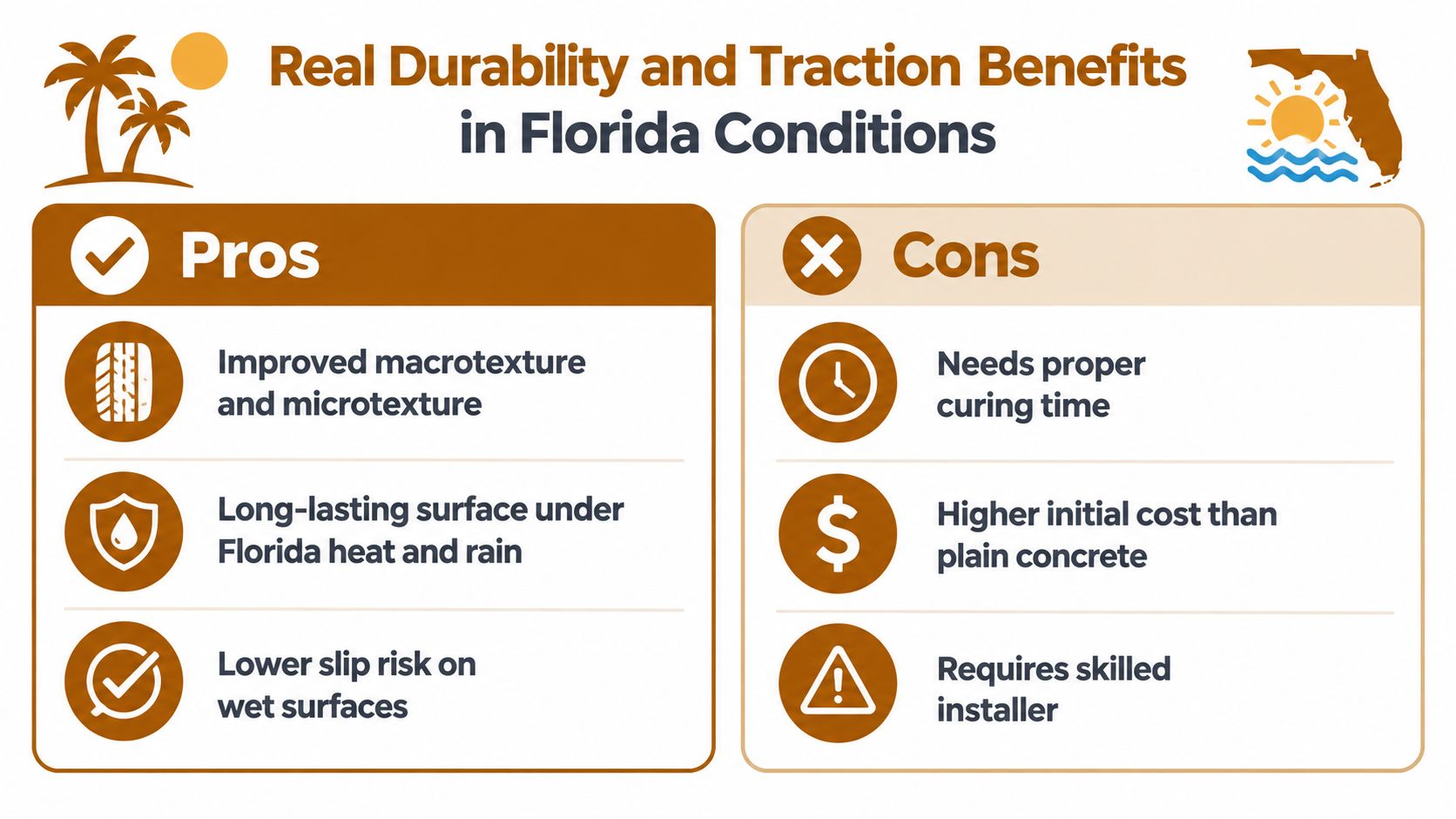
When the right stone is exposed evenly and remains firmly bonded, the textured surface can offer practical benefits as well as visual appeal. A technical review reports that properly designed exposed-aggregate concrete pavements can achieve good friction resistance, low tire-road noise, and durability comparable to conventional concrete pavements (technical review of exposed-aggregate concrete).
That texture can support traction and help surface water drain across the finish. It's a sensible feature to consider for driveways, entry walks, and outdoor areas that get wet in Central Florida downpours. But the surface won't fix a poor slope or drainage plan. If water collects beside the home or remains in low spots, address grading and runoff rather than expecting texture alone to solve it.
Why aggregate quality matters
The finish can only perform as well as the stone exposed at the surface. Hard, durable aggregate helps the texture hold up under regular use. Softer or more porous particles can wear, loosen, or contribute to surface defects. A surface that looks attractive when new can lose its texture if traffic gradually polishes the exposed stones.
Central Florida's heat, rain, and humidity make moisture management a practical concern. Water that drains poorly or remains against the slab can put unnecessary strain on the concrete system. The contractor should discuss aggregate suitability, mix design, joints, curing, and drainage as one connected plan, not treat the decorative finish as a substitute for those basics.
Federal Highway Administration guidance identifies susceptible aggregate's freeze-thaw deterioration as a cause of cracking and later spalling, with a typical appearance period of approximately 10 to 15 years (FHWA guidance on aggregate durability). Central Florida doesn't face the same routine freeze-thaw exposure as northern markets, but the broader lesson still applies: aggregate compatibility matters. Don't accept “it's exposed aggregate” as the whole durability specification.
The Hidden Cons Most Pros and Cons Lists Miss
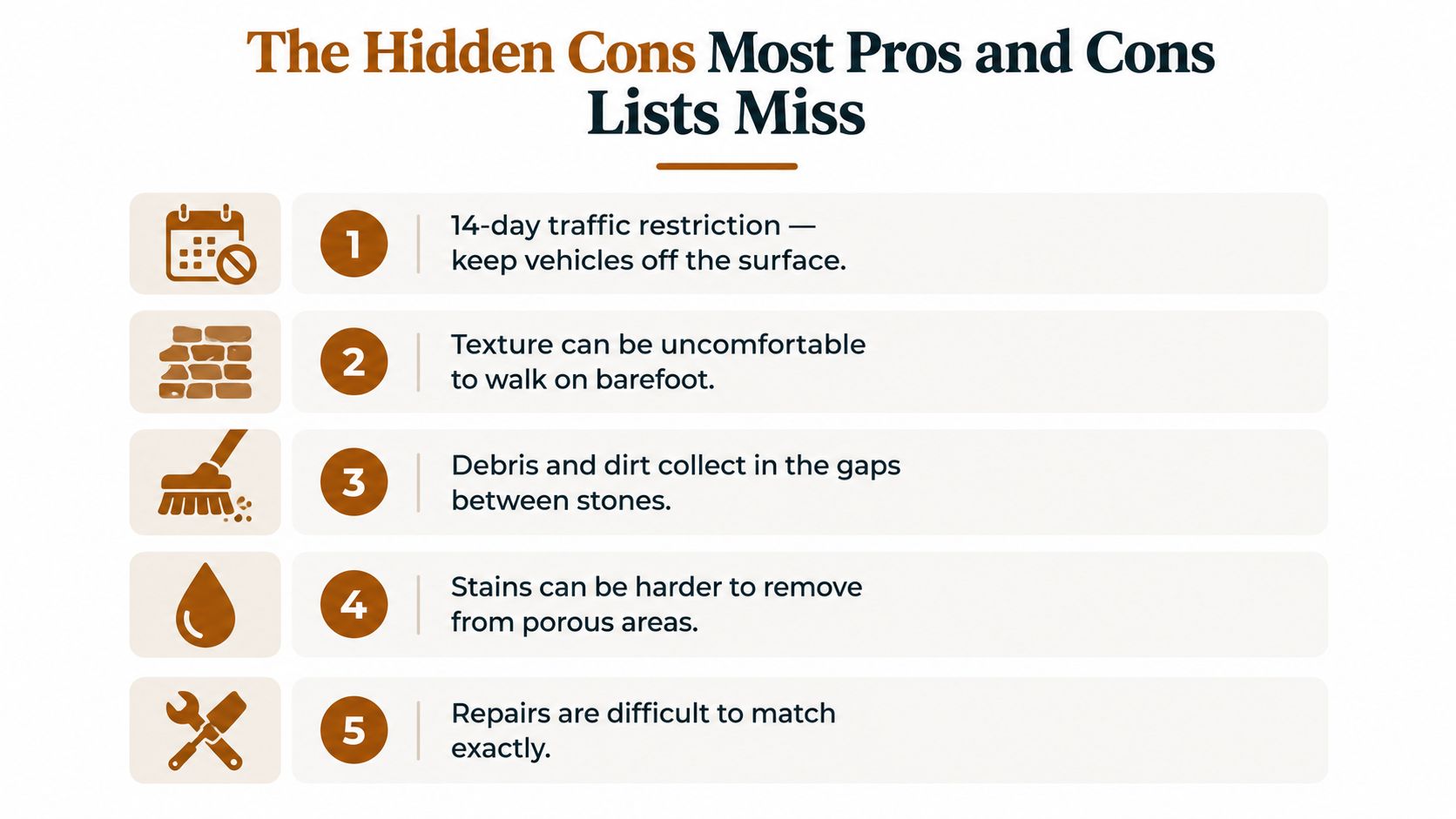
Exposed aggregate isn't automatically slip-resistant in every condition, and it isn't maintenance-free. Sealer, wear, slope, algae, dirt, and standing water all affect how the surface behaves. A shaded walkway that stays damp may become slippery from organic growth even when its original texture was well chosen.
Sealer deserves a direct conversation. Some acrylic sealers can enrich color and help protect against stains, but they may reduce slip resistance. Ask whether the proposed sealer is appropriate for a wet area and whether the contractor recommends a slip-resistant additive. For a pool deck or a walkway that receives regular rain, assess the finished surface when wet, not just when it's dry.
Plan for the early restrictions and routine care
A University of Houston exposed-aggregate paving specification requires a 28-day compressive strength of 3,000 psi, excludes traffic for at least 14 days after placement, and identifies methyl methacrylate acrylic resin as a suitable sealer for exposed-aggregate horizontal concrete (University of Houston exposed-aggregate specification). The traffic restriction can affect when you can use a driveway, so get the schedule in writing before work begins.
The textured surface can also hold leaves and dirt in its gaps. Oil or fuel stains may stand out, and repairs can be difficult to blend because the original stone mix and exposure are hard to duplicate. Clean spills promptly, remove organic buildup from damp or shaded spots, and inspect areas that see frequent vehicle turning or foot traffic.
On pool decks and shaded walks: Specify the wet-surface plan before the pour. Don't wait until after sealing to ask whether the finish will feel slippery.
Cost, Lifespan, and Maintenance Compared to Plain Concrete
For a Central Florida driveway, compare the full installed price, not just the finish. Exposed aggregate usually requires more planning and labor than a basic broom finish. Ask whether each written quote includes the same slab preparation, drainage, joints, curing, and sealing. A lower number may reflect a different scope, not a better deal.
The finish name alone does not predict how long a slab will last. Ask bidders to state in writing what base preparation, joint layout, and curing period their price includes. Those details give you a fairer basis for comparing lifespan expectations than the words “exposed aggregate” or “broom finish.”
Compare the maintenance, not just the appearance
Choose broom-finished concrete if budget and straightforward upkeep lead your decision. Choose exposed aggregate if you want visible stone and accept more attention to cleaning, inspections, and any resealing recommended for the installed surface. Neither finish corrects tree-root movement, a poorly prepared base, or inadequate drainage.
| Consideration | Exposed aggregate | Broom-finished concrete |
|---|---|---|
| Upfront planning | Requires a selected aggregate and controlled exposure | Typically a simpler finish decision |
| Appearance | Natural stone variation | Plain, consistent surface |
| Cleaning | Texture can retain debris and stains | Smoother surface is generally easier to sweep |
| Repair appearance | Matching the original stone and exposure can be difficult | Patches can still show, but don't need to match exposed stone |
| Best fit | Decorative character and texture are priorities | Simplicity and practical use lead the decision |
For patios, regular cleaning and inspection can help you spot problems early. Follow the care instructions for the specific sealer and surface, and use this concrete patio maintenance guide as a starting point.
What to Ask Before Hiring a Central Florida Contractor
A good contractor should be able to explain the proposed materials and sequence without hiding behind “that's how we always do it.” Ask about the site, not just the finish. The same exposed-aggregate mix may not suit every driveway, pool deck, shaded walk, or commercial approach.

Before you approve the job, get clear answers to these questions:
- What aggregate will you use, and where does it come from? Ask about its hardness, durability, and suitability for the intended traffic.
- Can I see a sample panel? Use the actual proposed stone and exposure method so you can judge color, texture, and consistency.
- What is your curing plan? Ask how the slab will be protected and when you can walk or drive on it.
- How will you manage drainage and joints? The slab should direct water appropriately and account for the site layout.
- What sealer and slip strategy do you recommend? Ask whether an additive is needed for wet areas and how the surface will be checked.
- How will you inspect the finished work? Confirm the surface has consistent exposure, no visibly loose stones, and an acceptable wet feel.
A written scope should also identify the work area, base preparation, finish, cleanup, schedule, and care instructions. If you're comparing bids, use these questions to ask a concrete contractor to keep the conversations specific.
When the slab is complete, check it in daylight and after wetting a representative area. Look for patchy exposure, loose particles, puddling, and an unexpectedly slick feel. Don't try to judge the whole project from a small dry sample.
When Exposed Aggregate Is the Right Call in Central Florida
A textured stone finish can suit a Central Florida driveway, entry walk, or patio when appearance and surface character matter. For a pool deck, decide how the surface will perform when wet and how you'll manage drainage and cleaning before choosing the finish. Florida rain makes those details part of the decision, not an afterthought.
A broom finish is the better choice if you need a lower-cost option or want simpler upkeep. Persistent shade can encourage algae, adding cleaning to your routine. Also consider future utility work: repairs that cross a decorative slab can be difficult to blend with the original finish.
The contractor's method matters more than the finish label. Ask for a specification that names the aggregate, exposure method, curing approach, drainage plan, and wet-surface treatment. Field performance depends on appropriate equipment and procedures, so don't accept a promise based on appearance alone.
In Marion and Citrus counties, match the surface to how you use the space and how much maintenance you'll handle. For homeowners in Ocala, Dunnellon, Crystal River, Inverness, and nearby communities, exposed aggregate is a sound choice when the installer can explain the plan for the site and the Florida conditions it will face.