
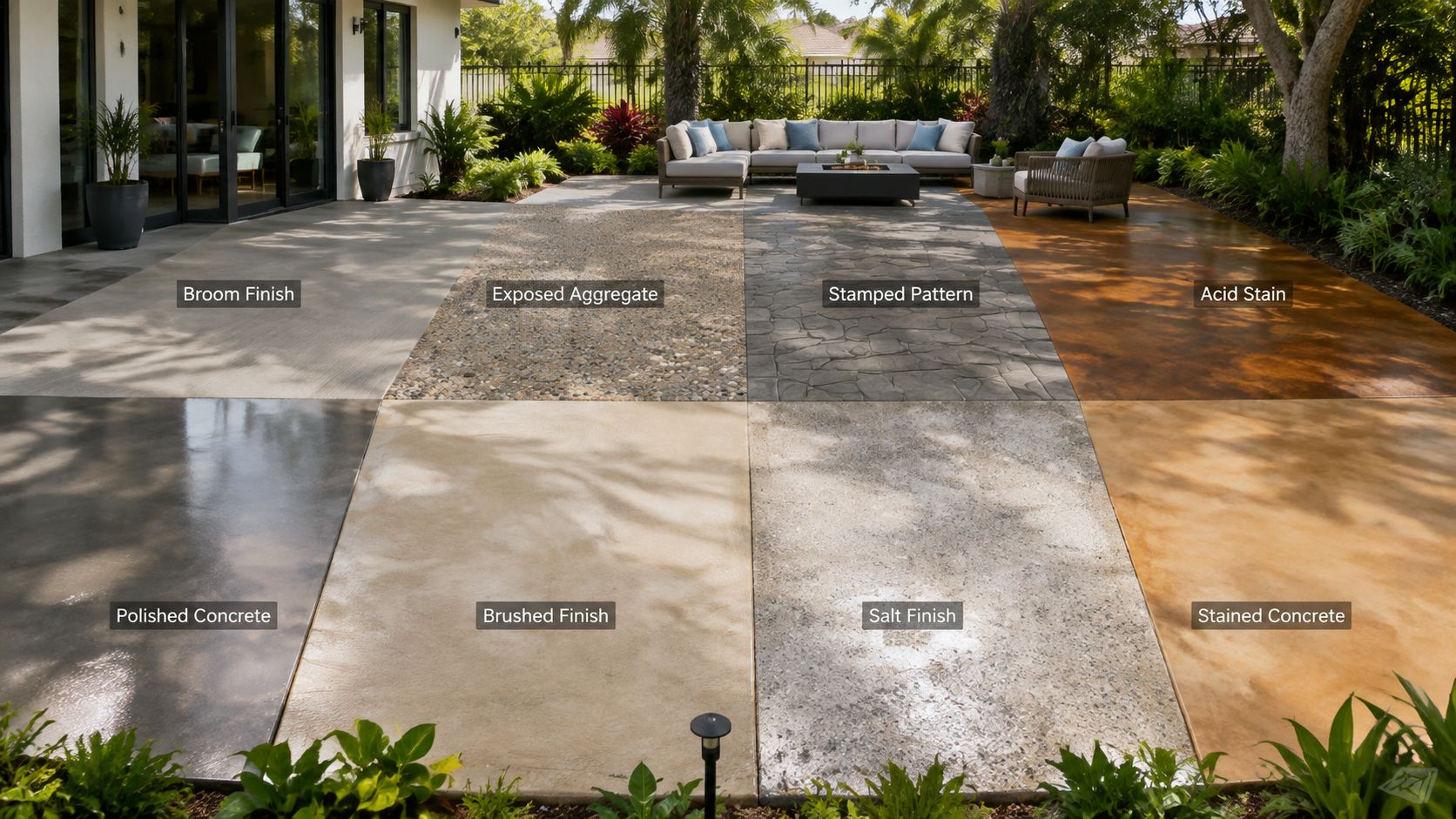
You're choosing a patio finish, and the attractive sample on a showroom board isn't answering the practical questions. Will it stay comfortable for bare feet? Will rain make it slippery? How much cleaning and resealing will it need after Central Florida's heat, UV exposure, and heavy storms? The best finish depends on how you'll use the patio, not just the pattern or color.
That matters across Marion County, FL and Citrus County, FL, from busy patios in Ocala and Dunnellon to outdoor living areas in The Villages and poolside spaces near Crystal River. Homes in Belleview, Summerfield, Silver Springs, Homosassa, Inverness, Lecanto, Beverly Hills, and Hernando can face different drainage, shade, traffic, and maintenance conditions.
This guide compares eight types of concrete finishes for patios by traction, barefoot comfort, appearance, upkeep, budget, and installation quality. A local evaluation should also consider the existing slab, slope, drainage, sun exposure, rain runoff, and the patio's intended use. Riverside Sealing & Striping, LLC, a local Concrete and Asphalt Expert in Marion and Citrus County, provides concrete work and free, no-pressure consultations to help homeowners choose a finish that fits the property.
Table of Contents
- 1. Broom Finish Concrete
- 2. Smooth Trowel Finish Concrete
- 3. Stamped Concrete Patio Finish
- 4. Polished Concrete Finish
- 5. Salt Finish Concrete
- 6. Exposed Aggregate Finish Concrete
- 7. Acid-Stained Concrete Finish
- 8. Brushed Concrete Finish
- 8-Way Patio Concrete Finish Comparison
- Choose the Finish That Fits Your Property
- Frequently Asked Questions About Patio Concrete Finishes
1. Broom Finish Concrete
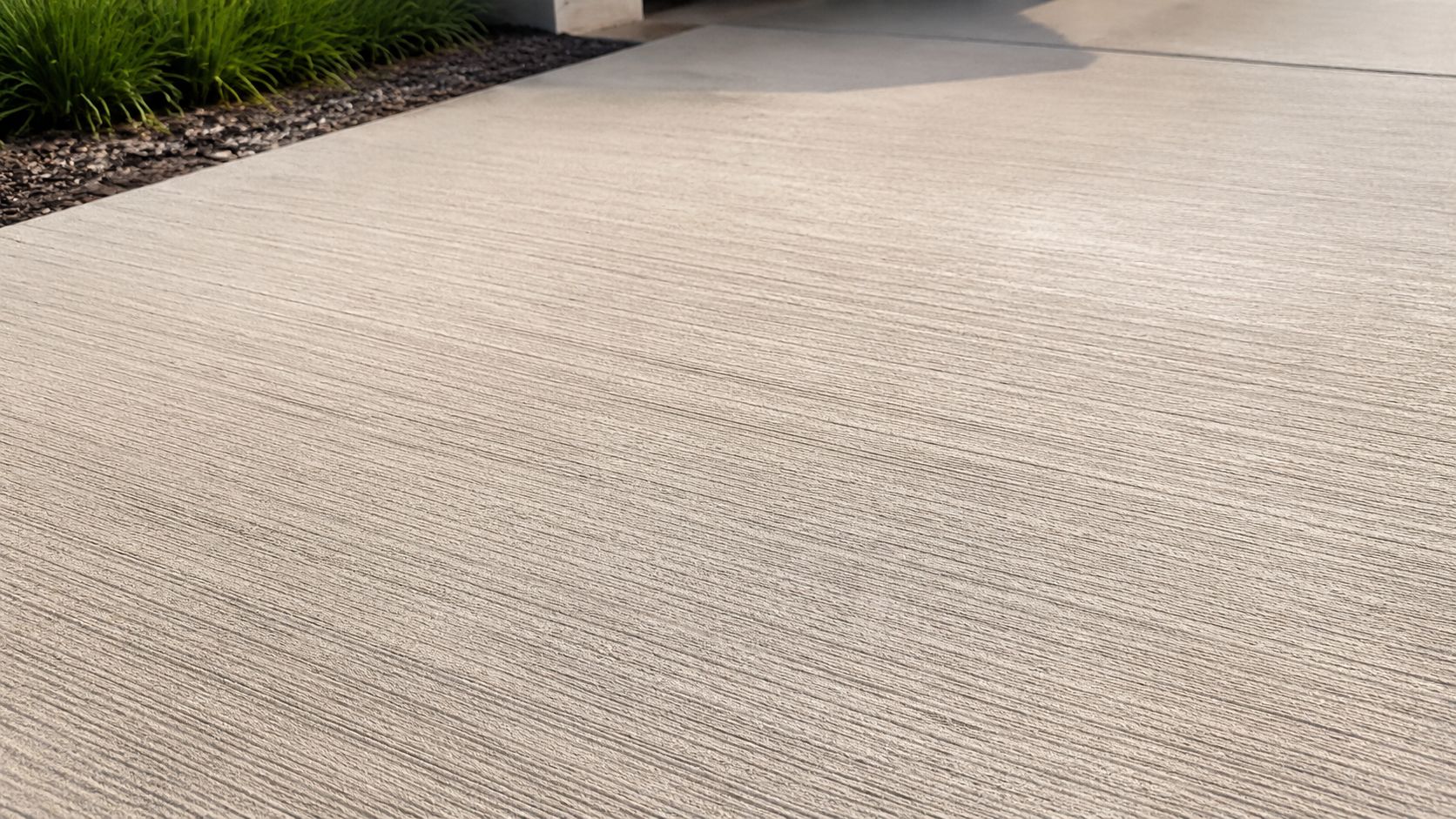
A broom finish is created by pulling a stiff-bristled broom across concrete while it is still workable, leaving fine, parallel ridges. The timing and pressure need to stay consistent. If the crew starts too early, too late, or varies the pressure, the lines can look uneven and traction may differ across the slab.
For many Central Florida patios, broom finish is a practical first option. Its texture helps water drain across the walking surface and suits pool decks, water features, sloped patios, entry walks, and active family areas. The Concrete Society's slip-resistance guidance cites a generally accepted pendulum test value of 36 or greater for low slippage potential. That reference does not replace an evaluation of the installed surface, drainage, footwear, algae exposure, and other site conditions.
Where broom finish works best
An Ocala patio with frequent foot traffic can benefit from the finish's straightforward grip and simple appearance. It also fits common-area walkways in The Villages, church access areas, and pool surrounds where wet shoes are expected. In Dunnellon, it can work well on side paths and entry areas exposed to heavy rain.
Practical rule: If wet-weather traction is your first concern, compare broom finish before choosing a more decorative surface.
According to the Angi guide to concrete patio finishes, broom finish costs about $4 to $7 per square foot. That places it among the more budget-friendly options, although the final cost still depends on slab preparation, layout, access, and contractor execution.
The ridges need regular cleaning because dirt and organic growth can settle into the texture. A pressure washer can refresh the surface, while a suitable exterior sealer can help limit staining and reduce exposure to Central Florida's heat, UV, and rain. Sealer does not correct poor drainage or eliminate routine cleaning.
Bare feet may find broom texture less comfortable than a lightly brushed surface, particularly around a pool. In exchange, homeowners get a useful balance of traction, durability, appearance, and manageable upkeep. Ask the contractor for a sample with the proposed broom direction and texture, then check how it feels underfoot and how water moves across the actual patio.
2. Smooth Trowel Finish Concrete
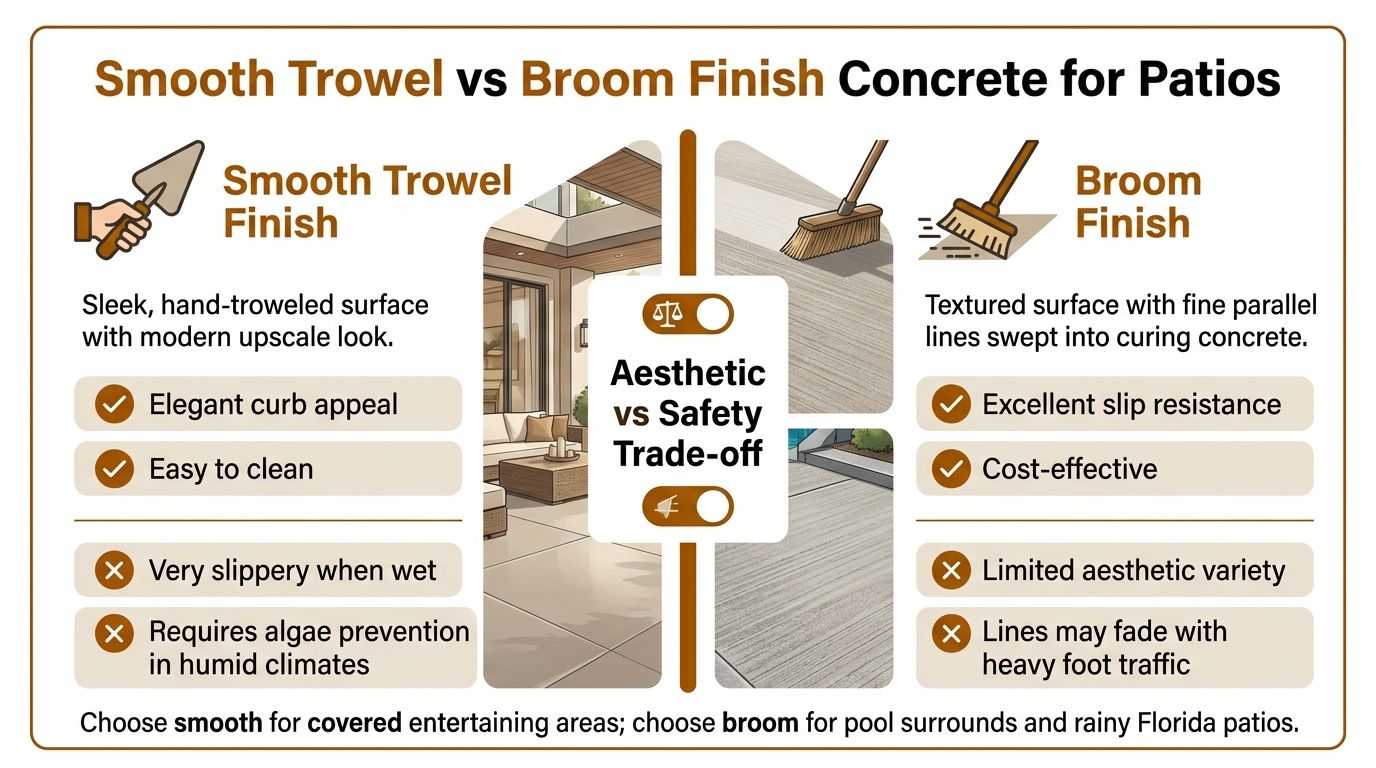
A smooth trowel finish gives concrete a flat, refined surface with very little visible texture. The installer uses hand tools, commonly metal trowels, during the final finishing stage to compact and smooth the surface. The result suits contemporary architecture, clean landscaping, and patios designed to look more like an extension of an interior living area.
That visual simplicity creates a clear Florida trade-off. Smooth concrete can become slippery when rainwater, pool splash, algae, or other organic buildup is present. It may feel pleasant under bare feet, but barefoot comfort doesn't eliminate the need for traction. A covered patio with controlled drainage is a safer application than an exposed pool deck or an area where water routinely ponds.
Use texture strategically
A Belleview homeowner with modern landscaping might use a smooth center area for dining and place a textured border along steps or drainage edges. A high-end entertaining space in The Villages can use the same approach. Crystal River commercial entrances and Summerfield residences should receive a more careful review because public traffic and wet conditions raise the consequences of a slick surface.
Consider these safeguards before selecting a smooth trowel finish:
- Non-slip protection: Discuss a non-slip sealer or coating suited to exterior concrete.
- Water control: Confirm that the patio slopes away from the building and doesn't collect standing water.
- Shade management: Plan cleaning for algae-prone areas beneath trees, screens, and covered structures.
- Finish combinations: Use smooth concrete where appearance matters most and textured concrete where people turn, step down, or encounter water.
For a closer look at installation choices, review Riverside's concrete finishing techniques. The workmanship matters as much as the selected finish. Overworking the surface, leaving inconsistent edges, or applying sealer under unsuitable conditions can undermine the appearance and performance homeowners expect.
Smooth trowel finish fits a design-led patio when the owner accepts regular maintenance and plans for wet-surface safety. It isn't the automatic best choice for every outdoor area.
3. Stamped Concrete Patio Finish
Stamped concrete uses specialized stamps to press patterns into freshly poured concrete. The finished slab can resemble brick, slate, flagstone, cobblestone, tile, or wood. Decorative stamping has roots in experiments by concrete manufacturers during the 1890s, as described in the history of stamped concrete.
A homeowner in Ocala might choose a slate pattern for an outdoor dining area, while a Dunnellon property may suit brick better. In The Villages, a stone-style surface can support curb appeal without the separate joints and installation steps of individual pavers. A Homosassa patio or driveway apron can also use a pattern that relates to the house instead of looking like an unrelated feature.
Design flexibility has a maintenance cost
Stamped concrete usually costs more and requires more upkeep than a basic broom finish. Its color, pattern, joints, and relief can make fading, wear, and sealer failure easier to see. Central Florida's strong UV exposure, heavy rain, and damp shaded areas make resealing and routine cleaning part of the ownership plan. Around a pool or frequently wet patio, ask whether the sealer will include a suitable non-slip additive.
Review these choices before installation:
- Choose the pattern carefully: Dense patterns can look busy across a large patio. Softer stone textures and restrained borders often suit modern layouts better.
- Plan for wet traction: A detailed pattern does not automatically provide safe footing. Ask how the surface will perform after rain, splash, or algae growth.
- Protect the color: Confirm the sealer type, application conditions, cure time, and future maintenance schedule. Poor timing or uneven coverage can affect the appearance.
- Match the architecture: Brick, slate, wood, and stone patterns create different relationships with the home, landscaping, and outdoor furniture.
- Confirm contractor execution: Stamps must align, borders must remain consistent, and release color must be controlled. Small installation errors stand out across a patterned slab.
Industry analysis for 2026 places stamped concrete at 39.86% of the decorative concrete market, citing its ability to imitate stone and brick at a lower installed cost than those materials. The Market.us decorative concrete market report describes a broad market projection, not the quality or value of a specific Central Florida installation.
Stamped concrete suits owners who want a customized visual result and will budget for resealing. Choose a simpler finish when barefoot comfort, low upkeep, and predictable wet-weather traction matter more than a stone or brick appearance.
Here's a visual demonstration of decorative concrete finishing methods:
4. Polished Concrete Finish
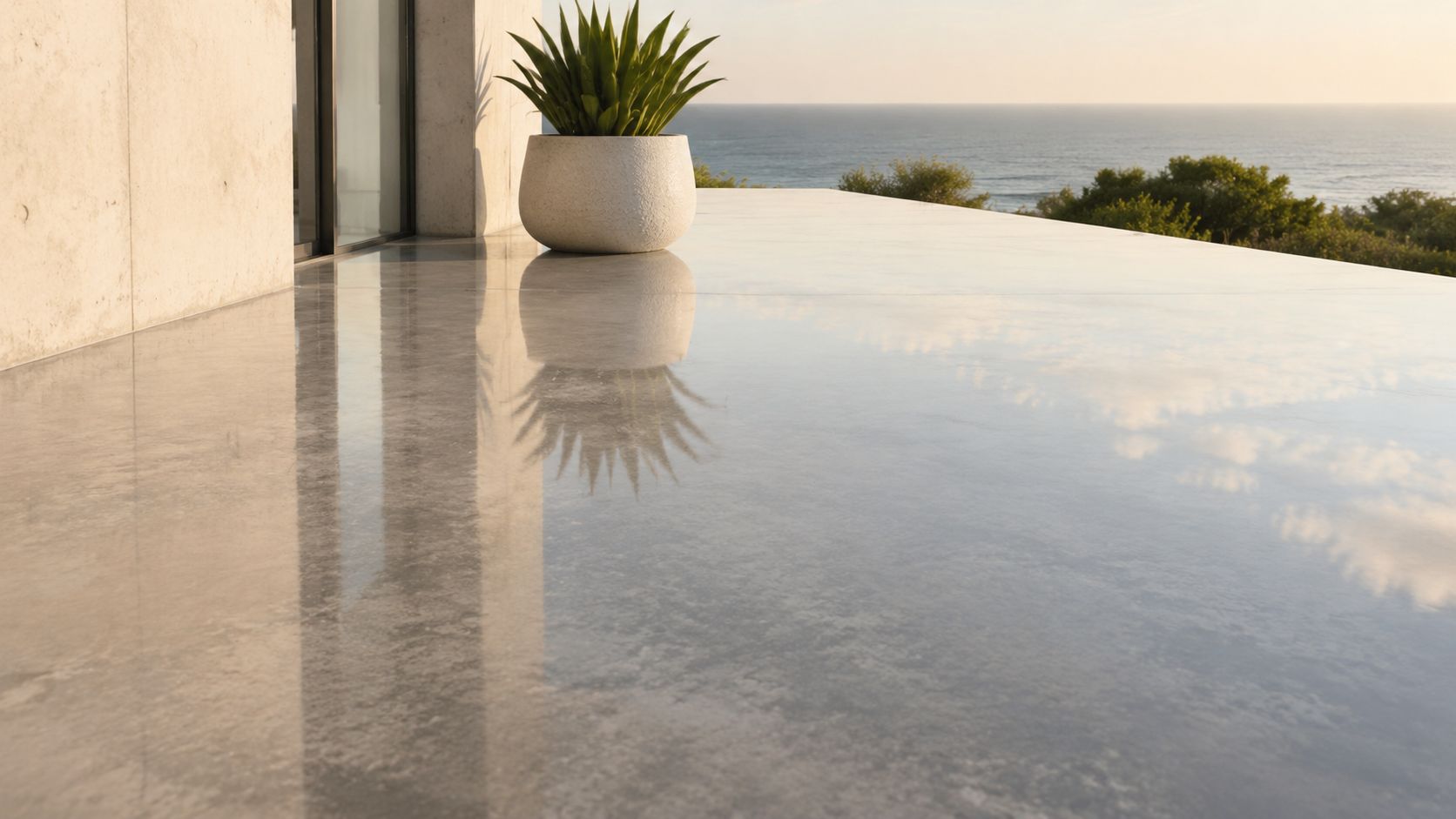
Polished concrete is produced by grinding the cured surface with progressively finer diamond abrasives, followed by densifying and protective treatment. It can create a glossy, light-reflective appearance that resembles polished stone. The finish is striking in a covered entertainment area, a statement entry, or a commercial patio where a refined appearance is part of the property's identity.
Outdoor conditions require restraint. A highly smooth surface can be difficult to manage when wet, especially if rainwater, pool splash, or algae is present. For that reason, polished concrete is better suited to covered patios, protected transitions, and carefully drained spaces than to an exposed pool surround.
Where polished concrete makes sense
A luxury renovation in Ocala might use polished concrete for a covered entertainment area. A property in The Villages could use it for a showcase patio with controlled exposure, while a Crystal River resort entrance or Silver Springs commercial showroom might select it for a high-visibility arrival space. Those applications justify the appearance because the owner is also prepared to manage drainage, cleaning, and surface protection.
Before approving the finish, ask the contractor to address:
- Wet traction: Identify the anti-slip sealer or coating and how it changes the final appearance.
- Water movement: Confirm that the design prevents pooling on the dense, sealed surface.
- Exposure: Review how direct sun and rain will affect the selected protective system.
- Maintenance: Establish a realistic cleaning and resealing plan for the location.
For design inspiration that includes patio layout considerations, see Riverside's concrete patio ideas for backyard spaces. Layout, shade, furniture placement, and drainage can determine whether a premium finish remains practical.
Polished concrete isn't the default recommendation for a wet Florida patio. It's a specialty choice for homeowners and commercial owners who want a high-end look and accept the added responsibility of wet-surface management.
5. Salt Finish Concrete
Salt finish concrete has a distinctive, lightly pitted surface. Installers broadcast rock salt over freshly placed concrete, allow the surface to set, and then remove the salt to leave small depressions. The result has a weathered, natural appearance with more texture than smooth concrete but less visual patterning than stamped work.
This finish suits rustic, cottage, Mediterranean, and informal settings. A Dunnellon patio with earthy plantings can use it as a natural-looking gathering surface. Belleview garden areas, Ocala boutique entries, and Homosassa church courtyards can also benefit from its combination of character and traction.
A good middle ground near water
Salt finish offers useful grip, but the pits can collect dirt and water if the surface isn't sealed and maintained. It can also feel less comfortable under bare feet than a fine brushed finish, so it deserves a closer review for patios surrounding a pool or outdoor shower. The right decision depends on whether the owner values its appearance more than a perfectly smooth walking feel.
Use salt finish when you want:
- Subtle character: The random depressions look more natural than uniform broom lines.
- Practical texture: The surface provides traction without relying on a glossy coating.
- Earth-toned design: Muted colors complement stone, stucco, wood, and cottage landscaping.
- A manageable decorative upgrade: It adds visual interest without the extensive pattern work of stamped concrete.
Plan regular cleaning, especially beneath outdoor furniture and in shaded areas where debris and organic growth can remain damp. A suitable sealer can reduce water entry and make cleaning easier, but it won't remove the need to keep the patio clear.
Salt finish is often a smart compromise for a homeowner who wants more visual interest than broom concrete without accepting the pattern complexity and resealing expectations associated with stamped work.
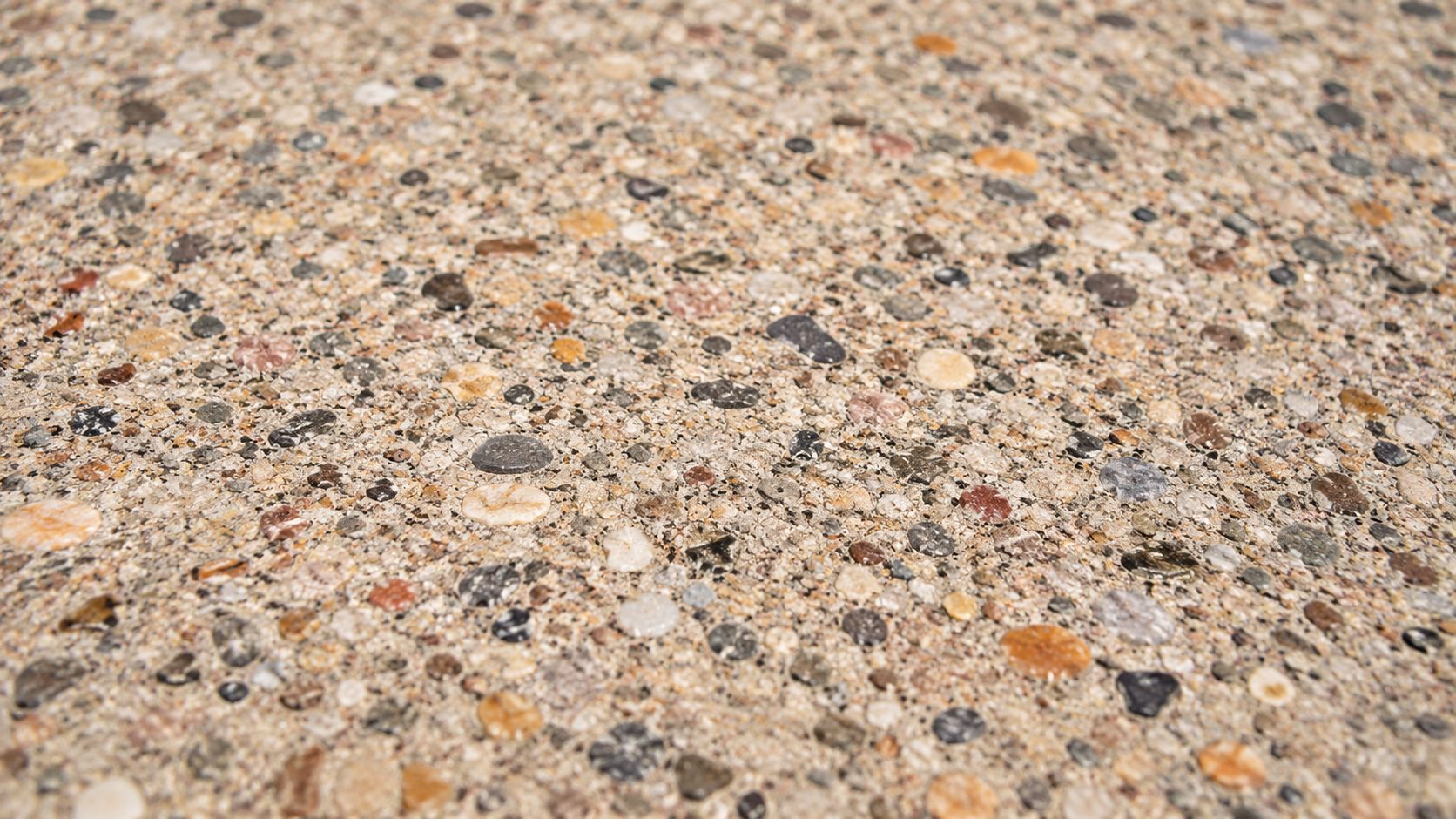
6. Exposed Aggregate Finish Concrete
Exposed aggregate reveals the decorative stone, pebbles, gravel, or other aggregate embedded in concrete by removing the surface layer of cement paste. The result has a speckled, multidimensional appearance, while the selected stone determines much of its color and character. Granite, quartz, and natural stone can create anything from a quiet neutral field to a more noticeable decorative surface.
This finish suits Central Florida homeowners who want visual depth and traction without a stamped pattern. Angi estimates exposed aggregate at about $2 to $3 per square foot, making it a comparatively budget-friendly decorative option. Its texture can help during wet weather, but the same texture may feel rough under bare feet and can hold dirt if the patio is not cleaned and sealed.
Select the stone before the slab is placed
An Ocala homeowner planning a high-visibility patio should review aggregate samples before installation. The same step matters for an Inverness resort walkway or Silver Springs commercial plaza, where color consistency affects the property's appearance. In The Villages, a carefully chosen aggregate can provide a modern finish without the labor and pattern control required by stamped concrete.
Review these details with the contractor:
- Color coordination: Compare samples with the home's exterior, roof, trim, landscaping, and surrounding hardscape.
- Barefoot use: Rough or sharp aggregate may be uncomfortable around pools, outdoor showers, and seating areas. Smaller, rounded stone is usually easier on bare feet.
- Sealing: A compatible sealer helps protect the surface, reduce water penetration, and maintain color under Florida sun and rain.
- Cleaning: Pressure washing can remove algae and embedded debris, but excessive pressure or poor technique can loosen the surface or expose weak spots.
Execution matters. The contractor must expose the aggregate evenly, control the washout, and protect nearby surfaces during placement and finishing. For preparation, layout, and finish planning, Riverside's guide to concrete patio construction provides useful background.
Choose exposed aggregate when natural visual depth, wet-weather traction, and moderate decorative cost matter more than a smooth barefoot feel. Select another finish if you need a completely uniform pattern or the softest surface around a pool.
7. Acid-Stained Concrete Finish
Acid staining creates color variation through a chemical reaction between the stain and the minerals in the concrete. Instead of producing a perfectly uniform color, the process can create marbled, mottled, or flowing effects in earth tones, blue-green shades, and copper-like colors. Every slab responds somewhat differently, so the finished appearance has a natural variation that paint and uniform coatings don't provide.
That variation is the main attraction and the main risk. A homeowner who wants an artistic patio may love the one-of-a-kind result. Someone expecting an exact showroom color may be disappointed if the existing slab, repairs, aggregate exposure, or mineral content changes the reaction.
Samples are essential
An Ocala property might use flowing blue-green effects for an artistic outdoor space. The Villages may suit a copper-toned design, while a Dunnellon courtyard could use earthy brown shades that work with landscaping. A Belleview luxury patio can make the stain a focal point, particularly when the design is coordinated with walls, furniture, and planting.
Before staining, require a small mock-up or sample area and discuss:
- Existing concrete condition: Stains reveal variation, repairs, and surface differences rather than hiding them.
- Color expectations: Muted complementary colors usually integrate more easily than a color selected from a small printed sample.
- Sealer selection: The protective layer controls sheen and helps defend the color against moisture and UV exposure.
- Future care: The surface needs planned maintenance, particularly in exposed Central Florida locations.
Stained concrete can be a strong design choice for a covered patio, courtyard, or carefully maintained entertaining space. It isn't a shortcut for a damaged or poorly drained slab. Preparation, stain application, neutralization, and sealing all require careful execution, and rushed work can leave uneven color or premature wear.
8. Brushed Concrete Finish
A brushed finish creates lighter linear markings than a conventional broom finish. The installer uses a wire or soft brush across semi-cured concrete to produce a restrained texture that sits between smooth trowel work and deeper broom ridges. The lines add direction and visual interest without dominating the patio.
This finish is well suited to entertaining areas where homeowners want a refined appearance and reasonable barefoot comfort. An Ocala patio with modern landscaping can use directional brushing to reinforce the layout. A Summerfield residence or a contemporary project in The Villages can pair the finish with simple furniture and clean architectural lines. Dunnellon commercial entries may also use it where the owner wants texture without an aggressively industrial appearance.
Balance texture with comfort
Brushed concrete offers less visual weight than exposed aggregate and less pattern definition than stamping. It can provide useful traction, but the exact result depends on brush depth, concrete condition, sealer, slope, and exposure. A patio near a pool or water feature still deserves a site-specific slip-resistance review rather than an assumption that any brushed surface is automatically safe.
Consider the following during design:
- Brush direction: Align the lines with the patio's longest dimension or use them to define walkways and seating zones.
- Barefoot comfort: Request a sample that shows the actual texture, not only a photograph.
- Sealer sheen: A high-gloss sealer can change both appearance and wet traction.
- Exposure: Covered or moderately exposed patios may preserve the understated look with less cleaning pressure.
A brushed finish is a good choice when the homeowner wants more texture than smooth concrete but a softer feel than coarse aggregate or deeper broom lines. It provides balance, not maximum traction or maximum decoration.
8-Way Patio Concrete Finish Comparison
| Finish | 🔄 Implementation Complexity | ⚡ Speed / Efficiency | ⭐ Expected Outcomes / Quality | Resource Requirements (cost & skills) | 💡 Ideal Use Cases / Key Advantages |
|---|---|---|---|---|---|
| Broom Finish Concrete | Low, simple broom technique during final cure | Fast application; minimal delay | ⭐⭐⭐, durable, highly slip-resistant; utilitarian look | Low cost; low-skilled labor; standard tools and mix | Pool decks, walkways, rainy Florida patios; cost-effective safety choice; annual sealing advised |
| Smooth Trowel Finish Concrete | Moderate–High, skilled hand troweling for uniform finish | Moderate, careful finishing; regular maintenance needed | ⭐⭐⭐⭐, sleek, upscale appearance; can be slippery when wet | Higher cost; skilled finishers; sealers and maintenance (monthly/annual) | Covered patios, front entries, entertaining areas; elegant curb appeal; use non-slip sealer |
| Stamped Concrete Patio Finish | High, specialized stamps and pattern alignment required | Moderate, added stamping steps during curing | ⭐⭐⭐⭐, decorative, high curb appeal; durable if sealed | High cost; skilled contractors; stamps, dyes, repeated sealing | Imitates stone/brick for visual impact; great for curb appeal; choose slip-resistant patterns, reseal every 2–3 yrs |
| Polished Concrete Finish | Very High, multi-stage grinding with diamond tools | Slow, multiple grinding/polishing stages | ⭐⭐⭐⭐⭐, mirror-like, luxury look; very durable but slippery when wet | Highest cost; specialized equipment and operators; densifiers and topcoats | Luxury patios, covered spaces, commercial entrances; anti-slip coatings and covered installation recommended |
| Salt Finish Concrete | Moderate, salt application then wash-out after cure | Moderate, simple application but requires wash/cleaning | ⭐⭐⭐, unique, pitted natural look; naturally slip-resistant | Low–moderate cost; common materials; moderate skill to control pitting | Rustic patios, safety-focused areas; distinctive aesthetic; pressure wash annually, avoid barefoot zones |
| Exposed Aggregate Finish Concrete | High, careful top-layer removal to reveal stones | Moderate, staged exposure process | ⭐⭐⭐⭐, natural, textured aesthetic; good slip resistance | Moderate–high cost (aggregates); skilled contractor; sealing | High-visibility patios, walkways; customizable aggregates for design cohesion; request samples, seal annually |
| Acid-Stained Concrete Finish | High, chemical reaction requires experienced applicator | Moderate–Slow, staining, neutralizing, and sealing steps | ⭐⭐⭐⭐, one-of-a-kind marbled colors; translucent, artistic finish | Moderate cost; professional applicator; hazardous chemicals and frequent sealing | Artistic/custom patios, covered areas; mock-up sample recommended, annual reseal and anti-slip coat |
| Brushed Concrete Finish | Moderate, requires timing and consistent brushing skill | Efficient, applied during mid-cure with modest time | ⭐⭐⭐⭐, refined linear texture; moderate slip resistance; barefoot-friendly | Moderate cost; skilled brushing; standard tools and sealer | Entertaining patios balancing elegance and comfort; plan brush direction, seal to protect finish |
Choose the Finish That Fits Your Property
The best patio finish is the one that matches the way people use the space and the amount of maintenance the owner will perform. Broom finish is usually the practical choice for traction, value, pool-adjacent areas, sloped patios, and high-traffic family spaces. Salt finish adds subtle character and useful texture, but its pits need cleaning and sealing. Both are strong options when performance matters more than a premium decorative pattern.
Choose brushed concrete when barefoot comfort, restrained texture, and modern appearance need to coexist. It won't provide the same aggressive grip as a deeper broom texture, but it can look more refined in an entertaining area. Exposed aggregate makes sense when natural visual depth, stone color, and traction are priorities. Ask for samples first, because the aggregate becomes a major part of the finished appearance and can feel rougher under bare feet than expected.
Stamped concrete is the better fit for homeowners who want a patio that resembles slate, brick, flagstone, cobblestone, tile, or wood. It offers substantial design flexibility, but resealing and traction management belong in the long-term budget. Acid-stained concrete suits an artistic property owner who accepts color variation and wants a one-of-a-kind surface. It requires careful preparation, a sample area, professional application, and protective sealing.
Use smooth trowel or polished concrete only when appearance justifies the wet-surface trade-off. Covered patios, controlled drainage, non-slip protection, and regular cleaning become especially important. Neither finish should be selected solely because a showroom sample looks elegant.
Questions to resolve before installation
Compare finish samples outdoors, not only under indoor lighting. Ask the contractor to place samples where you can see how the color and texture respond to direct sun, shade, rain, furniture, and surrounding landscaping.
Confirm these project details in writing:
- Sealer type and maintenance: Ask what product will be used, how it changes the sheen, and when resealing should be considered.
- Drainage and slope: Confirm where rainwater will flow and whether the patio connects safely to existing walks, landscaping, or pool areas.
- Repair expectations: Discuss how cracks, stains, surface wear, and future color variation will be addressed.
- Scope and cleanup: Request an estimate that separates preparation, removal, concrete work, finish, sealing, cleanup, and any drainage corrections.
Florida conditions affect every finish. Strong sun and UV exposure can change color and sealer performance. Rain exposes drainage problems, while humidity and shade encourage organic buildup. Traffic from family gatherings, HOA common areas, church events, or commercial visitors adds wear that a small decorative sample can't show.
Those considerations apply throughout Marion County, FL and Citrus County, FL, including Ocala, Dunnellon, Belleview, Summerfield, Silver Springs, The Villages, Crystal River, Homosassa, Inverness, Lecanto, Beverly Hills, and Hernando. A patio near the coast-facing communities of Citrus County may have different exposure concerns from a shaded backyard in Marion County, but both need sound preparation and controlled water movement.
Riverside Sealing & Striping, LLC is a licensed and insured, family-owned Concrete and Asphalt Expert in Marion and Citrus County. The company handles concrete work for patios, slabs, sidewalks, driveways, and replacement projects, along with asphalt sealcoating and parking lot striping for commercial properties. Reliable scheduling, clear timelines, and high-quality workmanship matter when a decorative finish has to be installed at the right stage of the concrete process.
For a new patio or replacement surface, a professional can evaluate the existing slab, site preparation, drainage, finish sample, sealer, and cleanup plan before work begins. Riverside offers free, no-pressure on-site consultations and estimates, helping homeowners make a practical decision without committing to the most decorative option. Request a professional evaluation or free estimate through Riverside Sealing & Striping, LLC.
Frequently Asked Questions About Patio Concrete Finishes
Which concrete finish is best for a Florida patio?
There isn't one universal answer. Broom finish is often the most practical starting point because it provides texture and straightforward maintenance. Exposed aggregate, salt, and brushed finishes can also work well, depending on barefoot use, drainage, appearance, and cleaning expectations. Smooth and polished finishes require more careful wet-surface planning.
Is stamped concrete safe around a pool?
Stamped concrete can work around a pool, but the pattern alone doesn't guarantee safe traction. Ask about the completed surface, sealer, and any non-slip additive. Drainage, algae control, and regular maintenance also matter. A textured design should still be evaluated under the wet conditions the patio will experience.
Which patio finish requires the least maintenance?
Broom finish is generally the lowest-maintenance option. Exposed aggregate and stamped concrete benefit from periodic resealing, while smooth, polished, stained, and salt finishes require maintenance plans suited to their surface and exposure. No finish will perform well if water ponds or organic buildup remains on the slab.
Is exposed aggregate comfortable for bare feet?
It depends on the aggregate selection and how aggressively the stone is exposed. A fine, rounded aggregate may feel more comfortable than a coarse or sharp material. Always inspect a physical sample with bare feet before selecting exposed aggregate for a pool area or family patio.
Should a concrete patio be sealed in Central Florida?
Sealing can help protect concrete, decorative color, and exposed aggregate from moisture, staining, and weather exposure, but the correct product and timing matter. Ask about the sealer's appearance, traction when wet, compatibility with the finish, and future maintenance. Sealing won't correct poor drainage, improper preparation, or a finish that doesn't suit the site.