
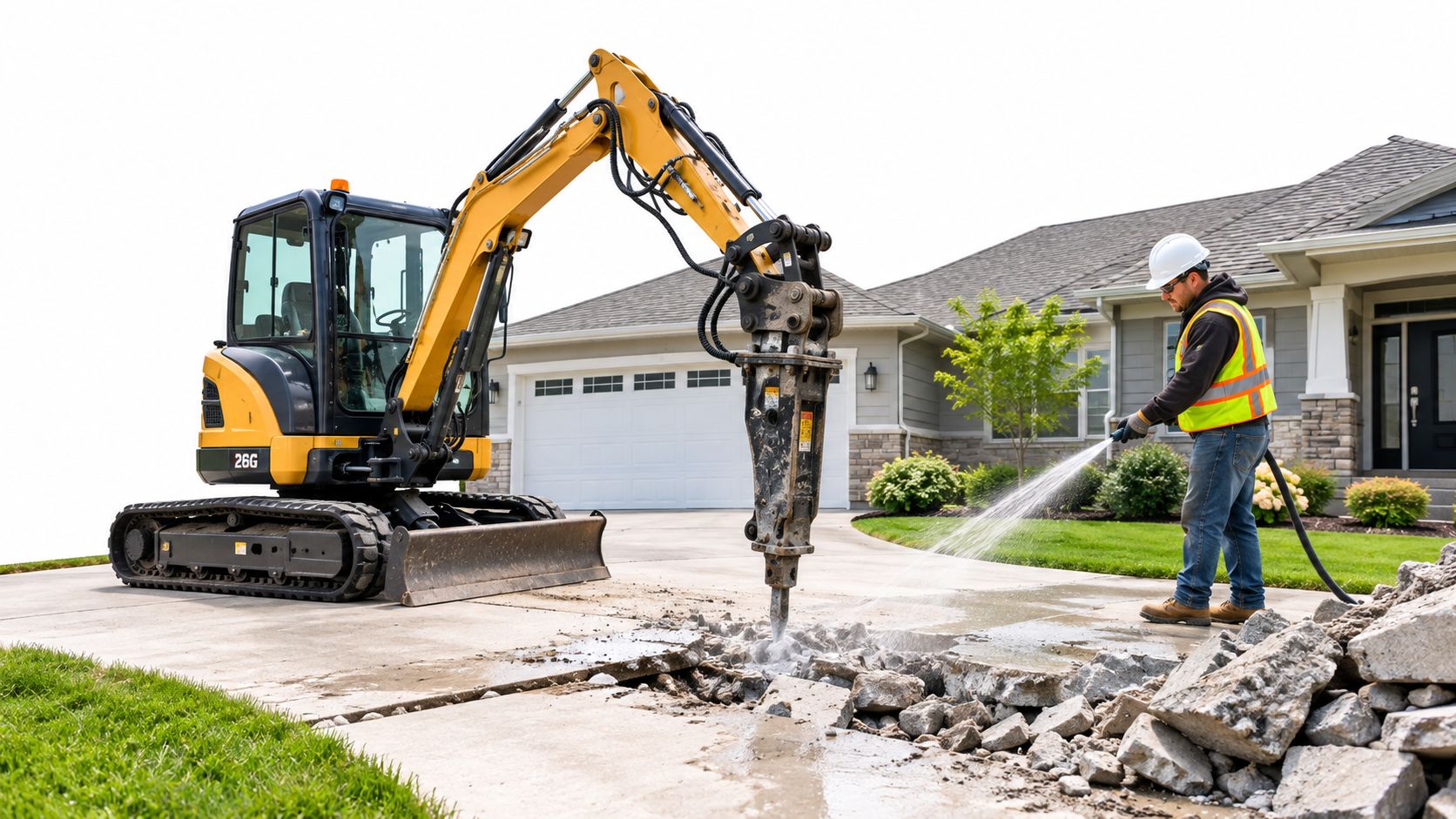
You're looking at a driveway that has become more liability than parking surface. Cracks have widened, rainwater sits near the garage, tree roots are lifting an edge, and every heavy Florida storm seems to reveal another weak spot. For homeowners in Marion County, FL, Citrus County, FL, and nearby Central Florida communities, concrete driveway removal often looks like a simple tear-out. On a real jobsite, the demolition is only one part of the decision.
The final cost and schedule usually depend on what happens before the breaker starts, how the crew handles haul-off, whether permits apply, and what the exposed base looks like afterward. Sandy soil, summer rain, septic systems, utility lines, and restricted access can change the work quickly in Ocala, Dunnellon, Belleview, Silver Springs, Summerfield, Crystal River, Homosassa, Inverness, Lecanto, Beverly Hills, Hernando, and The Villages.
Table of Contents
- Why Homeowners in Central Florida Pull Out a Concrete Driveway
- Planning Permits, Utilities, and Site Preparation
- DIY Removal vs Hiring a Crew in Marion and Citrus County
- How the Demolition Actually Happens on Site
- What Concrete Driveway Removal Really Costs
- Debris Disposal, Recycling, and What the Base Looks Like After
- When to Call a Local Crew and What to Ask
Why Homeowners in Central Florida Pull Out a Concrete Driveway
A typical removal decision starts with a Florida morning after heavy rain. The homeowner walks toward the garage and sees water tracking across the slab, a jagged crack running through the parking area, or a raised edge where an oak root has pushed upward. A patch may hide the surface damage for a while, but it can't correct a failed base or a drainage problem underneath.
Removal makes sense when the damage is structural rather than cosmetic. A network of cracks, widespread settlement, severe spalling, exposed reinforcement, or a slab that rocks under vehicle traffic usually points toward a full tear-out. The same applies when the driveway blocks a drainage correction or when the existing grade sends runoff toward the house.
Conditions that usually justify a full tear-out
Central Florida's sandy soils can drain quickly, but they can also shift when water moves through poorly compacted areas. Repeated wetting, drying, and vehicle loading may leave voids below the slab. Once the support becomes uneven, filling surface cracks won't restore the lost bearing.
Live oaks and citrus trees create another common problem. Roots can lift slab edges, disturb adjacent soil, and make a narrow repair look acceptable while the surrounding panels continue moving. Rusted rebar or wire mesh can also push through the surface as concrete spalls away.
Older driveways often create difficult choices. A slab poured during the 1970s or 1980s may be only four inches thick, and an overlay won't reliably solve major movement, poor drainage, or reinforcement corrosion. Owners preparing a property for resale may choose removal to eliminate a visible defect, while someone planning RV parking may need a stronger, properly supported surface rather than a cosmetic repair.
Practical rule: Patch isolated cracks and small surface defects. Remove the driveway when the slab has lost support, drainage needs correction, or reinforcement is breaking through the concrete.
The first planning question isn't “How fast can this be broken?” It's “What failed beneath it, and what must be corrected before a new surface goes down?”
Planning Permits, Utilities, and Site Preparation
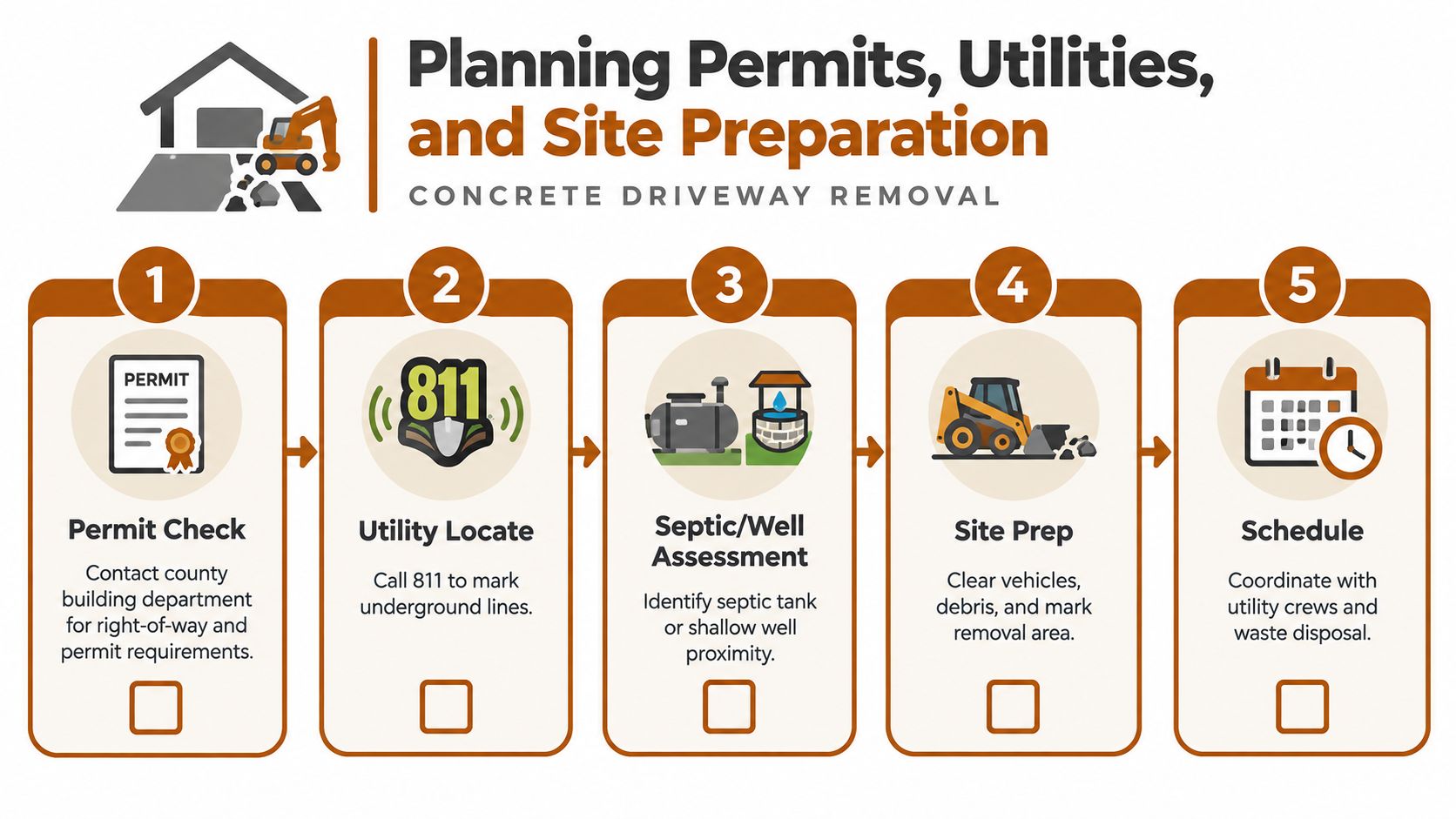
The safest demolition starts with paperwork and site information, not a rented jackhammer. Requirements can differ between an address inside a city and property in unincorporated Marion County or Citrus County, especially when the work reaches a public sidewalk, driveway apron, or right-of-way.
Close out the permit and utility questions
Start with the county or local building department. Ask whether the project needs a driveway, apron, sidewalk, excavation, or right-of-way permit. A permit may also control how the contractor protects the street, manages runoff, and restores disturbed areas.
Call 811 before excavation or demolition near buried services. Utility locates can identify electric, gas, communications, water, and other lines, but private lines may require additional investigation. Confirm the path of water and sewer laterals, irrigation lines, septic components, and shallow wells before machinery enters the work area.
For more detailed planning around buried services, review this underground utility location guidance. A marked line is valuable, but it doesn't replace careful hand work where a utility riser, cleanout, or private service crosses the driveway.
Prepare the property and the haul route
Remove vehicles, planters, loose decorations, and anything near the demolition boundary. Mark sprinkler heads, lighting, pool equipment, septic lids, wells, and irrigation controls. Protect trees and shrubs that must remain, and identify where equipment can turn without tearing up lawns or damaging a neighboring property.
Disposal logistics need attention before the driveway disappears. A roll-off dumpster or truck may need to sit on an apron that will be removed during the project, so confirm access, placement, and loading order in advance. Tight streets around Ocala neighborhoods, Inverness subdivisions, and parts of The Villages can make truck positioning more complicated than the breakup itself.
Notify neighbors when equipment, noise, or truck traffic will affect shared access. Review HOA rules if the property sits in a managed community near Summerfield, Belleview, Lecanto, or Crystal River. A written plan should identify the work area, utility marks, disposal method, expected access restrictions, and weather contingencies.
DIY Removal vs Hiring a Crew in Marion and Citrus County
DIY concrete driveway removal is possible in limited situations, but homeowners often underestimate the material-handling problem. Breaking a slab is only the beginning. Someone still has to separate manageable pieces, load heavy debris, protect utilities, keep the base intact, and arrange legal disposal.
A sledgehammer may work for a small, unreinforced section with open access. A larger driveway usually calls for a concrete saw, demolition hammer, skid steer, mini excavator, trailer or dumpster, and enough labor to keep the site moving. Rental availability in Ocala and Lecanto can also affect the schedule, especially when equipment is needed during a busy construction period.
A realistic side-by-side comparison
| Factor | DIY Route | Hiring a Crew |
|---|---|---|
| Equipment | You arrange saws, breakers, hauling equipment, fuel, and protective gear. | The crew supplies equipment matched to slab thickness, access, and reinforcement. |
| Labor | The homeowner handles cutting, breaking, lifting, loading, cleanup, and disposal coordination. | A coordinated crew separates demolition, hand work, loading, and site cleanup. |
| Hidden conditions | Wire mesh, rebar, thickened edges, buried lines, or weak soil can stop progress. | Experienced operators can change tools and sequence when conditions differ from the surface. |
| Property risk | A misplaced breaker or flipped panel can damage a septic line, water main, garage edge, or landscaping. | Professionals can use controlled cuts and hand demolition near sensitive areas. |
| Schedule | Progress depends on personal availability, weather, rentals, and disposal access. | A local crew can coordinate demolition and haul-off as one operation. |
| Liability | The homeowner assumes direct responsibility for injuries and accidental damage. | Ask for current licensing, insurance, and workers compensation documentation before work begins. |
A first-timer may expect the work to move quickly once the concrete cracks. Reinforcement changes that assumption. Rebar and wire mesh hold pieces together, while thickened edges and poor subgrade can force slower hand removal. A three- or four-person crew may complete an ordinary accessible driveway in a day, but the actual schedule depends on slab conditions, equipment access, disposal timing, and weather.
Homeowner insurance generally isn't a substitute for contractor planning. Damage caused during self-performed demolition may not receive the coverage a property owner expects, particularly when a buried service or adjacent structure is involved.
How the Demolition Actually Happens on Site
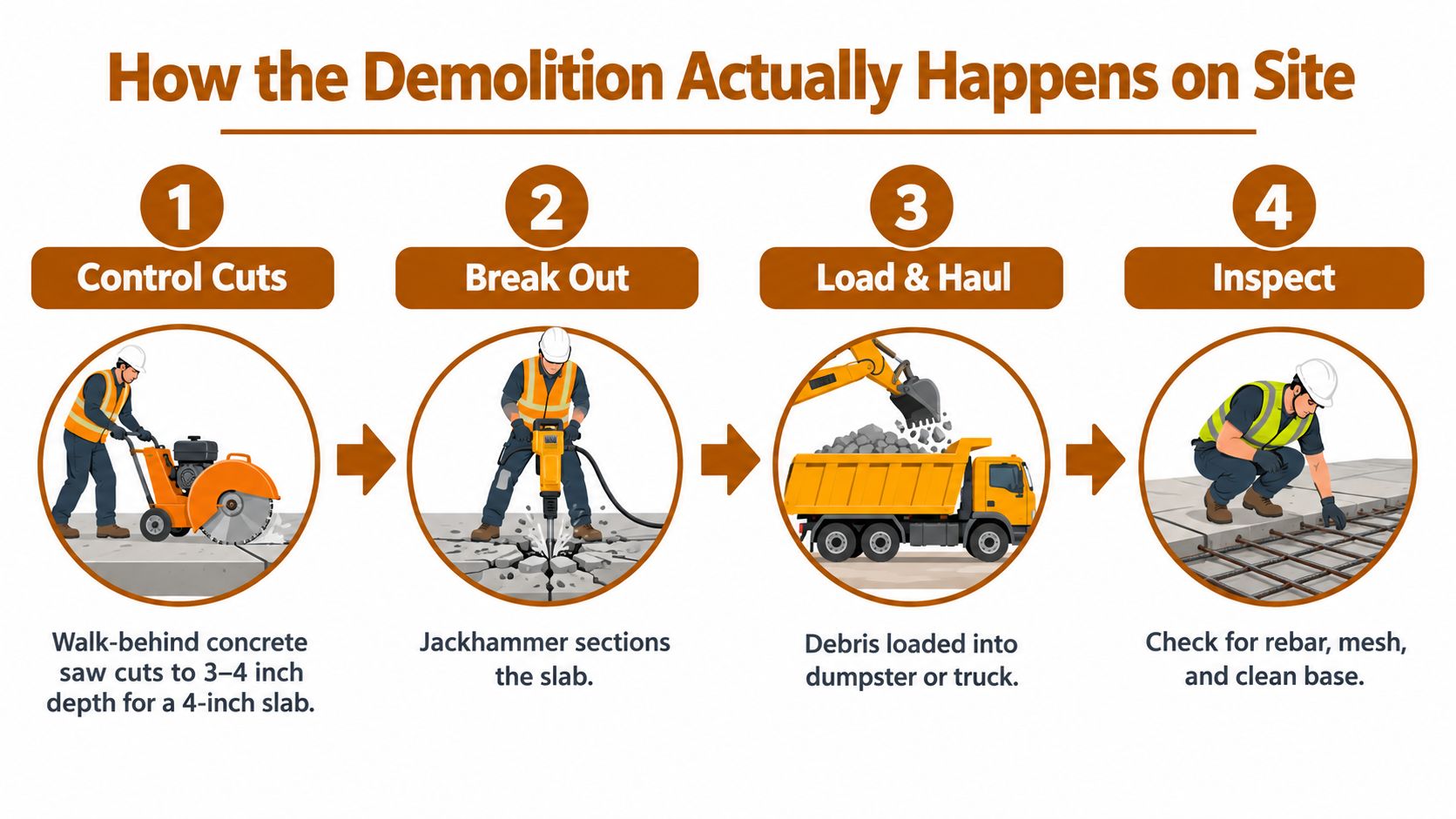
A controlled job follows a sequence. The crew first confirms the work boundary, utility marks, equipment path, and disposal setup. Then it creates sections small enough to break and load without scattering concrete across the yard or dragging the subgrade out of shape.
Control cuts and breakout
For a typical four-inch slab, a walk-behind concrete saw may make control cuts to approximately three to four inches deep, creating manageable panels. The crew adjusts the pattern around joints, edges, garage aprons, sidewalks, and features that need protection.
A breaker hammer, skid steer, or mini excavator then works along the cuts. The operator should pop panels free rather than scrape aggressively through the soil beneath them. Smaller sections improve control, reduce uncontrolled shattering, and make loading safer.
Municipal specifications can also affect where cuts belong. A Los Angeles engineering specification says that when a cut falls within 12 inches of a scoring line, the cut should follow that scoring line, and when a saw cut would fall within 30 inches of a joint or edge, removal should extend to the joint or edge. Those rules come from a municipal specification, so local Central Florida requirements still need confirmation with the governing authority. The broader lesson is useful: planned joints and edges often provide cleaner removal boundaries than arbitrary cuts. See the municipal concrete removal specification reference for the cited guidance.
Wet cutting and sensitive areas
Wet cutting suppresses respirable crystalline silica and helps keep dust from spreading across a home, garage, or neighboring property. A controlled study found that wet cutting reduced respirable dust concentrations by 85% compared with dry cutting, while dry cutting produced a geometric mean respirable dust concentration of 14.396 mg/m³. The same source discusses the 0.05 mg/m³ eight-hour workplace exposure standard cited for silica control. Review the controlled wet-cutting study for the research details.
Dry cutting long runs in a Florida summer is a poor trade. It creates more airborne dust, can shorten diamond blade life, and makes visibility worse for the operator. Near the house, garage, utility risers, sidewalks, and landscaping, workers often switch to hand demolition so the machine doesn't transfer force into something that must remain.
Watch the sky during the load-out phase. An afternoon thunderstorm can wash fine material into the exposed sand base before debris leaves, especially when the crew has opened more area than it can finish in one pass.
Here is a visual overview of the sequence:
What Concrete Driveway Removal Really Costs
A removal quote should separate demolition from the costs that follow it. Recent residential cost guidance places a broad driveway range around $1,200 to $4,500, with demolition often cited at approximately $2 to $7 per square foot, disposal adding $51 to $100 per ton, and permit fees potentially adding $25 to $300 or more, depending on location and requirements. These figures come from the concrete removal cost guide, and they should be treated as planning ranges rather than a guaranteed local price.
For Marion and Citrus County homeowners, the biggest swing may come from access and disposal rather than the first breaker pass. A reinforced slab takes more cutting and handling than plain concrete. A driveway behind a narrow gate may require more manual labor. A dumpster placed in a public right-of-way may require approval, while a truck that can't reach the loading area can add equipment movement and labor.
Cost items that deserve a line on the estimate
| Line Item | Typical Range | Notes |
|---|---|---|
| Demolition | $2 to $7 per square foot | The cited range covers common residential removal conditions and varies with thickness, access, and reinforcement. |
| Disposal | $51 to $100 per ton | Haul distance, facility rules, and whether material is accepted for recycling affect the final amount. |
| Permit handling | $25 to $300 or more | Local requirements vary, particularly for right-of-way or driveway work. |
| Base correction | Qualitative allowance | Soft spots, drainage corrections, excavation, aggregate, and compaction need site-specific pricing. |
| Mobilization and load-out | Qualitative allowance | Restricted access and difficult truck positioning can increase labor and equipment time. |
For a 400-square-foot driveway, don't multiply a square-foot figure and assume the result is complete. Ask whether the proposal includes saw cutting, concrete loading, haul-off, disposal, permit coordination, cleanup, and base restoration. A small project can carry a relatively large mobilization or disposal burden because the truck, crew, and facility trip still have to be coordinated.
Before approving work, compare the written scope with this concrete slab removal cost breakdown. The cheapest demolition line may not produce the lowest total cost if another quote excludes haul-off or leaves the base unsuitable for replacement.
Debris Disposal, Recycling, and What the Base Looks Like After
Concrete driveway debris belongs to the broader construction-and-demolition waste stream. The U.S. EPA estimated that stream at 600 million tons in 2018, more than twice the amount of generated municipal solid waste. The same EPA material-specific analysis reported 1.15 million tons of concrete from U.S. residential renovations in 2015, and an EPA characterization report notes that when a building is demolished, up to 100% of its weight, including foundations, driveways, and patios, may enter the debris stream. See the EPA construction and demolition debris analysis for those figures.
A responsible contractor asks where the broken concrete is going. Clean concrete may be accepted by a recycling facility, crushed, and processed into aggregate for construction uses. Soil contamination, trash, asphalt, vegetation, and mixed debris can change what a facility accepts, so separation during loading matters.
The exposed base tells the real story
Once the panels leave, the homeowner inherits an exposed subgrade. In Central Florida, that often means sand that drains quickly in some places, holds water in low spots, and ruts under vehicles if traffic begins before the surface is stabilized.
The contractor should inspect for soft areas, organic material, standing water, erosion paths, and evidence of previous utility work. A concrete replacement guide recommends evaluating and correcting the base, including deeper excavation where needed, drainage repairs, fresh compactable aggregate, and compaction in lifts before a new pour. Review the concrete removal and replacement guidance for Indiana for that base-preparation approach.
Removal is therefore only half the project. The next driveway, patio, gravel area, or slab will perform according to the support and drainage conditions left behind.
When to Call a Local Crew and What to Ask
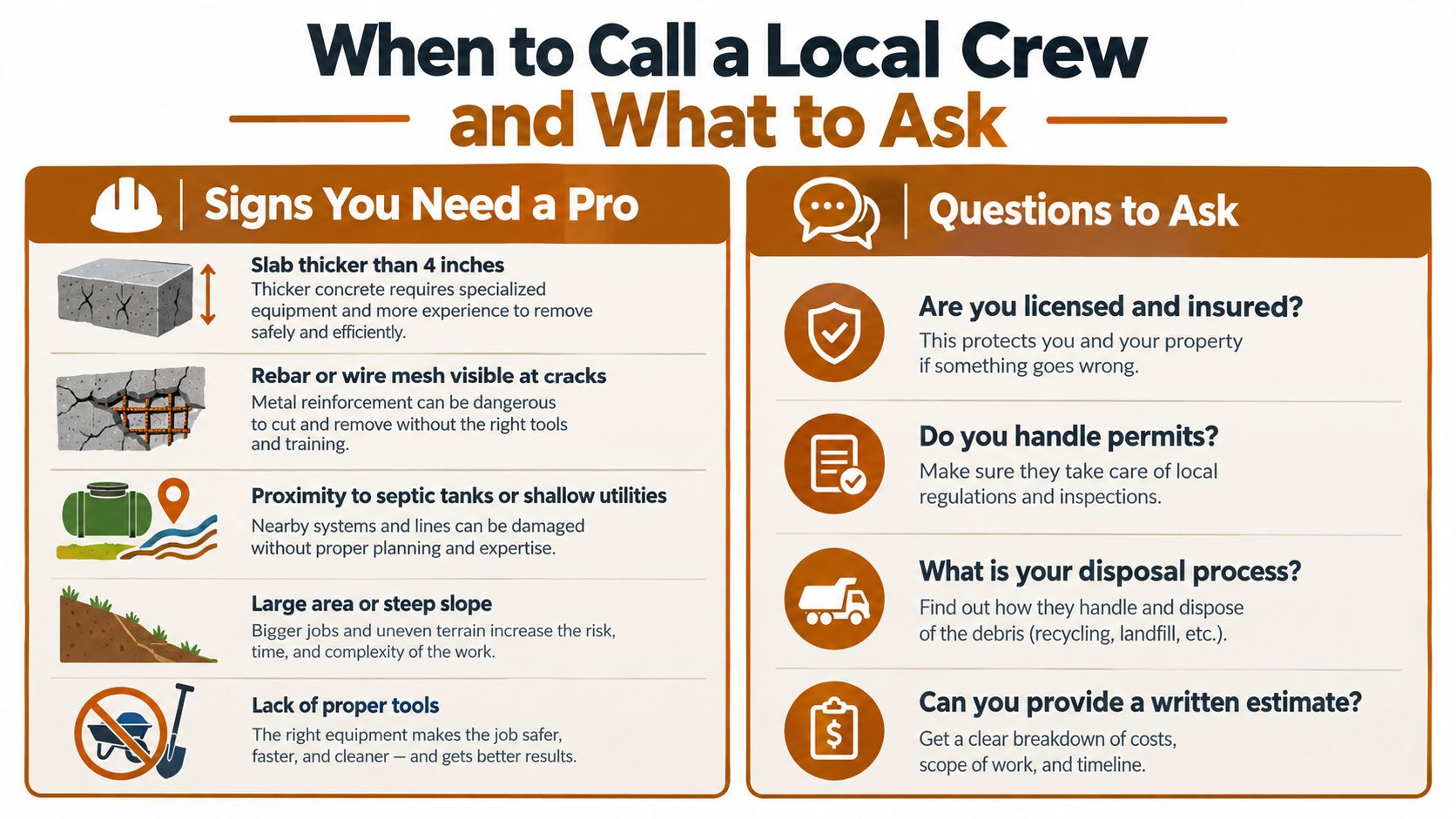
The DIY threshold is lower than many homeowners think. Call a professional when the slab is thicker than four inches, reinforcement appears at cracks, utilities or septic components run nearby, access is tight, the area is large or sloped, or the soil is too wet to support a dumpster or machine.
A site walk matters more than a phone quote for any driveway over 400 square feet. The contractor can measure the slab, check edges and access, identify likely loading points, inspect utility marks, and discuss what happens to the base after removal.
Questions that expose weak bids
Ask each contractor to answer these questions in writing:
- License and insurance: Can you provide current licensing information through the Florida Department of Business and Professional Regulation, general liability coverage, and workers compensation certificates?
- Permit responsibility: Will you identify and handle any driveway, sidewalk, apron, excavation, or right-of-way permits?
- Scope separation: Does the estimate distinguish demolition, loading, transportation, disposal, cleanup, and base restoration?
- Disposal documentation: How is tonnage calculated, and which landfill or recycling facility will receive the concrete?
- Base repair: Is excavation, aggregate placement, drainage correction, and compaction included, or priced separately?
- Weather planning: What happens if rain interrupts cutting, loading, or base preparation?
- Insurance certificate: Can you provide a sample certificate of insurance naming the homeowner where appropriate?
Use this list of questions to ask a concrete contractor before comparing bids. Also verify the written address, payment schedule, warranty language, cleanup expectations, and who owns responsibility for damage near private utilities.
A local crew with its own equipment can coordinate cutting, breakout, loading, and haul-off directly. That generally gives the homeowner clearer accountability than a broker who sells the job and subcontracts each part.
Riverside Sealing & Striping, LLC is a third- and fourth-generation, family-owned contractor based in Dunnellon, providing concrete driveway removal and replacement, new concrete driveways, patios, slabs, and sidewalks across Marion County, Citrus County, and surrounding Central Florida areas. For a site-specific scope, request a free, no-pressure consultation and visit Riverside Sealing & Striping, LLC to discuss removal, disposal, base conditions, scheduling, and the next surface.
Concrete driveway removal FAQs
Can a driveway always be resurfaced instead of removed?
No. Resurfacing or patching may suit isolated cosmetic damage, but it won't correct a failed base, active settlement, major drainage problem, severe root lifting, or reinforcement corrosion. A contractor should evaluate movement and support before recommending an overlay.
Do I need a permit for concrete driveway removal in Florida?
Possibly. Requirements vary by jurisdiction and may depend on whether the work touches a driveway apron, sidewalk, public right-of-way, or drainage area. Check with the applicable county or municipal building department before demolition begins.
Why does wet cutting matter?
Wet cutting suppresses respirable crystalline silica and reduces airborne dust compared with dry cutting. It also improves visibility and can reduce blade wear during control cuts.
What happens to the concrete after removal?
The hauler may take clean concrete to a recycling facility for crushing and processing. Ask how the contractor separates concrete from soil and mixed debris, and request disposal details in the written estimate.
Should the base be repaired before a new driveway is poured?
Yes, when inspection finds soft spots, poor drainage, organic contamination, settlement, or inadequate support. The replacement surface depends on a stable, properly graded, and compacted base, not on how clean the demolition looks.