
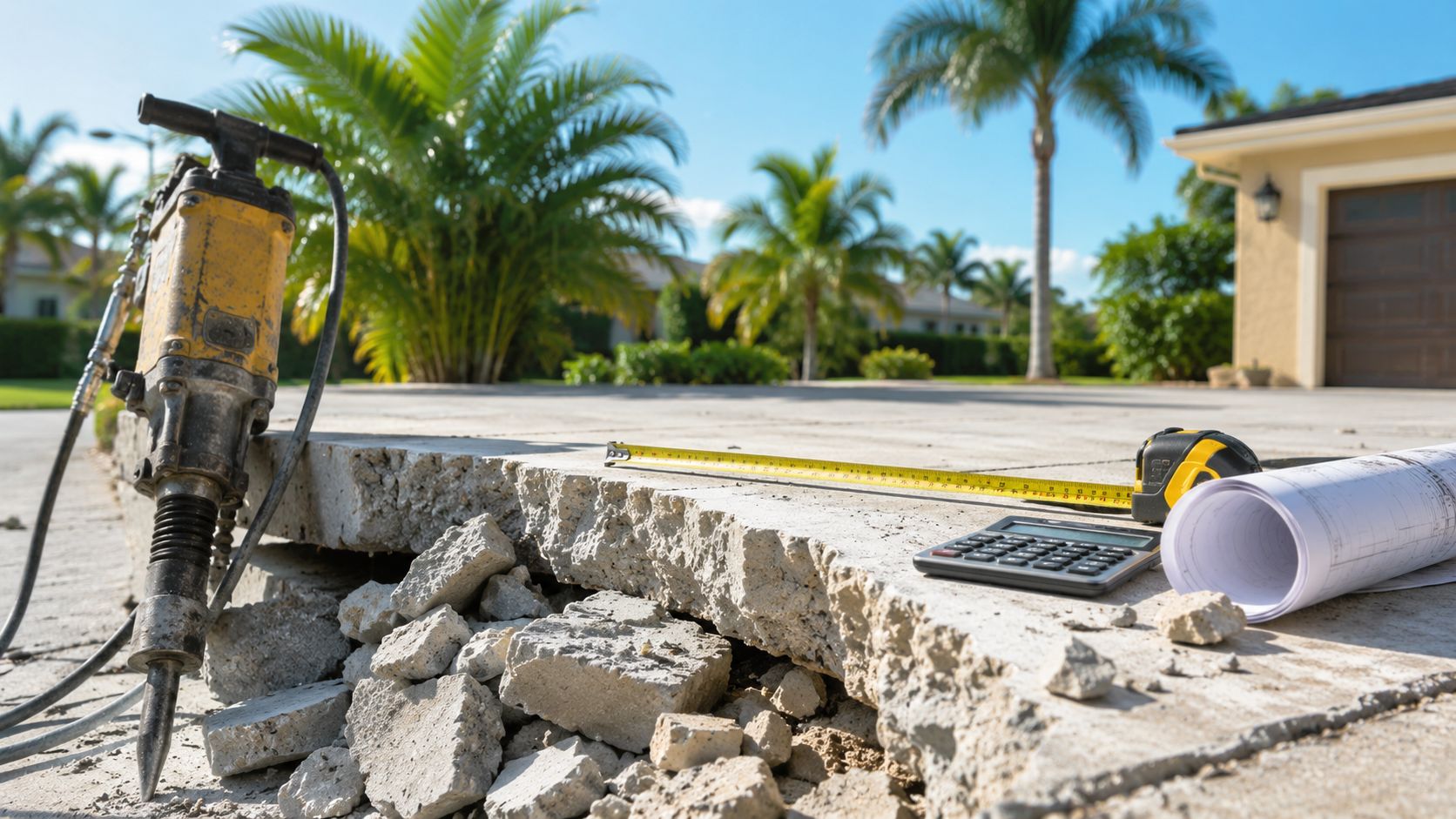
Concrete slab removal in Central Florida typically runs $2 to $8 per square foot, with most residential driveways and patios landing between $1,200 and $3,500 total before local disposal and permit fees. A small, uncomplicated slab can cost less, while reinforced concrete, difficult access, and full site restoration can push the project much higher.
A homeowner usually starts asking about removal after seeing widening cracks, settled sections, exposed reinforcement, or water collecting beside an old driveway. In Marion County, FL and Citrus County, FL, the demolition itself is only part of the job. Crews also have to protect landscaping, reach the slab through Florida subdivision lots, load heavy debris, handle disposal, and leave the sandy sub-base ready for whatever comes next.
That's why the advertised concrete slab removal cost often differs from the final invoice. A patio in Ocala with direct equipment access can be straightforward. A driveway in Homosassa Springs with a narrow side yard, rebar, irrigation lines, and a long haul route is a different project entirely.
Table of Contents
- What Concrete Slab Removal Typically Costs in 2026
- The Main Cost Drivers Behind Every Removal Quote
- DIY Removal Versus Hiring a Professional Crew
- How the Removal Process Actually Unfolds
- Real Project Budgets for Central Florida Homeowners
- Local Factors That Shape Pricing in Marion and Citrus Counties
- Smart Ways to Save and Choosing the Right Contractor
- Frequently Asked Questions About Concrete Slab Removal
What Concrete Slab Removal Typically Costs in 2026
National benchmarks provide a starting point, not a firm bid. Concrete removal commonly falls between $2 and $8 per square foot, with final pricing shaped by slab size, reinforcement, equipment access, hauling, and disposal. Small jobs may cost less, while difficult removals can reach several thousand dollars.
A thin patio with direct access usually stays near the lower end. A reinforced driveway requires more cutting, breaking, sorting, and loading. In Marion and Citrus counties, the same square-foot rate can produce different totals because subdivision lots often restrict equipment access, sandy sub-base material may need correction, and hurricane-season disposal bottlenecks can increase hauling time.
| Project Type | Per Sq Ft Range | Typical Total in Central FL |
|---|---|---|
| Thin, unreinforced patio | $2 to $4 | $300 to $800 for a 10×10 slab |
| Wire mesh slab | $3 to $5 | Varies with access and haul-off |
| Reinforced driveway | $4 to $8 | Commonly $1,200 to $4,500 |
| Thick or foundation-like slab | More than $8 in difficult conditions | Can reach several thousand dollars |
For planning purposes, a homeowner should ask what the quoted concrete slab removal cost includes. A Central Florida concrete slab cost reference can help establish an initial budget, but the written estimate should identify saw-cutting, demolition, loading, hauling, tipping fees, permits, rough grading, and base repair.
Restoration often controls the final bill more than homeowners expect. Removing the concrete may leave an uneven or contaminated base, damaged irrigation, disturbed landscaping, or a surface that needs fill and compaction before a new driveway, patio, gravel area, or lawn can go in. A quote limited to demolition may therefore look attractive while leaving the preparation work unpriced.
Disposal is frequently listed separately because concrete is heavy and hauling conditions vary. Steel reinforcement adds sorting and cutting work, while a narrow side yard or long carry from the slab to the truck increases labor even when the measured area is modest. In Ocala, a machine can sometimes work close to the slab. In Homosassa Springs, fences, landscaping, and tight residential access may force smaller equipment and more hand loading. The site visit determines which price applies.
The Main Cost Drivers Behind Every Removal Quote
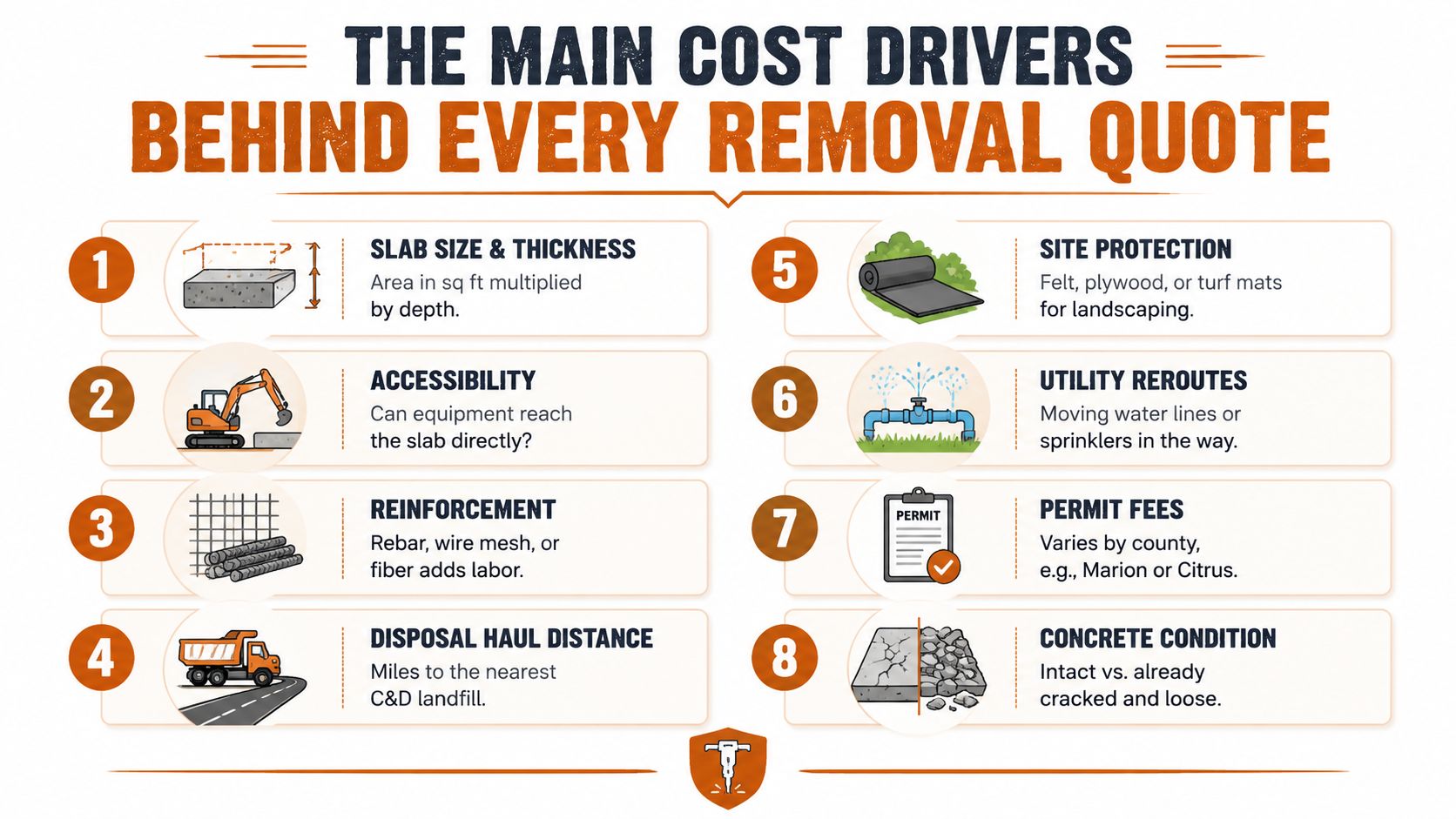
A removal estimate reflects the conditions a crew has to manage, not just the visible surface. Two slabs with the same dimensions can produce very different bids if one is a cracked patio beside a driveway and the other is a reinforced slab behind a fence.
Size and thickness establish the starting point
Square footage is the first multiplier. A larger slab creates more broken material, more loading time, and more trips or larger disposal loads. Thickness matters just as much. A 4-inch patio breaks differently from a 6- to 8-inch driveway or a thickened-edge slab.
Reinforcement changes the work
Unreinforced concrete is often estimated at $2 to $4 per square foot, wire mesh at $3 to $5, and rebar-reinforced concrete at $4 to $8. Concrete Calculate's demolition cost breakdown explains that crews must cut steel, separate debris, and manage the waste stream differently when reinforcement is present.
Wire mesh may pull free as sections break. Rebar often stays locked into the concrete and requires a cutoff saw, bolt cutters, or torch work, depending on the site and safety conditions.
Access can turn machine work into hand demolition
A skid steer with a hydraulic breaker saves labor when it can reach the slab. Tight side yards in Ocala subdivisions, narrow lots in Dunnellon, and waterfront properties around Homosassa Springs may force a crew to carry broken pieces farther or use smaller equipment.
Disposal, permits, equipment, and labor complete the estimate
Transfer station rules, tipping fees, haul distance, and material sorting all affect the disposal line. Permits may also apply, particularly when removal touches a right-of-way, curb cut, structural element, or public access area. Equipment choices range from a handheld jackhammer to a skid steer or excavator, and labor availability can shift with seasonal demand.
Practical rule: A quote should identify removal, loading, hauling, disposal, and restoration separately. “Break and remove” doesn't necessarily mean “leave the site ready for replacement.”
A combined situation can push a project from the low end to the high end quickly. A 500-square-foot reinforced driveway behind a fence in summer requires more labor, protection, equipment coordination, and haul planning than an open patio with truck access.
DIY Removal Versus Hiring a Professional Crew
DIY demolition can appear inexpensive until equipment, protection, hauling, and disposal enter the calculation. A breaker hammer rental may cost $200 to $400 per day, based on the project assumptions used for this comparison. The homeowner still needs a heavy-duty pickup or trailer, fuel, loading help, and a legal disposal plan.
A determined homeowner may spend two to three full weekends breaking and moving a 200-square-foot patio, particularly without experience or machine access. A professional crew can often clear a similar patio in under a day with a skid steer, hydraulic hammer, concrete saw, and established disposal relationships. Reinforcement, slab thickness, and tight access can change that schedule.
| Factor | DIY Removal | Professional Crew |
|---|---|---|
| Time | Often stretches across multiple weekends | Equipment can compress demolition into a shorter visit |
| Cost | Rental, safety gear, hauling, fuel, and disposal | One coordinated quote may include labor and haul-off |
| Safety | Homeowner manages flying chips, lifting, and utilities | Crew uses demolition procedures and protective equipment |
| Equipment | Breaker hammer, saw, trailer, and hand tools | Skid steer, hydraulic breaker, saws, loaders, and trucks |
| Disposal | Homeowner must arrange legal drop-off | Crew loads, transports, and handles the waste stream |
Concrete chunks exceeding 100 pounds can shift without warning. Chipping creates eye hazards, hearing exposure, dust, and sharp steel. Irrigation, electrical conduits, gas lines, and water services add risk even when the slab appears isolated. In Marion and Citrus counties, sandy sub-base conditions can also leave an uneven excavation that needs careful filling and grading after removal.
A small, thin, unreinforced slab under 100 square feet may suit an experienced DIYer with simple truck access and completed utility locating. Larger slabs, reinforced concrete, areas near a home or pool, and sites blocked by a fence generally call for a professional crew. Ask whether the quote includes loading, haul-off, disposal, and post-removal restoration, not only breaking the concrete. For patio-specific planning, professional concrete patio removal can clarify the work that belongs in the scope.
How the Removal Process Actually Unfolds
A competent crew doesn't begin by swinging a jackhammer at the nearest crack. The work starts with a site walk, measurements, photographs, and a utility locate through 811. The contractor checks slab thickness, reinforcement, drainage, gates, landscaping, irrigation, hose bibs, and the route to the truck.
If the work requires authorization, the contractor handles the permit process with Marion County, Citrus County, or the applicable city. Water serving hose bibs or fixtures mounted to the slab gets shut off before demolition. Plywood, poly sheeting, felt, or turf mats protect walls, plants, pavers, and finished drive surfaces.
The crew then saw-cuts edges and control lines where clean separation matters. A skid steer-mounted breaker or excavator-mounted breaker handles accessible sections, while a handheld jackhammer works around structures and utilities. Workers sort rebar and wire mesh from concrete because steel and aggregate may follow different disposal paths.
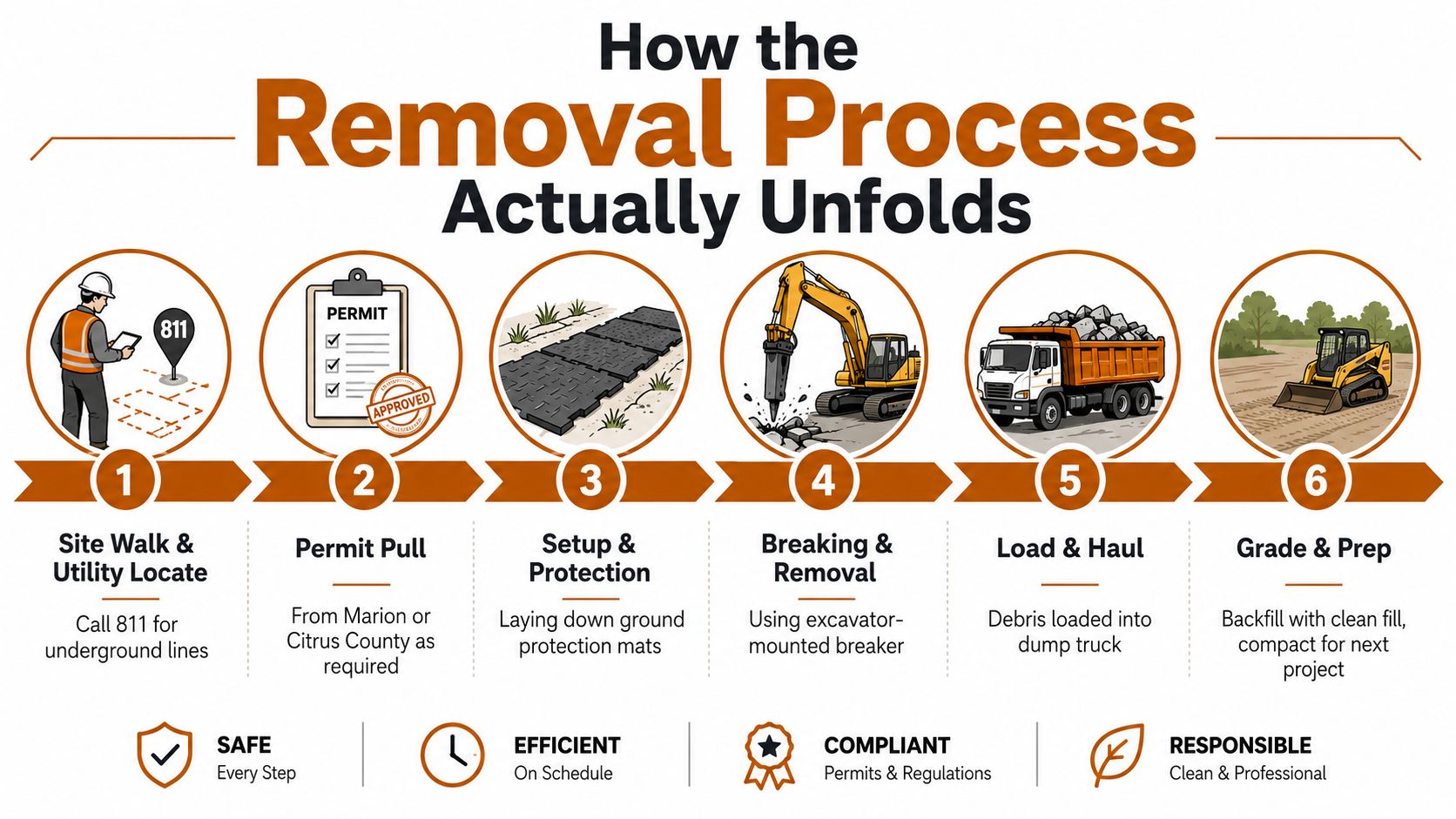
Concrete gets loaded into a dump truck, trailer, or other suitable haul vehicle and taken to an approved facility, such as a Marion County disposal site or Citrus County transfer station. The final step is rough grading. In Central Florida, that often means reshaping the sandy sub-base, removing loose pockets, and leaving the area ready for a replacement slab or landscaping.
The removal isn't complete when the last chunk leaves the property. It's complete when the remaining base is stable, accessible, and suitable for the next phase.
For a 400-square-foot driveway, a typical plan may involve one crew day for breakout and a second day for hauling and cleanup. Actual timing changes with reinforcement, weather, equipment access, and the distance to disposal.
Real Project Budgets for Central Florida Homeowners
Per-square-foot pricing becomes easier to understand when applied to familiar properties. A small patio may have a low total surface area but still carry fixed costs for mobilization, protection, loading, and disposal. A larger driveway spreads those costs across more square footage, although reinforcement and access can erase that advantage.
A 10×10 patio
A 10×10-foot slab, or 100 square feet, is commonly estimated at $300 to $800 for removal. HomeGuide's project examples uses that range for a slab of this size.
The low end fits a thin, unreinforced patio with direct access and limited restoration. The high end becomes more realistic when crews must hand-carry debris, protect landscaping, cut mesh, or rebuild a disturbed base.
A 500-square-foot driveway
A 500-square-foot driveway often totals $1,500 to $4,000 in broad residential estimates. For a straightforward Central Florida driveway, crews may write an estimate toward the middle of that range, then adjust for disposal, saw-cutting, thickened edges, and sub-base correction.
A 6-inch edge, rebar, narrow Ocala side yard, or a fence that prevents skid steer access can move the estimate upward. Angi's removal pricing guidance also identifies reinforcement, access, slab size, and disposal as major variables.
A 600-square-foot driveway or pool deck
A 600-square-foot driveway commonly falls around $1,200 to $4,200, while broader project guides place a similar surface nearer $1,800 to $4,800 when conditions vary. Dropcurb's driveway removal estimates provides the driveway-specific range.
| Project | Size | Low Estimate | High Estimate | Typical Cost Drivers |
|---|---|---|---|---|
| Patio | 100 sq. ft. | $300 | $800 | Thickness, access, hand loading |
| Driveway | 500 sq. ft. | $1,500 | $3,500 | Reinforcement, saw cuts, haul-off |
| Driveway or pool deck | 600 sq. ft. | $1,800 | $4,200 | Equipment access, disposal, base restoration |
Those are planning ranges, not replacement budgets. If the property owner wants a new driveway, patio, or pool deck, the estimate must add forming, base preparation, reinforcement, concrete placement, finishing, and curing requirements.
Local Factors That Shape Pricing in Marion and Citrus Counties
National guides rarely account for how a Central Florida job behaves once the crew arrives. In Marion County, FL, sandy soil can look firm before removal and then loosen quickly after the slab comes out. Citrus County, FL properties can present similar conditions, particularly where drainage, irrigation, or previous fill has disturbed the base.
Permitting depends on the scope and location. A private residential slab may not require the same review as work that affects a right-of-way, curb cut, property access, drainage, or a structural foundation. A driveway connection in Ocala or work beside a public sidewalk may also involve city or county requirements. Homeowners should ask the contractor to identify the responsible authority before demolition starts, rather than assuming every patio follows the same rule.
Disposal logistics matter during busy periods. Crews may use facilities serving the Baseline Road area in Marion County or the Lecanto area in Citrus County, but the practical cost depends on current acceptance rules, tipping arrangements, truck capacity, and travel distance. During hurricane season, from June through November, debris haulers can become harder to schedule when storm cleanup increases demand.
Sub-base restoration is the local cost people miss
A removed slab can expose loose sand, voids, washed areas, or poorly compacted fill. Before a replacement driveway or patio goes in, the crew may need to remove unsuitable material, place clean fill or crusher run, compact it, and correct drainage.
Subdivision rules can add coordination requirements. Communities such as On Top of the World, Stone Creek, and Sugarmill Woods may restrict work hours, truck routes, dumpster placement, or protection of common areas. The same slab can cost more when the crew must stage equipment away from the property or use a designated dumpster pad.
In Marion and Citrus counties, the cheapest demolition quote often leaves the most important question unanswered: what condition will the ground be in after the concrete is gone?
Smart Ways to Save and Choosing the Right Contractor
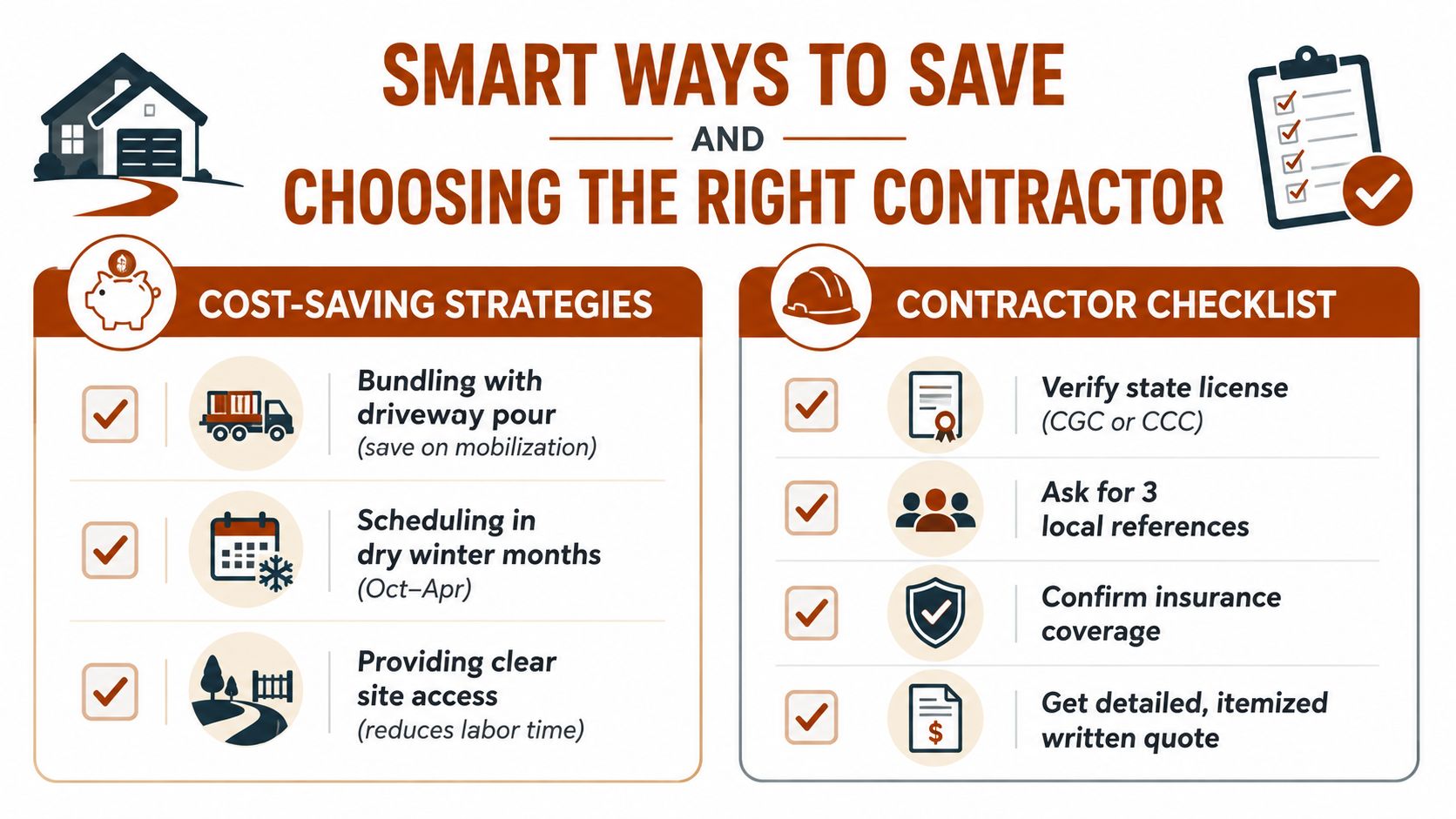
The most reliable savings come from reducing duplicated mobilization and avoiding preventable delays. If a new driveway is planned, bundling removal with the replacement pour can keep site preparation, equipment movement, and scheduling under one coordinated scope. It also makes it easier to assign responsibility for the base between demolition and construction crews.
Dry-season scheduling can help with access and site conditions. The infographic below identifies October through April as the dry winter scheduling window, but availability still depends on contractor workload and local weather. Providing clear access, removing vehicles, opening gates, and identifying irrigation lines before the crew arrives can reduce avoidable labor.
Ask for an itemized scope
A useful estimate should show:
- Saw cutting: Identify whether clean perimeter cuts are included.
- Demolition: State which tools and equipment the crew expects to use.
- Loading and hauling: Confirm that broken concrete leaves the property.
- Disposal: Ask whether tipping fees and material sorting are included.
- Restoration: Specify grading, fill, compaction, and preparation for replacement.
- Protection: List plywood, turf mats, dust control, and landscaping protection.
Check the contractor's state license and insurance, then ask for photographs of comparable work in Ocala, Dunnellon, Crystal River, Lecanto, or Homosassa Springs. References from local homeowners, HOAs, or property managers can reveal whether the company keeps its schedule and cleans the site properly.
A written warranty should explain what the contractor stands behind, especially if the quote includes base restoration. For a more complete screening process, use these questions to ask a concrete contractor before comparing the final bids.
Riverside Sealing & Striping, LLC is a local option that handles concrete removal, replacement, patios, driveways, and sidewalks, alongside asphalt sealcoating and parking lot striping. The company is licensed and insured, offers free no-pressure consultations, and serves Central Florida properties from residential sites to commercial and HOA settings.
Frequently Asked Questions About Concrete Slab Removal
How long does driveway or patio removal take?
A typical Central Florida driveway or patio removal takes one to three days, depending on size, reinforcement, access, weather, hauling, and whether the contractor restores the base. An accessible slab may break out quickly, but narrow gates and hand loading can extend the work.
Do Marion or Citrus counties require a permit?
Permit requirements depend on the scope and location. Private residential slab removal may follow different rules from work that affects a right-of-way, curb cut, sidewalk, drainage feature, property line, or structural foundation. Ask the contractor to verify requirements with Marion County, Citrus County, or the City of Ocala when applicable before demolition.
What does a new concrete driveway cost after removal?
The replacement price must be quoted separately from demolition. A standard residential concrete pour is commonly reported at $4 to $12 per square foot before unusual site conditions, with total project pricing depending on thickness, reinforcement, finish, base preparation, and access. Metal America Concrete's 2026 slab pricing guide provides that installation benchmark, but a local estimate is still necessary for a driveway in The Villages, Summerfield, Belleview, Inverness, or Beverly Hills.
How can I confirm a contractor is qualified?
Request proof of state licensing and insurance, a written scope, local references, and a clear explanation of disposal and restoration. The estimate should state who handles utility locating, permits, saw cuts, haul-off, grading, and compaction. Those details matter more than a low headline rate.
Should I repair or remove the slab?
Repair may make sense when damage is isolated and the base remains stable. Removal and replacement becomes more practical when settlement, widespread cracking, exposed reinforcement, drainage problems, or repeated patch failures affect the surface. A professional evaluation can separate cosmetic damage from a failed base.
Riverside Sealing & Striping, LLC provides concrete slab removal and replacement for driveways, patios, sidewalks, and other residential or commercial surfaces across Marion County, FL, Citrus County, FL, and nearby Central Florida communities. For a free, no-pressure on-site consultation, visit Riverside Sealing & Striping, LLC and request an estimate that accounts for demolition, hauling, disposal, and site restoration.