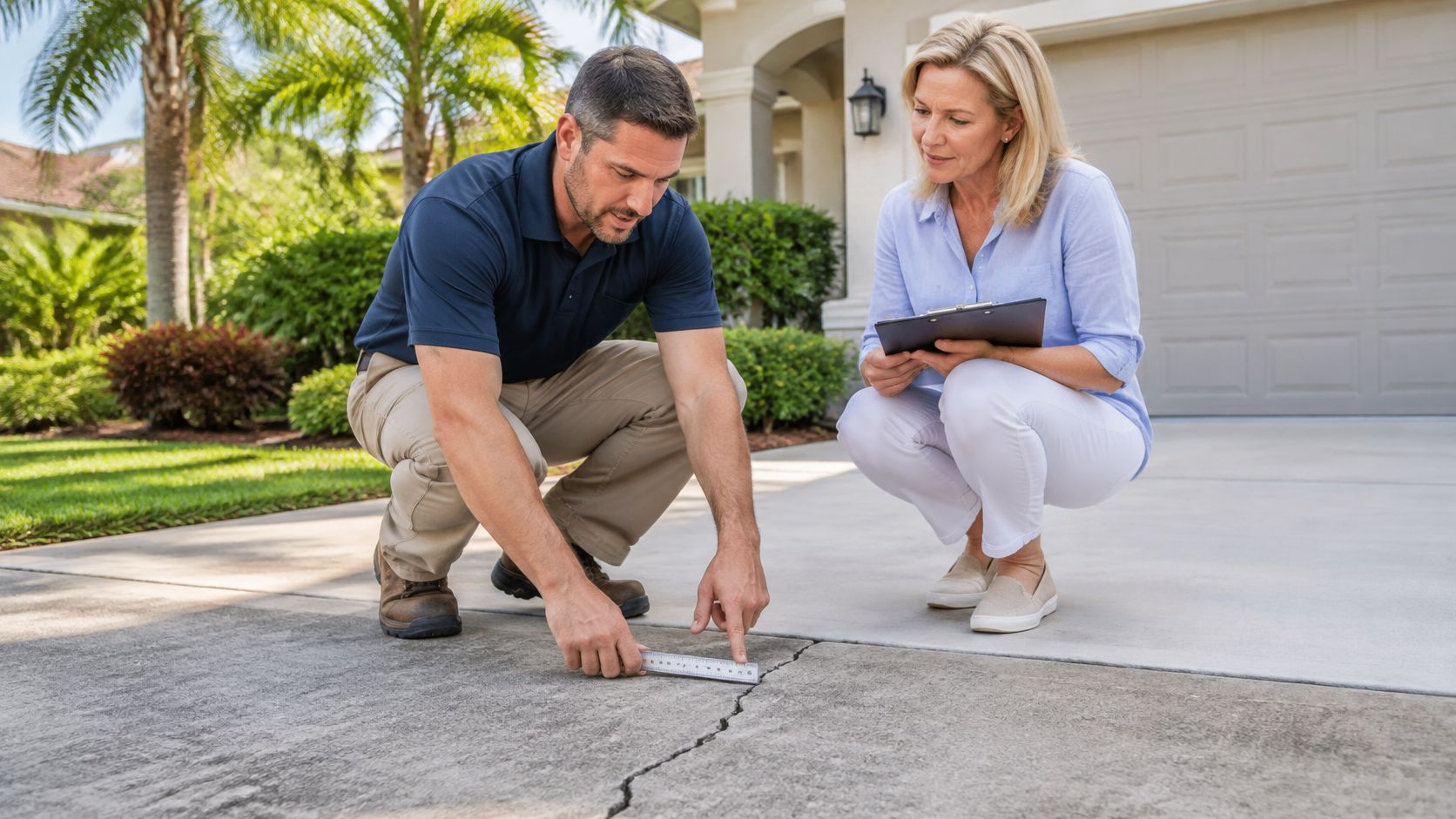
You've noticed a crack near the garage, a sunken corner by the street, or a patch that's already breaking loose. Now you're comparing concrete driveway repair contractors, and each one seems to recommend something different. One offers sealing, another suggests resurfacing, and another wants to replace the driveway.
For homeowners in Marion County, FL, and Citrus County, FL, the right choice starts beneath the surface. A repair should address support, drainage, and vehicle loading, not just hide the damage. Judge the written scope before the price per square foot, and you'll have a better chance of paying for work that solves the problem.
Table of Contents
- Diagnose the Damage Before You Call a Contractor
- When to Hire a Pro and When DIY Works
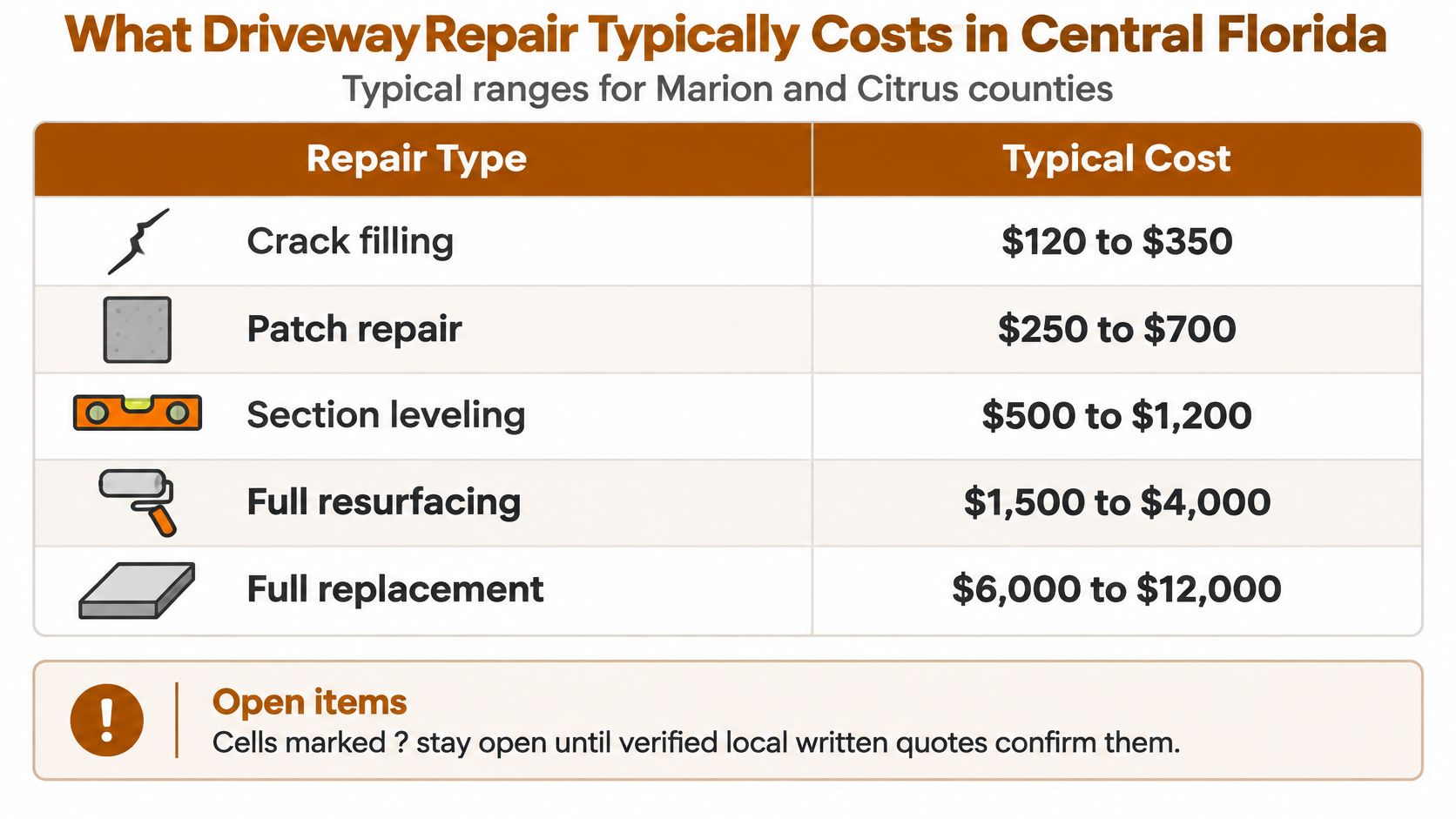
- What Driveway Repair Typically Costs in Central Florida
- Vet Credentials and Red Flags Before You Compare Bids
- What the Written Scope Must Spell Out
- How Florida Heat, Rain and Traffic Shape Driveway Repairs
- Book a Free Driveway Evaluation Before Damage Spreads
- Frequently Asked Questions About Concrete Driveway Repair Contractors
Diagnose the Damage Before You Call a Contractor
| Damage Seen | Likely Cause | Typical Repair |
|---|---|---|
| Hairline cracks narrower than 1/8 inch | Surface shrinkage or normal movement, unless the slab also shifts | Monitor, then seal if water enters |
| Cracks wider than 1/8 inch (3 mm) | An open pathway for water, though width alone doesn't establish the cause | Saw-cut, clean and seal a stable crack |
| Small spalled area under half the slab thickness | Localized surface loss, provided sound concrete remains beneath it | Partial-depth patch |
| Slab sunk, tilted or pulling from the curb | Loss of support beneath the slab | Slab stabilization by injection, or replacement |
| Several cracked or heaved panels | Failed base, roots or poor drainage | Full-depth removal and replacement after correcting the cause |
| Failed or missing joint sealant | Water and debris entering joints | Remove old sealant, reface the joint and reseal |
The measurement categories above follow Federal Highway Administration concrete repair guidance, which describes crack sealing for cracks wider than 0.125 inches (3 mm) and limits partial-depth repairs to no more than half the slab thickness. It also distinguishes slab stabilization, which fills underlying voids with cementitious grout or polyurethane, from surface repair.
Appearance can mislead you. A fine crack can sit above a washed-out base, while a wide opening may be an intentional joint rather than a broken slab. For more background on the causes, review why a driveway develops cracks.
Check width, movement and water
Start with a ruler or crack comparator gauge. Measure the widest opening, photograph it, and note whether the edges remain level. Don't force a screwdriver into the crack and enlarge it.
Next, apply gentle foot pressure near an accessible slab edge while standing on stable ground. Stop if the panel rocks or feels unsafe. Lack of visible movement doesn't prove the base is sound, but movement is a clear reason to call a professional.
After rain, look for dark staining, pooled water, washed-out sand and damp joints. Whether you're in Ocala, Dunnellon or Belleview, those observations help a contractor distinguish a maintenance issue from loss of support.
Practical rule: A contractor who prescribes a repair before measuring the damage and checking the site is selling a method, not assessing your driveway.
When to Hire a Pro and When DIY Works
| Task | DIY Reasonable | Hire a Pro |
|---|---|---|
| Hairline crack sealing on a small area | Yes, with compatible flexible sealant on clean, dry concrete | If water enters beneath the slab or movement appears |
| Joint resealing along a short run | Yes, after completely removing failed sealant | When failure extends across the driveway |
| Partial-depth patch on a shallow surface defect | Possible for a small spall with sound concrete beneath it | When deterioration is extensive or support is questionable |
| Slab stabilization by injection | No, specialized equipment is required | Always |
| Full-depth replacement | No | Always, with permit review and appropriate load-transfer details |
| Drainage correction or grading | No | Always, especially near structures or county right-of-way |
A careful homeowner can handle limited sealing. The job requires more preparation than squeezing material into an opening: remove loose debris, vacuum the joint, clean its sidewalls and let it dry. Use exterior concrete joint sealant, not household caulk or rigid mortar.
For deeper joints, use compatible backer rod to control sealant depth and prevent bonding to the bottom. Choose self-leveling sealant only where the slope won't let it run out. A non-sag product is usually easier to control on inclined sections.
Choose the weather window
The FHWA pavement preservation guide identifies spring and fall as optimum seasons for joint resealing, because moderate installation temperatures are more favorable. It also explains that sealing limits water and incompressible debris that can contribute to spalling, corner breaks and slab movement.
In Central Florida, choose the actual weather window rather than relying on the calendar. Don't seal a damp joint, and allow enough rain-free time for the product's stated cure requirements.
Stop DIY work when the slab isn't stable
Call a licensed crew when you notice:
- Spreading damage: Cracks lengthen or branch between inspections.
- Movement: A panel rocks, tilts or separates vertically.
- Persistent pooling: Water collects beside the garage or along a repaired joint.
- Public-apron involvement: The work extends toward a road connection or roadside drainage feature.
A small patch is reasonable only when the surrounding concrete is sound. Applying filler over movement won't stabilize the slab, and a failed DIY seal can leave moisture behind poorly bonded material. Removing that material adds labor to the eventual professional repair.
What Driveway Repair Typically Costs in Central Florida
A bid for a driveway crack repair is hard to compare with a bid for a replacement. Compare the pricing basis and the work included: crack sealing by crack length or count, joint resealing by measured joint length, patching by repair area and depth, and replacement by measured square footage.
| Repair Type | Pricing Basis | What Moves the Price |
|---|---|---|
| Crack sealing, typical residential driveway | Crack length or count, with preparation specified | Crack width, cleaning and preparation |
| Joint resealing | Measured joint length | Joint length and old sealant removal |
| Partial-depth patch | Measured patch area and depth | Preparation and access |
| Slab stabilization | Per slab, based on specialist assessment | Void size, lifting requirements and slab count |
| Full driveway replacement | Measured square footage, with work itemized | Thickness, finish, demolition, base work and drainage |
| Demolition and haul-off | Measured area, with disposal specified | Concrete thickness, reinforcement and access |
The written scope matters more than a single price per square foot. For Marion and Citrus counties, ask bidders to measure the work and identify what each line item includes.
Compare what the money buys
Demolition and haul-off, base work, drainage changes, decorative finishing and permit fees should be listed separately when they apply. Ask how concealed reinforcement or other conditions will affect the price before work begins.
A lower bid can still be sound if its scope matches the others. It becomes difficult to judge when it omits the failed support or drainage issue behind the damage. A surface patch may improve appearance, but it does not correct an unstable slab or underlying water problem.
The FHWA pavement preservation findings describe traditional concrete pavement design life as approximately 20 to 25 years. That highway benchmark is not a residential driveway warranty. Use it as context, and judge a repair by the slab's condition and the work required to address the cause of failure.
Compare replacement bids by measured area and itemized work. Compare joint resealing by joint length and patching by repair area and depth. The concrete driveway repair cost guide can help you prepare questions about the estimate.
Vet Credentials and Red Flags Before You Compare Bids
A professional-looking truck doesn't establish qualifications. Neither does a low price, a polished website or a promise that the crew can start immediately. Verify the business before negotiating the work.
Use this checklist to organize the paperwork you request.

Verify the business in writing
License or registration appropriate to the scope. Check the contractor's stated credential through Florida's license lookup and the Marion or Citrus County building department. Ask the department which qualification applies to the proposed work rather than assuming every concrete task has identical requirements.
Active general liability insurance. Request a certificate naming you as certificate holder and confirm coverage directly with the insurance agent. Certificate-holder status documents receipt of the certificate; it doesn't automatically make you an additional insured.
Workers' compensation coverage or valid exemption. Confirm that the documentation matches the business and crew arrangement. Don't accept a verbal assurance that every worker is independently responsible for injuries.
A verifiable local operating history. Request a business address and recent references, including nearby work in Ocala, Inverness or Crystal River. Ask those owners about communication, cleanup, scheduling and how the contractor handled problems.
Finished work you can inspect. Look at driveway edges, transitions, drainage and older repairs, not just freshly finished surfaces. Obtain the property owner's permission before entering.
Understanding bonded and insured contractors also helps you separate different protections. Insurance, licensing and bonding aren't interchangeable, and none replaces a detailed contract.
Watch how the contractor answers
Warning signs include:
- Front-loaded payment: A large deposit without a clear connection to mobilization, ordered materials or completed milestones.
- Doorstep pressure: A discount that disappears unless you sign immediately.
- Missing specifications: No written base material, slab thickness, repair boundaries or finish.
- Cosmetic diagnosis: A surface patch offered without examining displacement or runoff.
- Unverified permit claims: A blanket statement that apron or drainage work never requires approval.
- Absolute promises: A guarantee that concrete will never crack despite roots, soil movement or heavy loading.
Ask what could make the proposed repair fail. A credible answer identifies site-specific risks and explains which ones the scope addresses and which remain excluded.
Fast turnaround isn't a substitute for reliable scheduling. Request a realistic start window, weather-delay procedure and separate vehicle-return date. At Riverside, our Central Florida operating history and clear timelines support that conversation, and our commercial services use licensed and insured contractors.
A clear explanation of limitations is a stronger trust signal than an impossible promise.
If the paperwork and explanation leave you uncertain, get another on-site assessment before paying a deposit.
What the Written Scope Must Spell Out
| Scope Item | What to Require | Why It Matters |
|---|---|---|
| Base preparation | Excavation depth, compacted base material and thickness | Support controls settlement risk |
| Drainage | Proposed grades, discharge route and removal of trapped water | Water beneath the slab can weaken support |
| Joint layout | Joint locations, spacing and depth on a plan | Planned joints manage cracking |
| Load transfer | Dowels or another appropriate detail where needed | Supported interfaces reduce faulting and edge damage |
| Curing | Method and written vehicle-return requirements | Concrete needs protection while developing strength |
| Joint sealing | Sealant type and perimeter treatment | Limits water and debris entry |
| Permits | Responsible applicant and fee allowance | Clarifies approval and inspection responsibilities |
| Warranty and exclusions | Written term, coverage and exclusions | Establishes responsibility after completion |
Removal and repouring aren't the complete repair. The FHWA full-depth repair procedure treats the work as a sequence involving repair boundaries, removal, support preparation, load transfer, placement, curing and joint treatment.
Require a complete replacement sequence
- Define the repair boundaries and identify the concrete that remains.
- Saw-cut the boundaries and remove deteriorated material without damaging adjacent sound concrete.
- Pump out or drain collected water before repairing the subbase.
- Prepare and compact the support, then install the specified load-transfer detail where required.
- Place, finish and cure the concrete using the agreed method.
- Saw and seal the specified joints, including perimeter interfaces where appropriate.
Dowels aren't automatically appropriate at every residential interface. The contractor should explain where load transfer is needed and where the new concrete must remain isolated from a building or adjacent slab.
Likewise, an excavation that's already dry doesn't require pumping. The important distinction is whether the contractor has evaluated water and support, not whether a pump appears on site.
A thin layer placed over failed concrete is a surface patch, not full-depth replacement. Removing the slab but neglecting failed support is an incomplete replacement, even if the finished surface looks new.
Put the drainage route on paper
Specify where runoff will go after the work. Raising a driveway to eliminate a puddle can create a garage-entry problem or redirect water toward a neighboring property.
For a connection within county right-of-way, ask whether the apron requires a permit, reinforced connection or culvert review. Ask whether a grade change requires engineering documentation, then confirm those answers with Marion or Citrus County public works before signing.
The scope should also describe cleanup, disposal, site disturbance and the procedure for authorizing extra work. Request the written scope before comparing totals, so each contractor prices substantially the same repair.
How Florida Heat, Rain and Traffic Shape Driveway Repairs
A driveway in Dunnellon may look similar to one in Crystal River, but exposure, runoff and vehicle use can justify different repair details. Start with what happens on that particular property.
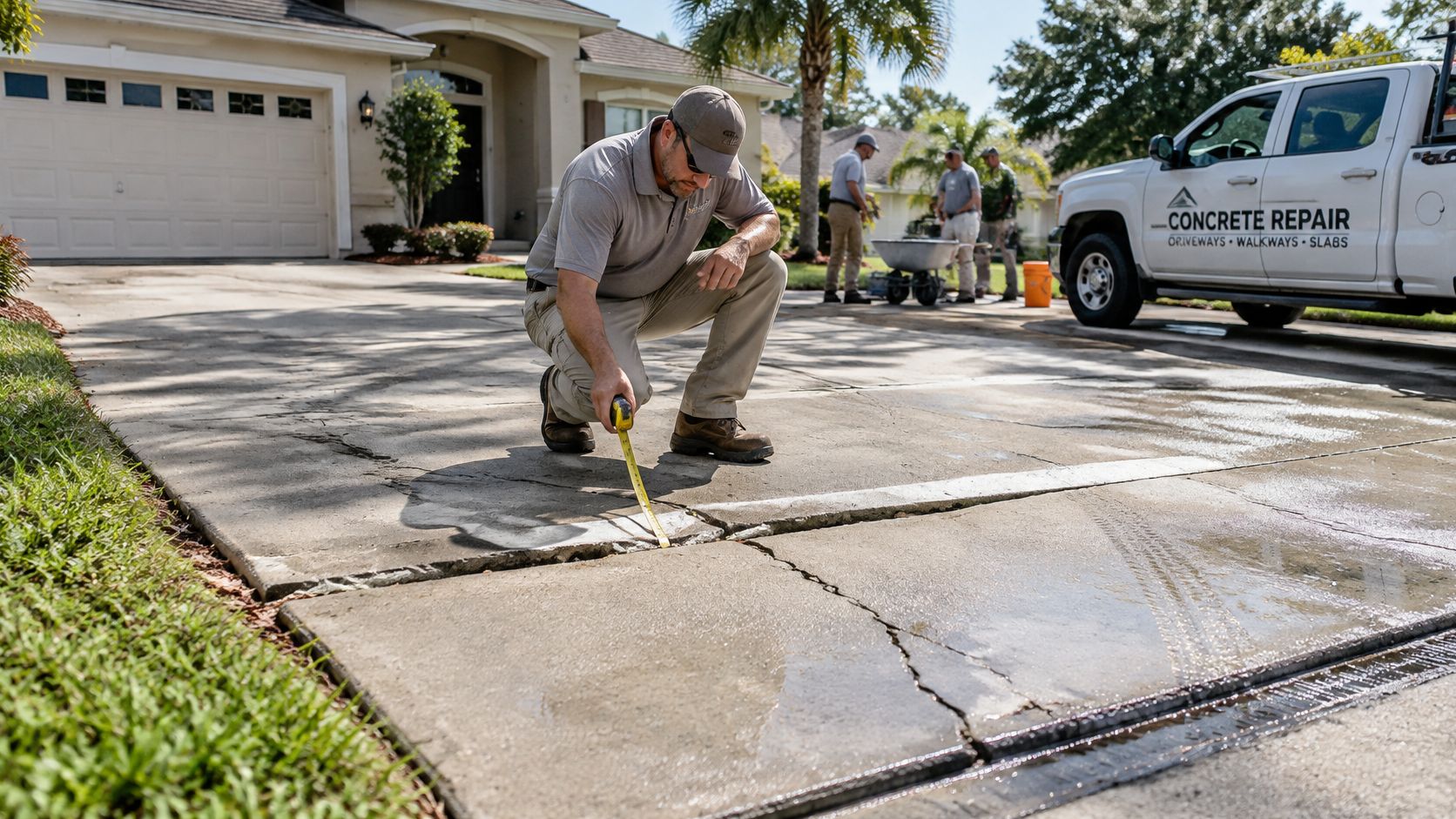
A useful assessment includes close measurement rather than a glance from the street.
Heat changes placement and joint performance
Say an Ocala driveway sits in full afternoon sun. The FHWA joint guidance explains that joints control cracking and accommodate expansion and contraction caused by temperature and moisture changes. Failed sealant requires removal and joint preparation, not another bead over dirt.
For summer replacement, favor an early-morning placement window where practical. Ask how the crew will manage rapid evaporation, finishing and curing, rather than treating a midday pour as business as usual.
Rain changes the support conditions
Consider a low-lying yard in Homosassa or Beverly Hills where runoff collects against the driveway. Check the site after a storm and identify whether water arrives from a roof, neighboring grade or roadside swale.
Before replacement, establish a workable discharge route. In sandy areas around Silver Springs and The Villages, look for erosion at slab edges rather than assuming quick surface drainage means the underlying support is secure.
This video offers additional visual context for evaluating driveway conditions.
Traffic changes the design assumptions
A boat trailer in Inverness, an RV in Summerfield or a work truck in Lecanto can concentrate loads differently from a passenger car. Owners in Belleview and Hernando should identify parking positions and turning paths before the contractor specifies the slab and edges.
Concrete needs appropriate support and joint details. Asphalt requires a different maintenance approach, with UV exposure, rain and wear informing sealcoating decisions. Don't accept asphalt maintenance products as substitutes for concrete repair materials.
Book a Free Driveway Evaluation Before Damage Spreads
An evaluation is most useful when the contractor arrives with your observations, not just a request for a price. Prepare a short record that separates cosmetic concerns from access, drainage and movement problems.
- Photograph the damage. Include a ruler beside cracks and record the condition of each joint.
- Classify what you see. Match the visible defects to the diagnosis categories without assuming you've established the underlying cause.
- Request comparable proposals. Send the same photographs and concerns to competing contractors, and request the written scope items.
- Arrange an on-site evaluation. Confirm repair boundaries, water flow, vehicle use and the estimate's exclusions before authorizing work.
Local help with concrete and asphalt
Riverside Sealing & Striping, LLC is based in Dunnellon and is family owned and operated by third- and fourth-generation asphalt and concrete professionals. Our position is straightforward: Concrete and Asphalt Experts in Marion and Citrus County.
Our concrete driveway work includes removal and replacement of damaged driveways and new installations with professional finishing; related services include asphalt sealcoating and parking lot striping. We offer a free, no-pressure consultation and estimate, with reliable scheduling and clear timelines so you can plan around access restrictions.
Book an evaluation while repair options remain open, rather than waiting until broken or displaced concrete forces a larger project.
Frequently Asked Questions About Concrete Driveway Repair Contractors
How do I know if a crack needs a contractor or just sealing?
Check whether the slab remains level, whether the opening changes and whether water enters beneath it. A stable surface crack may be suitable for sealing, while movement or loss of support calls for professional assessment.
Use the diagnosis table to organize observations, not to make a structural determination from width alone. Don't cover the crack before an assessment if doing so would hide displacement or water evidence.
Do I need a permit to repair my driveway in Marion or Citrus County?
Confirm the requirement with the appropriate building department or public works office before work starts. A limited maintenance repair and a replacement affecting a public apron, culvert or drainage pattern can have different approval requirements.
Provide the property address, a sketch of the proposed work and information about grade changes. Have the contract identify who obtains approvals and schedules inspections, rather than relying on a general statement that permits aren't necessary.
How much should driveway repair cost in Ocala or Crystal River?
Use a measured, itemized written estimate rather than a generic advertised range. The meaningful comparison is the price for the same demolition, base work, drainage correction, concrete specification and finishing.
For a localized repair, confirm whether pricing is by patch, joint length or slab. For replacement, verify the measured area and ask how concealed base damage will be handled before accepting the total.
When is the best time to reseal driveway joints in Central Florida?
Spring and fall generally offer more favorable installation conditions, but the joint must be dry and the forecast must suit the chosen sealant. Moderate weather doesn't compensate for moisture, dust or old material left on the bonding surfaces.
Ask when the repaired area can reopen to foot and vehicle traffic. A fast application isn't the same as a completed cure, and reopening too soon can damage otherwise careful work.
Riverside Sealing & Striping, LLC offers concrete driveway repair, removal and replacement, and new installation with professional finishing across Marion and Citrus counties. Visit Riverside Sealing & Striping, LLC to arrange a free, no-pressure evaluation and discuss a written scope that addresses the damage, drainage and support beneath your driveway.