
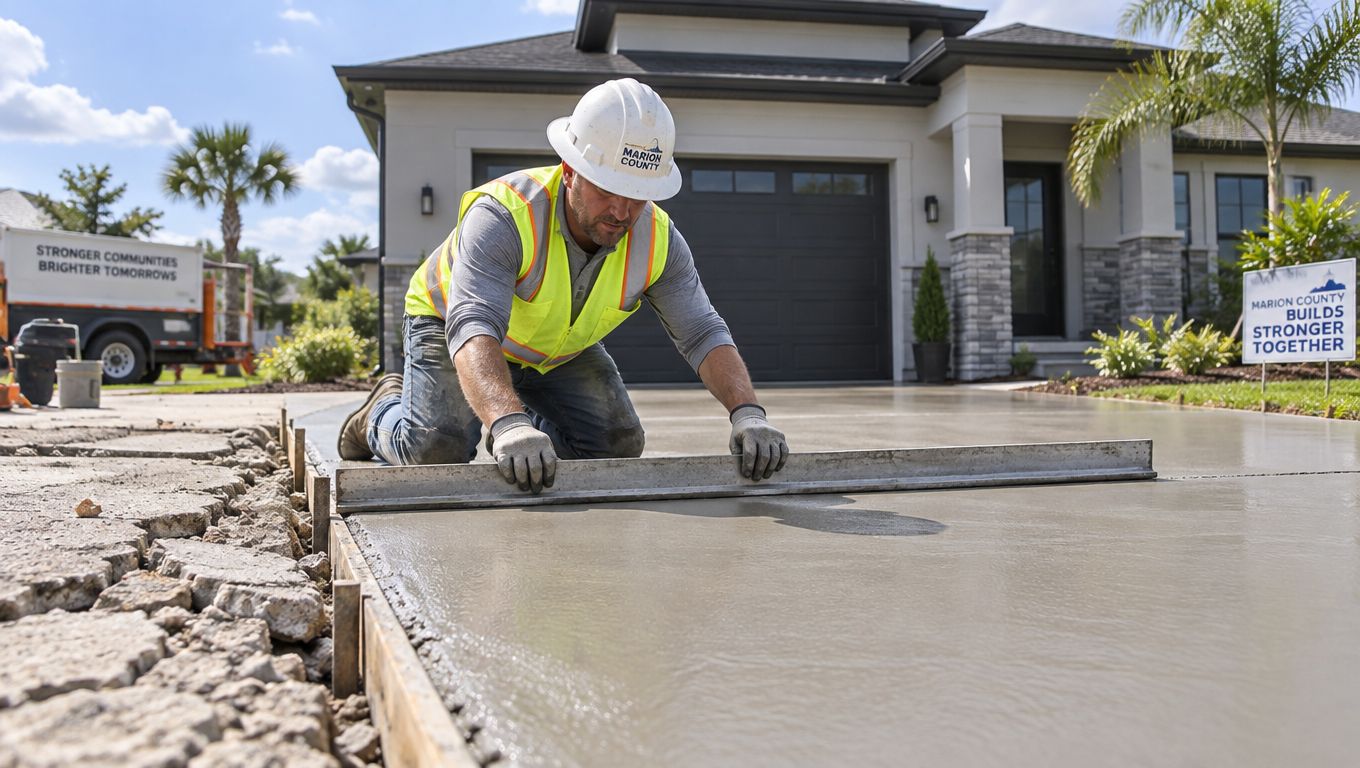
You pull into the driveway after an afternoon storm and notice the same problems again. Water sits beside the garage, a crack has widened across the parking area, and one corner has settled enough to catch a tire. A patch might improve the appearance for a while, but it won't correct a soft base, a blocked swale, or a poorly planned transition to the road.
That's why choosing experienced concrete driveway replacement contractors matters in Marion County, FL and Citrus County, FL. A driveway that survives Central Florida weather depends less on a decorative finish than on what happens below the surface, how runoff moves across the property, and whether the joints and curing plan match the slab.
Table of Contents
- Recognizing When It Is Time to Replace Your Driveway
- How to Vet Local Concrete Experts
- Understanding Cost Drivers and Budgeting
- What to Expect During the Replacement Process
- Evaluating and Comparing Bids Effectively
- Selecting Finishes and Ensuring Long-Term Durability
Recognizing When It Is Time to Replace Your Driveway
A homeowner in Ocala may first notice a crack near the edge of the driveway. After a few months, water collects in the same area, the crack branches toward the garage, and a patch begins separating from the surrounding slab. The visible defect looks minor at first. The repeated movement underneath is the key warning.
I've seen the same pattern around Dunnellon, Belleview, and Summerfield. A contractor fills cracks without checking the base, then the repaired area moves again because the soil beneath it still settles. Patching makes sense for isolated cosmetic damage. It's the wrong answer when the slab has lost support.
Read the driveway as a system
Walk the entire driveway after rainfall, not just the damaged section. Look for:
- Standing water: Persistent pooling can point to grading, a swale, a culvert, or a roadway transition problem rather than a surface defect.
- Settlement: Depressed areas, rocking slabs, and gaps along the edges indicate movement below the concrete.
- Root heaving: Tree roots can lift panels and create trip hazards that surface repairs won't correct.
- Widespread cracking: Branching cracks across multiple panels usually deserve a structural evaluation.
- Edge failure: Broken edges often reveal inadequate support, vehicle loading, or runoff washing material away.
Seminole County's residential driveway permit guidance shows why the connection beyond the slab matters. The document addresses unaffected drainage, stormwater conveyance beneath some ditch-front driveways, positive flow through swales, and vehicle-capable sidewalk construction. Those requirements are relevant to the broader Central Florida lesson: a replacement can look excellent and still create standing water, erosion, or permitting trouble if the driveway, sidewalk, roadside drainage, and right-of-way aren't considered together. Review the driveway cracking guide for additional warning signs, but don't treat an online symptom checklist as a substitute for a site inspection.
Superintendent's rule: If the same area keeps cracking after repair, stop buying patches and find out why the base is moving.
A professional evaluation should identify whether the problem is limited to the surface or extends into the subgrade. That distinction determines whether repair is sensible or whether complete demolition and replacement will provide the safer, cleaner result.
How to Vet Local Concrete Experts
A contractor's truck and freshly poured sample don't tell you enough. Before signing, verify the business, the insurance, the written scope, and the crew responsible for preparing your property. Concrete work is unforgiving when the contractor skips preparation, and Florida homeowners need a clear record of who is accountable.
Start with credentials, not promises
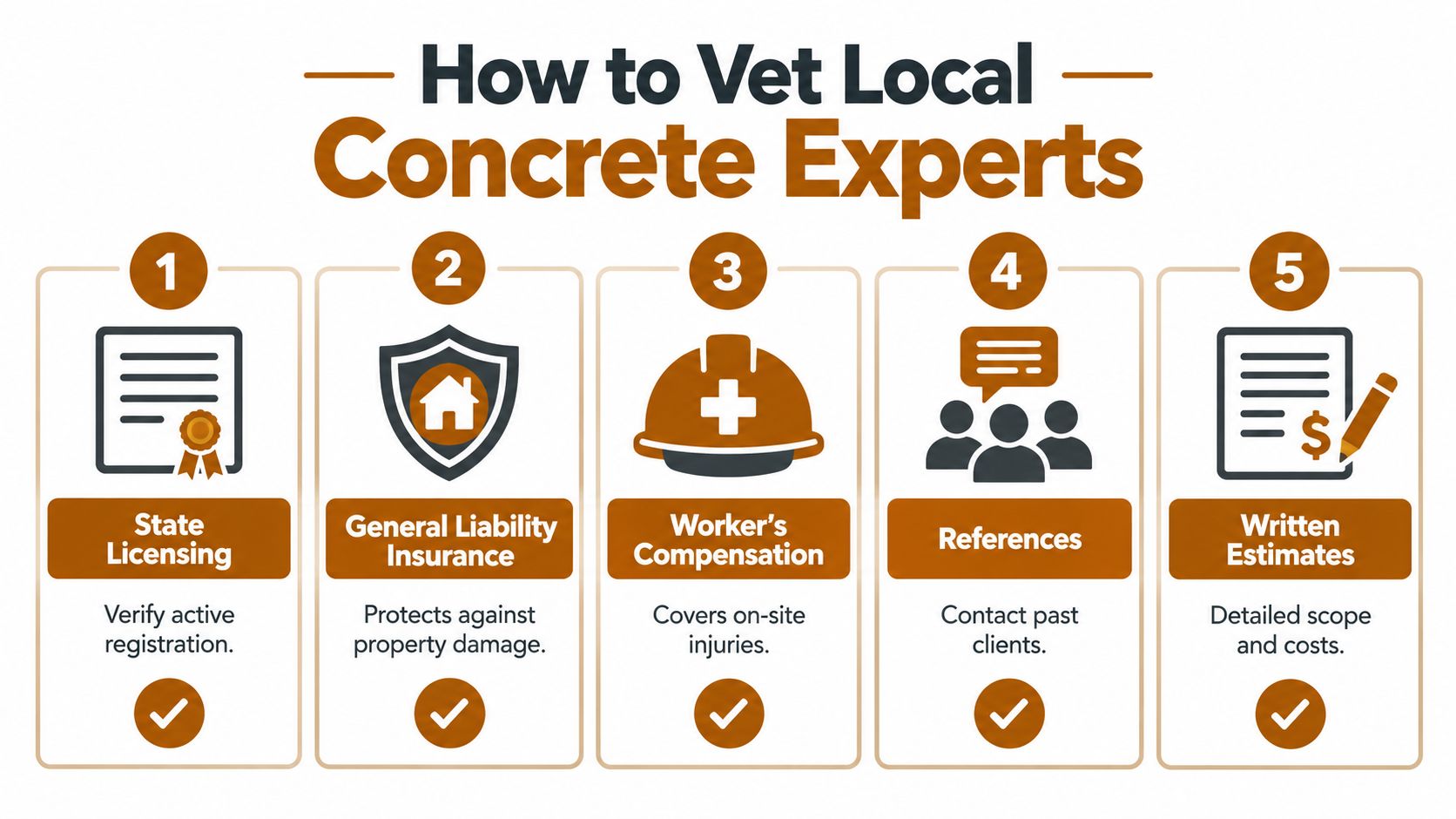
Use this order when comparing concrete driveway replacement contractors:
- Verify licensing. Ask for the contractor's Florida license information and confirm that the business performing the work is properly registered for the project.
- Request general liability insurance. This protects against covered property damage connected with the work. Ask for current documentation rather than accepting a verbal assurance.
- Confirm workers' compensation coverage. Concrete demolition and placement involve heavy equipment, saws, forms, and wet material. Workers' compensation coverage addresses on-site employee injuries.
- Check references. Ask for recent driveway projects in areas with similar conditions, then contact past clients. Reviews from Ocala or The Villages can reveal whether the contractor communicates, protects the property, and completes cleanup.
- Demand a written estimate. The document should identify demolition, disposal, base correction, slab details, joints, finish, curing, access, and payment terms.
Local experience matters because Central Florida sites don't behave like uniform building pads. Sandy soils, heavy summer rainfall, swales, roadside ditches, and mature landscaping can change the required preparation from one property to the next. A crew that only discusses the visible slab is missing the job.
Ask who will actually build the driveway
Some companies sell the project and subcontract every phase. That isn't automatically unacceptable, but you should know who handles demolition, excavation, grading, formwork, concrete placement, finishing, and cleanup. Ask whether the same project manager will inspect the base before the pour and who makes decisions if soft spots appear.
Permits and right-of-way questions deserve a direct answer. The contractor should explain what the homeowner must submit, what the company will coordinate, and whether a sidewalk, culvert, apron, or roadside connection changes the scope. Use these questions to ask a concrete contractor before comparing prices.
A reliable local contractor should also provide a realistic schedule instead of promising an immediate start without examining the site. Look for clear communication, documented insurance, dependable scheduling, and workmanship you can inspect in person.
Understanding Cost Drivers and Budgeting
A low quote can hide the work that keeps a Florida driveway stable. Two contractors may measure the same surface yet price different subgrades, drainage corrections, slab thicknesses, and joint plans. Compare the foundation scope before comparing totals.
Price the hidden work first
The main cost drivers are:
- Demolition and disposal: Removing the existing slab involves labor, equipment, hauling, and disposal fees.
- Subgrade correction: Soft spots, settlement, roots, and saturated soil may require excavation and replacement with suitable aggregate. In Florida, heavy rain can expose weak areas that looked firm during a dry inspection.
- Base preparation: Aggregate must be placed and compacted consistently across the full driveway. Spreading stone only where the old concrete was removed leaves weak transitions.
- Thickness and loading: A 4-inch slab is commonly specified for passenger vehicles. Delivery vehicles or light trucks generally warrant at least 5 inches, while repeated heavier loads require project-specific engineering.
- Drainage and grades: Water must move away from the house and avoid ponding along edges. Correcting a low driveway, blocked swale, or poor roadside transition can cost more than a simple replacement.
- Reinforcement and joints: Reinforcement, isolation joints, and control-joint layout affect materials, labor, and the way the slab handles movement. A joint plan should suit the driveway's shape instead of being added after the pour.
- Finish and access: Broom finishing, decorative treatment, restricted access, hand placement, landscaping protection, and difficult haul routes can change the labor plan.
A surface crack does not automatically require full replacement. Widespread settlement, pumping, standing water, exposed roots, or a failing base points to structural work. Ask the contractor to identify the cause, not just describe the visible damage.
Material availability can also affect scheduling and pricing. The USGS cement summary connects residential concrete work with regional cement production, ready-mix suppliers, and delivery networks. In practice, a contractor should explain whether batching capacity, truck access, or delivery timing affects the proposed pour.
Build a budget you can audit
Request a line-item estimate that identifies included and excluded work. It should address demolition, disposal, excavation, base correction, drainage changes, slab details, joints, curing, permits, cleanup, and restoration of disturbed landscaping. It should also state how the contractor will price unexpected soft spots or damaged adjacent concrete.
Do not choose the lowest headline number. Choose the bid with matching scope and clear allowances. This concrete driveway replacement cost guide can help organize questions, but only an on-site inspection can account for your property's actual soil, drainage, access, and loading conditions.
What to Expect During the Replacement Process
A driveway replacement succeeds below the surface first. In Florida heat, a polished finish cannot compensate for unstable subgrade, trapped water, or poorly planned joints. Watch the preparation, not just the pour, because rushed work usually hides in those stages.
Compare the phases before work begins
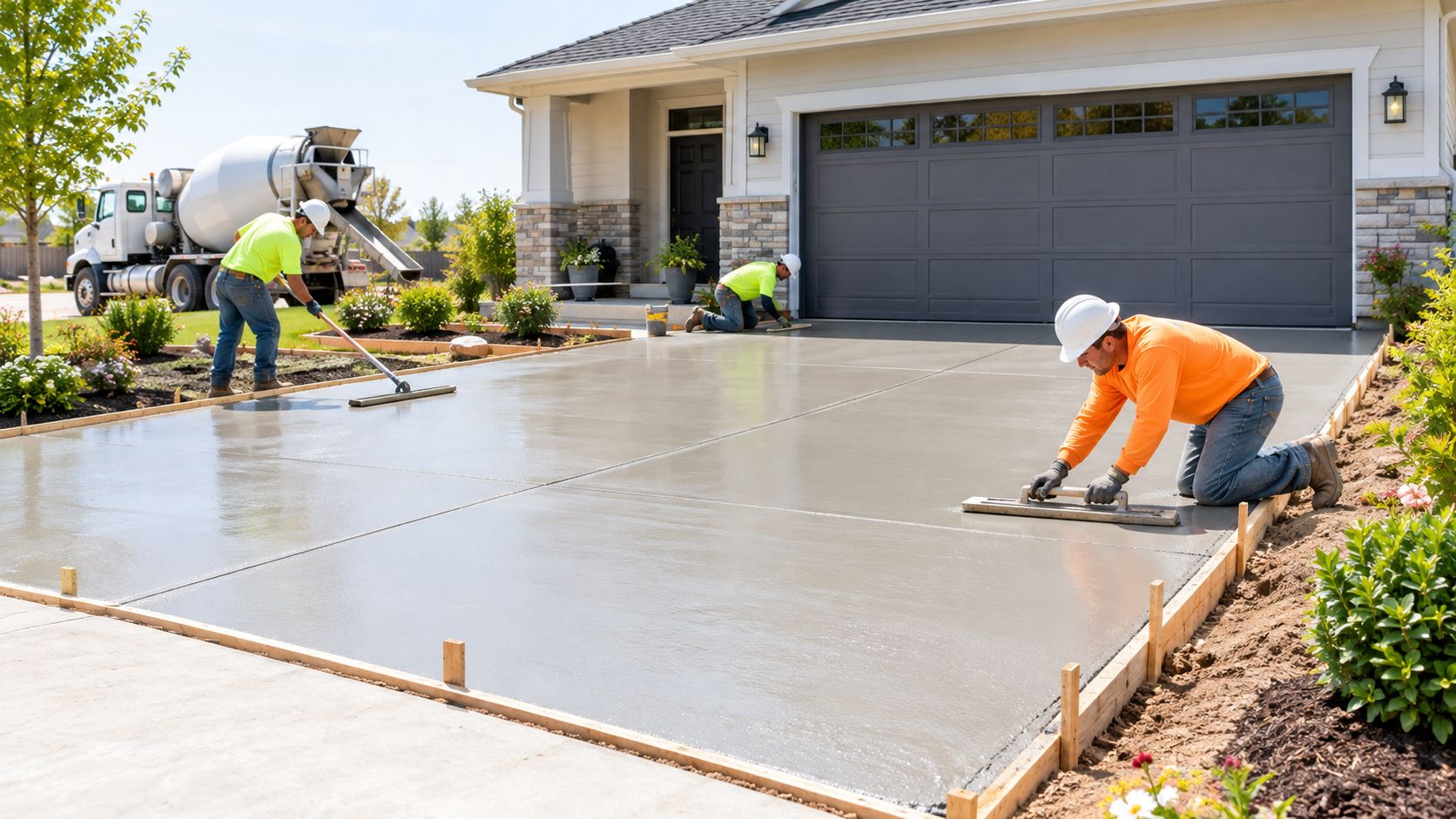
The consultation and measurement should document dimensions, grades, drainage paths, adjacent sidewalks, access limits, and vehicle loads. During demolition, the crew should remove the old concrete and inspect the exposed ground instead of covering questionable soil immediately.
Base correction follows. The contractor should remove unsuitable material, repair soft spots, place aggregate, and compact it evenly. Forms then set the edges and grades. Before concrete arrives, confirm that water will drain away from the home and that connections to sidewalks, curbs, and roads will not create low points.
Joint planning should match the panel layout, not follow a convenient line chosen after placement. Keep panels as square as practical, with a length-to-width ratio no greater than 1.5:1. For the spacing guidance and the roughly 8-foot limit used in this layout, review the driveway and sidewalk design guidance.pdf?hsLang=en). The contractor should also explain the planned sawing window before the pour, since hot weather can narrow the time available to control shrinkage cracking.
Placement is only part of the job
During placement, the crew distributes and consolidates the concrete, strikes it to grade, finishes the surface, and preserves the planned joints. Isolation joints should separate the new slab from fixed structures and continue through the full slab depth.
Curing starts after finishing, once the surface can accept the selected method. Federal Highway Administration guidance describes approximately 7 uninterrupted days of curing for typical concrete-pavement work, with longer periods possible when supplementary cementitious materials are used. Joint sawing commonly begins within 4 to 24 hours, depending on temperature, wind, mix, and setting rate. The FHWA concrete pavement construction guidance explains the technical basis for these practices.
The driveway may look hard before it can carry traffic. Follow the contractor's written curing and reopening plan, and keep vehicles off the slab until that plan allows access.
Here's a useful visual explanation of the work sequence:
Evaluating and Comparing Bids Effectively
Three bids can create false confidence if each contractor measured a different project. A low proposal may omit base excavation, drainage work, disposal, curing, or restoration. A higher proposal may include the preparation that prevents the new slab from repeating the old failure.
Put every proposal on the same footing
Read each estimate line by line and ask these questions:
- What gets removed? Confirm the demolition limits, haul-out, disposal, and treatment of buried debris.
- What happens below grade? The bid should explain base material, compaction, soft-spot correction, and how unexpected conditions will be priced.
- What slab is being proposed? Check thickness, reinforcement, concrete mix, edges, finish, and intended vehicle loading.
- How are joints handled? Look for control-joint spacing, depth, timing, and isolation at the garage, sidewalk, curb, or other fixed structures.
- Who handles water? The proposal should address slope, swales, culverts, drainage connections, and roadway transitions where relevant.
- What does completion mean? Require cleanup, form removal, excess-material disposal, landscaping protection, and final access conditions in writing.
The drainage question deserves more attention than it usually receives. Seminole County's residential driveway permit application illustrates how driveway work can intersect with swales, ditch conveyance, sidewalks, and public right-of-way concerns. Your property may have different rules, but the inspection principle is the same: don't approve a surface-only scope until the entire water path has been considered.
Treat payment terms as part of the bid
A fair proposal identifies the deposit, progress payments, change-order process, and final payment trigger. Avoid vague language such as “repair as needed” without a method for documenting the condition and approving additional work.
Warranty language should also distinguish workmanship from normal concrete behavior. Ask what the warranty covers, what maintenance the owner must perform, and how drainage or third-party damage affects coverage.
The best bid is the clearest one. If you can't tell what the crew will do before the pour, you won't have a fair way to judge the result afterward.
Concrete work isn't the only pavement decision property owners face. For a commercial site, HOA, church, or retail property, coordinate concrete replacement with asphalt sealcoating and parking lot striping when those services are part of the broader maintenance plan.
Selecting Finishes and Ensuring Long-Term Durability
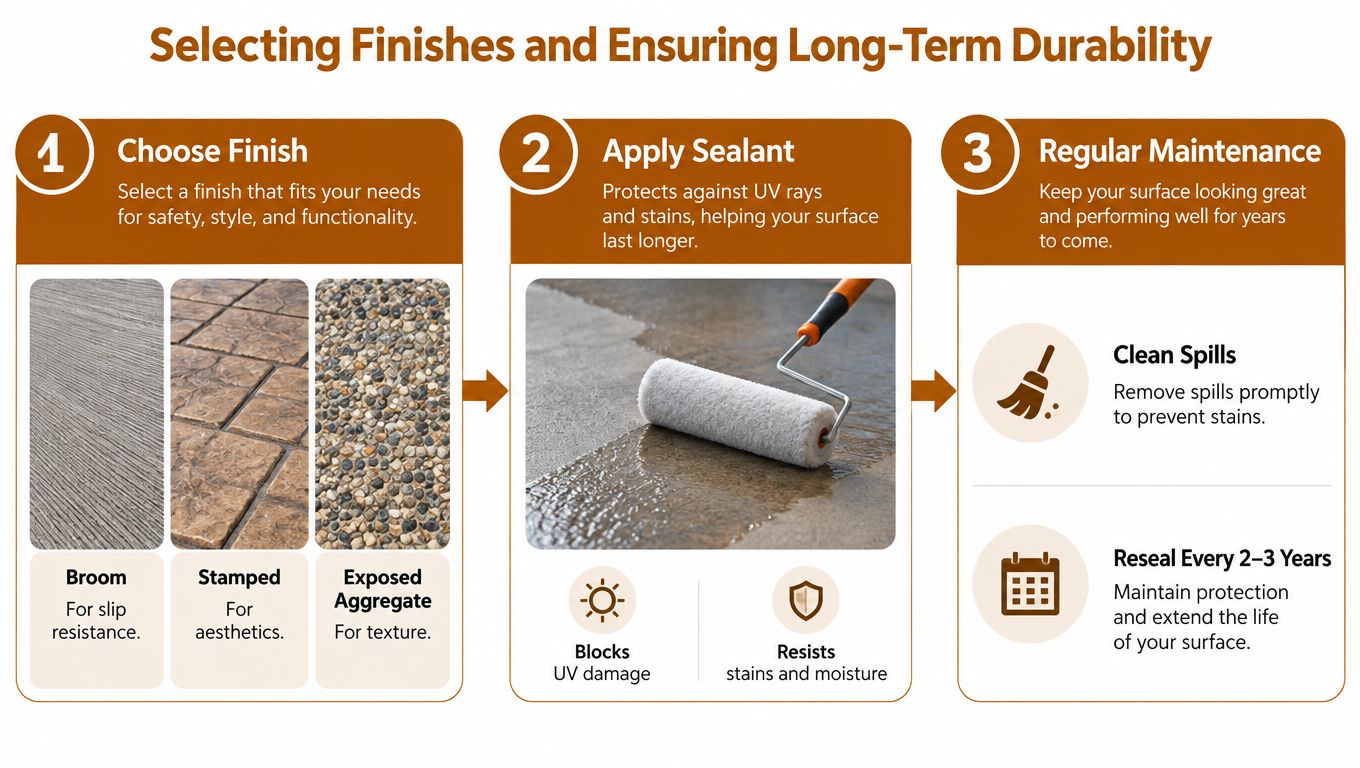
The finish should serve the property, not distract from construction defects. A broom finish provides practical traction and a straightforward appearance. Stamped concrete can complement a home's architecture, while exposed aggregate adds texture and visual interest. None of these finishes can rescue a driveway placed over a weak base or graded toward a foundation.
Match appearance to use
For most homes in Ocala, Crystal River, Inverness, Lecanto, Beverly Hills, Hernando, and nearby communities, I recommend starting with traction, drainage, and vehicle use. Decorative work comes after those decisions.
A finish comparison looks like this:
| Finish | Practical strength | Best fit |
|---|---|---|
| Broom finish | Textured and practical for everyday foot and vehicle traffic | Primary driveways and sloped approaches |
| Stamped finish | Decorative pattern with more finishing complexity | Homes where appearance is a major design priority |
| Exposed aggregate | Textured surface with a distinct visual character | Entries, walkways, and coordinated outdoor spaces |
Edges need attention as well. Water flowing along an unsupported edge can wash out material, while landscaping that traps moisture against the slab can keep the perimeter damp. Keep irrigation heads from spraying directly onto the driveway, maintain a visible edge where possible, and make sure new soil or mulch doesn't block drainage.
Protect the work after the crew leaves
Central Florida brings intense sun, heat, heavy rainfall, and frequent vehicle use. The concrete's service life depends on the installation, but it also depends on how owners manage spills, runoff, landscaping, and traffic after placement.
Clean oil and other spills promptly using products suitable for concrete. Don't use harsh deicers that your property doesn't need, and don't allow concentrated roof or irrigation discharge to erode the edges. Ask the contractor whether a sealer suits the selected finish and mix, how the surface should be cleaned, and when resealing is appropriate.
Concrete's environmental scale reinforces the value of accurate quantities and durable work. Modern concrete has a history extending more than 2,000 years, while Joseph Aspdin patented Portland cement in 1824. Today, more than 4 billion tonnes of cement are used worldwide each year, and cement production generates approximately 2.5 billion tonnes of carbon dioxide annually, equivalent to about 8% of global emissions, as explained by the Science Museum's history of concrete. A well-planned replacement reduces avoidable waste by getting the quantities, demolition limits, and installation details right the first time.
Accessible parking requires another level of precision. Accessible parking spaces and access aisles must be level, with a maximum slope of 1:48 in all directions, approximately 2.08%, and each aisle must connect to an accessible route under the ADA Title II guidance. That matters for HOA common areas, churches, schools, commercial properties, and driveway approaches connected to designated accessible parking. Measure the space, aisle, curb ramp, and pedestrian route before demolition, then coordinate concrete grades with striping and markings.
Riverside Sealing & Striping, LLC provides concrete driveway demolition and replacement, along with new driveways, patios, slabs, and sidewalks, while also handling asphalt maintenance and parking lot striping for Central Florida properties.
Riverside Sealing & Striping, LLC offers concrete driveway evaluation, demolition, site preparation, replacement, and professional finishing for homeowners in Marion County, FL and Citrus County, FL. Request a free, no-pressure on-site consultation through Riverside Sealing & Striping, LLC to discuss drainage, subgrade stability, joints, finish options, and a clear replacement estimate.