
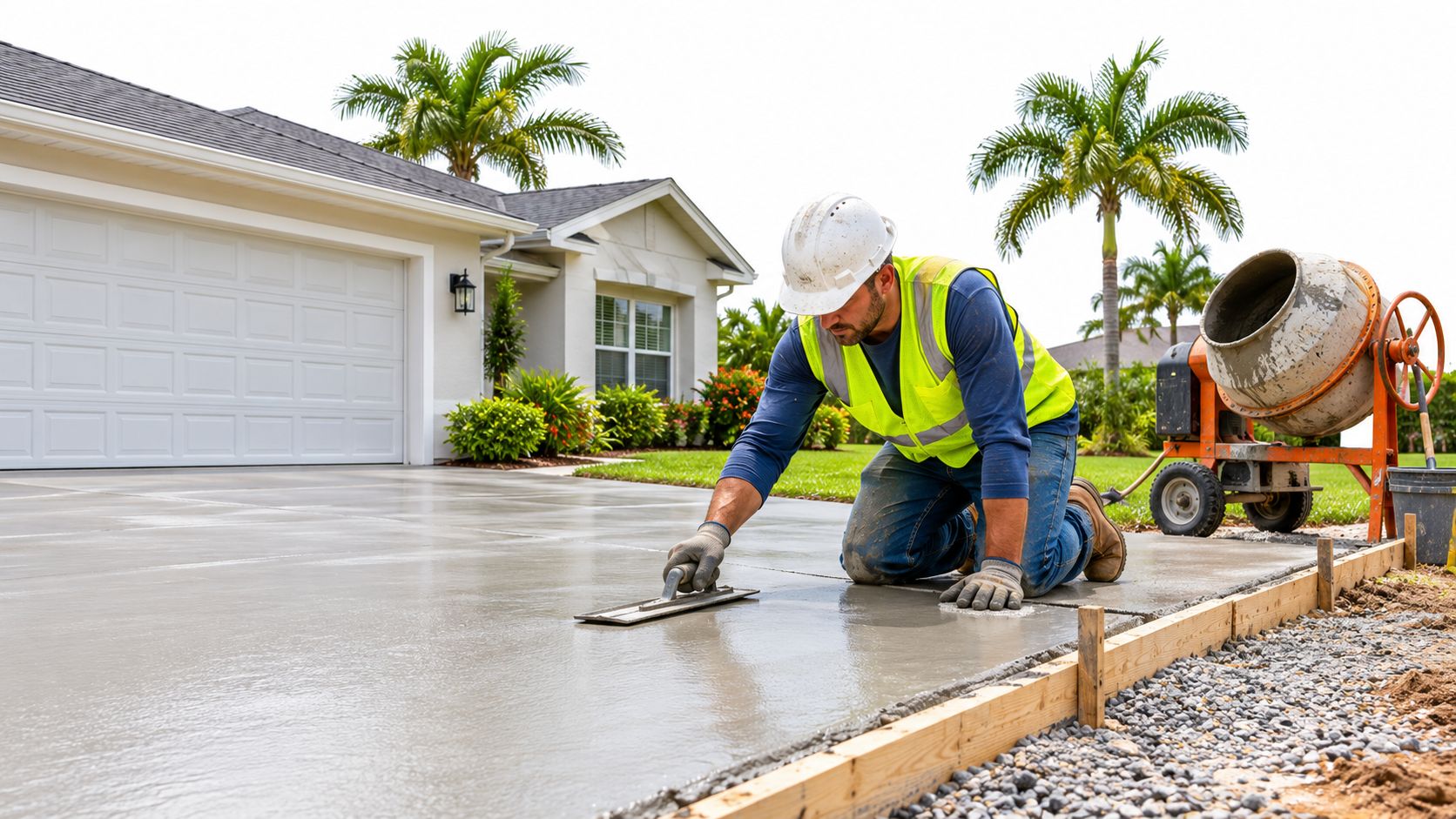
You're probably searching for concrete driveway replacement near me after another Central Florida storm left standing water beside the garage, exposed a widening crack, or made the driveway transition uncomfortable to drive over. In Ocala, Dunnellon, Belleview, Summerfield, and The Villages, the visible damage is often only part of the problem. Flat lots, intense sun, sudden rain, tree roots, and weak spots beneath the slab can all contribute to failure.
The right replacement isn't a new layer of concrete. It's a pavement system that must handle drainage, soil movement, vehicle loads, joint movement, curing, and the connection between your private driveway and the public road. The same concerns apply across Marion County, FL and Citrus County, FL, including Silver Springs, Crystal River, Homosassa, Inverness, Lecanto, Beverly Hills, and Hernando.
Table of Contents
- Deciding if Your Concrete Driveway Needs Replacement
- The Step-by-Step Concrete Driveway Replacement Process
- Managing Florida Drainage and Local Permits
- DIY Versus Hiring a Local Concrete and Asphalt Contractor
- How to Choose the Right Local Contractor
- Frequently Asked Questions
- Planning Your Driveway Upgrade for Lasting Results
Deciding if Your Concrete Driveway Needs Replacement
A homeowner in Ocala recently faced a familiar decision. The driveway had started with a few cracks near the street, then developed a raised section beside a mature tree. After heavy rain, water collected near the garage, and one vehicle wheel dropped noticeably when crossing the settled area. A surface patch might have improved the appearance temporarily, but it wouldn't have corrected the movement below the slab.
That distinction matters. A driveway is a structural system made up of the concrete, joints, base, subgrade, drainage, and surrounding transitions. If the support beneath it has settled or shifted, repairing only the visible crack leaves the original failure mechanism in place.
Signs that repair may not be enough
Look across the entire driveway rather than focusing on one damaged spot. Replacement becomes more reasonable when several of these conditions appear together:
- Widespread interconnected cracking: A network of cracks across multiple panels suggests broader structural distress rather than one isolated defect.
- Settlement near the garage or street: Low sections can collect water and create uncomfortable or unsafe transitions.
- Tree-root heaving: Roots can lift panels, push edges out of alignment, and continue moving after a cosmetic repair.
- Broken edges: Crumbling edges often allow water to reach and weaken the supporting material.
- Repeated patch failure: If the same areas keep cracking after repairs, the slab or base may be unsuitable for another surface treatment.
- Drainage-related damage: Water flowing toward the home, sitting along the driveway, or washing out the edge can shorten the life of a replacement.
The Federal Highway Administration documents concrete pavements with original service lives exceeding 40 years, while modern long-life concrete pavement practice commonly targets 40 years or more when design and construction are appropriate. That history doesn't mean every residential driveway will last for a fixed period. It shows why the quality of the subgrade, drainage, thickness, reinforcement, joint layout, curing, and loading deserves more attention than age alone. FHWA concrete pavement guidance
Practical rule: Don't approve a replacement until the contractor explains why the old driveway failed and what will change below the new slab.
For a useful look at common cracking causes, review why a driveway cracks. A professional evaluation should distinguish shrinkage cracks, settlement, root movement, edge erosion, drainage damage, and loading-related distress. That diagnosis determines whether limited repair is sensible or whether removal and replacement will provide the more dependable result.
The Step-by-Step Concrete Driveway Replacement Process
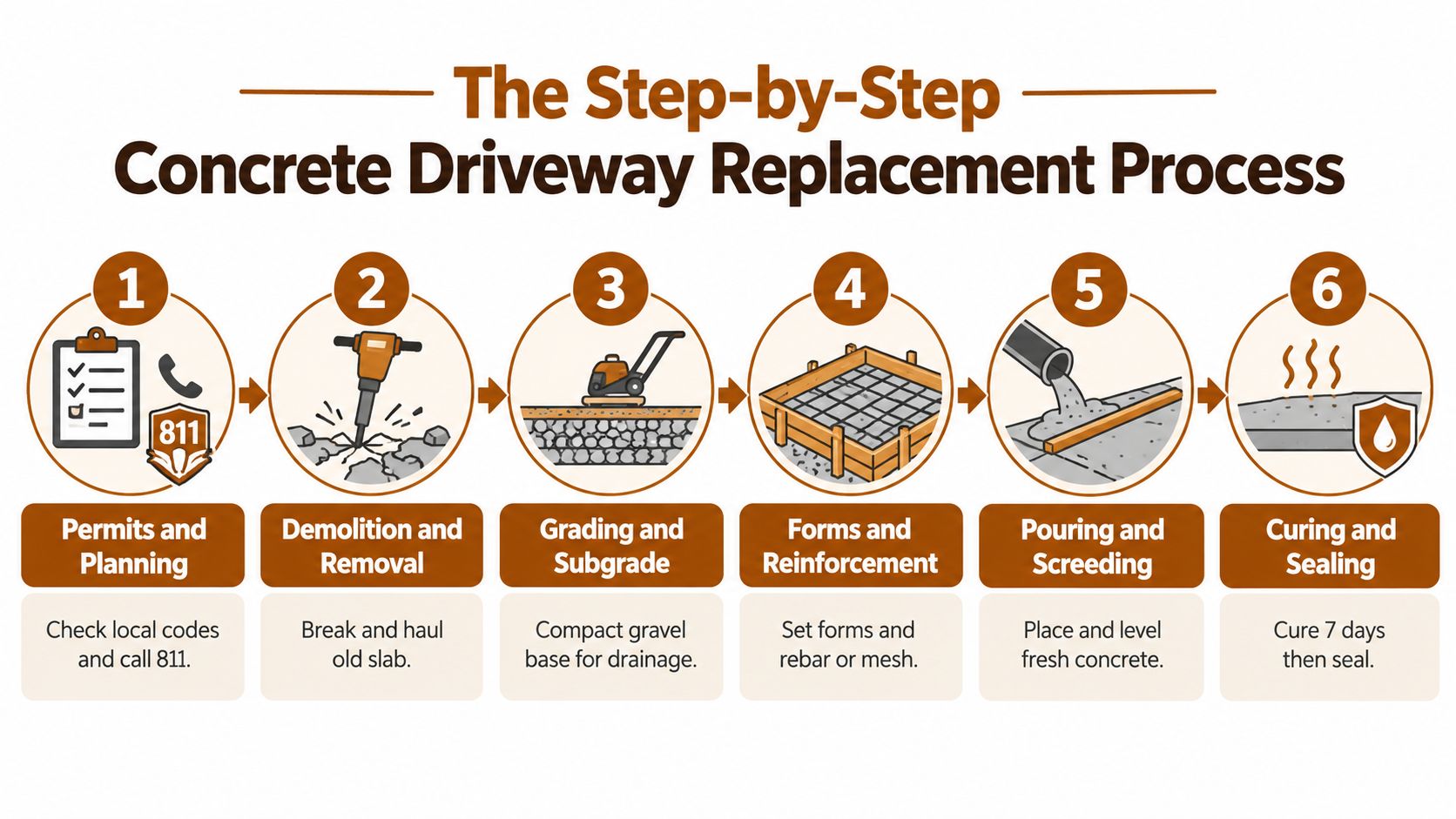
A driveway replacement succeeds when each stage addresses the failure below the surface, not just the visible cracks. In Central Florida, unstable fill, trapped water, and fast moisture loss during hot weather can undermine a new slab before the finish shows any problem. The crew should follow a controlled sequence from site planning through traffic opening.
Plan the site before demolition
Document the existing grades, drainage paths, structures, trees, utility locations, and vehicles that will use the driveway. A driveway serving passenger cars may need a different loading assessment from one used by a heavy pickup, trailer, recreational vehicle, delivery vehicle, or construction machine.
Check whether the work affects a garage threshold, sidewalk, curb, culvert, swale, or roadside apron. On flat lots in Marion and Citrus counties, a small elevation change can redirect runoff toward a garage or leave water beside the slab. Call 811 before excavation where required, and confirm whether local permits apply before removing concrete.
Remove the failed system
Demolition involves more than breaking the old surface. Remove the slab and unsuitable base material, haul the debris responsibly, and expose the subgrade for inspection. Once the pavement is gone, the crew can find soft areas, wet pockets, voids, and poorly compacted fill that were hidden beneath the driveway.
Leaving unstable material in place transfers the old failure into the replacement. The new concrete may look straight on installation day and settle later.
Prepare and compact the subgrade
Shape the exposed soil to the planned slope, proof-roll it, and compact it. Proof-rolling can reveal yielding areas that a visual inspection misses. Correct those locations before placing aggregate.
Place a uniformly graded aggregate base and compact it in a controlled manner. The base provides a consistent platform, supports drainage, and distributes vehicle loads. It cannot correct a site that is poorly graded or holds water beside the driveway. The soil condition and drainage plan must work together.
Set forms and reinforcement
Forms establish the driveway's lines, finished elevation, width, and slope. Reinforcement specified for the project should be supported at its intended position, not left on the ground where it contributes less to slab performance.
Joint planning belongs at this stage. For a typical 4- to 5-inch driveway slab, contraction joints should be spaced at approximately the slab width, with panels kept close to square. Length-to-width ratios above 1.5:1 are more crack-prone. Joints should extend at least one-quarter of slab thickness, roughly 1.0 to 1.25 inches for those slab depths. Drives wider than 10 to 12 feet generally need a longitudinal center joint. These are benchmark guidelines, not a replacement for site-specific design. Concrete joint guidance from the American Cement Association
Place, consolidate, and finish the concrete
Place the concrete within the forms, consolidate it without overworking the surface, and use a screed to establish the plane. Finish selection should match driveway use. A broom texture usually provides practical traction after rain. Finishing over bleed water can weaken the surface and contribute to dusting or scaling.
Cut contraction joints after bleed water has disappeared and the slab can support the cutting operation. Late, shallow, offset, or discontinuous cuts leave the concrete more likely to crack randomly.
The concrete driveway installation process includes further detail on site preparation, placement, joint work, and finishing.
Cure before opening to traffic
Curing starts before the surface appears dry. FHWA guidance identifies moisture retention and temperature control as important to concrete strength development. Common methods include a compliant curing compound, wet coverings, fogging, or plastic sheeting. A typical pavement curing period is 7 days, with the surface kept moist or protected from evaporation during that time. FHWA curing guidance
Central Florida heat, wind, and direct sun can remove moisture quickly, especially from exposed driveway edges. The contractor should record delivery time, concrete temperature, weather, placement thickness, joint-cut timing, curing start time, curing method, and the agreed traffic-opening criterion. Do not open the driveway based only on a dry-looking surface. Follow the planned curing and traffic instructions.
This video provides a visual overview of driveway replacement work:
Managing Florida Drainage and Local Permits
In Central Florida, a driveway can fail even when the concrete mix and finish look acceptable. Flat lots leave less natural fall for runoff, and a replacement can change where water travels by altering the finished elevation, edge, slope, or connection to the road.
A new slab may direct water toward a garage, interrupt a roadside swale, cover a culvert opening, or push runoff toward a neighboring property. Those changes create both performance and compliance concerns. Water that repeatedly saturates the base can contribute to settlement, joint deterioration, edge damage, and cracking.
Check the road connection first
Before demolition, identify who maintains the road. It may be a county, city, or state route, and the public connection may be governed separately from the private slab. Photograph the existing apron, culvert, swale, shoulder, and drainage path. Ask the contractor to show the proposed finished elevation and explain where runoff will go.
Florida transportation guidance states that new or modified driveways associated with new or expanded development must be permitted under Rule 14-96, F.A.C. Florida Department of Transportation driveway guidance
Local rules can apply to ordinary residential work as well. Sumter County requires a permit for installing a driveway, changing an existing driveway's surface, or widening its street connection. Lake County requires residential driveway permits for new residential structures and accessory dwellings and sets standards for connections within the county right-of-way.
Questions to ask before work begins
A permit question isn't limited to, “Can I replace my slab?” Ask who is responsible for the apron, culvert, swale, elevation, inspections, and restoration of disturbed areas.
- Road ownership: Is the connection on a county-, city-, or state-maintained road?
- Right-of-way limits: Does the planned work extend beyond the private property line?
- Drainage continuity: Will the replacement preserve the existing swale or alter its flow?
- Finished elevation: How will the new slab meet the garage, sidewalk, street, and lawn?
- Inspection responsibility: Who schedules required inspections and keeps the permit documentation?
A visually attractive driveway that blocks a swale or sends runoff toward the home is not a successful replacement. In Marion County, FL and Citrus County, FL, drainage planning belongs in the initial site assessment, not as an afterthought after forms are already set.
DIY Versus Hiring a Local Concrete and Asphalt Contractor
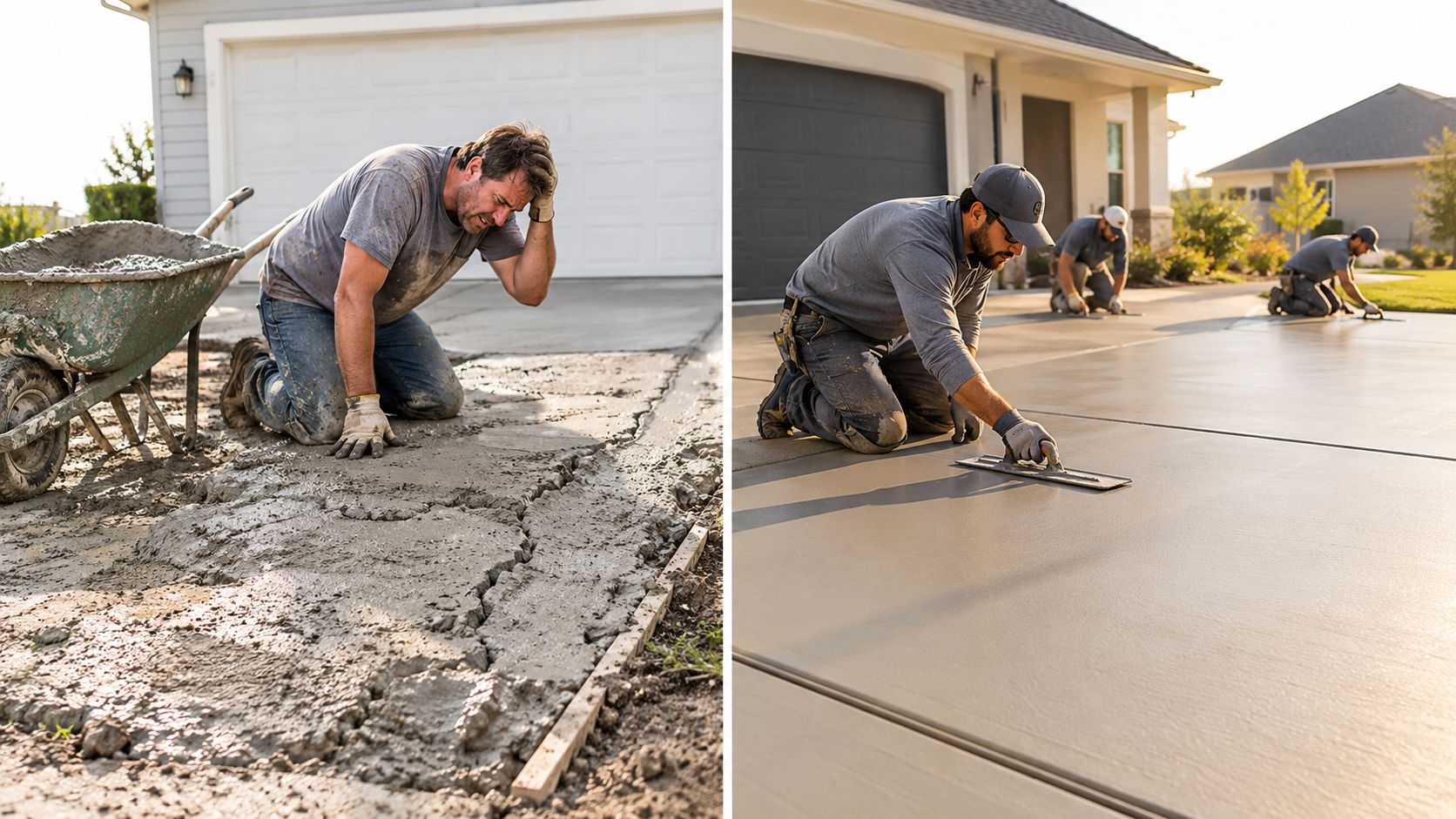
A small concrete repair can sometimes suit an experienced homeowner. Full driveway replacement is different. The slab must be removed, the base must be corrected, forms must hold their position, concrete must arrive and be placed within its working window, joints must be cut at the right time, and curing must begin before the surface dries.
DIY work may appear less expensive because the homeowner supplies the labor. That apparent saving can disappear if the subgrade remains soft, the slope is wrong, the concrete truck arrives before the site is ready, or the surface is finished while bleed water remains.
Where professional work earns its place
A local crew brings equipment and coordination that are difficult to replicate with hand tools. That can include demolition equipment, grading tools, compaction equipment, forms, finishing tools, saw-cutting equipment, and curing materials. An experienced contractor can connect the visible failure to the drainage, base, soil, loading, and joint decisions below it.
Central Florida heat adds another risk. If the crew doesn't plan placement time, shade, wind exposure, curing coverage, and joint-cut timing, the surface may dry faster than expected. The contractor should also understand that a driveway serving an occasional passenger vehicle isn't loaded the same way as one used by trailers, work trucks, or recreational vehicles.
The least expensive bid isn't a bargain if it leaves the original failure mechanism beneath a new slab.
Hiring one local concrete and asphalt contractor can also simplify related property work. A company that handles concrete replacement may also coordinate asphalt sealcoating for another surface on the property or parking lot striping for a commercial site. Those are separate scopes, but one point of contact can make scheduling and site coordination easier.
Before signing, use this list of questions to ask a concrete contractor. Ask for a written scope covering demolition, base preparation, thickness, reinforcement, joints, curing, drainage, permits, traffic opening, cleanup, and warranty terms.
How to Choose the Right Local Contractor
Search results for “concrete driveway replacement near me” can produce a long list of companies. A short list is useful only if you know how to separate a real site assessment from a quick sales quote.
Start with licensing and insurance documentation. Then look for local Central Florida experience, reliable scheduling, clear timelines, and high-quality workmanship. A contractor working in Ocala may face different site details from one working near Crystal River, but both should be able to discuss wet subgrades, flat-lot drainage, heat exposure, and road connections.
Use the site visit as a technical interview
Don't judge the contractor only by the appearance of the finished driveway. Pay attention to what they inspect and what they ask you.
- Failure diagnosis: Do they identify settlement, roots, drainage, base failure, loading, or joint problems instead of recommending demolition?
- Subgrade plan: Do they explain proof-rolling, unsuitable soil removal, aggregate placement, and compaction?
- Joint layout: Do they show where contraction and isolation joints will go?
- Curing method: Do they identify the curing product or protection method and explain when it will begin?
- Drainage details: Do they examine the swale, apron, culvert, garage transition, and street connection?
- Loading assumptions: Do they ask whether the driveway will serve trailers, heavy pickups, recreational vehicles, or equipment?
A trustworthy contractor won't promise a fixed lifespan without knowing the site. They should explain which decisions affect durability and where local conditions introduce uncertainty.
Compare written scopes, not just totals
Two proposals may describe “new concrete driveway” while including very different preparation. One may remove unsuitable base and compact new aggregate. Another may demolish the visible slab and pour over whatever soil remains.
The written scope should state the work sequence, project thickness, reinforcement approach, joint plan, curing method, drainage adjustments, permit responsibilities, and cleanup. It should also identify exclusions, such as tree-root removal, culvert repairs, utility relocation, or restoration beyond the driveway edge.
Ask for references relevant to your property type and location. A contractor serving Marion County, FL, Citrus County, FL, and surrounding communities should be comfortable explaining work in places such as Dunnellon, Inverness, Lecanto, Beverly Hills, Hernando, and Homosassa.
Frequently Asked Questions
Is a concrete driveway replacement always better than repair?
No. Repair can be sensible when the slab is stable and the damage is limited to a small area. Replacement usually makes more sense when cracks run across many panels, sections have settled or heaved, edges are breaking away, drainage has weakened the base, or earlier repairs continue to fail.
Start with the support system, not the surface appearance. A new topping or patch cannot correct unstable soil, root movement, or water flowing beneath the slab. On flat lots in Marion and Citrus counties, drainage problems can be easy to miss until heavy rain exposes them.
How long should a new concrete driveway cure before traffic?
A typical curing period is 7 days, but the contractor should set opening requirements for the actual project instead of relying only on the calendar. FHWA repair and curing guidance emphasizes retaining moisture and controlling temperature during curing. FHWA repair and curing guidance
Florida heat and direct sun can dry the surface quickly, while afternoon storms can disturb fresh concrete. Ask when foot traffic is acceptable, when passenger vehicles may return, and whether heavier vehicles require more time or a strength-based approval.
Should a driveway have control joints?
Yes. Properly placed contraction joints give shrinkage cracking a planned location. For typical 4- to 5-inch driveway slabs, joints should reach at least one-quarter of the slab thickness, with panels kept close to square. Concrete joint layout guidance
Joint timing matters too. If saw cuts are delayed, random cracks may form before the planned joints can control them. The layout should also account for garage slabs, sidewalks, walls, and other fixed structures.
Can a replacement affect my swale or roadside apron?
Yes. A new driveway can change finished elevation, slope, culvert access, and runoff flow. The risk is higher on Central Florida's flat lots, where a small grade change may send water toward the garage or across the road connection.
Before demolition, confirm the road owner, right-of-way limits, permit requirements, finished elevations, and drainage path. The private driveway and public apron may have different rules and responsible parties.
Does concrete work also make sense for commercial properties?
Concrete can work well for sidewalks, loading areas, equipment pads, accessible routes, and other areas requiring a rigid surface. Commercial planning must also address drainage, pedestrian movement, vehicle loading, striping, and accessibility.
For accessible parking, the 2010 ADA Standards set requirements for space dimensions, access aisles, slopes, surfaces, and connections to an accessible route. Review the 2010 ADA Standards before restriping or redesigning a commercial parking area.
Planning Your Driveway Upgrade for Lasting Results
A durable driveway starts before the concrete truck arrives. First, determine whether the existing slab has a repairable surface problem or a structural failure. Then identify the cause, whether it's settlement, roots, drainage, poor base preparation, repeated heavy loading, or a combination of factors.
The replacement plan should respond to that cause. If water is the problem, a thicker slab alone won't solve it. If the subgrade is unstable, a decorative finish won't stabilize the driveway. If the driveway serves heavier vehicles, the contractor needs to account for actual loading rather than treating every residential site as identical.
A practical pre-construction checklist
- Walk the full site: Mark cracks, settled panels, heaved sections, ponding, broken edges, and areas where water approaches the home.
- Document existing drainage: Photograph swales, culverts, aprons, sidewalks, garage thresholds, and street connections after rain when possible.
- Confirm the use: Tell the contractor about trailers, work trucks, recreational vehicles, delivery vehicles, and equipment.
- Review the base plan: Ask how unsuitable material will be removed, how the subgrade will be compacted, and how aggregate will be placed.
- Approve the joint layout: Confirm panel proportions, center joints where needed, isolation joints at fixed structures, and cutting timing.
- Put curing in writing: Record the curing method, coverage, start time, and traffic-opening requirements.
- Clarify permits: Establish who checks county, city, state, right-of-way, apron, culvert, and swale requirements.
Concrete construction and asphalt maintenance also belong in the wider property plan. A home may need a new concrete driveway while an HOA, church, shopping center, or commercial property needs asphalt preservation and clear pavement markings. Preventive maintenance works best while asphalt remains in excellent-to-good condition, before water intrusion and structural damage become severe. FHWA notes that crack sealing and related treatments can extend pavement life by approximately 1 to 4 years in suitable conditions, while more surface treatments may extend useful life by about 3 to 7 years. FHWA pavement preservation guidance
The best result comes from matching the material and construction method to the site. Concrete offers a durable, finished surface, but its performance still depends on drainage, support, loading, joints, and curing. In Marion County, FL and Citrus County, FL, that technical preparation is what helps a driveway handle heat, intense rain, daily vehicle use, and the gradual movement of the surrounding ground.
Riverside Sealing & Striping, LLC provides concrete driveway demolition and replacement, new driveway installation, site preparation, finishing, asphalt sealcoating, and parking lot striping across Marion and Citrus counties. Request a free, no-pressure on-site consultation by visiting Riverside Sealing & Striping, LLC to discuss your drainage, replacement, and scheduling needs.