
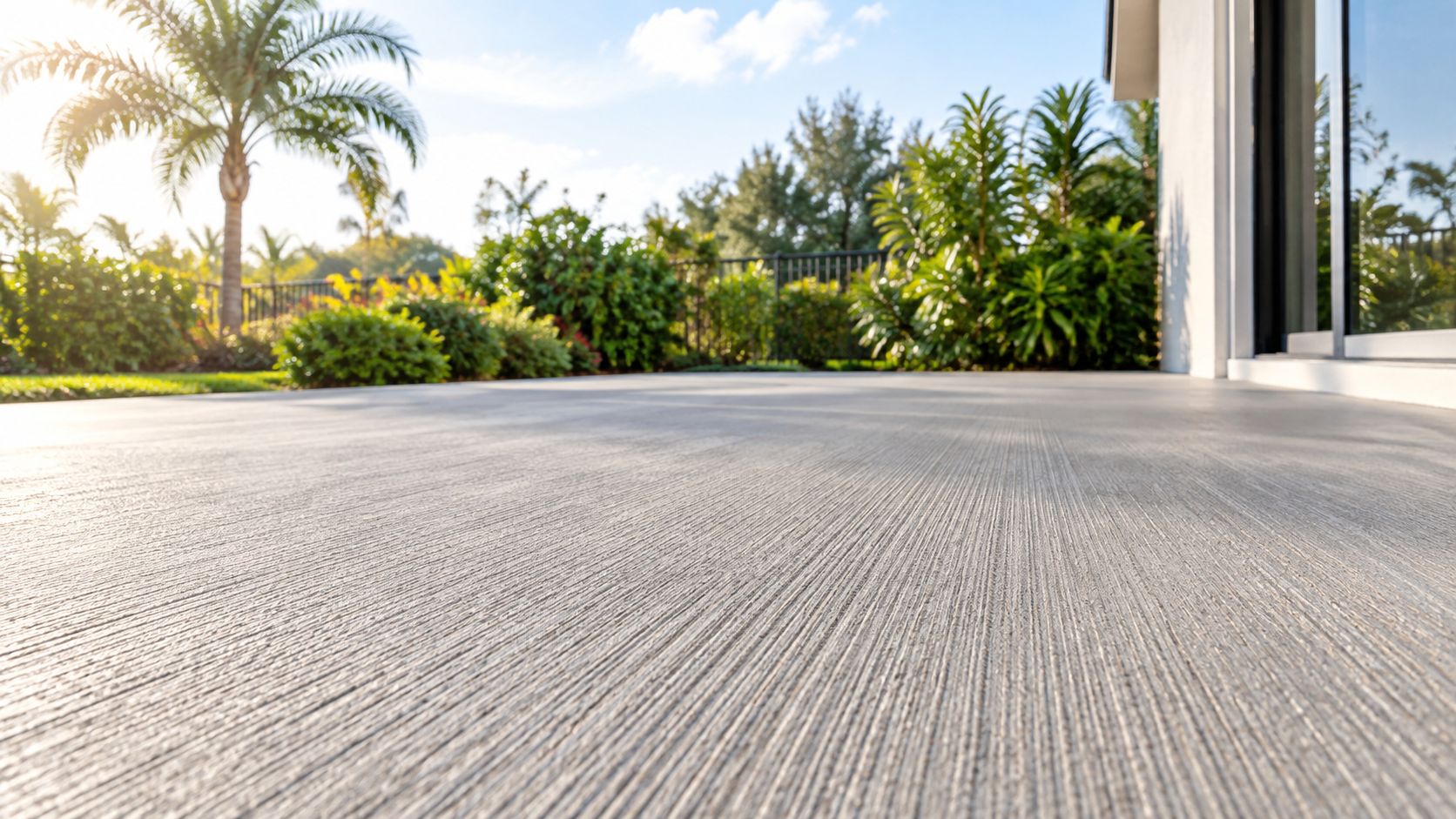
A concrete patio broom finish is the standard high-traction texture for outdoor patios, formed by dragging stiff-bristle brooms over wet concrete to leave a light-to-medium texture about 1/16 to 1/8 inch deep. That shallow ridged surface is what helps a patio stay safer when Florida rain blows in and the slab gets wet.
If you're standing in your backyard in Ocala, Dunnellon, Belleview, or Crystal River wondering whether a smooth slab will be fine, the short answer is usually no. In Central Florida, patios don't just deal with foot traffic. They deal with intense sun, sudden thunderstorms, wet shoes, pool splash, spilled drinks, and long stretches of heat that punish poor finishing decisions.
For homeowners in Marion County, FL and Citrus County, FL, broom finish isn't just a style choice. It's the practical default because it fits the way patios get used, from morning coffee in Summerfield to family cookouts in Homosassa and evening get-togethers in The Villages. The texture is simple, durable, and built for weather that can go from dry and blazing to soaked in half an hour.
Table of Contents
- Why Broom Finish is Essential for Central Florida Patios
- Understanding How the Texture Is Created
- The Safety and Functional Benefits
- Is Broom Finish the Right Choice for Your Patio
- Maintaining Your Finished Concrete Patio
- Cost Factors and When to Hire a Pro
- Frequently Asked Questions
Why Broom Finish is Essential for Central Florida Patios
A patio in Central Florida has to perform every day, not just look good on pour day. In places like Silver Springs, Inverness, and Lecanto, homeowners want an outdoor space they can walk across safely after a thunderstorm without feeling like they're stepping onto a slick floor.

Florida weather exposes the wrong finish fast
A smooth patio can look clean at first. Then summer shows up. Afternoon rain hits a hot slab, water sheets across the surface, and the patio becomes the kind of place where kids run out barefoot and older family members slow down because it doesn't feel secure.
That's why broom finish became the standard for exterior flatwork. Industry guidance for exterior broomed concrete calls for a light-to-medium transverse texture with corrugations between 1/16 and 1/8 inch deep, applied right after floating, because that texture adds traction without the cost or complexity of specialty coatings, as outlined in this broom finish concrete overview.
Practical rule: On an outdoor patio in Florida, traction isn't an upgrade. It's part of the basic job.
What that means on a real backyard patio
On a site walk, this usually comes down to how the patio will be used.
- Morning and evening use: If you step out with coffee at sunrise or host dinner outside after sunset, you'll eventually walk onto the slab with dew, rainwater, or condensation underfoot.
- Storm exposure: In Beverly Hills, Hernando, and Crystal River, a patio may dry hard under the sun, then get soaked again the same afternoon.
- Everyday mess: Sunscreen, grill grease, and tracked-in dirt all make a slick surface worse if the slab was finished too smooth.
A broom finish handles those realities better than a plain slick surface. It also looks appropriate on most homes across Ocala and surrounding neighborhoods because it reads as clean and functional, not overworked.
Understanding How the Texture Is Created
A lot of homeowners think broom finish gets added later like a coating. It doesn't. The texture is made while the slab is still workable, and timing is what separates a clean, durable finish from a rough or weak one.
The texture has to be made in the right window
A broom-finished patio should be textured after the slab loses its surface water sheen and before it gets too hard to hold the pattern. Industry guidance commonly places that window at about 30 to 90 minutes after troweling, with actual timing changing based on temperature, humidity, and mix design, as noted in this broom finish timing reference.
In Florida, that window can move quickly. Heat, sun, and wind can tighten a slab faster than many homeowners expect, especially on open lots around Belleview or on backyards with full afternoon sun in The Villages.
What a good broom finish should look like
The target isn't a harsh, deep rake pattern. The target is a light-to-medium texture that gives grip without making the patio feel abrasive or hard to clean.
Construction guidance for broomed exterior concrete says the texture should be applied immediately after floating, before the paste hardens, with the broom drawn perpendicular to the main traffic route and kept consistent across the panel. The same guidance describes corrugations of about 1/16 to 1/8 inch deep and warns against overly deep brooming in exterior work, as detailed in these construction specifications for broomed concrete.
A contractor who understands concrete finishing techniques will pay attention to more than just the final broom pass. The slab has to be placed, leveled, floated, and watched carefully so the texture lands at the right moment.
Technique matters as much as the material
Three things usually decide whether the finish comes out right:
| Finish detail | What works | What causes problems |
|---|---|---|
| Timing | Broom after the sheen is gone but before the surface hardens | Brooming too late, which leaves weak texture |
| Direction | Keep strokes perpendicular and consistent across the panel | Switching direction mid-panel |
| Depth | Stay light to medium for balance | Going too deep and creating harsh grooves |
If the broom pass is too aggressive, the patio may hold dirt in the grooves and feel rough under bare feet. If it's too light, you lose the reason for choosing broom finish in the first place.
The Safety and Functional Benefits
The biggest reason homeowners choose a concrete patio broom finish is simple. It helps people keep their footing when the slab is wet.
Why traction matters more on patios than people think
Patios collect the exact conditions that create slips. Water from a storm. Pool splash. Condensation. Grill drips. Sunscreen on bare feet. None of that is unusual on a residential patio in Marion County or Citrus County.
Industry safety guidance has long treated broom-finished concrete as one of the highest-traction conventional concrete surfaces, and among smooth-type finishes, broom-finished floors offer the highest level of slip resistance. A widely cited benchmark in slip resistance is ASTM D2047, first approved in 1964, which used a static coefficient of friction of 0.5 or greater as slip-resistant under that test method, according to this industry article on broom finish slip resistance.
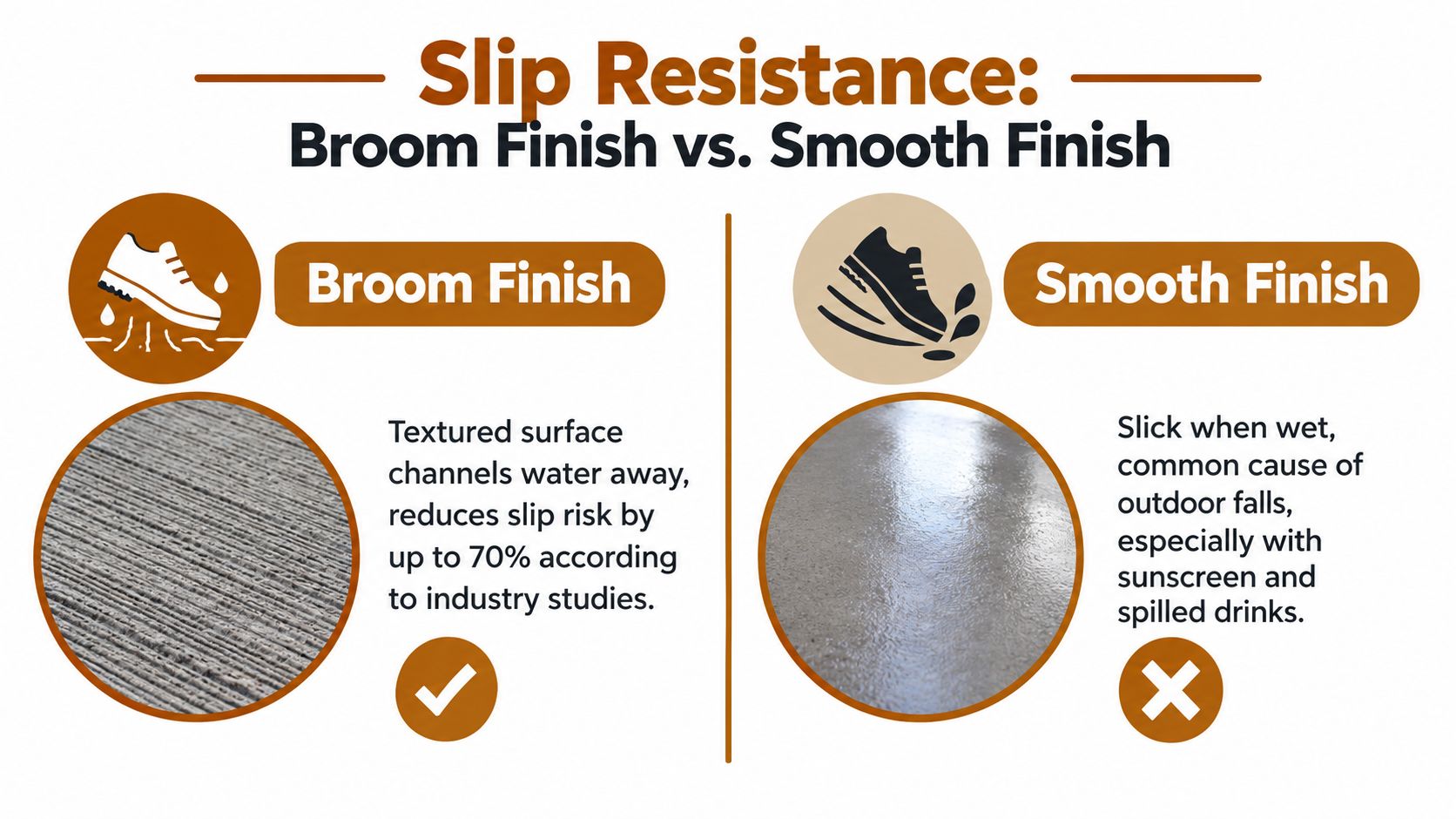
That historical benchmark matters because it explains why broom finish became the baseline choice for outdoor flatwork. It improves footing without relying on a coating that can wear differently over time.
The tradeoff homeowners should know
More texture isn't always better. On a patio, comfort matters too.
Available coverage suggests that light broom surfaces cluster around about 0.5 to 0.6 COF, medium broom around 0.6 to 0.7, and heavy broom around 0.7 to 0.8, while smooth troweled concrete is closer to 0.4 to 0.5. That means heavier brooming can improve wet traction, but it can also feel more abrasive under bare feet and hold more grime in the grooves, as explained in this discussion of slip-resistant concrete texture choices.
For most patios in Homosassa, Inverness, and Summerfield, a light nylon broom texture is often the sweet spot. It gives you usable grip without turning the patio into a rough surface that feels unpleasant around lounge chairs and outdoor seating.
Functional benefits beyond slip resistance
A broom finish also helps in a few practical ways that homeowners appreciate later.
- Everyday appearance: It hides minor finishing variations better than a glass-smooth slab.
- Usability: The patio stays serviceable in changing weather without specialty treatments.
- Straightforward performance: It does its job through texture itself, not through a decorative layer that might change the feel of the surface.
Is Broom Finish the Right Choice for Your Patio
Not every patio needs the same finish. If a homeowner wants a decorative showpiece with patterns and color variation, stamped concrete may make sense. If the goal is a practical slab that handles Florida weather and daily use well, broom finish is usually the more sensible call.
Where broom finish wins
For most residential patios in Central Florida, broom finish lands in the best middle ground.
It gives you traction, a clean look, and a finish that fits almost any home style from ranch homes in Ocala to retirement communities in The Villages. It also tends to look honest. You don't have to baby it the same way you would a more decorative surface that shows every stain or gets slicker when sealed the wrong way.
A lot of homeowners comparing options find it helpful to look through types of concrete finishes for patios before choosing. Once you compare them by function instead of just appearance, broom finish usually rises to the top for outdoor living areas.
Where another finish may fit better
There are cases where another finish makes sense.
- Stamped concrete: Better if appearance is the top priority and you're prepared for more upkeep.
- Smooth decorative finishes: Better for covered areas where wet-slip risk is lower and the design goal is more polished.
- Exposed or specialty textures: Worth considering when a homeowner wants a specific architectural look and accepts the added maintenance questions.
On an uncovered patio in Central Florida, the best-looking finish on day one isn't always the best-performing finish in August.
The practical recommendation
If the patio will see rain, regular foot traffic, bare feet, patio furniture, and normal backyard use, broom finish is the choice that solves the most problems at once. It isn't flashy, but it's dependable. For homeowners in Silver Springs, Beverly Hills, and Lecanto, that's usually the better investment.
Maintaining Your Finished Concrete Patio
A broom finish is durable, but it still needs basic care if you want it to hold up through sun, rain, and regular use. The two most common mistakes are sealing too early and using the wrong kind of sealer.
Wait for the slab to cure
New concrete should generally cure for roughly 28 days before applying most sealers, and it's important not to confuse a curing compound with a sealer. Curing compounds help retain moisture early in the life of the slab, while sealers are applied later to reduce water intrusion, as explained in this concrete curing and sealing FAQ.
If someone seals too soon, they risk trapping moisture or changing the way the patio wears in its first season. In Florida, where slabs can cycle from wet to hot quickly, patience matters.
Choose a sealer that doesn't fight the texture
For broom-finished patios, penetrating siloxane or silane sealers are a strong fit because they protect the surface without changing the texture. Film-forming acrylic sealers can work in some situations, but they may need grit additives and typically bring more maintenance.
That matters because the whole point of a broom finish is functional texture. A sealer shouldn't undo that.
If you want a practical overview of concrete patio maintenance, focus on preserving the surface, not making it glossy.
Simple care that keeps the patio usable
A good maintenance routine doesn't need to be complicated.
- Rinse dirt before it packs in: Florida storms splash soil and organic debris onto patio surfaces. Regular washing keeps grooves cleaner.
- Clean spills promptly: Grill grease, drink spills, and leaf stains are easier to handle early.
- Watch the surface after the first wet season: If water starts soaking in instead of shedding normally, it's time to evaluate resealing.
- Avoid harsh texture-changing products: Anything that leaves a slick film works against the finish.
A broom-finished patio should still feel like concrete underfoot after sealing. If it feels coated, something probably changed the surface more than it should have.
Cost Factors and When to Hire a Pro
Patio pricing isn't driven by finish alone. Broom finish is usually one of the more straightforward exterior finishes, but the total job depends on what has to happen before the concrete is ever poured.
What actually moves the project cost
Homeowners often focus on square footage first, and that's fair, but site conditions matter just as much.
- Site prep: Soft ground, drainage problems, roots, old concrete removal, and grading issues add labor before the pour starts.
- Access: Tight backyards in Ocala neighborhoods or fenced lots in Crystal River can change how crews move material.
- Layout and edges: Curves, steps, and tie-ins to existing slabs increase finish detail work.
- Weather timing: In Florida, crews sometimes have to work around rain windows and high-heat finishing conditions.
Those variables explain why two patios that look similar on paper don't always price the same.
When DIY stops making sense
Small concrete projects tempt a lot of homeowners. The trouble is that broom finish has a narrow working window, and Florida weather makes that window less forgiving.
If the slab gets away from you, you don't just end up with an ugly texture. You can end up with inconsistent traction, weak surface finish, poor drainage, or a patio that feels rough in one area and slick in another.
For homeowners who want to see how a local contractor approaches site work, concrete placement, and outdoor flatwork, Riverside Sealing & Striping, LLC is one option serving Dunnellon, Ocala, Marion County, FL, and Citrus County, FL as Concrete and Asphalt Experts in Marion and Citrus County. The company handles concrete work as well as asphalt sealcoating and parking lot striping, which matters for property owners who need one contractor for multiple exterior surface needs.
A good installer is watching the slab constantly, especially when heat and storm risk are both in play.
What a pro brings that matters long term
Licensed and insured local contractors earn their keep on jobs like this through judgment, not just labor.
| Why hire a pro | Why it matters on a Florida patio |
|---|---|
| Base preparation | Helps reduce settling and uneven support |
| Timing the finish | Keeps the broom texture consistent across the slab |
| Drainage awareness | Prevents standing water and ugly runoff patterns |
| Reliable scheduling | Reduces the chance of rushed work around stormy weather |
This video gives a useful look at the kind of concrete work homeowners often compare when planning a patio project.
Hiring a pro usually makes the most sense when the patio ties into the house, needs proper slope, replaces failed concrete, or has to look consistent with existing walkways or driveways. In places like Dunnellon, Belleview, and Hernando, that local experience often saves money later because mistakes in grade, prep, or finishing are expensive to live with once the slab hardens.
Frequently Asked Questions
Is a broom-finished patio comfortable for bare feet
Usually, yes, if the finish is kept in the light-to-medium range. An overly deep broom texture can feel harsh, which is why patio work should avoid aggressive grooves.
How soon should a new patio be sealed
Most new concrete should cure for roughly 28 days before most sealers are applied. That waiting period helps avoid trapping moisture.
Does broom finish work well in heavy Florida rain
Yes. That's one of the main reasons it's used so often on outdoor flatwork in Central Florida. The texture helps with footing when the surface gets wet.
Does a broom-finished patio need replacement or just repair
That depends on the slab condition. Surface stains or minor wear may be manageable, but significant settlement, drainage failure, or major cracking usually calls for an in-person evaluation.
Can broom-finished concrete still look attractive
Yes. It won't have the decorative impact of stamped concrete, but it gives a clean, durable appearance that fits most homes and hides minor surface variation better than a slick finish.
If you're planning a patio, walkway, driveway, or exterior surface upgrade in Central Florida, Riverside can evaluate the site conditions, explain the right finish for the way you use the space, and provide a free, no-pressure estimate. To learn more about concrete patios, asphalt maintenance, and local exterior surface work in Marion and Citrus County, visit Riverside Sealing & Striping, LLC.