
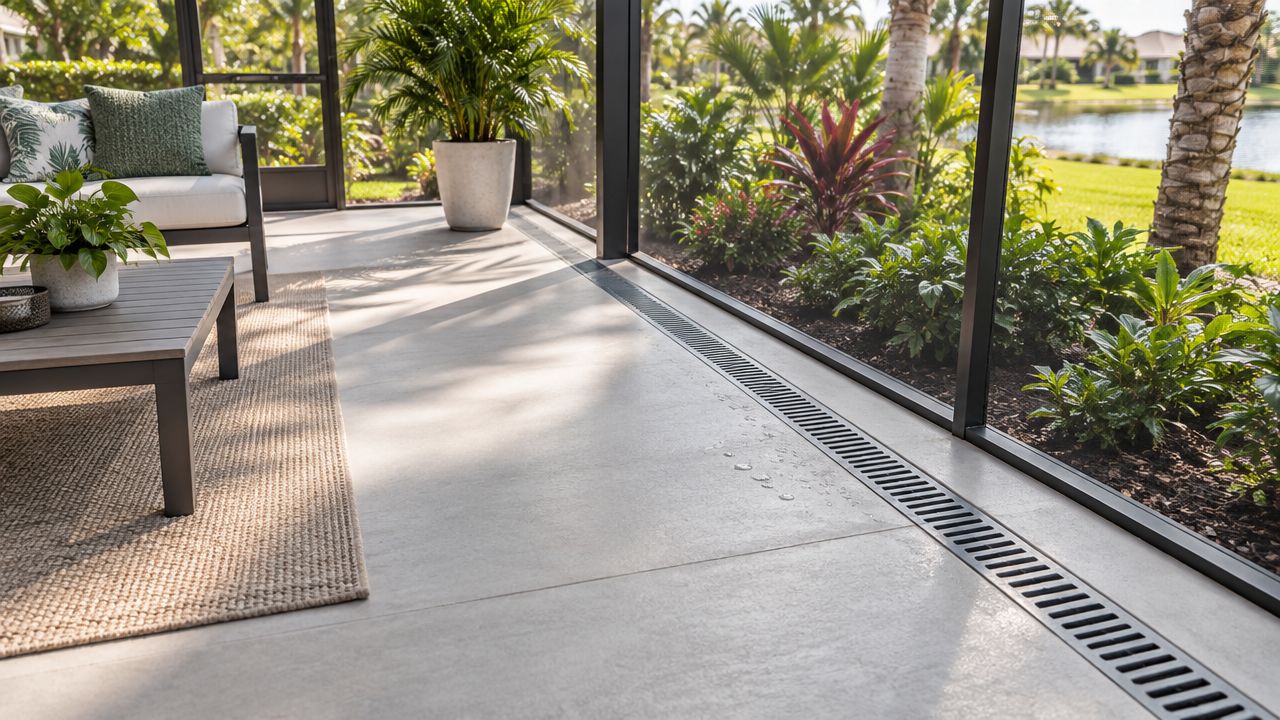
After a Central Florida thunderstorm, a patio can look fine from the yard while water sits beside the sliding door. On a Dunnellon job site, that's often the first clue that the concrete patio drain was chosen before anyone solved the larger drainage problem.
A successful patio drainage plan has three connected parts: the slope on the concrete, the drain that captures runoff, and the outlet that carries water away. That system matters in Marion County, FL, and Citrus County, FL, where intense rain, sandy ground, slab-on-grade construction, landscaping, and low areas can all influence where water collects. Whether your patio is in Ocala, Crystal River, The Villages, or a smaller community nearby, the same principle applies. A drain can't rescue a slab that sends water the wrong way, and a well-sloped patio can still fail if its outlet becomes a buried sump.
Table of Contents
- Why Central Florida Patios Need a Drain in the First Place
- The Slope Rule That Makes or Breaks Patio Drainage
- Channel Drains, Point Drains, and French Drains Compared
- Materials and Grates That Hold Up in Florida Weather
- Siting the Drain and Planning a Real Outlet
- Maintenance, Common Problems, and When to Call a Pro
- Putting It All Together for Your Patio
Why Central Florida Patios Need a Drain in the First Place
A Dunnellon homeowner may notice the problem during an afternoon storm. Water gathers beside the screened enclosure, reaches the slider threshold, and begins creeping toward the block stem wall. The patio may have looked level and usable for years, but one low area now gives runoff a place to stay.
Central Florida patios often sit directly on prepared ground instead of over a basement or raised crawlspace. That slab-on-grade design keeps the finished surface close to the yard, but it also makes the relationship between concrete, soil, and runoff important. Sandy soil can move water quickly through some areas, while compacted fill, organic debris, landscaping, or a high water table can limit how effectively water leaves the patio edge.
The damage doesn't always appear as a dramatic leak. Moisture can leave efflorescence, surface staining, or spalling on the slab. Water moving along an edge can undermine support. Splashback may mark stucco, while damp areas under roof overhangs encourage mildew. Standing water also makes the patio less comfortable and can attract insects.
Drainage is a connected system
Start with the three links:
- Slope: The concrete needs a deliberate fall toward a safe collection point.
- Drain: A channel drain, point drain, or another collector must intercept water where it travels.
- Outlet: The collected water needs a functioning path to daylight, a dry well, or an approved storm connection.
A French drain may help with groundwater or a wet lawn border, but it isn't automatically a replacement for surface drainage. Likewise, a grate beside the patio won't help if the slab falls away from it.
Job-site rule: Solve where the water starts, where it concentrates, and where it can legally and safely finish.
That approach works for a covered patio in Summerfield, a pool deck near Homosassa, or a slab behind a home in Inverness. It also helps homeowners in Belleview, Silver Springs, Lecanto, Beverly Hills, Hernando, and surrounding Central Florida areas avoid buying a drain type based only on how it looks in a product photo.
The Slope Rule That Makes or Breaks Patio Drainage
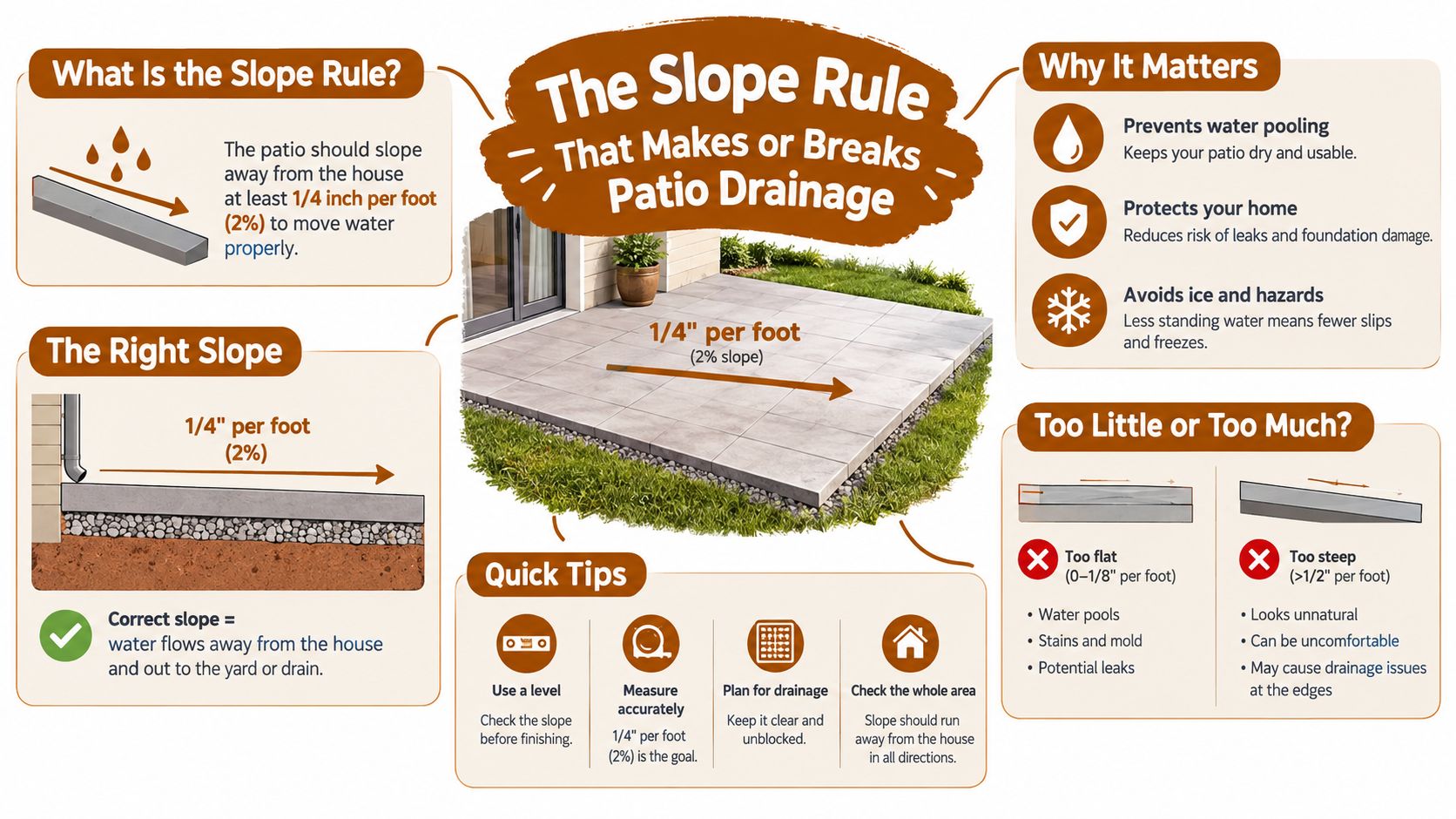
A concrete patio needs a slope that looks subtle but moves water consistently. A widely used exterior concrete benchmark is 1/4 inch of fall per foot, equal to a 2% grade, away from the structure. Concrete industry guidance uses this magnitude because it supports runoff without making the walking surface feel excessively steep, although localized birdbaths can still develop from construction tolerances and normal surface irregularities over time. Concrete industry guidance on exterior slab drainage
The calculation is straightforward. A 12-foot-wide slab falling toward one edge needs 3 inches of total fall, using that benchmark. A 16-foot patio draining toward a center point would drop 2 inches from each side to the center drain, creating the same overall drainage logic while concentrating runoff at the middle. The exact layout still depends on doors, walls, landscaping, and the available outlet.
Slope is not the same as a steep pitch
Homeowners sometimes hear “slope” and picture a visibly angled surface. In practice, a properly formed patio can appear almost flat while still directing water. The crew builds the fall into the forms and base preparation. They shouldn't pour a flat slab and hope the finishing crew can taper the surface near the outer edge.
That shortcut often creates a puddle zone beside the threshold. The outside edge may look lower, but water still sits close to the home because the main field of the slab doesn't lead it away. Sandy sub-bases may settle differently from clay-heavy ground, yet they still need proper preparation and deliberate formwork.
For a broader explanation of how a patio can be designed around changing elevations, review this guide to a concrete patio on a slope.
Check the low area before choosing a drain
You can learn a great deal before excavation begins:
- Place a 6-foot level in several directions, especially near the house, doorway, and outer edge.
- Mark any area where the bubble shows a reverse fall or where the slab changes direction.
- Pour water from a hose in a controlled stream and watch where it travels.
- Note whether water reaches an edge, collects at a corner, or turns back toward the threshold.
A hose test doesn't replace a site evaluation, but it can reveal why a small grate in the wrong location won't solve the problem. The drain should follow the water path, not the other way around.
Channel Drains, Point Drains, and French Drains Compared
The right concrete patio drain depends on how water moves across the slab. A channel drain handles a broad sheet of runoff. A point drain collects water at a concentrated low spot. A French drain works below the surface, where groundwater or wet soil needs another path.
Compare the three drain families
| Drain Type | Best Fit On a Patio | Florida Strengths and Limits |
|---|---|---|
| Channel drain | Along a slab edge, across a doorway, or at the low side of a broad patio | Captures sheet flow across a wide opening and suits large screened patios and pool decks. It needs accurate setting, regular grate cleaning, and a real outlet. |
| Point drain | At a single low corner or controlled collection basin | Concentrates runoff at one location and can suit a slab designed around one low point. It may struggle if water approaches from several directions without enough fall. |
| French drain | Beside a slab, under a wet border, or where groundwater reaches the patio area | Collects subsurface water through gravel and perforated pipe. It does little for surface water sitting on the finished concrete. |
A channel drain, also called a trench drain, is often the practical choice when a wide screened patio sends water toward the house or along one long edge. Its narrow grate can create a clean transition when it's installed at the finished low point. It also works well around pool decks, where sheet flow may arrive across a broad surface.
A point drain makes more sense when the concrete has been intentionally shaped toward one corner or basin. The grate needs to remain clear of leaves, sand, and lawn debris, particularly around homes in Marion County where landscaping can shed organic material onto the slab.
A French drain belongs in a different part of the plan. It can intercept water moving through the ground beside a freestanding pavilion or soften a wet lawn border, but it can't correct a flat patio surface. Using it as a substitute for proper slope is one of the most common drainage mismatches.
Practical distinction: A channel drain catches water across a line, a point drain catches water at a location, and a French drain catches water below the surface.
The surrounding layout matters as much as the patio size. A home near a low lawn in Citrus County may need a point drain and dry well, while a patio attached to a house in Ocala may need a channel drain near the threshold. The soil, roof runoff, pool deck, and available discharge route should all be considered together.
Materials and Grates That Hold Up in Florida Weather
Drain materials have to tolerate more than rainfall. A Central Florida patio drain may face direct sun, fertilizer splash, lawn chemicals, grit, furniture loads, and repeated cleaning. The best material depends on where the channel sits and what crosses it.
Match the channel to the load
Polymer concrete channels offer a rigid body that resists many common outdoor exposures and stays dimensionally stable through hot weather. They suit permanent patio installations where the channel needs to remain aligned with the slab.
PVC channels can be budget-friendly and easy to handle. Their limitation is flexibility, especially in a long run or where the surrounding concrete doesn't support the channel evenly. The installer must protect the channel during placement and make sure the bedding doesn't leave unsupported sections.
Cast iron channels and grates suit locations that receive heavy point loads, such as a tie-in between a patio and driveway. Cast iron also handles heat well, but the added weight and corrosion considerations affect installation and maintenance.
The grate deserves the same attention as the channel body. A stamped iron grate can suit a busy entry. Galvanized steel may work for moderate use, while plastic can fit a budget-conscious or concealed application. Stainless steel is worth considering on waterfront lots or wherever corrosion resistance carries extra weight.
Consider feet, chemicals, and debris
Grate selection should account for how people use the patio:
- Walkways and doorways: Choose a heel-proof slot pattern that won't catch shoes or create a trip concern.
- Patio furniture areas: Don't assume a plastic grate will tolerate concentrated loads from chair legs, tables, or grills.
- Lawn edges: Expect fertilizer, soil, leaves, and grass clippings to enter the drainage path.
- Driveway connections: Use a grate and channel rated for the traffic that will cross them, not just the rainfall they will collect.
Plastic can crack under loads it wasn't designed to carry. Metal can corrode when lawn chemicals and persistent moisture remain on the surface. The sandy runoff common around Marion County can also carry grit that settles in the channel and reduces its effective opening.
This short video offers a visual look at channel-style drainage components and installation concepts:
A durable installation still needs maintenance. Even a strong grate won't perform if leaves and roof grit form a mat over the inlet.
Siting the Drain and Planning a Real Outlet
Once the slope is established, the drain location becomes a field decision rather than a product decision. Walk the patio during a hose test or after rain and identify the point where water would naturally concentrate. That location may be beside the house, along the low outside edge, or across the slab as a mid-span interceptor.
A channel near a sliding door can protect the threshold when the patio is shaped toward the house. A channel at the low edge can collect water before it reaches the lawn. A wide patio may need an interceptor across the surface if water travels too far before reaching the perimeter.
Set the inlet at the finished elevation
The grate should sit slightly below the surrounding finished surface, not proud of it. A proud grate can become a trip point and may cause water to pass around the inlet. A channel set too low can collect sediment and leave an awkward depression.
Keep cleanout access reachable. The best route underground is the one a contractor can inspect, flush, and repair without dismantling the patio or cutting through an important structural area.
Before digging, identify buried utilities and existing lines. A contractor may use underground utility location services to reduce the risk of placing a trench where irrigation, electrical, or other services already run.
Give the water somewhere to finish
The outlet must connect to a genuine discharge path, such as:
- Daylight discharge: The pipe exits at a lower point on a slope, curb, or approved area where water can flow away.
- Dry well: The system releases water into a below-grade structure designed for the site's soil and groundwater conditions.
- Permitted storm connection: The line connects to an approved stormwater system when local requirements allow it.
- Pop-up emitter: The outlet opens at a suitable surface location when a direct daylight route is not practical, including sites where the nearest visible grade is uphill.
The outlet line still needs continuous fall. A commonly used drainage-pipe minimum is 1% grade, or roughly 1/8 inch per foot, because an inlet can collect water correctly while a poorly sloped outlet line holds it and becomes a bottleneck. Guidance on sloping patio drain outlets
Don't create a sump by sending the pipe uphill and expecting pressure to solve the problem. The patio, drain, pipe, and discharge point form one chain. If one link stops moving water, the whole concrete patio drain system underperforms.
Maintenance, Common Problems, and When to Call a Pro
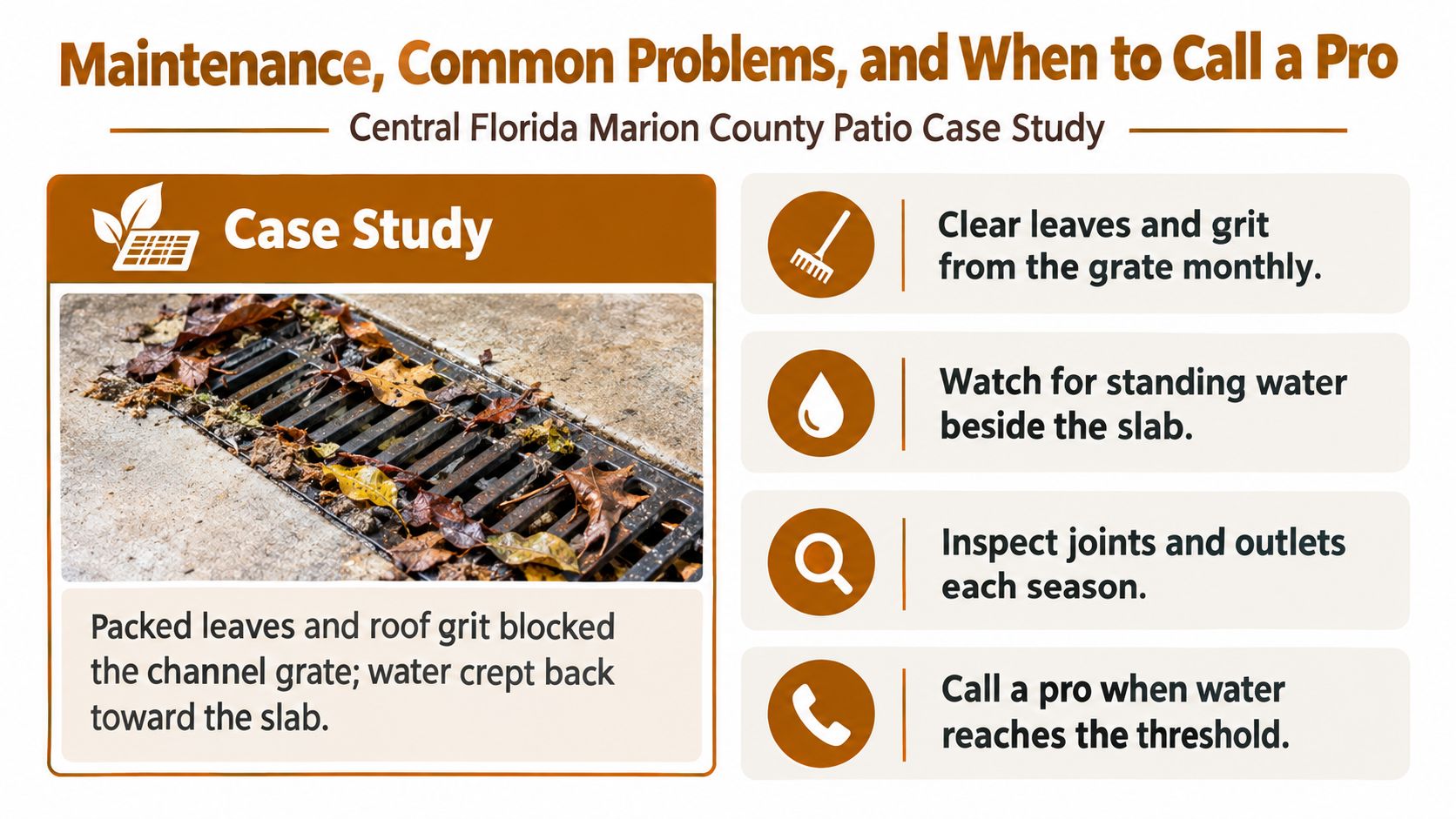
A representative Marion County patio can develop a drainage problem without any obvious failure in the concrete. Leaves and roof grit pack against the channel grate, water slows down, and runoff begins creeping back toward the slab. The homeowner may first notice a green stain on the stucco rather than the blocked inlet.
That situation calls for routine cleaning before a major storm, not just a reaction after water enters the house. Sweep the grate, lift the removable cover when the system allows it, and flush the channel with a hose. Check whether water reaches the outlet and whether the pop-up emitter still rises and closes normally.
A simple seasonal routine
Use the patio's surroundings to set the maintenance habit:
- Before heavy rain: Clear leaves, pine debris, mulch, and roof grit from the grate.
- During a hose test: Watch for slow movement, backflow, or water bypassing the channel.
- At the outlet: Look for sand buildup, roots, broken fittings, or a buried emitter.
- Along the slab: Check joints, edges, stains, and any new area where water remains.
- Around the threshold: Treat any indoor seepage as a reason to arrange a professional evaluation.
A homeowner can usually handle surface cleaning and visual checks. Excavation is different. Once the work involves deep trenching, pipe connections, structural slab edges, permits, or a municipal storm system, the drainage plan needs qualified oversight.
Signs the problem is bigger than a clogged grate
Standing water after a short shower suggests that the surface may have lost its intended fall or that the drain cannot discharge fast enough. Efflorescence lines can indicate persistent moisture movement through the slab. A channel that has settled may no longer have a continuous path, even if the grate looks clean.
The International Residential Code includes a foundation drainage provision requiring surface water to drain away from foundation walls. Common summaries describe a fall of at least 6 inches in the first 10 feet, which equals a 5% slope, a more aggressive benchmark than the typical finished patio recommendation because foundation protection and patio-surface drainage serve different purposes. IRC R401.3 drainage guidance and patio slope discussion
For a damaged or settled patio, maintenance may not be enough. A contractor may need to correct grading, retrofit a channel, repair the outlet, or replace a section of concrete. The right choice depends on whether the failure starts at the surface, below the slab, or at the discharge point.
For ongoing care, a documented concrete patio maintenance plan can help homeowners spot changes before water reaches the home.
Putting It All Together for Your Patio
The most useful way to plan a concrete patio drain is to treat the project as a chain:
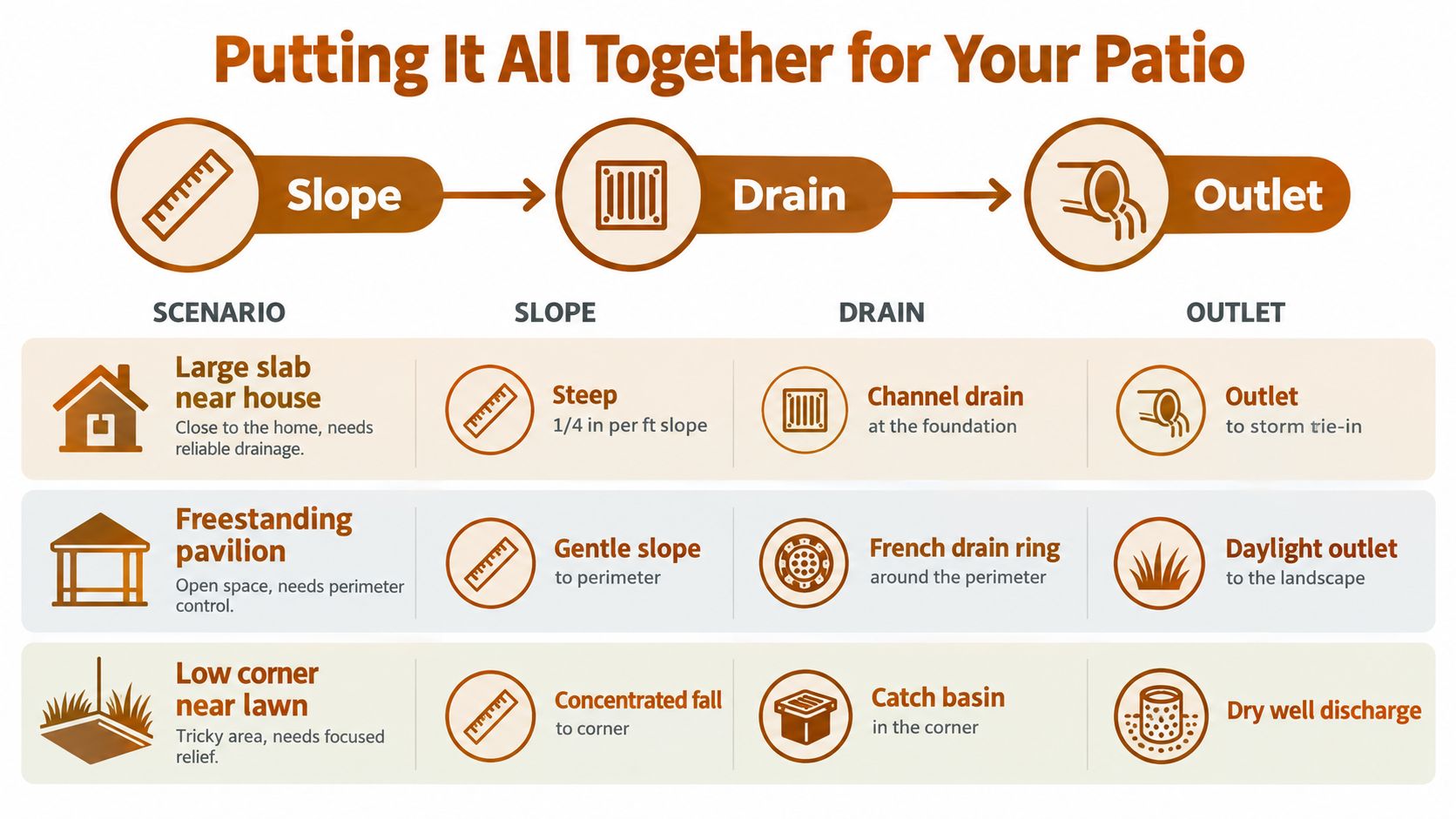
Slope → Drain → Outlet
The slope directs water. The drain captures it. The outlet removes it. Maintenance keeps the openings and pipe route usable.
Match the system to the patio
A large slab near the house may need a deliberate fall away from the structure, a channel drain at a vulnerable foundation or doorway edge, and an outlet connected to an approved storm path. A polymer concrete channel with a heel-proof grate may suit a busy screened entry, provided the pipe can maintain continuous fall.
A freestanding pavilion may not need a drain directly against the home. The slab can direct surface water toward its perimeter, while a French drain ring addresses groundwater or a wet surrounding lawn. That subsurface system still needs a suitable daylight or other discharge route.
A low corner near the lawn may benefit from concentrated fall toward a point drain or catch basin, followed by a dry well or another approved outlet. The grate should match the traffic and debris conditions, and the dry well should suit the site's ability to accept water.
Avoid the three broken links
A flat slab can overwhelm a perfectly installed grate because runoff never reaches the inlet. A grate made from the wrong material can crack, corrode, or become a hazard under the patio's actual use. An outlet that runs uphill can hold water and turn the collection system into a hidden reservoir.
Those failures are preventable when the contractor reviews the existing grade, soil, roof runoff, door elevations, utilities, and discharge options before pouring. The same site-first approach helps with a new patio in The Villages, a replacement slab in Lecanto, or drainage improvements beside a home in Beverly Hills.
A free on-site consultation gives you a chance to verify those details before work begins. It also keeps the guide in its proper role. Patio drainage is site-specific, and the right combination of slope, drain type, grate, pipe, and outlet should be confirmed in the yard.

Common questions about patio drains
Should every concrete patio have a channel drain
No. A patio with reliable fall toward a safe yard outlet may not need a channel drain. A channel becomes more useful when a doorway, foundation edge, broad slab, or site grade concentrates runoff where it could cause damage.
Can a French drain fix standing water on concrete
Not by itself. A French drain collects subsurface water, while surface standing water requires a path across the finished slab to a channel drain, point drain, or other collector.
Where should a patio drain discharge
The outlet may lead to daylight, a suitable dry well, or an approved storm connection. The pipe needs continuous fall and must not direct water toward the foundation, a neighbor's property, or an unsafe walking area.
What should homeowners inspect after installation
Clear the grate, check the channel for sand and organic debris, run water through the system, and confirm that the outlet remains open. Call a professional if the slab settles, the channel loses grade, or water reaches the threshold.
Riverside Sealing & Striping, LLC provides concrete patio and slab work with drainage-focused site evaluation, including slope, runoff direction, and outlet planning, along with asphalt sealcoating and parking lot striping for Central Florida properties. For a free, no-pressure consultation in Marion County, FL, Citrus County, FL, or surrounding areas, visit Riverside Sealing & Striping, LLC to discuss your patio drainage needs.