
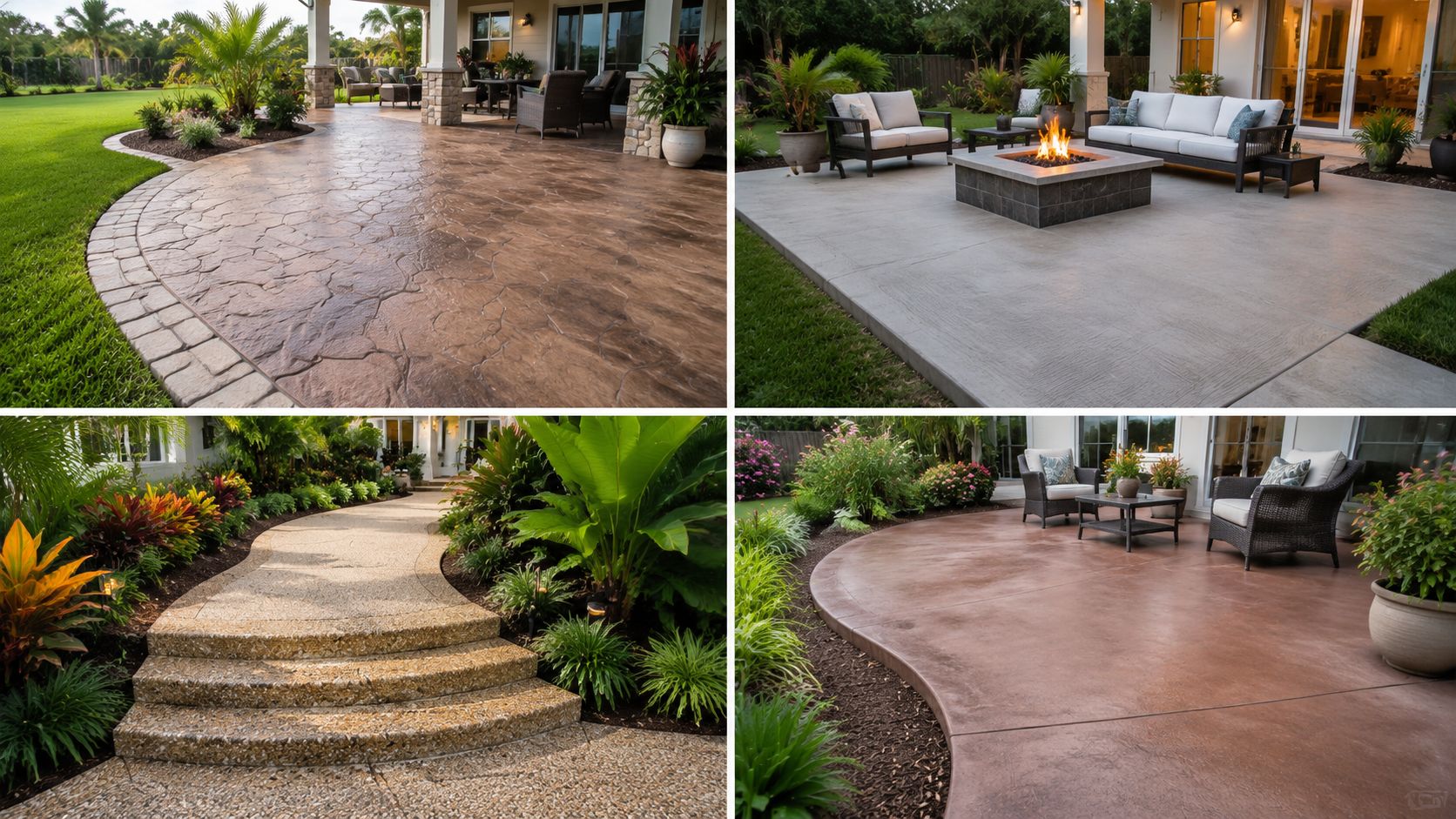
Planning a patio in Central Florida usually starts the wrong way. Most homeowners look at pretty photos first and ask about color or pattern second. The better question is whether the patio in the picture will still look good after Ocala heat, Summerfield sun, and heavy rain moving through Citrus County, FL.
That's where concrete patio pictures become useful. Not as decoration, but as jobsite references. A good patio photo shows texture, slope, joint layout, edge detail, and how the slab meets the house, screen room, pool deck, or lawn. For homeowners in Marion County, FL and nearby areas like Belleview, Dunnellon, Silver Springs, and The Villages, that matters more than a perfect showroom finish.
Patios are a mainstream part of new-home design. Patios were included in 63.7% of new single-family homes in 2023, after 63% in 2021, and that was described as the eighth consecutive year of record growth. The same market overview says poured concrete is the most popular patio material nationwide, which helps explain why so many of the best patio references homeowners save are concrete examples in different finishes and layouts (outdoor patio construction trends and sizing data).
This guide keeps it practical. These aren't random inspiration shots. They're Florida-friendly patio ideas with honest notes on what works, what needs upkeep, and what I'd want a homeowner in Ocala, Inverness, Crystal River, Homosassa, Lecanto, Hernando, Beverly Hills, or The Villages to notice before signing off on a project.
Table of Contents
- 1. Stamped Concrete Patio with Natural Stone Pattern
- 2. Brushed Finish Concrete Patio with Broom Texture
- 3. Polished Concrete Patio with Decorative Scoring
- 4. Colored Concrete Patio with Integral Dye
- 5. Permeable Concrete Patio with Eco-Friendly Drainage
- 6. Exposed Aggregate Patio with River Rock Design
- 7. Stained Concrete Patio with Acid or Acrylic Finish
- 8. Patterned Concrete with Saw-Cut Designs and Linear Scoring
- 8-Style Concrete Patio Comparison
- Your Local Concrete and Asphalt Experts in Central Florida
- Frequently Asked Questions
- Are stamped patios a good fit for Florida homes?
- Which patio finish is usually the safest when wet?
- Do patio photos really help with planning?
- Should I resurface or replace an older concrete patio?
- Can one contractor handle both concrete and asphalt work on the same property?
1. Stamped Concrete Patio with Natural Stone Pattern
Stamped concrete is the finish most homeowners in Marion County ask about when they want a higher-end look without committing to individual pavers or natural stone.

In the right photo, you can see more than pattern. You can judge whether the installer kept the texture consistent, whether the color release looks balanced, and whether the borders make sense with the house. Around Ocala and The Villages, this style works especially well on larger rear patios where homeowners want the look of slate or flagstone but still need one continuous slab that's easy to maintain.
Why Homeowners Save This Look
Stamped concrete also covers a wide visual range. Industry guidance places a basic concrete slab at $6 to $10 per square foot, while stamped and decorative concrete commonly runs $12 to $18 per square foot, which is why so many concrete patio pictures feature stamped finishes as the “upgraded but still attainable” option (concrete patio pricing and decorative finish guidance).
That spread matters in real planning. A homeowner in Belleview may want a simple rectangular patio with a slate stamp, while a homeowner in The Villages may want a larger entertainment space with borders and color variation. The base material stays the same, but the finished look can move from straightforward to custom.
For a realistic budget discussion, compare pattern choices with concrete patio cost ranges in Florida projects.
What to Check in the Picture
A stamped patio picture should show the whole layout, not just a cropped close-up. One published stamped-concrete case study is useful for exactly that reason. It shows slab geometry, borders, coping, and how the patio and pool deck tie into multiple entertainment areas rather than acting as isolated surfaces (stamped patio and pool deck case study).
Practical rule: If the picture only shows texture, you still don't know whether the patio was laid out well.
Later in the review process, video helps too because light moving across the slab exposes uneven color, poorly blended seams, and weak edge detail.
Here's a good example of the style in motion.
2. Brushed Finish Concrete Patio with Broom Texture
Broom finish is the workhorse patio in Central Florida. It isn't flashy, but it solves real problems. If a patio gets regular foot traffic, summer rain, or kids running in from a pool or sprinkler, this is one of the safest and most dependable finishes to consider.
A lot of homeowners in Dunnellon, Summerfield, and Silver Springs skip this option too quickly because they think it looks plain. In practice, a clean broom finish with straight edges, good slope, and proper spacing of joints often looks better long term than a decorative finish that wasn't installed or maintained correctly.
Where This Finish Makes Sense
This is the finish I'd favor for homes with pets, rental properties, church patios, walkways, and backyard spaces where function matters more than pattern. It also fits homes that already have simple concrete flatwork and don't need the patio to become the focal point.
What makes photos of broom-finished patios useful isn't the color. It's the texture consistency. You want to see uniform brush lines, a clean perimeter, and no obvious low spots where water will sit after a Florida storm.
- Surface traction: A broom texture usually gives better footing than smoother decorative surfaces in wet weather.
- Easier upkeep: Dirt, pollen, and mildew still need cleaning, but homeowners don't have to worry as much about preserving a patterned surface.
- Broader use cases: This finish works on patios, sidewalks, and utility slabs where practicality comes first.
If you want to compare texture options before choosing a patio finish, review these concrete finishing techniques for residential and commercial surfaces.
A good broom finish doesn't look accidental. It looks straight, even, and intentional.
For homeowners in Citrus County, FL communities like Inverness, Lecanto, and Homosassa, this option usually makes sense when the patio will stay uncovered or partially exposed to frequent moisture. It won't imitate stone, but it does exactly what a patio needs to do.
3. Polished Concrete Patio with Decorative Scoring
Polished concrete outdoors is a niche look, but it can work when the patio is covered or semi-covered and the design style is modern. The appeal is clean lines, sharper reflection, and a more finished architectural look than a standard slab.
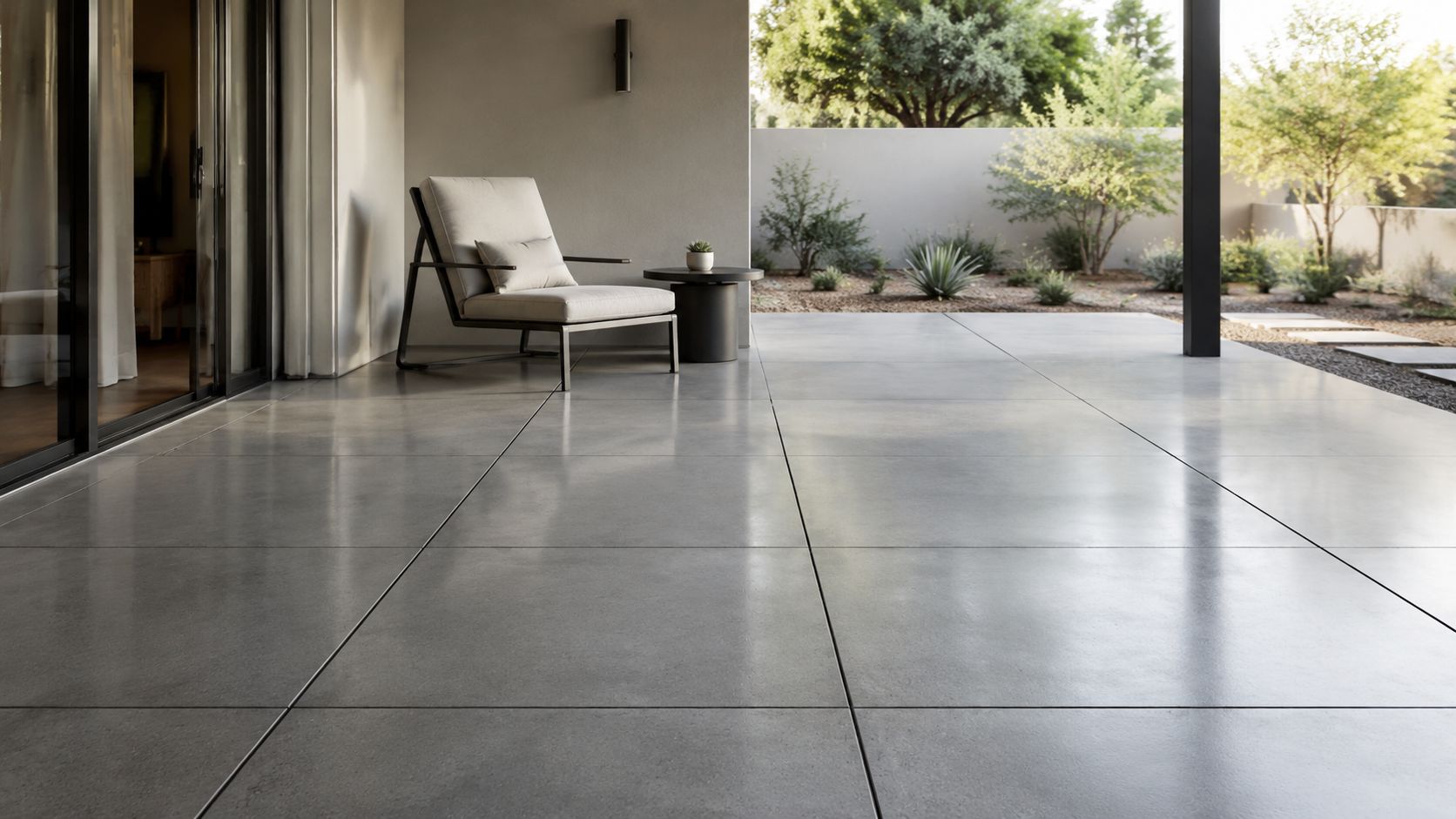
In concrete patio pictures, scoring is often what makes this style work. A plain smooth slab can look unfinished. Well-planned scoring turns the surface into a deliberate grid or tile-like pattern that fits contemporary homes in Ocala subdivisions, custom homes near The Villages, or upscale lanais in Marion County.
When the Modern Look Works Best
Scored concrete has practical value beyond appearance. In a documented stained-and-scored concrete gallery, grooves cut into the slab create board-like or tile-like geometry without replacing the slab itself, and before-and-after images make it easier to judge whether the spacing is wide enough to read across the full patio (scored concrete design examples and before-after visuals).
That point matters outdoors. Tight scoring that looks good in a close-up photo can disappear when you step back into the yard. Wide, balanced lines usually read better from the back door, the pool edge, or the screen enclosure.
A polished or smoother patio needs more caution in wet conditions, especially in Florida humidity. That doesn't automatically make it a bad choice. It just means the patio has to match the setting. Covered entertainment areas, outdoor kitchens under roof, and transitional spaces from interior to exterior are better fits than fully exposed open patios.
- Best setting: Covered lanais and semi-protected outdoor living areas.
- Design benefit: Scoring gives the slab structure and can visually shrink or widen the space.
- Main watchout: Smooth finishes need thoughtful slip resistance planning near wet zones.
4. Colored Concrete Patio with Integral Dye
Color changes the whole feel of a patio faster than pattern does. A warm tan slab can make a backyard feel natural and soft. A cooler gray can sharpen the lines of a contemporary house in Belleview or Beverly Hills. The problem is that many online patio photos are edited, filtered, or shot in flattering light that won't match a real yard at noon in Central Florida.
That's why I tell homeowners to treat color photos as direction, not a guarantee. A useful picture shows the slab next to stucco, trim, landscaping, and shadow lines. It should help you judge whether the patio fits the house instead of floating beside it as a separate project.
How to Judge Color from Photos
Integral color works best when you want consistency throughout the slab rather than a surface-only treatment. If the patio sees furniture movement, regular use, or the occasional chip at an edge, a through-color approach keeps the appearance more uniform.
Lighter colors usually make more sense in exposed Florida yards because they feel less visually heavy and generally suit the bright sun better than very dark finishes. In places like Crystal River and Hernando, where outdoor living spaces stay exposed to strong light for long stretches, lighter earth tones and soft grays often age more gracefully from a design standpoint.
Don't choose a patio color from one close-up photo. Look at full-yard photos, shaded photos, and wet-surface photos if you can get them.
A colored slab still needs good execution. Blotchy placement, poor finishing timing, or weak curing practices can leave a patio looking uneven. The best concrete patio pictures for this category show broad areas of color, not just a cropped corner where inconsistencies are hidden.
5. Permeable Concrete Patio with Eco-Friendly Drainage
This is one of the most overlooked patio categories in homeowner searches. People look for style first, but a patio in Florida has to move water well. If it doesn't, the prettiest slab in the neighborhood can become the one with pooling, discoloration, and algae around the furniture legs.
Permeable systems deserve a closer look in parts of Marion County, FL and Citrus County, FL where drainage is a constant concern. They aren't right for every yard, and they require the right base conditions, but they solve a different problem than a standard decorative slab.
What the Photo Should Prove
Good concrete patio pictures in this category should show more than a finished surface. They should show grade changes, transitions to surrounding landscaping, and how runoff is handled near the patio edge. Search trends increasingly show that homeowners want patios that perform as well as they look, especially around drainage and wet-climate use, but most inspiration content still presents these systems mainly as visual options (patio design ideas with drainage and sustainability discussion).
That gap shows up all over Central Florida. A smooth solid slab may look clean in photos, but if the grade is wrong, the homeowner is left with standing water after every summer storm. A permeable option can help in the right conditions, though only if the sub-base, soil, and site drainage all support it.
- Best use case: Yards with drainage concerns where a site review supports a permeable approach.
- Biggest mistake: Treating permeability like a decorative add-on instead of an engineering decision.
- Maintenance reality: The surface has to stay open and clean to keep doing its job.
For homeowners near low areas in Dunnellon, Inverness, or Homosassa, pictures of permeable patios should answer one question first. Where does the water go?
6. Exposed Aggregate Patio with River Rock Design
Exposed aggregate is one of the few finishes that can feel decorative without trying too hard. It fits natural settings, pool areas, and backyards with planting beds, palms, or softer outdoor design.

In photos, this finish reads as texture first. That's a good thing in Florida. Texture can help visually hide ordinary dirt, minor leaf staining, and daily wear better than a flat monotone finish.
Why It Fits Florida Backyards
This style works well in homes around Lecanto, Crystal River, and Ocala where the backyard connects to grass, planting beds, or a pool surround. The exposed stone gives the slab a more organic look than smooth concrete, and it usually feels less stark against mature landscaping.
What matters in the picture is aggregate exposure depth and consistency. If too much surface paste remains, the finish looks muddy. If too much is washed away, the stones can feel overly prominent and the surface may look rough or uneven.
A strong exposed aggregate patio photo should show these details clearly:
- Stone distribution: The rock should look evenly spread, not clumped in one section and sparse in another.
- Edge quality: Borders and transitions should look deliberate, especially where the patio meets grass or coping.
- Scale: A close-up is helpful, but you also need a wider shot to see whether the finish feels busy over the full slab.
For Central Florida homeowners who want more texture than broom finish but less pattern than stamping, exposed aggregate often lands in the sweet spot.
7. Stained Concrete Patio with Acid or Acrylic Finish
Stained concrete is often the best answer when a slab already exists and the owner wants a visual upgrade without tearing everything out. It can also work on new patios, but it's especially appealing on renovation jobs in older Ocala, Inverness, and Beverly Hills neighborhoods where the layout is fine and the finish just looks tired.
This is also where concrete patio pictures can be misleading. Fresh stain and fresh sealer look great on day one. What many galleries don't show is how those colors settle over time, or how the slab looks after weather, furniture use, and a few rainy seasons.
What Real Photos Reveal
A useful stained patio photo should show variation accurately. Acid stain tends to create more movement and unpredictability, while acrylic color is usually more controlled. Neither is automatically better. It depends on whether the homeowner wants a more artistic, mottled finish or a more uniform tone.
One of the biggest blind spots in online patio galleries is aging. Many design pages emphasize new installs and pattern choices, but they rarely show how concrete finishes hold up after UV exposure, staining, sealant wear, or seasonal moisture. That matters in Florida because appearance over time depends on climate exposure, maintenance, and finish choice, not just how photogenic the patio looked at completion (design inspiration and long-term patio appearance considerations).
The best-looking patio on install day isn't always the one you'll like most three rainy seasons later.
For homeowners in Summerfield or The Villages considering stain, ask for photos taken in direct sun and after cleaning. That's when uneven prep, weak color blending, and sealer issues usually become obvious.
8. Patterned Concrete with Saw-Cut Designs and Linear Scoring
Saw-cut and line-scored patios are a smart option for homeowners who want design without the busier texture of a stamp pattern. This style fits contemporary homes, clean outdoor plans, and patios where furniture and architecture already provide enough visual detail.
It also gives installers a chance to organize the slab visually. When the cuts are planned correctly, the patio looks intentional from the house outward instead of reading as one wide blank surface.
Where Precision Matters
This finish depends on layout discipline. The pattern has to work with door locations, columns, screen walls, and furniture placement. A centered grid on paper can look off-balance in real life if it ignores the house geometry.
In photos, the biggest quality signals are straightness, spacing, and line visibility from a distance. If the cuts only look good in a close-up, they probably won't read well from the patio door or the yard. Wider, simpler layouts usually age better visually than overcomplicated designs.
For existing slabs that need a fresh look, resurfacing can sometimes pair well with new patterning. Homeowners comparing renovation paths can review concrete patio resurfacing options for worn outdoor slabs.
A patterned saw-cut patio is often a strong fit for homes in Marion and Citrus counties where the owner wants a cleaner, lower-profile decorative finish. It won't mimic stone. That's the point. It looks like concrete on purpose, with sharper lines and a more architectural feel.
8-Style Concrete Patio Comparison
| Finish | Implementation Complexity 🔄 | Resources & Maintenance ⚡ | Expected Outcomes ⭐📊 | Ideal Use Cases 💡 |
|---|---|---|---|---|
| Stamped Concrete Patio with Natural Stone Pattern | Moderate–High: requires skilled stamping and timing 🔄 | Specialized stamps, dyes, regular sealing (every 2–3 yrs); professional labor ⚡ | High aesthetic mimicry and durability; 20–25 yrs with care ⭐⭐⭐📊 | Upscale look on a budget; residential patios, HOAs |
| Brushed (Broom) Finish Concrete Patio | Low: simple broom technique, fast application 🔄 | Minimal materials; low maintenance (sweeping, occasional washing); optional sealing ⚡ | Functional, very slip‑resistant and economical; long service life ⭐⭐📊 | High‑traffic areas, ADA walkways, budget projects |
| Polished Concrete Patio with Decorative Scoring | High: multi‑stage grinding and precision scoring 🔄 | Heavy equipment, expert contractors; low routine care but may need anti‑slip treatments ⚡ | Sophisticated, reflective finish; extremely durable; cautious when wet ⭐⭐⭐⭐📊 | Covered/semi‑covered upscale patios, modern homes, showrooms |
| Colored Concrete Patio with Integral Dye | Moderate: color mixed in batch; requires quality control 🔄 | Pigments integrated at pour; sealing recommended; moderate upkeep ⚡ | Uniform, fade‑resistant color throughout slab; long‑lasting appearance ⭐⭐⭐📊 | Coordinated color schemes, HOAs, driveways, design‑matched patios |
| Permeable Concrete Patio with Eco‑Friendly Drainage | High: special mix, site assessment and base prep required 🔄 | Higher initial cost; periodic power‑washing; no sealing to retain porosity ⚡ | Strong environmental benefit (reduced runoff, recharge); durable if installed properly ⭐⭐⭐📊 | Stormwater management sites, green‑certified projects, flood‑prone areas |
| Exposed Aggregate Patio with River Rock Design | Moderate–High: careful exposure process and timing 🔄 | Decorative aggregates, sealing advised, regular cleaning to remove debris ⚡ | Natural, textured aesthetic with excellent traction and longevity ⭐⭐⭐⭐📊 | Pool surrounds, upscale landscaping, HOAs, resort areas |
| Stained Concrete Patio (Acid or Acrylic) | Moderate: surface prep and skilled application; acid is unpredictable 🔄 | Stain materials and sealers; reseal every 2–3 yrs for best longevity ⚡ | Versatile artistic or uniform color effects; good renovation option ⭐⭐⭐📊 | Renovations, artistic/custom patios, cost‑effective visual upgrades |
| Patterned Concrete with Saw‑Cut Scoring | Moderate: precise planning and timed saw‑cutting 🔄 | Saw equipment and skilled operator; periodic cleaning of cut lines ⚡ | Clean geometric look; helps control crack placement; cost‑effective decoration ⭐⭐⭐📊 | Modern/minimalist homes, contemporary driveways, designers wanting precision |
Your Local Concrete and Asphalt Experts in Central Florida
Concrete patio pictures are useful when you read them like a contractor, not just a shopper. In Central Florida, the finish has to make sense for heat, rain, humidity, cleaning habits, and how the space is used. A patio in Ocala may need to handle open sun most of the day. A patio in Crystal River or Homosassa may need closer attention to moisture, drainage, and surface traction. A pool-adjacent patio in The Villages has different priorities than a shaded backyard sitting area in Dunnellon.
The local climate changes the trade-offs. Smooth decorative surfaces can look sharp, but they need more thought around slip resistance in wet weather. Darker colors may suit the home, but they can feel harsher in full sun. Textured finishes often perform better in daily use, especially for uncovered patios, while decorative systems usually depend more on good sealing and routine upkeep to hold their appearance.
For most homeowners in Marion County, FL and Citrus County, FL, the best patio choice comes down to three things. First, how much maintenance are you comfortable with. Second, how exposed is the slab to weather. Third, do you want the patio to blend into the yard or stand out as a design feature.
Riverside Sealing & Striping helps property owners sort through those questions with practical recommendations, not showroom talk. As Concrete and Asphalt Experts in Marion and Citrus County, the team handles concrete patios, slabs, sidewalks, driveway replacement, and site prep for residential work across Ocala, Belleview, Silver Springs, Summerfield, and surrounding communities. On the asphalt side, they also help commercial properties, HOAs, churches, and businesses with seal coating, striping, ADA-related pavement markings, and long-term surface maintenance.
Licensed and insured local experience matters here because patio performance starts below the finish. Site prep, grading, compaction, drainage, joint placement, and finishing technique all affect how the slab will look later. If you're seeing settling, drainage problems, surface wear, or an older patio that no longer fits the property, that's the point where a professional evaluation saves guesswork.
Frequently Asked Questions
Are stamped patios a good fit for Florida homes?
They can be, especially when homeowners want a decorative look without installing separate stone materials. The key is proper installation, a finish that suits wet conditions, and maintenance that protects the surface over time.
Which patio finish is usually the safest when wet?
Broom finish and other textured surfaces are usually the most practical starting point for wet areas. Decorative finishes can still work, but they need to be selected carefully for the setting.
Do patio photos really help with planning?
Yes, if the photos show full layout, edges, drainage, and transitions. Tight close-ups help with texture, but wide shots are what reveal whether the patio works with the property.
Should I resurface or replace an older concrete patio?
It depends on the slab condition. If the structure is sound, resurfacing may be worth discussing. If there's major settlement, drainage trouble, or widespread failure, replacement is often the better long-term move.
Can one contractor handle both concrete and asphalt work on the same property?
Yes. That's often useful for homes, HOAs, and commercial sites that need patio or sidewalk work along with seal coating or parking lot striping. Coordinating both scopes with one local contractor can simplify scheduling and quality control.
The right patio isn't always the most decorative one in the photo gallery. It's the one that fits your house, your maintenance expectations, and Florida weather. If you're comparing concrete patio pictures and want honest guidance on what will hold up in Ocala, The Villages, Crystal River, Inverness, or anywhere nearby, start with a site-specific conversation and work from there.
If you're planning a new patio, replacing damaged concrete, or weighing decorative finish options for your home or property, Riverside Sealing & Striping, LLC offers free, no-pressure consultations across Marion, Citrus, and surrounding Central Florida counties. The team brings local experience in concrete installation, resurfacing, sealing, asphalt maintenance, and striping, with reliable scheduling and practical recommendations built for Florida conditions.