
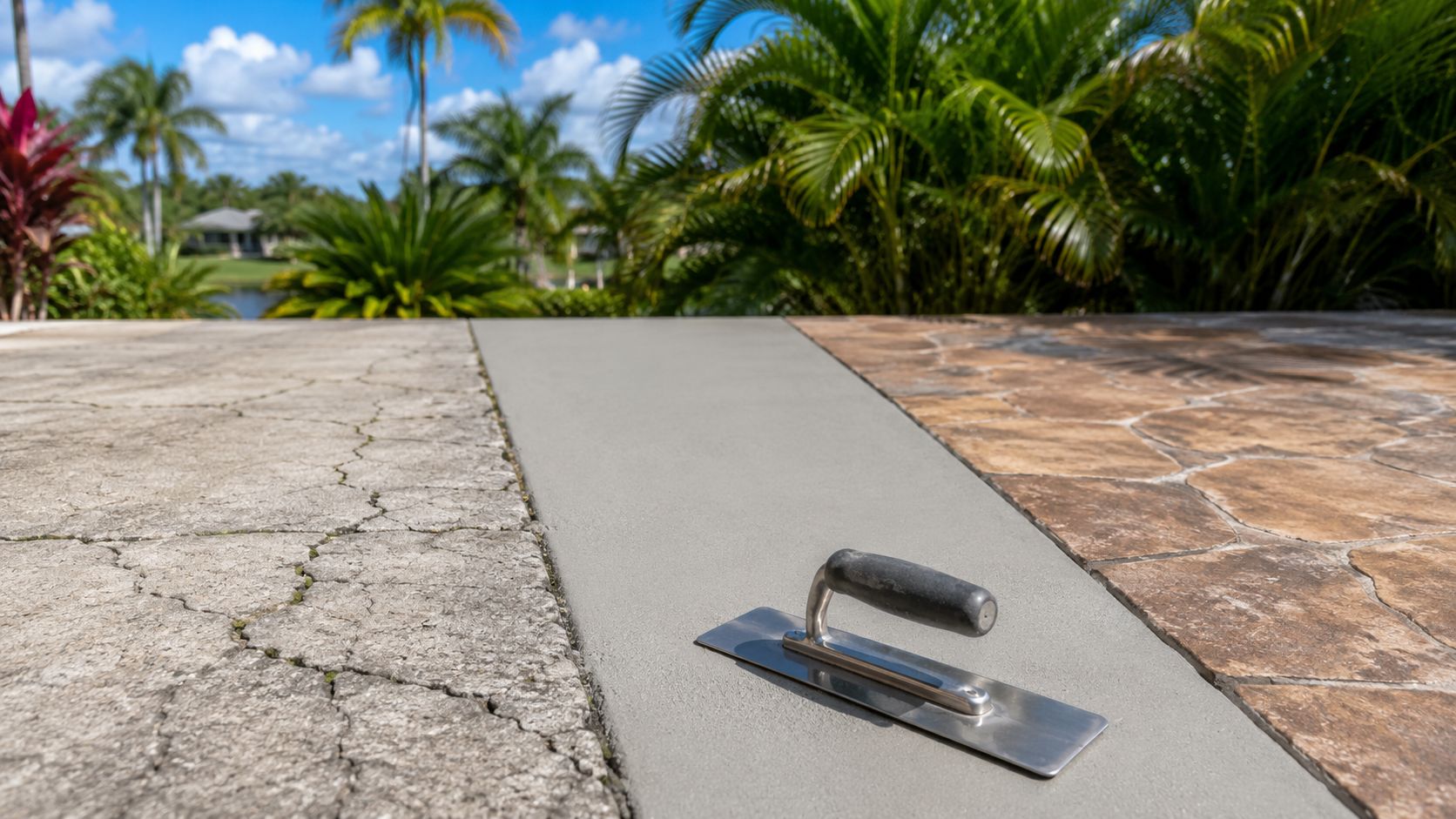
A lot of patios in Central Florida reach the same point. The slab is still there, still usable, but it no longer looks like a place where you want to sit with friends or grill on the weekend. In Ocala, Dunnellon, Belleview, and The Villages, I see the same mix of problems over and over: faded color, rust stains from furniture, hairline cracks, mildew in the shaded spots, and a surface that feels tired even when the rest of the yard looks good.
That leaves most homeowners with three questions. Can I live with it? Can I patch it myself? Or am I stuck paying for a full tear-out? In many cases, concrete patio resurfacing options give you a middle path that makes sense, especially when the slab is sound but the surface is worn.
For homes across Marion County, FL and Citrus County, FL, resurfacing can be a practical upgrade instead of a full replacement. It can improve appearance, add texture, and help protect the slab, but it only works when the original concrete is a good candidate. If the base is failing, a pretty finish won't save it.
Table of Contents
- Introduction Is Your Patio an Eyesore or an Oasis
- Understanding Concrete Resurfacing vs Replacement
- A Detailed Comparison of Resurfacing Options
- Which Resurfacing Method Suits Your Patio Condition
- The Central Florida Factor How Weather Impacts Your Patio
- When to Call a Concrete and Asphalt Expert
- Frequently Asked Questions About Patio Resurfacing
Introduction Is Your Patio an Eyesore or an Oasis
A homeowner in Summerfield recently described the problem in a familiar way. “The patio isn't broken enough to replace, but it looks bad enough that I'm tired of looking at it.” That's usually the sweet spot where resurfacing enters the conversation.
If your patio in Silver Springs, Homosassa, Inverness, or Lecanto has surface stains, light cracking, discoloration, or general wear, you may not need to remove the whole slab. You may need a new surface system that bonds correctly, handles Florida weather, and fits how you use the space.
Practical rule: If the concrete is ugly but stable, resurfacing is worth a serious look. If the concrete is moving, sinking, or breaking apart, start thinking replacement.
That distinction matters because homeowners often get sold on finish samples before anyone talks about slab condition. A stamped pattern or decorative coating can look great on a sample board. It won't last on a patio that's already failing underneath.
The right way to choose among concrete patio resurfacing options is to start with the slab, then the finish, then the maintenance. That's true whether you're updating a backyard sitting area in Beverly Hills or a poolside patio in Crystal River.
Understanding Concrete Resurfacing vs Replacement
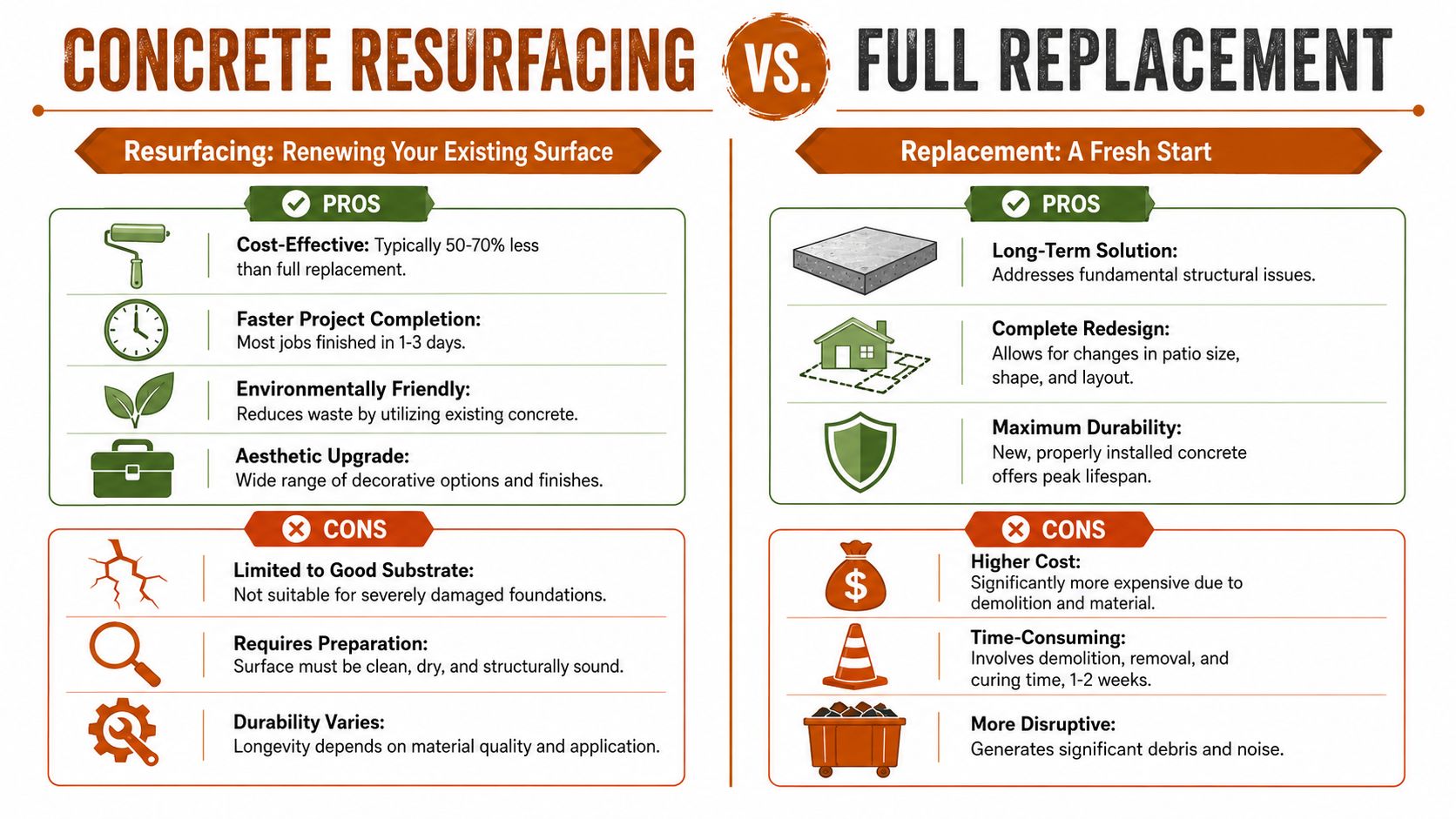
Resurfacing and replacement solve different problems. If you confuse the two, you usually spend money twice.
What resurfacing actually is
Concrete resurfacing means applying a new overlay or topping over an existing slab that is still structurally sound. It is not the same thing as paint. It is not a quick seal coat. It is a surface renewal system that depends on solid prep and solid concrete underneath.
Industry guidance stays consistent on the basic sequence: prepare, repair, resurface, then cure and seal, and resurfacing is typically chosen for minor cracks, stains, and general wear rather than major structural failure, as outlined by Sundek's patio resurfacing guidance.
When refinishing a heavy outdoor table, if the frame is strong, a new top layer can make it look and perform much better. If the legs are rotten and wobbling, refinishing the top is wasted effort.
Surface prep is where most bad jobs fail. The slab has to be clean. Cracks have to be addressed properly. The surface needs profiling so the overlay can bond. If someone wants to skip straight to coating or texture, that's a warning sign.
For homeowners comparing materials, design, and lifespan, it's also worth looking at how concrete and pavers differ for patio projects, because the right answer isn't always another layer over old concrete.
When replacement is the better call
Replacement is the right move when the slab has deeper trouble. If the patio has heaving, settlement, major movement, crumbling edges, or cracks that keep opening, resurfacing won't correct the root problem.
Here are the situations where replacement usually makes more sense:
- Movement in the slab: One section sits higher or lower than the next.
- Widespread structural cracking: Not just hairlines, but repeated cracking through multiple areas.
- Surface breakdown with weak concrete underneath: The top isn't the only problem.
- Drainage failures: Water repeatedly sits where it shouldn't and the slab was poured wrong to begin with.
A finish system can upgrade a patio. It can't rebuild a failed foundation.
That's the honest dividing line. Resurfacing is for renewal. Replacement is for correction.
A Detailed Comparison of Resurfacing Options
Once a patio is sound enough to resurface, the smart choice is the system that fits the slab, the budget, and Florida weather. Homeowners around Ocala and Crystal River often start with color and pattern. I start with how much wear the patio sees, how much surface damage needs to be covered, and whether the finish will hold up through sun, rain, and mildew season.
For budgeting, Angi's resurfacing cost guide notes that basic resurfacing is generally around $3 to $5 per square foot, while stamped or decorative overlays commonly run $7 to $20 per square foot. The same guide notes that sealing can add about $1 to $1.75 per square foot, and prep items like crack repair and cleaning can change the final total.
Concrete Resurfacing Options Compared
| Method | Avg. Cost/Sq. Ft. | Best For | Appearance | Durability |
|---|---|---|---|---|
| Basic overlay | $3 to $5 | Patios with general wear, stains, and minor cosmetic issues | Clean, renewed concrete surface that can be simple or lightly decorative | Good when prep and sealing are done right |
| Microtopping | Qualitative only | Smooth decorative refresh on a sound slab with minor defects | Thin, refined, continuous surface | Best for light correction, not major surface rebuild |
| Stamped or decorative overlay | $7 to $20 | Homeowners who want a stronger visual upgrade with texture and pattern | Can mimic stone, tile, or other decorative finishes | Good to very good when installed on a solid slab |
| Sealed decorative surface | Add about $1 to $1.75 for sealing | Patios that need added weathering and fade resistance after resurfacing | Depends on underlying resurfacing system | Sealer helps protect the finish from weather and wear |
What each option does well
A basic overlay is the practical choice for many older patios. It covers discoloration, light pitting, and worn-looking concrete without pushing the job into premium decorative pricing. If the slab is stable and the main complaint is appearance, this is often the best return on the money.
A microtopping works on sound concrete that only needs a light cosmetic reset. According to National Concrete Polishing's breakdown of resurfacing types, microtoppings are typically 1/8 to 1/4 inch thick and are used for a smooth decorative finish rather than major correction. That trade-off matters. They look clean and modern, but they do not hide rough patches, old repairs, or larger texture problems very well.
A stamped or decorative overlay makes sense when the patio is a visible part of the backyard and appearance matters enough to justify the extra cost. Texture can help with traction, and pattern can disguise small visual inconsistencies better than a flat finish. The downside is that decorative work is less forgiving. If prep is weak or the installer rushes the timing, those flaws show up fast.
Here is the plain-language breakdown:
- Basic overlay: Best for solid patios with wear, stains, and cosmetic aging.
- Microtopping: Best for good slabs where the goal is a cleaner, smoother look.
- Stamped overlay: Best for homeowners willing to pay more for texture and design.
One caution belongs in this comparison. If the patio has flaking, scaling, or surface pop-outs, confirm whether you are dealing with surface concrete spalling before choosing a finish. A decorative resurfacer can cover minor blemishes, but it will not solve active surface failure underneath.
Some homeowners ask about epoxy or other coating systems. On an exposed Florida patio, I treat those with caution. Strong sun, trapped moisture, and hot surface temperatures can shorten the life of the wrong product, especially on slabs that were not prepared well.
The practical decision framework is simple. Choose basic overlay for value, microtopping for a cleaner design on a near-sound slab, and stamped overlay when looks matter enough to accept higher cost and tighter installation demands. If the slab is too far gone, replacement is the better investment than dressing up concrete that is already failing.
Which Resurfacing Method Suits Your Patio Condition
The surface condition should choose the method, not the sample board. That's where a lot of patio jobs go sideways.
Match the method to the problem
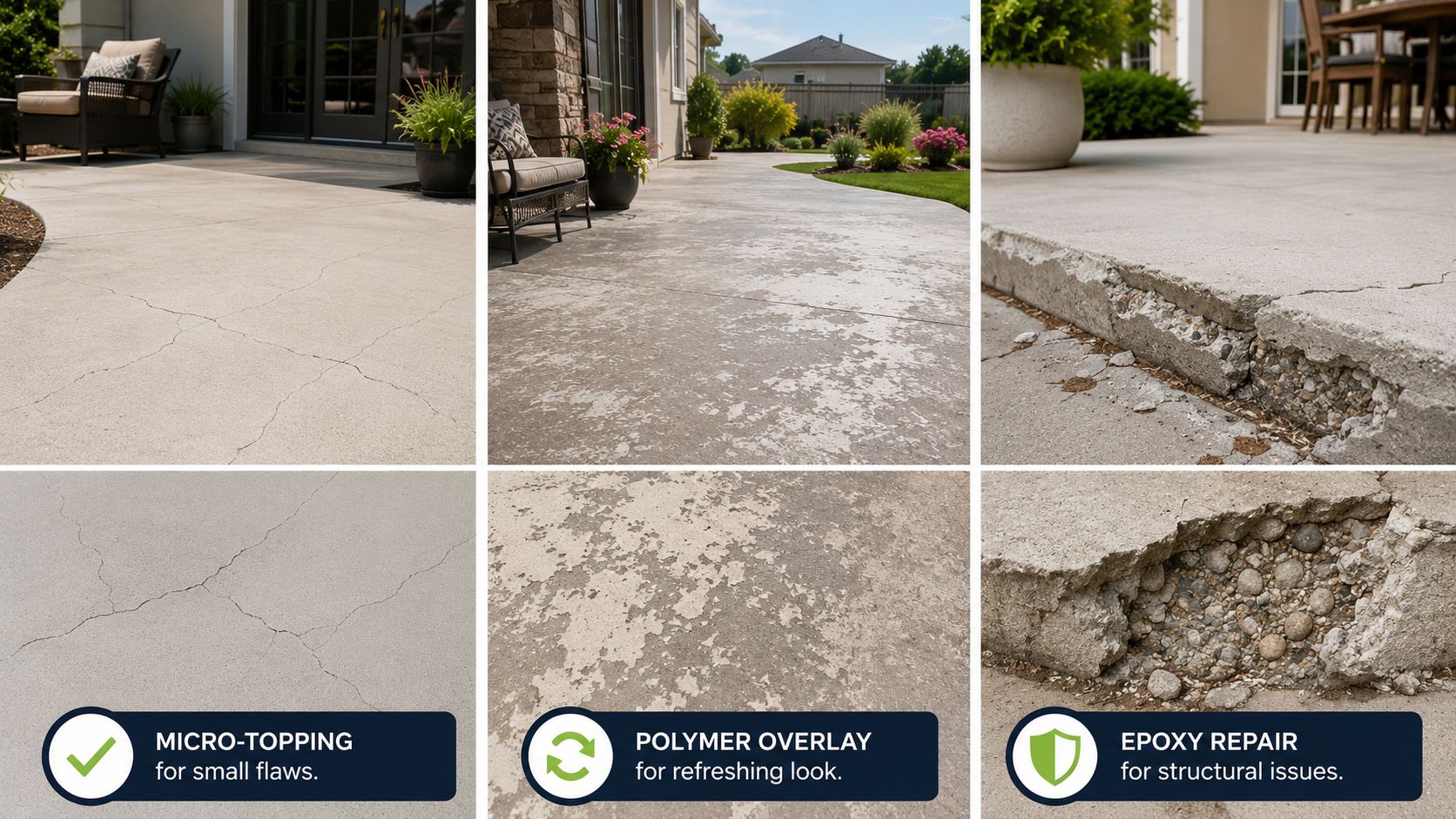
If your patio has light staining, faded color, and general wear, a standard overlay usually makes the most sense. It gives you a fresh face without pretending the slab is brand new.
If the slab is sound and you want a smoother decorative finish, microtopping is a better fit. This works well on patios where the owner wants a cleaner modern look and doesn't need to hide much.
If the patio has minor surface imperfections and you want texture, stamped or textured resurfacing is often the better answer. The pattern helps disguise visual flaws better than a flat monotone finish.
If your surface has localized flaking or surface breakdown, stop and make sure you're not dealing with a deeper issue such as concrete spalling. Cosmetic resurfacing over active surface failure usually doesn't end well.
One more thing matters here. Concrete Network's patio resurfacing guidance makes an important point that gets missed all the time: the existing slab must be structurally sound, and professional evaluation is recommended when damage is more than hairline cracking because resurfacing is cosmetic renewal, not structural repair.
When the slab is telling you not to resurface
These are the signs to slow down and get the slab evaluated before you choose a finish:
- Cracks that are wide or changing: If they keep reopening, movement is still happening.
- Sections that have settled: One panel lower than another usually means the problem is below the surface.
- Repeated moisture issues: Water intrusion can break bond and shorten finish life.
- Old coating failure: If a prior coating peeled badly, the new system has to address why.
This video gives a helpful visual look at patio resurfacing and repair considerations:
A smart patio owner in Ocala or Crystal River doesn't ask only, “What finish looks best?” The better question is, “What system fits the condition I have?”
The Central Florida Factor How Weather Impacts Your Patio
A resurfacing system that behaves well in a mild, dry climate may struggle in Central Florida. Heat speeds things up. Rain interrupts curing. Humidity complicates timing. Shade creates mildew and algae problems. Full sun bakes color and sealer.

Heat rain and humidity change the job
In places like Ocala, Silver Springs, Inverness, and Homosassa, patios take a beating from UV, downpours, and long humid stretches. That affects both appearance and installation quality.
A decorative finish that isn't sealed well can fade faster than homeowners expect. A slick surface in a shaded wet area can become a maintenance problem. And a rushed installation before an afternoon storm can ruin bond and curing.
Florida doesn't forgive shortcuts on outdoor concrete. The slab prep, product choice, and weather window all have to line up.
Why timing and curing matter here
One useful field-based detail comes from this Florida-focused patio resurfacing discussion, which notes that long-term performance depends heavily on climate and that some products have only a 5- to 15-minute working window, a roughly 30-minute pot life, and must be protected from water during curing. That's exactly the kind of jobsite reality homeowners need to know.
That short window is one reason installers need a plan before material is mixed. On a hot day in Marion County or Citrus County, there isn't much room for hesitation. Crew timing, shade conditions, and storm risk all matter.
Curing matters after installation too. If you're planning patio work, it's worth understanding how long concrete takes to cure in real conditions, because use time and full cure are not the same thing.
For Central Florida patios, the most durable approach usually isn't the trendiest finish. It's the system that matches exposure, traffic, drainage, and maintenance expectations.
When to Call a Concrete and Asphalt Expert
A lot of Central Florida homeowners call for help after the resurfacing has already started failing. The patio looked better for a few months, then the coating began to peel at the edges, hold moisture in shady spots, or show the same cracks right through the new finish. At that point, the cheap fix is gone, and the repair usually costs more.
What a pro catches before materials go down
A good contractor starts with the slab itself. The first question is whether resurfacing makes financial sense, or whether replacement will hold up better and cost less over the life of the patio.
That means checking for old sealer residue, surface dusting, soft or weak paste, hidden moisture issues, poor drainage, crack movement, edge breakdown, and low spots that keep water sitting on the slab. It also means deciding how the surface needs to be prepared. Some patios need grinding. Some need patching first. Some are too far gone for a thin cosmetic overlay to last.

Experience saves money. A contractor who knows concrete can tell the difference between a patio that needs a surface system and one that needs structural work. That matters in Florida, where heat, rain, and constant moisture exposure expose bad prep fast.
Local judgment matters too. A covered lanai in Ocala does not age the same way as an open backyard patio in Crystal River, and neither one behaves like a pool deck. The right recommendation depends on sun, drainage, traffic, slip resistance, and how much maintenance the homeowner is willing to do.
How local contractors help you avoid the wrong fix
Riverside Sealing & Striping, LLC is one example of a local company that handles concrete and asphalt work in Marion and Citrus County, including repair and replacement work when resurfacing is not the right answer. The bigger point is to hire a licensed, insured contractor who will give you a straight assessment instead of selling a decorative finish over a failing slab.
Ask direct questions before hiring anyone:
- How will you prepare the surface? Grinding, shot blasting, patching, or acid etching are not interchangeable.
- How will you handle cracks? Hairline cosmetic treatment is different from repairing active movement.
- What happens if the slab has drainage or bonding problems? You want that answer before the job starts.
- What sealer or topcoat is included? Outdoor performance depends on the product, not just the appearance.
- At what point would you recommend replacement instead of resurfacing? A good contractor should answer that without hesitation.
If the conversation jumps straight to color, pattern, or a quick price without a serious look at slab condition, keep looking. In this part of Florida, the best-looking option is not always the smartest one.
Frequently Asked Questions About Patio Resurfacing
Can resurfacing fix cracks in my patio
Sometimes. Resurfacing can hide and fill minor hairline cracks if the slab is otherwise stable and the crack treatment is done correctly during prep.
It will not stop active movement. If cracks are widening, offset, or coming back after past repairs, the problem is in the slab, base, or drainage. In that case, a new surface coat usually buys appearance, not a lasting fix.
What does a patio resurfacing project usually cost
Cost varies with condition more than square footage alone. A clean patio with light prep and a basic overlay costs far less than a slab that needs crack repair, grinding, patching, slope correction, and a slip-resistant topcoat.
Decorative work also changes the number quickly. Texture, multiple colors, saw-cut patterns, and premium sealers add labor and maintenance, so the lowest price is rarely the best value for a Florida patio that sees hard sun and regular rain.
Is resurfacing cheaper than replacing a patio
Usually, yes, if the existing slab is sound. Resurfacing makes financial sense when the concrete has cosmetic wear, light surface scaling, minor discoloration, or old finish failure without deeper structural trouble.
Replacement is often the smarter spend when the slab is settling, heaving, breaking apart, or holding water in the wrong places. I have seen homeowners pay for a decorative resurfacing job and then tear it out a year or two later because the problem was underneath.
Which finish is best for Florida patios
For Central Florida, the best finish is usually the one that stays bonded, sheds water properly, and gives enough texture under wet feet. That often points homeowners toward practical systems over flashy ones.
Acrylic coatings and some spray textures can work well on the right slab, especially where cooler footing and slip resistance matter. Thicker overlays can hide more surface wear, but they demand better prep and a sound base. Stains and sealers look good on cleaner slabs, though they will not disguise much damage. The right choice depends on slab condition first, appearance second.
How do I know if my patio should be replaced instead
Look at the slab, not just the surface. Replacement deserves a hard look if you see sections that have dropped, soft or crumbling concrete, large structural cracks, repeated patch failures, or drainage problems that send water toward the house or leave standing puddles.
Age by itself does not decide it. Condition does.
Riverside Sealing & Striping, LLC serves property owners in Marion and Citrus County with concrete and asphalt work, including repair, resurfacing, and replacement evaluations. For homeowners in Ocala, Dunnellon, Belleview, Summerfield, Crystal River, Homosassa, Inverness, Beverly Hills, Hernando, Lecanto, Silver Springs, and The Villages, the smart first step is a straight assessment of whether the slab is worth saving.