
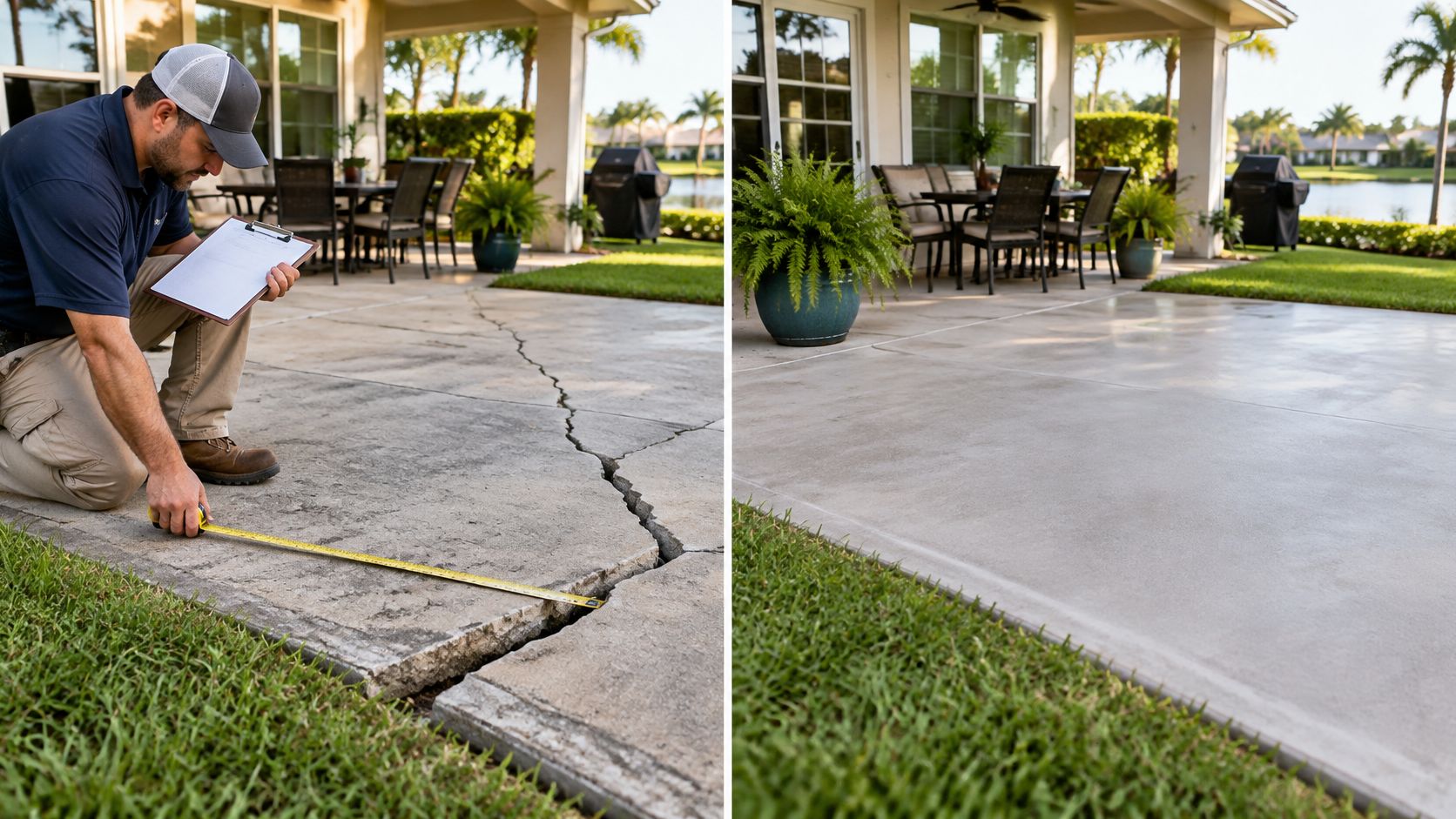
Professional concrete patio repair costs about $3 to $15 per square foot. The cause of the damage and the repair method, not patio size alone, determine where a specific job lands.
For homeowners in Central Florida, the expensive surprise usually isn't the concrete itself. It's discovering that a surface repair also needs drainage correction, base preparation, or removal of a section that no longer has proper support. A useful budget starts with identifying what failed, then pricing the work that will correct it.
Table of Contents
- Concrete Patio Repair Cost by Method and Size
- Diagnose the Damage Before You Price the Repair
- Permits, Drainage and Other Hidden Costs
- Florida Weather and Local Market Pressure on Pricing
- Budgeting Tips for Comparing Patio Repair Quotes
- When to Bring in a Professional for Your Patio
- Concrete Patio Repair Cost Questions Answered
- Next Steps for Your Patio Repair Budget
Concrete Patio Repair Cost by Method and Size
For homeowners in Marion County, FL, and Citrus County, FL, national price lists are a starting point, not a local bid. Fixr's patio repair benchmarks put professional work at $3 to $15 per square foot, with extensive repairs reaching $5 to $20 per square foot.
Labor is usually the largest share of that bill. A patio behind a narrow gate can cost more to fix than an identical slab beside an open driveway, because crews still carry broken concrete out, bring material in, prepare the base, and finish the surface by hand.
Match the price to the method
Two sources cover the rates below, and each row maps to one of them. The crack-filling rate follows HomeAdvisor's concrete repair benchmarks, while the project-level repair figures and the overlay range follow its concrete resurfacing and overlay cost guide. The broad per-square-foot screening ranges at the bottom come from the Fixr benchmarks cited above.
| Repair method | Typical cost | Billing unit | Best suited for |
|---|---|---|---|
| Crack filling | $0.50 to $3 | Per linear foot | Narrow, non-structural cracks in a stable slab |
| Typical professional crack repair | $250 to $800 | Per repair | Isolated cracks and small surface defects |
| Ordinary concrete repair | $300 to $3,500 | Per project | Localized chipping, spalling, and small damaged sections |
| Resurfacing or overlay | $3 to $7 | Per square foot | Sound slab with surface wear or scaling |
| Full removal and replacement | $6 to $14, plus $1 to $6 for removal | Per square foot | Settled, displaced, or structurally failed slab |
| Typical professional range | $3 to $15 | Per square foot | Screening benchmark for most patio repairs |
| Extensive or complex repair range | $5 to $20 | Per square foot | Restricted-access or labor-intensive work |
The replacement row uses Angi's slab replacement and removal benchmarks, which also provide the unit rates for the calculations below.
Square footage sets the arithmetic. The cause of the damage sets the method, and the method sets where your job lands inside these ranges. A 200-square-foot patio with hairline shrinkage cracks is a crack-filling bill; the same footprint with settled corners is a removal-and-replacement bill.
Apply the method to your measurements
Measure length times width and round up for preliminary budgeting. Measure only the affected section when partial replacement is appropriate, rather than automatically pricing the entire patio.
| Affected area | Replacement at $6 to $14 per square foot | Removal at $1 to $6 per square foot |
|---|---|---|
| 100 square feet | $600 to $1,400 | $100 to $600 |
| 200 square feet | $1,200 to $2,800 | $200 to $1,200 |
| 300 square feet | $1,800 to $4,200 | $300 to $1,800 |
| 400 square feet | $2,400 to $5,600 | $400 to $2,400 |
These are arithmetic screening estimates using the cited replacement rates, not complete project totals. Permits, difficult access, drainage changes, and unusual base preparation can add scope, and they are the line items that most often push a final invoice above the table math.
Resurfacing follows a different calculation because the existing slab stays in place. Our concrete patio resurfacing cost guide explains that option in more detail, but the qualifying condition is simple: the underlying slab must be sound. An attractive overlay cannot compensate for failed support underneath it.
Diagnose the Damage Before You Price the Repair
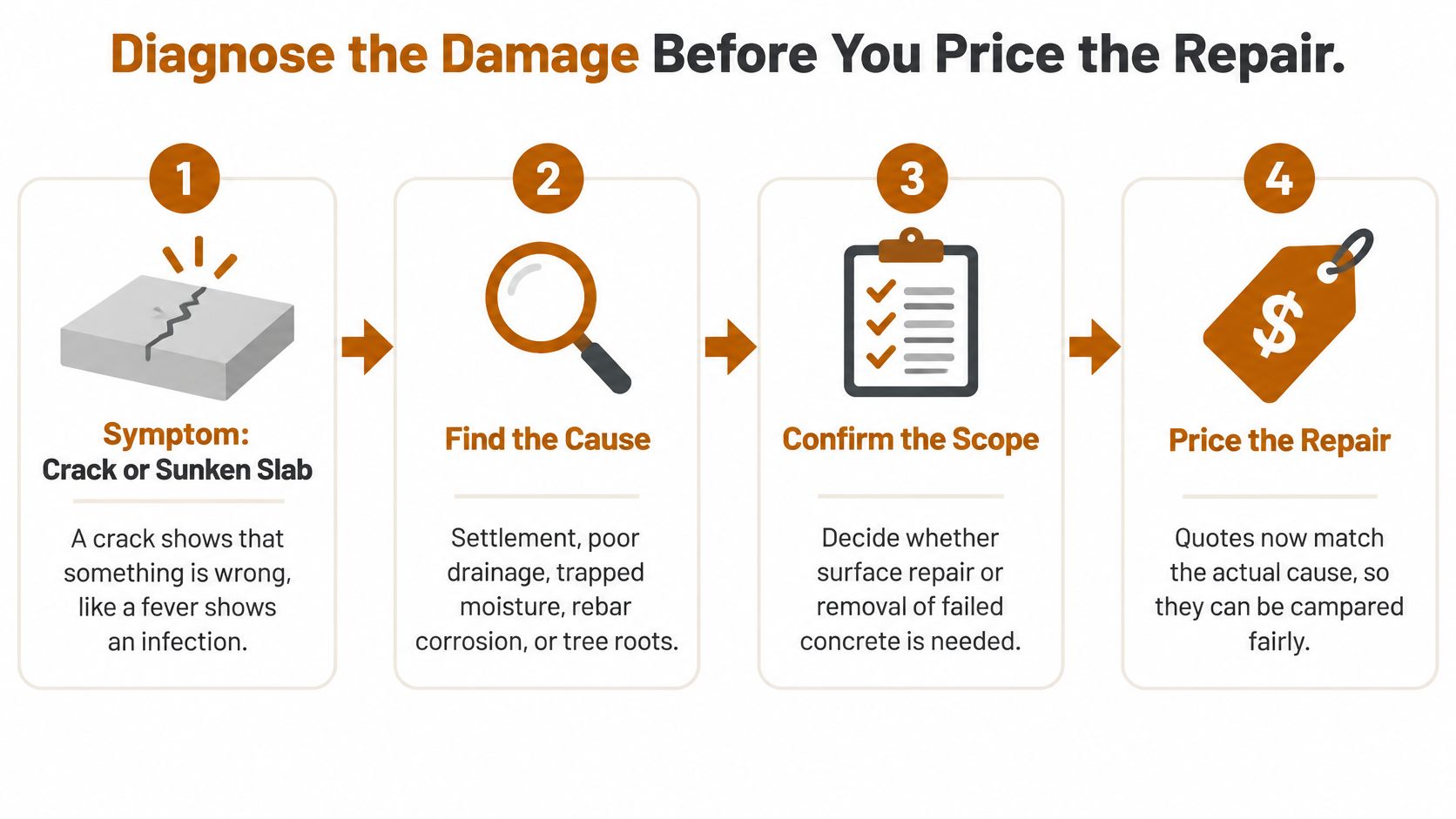
A crack is a symptom, much like a fever. Filling it without identifying the cause can improve its appearance without resolving the problem.
The American Concrete Institute's repair framework calls for evaluating the existing concrete, identifying the deterioration mechanism, and selecting compatible repair materials and methods. Potential causes include drying shrinkage, thermal movement, excessive loading, chemical reactions, corrosion, and freeze-thaw damage; settlement beneath the slab also changes the appropriate repair.
The practical sequence is to identify the symptom, investigate the cause, confirm the scope, and then calculate the price.
What the visible damage can indicate
This table is a screening tool, not a diagnosis from a photograph. Similar-looking defects can require different work once the contractor checks the slab and its support.
| Symptom | Likely cause | Repair scope | Cost tier |
|---|---|---|---|
| Hairline or narrow surface cracks | Drying shrinkage or minor thermal movement | Crack filling | Low |
| Wide cracks that reopen after filling | Movement or unstable subgrade | Stabilize, then fill or replace the section | Moderate to high |
| Scaling or flaking surface | Surface wear, moisture exposure, or weak finish | Resurfacing if the slab is sound | Moderate |
| Sunken, uneven, or lipped slabs | Settlement or erosion beneath the slab | Lifting or removal and replacement | High |
| Hollow sound or rocking section | Voids or delamination | Remove and replace affected concrete | High |
| Water pooling on the patio | Grade or drainage problem | Correct drainage, then repair | Moderate to high |
| Rust stains or exposed rebar | Reinforcement corrosion | Remove damaged concrete, assess steel, then patch or replace | High |
Surface flaking deserves particular attention before an overlay. Understanding what concrete spalling looks like helps distinguish a cosmetic complaint from deterioration that requires removal of unsound material.
A useful inspection records crack width and pattern, slab-edge elevation differences, hollow or delaminated areas, drainage paths, and existing joint condition. The written proposal should connect those findings to the selected method.
Practical rule: Stable surface defects may suit repair. Vertical displacement, rocking sections, persistent ponding, or reinforcement deterioration require a closer assessment of partial or full replacement.
Be cautious when a contractor supplies only a square-foot rate. Without diagnosis, that price may exclude demolition, disposal, subgrade correction, or control-joint reconstruction. Those omissions can turn an inexpensive quote into an open-ended project.
Permits, Drainage and Other Hidden Costs
A repair that looks cosmetic can become a permitted improvement when the scope changes. Replacing concrete at a different elevation, enlarging the patio, or altering runoff can involve more than surface restoration.
An inspection helps establish what the project actually includes.
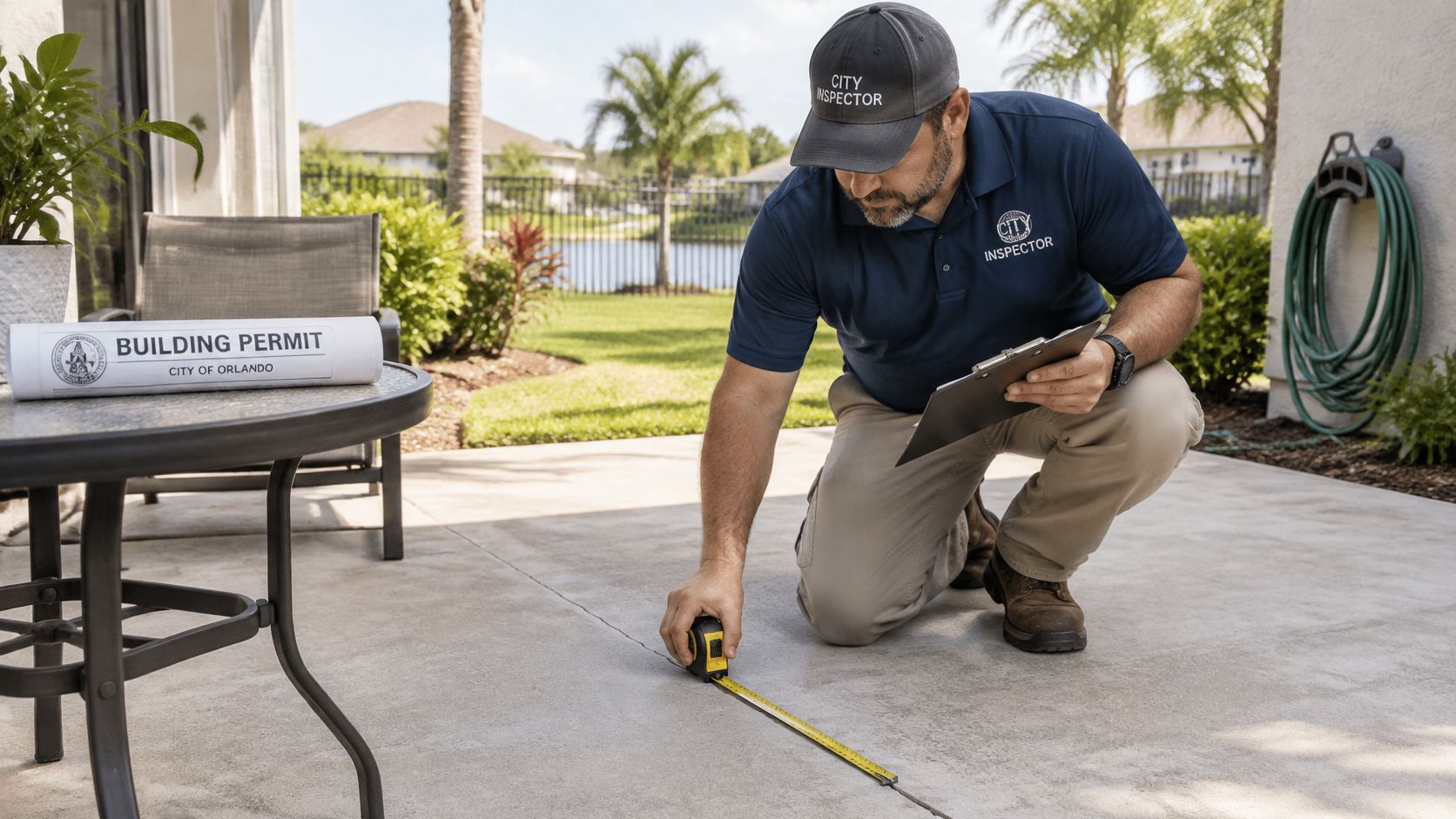
For perspective, Miami Springs' permit fee schedule lists a $125 minimum plus $0.18 per square foot for a concrete patio permit. That is another municipality's fee structure, not a price homeowners should apply in Marion or Citrus County.
Confirm the jurisdiction before budgeting fees
Ask the building department responsible for your address, whether that's Ocala, Dunnellon, Inverness, Crystal River, or the county. Describe whether you're filling cracks, resurfacing, replacing a section, or removing and rebuilding the patio.
Potential scope changes deserve separate questions:
- Grade and drainage: Will the finished elevation or direction of runoff change?
- Footprint and setbacks: Will the patio become larger or approach a property restriction?
- Flood-hazard considerations: Does the location require additional review?
- Accessible routes: Will the work affect an accessible walkway or entrance?
- Impervious coverage: Could the proposed expansion affect site limits?
Field costs also need their own line items. Depending on the diagnosis, the contractor may recommend regrading, downspout extensions, a drainage system, joint reconstruction, or engineering review for significant movement. A French drain shouldn't be an automatic add-on; the drainage solution needs to match the water source and discharge conditions.
Use the following video as an additional visual reference while reviewing the proposed scope.
Before approving work, ask whether the estimate includes permit fees, plan review, inspections, disposal, and drainage correction. Any exclusion should be written plainly, along with who will arrange and pay for it.
Florida Weather and Local Market Pressure on Pricing
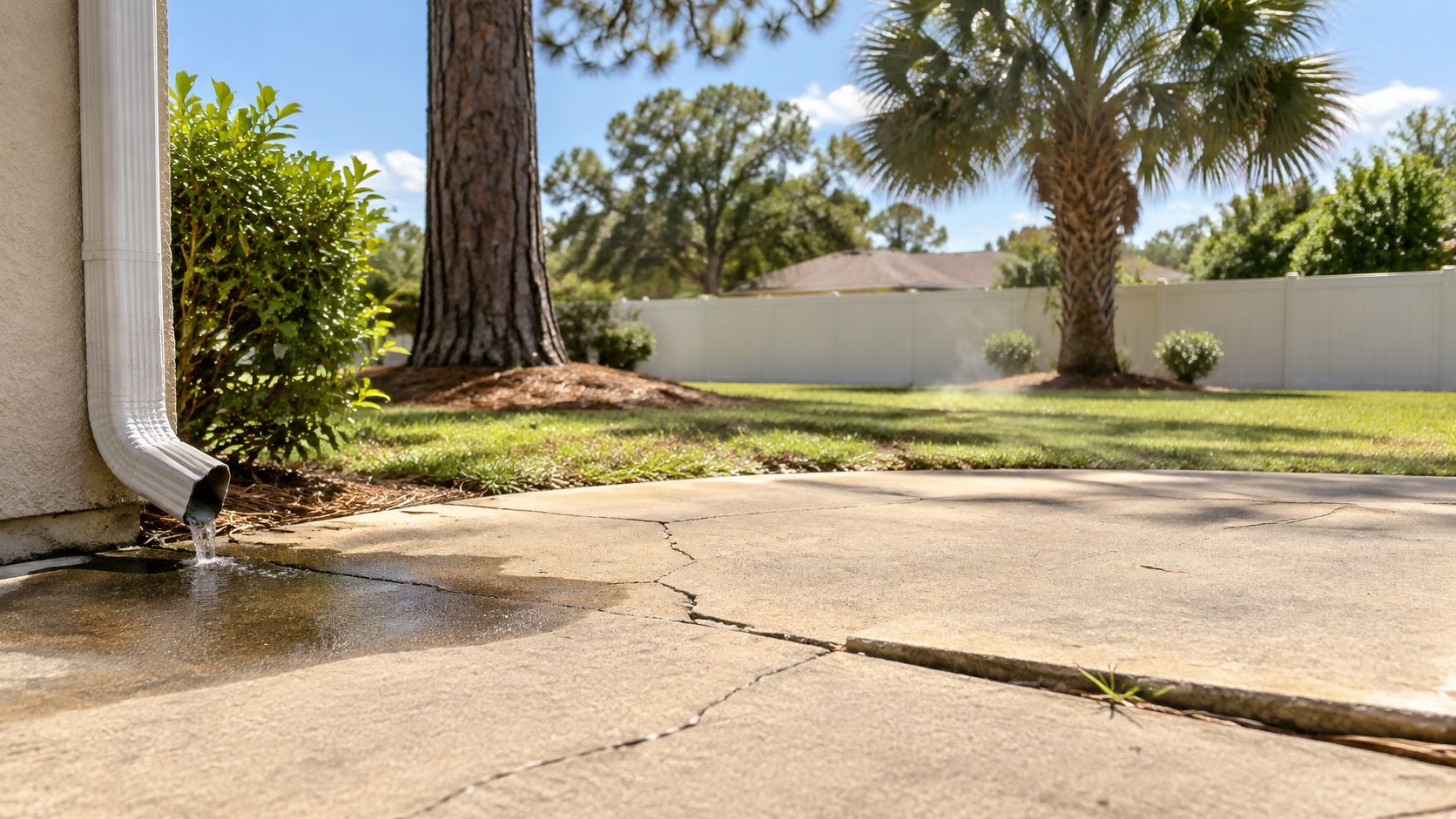
Two patios with identical square footage can price very differently in Central Florida, because the same weather that caused the damage also decides the scope. Heavy wet-season rain washes sandy subgrade out from under slab edges, and a crack that looked like a patching job becomes a releveling or partial replacement once a void shows up underneath.
A downspout discharging beside damaged concrete is worth investigating before paying for a new surface.
Checks that change the repair, and the price
Before quoting, a contractor working in Marion or Citrus County should walk the slab for conditions that alter scope:
- Voids under edges and corners: probe for hollow spots where washout removed support.
- Ponding after afternoon storms: standing water marks a drainage failure that a surface patch will not fix.
- Joint condition: slabs expand in sustained heat, so closed or spalled joints point to thermal movement, and replacement sections need working joints to avoid repeat cracking.
- Discharge points: note where downspouts, pool overflow, and yard runoff exit relative to the slab.
- Ground saturation: high water tables keep soil soft longer and affect base preparation for any replaced section.
Price follows cause. A resurface over a washed-out base buys a better-looking slab over the same failure.
What local demand does to a quote
Timing changes numbers too. Post-storm periods push repair calls up while new construction absorbs flatwork crews across Marion and Citrus counties, and tighter labor shows up as higher bids and longer lead times. Rainy-season scheduling adds cost of its own: fresh concrete cannot go down into standing water or an approaching storm, so contractors plan shorter pours and more weather holds. Ask how long a quote stays valid, because an estimate written in the dry season may not hold once the schedule tightens.
Published indices give broader context for that movement. The BLS producer-price series tracks price changes over time, while construction material index series show wider material cost trends.
Neither index is a homeowner's invoice. Use them as context for refreshing an older estimate, not as a multiplier to calculate a local bid. Current labor, access, preparation, and finishing requirements still need an on-site quote.
Budgeting Tips for Comparing Patio Repair Quotes
The cheapest quote can be the most expensive choice if it pays for work that doesn't address the failure. Compare the proposed outcome and exclusions before comparing the total.
For repair selection, use the diagnosis criteria above rather than assuming resurfacing is always the economical middle ground. Decorative resurfacing and plain replacement concrete can also have different maintenance requirements, so ask what you'll need to maintain after installation.
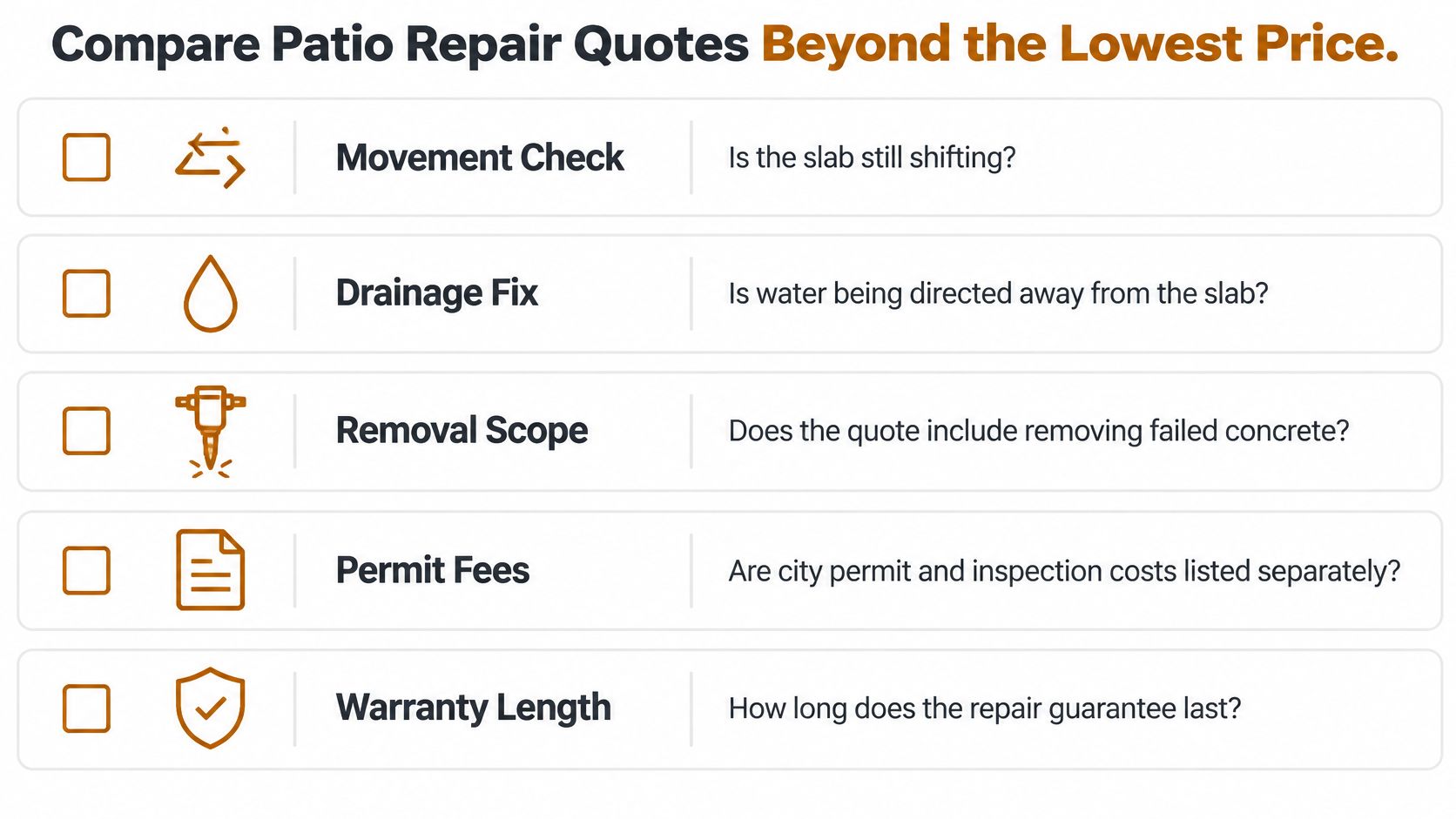
Require a comparable written scope
Use these items when reviewing estimates:
- Itemized work: Request demolition, disposal, mobilization, base preparation, reinforcement, finishing, joint restoration, and permit responsibilities.
- Written findings: Ask for the measurements and drainage observations that support the recommendation.
- Comparable proposals: Get competing contractors to price the same affected area and intended finish. A patch quote and a replacement quote aren't directly comparable.
- Hidden-condition terms: Have the contractor explain how unexpected subgrade problems will be documented, priced, and approved.
- Warranty and curing requirements: Confirm what's covered and when the surface can accept its intended use. Never assume a pedestrian patio is suitable for vehicles.
Our guide to questions to ask a concrete contractor can help organize those conversations.
Plan around conditions, not a promised pour date
Ask how the crew handles rain forecasts, surface preparation, curing, and weather delays. Reliable scheduling means clear communication and realistic weather decisions, not placing concrete just to preserve a calendar slot.
Fast turnaround on an estimate shouldn't mean rushed workmanship. Ask for a clear start window, expected work sequence, and written instructions for keeping people, furniture, and equipment off the repair.
Compare what each contractor will leave you with, not just what each contractor charges to begin.
Finally, ask whether the finish will blend with the existing patio. High-quality workmanship can improve curb appeal, but a localized patch shouldn't be sold as an invisible repair or a guaranteed increase in property value.
When to Bring in a Professional for Your Patio
A single hairline crack in otherwise stable concrete may be suitable for a compatible homeowner-applied filler. A rocking slab, uneven edges, recurring cracks, pooled water, or visible reinforcement needs measurement and diagnosis rather than another cosmetic treatment.
An estimate that can't explain its own repair scope is another reason to seek an on-site evaluation. You should understand both the recommended method and why a less extensive option was rejected.
Prepare for an on-site evaluation
A local contractor is one option alongside an independent concrete assessment when the damage is complex. Look for licensed and insured service, Central Florida experience, reliable scheduling, and a written workmanship scope.
For a useful visit, prepare:
- Damage photographs: Include close-ups and wider views showing the surrounding yard.
- Rough measurements: Record patio length, width, and the visibly affected area.
- Damage history: Note when cracks appeared and whether earlier repairs reopened.
- Rain observations: Identify where water collects and where downspouts discharge.
Homeowners in Silver Springs, Beverly Hills, and Hernando should bring the same information as those in the larger nearby cities. Site conditions matter more than a mailing address.
A full-service concrete and asphalt contractor can also coordinate patio or slab work with separate pavement needs. Concrete work, asphalt sealcoating, and parking lot striping require different methods, even when they're part of the same property-maintenance plan.
For homeowners seeking Concrete and Asphalt Experts in Marion and Citrus County, a free, no-pressure consultation is a practical starting point. Confirm the cause, price the scope, then compare the proposal against the relevant benchmarks.
Concrete Patio Repair Cost Questions Answered
How much does it cost to repair a concrete patio in Ocala?
For screening, expect typical professional work to land around $3 to $15 per square foot, with localized repairs often totaling about $300 to $3,500 per project. Treat those as example ranges, not an Ocala quote. Local labor, saw depth, access, prep, permits, and drainage correction can move the final number fast. A small crack is only cheap if the slab is stable; a settled corner or runoff toward the house changes the job.
Can I fill the cracks myself?
A single hairline crack in stable concrete can be DIY with a compatible filler used exactly as directed. If cracks reopen, edges differ in height, or water ponds after rain, stop and get the cause checked before buying more surface product.
Do I need a permit to repair my patio?
It depends on the city or county and whether the work changes grade, drainage, footprint, or accessibility. Call the building department in Ocala, Dunnellon, Inverness, Crystal River, or the county and describe the exact scope before work starts.
Why does resurfacing fail on some patios?
Overlays fail when the base still moves, active cracks keep reopening, the surface is dusty or contaminated, moisture pushes up through the slab, or ponding water keeps the coating wet. Ask which of those conditions were ruled out and how.
Should I choose the cheapest quote?
Choose it only if the written scope solves the cause, not just the visible damage. Require the diagnosis, repair method, prep steps, drainage fix, and the price triggers for hidden soft base, extra sawing, or unsound concrete in writing.
Next Steps for Your Patio Repair Budget
Your concrete patio repair cost depends on what failed, how much concrete is affected, and what the site requires before a lasting repair can begin. Establish the cause, select the appropriate method, and account for drainage, access, and administrative costs before committing.
A diagnosed, itemized proposal gives you a stronger basis for comparison than a low square-foot rate. It also helps you distinguish necessary corrective work from optional cosmetic upgrades.
For Marion and Citrus County homeowners, the next step is a professional evaluation rather than another guess from photographs. Seek Concrete and Asphalt Experts in Marion and Citrus County who can explain the concrete repair scope and keep any asphalt maintenance needs clearly separated.
Riverside Sealing & Striping, LLC offers concrete patio evaluations and concrete work, alongside asphalt sealcoating and parking lot striping. Visit Riverside Sealing & Striping, LLC to schedule a free, no-pressure on-site estimate and confirm the cause and scope of your patio damage before choosing a repair.