
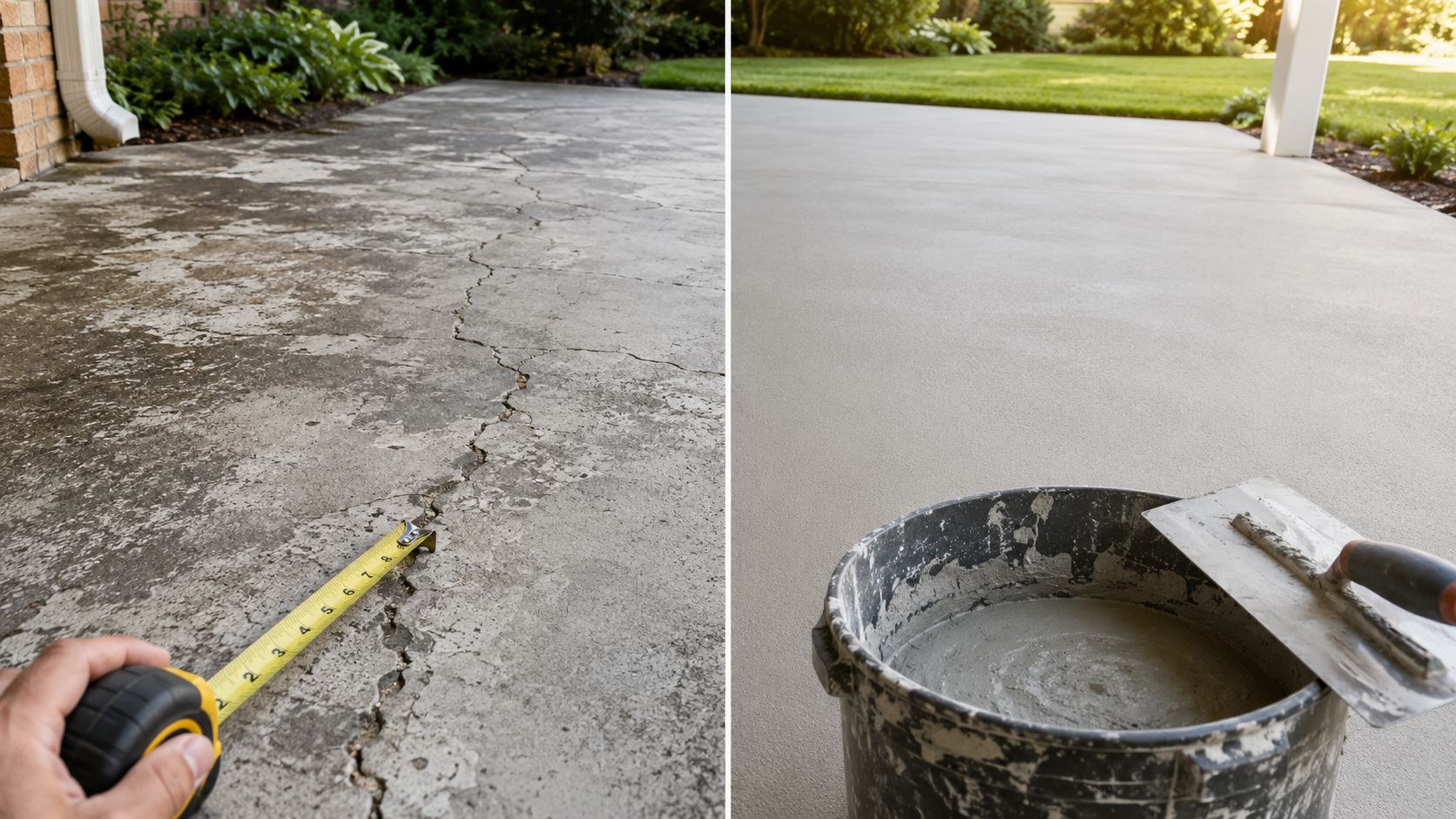
Concrete patio resurfacing usually runs about $3 to $5 per square foot for basic finishes, and $7 to $20 per square foot for stamped or decorative overlays. Most Florida patios land somewhere between $1,000 and $5,000 total, depending on size and repair work.
If you're staring at a cracked patio in Marion County, FL or Citrus County, FL and trying to decide whether to patch, resurface, or replace it, those are the numbers that matter. The bad news is that online estimates usually sound cleaner than real jobs. The good news is that a sound slab can often be brought back without paying for a full tear-out, which is why resurfacing stays popular with homeowners in Ocala, Dunnellon, Belleview, Silver Springs, Summerfield, Crystal River, Homosassa, Inverness, Lecanto, Beverly Hills, Hernando, and The Villages.
Table of Contents
- Concrete Patio Resurfacing Cost Overview
- Breaking Down Material and Labor Costs
- What Drives the Price Up or Down
- Sample Cost Calculations for Common Patio Sizes
- Resurfacing Versus Full Replacement
- Timeline, Permits, and Contractor Questions
- How Florida Climate Affects Your Resurfaced Patio
- Ways to Lower Your Resurfacing Cost
Concrete Patio Resurfacing Cost Overview
The honest answer is simple, basic patio resurfacing starts around $3 to $5 per square foot, and decorative systems climb to $7 to $20 per square foot HomeAdvisor's resurfacing cost guide. That is why the same patio can read as a modest project or a serious expense, depending on the finish you pick.
Why per-square-foot pricing can mislead you
A square-foot price is only the opening number. A small 10×10 patio often lands around $300 to $700, while a 10×20 patio commonly runs $600 to $1,400 HomeAdvisor's resurfacing cost guide. Broader project totals often sit near a national average around $2,000, with typical ranges from about $1,000 to $5,000 and higher totals up to $13,000 when the patio is larger or needs more repair work HomeAdvisor's resurfacing cost guide.
Those numbers vary because contractors do not price a patio by math alone. They price the slab, the prep, the finish, the access, and the risk. A clean, sound patio in The Villages is a different job from a cracked, uneven slab in Homosassa with drainage problems and patchwork repairs.
Practical rule: if your patio is structurally sound, resurfacing usually stays in the lower or middle part of the range. If the slab is failing, the price moves fast.
Florida weather changes the quote too. UV, humidity, and rain punish weak prep and cheap finish choices, so a Marion or Citrus County patio often needs more attention to cleaning, patching, and sealing than a dry-climate guide suggests. If you want a better sense of how concrete costs build out before you compare patio bids, review this concrete cost breakdown from Riverside Sealing & Striping.
What that means for your budget
I tell homeowners to think in tiers. Budget tier means a simple refresh on a decent slab. Mid-range means prep work, patching, and a better finish. Premium means stamped or decorative work with more labor and more surface prep.
If a contractor gives you a number without looking at the slab, that number is not a quote. It is a guess.
Breaking Down Material and Labor Costs
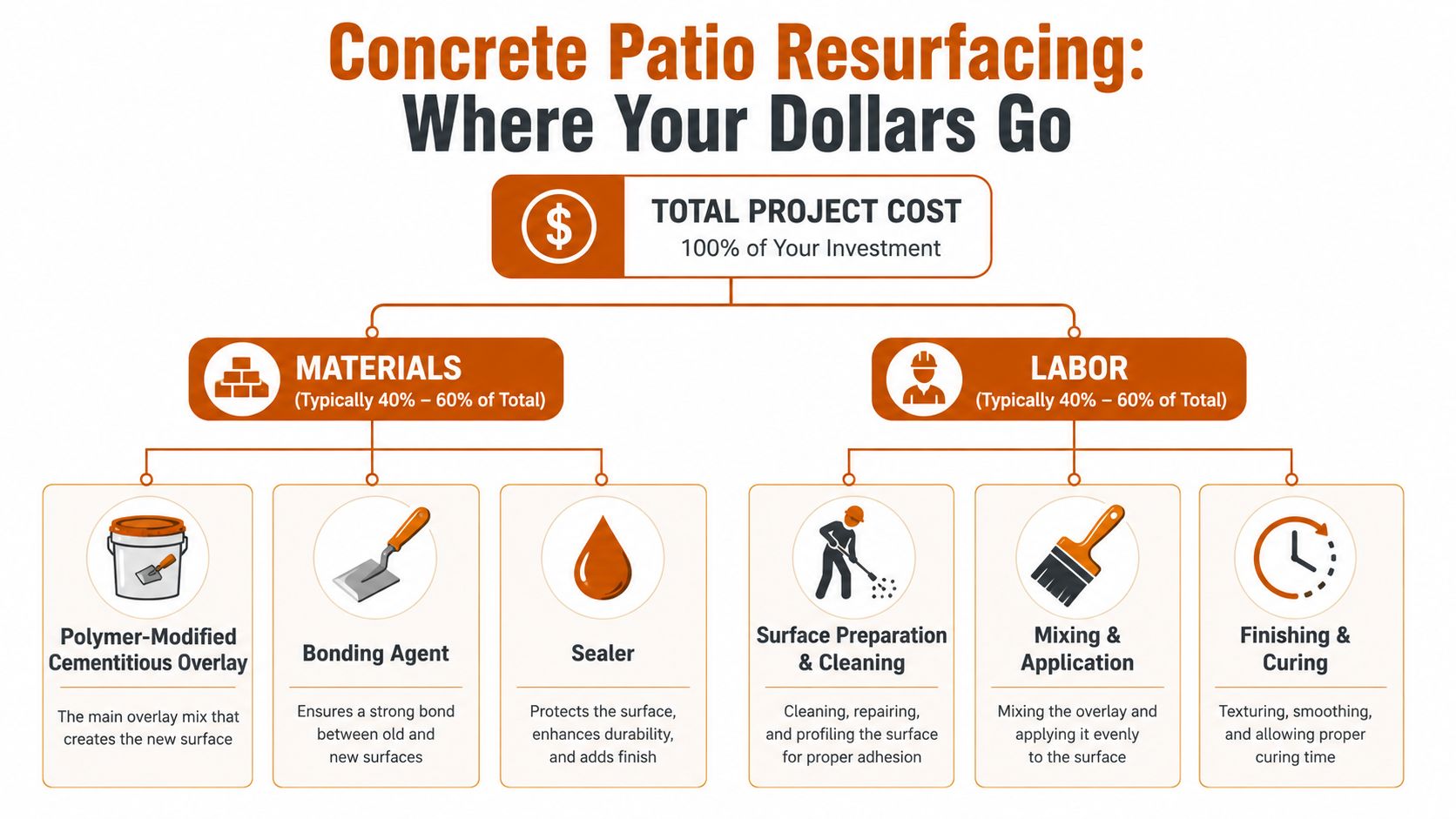
A resurfacing bid is really two bills in one, materials and labor. The material itself is usually a polymer-modified cementitious overlay, and it's only part of the story. What homeowners pay for is the crew's time to prep the surface, mix the product correctly, place it, texture it, and cure it without messing up the finish.
Materials are only half the equation
Basic overlays are typically about 1/8 to 1/4 inch thick, while stamped or textured overlays are generally 1/4 to 3/8 inch thick Angi's concrete resurfacing guide. That thickness matters because it changes how much material is used and how much control the installer needs to keep the surface even. Decorative work is not just prettier, it's more demanding.
I also look at the sealer. A decent sealer protects the finish and helps the patio hold up in real outdoor use, especially in Central Florida. When a quote leaves out sealing, the price may look lower than it really is.
Labor is where the bill grows
Labor covers surface preparation and cleaning, mixing, troweling, pattern work if needed, and curing control. That's the part homeowners underestimate. A crew can't just sweep the slab and roll on a finish. They have to deal with the existing surface first, and that is where the hours go.
Minimum-job charges are another reason tiny patios cost more than simple math suggests. Thumbtack notes some contractors charge a flat fee of at least $500 to $1,000 for smaller jobs, while typical national averages cluster around $2,000 to $2,160 Thumbtack's concrete resurfacing cost guide. That's why a small patio often doesn't feel “cheap” even when the square footage looks modest.
If you want a plain comparison point for base concrete pricing, this concrete cost guide helps show how resurfacing stacks up against other concrete work.
What Drives the Price Up or Down
The biggest swing in concrete patio resurfacing cost usually comes from the slab below the finish. If the concrete is solid, the job stays fairly direct. If the slab is cracked, settled, or drains badly, the quote rises fast because the crew has to correct the base before it can resurface anything.
The condition of the slab decides a lot
Preparation and repair on typical jobs can run from about $300 to $1,300, and can reach $4,000 on heavily damaged surfaces Design Transition Studio's resurfacing cost breakdown. Crack repair and patching are often priced separately at roughly $2 to $5 per square foot Design Transition Studio's resurfacing cost breakdown. That is the number that surprises homeowners. It is also the part that matters most in Central Florida, where heat, humidity, and heavy rain punish weak prep work and make a cheap quote look better than it is.
Practical rule: if a patio needs major patching, drainage correction, or leveling, do not compare that quote to the lowest advertised resurfacing price. You are not buying a simple cosmetic refresh anymore.
The hidden line items that matter
Access changes the labor load. So does slope work. So does correcting drainage so water does not sit on the slab after a summer storm. Those items sound ordinary, but they are what separate a patio that holds up from one that flakes early.
A quote should tell you whether the contractor is resurfacing over a slab that already passed inspection, or whether they are rebuilding the surface in stages. If the estimate is vague, ask what prep work is included and what is excluded. That one question can save you from a nasty change order later.
If you are comparing resurfacing to a removal job, this patio removal cost page shows why demo work changes the price so much.
Sample Cost Calculations for Common Patio Sizes
The fastest way to sanity-check a quote is to run the square footage yourself. A small patio can look inexpensive on paper, then jump once prep and minimum charges are added. A larger patio spreads those fixed costs more efficiently, which is why the per-square-foot number matters less than the total scope.
What common sizes usually look like
| Estimated Cost by Patio Size and Finish Tier | Basic ($3-$5/sq ft) | Mid-Range Overlay | Stamped/Decorative ($7-$20/sq ft) |
|---|---|---|---|
| 10×10 patio, 100 sq ft | $300 to $500 | $500 to $700 | $700 to $2,000 |
| 12×12 patio, 144 sq ft | $432 to $720 | $700 to $1,000 | $1,008 to $2,880 |
| 20×20 patio, 400 sq ft | $1,200 to $2,000 | $2,000 to $3,500 | $2,800 to $8,000 |
A 10×10 patio can look like a simple job, but after prep and contractor minimums, the total often feels closer to the next bracket. That is normal. A 20×20 patio gives the contractor more square footage to work with, so you usually get a cleaner cost spread, especially when the slab is in decent shape.
How to use the table without fooling yourself
If your patio is small and badly damaged, expect the project to drift upward because repair costs don't shrink just because the slab does. If your patio is larger and the surface is sound, the basic tier can stay surprisingly reasonable.
I tell homeowners in Ocala and Belleview to budget for the finish they want, not the cheapest look they can tolerate for one season. A patio sits in full view every day. Saving a little up front and hating the result for years is not a smart trade.
Resurfacing Versus Full Replacement
If the slab is still structurally sound, resurfacing usually makes the better financial sense. It avoids demolition and haul-away work, so the total typically comes in well below a full replacement, and HomeGuide's resurfacing cost comparison supports that gap. Zion Outdoors' resurfacing guide points in the same direction. Around Ocala and Citrus County, that difference matters even more because every extra step, from demo to disposal, adds cost fast.
When resurfacing wins
For a 500-square-foot patio, replacement can land around $6,000 to $10,000, while resurfacing the same area is more often about $3,000 to $5,000 HomeGuide's resurfacing cost comparison. Another benchmark puts new concrete patio installation at roughly $4 to $12 per square foot, compared with resurfacing at about $3 to $10 per square foot for simpler finishes. Those numbers make one thing clear. If the base slab is sound and the problem is mostly cosmetic, resurfacing is the first quote I would ask for.
A small patio can still carry contractor minimums and prep labor, so the savings do not always look dramatic on the lowest end. Even so, once the slab is in decent shape, resurfacing keeps you from paying for concrete removal you do not need. That is the smarter spend in most normal repair jobs.
My rule of thumb: if the patio is level enough to keep and the damage is mostly surface-level, choose the overlay and spend the rest on a better sealer and finish.
When replacement is the smarter call
Replacement makes more sense when the slab has settlement, widespread deep cracking, heaving, poor drainage under the slab, or rusted rebar near the surface. Those problems point to a slab that is failing underneath, not just a worn top layer. An overlay on that kind of base will look better for a while, but it will not fix the structure.
For homeowners comparing those two paths, this removal and replacement resource is the better place to start than a resurfacing-only estimate. The right call depends on the condition of the concrete itself, the slope, and how water moves across the patio after summer rain. In Central Florida, that last part matters more than people expect.
Timeline, Permits, and Contractor Questions
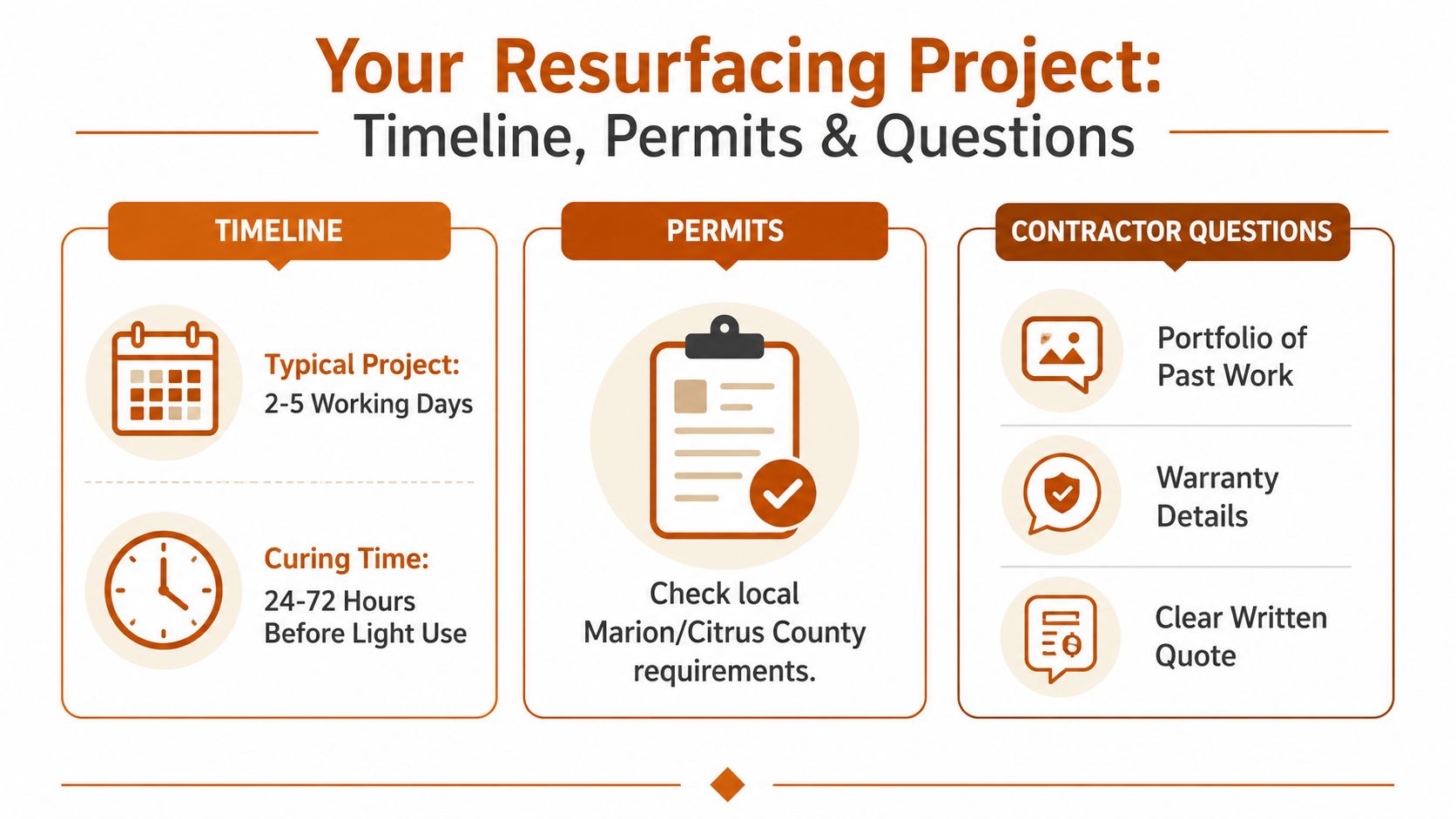
Most patio resurfacing jobs finish in 2 to 5 working days. Light use usually waits on 24 to 72 hours of curing before heavy traffic goes back on the surface. That is a normal window for a clean slab with solid prep. If the crew has to fix cracks, patch edges, or lay down a decorative finish, expect the schedule to stretch. A simple job should not drag on.
When permits may matter
In Marion County, FL and Citrus County, FL, permits usually come into play when the work moves past resurfacing and starts involving structural changes, drainage changes, or square footage expansion. If you are only refreshing the existing patio surface, the paperwork is often simpler. If the project changes the slab's footprint or alters how water moves, ask before anyone starts digging.
Questions that separate real contractors from guessers
A contractor should answer these without hesitation. If they dodge them, keep looking.
- License and insurance proof: Ask for both before you sign.
- Written scope of prep work: Find out exactly what gets repaired and cleaned.
- Finish system: Basic texture and decorative systems are not the same job.
- Warranty terms: Get the coverage in writing.
- Sealing included or extra: That line item changes the final price.
I would also ask to see past patio work, especially in Dunnellon, Crystal River, Homosassa, Inverness, Lecanto, and Hernando. Local experience matters when the job sits in Florida heat and rain. If you want a tighter checklist before you hire, use these questions to ask a concrete contractor and compare the answers line by line. Riverside Sealing & Striping, LLC handles concrete work along with asphalt sealcoating and parking lot striping, so the company's concrete and pavement side of the business is part of the same service model, not a side hustle.
How Florida Climate Affects Your Resurfaced Patio
Florida is hard on concrete. The UV, the humidity, and the afternoon rain all punish weak prep and cheap finishes. A patio that looks fine on day one can start to show wear faster if it wasn't sealed properly or if the underlying slab already had movement.
Why local conditions change the job
Sun exposure matters because unprotected surfaces age faster under constant UV. Summer humidity and thunderstorms make curing and moisture control more important than they are in milder climates. Around Ocala, Dunnellon, Belleview, and The Villages, sandy soils also contribute to slab movement, which means the base has to be evaluated carefully before anyone applies an overlay.
That's why finish choice matters more here than in a cooler, drier market. A sealer isn't a decorative afterthought in Central Florida. It's part of the system that helps the patio resist weather, staining, and premature breakdown.
Why local experience pays off
A crew that works Marion County, FL and Citrus County, FL every week sees the same pattern. Patios near Crystal River and Homosassa deal with moisture. Patios in Inverness and Lecanto often need attention to drainage and texture choice. Patios in Beverly Hills and Hernando can behave differently again depending on the base and the exposure.
That's where a local contractor makes sense. Riverside Sealing & Striping, LLC is based in Dunnellon and serves Marion and Citrus counties with concrete and asphalt services, which means the crew understands both patio surfaces and the conditions they face in this part of Florida. If you want a free on-site estimate, that local experience is worth more than a polished website.
Ways to Lower Your Resurfacing Cost
You can trim the bill without cutting corners. Bundle the patio with a driveway or sidewalk job so the crew only mobilizes once. Do light cleaning before they arrive, and choose a simple broom or light texture finish instead of stamped work if the budget is tight.
Scheduling also matters. Spring and fall are usually easier on everyone than peak summer chaos, and asking for sealing to be included up front is smarter than tacking it on later. A clear, no-pressure estimate from a contractor who handles concrete and asphalt work in Marion County, FL and Citrus County, FL will usually show you where the savings are.
Riverside Sealing & Striping, LLC provides concrete patio resurfacing guidance, concrete work, and asphalt maintenance for homeowners and property owners across Central Florida. If your patio is cracked, dull, or just overdue for a proper refresh, visit Riverside Sealing & Striping, LLC for a free, no-pressure on-site estimate and a straight answer on whether resurfacing or replacement makes more sense.