
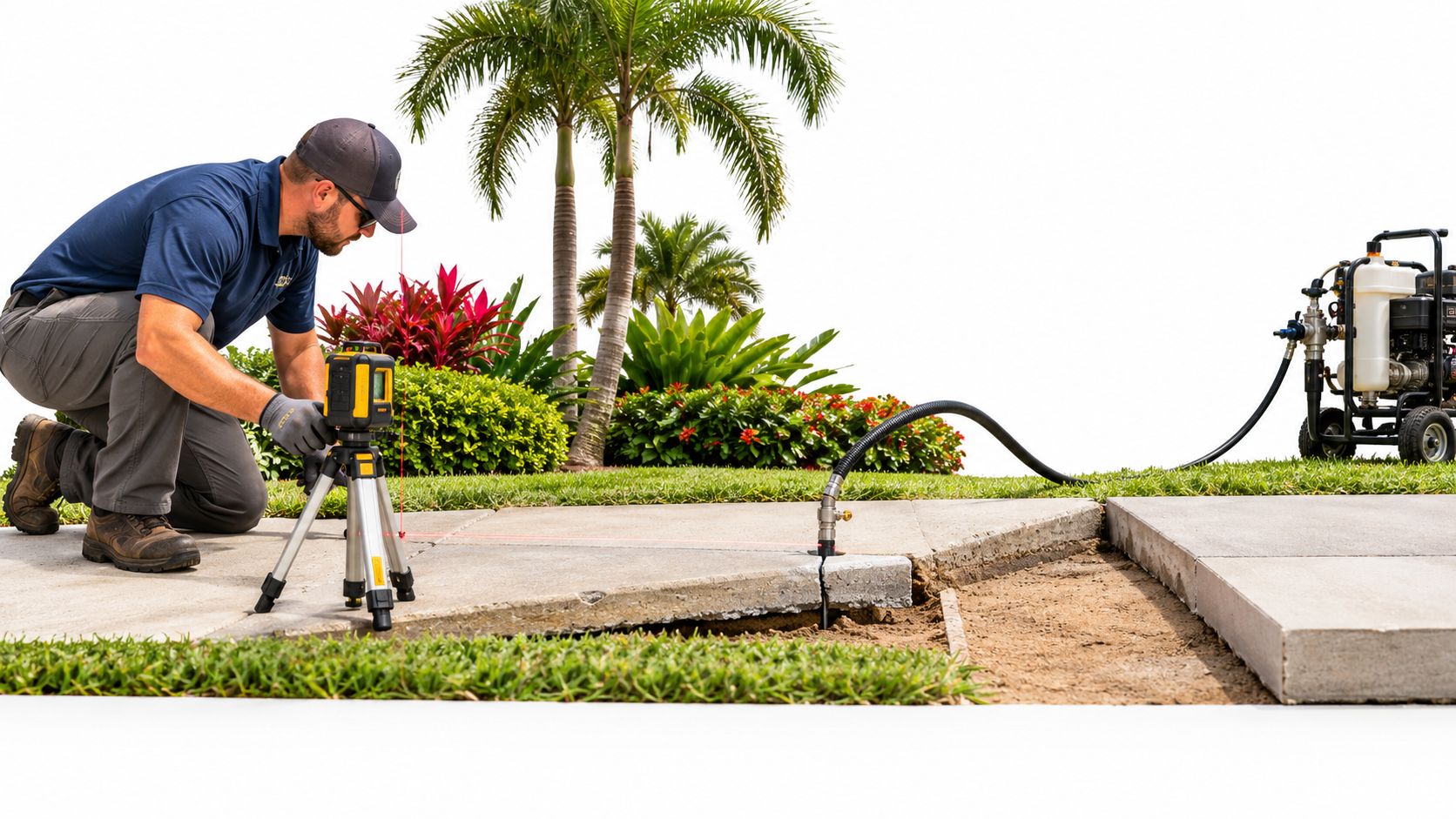
Mudjacking is published at about $5–$11 per square foot, polyurethane foam injection at $12–$25, and full slab replacement at $16–$35, before unusual access, drainage, soil, or disposal work. Those ranges are starting points, not a complete concrete sidewalk leveling cost: a defensible total requires an on-site measurement of the slab, its condition, and the work area.
If you've spotted a sunken sidewalk panel near your driveway, you may be wondering whether a contractor can lift it quickly or whether the concrete needs to come out. In Central Florida, the visible dip alone can't answer that. The slab's condition, nearby slopes, drainage, access, and the route's accessibility requirements all affect what a practical repair involves.
Table of Contents
- Why Sidewalk Leveling Costs Are Hard to Predict
- What Sidewalk Leveling Actually Fixes
- Compare Mudjacking Foam Injection and Replacement
- What Drives a Sidewalk Repair Estimate
- Why Small Sidewalk Jobs Cost More
- When to Level or Replace a Sidewalk
- Florida Climate and Regional Site Considerations
- A Practical Sidewalk Repair Evaluation Checklist
Why Sidewalk Leveling Costs Are Hard to Predict
A homeowner in Belleview calls three contractors about a walkway panel that has dropped along the front walk. One quotes a per-panel lift. Another prices foam injection across two panels. A third recommends cutting the slab out entirely. Same dip, three different jobs: each contractor measured something different.
Published ranges reflect that spread. One cost guide lists sidewalk leveling at roughly $150–$800 and broader concrete leveling projects at $630–$1,723 (published concrete repair cost ranges). A spread that wide exists because each total is assembled from measurements taken on site.
The visible dip is only one measurement
A defensible estimate accounts for panel count and dimensions, settlement depth, concrete condition, drainage, equipment access, and the surfaces the slab meets at each end. Disposal, traffic control, and minor grading can sit inside one quote and outside another. Two walkways covering the same square footage can legitimately price far apart when one is open lawn and the other runs beside a roadway with constrained access.
Practical rule: Compare what each quote measures and includes instead of fixating on the per-square-foot rate.
That gap matters across Marion County, FL, and Citrus County, FL. A residential path in Dunnellon with open access presents different conditions than a commercial route in Crystal River, Inverness, or The Villages, where pedestrian traffic and adjoining surfaces shape the work.
The ranges above function as decision benchmarks. A comparable estimate names the repair method, the measured work area, site access, and any work required beyond the visibly settled spot.
What Sidewalk Leveling Actually Fixes
Leveling is best understood as a correction to a sidewalk's geometry and function, not as one standardized product. A contractor may be asked to address a raised edge, a settled panel, water collecting near a joint, or an abrupt transition to a driveway or curb. Those issues can overlap, but they aren't necessarily solved by the same repair.
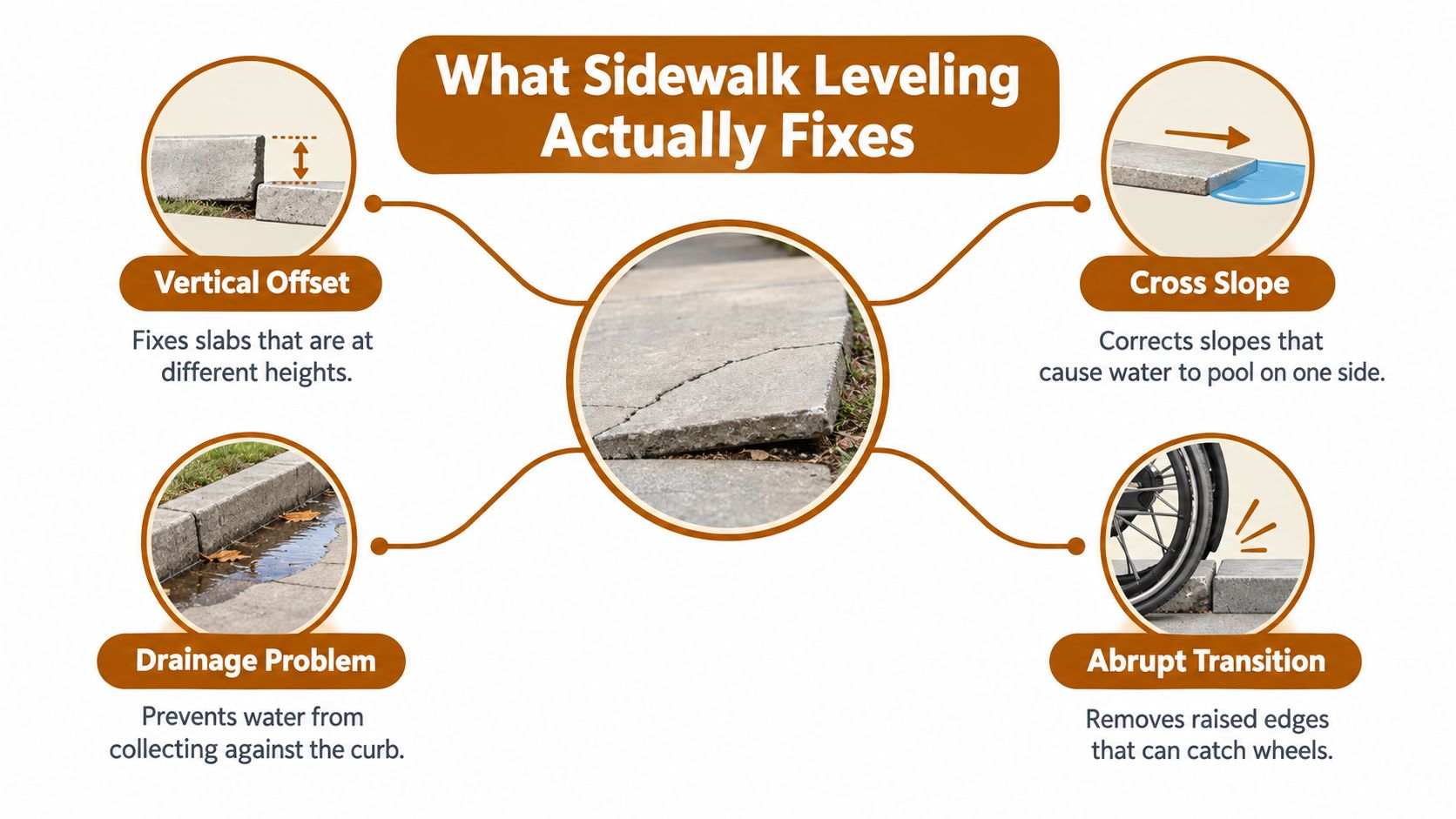
Check the route, not only the panel
A sidewalk can look almost flat and still have a problematic cross slope or an abrupt vertical joint. The U.S. Access Board sets the maximum running slope for ordinary walking surfaces at 1:20, or 5%, and the maximum cross slope at 1:48, approximately 2%. It also sets a 1:12 maximum running slope for ramps and states that accessible routes shouldn't contain level changes beyond the permitted running slope (U.S. Access Board guidance on accessible routes).
Those measurements matter when a repair connects to a driveway, curb ramp, building entrance, or adjoining sidewalk panel. Raising one slab might reduce a lip while changing the grade elsewhere. A contractor assessing an accessible route should consider the affected path and its transitions, not just the spot that first caught someone's attention.
Decide whether the slab can be lifted
Before comparing lifting methods, ask whether the slab is structurally sound enough to keep. A settled but relatively intact panel may be a candidate for lifting. Cracks, spalling, a hollow area, or ponding can signal a more extensive problem that leveling alone won't correct.
Start by identifying the defect, then check what surrounds it: the neighboring panel, the path water takes after rain, and the connection to any curb, ramp, or driveway. A cosmetic correction that leaves the route's drainage or transition unresolved may not solve the functional problem. Conversely, a visible defect doesn't automatically mean the entire sidewalk must be replaced. The method should follow the actual condition of the concrete and the route it serves.
Compare Mudjacking Foam Injection and Replacement
Lifting methods aim to raise or support an existing slab. Replacement takes a different approach: remove the existing concrete and build a new surface. The published rates show the difference in typical price structure, but a rate alone can't determine the right choice. The slab's condition, correction geometry, access, and any related site work all matter.
| Repair method | Published rate | Best fit | Key limitations | Estimate questions |
|---|---|---|---|---|
| Cement mudjacking | $5–$11 per square foot | A slab that's suitable for lifting | The contractor must confirm the slab and site can be repaired this way | What material and work area does the rate cover? |
| Polyurethane foam injection | $12–$25 per square foot | A slab that can remain in place and be lifted | Cost still depends on site conditions and the scope of correction | What correction is planned, and what's excluded? |
| Demolition and replacement | $16–$35 per square foot | Concrete that needs removal rather than lifting | Requires demolition, removal, and reconstruction | Does the quote include removal, disposal, and preparation? |
These published method rates are described as applying before unusual access, drainage, soil, or disposal requirements (sidewalk leveling and replacement cost comparison). Treat them as comparison points, not bids for a particular property.
Compare scope as well as price
For mudjacking or foam injection, ask which panels the contractor intends to lift and how the finished surface will meet the neighboring slabs. The result should be assessed for the transition, drainage, and overall route, not just the new height of the target panel.
Replacement has a broader scope because it involves demolition and reconstruction. Florida municipal rehabilitation requirements identify cracking, spalling, and ponding as deficiencies that can call for demolition and reconstruction. The cited project requirements specify sidewalks at least 5 feet wide and 4 inches thick in pedestrian areas, with 6-inch concrete for driveways and heavy-loading areas (Florida sidewalk rehabilitation requirements). Those project specifications illustrate why a replacement estimate may include more than a pour: removal, hauling, preparation, thickness, and finishing can all affect the work.
A grinding quote is another distinct option for some minor offsets, but it permanently removes concrete and isn't suitable for every panel. Ask the contractor to state the correction method and transition plan clearly. For homeowners comparing lifting approaches, concrete lifting solutions can provide context, but the slab still needs an on-site assessment before a method is chosen.
What Drives a Sidewalk Repair Estimate
A useful quote separates the measurable repair from the work needed to reach, perform, and finish it. That makes it easier to compare proposals that may use different methods or include different parts of the site.
Separate quantities from site conditions
Ask the contractor to document the affected panels, their dimensions, the settlement being corrected, and the proposed transitions. If a panel may be removed, ask whether the quote accounts for preparation and disposal. If it will be lifted, ask what area and correction the price covers.
Then look for costs that don't map neatly to square footage:
- Mobilization and equipment access: How will equipment reach the sidewalk, and is setup included?
- Traffic control: Is the route near a roadway or another area where access must be managed?
- Drainage and base work: Is water contributing to the problem, and does the proposed scope address it?
- Permits and cleanup: Are these included, excluded, or dependent on local requirements?
- Removal and disposal: If the contractor recommends replacement, are those items listed separately?
Public sidewalk work is often priced using unit-price contracts, where measurable items such as square footage, linear footage, removal, disposal, and base correction are separated from access and site conditions (Florida Department of Transportation sidewalk maintenance solicitation). That approach is useful for private estimates too: it shows what the contractor is pricing instead of hiding the entire scope under a single “leveling” line.
Include adjacent transitions
The visibly sunken point may not define the full repair area. If the sidewalk meets a driveway, curb ramp, or neighboring panels, the contractor may need to evaluate those connections to plan a safe, workable finish. An estimate should say whether that wider review is included and what work would cost extra.
A low headline rate isn't a comparable bid unless the included work is comparable.
For a commercial walk beside a road, ask whether the proposal includes traffic control and access planning. For a residential path, confirm whether setup, cleanup, and any minimum charge are included. A line-item estimate won't eliminate uncertainty, but it lets you see whether competing bids are pricing the same repair.
Why Small Sidewalk Jobs Cost More
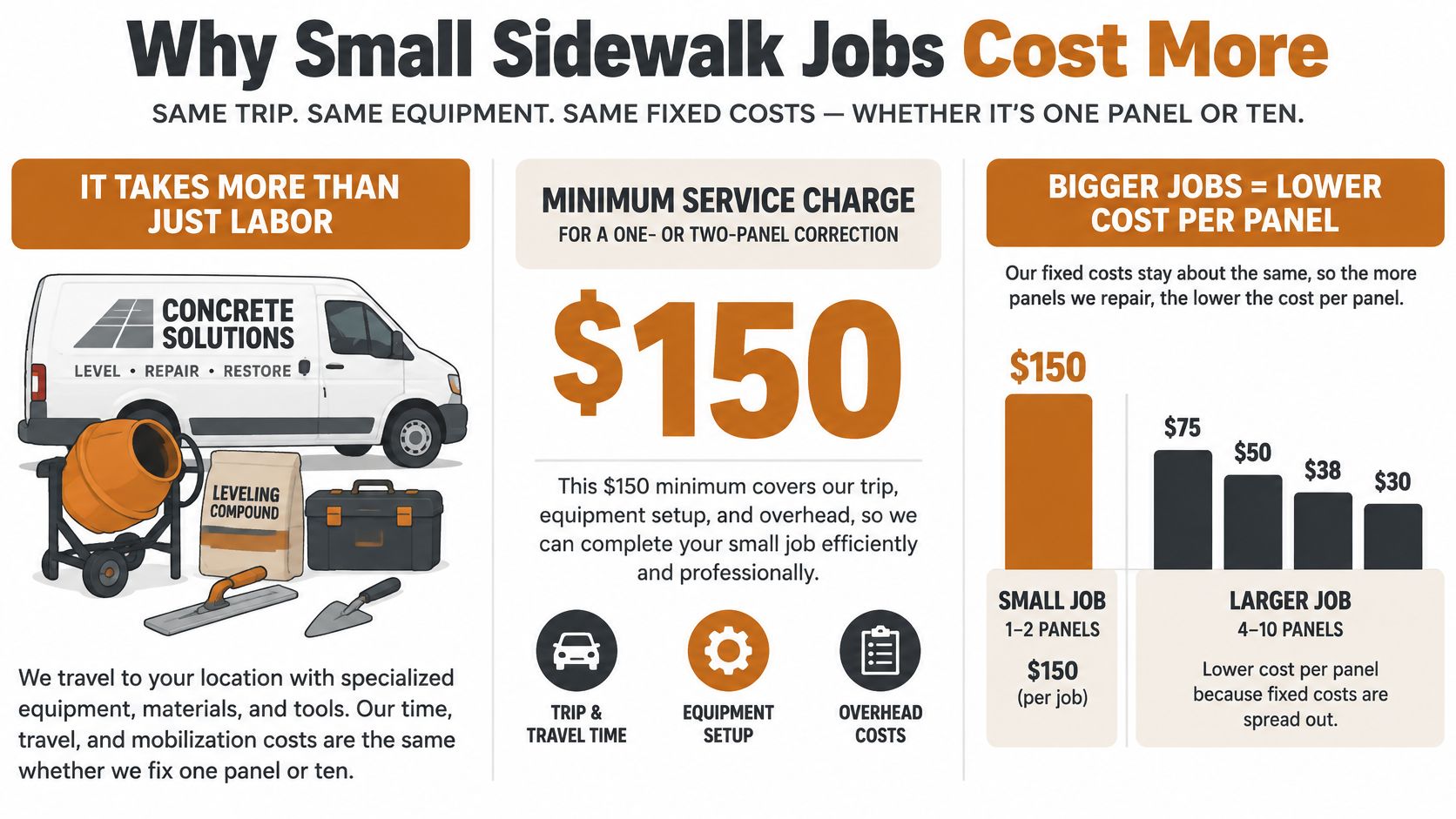
A 40-square-foot panel priced at $8 per square foot comes to $320 on paper. Add a $400 minimum service charge and the actual invoice is $400, a 25% premium for a one-panel visit. That gap between unit rate and bottom line is where small jobs get expensive.
Every repair carries fixed work that does not shrink with the slab: the trip to the site, equipment setup, patching, and cleanup before the walkway reopens. As noted earlier, published cost guidance sets minimum service charges for exactly this reason, so a quote for one or two panels often prices the visit itself rather than the square footage.
Compare one panel with a larger job
A homeowner lifting a single panel absorbs the full mobilization cost into one invoice. A neighbor correcting four adjoining panels spreads that same cost across more work, lowering the effective price per panel. The discount is real but limited, since each site still carries its own condition, access, and scope.
Before accepting a quote, ask whether it is a per-square-foot repair rate or a complete mobilization price, and what changes if additional panels join the scope. If the driveway or patio also needs concrete work, having those areas assessed during the same visit can make the trip more efficient, provided the contractor prices each repair separately rather than implying a saving that the scope does not support.
The useful comparison is total price, included work, and how much of the invoice is fixed setup versus actual repair.
When to Level or Replace a Sidewalk
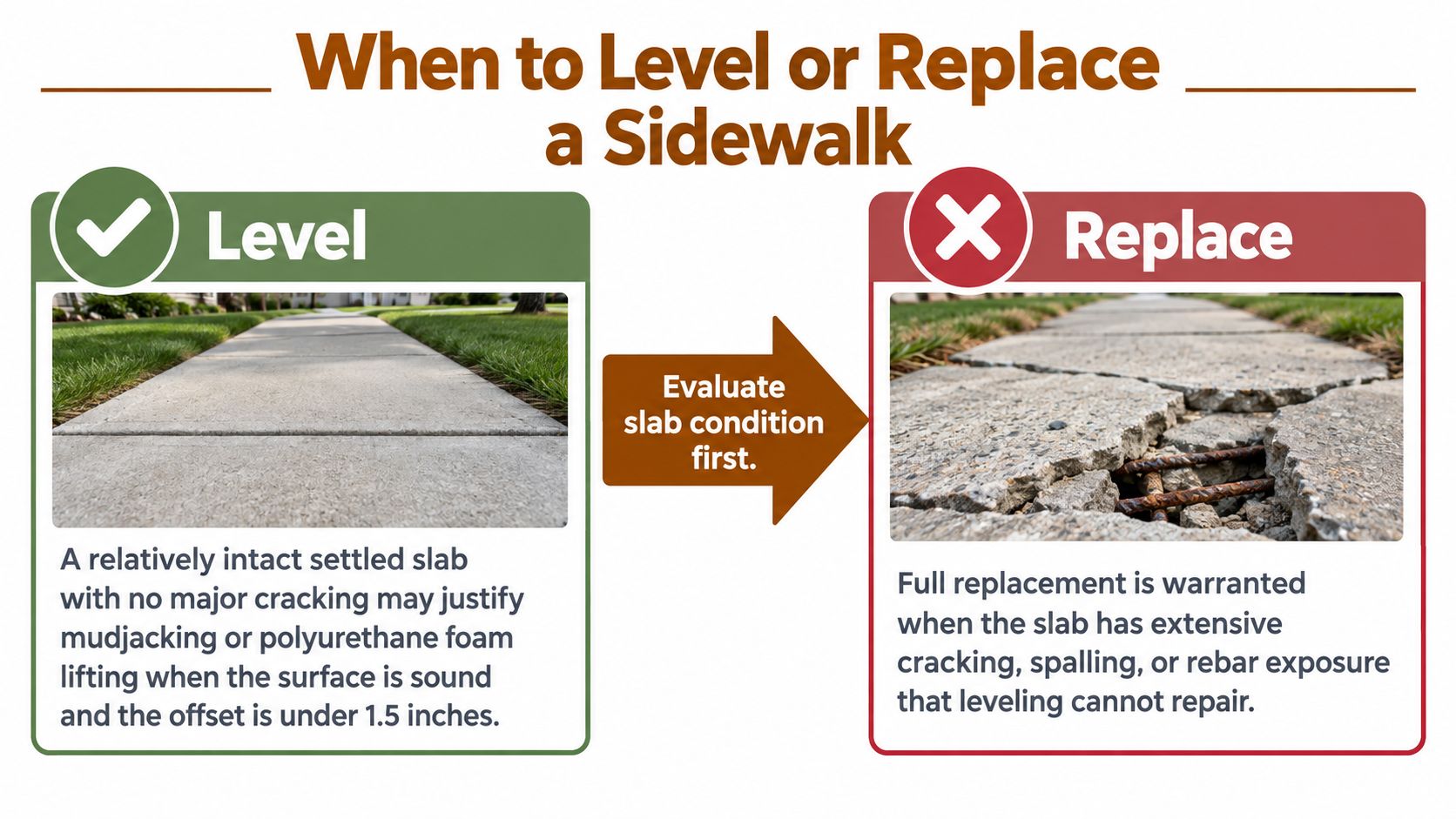
A settled panel may be worth lifting if the concrete is relatively intact and the contractor can correct the grade and transitions without worsening drainage. The decision changes when the panel is deteriorated or when movement appears connected to a broader failure below or beside the slab. A repair method should fit the defect, not just the price range.
Use condition and route context together
Consider lifting when the panel is sound enough to remain in place, the settlement is the main problem, and the planned correction can meet adjacent surfaces without creating a new slope issue. Before authorizing the work, ask the contractor to check slab thickness, drainage, and access.
Replacement deserves serious consideration when the concrete has widespread cracking or spalling, when water ponds because of a larger grading problem, or when the slab's condition makes lifting impractical. A Florida sidewalk-rehabilitation specification calls for demolition and reconstruction for deficiencies including cracking, spalling, and ponding (Florida municipal sidewalk rehabilitation guidance). That doesn't mean every crack or puddle requires replacement, but it's a reason to ask the contractor to explain whether the defect is local or part of a wider failure.
Grinding may be a lower-disruption correction for a minor, localized offset when the concrete has enough thickness to remain serviceable. It removes material rather than raising the slab, so ask how much concrete will be removed and whether the proposed transition is adequate. A repair reference describes extending the grinding transition horizontally by at least 3 inches for every 1/4 inch of vertical displacement; ask the contractor to identify the transition length and remaining slab thickness in the estimate (pedestrian-facility repair guidance).
Leveling one panel doesn't resolve an inaccessible route if the next panel, curb ramp, cross slope, or drainage path still creates a problem.
The practical decision combines panel condition, the offset, route connections, and site logistics. A professional assessment should explain why lifting, grinding, or replacement fits the observed conditions, and what the proposed repair won't fix. The following video provides additional context on evaluating sidewalk repair options.
Florida Climate and Regional Site Considerations
A summer storm moves through Ocala, the soil beside a sidewalk stays saturated for days, and a panel that had settled slightly starts to rock underfoot. In Marion and Citrus counties, prolonged saturation after summer storms is the condition most likely to turn a local settlement into a base failure, so ask whether the estimate includes base correction, not just slab lifting. A lift can change the slab's position, but it will not correct a drainage problem unless the scope addresses it. The first practical question on any Central Florida estimate is where water moves during and after rain.
Heat and UV exposure, traffic, and how vehicles or pedestrians use the route all belong in the contractor's inspection. A sidewalk beside a busy road raises a second set of questions: how the crew reaches the repair, whether the work zone needs traffic control, and whether nearby driveway or curb transitions are part of the assessment. For a related issue involving raised sidewalk panels, sidewalk repair for raised tree roots can help frame what to ask during an evaluation.
Get a locally grounded estimate
Regional conditions affect trucking, concrete availability, permitting, and weather-related scheduling. The estimate date and specific work scope matter when comparing bids, because an older price or a quote from another market may not reflect current local conditions (ENR's construction price-data overview).
A site visit is the reliable way to clarify what each bid covers. That matters across Marion County, FL, and Citrus County, FL, where residential access, commercial frontage, and the repair area differ from one property to the next. Riverside Sealing & Striping, LLC works as Concrete and Asphalt Experts in Marion and Citrus County, serving communities including Ocala, Dunnellon, Belleview, Silver Springs, Summerfield, Crystal River, Homosassa, Inverness, Lecanto, Beverly Hills, Hernando, and The Villages.
The company's work spans concrete construction and repair along with asphalt maintenance such as sealcoating and parking lot striping. The evaluation itself stays simple: document the site conditions first, then price the repair that fits them.
A Practical Sidewalk Repair Evaluation Checklist
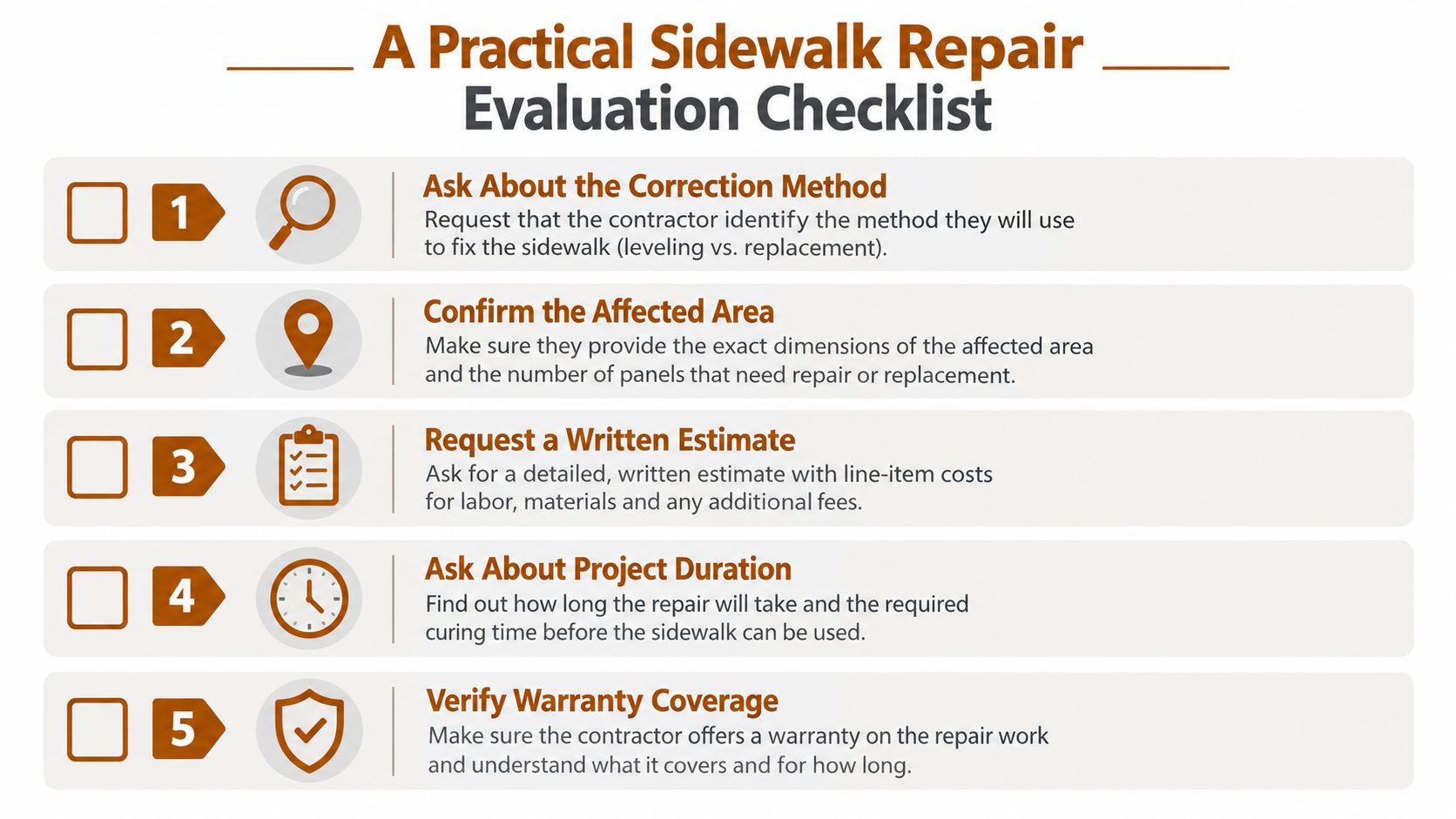
Before approving a repair, ask for a written description of the method and the work it covers. A contractor should be able to explain whether the proposal is for lifting, grinding, or replacement, and why that approach fits the slab's condition. For public-facing paths, the review should also consider adjoining panels and curb transitions, not just the most visible defect.
Questions to compare estimates
- Method: Does the quote specify lifting, grinding, or removal and replacement?
- Measurements: Does it identify the affected panels, dimensions, and correction depth?
- Transitions and thickness: Does it address the finished edge, remaining slab thickness if grinding is proposed, and nearby sidewalk or curb connections?
- Site work: Are access, drainage, disposal, traffic control, and cleanup included or listed separately?
- Schedule and coverage: What work duration and curing requirements should you plan for, and what warranty terms apply?
For an accessible route, compare the proposal with the relevant ADA sidewalk requirements, and ask whether the surrounding route needs review. A square-foot headline can't tell you if one estimate includes those checks while another excludes them.
Homeowners can request a professional evaluation of a settled walk, while HOA boards and commercial managers can ask for a clearly scoped review of multiple panels and shared routes. Riverside Sealing & Striping, LLC offers concrete sidewalk removal, replacement, and installation, with free, no-pressure on-site estimates. When you compare proposals, look for clear dimensions, reliable scheduling, and workmanship expectations, not just a low starting rate.
Frequently asked questions
Is concrete sidewalk leveling always cheaper than replacement?
Published per-square-foot comparisons generally show lifting methods below full slab demolition and replacement, but the appropriate choice depends on the concrete's condition and the full scope. A contractor should explain what the price includes before you compare methods.
Why can a small repair have a high per-square-foot cost?
A small job still involves travel, equipment setup, and cleanup. Minimum charges can make the total for one or two panels look high when divided by a small area.
Can a leveled panel still have an accessibility problem?
Yes. The adjoining panels, cross slope, curb transition, or drainage may remain unresolved even if the target slab is lifted. Ask for an assessment of the connected route.
What should a sidewalk estimate include?
Look for the repair method, measured work area, correction depth, transition plan, access requirements, drainage considerations, and any removal or disposal costs. The estimate should also state what's excluded.
Riverside Sealing & Striping, LLC provides concrete sidewalk evaluations, removal and replacement, and new sidewalk installation for properties across Marion and Citrus counties. Request a free, no-pressure estimate through Riverside Sealing & Striping, LLC to discuss the sidewalk's condition, repair options, and a site-specific scope.